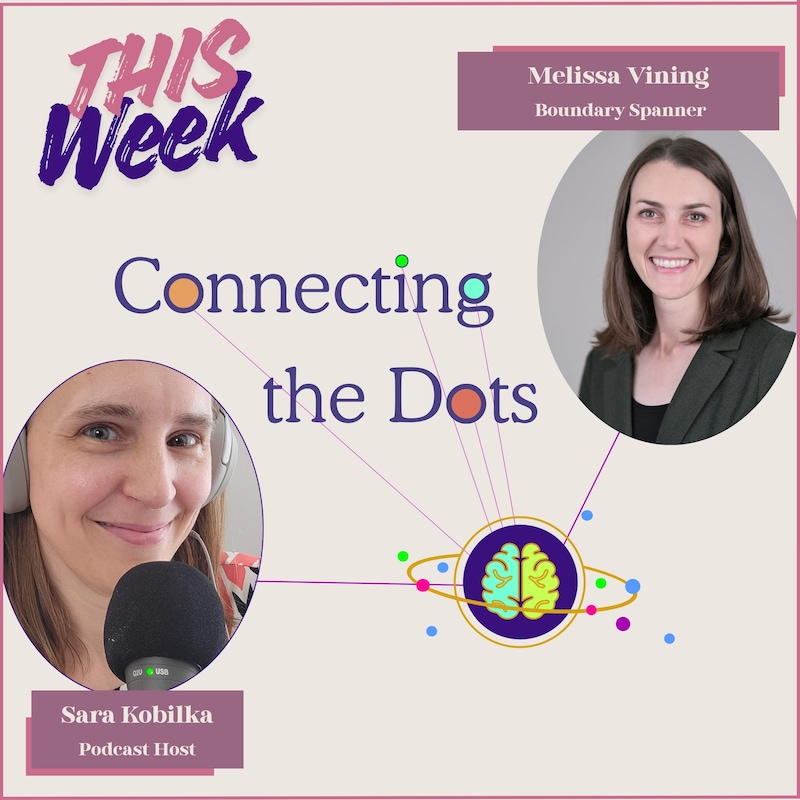
Shownotes
In this episode, I am joined by Boundary Spanner Melissa Vining. In a multi-faceted conversation, Melissa and I talk about many topics of shared interest aka our significantly overlapping Venn diagrams. The conversation weaves its way through music, teaching, storytelling using a golden thread to support your message, career coaching, neurodivergence and motherhood, and our mutual past as people who grew up in Minnesota and moved away.
We explore some of the unique contradictory qualities of AuDHDers who have both an autism and ADHD diagnosis and the challenges of neurodivergent job seekers. Melissa delighted me by offering a challenge to one of my rapidish fire question about using metaphors.
Promised Show Notes Materials (take a drink):
- CliftonStrengths Assessment
- Sara’s episode on Melissa’s podcast, Job Search for High-Performing Misfits
- Sara's Find Your Golden Thread offer
- The Neurodivergent Woman Podcast
- CSCCE Series on Gardening as a Metaphor for Community Management
- Range: Why Generalists Thrive in a Specialized World by David Epstein (misspoken during the podcast)
- Neurodiversity in the Workplace: website and podcast/YouTube
- The Anxious Achiever podcast with Morra Aarons-Mele
- Dialect Quiz (warning, this inaccurately guessed where I’m from, but it does mention the bubbler)
- Find Your Local American Job Center
Follow Melissa on Social Media:
A few things Melissa and I discuss:
- 2:45 Being outside-the-box
- 4:02 Music and teaching (and “flutist” vs “flautist”)
- 7: 18 CliftonStrengths
- 10:27 Finding your golden thread
- 11:40 Renaissance People thrive in innovative spaces
- 13:28 Goal focused vs process focused environments and the issue with school systems
- 15:31 Overlap between Renaissance People and “neurospicy” folks
- 16:20 Changes in ADHD and autism diagnoses
- 20:53 Neurodivergence and the job search
- 22:16 Misfits finding their place
- 26:11 Explaining your complexity with stories and a golden thread
- 32:20 Using caution around AI and telling your story during your job search
- 34:57 Improv Game
- 37:06 Rapidish Fire Questions
Quotes from the Episode:
- "Where a lot of people tend to approach things as, ‘oh, this is how we've always done it’. Or maybe even if they don't explicitly say that, they're thinking of, ‘how can we build off of what we have?’ What I tend to do is just want to level the thing and just start from the ground up, and I find that when I approach problems or projects in that way, I tend to get a lot better results." (Melissa)
- "I think as a boundary spanner or Renaissance Person, you end up taking pieces of each thing and kind of incorporating it into everything that you do, which has definitely been the case for me." (Melissa)
- "So if we were to draw a Venn diagram of your interests and my interests, the amount of overlap would be amazing. Like your background, your experience, when I went on your podcast (which we will also link to in the show notes, take a drink) I was like, this is like... this is my sister from another mister!" (Sara)
- "The other thing that's so interesting that I think happens so often is that when you're AuDHD, you have autism and ADHD, those things kind of cover each other up or compensate for each other in different ways. Which also ties into your idea about being kind of a contradiction because they're kind of contradictory neurotypes essentially." (Melissa)
- "People always are like, how is it that I can remember a song I learned when I was six, but I can't remember my password? And it's like, well, you know, learning things through music does something different in your brain." (Sara)
- "When I first started talking about my career path and the fact that I had more than 20 jobs before I was 30 years old. I was so freaked out to go tell everyone about it on my webinars, but then I got such a positive reaction because people could relate to it. And they were like, OK, she understands me." (Melissa)
Calling all Renaissance People!
If you’re a Renaissance Person who’d like to join the conversation as a guest on my show, complete this quick form and I’ll get back to you as I’m scheduling recording dates.
Follow me, your host, Sara Kobilka on LinkedIn, where I put most of my social media energy and Facebook.
Stay updated about the Renaissance People Community I am building. This podcast is just one part of a multifaceted project because that’s how Renaissance People roll!
And should you care to support the production of this podcast, I'd love it if you'd buy me an oat milk cappuccino, the caffeinated beverage of my choice.
This podcast is hosted and edited by Sara Kobilka.
Theme music is by Brian Skellenger
Podcast distribution support provided by K.O. Myers of Particular Media
Transcripts
So like for me, even thinking about all six of the things that I mentioned, one of the baseline pieces or that golden thread is the learning, which I know you talk about as a Renaissance trait of that learning for learning sake, which is definitely me. I love to just gather all the information I can about all of these topics, just because I wanna know, right? Like I just, I wanna have the information because it's interesting to me.
[:Connecting the Dots with The Renaissance People
[:Hello Renaissance people and people who would like to cultivate a Renaissance mindset. Have you ever had a time where you met someone and you immediately connected with them? You were just shocked by how much you had in common. Well with today's guest, Melissa Vining, that's exactly what happened to me.
We, I believe, initially connected through LinkedIn, and then as we started talking, it was like our Venn diagram of interest was almost perfectly overlapping. So I'm really excited to share today's episode with you.
We talked about all sorts of different things, including what it's like to be someone who thinks outside the box, whether it's a flutist or a flautist, how to find your golden thread and tell your story, whether there's an overlap between Renaissance People and people who might be defined as neurospicy, what it means to be AuDHD especially as someone doing a job search, where misfits can find their spot, the dangers, at least the cautions, around using AI and telling your story during your job search, and how to get rid of that wicked Minnesota accent, which is always a challenge. So stay tuned as today I am going to be talking with boundary spanner Melissa Vining.
Here we go.
[: [:Melissa, I'm so excited to have you here today. I wanna start off with my first question that I sent you so you could kind of like ponder over it ahead of time. So, big part of the idea of Renaissance Women and Renaissance People is identity. And so I've been using a lot of terms as I've been promoting my Renaissance People community. They include Renaissance person, multi-passionate, generalist, versatiles, Jack, Jill, Jay of all trades, boundary spanner, or perhaps something else. What would you say is the term that best aligns with your identity?
[:I would say boundary spanner because I feel like it's one that is more directly related to being outside of the box. And for me, like, where a lot of people tend to approach things as, oh, this is how we've always done it. Or maybe even if they don't explicitly say that, they're thinking of, how can we build off of what we have?
What I tend to do is just wanna level the thing and just start from the ground up, and I find that when I approach problems or projects in that way, I tend to get a lot better results.
[:So you're a boundary spanner. Tell me about some of those areas of expertise, those places where you are spanning boundaries in your work or in your life in general.
[:Yeah, so you had sent me some of these questions to think about beforehand and when I was going through and thinking about this one, it seems kind of funny to say, but I started writing a list and as I went I was like, oh, this just keeps going. So it's one of those things like, you like to say, how tall is the building?
Right? Like, we can go on for a while. So I did. End up coming up with six things, and I'm sure I could go on, but we're gonna keep it to six for today.
[:Fair.
[:So the things that I came up with here. And I also have to say this has kind of evolved over time for me, and I'm sure everyone can kind of say that too. But I, I think as a boundary spanner or Renaissance Person, you end up taking pieces of each thing and kind of incorporating it into everything that you do, which has definitely been the case for me.
So the first area that I thought of immediately was music and teaching. Um, that was what I did at the start of my career. And I had been playing the flute since I was eight years old. So it was kind of one of those things that I had built up expertise early on in that area.
[:Are you a flutist or a flautist? Cause I am also one of those two things.
[:Yeah, uh, I used to say flautist when I was younger, and now I think I tend to say flutist. I don't think it really matters. You could say either.
[:You say flautist, but perhaps that's just to sound, I don't know. More highfalutin?
[:Yeah, exactly.
I did end up going to study music education in college. And in that setting I also became really interested in leadership and what it meant to be a leader in my music program and kind of the elements of what it means to be an effective leader. So that became kind of the second area of expertise that I was thinking of when I was making this list.
So I've always been kind of interested in leadership strategy, and that's carried through since college for me in the workplace and other things that I've done.
The third thing, which is kind of crazy to say, and most people will be surprised by this, but I love job searching. Um, it is one of those things for me that I had started off my career as a musician and a music teacher, loved it in a lot of ways, but found it to be not very sustainable in terms of career path.
And so I went through the whole process of, um, career change and looking for the next thing. And anyone who's been through a job search can probably tell you that job searching is terrible. And it is crazy to have to say I love it. But at this point I did end up in career coaching and was able to connect kind of my personal experience in that way to relate to people who are changing careers, people who are on the job search.
I built up my expertise in that and it kind of sparked my interest when I started doing it, and it became one of those things that I really love. Uh, so that's kind of my main, um, expertise at this point in my life. I would say anything related to job searching, career coaching, resumes, all of those types of things.
Within that, also integrates workplace culture and strengths, and that's something that I'm really interested in as well and love to learn about. So, what makes a good culture? How do you cultivate that within organizations? Interestingly, this often means having good leadership, so it kind of brings in some of those pieces that I talked about before.
And strengths-based approaches, tools like CliftonStrengths, so that's one of those resources we can put in the show notes.
[:Have a drink! That's my little running gag. For people who haven't listened to previous episodes. Um, I want it to be a, a drinking, uh, game. Every time you hear about something in the show notes. You can drink water though. That's OK. Hydration is important.
[:Perfect. Yes. Um, yeah, I love CliftonStrengths because it applies in so many different ways. You can use it within your job search, you can use it, um, within your work. You can use it as kind of a professional development tool. So that's something that I am also really interested in. That was number four.
So number five is neurodiversity and neuro inclusion. And this has become something I am really interested in. And I don't know if I would say expert yet, but kinda getting in that direction, um, within the past year or so from personal experience. So I found out that my child was autistic and ADHD.
And it's one of those situations where this tends to happen a lot that the child is diagnosed and then the rest of the family looks around and is like, oh wait, that applies to me too. Um, and it is genetic, so it's something that is a really common experience where the parents may be late diagnosed after discovering that about their child, which is what happened to me and my spouse.
So found out that all of us are what we call AuDHD. We have autism and ADHD. And so that has really sparked my interest in what does this mean? How does this apply to our lives? How does this apply to else that I'm doing? It's one of those things where you find out, it's kind of like, oh, all these pieces of your life that didn't really make sense before now suddenly do. So that, that sparked my interest in everything around neurodivergence.
And then number six is instructional design and facilitation. So I love creating content on all of the topics that I just talked about and teaching other people about it. So I can happily talk for 90 minutes about resumes or what it means to be neurodivergent in the workplace or any of those things.
[:So if we were to draw a, a Venn diagram of your interests and my interests, the amount of overlap would be amazing. Like your background, your experience, um, when I went on your podcast, which we will also link to, uh, in the show notes, take a drink. Um, I was like, this is like... this is my sister from another mister! Like our background, our experiences, even the experience of having a child receiving a diagnosis and then asking about yourself. Been through that exact same thing in the last year. So yeah, there's so much here and I'm so excited to dig into it. And congratulations to you to limiting yourself to six because that's hard! But you did it.
[:Yeah.
[:That's impressive. And I, one of my new offerings for my Renaissance People community that's kind of like a Venn diagram overlap between my career coaching that I do, where I really focus on people who are changing industries or disciplines or Renaissance people, people who move around a lot, kind of like you've done. One of the things I'm offering is a Find your Golden Thread service where we look at all these different things that they've done and we try to figure out like what's the golden thread that connects all of those different things. Because when outsiders, I think, look at Renaissance People, they're like, "You're doing that now? And now you're doing that? And, what the... Where is this coming from?"
But there usually is something guiding you underneath. And one of the themes that's kind of arising in my mind as I listen to your story and kind of aligns to my story too, is the concept of identity. a lot about identity that goes into the, the different themes that you're talking about. And like, what is our identity? How do we form it? How do we find places that support our identity and where we can feel a sense of of real belonging.
[:Yeah.
[:And that actually takes me perfectly to my next question, which is where in your life, in your career have you thrived as like a full on multi-passionate, complex Renaissance person?
Or where have you seen other Renaissance people really thriving?
[:Yeah. That is a great question and I think it's one that we're all always trying to answer. And it's something that changes also over time. So it's like you might find a place that supports you and helps you thrive with your identity in that moment, and then things shift and you have to figure it out again, which can sometimes be frustrating.
But I think overall for me, and I would say applies to a lot of people who would identify as Renaissance People, it's a place where people and the environment is really authentically excited about innovation and open to new ideas and new ways of doing things. I mean, I just gave the example of the fact that a lot of times people are like, well, we've done it this way and we wanna build off of that, or we wanna continue doing it 'cause that's the way we do it.
And for us, we're like, well, what if that wasn't the way we do it? What if there was this whole new way that's actually gonna be so much better? And so, I know for my own experience, I cannot be in a situation or with a group of people that's just like, we're gonna do it this way just because. I need to know why is it being done this way?
What is the goal? Is there a more efficient way? Is there a better way? Let's think about the whole design and figure out how we can make this make more sense for everyone. So I think that's like kind of the first part.
And the, the second part I would add to that is that in those situations, the bigger goal, the more overarching piece of it is gonna be more important than how do we get there.
Because a lot of the times as Renaissance People, we are approaching things in a very different way. We might be doing the process in a very different way than what someone else might do, and that has to be accepted. And in order to really have that kind of environment, the focus on the goal instead of the process is gonna be really important.
[:That's really interesting. I know personally have worked in a lot of school settings. And I would say that schools aren't known for necessarily as a system, moving very quickly. Like sometimes within your own school, your own classroom you might have that freedom to do things slightly differently, but it takes forever in the bigger system to have that happen. Do you feel like when you worked in the schools, that was one of the reasons that it didn't feel like the right fit to you?
[:Yeah, I would say definitely that's a big piece of it. It's the fact that there's so much bureaucracy around the school system, and this can be true of like a lot of different environments, right? It can be true of large companies. Um, things like that. So, yeah, for me, in the school system, one of the things that was really frustrating was the fact that was a music teacher, and that tends to be pretty undervalued overall.
So it's like you're running into all these roadblocks where you might not even have a classroom to teach in. Like, I might be teaching in the hall. I might be teaching in a cafeteria. And it's like, OK, for one thing, knowing my neurodivergence, that's totally overstimulating. And then for another thing, it's like, why is it that, that you're not making space for this?
Right? Like in, in the school, both metaphorically and in reality.
[:I can see that. Do you think that Renaissance people have a tendency to be, as the popular term is “neurospicy”? I see a lot of pattern in that, in, in who I get close to, and all of a sudden they're like, oh, by the way, I'm autistic. Or I, you know, I, I'm like, oh, yeah, no, that makes sense.
[:Yeah, no, I would say definitely. And as I was preparing for this and from, you know, the other things that I've known that you've done, I can see so much overlap in the kinds of people that you are really targeting for your audience and the, the neurodivergent population. So I definitely think, similar to my typical audience which is high performing misfits, a lot of the times they are neurodivergent, or maybe they are and they don't know it.
[:Yeah. It's not always a fully diagnosed um, thing, though we're seeing more of it.
[:Yeah.
[:It's kind of interesting because I know you and I fall in the category of women who are most likely to be diagnosed with ADHD I know for certain. And I'm assuming autism's probably the same, because we're mothers who have children...
[:Yes
[:...getting diagnosed. That's, we're in the the group that is the highest increasing rates of ADHD diagnosis, autism diagnosis, which is intriguing.
[:Yeah. I mean, I could take us on a huge tangent about this. But this is like where, you know, in the eighties and nineties when we were growing up, it was seen completely differently. There was actually different diagnostic criteria, so that was one of the things where like we weren't gonna get caught because we didn't necessarily align at that time with what they knew these things to be.
Not only that, but the fact that. A lot of the times presentation in women is much different than in men or in boys and girls and of the research and all of the diagnostics were based on boys. And this is also true not only of like gender. But within like other groups as well. So black and white and Hispanic, and all of these areas where so many people got missed. And now we're coming into this place where they recognize this much differently and then we're able to see it because of our kids or because of our other family members.
The other thing that's so interesting that I think happens so often is that when you're AuDHD, you have autism and ADHD, those things kind of cover each other up or compensate for each other in different ways. Which also ties into your idea about being kind of a contradiction because they're kind of contradictory neurotypes essentially.
And then when you put 'em together, it becomes such an interesting mix.
[:It is intriguing. I, one podcast that I enjoy listening to is, I believe it's called The Neurodivergent Woman, and it's actually out of Australia. Co-hosted by two women who are, um, psychologists. One who is neurotypical, and then I think the other woman has both diagnoses. I forget if she has both or whether she's ADHD, but I wanna say she's both.
So I'll put that in the show notes and I highly recommend listening to it. One of the things that sometimes bothers me when I see discussions around neurodivergence is that people think autism and ADHD are the only two that exist out there. And we are contending with some other things, including anxiety.
So that particular podcast does a nice job of talking about a lot of different things. And the word I hate the most from my new interest, diving down the rabbit hole of accessibility, is comorbidity. It sounds like two things that'll kill you...
[:Yeah.
[:...which is not what it is! But two things that commonly occur in the same person. So they talk about a lot of those different things that can be happening. The OCD, the eating disorders, there's, there's all depression. There's all these different things that are happening because our bodies and our minds are a system and it's complex. And I think our healthcare system personally does a disservice to us by hyper specializing people instead of them being allowed to be Renaissance People in any way, shape, or form. Or even like, interested in multiple fields of medicine. They have to specialize and specialize more and more and more because that's how you get paid is if you are the specialist in big toes on the right foot. Then you can make this huge career out of it.
[:Yeah.
[:It does such a disservice to us, I think.
[:Yeah. And the lack of understanding overall in the medical profession of neurodivergence and how it presents and what that means. It's shocking.
[:Yeah. It's, it's frustrating. Well, tell me, we're talking about connecting the dots, the title of my podcast. And going off on a tangent was a potential title. And I love that you already use that idea because it's something that we, Renaissance People do a lot. But I wanna know about connecting the dots.
And where in your life, or in your work, do you feel like you really do that a lot?
[:I think the main place where I do that is through the content that I create. So for example, I started career coaching about four years ago. And I became the, the person that creates all of the content for our career center. And so a lot of it that I develop is, you know, the typical job search content.
We talk about resumes, we talk about interviewing, all those things. But when I got to the point where I started to do this deep dive on neurodivergence and recognized that a lot of the career issues that I had throughout my life were related to being undiagnosed AuDHD, I was like, OK, wow. All of this makes sense now.
And also, let's infuse this into what I'm doing. Let's create a webinar for neurodivergent people who are job searching. Because the challenges look different than they would for a typical population. So that's where I was able to kind of merge those different specializations or interests of mine. And to be able to say, let's design this thing that's gonna be helpful for this huge group of people that's often left out.
And it was very obvious that that was needed because it was a record breaking launch for my career center. We had over a hundred people come to the first webinar.
[:Wow. The term misfit, which is part of your podcast title in which you've used in a number of different cases. Is that a term that when you were younger, you would've used to kind of describe yourself? Did you really understand that you didn't fit in all of these places? Or was it just like a vague feeling and you, you hadn't really given it a name yet?
[:That's such an interesting question and I wanna speak like only for myself because I know that this is very different depending on your situation. And I am not speaking overall for the neurodivergent population. But I, I will say that for me, I feel like I got kind of lucky in this where I didn't necessarily feel like a misfit growing up because I had the music space and it's kind of a space of a bunch of misfits that come together, right?
So we find our fit because we're all together and it doesn't necessarily even feel like we didn't belong, right? It's like, and I think a lot of people in the theater space feel that same way. So it's one of those things like for me, it always felt like I had a space because of that. And obviously that carried through for me even into my career because I ended up pursuing music as a career.
And the thing that became kind of a, like jumping into cold water type feeling was that like when I started to interact with the world outside of the music community. That's where it became so clear. I was like, this is, something is off. Right? Like it's it's not quite right. I'm not fitting. And I remember even a year or two ago, I was working with a career coach doing a certification program. I had asked him something like, is it me, is it them? And it was like one of those things where it's like, what, what is going wrong here? I'm not exactly sure.
[:I went to the same school from kindergarten all the way through 12th grade, only 185 in my graduating class. And so like these people had known me and categorized me because that's what kids do, that's how their brains work.
They put you in a category and then you can't leave that one. And so I was the teacher's pet. In the middle school yearbook, um, as the teacher's pet with one of a person who became one of my good friends in high school. And I had the theater friends. But I kind of fit with that, but not quite.
I had my band friends. That was probably like my safest space was band. And then I got involved with stuff outside of my high school. I had like the church youth group where I had a couple of close friends. I was in Youth in Government where I felt like had a lot of fun. And then like all state band where it got to go away and only like two people from my high school were there.
And those were the places where I like, I really felt like I could be myself a little bit more. And then I chose to go to college at a state that was one state away from where my parents lived. I'm like, I gotta be at least one state away. and that's where I felt like, OK, now I get to reinvent myself. In a way that you could never do in your school because kids put you in a category and you can't leave it.
[:Yeah. No, that's so interesting because I did the same thing with college. I was like, I'm not gonna stay in Minnesota. I'm gonna go at least to Iowa, which I did, and
[:I went to Missouri. I needed the Iowa buffer for myself.
[:OK
[:'Cause we're also both Minnesotans, which, you know, I told you we are such an overlapping Venn diagram.
[:We're probably related in some way, honestly.
[:You know, half of Minnesota and Iowa are, is related to one another. They're all Norwegian and stuff like that.
[:Yeah.
[:We'll just have to do some like genealogy searching and we'll figure it out. I love it.
Well, I wanna move on to another question. That is something I know you have been thinking of a lot about because of the whole identity interest that you have, which is how do you describe your multifaceted background without overwhelming people? Especially when you meet like a brand new person who has no idea who you are. And they're like, so what do you do? How do you feel when they ask you that? And then what do you actually do?
[:So as an autistic, I feel very uncomfortable because my typical, uh, approach to conversation is like to say one word and then it's over, right? Like, well, I'm a musician. Like, and then they're like, oh, OK. And then, you know...
[:moving on...
[:...go on with our lives. Um, but in reality, if I'm actually going to try and sit down and explain this to someone. I think there's two approaches, and this ties into kind of what I teach with job seekers. Because a lot of times it can be hard, even if you don't consider yourself a Renaissance person, you've had several different experiences throughout your career, so figuring out how to tell this story can feel really hard.
And so, I think there are two main things that I would suggest. The first is to tell it as a story. And I think we know, you know, based on research that's out there, one of the most effective ways of communicating is through storytelling. So this automatically makes it feel like it makes more sense, right? You're not just gonna say like, here are the six categories, but let's talk about the evolution of that and where it started and what step led to the next and like how you got there. So I think engaging in that way to be able to say, this was what happened at first, this is why I ended up moving into this space. This is kind of what led me here. What sparked my interest. You heard me say that a lot when I was talking about my six things.
Then, the second thing that I would say is basically what you said earlier, this idea of finding the golden thread, because you have to be able to tie everything together in some way, and chances are there is a golden thread. Maybe you don't recognize it yet if you haven't really stopped to think about it. But being able to ask yourself, OK, I love these three things that might seem super different, but why is it that I love each of these things? What is it at at the base, right, that's drawing me to this? And usually there's going to be something there. So like for me, even thinking about all six of the things that I mentioned, one of the baseline pieces or that golden thread is the learning, which I know you talk about as a Renaissance trait of that learning for learning sake, which is definitely me. I love to just gather all the information I can about all of these topics, just because I wanna know, right? Like I just, I wanna have the information because it's interesting to me.
So being able to learn it, but then not only stopping there, actually taking it, distilling it, creating systems around it, creating content around it, like I talked about and helping other people make sense of it because it might be a lot of complex information. And then being able to communicate it in a way that helps either people or organizations or myself or whatever it is, achieve excellence. So that's kind of like the baseline of what I'm always trying to do.
[:I love that. Yeah. I think it's really interesting you brought up storytelling because yesterday I recorded another episode, with my friend Nancy Scales Coddington. She's a fellow science communicator with me. We got involved with girls in STEM efforts and storytelling came up. With that as well, the, just the power of telling stories. You mentioned the side of how it, it helps organize what you're telling to someone in a way that they can process it. That they can, we know that stories help people remember better. And what we really talked about a lot was another element of stories, which is that they involve emotion. And we know that when it comes to learning, if something that you'll learn can be tied to an emotional experience, whether it's positive or negative, you're more likely to remember that sort of thing.
And then also, if you do something that is tapping into music or art or something like that, you're using more of your brain so you can remember it. People always are like, how is it that I can remember a song I learned when I was six, but I can't remember my password? And it's like, well, you know, learning things through music does something different in your brain. But I think it's that interesting of the, the storytelling as a structural element for remembering things, but then also tapping into that emotional side of things. Do you think, what do you think of when you think of any sort of emotional impact from that storytelling strategy?
[:Yeah. I think that's a huge part of it, and that's why like in a lot of the content that I create and the things that you might hear me saying on the podcast or in my webinars or wherever is the personal piece of the story and being able to relate it to like, this is my identity. This was my experience. Because then other people relate to that and then they, they get that emotion right? That that kind of sparks the emotion and it helps them connect to it and to remember it and to relate it to their own life. So that's something that I think is a skill that you have to practice because at first it can feel really uncomfortable.
And I will say that's, that's been true for me even when I first started talking about my career path and the fact that I had more than 20 jobs before I was 30 years old. I was so freaked out to go tell everyone about it on my webinars, but then I got such a positive reaction because people could relate to it. And they were like, OK, she understands me. She's been through this, and that's the piece that I think is so important.
[:Yeah. It is hard yet seeing each other as authentic, real complex human beings that, things that can't be tied up in a neat little bow is what makes us human and what makes us feel more human. Which is also why I think that I push the message of be very cautious with use of AI.
[:Yes.
[:That is one thing that AI is not going to be able to replace.
It has a place, it can be really helpful. Some of the machine learning stuff when you're talking about big data sets that humans can't possibly process. Great like. Uh, let's use it to make the newest tool for making hurricane forecast. I love that idea, but let's use it to write my cover letter tell me what to say when I get asked the question in an interview of like, so tell us about yourself. That's where I tell people, you know, maybe you can let it help you organize your thoughts or like, did I miss anything? But only you know your story. Only know, you know your experience.
[:Yeah.
[:And so it's not gonna do that for you.
[:Right! Exactly. And that's where, like now that AI has kind of taken over in so many areas, being human actually matters even more. And I'll tell you just like a quick story about this, that I was giving a LinkedIn webinar the other day, maybe last week. And someone looked at my LinkedIn because I always suggest look at it as inspiration. You can use it, whatever.
And he was like, wow, this is amazing. I've never seen anything like this, right? You can go to my About section and read my authentic story of my career path and the things that I kind of talked about here. And it stands out in such a different way because I wrote it before AI was a thing, right?
I mean, AI was a thing at that time, but several years ago we weren't using it for these things. So I wrote this by myself, and you can tell. It's, it's human. So take it back to how can I be human and tell my human story?
[:I just redid mine not that long ago, which inspired me to create my Find Your Golden Thread offering because, and I've had the same thing. I've had multiple people reach out to me specifically 'cause they read my bio and said, oh, I love how you said this or how you talked about that. Like, I really connected with it.
And I'm like, yep, a hundred percent written by me. No technology involved. This is just me being, being all out Sara. So, uh... handle it!
(Improv Game)
[:OK, so I want to move on to playing a little bit of a game, I gave you a little precursor to it, which, which I'm fine with because it's, it involves a little bit of improvisation and I know that for folks who are autistic in particular, trying to like improvise something is not a comfort area, which. If you're ever someone who does interview people for jobs, consider giving them the questions ahead of time.
[:Yes
[:Then you can like genuinely listen to their answers and like ask follow up questions, but like trying to surprise them with every single question is not gonna get the best out of them. So you're not gonna know whether they're the right candidate for you.
[:Right, yes.
[: [:Yeah.
[:I'm gonna let you go. You know, you're a Renaissance Person if...
[:...if you are asking the questions that no one else thinks to ask.
[:Oh, I like that one! OK, my turn again. Uh, you know you are a Renaissance Person if you are a walking Venn diagram that is overwhelming and needs 15 dimensions to actually see. Is that a correct answer? No, there's no correct answers. OK, walking Venn diagram.
[:OK, so you know you're a Renaissance Person if you are always thinking outside the box.
[:Yay! OK. Two, excellent, excellent options.
(Rapidish Fire Questions)
[:Finally, we're gonna do three rapidish fire questions. I say rapidish because, you know, answer as slowly as you want. And then I wanna give you a chance to share a little bit more about how people can learn from you. Where they can go, websites, social media, all that sort of stuff.
So my first rapid ish fire question is, what is one metaphor that you find yourself using frequently? And if you want, I can go first if you'd like a second to think.
[:OK, you go first.
[:OK. So one that I use like all the time is the metaphor of a garden. I use that a particularly when I'm talking about like networking and community building and all that sort of things, and it makes me absolutely delighted that some of my very good friends at the CSCCE, the Center for Scientific Collaboration and Community Engagement, they actually wrote up this whole thing about thinking about managing a community with the garden metaphor. And I'm like, yes. You are my people, but so gardening is one of my favorite metaphors. What about you?
[:OK, so this is not the answer that you would have expected. But, uh, I don't really use metaphors because the autistic brain process is so literally when someone else says a metaphor, I have to get there. I'm like, it takes me a while. So I would say I am not the the metaphor person.
[:That's really interesting! I came up with this question on the book that we're reading for the Renaissance Readers, which is my book club for the Renaissance People Community, and it's called "Range: Why Generalist Thrive in a Specialist Society".
And one of the things that he talks about is like generalist tend to think in metaphors. But I, I really appreciate your highlighting the fact that maybe that's more, say, an ADHD or just a, a creative mind.
But then, like you said, you're a walking contradiction, and so you have this autistic side and I have multiple autistic friends and family members who are, they're those literal people. And so I could understand why metaphors are not perfectly aligned with your go-to actions. So, good answer!
[:Yeah.
[:I like that answer! And I love how it challenged me to think a little bit more deeply about what person is and, and how they operate. 'cause that's part of the goal of this podcast is to just like, think about like, who are we? What are we? We're so complex. And add layer after layer, after layer.
OK. This one I know, though, you will be able to answer. 'cause you may have multiple answers. So it is what is one rabbit hole you have gone down recently. What's something that you got really into and you're like, I have to read everything and learn everything about this topic, or I will collapse.
[: [:Take a drink!
[:...called Neurodiversity in the Workplace. And they are doing such great work on trying to help companies become more neuro inclusive and then help connect neurodivergent job seekers with those companies. And of course, they have found this crazy way to just take all of my special interests and combine them into one. So I am obsessed with them right now. And trying to listen to all of their podcast episodes, which I believe they started this year, so they don't have too many. So it's possible to actually go listen to all of them.
[:That's fabulous! Do you ever listen to the Anxious Achiever podcast?
[:I don't, but that sounds awesome.
[:I think I'm gonna have to put that in the show notes and send it to you before. It's one of the LinkedIn podcasts, and the host is anxious and she really talks to something that again, you're interested in, is, in particular for leaders, and how to leaders create an environment that supports anxious employees. Or how do they themselves, if they're anxious, how do they be a good leader? But she has gone broad beyond that and just really talks about neurodivergence broadly. So it's a fabulous, fabulous, and I'll warn you, she's been doing it for a while...
[:Oh no!
[:...so you got a lot of episodes to go back through. So just, you know, you take your time though.
[:OK.
[:You don't have to...full permission slip to take your time. And, uh, when you find an episode that you love, let me know 'cause we can chat about it.
[:Yeah.
[:OK, you've already given one of these little samplers, but do you have something else from your background that might surprise people? Anything else you wanna share?
[:Oh, that's a tough one. Um, I mean, I think I've probably talked about all the things that would be surprising about my background. I guess one thing that I didn't mention, it's not really surprising. But just like I, something that I didn't mention was that, as I said, I'm from Minnesota. I moved out to Boston after college and I lived there for about eight years. Kind of became an East Coast person. And now I live in Philadelphia. So just that, um, evolution of time and place.
[:Us Midwest transplants. We got out. Do you still say "fur" instead of "for"?
[:Probably.
[:That was the thing that I worked on. 'cause I went to Missouri and went to journalism school right away and was on TV and that was my worst Minnesota accent. I wasn't an "oh" person. That I didn't have to work on. But saying "fur" instead of "for".
And then the dangling "with". Because in Minnesota it is very appropriate to say, I'm going to the movie you wanna come with? Then everybody else in the country, in the world who speaks English is like, with what? With me? With us? And I'm like, no, this is. That is a complete question. End statement.
[:
Wow! I've never thought about that one. Interesting.
[:Yeah, that's one of my rabbit holes. I sometimes like to go down is like, what are the little minute things that are regional when it comes to like dialect or language? Like the bubbler. Do you know what a bubbler is?
[:Yeah, but only because a lot of my family's from Wisconsin and we did not use that in my area of Minnesota anyway.
[:Nope!
[:But like they used it in Wisconsin.
[:Yeah, and not all of Wisconsin. It's like a Milwaukee thing. Like Milwaukee and some of like the bubble around Milwaukee. It doesn't make its way to Madison though. Madison has some Milwaukee transplants who might say it, but in Madison they don't call it a bubbler. So...
[:Interesting.
[:It's one of those intriguing... there's sometimes maps that'll like show you all the different like variations of the English language accent, and...
[:Wow!
[:That's my kind of rabbit hole. OK. Off on a tangent in rabbit holes, we'll share things, uh, in the show notes. And I'll end this by giving you the opportunity to tell everybody if they wanna continue to learn from your amazing boundary -spanning self, what should they do?
[:You can find me on LinkedIn. We can link it in the show notes. That is the place where I am most often. And I also have my podcast, Job Search for High Performing Misfits. So you can find that on any podcast platform and also on YouTube.
[:Excellent. And if people wanted to check out any of these webinars for career coaching that you mentioned, where would they find that?
[:So those are available through my career center, unfortunately, which limits a little bit. If you are in Massachusetts, you can attend those for free through the Mass Hire career centers.
[:That's fabulous. And what city in Massachusetts is that in?
[:That is in Boston, but you can be located anywhere in Massachusetts to access that. And I do also have to like give a national plug because every state has career centers that are similar. So they're funded by the national funding called WIOA, which is the Workforce Innovation and Opportunity Act. And that makes these career services available to everyone for free.
So wherever you are, you can find your one stop career center, they call it or the American Job Center. And you should be able to find similar services.
[:Wonderful. Well, that's a great resource and I know, uh, unfortunately a lot of people are looking for work right now and really struggling in that search. Which is why it's nice that you and I are able to do the work of career coaching and supporting people. So thank you again, Melissa. This is so much fun and I look forward to continuing to listen to the episodes of your podcast and staying in touch and finding more overlaps in our Venn diagrams.
[:Awesome. Thank you for having me.
[:Thank you.
[:


