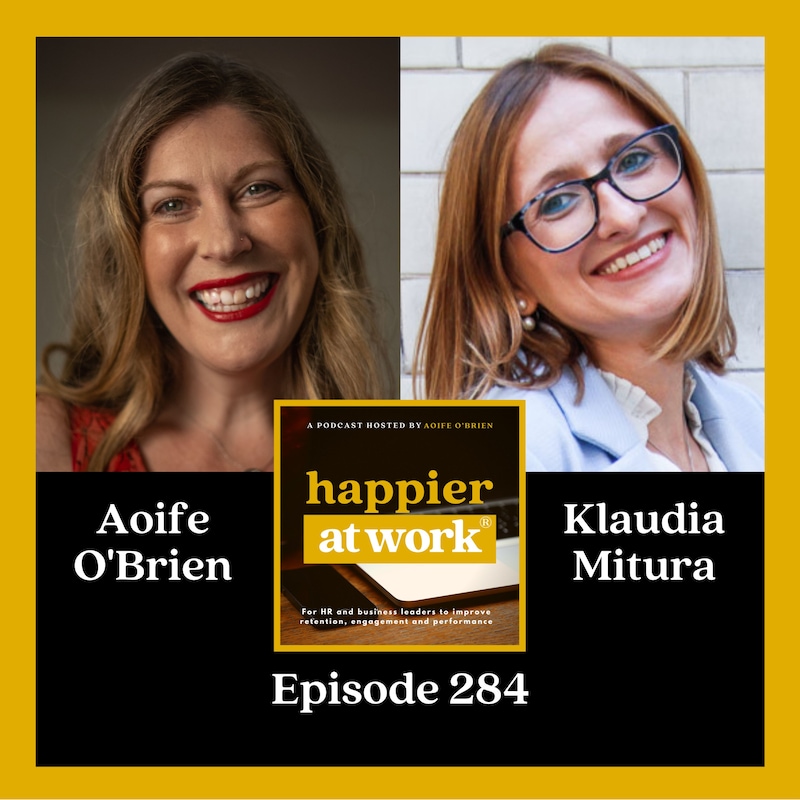
Shownotes
Are you ready to take charge of your happiness, both at work and in life?
In this episode of the Happier at Work podcast, Aoife O'Brien sits down with Klaudia Mitura, Learning and Development Manager at the Science Museum Group UK and certified Chief Happiness Officer, to explore the science of happiness. Klaudia reveals how happiness isn’t just “fluffy”, it’s grounded in research and practical habits. She shares her personal journey, the breakthrough habits supported by positive psychology, and actionable ways listeners can boost their wellbeing, cultivate joy, and foster more meaningful work and life experiences.
In This Episode, You’ll Discover:
- Happiness as a Science: It’s rooted in positive psychology and more than momentary joy, it’s also about overall life satisfaction.
- The difference between Day-to-day joy and long-term contentment.
- The surprising breakdown of what drives happiness, 40% comes from daily habits you control.
- Klaudia’s “Alphabet of Happiness”: Her tested collection of science-backed hacks for everyday joy.
Related Topics Covered:
Self-awareness, Purpose at Work, The Power of Choice, Achievement vs Happiness
Connect with Aoife O’Brien | Host of Happier at Work®:
Connect with Klaudia Mitura | Certified Chief Happiness Officer:
Related Episodes You’ll Love:
About Happier at Work®
Happier at Work® is the podcast for business leaders who want to create meaningful, human-centric workplaces. Hosted by Aoife O’Brien, the show explores leadership, career clarity, imposter syndrome, workplace culture, and employee engagement — helping you and your team thrive.
If you enjoy podcasts like WorkLife with Adam Grant, The Happiness Lab, or Squiggly Careers, you’ll love Happier at Work®.
Join Aoife O’Brien for weekly insights on leadership, workplace culture, career clarity, imposter syndrome, and creating work that works for you.
Website: https://happieratwork.ie LinkedIn: https://www.linkedin.com/in/aoifemobrien/ YouTube: https://www.youtube.com/@HappierAtWorkHQ
Transcripts
What most of us want is to be happy in our lives. Today's guest talks all about that. This is the Happier at Work podcast. I'm your host, Aoife o', Brien, the career and culture strategist for People First Leaders. And my guest today is Klaudia Mitura and she talks all about the science of happiness as a science rather than as an art. I think a lot of people associate happiness with being fluffy, but maybe if you're listening to this podcast, you think happiness at work work is possible. And Klaudia shares some very practical examples, some things that may be getting in the way of happiness and some things that you can do to improve your own happiness starting from tomorrow. We do touch on happiness at work towards the end, but the big focus is around our general happiness and I think a lot of the things we talk about can be applied to work as well.
Aoife O'Brien [:I really know you're going to enjoy today's episode and I'd love for you to get involved in the conversation. If we're not already connected to do, feel free to reach out and connect with me on LinkedIn or through the podcast podcastappieratwork ie. And I'd love to hear what you think of today's episode. Also, don't forget to leave a rating or review on Apple or on Spotify or wherever you're listening to the podcast. Klaudia, welcome to the Happier at Work podcast. I'm so thrilled for this conversation. I know we've had a few conversations in the past, but I'm really excited for this one in particular. Do you want to let people know a little bit about you, your background and how you got into doing what you're doing today?
Klaudia Mitura [:Yes, absolutely. Thank you so much for having me. This is absolutely so exciting. My name is Klaudia Mitura. I'm the Learning and Development Manager at the Science Museum Group in the uk. I'm also certified Chief Happiness Officer, which some people think. Is that even a qualification? Yes, that's a real thing that you can qualify in in the science of happiness. And I run a podcast called the Happiness Challenge where I test drive the best happiness hacks that that science has on offer.
Klaudia Mitura [:And also this year I publishing a book called the Alphabet of Happiness which is out now. Really? I got into the topic of Science of Happiness. As you can see, there is lots of happiness in my intro as a result of going through a very difficult time in my life and I was looking for hope frankly. And I decided to go on this happiness experiments when I look what science has on offer in relation to that to that topic and how can I build a positive wellbeing in a more sustainable way? And that journey then led me into the work that I'm currently doing.
Aoife O'Brien [:I think it's, it's really interesting because we all have these things in our life that kind of prompt us down a specific road. And it's really proactive of you to look out for those like where can I get help from? How can I understand more about this? How can I understand more about happiness and how to be happier? Because like you say it is a science. Like a lot of people I think they associate happiness with, with in my opinion, fluffiness. Like most of the people I talk to don't say this, but my perception is that people who don't get it are a bit like oh well that's fluffy or that's something that other people have or whatever or work is work. Why should we be happy at work? But I'd love to explore that in a bit more detail. Like the science that, the fact that it is a science and it's not an art. Do you want to talk to us a little bit more about like what does happiness actually mean?
Klaudia Mitura [:Love this question and I love your observation straight away because I get exactly very similar comments that I think it's really interesting that we, if you ask anyone what we want in life is to be happy and yet we don't know how to be happy. And actually we're not being taught how to be happy either. So it's really interesting concept in that perspective. When we think about happiness in the context of the science of happiness specifically, which is the field within positive psychology, we thinking about happiness in two ways. First of all is your day to day happiness, your joy, your excitement, how often you experiencing positive emotions from moment to moment. But the second aspect is how overall you are satisfied with your life. So if you look overall at everything in your life from this time perspective, from all experiences perspective, how satisfied you are in life. So happiness actually can be very day to day, moment to moment.
Klaudia Mitura [:Moment, but also it's an overall feeling of purpose, contentment, meaning and life satisfaction.
Aoife O'Brien [:Effy, I love that you can look at these two different ways. Would it be fair to say that if, if things are going well in one aspect, so you have day to day moments of joy that there doesn't necessarily translate into that longer term overall life satisfaction. And, and can you share some specific examples of that?
Klaudia Mitura [:Yes. And ideally we want those two things to be parallel for us to be happy day to day and then being yes, my life is really good and I feel, you know, great as a person. This is, this is good. But of course, as you said, there are moments where that, that doesn't happen and I think they can work to our advantage or disadvantage. So for example, you could be having a really bad day at work or very bad day overall and feel really like, well, I'm really unhappy in this moment. And understand that, okay, yes, this is difficult. I'm experiencing those emotions. But that does not mean that my entire life is not good.
Klaudia Mitura [:And it does not mean that I have to regret every single choice I've taken in life. So having that separation really helps. And of course vice versa is true. You might be thinking, well, I'm really enjoying myself and I'm going on this like pleasure seeking activities journey and I'm doing all those amazing things, look at me. But actually feel quite empty inside and think, actually I don't feel satisfied with my life and I'm. And I'm lacking purpose. But I think either way, if you reflect on your happiness with those two lenses, it can give you insights of what happiness means to you.
Aoife O'Brien [:Yeah.
Klaudia Mitura [:But the biggest thing we also need to understand when we do that is that conventional wisdom that says I will be happy if I do one thing, then I'll be happy is not correct. Really?
Aoife O'Brien [:Yeah.
Klaudia Mitura [:So studies don't support this idea that we need to achieve certain things in life to be happy. Research clearly shares that first of all, foremost we need to be happy. And then we'll be more creative, successful, healthy, have better relationship, will be more resilient, will live longer. But it all starts with happiness, which is something that frankly, if you, if we don't look into science of happiness, we don't know.
Aoife O'Brien [:Yeah, Yeah. I have so much to ask about that, Klaudia. Maybe we start with this idea that when you talk about this idea that I'll be happy when that. It's just so common. It's so, so common. And the example I always think about is promotions when we think things are really busy now, but it's all going to be worth it because I'm going to get that promotion and then you get the promotion and things get even busier or they stay the same. And so the focus for me is always on that journey and your day to day experience of your life. The other question that I have, and this is everything that I'm taking from what you're saying, the other question that I have is the causes of happiness on a day to day basis versus longer term.
Aoife O'Brien [:And I get that it's Unique to each one of us. But I think from a societal perspective, we're taught the big house, the car, the partner, these are all the things that are going to make us happy. But are there things on an individual level like is it different? What, what brings us joy on a day to day basis versus what gives us that overall life satisfaction?
Klaudia Mitura [:Yes, and this is again such a fascinating topic and it's so incredible to see so many researchers looking into that, because as you said, we reject this idea that those are all the external circumstances that lead to our happiness. Then what's left? What? How can we generate more happiness? And this is a very valid research question. So we have here fantastic researcher Sonia Lyubomirski and she looked into over 300,000 data sets. That is like enormous.
Aoife O'Brien [:A lot.
Klaudia Mitura [:Yes, and a lot. She was incredible to actually look into each of those data points and kind of have a look and see. Okay, so yeah, what, what, what is happiness in that sense? So she on average created this percentage is really what determines our happiness. So 50% of it, it's genetics. So you might be thinking, oh thanks Klaudia, you know, what I supposed to do with it. So 50% is genetics in the sense of how our brain is wired up. Okay. We may have different happiness, baseline it is called.
Klaudia Mitura [:However, our brains are very much work in progress. We can influence that. But 50% is genetic. Around 10% is our life circumstances. So of course we're not talking here about toxic positivity. There will be time in life when things are so stressful, so difficult that of course your happiness level will go down, but that's around 10%, then 40%. And this is where the exciting things come. 40% is day to day habits.
Klaudia Mitura [:Okay. So the habitual actions that we take every day build the day to day happiness. And also over time, like blocks get stuck together for that higher life satisfaction. So when you really look at the difference between happy people versus unhappy people, we cannot control genetics, we cannot control life circumstances, but we can control how many or what type of happiness boosting habits we are engaging in.
Aoife O'Brien [:I love that. And something that I read previously said, something about the day to day habits may not necessarily bring you joy in the moment, but if it's contributing to your overall life satisfaction. So you might have something that's, that feels like a bit of a drudge to you. And the example again that I think of is going to the gym. I go to the gym about four times a week. I've really got into lifting weights and stuff recently. And it's now just part of my habits I definitely can tell when I haven't gone because of my mood and things like that. But on the life satisfaction over time I will see definitely improvements.
Aoife O'Brien [:Even if I like, I don't really feel like going to the gym today, for example. So it's not for me about the day to day joy necessarily or at least it doesn't have to be like it's great when you have joyful moments and things like that. But what I'm trying to say here is that you don't have to be happy every single day and the habits that you do don't have to bring you joy in every moment, but if they're contributing to a more fulfilling life, then it's worth it.
Klaudia Mitura [:The point of happiness boosting habits is that they give our body and our mind a chance to be happy. Okay, Often we don't do that. So if you think about stress at work, when we are stressed at work, we don't sleep very well, we don't have time to exercise, but then we also don't drink water, we don't have time to take a lunch break, we don't giving our body and mind to actually a chance to be happy. And then we kind of surprise like well, why I'm not happy? Well, you know, you not putting a certain components in to allow yourself to be happy. So that's how I think we need to be thinking about happiness boosting habits. And yes, some of them might be not your favorites but they're good for you. But there'll be lots of pleasant ones as well.
Aoife O'Brien [:Yes.
Klaudia Mitura [:So time in nature, gratitude. Two examples of something that are absolutely boosting our happiness in the moment and long term and are very overall pleasant to engage with.
Aoife O'Brien [:Have you got any examples of how people can start thinking about this stuff for themselves if they haven't really done this reflection or if life has just got in the way and they haven't made deliberate time for these kind of habits on a day to day basis, but a reflection to understand, well, what are the things? And I've done this and I remember one thing that's coming to my mind now that I we had someone come in and this is when I was still working in corporate, but we had someone to come in and talk about, well, what did you really enjoy doing when you were a kid? And I was like, you know what I really enjoyed doing jigsaw puzzles. And so I've started buying myself jigsaw puzzles and doing them. It's something that I really enjoy and I Get into flow. And I just love doing it. But I'm thinking how do people find that stuff out? Maybe that's one thing is what did you really enjoy when you were a kid? Did you like climbing trees and therefore do you like going hiking or that kind of thing?
Klaudia Mitura [:I think any of the questions like that that put us in a different perspective are very useful. And I love your curiosity based question about the childhood when we were more free in the sense that we didn't feel we have to fit in different boxes or labels. So I think that's definitely a great way to reflect on that and come back to that. I think when we consider our work and day to day is to start with reflection of tracking our mood, tracking our happiness and having a bit of reflection of okay, what was happening at work that day or what was happening in my personal life that day, how did I start my day, how have I finished my day? Just a few highlights and how I felt. And what emerges is a clear picture of things that energize us and things that drain us. And very quickly we can also see habits that we are self sabotaging ourselves. For example, when I did this exercise very quickly I realized that when I wake up I'm quite grumpy straight away. And I thought, okay, why is that? Is that my brain? I have a very much a monkey brain.
Klaudia Mitura [:Is it that I wake up straight away and go into this worst case scenario? But I realized that very quickly upon waking up, I reach for my phone, okay, I reach for technology. I check something because I have my alarm on the phone.
Aoife O'Brien [:I think a lot of people will relate to that. Yeah, phone is inside me because it has the alarm on it. Even though I have a separate alarm clock that I bought for exactly that purpose.
Klaudia Mitura [:But then of course it doesn't stop there. I don't only check time. There is notification about something, there is nothing. You know, there is a message that is this. And I very quickly realized that I by reaching for technology as a first thing in the morning, I'm flooding my system with stress hormones. So before if I'm woken up, that's it. I'm already grumpy because I'm already stressed and I haven't even got out of bed. So I haven't even given myself a chance to feel happy.
Klaudia Mitura [:So what I do now is that I moved away from having a phone next to me. When I wake up, the first thing that I do is I just take 10 deep, deep breaths. I then think about three things I'm grateful for three things I'm looking forward to. It takes less than five minutes. It's the best thing that has changed how I start my day. And then I can go with that positive energy and translate it into exercise or connecting with my husband and all of those other aspects that are important. But that's a small shift, so. And I only find that out by doing this reflection of tracking my mood, thinking what energizes me, what drains me, what are some themes, and spotting that actually I'm quite unhappy in the morning and then asking my question, why? So I think that's your starting point.
Klaudia Mitura [:Now the Alphabet of happiness is an Alphabet, A to Z. And it looks at lots of different concepts that impacts our happiness from acceptance to zest. And in that book I have tested over 150 different hacks when it comes to our happiness that are based on science. So if you think, you know what, I don't know where to start. Every influencer, every wellbeing website says something else I should be doing and I already feel stretched hope. I'm hoping that my book will allow you to look at some science backed experiments that you can do and see whether that happiness boosting habits suits you and your lifestyle.
Aoife O'Brien [:I, I love that as an experiment, being kind of a scientist myself. And how I originally got into this whole idea of happiness was through Gretchen Rubin. I picked up her book while I was traveling around the US it just really spoke to me. I was like, oh, this sounds quite interesting. And she, she basically does it in an experiment type of style as well, where she'll do something for a month and she'll track it and she'll see the impact. So one example from her book would be like taking more photographs when we have family occasions, that kind of thing. So that's how I got into it from that experiment perspective. So I love that approach.
Aoife O'Brien [:I have a question on, and this is kind of a personal question, but also from stuff that I've read as well. We do this stuff and then we just get out of the habit. We just stop doing it for one reason or another and then we beat ourselves up. So we maybe go into a cycle of like, oh, I'm useless, I'm terrible, why can't I stick to this habit that I had? And I'm thinking specifically of the phone or any circumstances change, like moving house or moving abroad, new job, new routines, new new thing to do in the evening. Anything that disrupts our day can have the negative impact of, of impacting on our habits. And I'm thinking like, I Say for me, for the phone in particular because there was a time where I was sleeping with the phone out of my bedroom and now it's back in the bedroom. So any thoughts on like how to get back on the wagon, so to speak?
Klaudia Mitura [:My best advice here that really worked for me is that we cannot think about habits as the final thing. So often what we do is like I'm going to develop this habit and if I don't stick to it, bad me, naughty me. And we're going into that guilt and shame. That's not the point of the habits. We need to think about happiness and happiness boosting habits in a more flexible way. That is you need to have a toolbox and a toolkit and a selection of habits that work for you and then you need to reach out for specific habits depending on the circumstances. So exactly what you're saying here about yes, of course. Overall I aim to exercise, let's say three times a week and this is my favorite exercise.
Klaudia Mitura [:But this particular week I'm working on a project that I may not be able to exercise or I'm moving a house or I'm feeling poorly. So what other habit I can implement that can help me to sustain my happiness on this, this particular week or a day? So we then creating this idea of a self compassion of what do I truly need right now that can help me to sustain my happiness. So when I talk about habits, I don't mean rigidly repeating all the time on a regime because life doesn't work like that. I am so sorry to say it to people, I wish it would but often course our motivation goes down. Of course things are changing so let's have a selection of specific habits that we can tap into when we need them. So for example, let's say I'm having a stressful day at work and let's say that overall I take a lunch break and I can go away to the near park in the center of London. That's great. There are days I cannot do that.
Klaudia Mitura [:Okay, I cannot do that for whatever circumstances. Yes, I can negotiate boundaries, I can negotiate time skills, but there are moments when it is what it is. This is what's happening in the moment. I have a quick hack of sound healing bath which is basically a five minutes when I will just sit with my eyes closed and I listen to the sound healing music that stimulates my parasympathetic nervous system to then go into that rest and digest so I can be more grounded. So rather than beating myself up for you haven't Taken a full lunch break. Why are you not in the park and going into those negative self thoughts? I said I cannot do this today. That's okay, tomorrow is a fresh start. In this moment I need to regulate my nervous system.
Klaudia Mitura [:I can do this in five minutes because I have five minutes, not one hour. So be flexible. Think about all of those happiness boosting habits as tiny experiments. Okay? This is not forever. I'm trying something, I can see how it works. And also that way we also reducing resistance to change. Because if you say to your brain, okay, now we're going to do this for the rest of our lives, we panic. Right? We panic.
Klaudia Mitura [:It's like, no, this is too big. But if you say don't worry, what I'm going to do is I'm going to try this habit for three weeks and then I'm going to see how I feel. That's more flexible approach. And also our brain gets bored. So if we can have lots of different things, if we can be breaking up our routine that help us to sustain our habits.
Aoife O'Brien [:I love that from what I'm hearing, from everything that you're saying, it's about choice. And every day I wake up and I choose to do this. And if I don't have the option to take a full hour at lunch or to go out to the park to get outside into nature, I have other options at my disposal that I can take. And again, if I think back to my corporate days where I was really stressed and I was working on a presentation not in a fit state to continue, but of course you're just pushing on through and you're like, I just need to get this over the line, I need to get this finished. The times when I reminded myself that if I just get outside to get some fresh air, go for a five minute walk, I will come back and I'll be so much more refreshed, I'll be able to finish that presentation more efficiently and more effectively as well.
Klaudia Mitura [:Yes. And I think that's the key aspect of choice and one of. So there are a few choices that we can make towards happiness that are very impactful. One, how do you start your day to day your. How do you spend your breaks across your day? Because if you want to increase the quality of your sleep, I'm sorry if you haven't taken any mindful breaks during the day, you're not going to sleep soundly because there is no time during the day to release what you are feeling or experiencing. And the last one is how you spend your evenings and flopping in front of TV every single day. It's actually not the best happiness boosting habit and having a choice of lots of different activities that you can engage with. Playing sports, playing board games.
Klaudia Mitura [:You mentioned jigsaw, connecting with people, having something specifically to look forward, creative breaks, curiosity breaks, all of that help us to sustain our happiness. And those are choices. We can make that choice depending on the situation we are in every day.
Aoife O'Brien [:And can I reflect something back to you now? So you're talking about how you start your day, how you take your breaks and how you spend your evenings. And I'm thinking right now I'm failing across all three. And I want to say that's what's coming up for me. So maybe that's coming up for other people who are listening now I'm going to reframe that and say it's a choice. And when I recognize that pattern, I can give myself other options, give myself other choices of how to do things, how to spend my evenings, to actually take breaks. And I did get into the habit of doing meditations during the middle of the day, which was lovely. I do tapping as well. Emotional freedom technique, which really helps.
Aoife O'Brien [:I do jigsaw during the day. So I am doing some things, but I feel on the breakfront I am probably not the best at taking breaks. And then in the mornings it's like, yeah, reach for the phone, check the emails. I'm like, no need to get out of that. Although I do after I do that briefly, then that's when I go to the gym as well. But if there's anyone else thinking this, it's the reframe, isn't it? It's thinking, okay, so I've recognized this as a pattern. Now I have a choice in how I want to. And it's not about failure, it's just I've got into these habits that are not supporting me.
Aoife O'Brien [:And we won't call them bad habits, but we'll say they're not supporting our day to day happiness and or our long term happiness.
Klaudia Mitura [:There is also very interesting to understand that when the more stressed we are because of cortisol, the stress hormone, the less likely we would want to engage in any of those activities that are good for us. Because cortisol decreases our motivation levels and it impacts our decision making. So kind of think to yourself, it's not you that you don't feel like doing those positive habits, it's your stress. And it's what helps me personally is to have literally written down lots of activities, lots of different habits that brings me joy.
Aoife O'Brien [:Yeah.
Klaudia Mitura [:So that when my, when I feel cannot be asked, you know, I just cannot be asked, I can pull it out and remind myself, well, look at all of those things that really make you feel good.
Aoife O'Brien [:Yeah.
Klaudia Mitura [:Why don't you do something for five minutes and see how you feel. And of course, once I've done five minutes, I'm hooked. My brain is hooked. Exactly. My brain wants to do more. But that first start is really difficult. Yeah, it's very difficult. But remember, it's not you, it's the stress.
Aoife O'Brien [:Specifically. Klaudia, from the book. Are there any habits that you particularly like that you recommend to people? And I'd love to know as well, like what really surprised you? What did you not know about before? That was really surprising in relation to the first question.
Klaudia Mitura [:I love all of the kind of habits and I love the fact that they're giving me lots of choice. And for me it's about that choice, about the diversity. But the one key habit that I think we all know about and we forget to do and the one that I actually found the most difficult to implement in my life was gratitude. And gratitude is they super powerful habit. Because gratitude has the potential to rewire our brain to concentrate on positive things in our life more often. And that is just mind blowing that by feeling grateful on daily basis, we can train our brain to look after and look, look for those positive aspects. So remember when I said about 50% genetics, how our brain has rewired. And gratitude is a powerful tool to change that.
Klaudia Mitura [:So if for example, like myself, you have a tendency to look, jump into worst case scenarios and you have a tendency to over worry and overthink. Gratitude is an incredible habit to develop. And yet I find it the most difficult because on top at times it kind of feels fake. Like what am I, what why I should be grateful. But it's again about, you know, it can be a bad day. But even in a bad day there'll be some things that are absolutely good. So how can I spot those without minimalizing what I'm feeling at that emotional level? And you can do gratitude in any, in any way. You could be texting it to your friend.
Klaudia Mitura [:I love having a gratitude body because then we're holding each other accountable. You could be writing it. You mentioned photographs, taking pictures of things that brings us joy, anything you want. It could be a conversation with someone. But just think about the gratitude. So that was the most powerful for me in terms of the most surprising for me was this idea of overall how our Dopamine and the reward center in our brain works and how many amazing natural things we have in life that can boost that dopamine level. So again, coming back to this idea that we need to give our body and brain and mind a chance to be happy. That's it.
Klaudia Mitura [:So when it comes to dopamine levels and very surprising facts are cold showers. And I know this right away sounds like what? Why would I want to have a cold shower? For that natural reason of boosting dopamine levels in our brain. So if you in your day, day to day routine, you add one minute of a cold shower at the end of your daily shower, the dopamine we you're giving your chance, you giving your brain a chance to boost your dopamine by 250% huge unpleasant. That's why our brain decides to put us through this by giving us that dopamine boost. But very powerful other aspects that you can explore. Laughter exercises, laughing continuously for 10 minutes is an amazing dopamine boost. Listening to the favorite music, but positive upbeat music especially that it links with positive memory from the past. And another very much surprising gut health.
Klaudia Mitura [:So diversity of diet is important for our body, but it's also important for our gut health. That is our microbiomes in our gut are responsible and involved in production of the feel good hormones in our brain. Which again is like wow, how what so fermented foods, diversity of food actually make sure that your gut is healthy. If you haven't got inflammation, you will be much more prone to anxiety and depression.
Aoife O'Brien [:Yeah. I must admit, Klaudia, I struggle with gratitude sometimes as well. I know that it's good for me. I know that I quote unquote should sit down every day. Don't like using that word. But two like even three things that I'm grateful for either at the start or the end of the day. It's something I don't do on a regular basis, but I know that I, if I do it, it will make me much happier. I did know about cold showers, but I didn't know that level of detail about why they're so important and interestingly about laughter and music.
Aoife O'Brien [:That was something during the pandemic that I really made a conscious effort to do. So I don't think I had ever watched Modern Family. I had seen bits of it, but I'd never watched it from start to finish. And I put it on during the pandemic in the evening when we weren't able to go out. We didn't have that many options for what we would do but it just gave me that belly laugh that I needed at the end of the day and it was just pure magic. And music is something that I've noticed and for a long time I resisted paying for Spotify and paying for it now, but for a long time I resisted paying for it, but now that I'm paying for it, I've got my liked songs, I've got my Shazam songs and I can play the songs that I really like. And so a song will come on on my Alexa or whatever it might be and I'll be like, oh wow, I love this song. Yeah, of course I do because it's in my liked songs and maybe I haven't heard it in ages and it just brings me so much joy to, to hear that music.
Aoife O'Brien [:So thank you for making those suggestions.
Klaudia Mitura [:I think if you really like thinking at the end of the day, what could I do to boost my energy? You know, have a dance off with your loved one. Then you have everything here we have a connection, we have movement, we have favorite music and we have laughter because we look ridiculous. Great. Four things that absolutely boosts our happiness and can make sure that we finishing the day on the positive. Yes, I love the additional aspect to think about is that happiness is not selfish. I often have people saying, oh Klaudia, how can I be happy? Have you seen what's happening in the world? Like I feel, you know, I feel selfish by thinking about my happiness. Actually studies show very strongly that we need happy people to create happy societies. That is if you are happy, you are more likely to engage in pro social behavior towards a stranger on the street.
Klaudia Mitura [:That is you are kinder to other people. So again thinking about rippling effects of kindness. When we are happy, we are more generous with our money, we donate more often to good causes. When we are happy, we are more patient towards our loved ones and when we are happy, we are more helpful at work. So there is just a range of incredible science here showing that actually no, happiness is not selfish. We need to be looking at our happiness because when we are happy we have all of those benefits that benefits people around us and ultimately our communities and society.
Aoife O'Brien [:Yeah, it's. To me it's like the idea of putting your own oxygen mask on first. I know it's, it's kind of cliche at this stage that phrase but looking after yourself first so that you can look after other people. So figuring this stuff out for yourself. I know we haven't really touched on the idea of happiness at work and how to apply this Stuff. But I think a lot of what we've talked about we can translate into the workplace. Taking breaks, getting outside, you know, taking those moments in the morning, setting yourself up properly in the morning and setting yourself up properly at the end of the day by having a range of options and not just plunking in front of the tv oftentimes with a, with some wine or whatever it might be. But is there anything that really stands out that people need to know in translating this stuff into the workplace? Is there anything very specific, any specific habit for workplace happiness?
Klaudia Mitura [:Yes, there is one. And that's curiosity and learning. So in addition to, as you said, looking after our wellbeing, if my wellbeing is positive, I'll show up in a positive way as a leader and I can create more engaged and impactful teams as a result. But one specific component, learning and curiosity. So again, that is very hard to achieve if we have such a hectic schedule that we don't have any time to think about those two concepts. And yet research shows that when we are curious, when we are curious about new topics, when we are curious about our colleagues, when we are curious about developing new skills, when we are curious about applying our strengths at work, we are ultimate more satisfied at work. So think about having a micro learning or micro curiosity breaks across your week where you will discovering and learning something new. It could be that, that you're doing that by having a curiosity conversation with your colleague.
Klaudia Mitura [:Or it might be that by yourself, on your own, when you're researching certain topics, set yourself a learning goal for that month, what is it? One thing you want to learn about and then every week work towards meeting that goal. So curiosity and learning is the key thing that we need to implement more of at work for more satisfaction and engagement.
Aoife O'Brien [:I feel like it doesn't have to take a huge amount of time to do this stuff. It's in some ways a shift in attitude. So coming at it from an open mind rather than a closed mind and how you show up on a day to day basis, there are a few exceptions. Maybe reflection time might take a little bit of time, but aside from bringing more joy and happiness, it actually will have a longer term term impact on your performance at work as well. So it's not just about ourselves and again it's not about us being selfish by wanting to look after ourselves at work. And I'm as you know, writing a book at the moment and I'm in this section around capabilities and I'm looking at, okay, so people are overstretched at the moment, they're really overwhelmed. There's so much going on. But if we freed up that time for them, would they actually know how to spend, spend it? And it's a, it's a question I'm kind of wrestling with that if you give people more time, are they going to fill it with busy work, with things that are easy rather than the hard stuff, like the thinking and like you say, the curiosity which can, and the learning which can be hard.
Aoife O'Brien [:But having that thinking and reflection time, I think sometimes is, is quite a difficult thing to do, even though it might not take a lot of time when you're starting to go deep into that stuff. So to me that's a big challenge as well. If you give people this additional time, how would they spend it? And do they know what the priorities are within the business that will move the dial and how they should be spending the time? So that's kind of a thorny question that I'm wrestling with at the moment in the book.
Klaudia Mitura [:Yeah, I love that question. So thought provoking. I agree with you. And I think that's why when it comes to workplaces, we have to have those nudges to actually engage in those activities. So something nudging me to go and learn, something nudging me to go and be curious because I agree with you, if we have more of that time, what would the nudge me to move towards that positive and happiness boosting habit?
Aoife O'Brien [:Yeah, love it. And the question I ask everyone who comes on the podcast, what does being happier at work mean to you?
Klaudia Mitura [:For me, that's definitely collaboration and learning from other colleagues. I get lots of energy by working with passionate people who know so many incredible things that I can pick up and think about. So for me, conversations like this are what makes workplaces happier.
Aoife O'Brien [:I've loved this conversation. Thank you so much, Klaudia. If people want to reach out, if they want to know more about what you do, what's the best way they can do that?
Klaudia Mitura [:You can Visit my website, thehappinesschallenge.co.uk. you'll find all the information about the book, you'll find all the information about the podcast, and you can subscribe to my substack newsletter that I send month weekly for some dose of happiness into your inbox.
Aoife O'Brien [:Brilliant. I love it. Thank you so much for your time. I've so, so enjoyed this conversation and I'm looking forward to more of these as well.
Klaudia Mitura [:Thank you so much.
Aoife O'Brien [:That was Klaudia Matura talking all about the Science of Happiness and I'd love for you to join in the conversation. What are you going to do differently after listening to today's episode? And of course, as always, don't forget to leave a rating or review on your favorite podcast platform. If you're not already following us, don't forget to hit that follow button.




