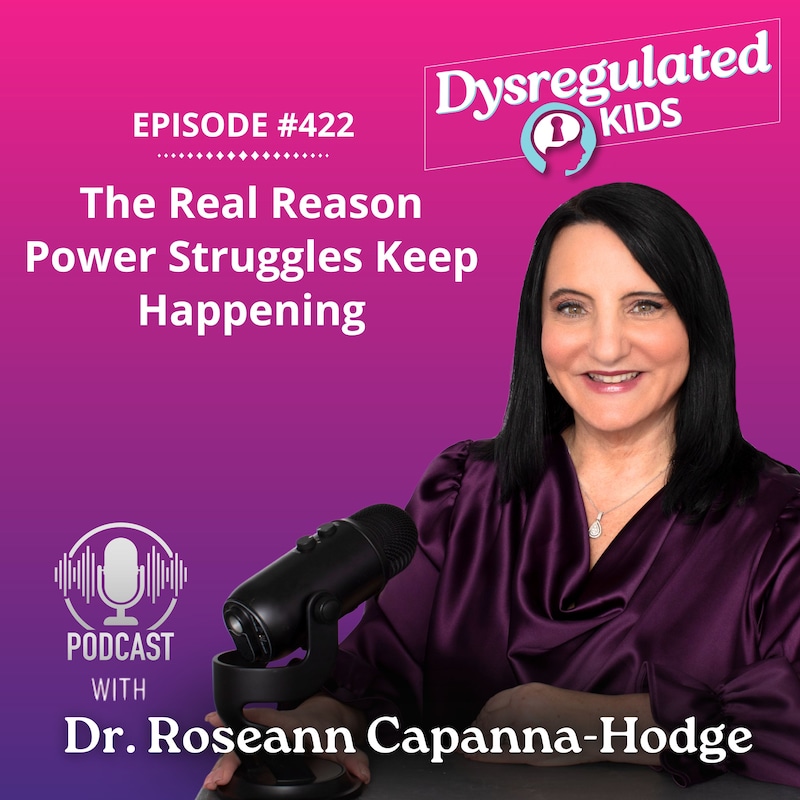
If you feel stuck in the same daily battles with your child, this episode breaks down the real reason power struggles keep happening—it’s not defiance, it’s dysregulation loops. Dr. Roseann Capanna-Hodge, expert in Regulation First Parenting™, shows how to calm the brain first.
Have you ever felt like you’re having the same fight with your child over and over again—no matter what you try? You’re not imagining it, and you’re definitely not alone.
When power struggles keep repeating, it’s not just about behavior—it’s about a nervous system loop that keeps both parent and child stuck.
In this episode discussing the real reason power struggles keep happening, let us break down why escalation happens so fast—and what actually interrupts it so real change can begin.
Why does my child keep arguing with me over the same things?
If it feels like déjà vu every time you ask your child to do something, there’s a reason for that. These repeated arguments aren’t random—they’re patterned responses between two activated nervous systems.
- Small triggers escalate quickly (a request → hesitation → pushback → frustration)
- Both parent and child become more reactive as intensity builds
- The brain shifts from listening mode to survival mode
Real-life example: You ask your child to turn off their device. They ignore you. You repeat it. Their resistance grows. Your tone sharpens. Suddenly, you're both arguing—and no one remembers how it started.
Behavior is communication—but dysregulation drives the loop.
Is my child being defiant or dysregulated?
This is one of the most common questions parents ask—and the answer changes everything.
What looks like defiance is often a dysregulated nervous system that cannot process the request in the moment.
- Dysregulated kids cannot access their “thinking brain” during escalation
- Pushback, yelling, or shutting down are stress responses, not disrespect
- Correction without regulation often increases resistance
You’re not seeing bad behavior—you’re seeing a brain that can’t regulate yet.
When your child is dysregulated, it’s easy to feel helpless.
The Regulation Rescue Kit gives you the scripts and strategies you need to stay grounded and in control.
Become a Dysregulation Insider VIP at www.drroseann.com/newsletter and get your free kit today.
Why do power struggles escalate so fast between me and my child?
Power struggles don’t just repeat—they intensify because each interaction strengthens the pattern.
- The nervous system learns the cycle: pressure → reaction → escalation
- Parents often increase urgency, tone, or consequences
- Kids mirror that energy through resistance or shutdown
Over time, both systems become quicker to react.
This is what I call a reactivity loop—and it’s why things feel harder, not easier, over time.
🗣️ “Power struggles don’t stop when you say the perfect thing—they stop when the pattern gets interrupted.” — Dr. Roseann
How do I stop reacting so quickly when my child pushes back?
You don’t break the cycle by saying the perfect thing—you break it by interrupting your own reaction first.
I want to share a simple tool called the “Love Pause”:
- Pause for 3 seconds before responding
- Take a breath or use a grounding action (hand on heart, hum, slow exhale)
- Lower your voice and slow your body
Even a few seconds can shift the direction of the moment.
Parent example: Instead of snapping back when her child yelled “No!”, she paused, softened her tone, and the escalation stopped before it spiraled.
Why does my child calm down when I stay calm?
Because nervous systems are contagious.
- Regulation leads to regulation
- Dysregulation leads to more dysregulation
- Kids—especially those with ADHD, anxiety, autism, or PDA traits—are highly sensitive to emotional tone
When you regulate yourself first, you become the external calm your child’s brain can mirror.
The more regulated you are, the more access your child has to regulation.
Takeaway & What’s Next
Power struggles don’t mean your child is “difficult”—they mean the nervous system loop hasn’t been interrupted yet. When you shift from reacting to regulating, everything starts to change: intensity lowers, recovery improves, and connection returns.
You’re not alone in this—and it is possible to break the cycle.
Tools like Quick CALM and The Dysregulated Kid can help you regulate your own nervous system in real time so you can respond instead of react.
For deeper support, the Regulated Child Summit brings together strategies to help you understand and calm dysregulation at its root.
It’s not bad parenting—it’s a dysregulated brain. And it’s gonna be OK.
FAQs
Why does my child keep having power struggles?
Because both nervous systems get locked in a repeating stress-response loop that escalates over time.
How do I stop arguing with my child every day?
Pause before reacting, lower emotional intensity, and focus on regulation before correction.
What is the Love Pause in parenting?
A 3-second intentional pause that interrupts escalation and helps reset your nervous system before responding.
Why does my child escalate when I get frustrated?
Children mirror emotional energy—parent dysregulation often triggers child dysregulation.
What is the real cause of repeated behavior problems?
Often it’s not behavior—it’s a dysregulated nervous system reacting to perceived pressure or threat.
Not sure where to start?
Take the guesswork out of helping your child.
Use our free Solution Matcher to get a personalized plan based on your child’s unique needs—whether it’s ADHD, anxiety, mood issues, or emotional dysregulation.
In just a few minutes, you'll know exactly what support is right for your family.
Start here: www.drroseann.com/help