Shownotes
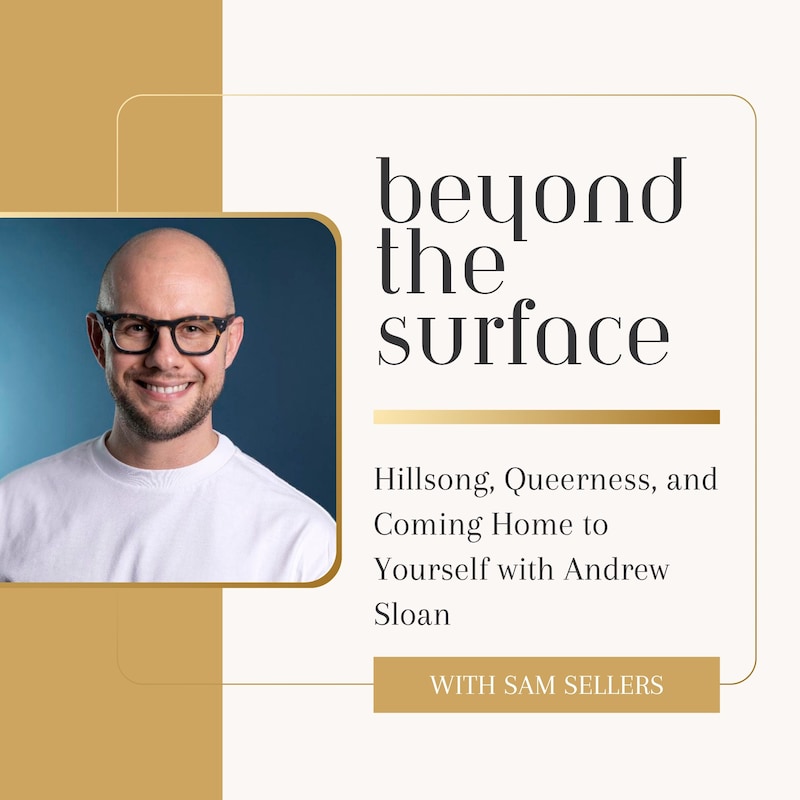
Andrew joins Sam for a conversation that is as honest as it is moving, reflecting on his journey out of a fundamentalist environment and the particular complexity of navigating that path as a queer person. Together they explore the painful dissonance between the safety and belonging religious communities can offer and the alienation that can follow when your identity no longer fits the mould and what it takes to begin rebuilding from that place. Andrew speaks to the role therapy and genuine human connection have played in reclaiming his sense of self, and the two dig into grief not as something to push through, but as a teacher in its own right. It's a rich, layered conversation that gently challenges listeners to consider what spirituality, healing, and self-acceptance might look like when they're finally on your own terms.
Who Is Andrew?
ANDREW SLOAN is a practising psychotherapist and leadership coach, working with people across diverse communities, multiple industries and unique businesses and circumstances. He is a Gallup® Certified CliftonStrengths® Coach and a Registered Clinical member of the Psychotherapy and Counselling Federation of Australia (PACFA).
Andrew is a self-confessed lifelong work in progress, constantly being reshaped by new learnings and practices, as well as the wisdom of others. He is on his journey toward a better world, one small change at a time.
Andrew is based in Sydney, Australia, on Gadigal Country.
Connect
- You can find out more about Sam on her website - www.anchoredcounsellingservices.com.au
- To connect with Sam on Instagram - @anchoredcounsellingservices
- Want to contact with Sam about the podcast or therapy? Use this contact form.
- Also check out The Religious Trauma Collective
Transcripts
I would like to begin by acknowledging the traditional custodians of the land on which I live and work, the Gundagara land and people. I pay my respects to their elders, past, present and emerging, and extend that respect to all Aboriginal and Torres Strait Islander people.
I also want to acknowledge the traditional custodians of the lands on which you, our listeners, are joining us from today.
I recognize the deep connection that first nations people have to this land, their enduring culture and their commitment to the preservation and care for their country. This land was never ceded and it always was and always will be Aboriginal land. Welcome to beyond the Surface.
This is a space for conversations that sit at the edges of faith, identity, power and recovery, especially for those of us who have been shaped so stretched or harmed by fundamental religion or high control systems. Some episodes are personal, some are reflective, some are educational or curious or quietly disruptive.
All of them are grounded in lived experience and a deep respect for the complexity of leaving, questioning and rebuilding meaning.
We will be talking about religious trauma, various forms of abuse, cult dynamics, queerness and recovery, not in answers, but in honest conversations. In listening to these conversations, some parts might be heavy or activating for you.
Please take care of yourself while listening and feel free to pause or step away if you need to. I'm Sam and I'm really glad that you're here with us.
Sam:Welcome, Andrew. Thanks for joining me.
Andrew:Thank you, Sam. I am so tickled pink being here.
Sam:I'm so glad to have you here.
Sam:I feel like Aaron Kelly is going.
Sam:To get a name for himself. Starting to like pimp people out my.
Sam:Podcast, which, to be fair, I think he would just absolutely love, which is totally fine.
Andrew:It's all in the name Pastor Aaron Kelly. He is bringing us together.
Sam:Still, still connecting people. Where in the world are you?
Andrew:At the moment, I'm in Robe, South Australia. I am in the most divine location. Well, I've been in a couple of divine locations recently, but this one is particularly amazing.
I'm literally out of my motorhome, which I've moved into in August. I have about 180 degrees of the southern ocean right at my doorstep.
A pod of dolphins just passed and the Irish family next to me absolutely lost their minds. It was amazing.
So, yeah, I'm on my way to continue the lap of Australia this year and we might get into all of the things that have changed, changed in the last, you know, 12 months. But this has been the monumental one. And so I'm, I'm in Robe. I just was in Regional Victoria.
I'M now headed to Adelaide and then Margaret river and then Western Australia for most of the year.
Sam:Well, I mean that all just sounds.
Sam:Very lovely and rude, Andrew.
Sam:Like I'm just like stuck in like.
Sam:Boring little windy Goulburn and with my neighbor's car revving outside and pods of dolphins.
Andrew:It's so ridiculous.
And like to have found myself at 41 in the current sort of capacity to make these sorts of choices, like oh God, I, I just, you know, as a younger person, I could not imagine being able to say to you what I just said, where I am and how I am.
Sam:And for everybody listening, they're going to work out why very soon. So I start these episodes with big vague question because I. Everybody's story starts in like a little bit differently. So where does your story start?
Andrew:Oh gosh, I love that question. It starts in my parents walk in wardrobe when I was five.
Sam:That is unlike any response I have ever heard.
Sam:Why in your parents walk in wardrobe?
Andrew:I had spotted a blue gingham skirt as a five year old and I was fixated with it obviously and I found myself in it in the wardrobe. I obviously had conspired to get in there.
And I remember closing the sliding wardrobe door like quietly so no one could hear me and I pulled up the gingham skirt and I just started to swish. I obviously had this, this knowledge, this, this feeling that this was the sort of thing that I wanted to do for some reason.
And I was five and I was of course caught. But mum was gracious, you know, that wasn't very foretelling of a lot of graciousness from her about my sexuality later on.
Sam:But.
Andrew:Yeah, that, that was, that's where life started. And in many ways this queer little kid begin their story in that transgressive act, you know, of doing something that should not have been done.
And I suppose whatever happened after that has always been a reaction between those desires, those, they're not even desires, they're like, they're impressions. They're moves inside of us, aren't they? They become desires out in the world but in those moments it's, yeah, it's just doing what feels good.
And I suppose I've been trying to do what feels good ever since and takes, took took some really wrong turns and then clearly have taken some really right ones to make you really fucking jealous today.
Sam:So interesting.
And like, I'm sure we'll get into it but my instinct is to always be like, I don't even look back at some of the like quote Unquote, wrong turns that I took as wrong anymore. But like it's a weird dynamic. But my instinct hearing you tell that.
Sam:Story was, oh my gosh, what sort.
Sam:Of family is going to like, are.
Sam:You in at this point? How is that sort of like putting this skirt on, swishing around, going to land with the people around you?
Andrew:Well, you know, I, I think that that moment must have been maybe secretized by mum for so long until it was funny, you know, and until we could jest about it. But the family that I grew up in was, you know, a family of the late 80s, early 90s. We always had the mood that we were poor, but really we weren't.
We were kind of climbing the middle class ladder to some I, what I think is quite wealthy, you know, but we didn't, you know, we didn't have everything that we probably wanted. But did mum and dad work damn hard at making that possible? Absolutely they did. And so yeah, that family setup was just so typical.
White, middle class Australian. And I, I reflected on this only last year. It's like, what would it have been like to be bringing up a queer kid in a very straight world?
And I wonder about the echo effect of the AIDS epidemic at that time and its role in creating sort of a dislodgment that this queer kid is a puzzle, like, and not a really great puzzle to solve. Like this is actually hurting us to have to help this kid. And yeah, no one knew what to do in many ways.
And you know, it's, it's fascinating to me to then reflect on that sort of fear based homophobia that probably was a part of the backdrop right of my upbringing. And in many ways I was left the alone to figure it all out.
And really, quite harrowingly, some really tough experiences I had to kind of handle just by my own some, you know.
Sam:Did you grow up in a religious household?
Andrew:No.
Sam:I love when I was like, you're.
Sam:Talking and I'm going, oh my gosh, he hasn't mentioned religion yet because I didn't either.
Sam:And I meet so few people who like chose, I call it like I chose to get on this roller coaster of like religion at some point. But like you weren't mentioning it. And so I was like, oh, okay,.
Andrew:Maybe they were not religious almost at all and almost like a reaction action against the religion of their parents. But in many ways like dad was more like an atheist than religious and mum was sort of like, oh God, yeah, Mum.
Her mum and dad were quite, you know, uniting church focused. But no, absolutely Not, I think from 5 to 13, what happened is the world sort of showed up continually not accepting how and who I was in the world.
And so I like the worst decision my mum could have ever made was moving me from year three to a new school. Sorry.
From year two to year three to a new school where I had all of my girlfriends, I had, you know, the fairy play dates, I had all of the stuff that I needed as a queer little kid to thrive. And then she plucked me out of that school. We were only moving 15 minutes down the road.
Sandra, she picks me up out of one school and puts me in another. Of course, today she would have made this decision differently, right?
Sam:Yeah.
Andrew:But she didn't know what she was doing. What she did actually was just completely fracture my social setup and I was the queer little kid being run away from by other boys.
I couldn't find my groove with the girls because I was a boy. It was all very confusing and it was a fight, it was a terrible time.
And then puberty hit and, you know, high school hit and I was like, oh, this is just foundationally an awful life.
And then we moved into a, an estate, you know, that middle class family had made it and we had built a brand new home and two doors down was a person that went to Hillsong Church. Of course there was. And that beautiful family really invited me to go with their son, who was a similar age to me, to summer camp. Yeah.
And I went into what I now describe as a full blown indoctrination camp where seven days, you're completely isolated, you're in the dark with the Holy Spirit more times than you're out. And yeah, I didn't look back because, you know, like I put myself in that 13 year old kid. Like, this has been awful.
Oh, what, there's like Jesus who's gonna save me and I can be. He can enter a room and flatten me on my back. Oh my God, this is amazing. And I didn't get bullied or run away from once.
And I was held and completely loved, you know, just as I am. Because in many ways I don't think they. We never saw queer people. Of course, there's so many in the church. Right. But we never saw them as queer.
We just saw them as, I don't know, a straight person loved by Jesus, I suppose. Anyway, maybe you could tell me a bit more about that. So, yeah, and I. At 13, what else am I going to do?
Sam:Yeah, absolutely.
Andrew:So I spent from 13 to 21 in Hillsong Church and I Got every star, every tick in the box, every award for being the best, best Hillsong Church member ever. And you can ask me more about that. But I did. I got the badges. I got.
Sam:Yes. Yeah. I mean, like, hearing you say that you.
Sam:Because I wasn't 100 sure. On how old you were when you went to Hillsong, and I was like, so, like, I joined the church that I ended up a part of when I was 12.
And, and I talk about it in a similar way in the sense of like, why, why else would, why would a kid leave that? Like, you receive like complete belonging automatically.
Like this, like, manufactured form of belonging that we know now, but at the time, as a teenager, it feels really, really good. Why would you ever leave that? Why would you ever think that there was anything wrong with that?
Sam:What.
Sam:How do you.
Okay, I'm going to ask a dual question because I feel like it might shift, which is like, what did you think of summer camp while you were in it and how do you look back on it now? Because I imagine they're quite different.
Andrew:Well, in it. God, I was so numb. So numb. I would have.
Look, I look back and I remember moments of sitting on someone's bed and us all being together and talking and having a conversation and me going, is the first time I've actually been in a sort of peer conversation that felt safe. Yeah. And so at the time, I would have just been so caught up in the ecstasy of that. Plus, plus, plus, plus like, what do you mean?
There's music in a band. Like, could I be a part of that? Like, could I, could I do that? It turns out I could in a really big way.
But yeah, how I look back at it now as an artist, all encompassing nervous system overload. And so I think what I. Now, if I put my therapeutic lens on, I go.
And everything I've learned about the nervous system, like, oh, that's, that's a, that's a nervous system headed towards collapse.
Like so much activation that we're headed to collapse, but with a hijacking of all of those social networks inside of our nervous systems that really enrich the human experience as well. And so it's, it's. It's a real manipulation, isn't it?
Because, you know, I, and I, I say this in the book that you so generously read that I wrote last year, but I, the I, it took me so long to recognize that belonging didn't have to come with a rule book. And it's the rule book that allows all of those parts of our nervous system to be activated in those ways.
But it comes with a lot of fine print that isn't really fit for human consumption. And so, yeah, that's how I look back at it. It's a complete.
It's a complete befuddlement because you're basically hijacking the nervous system to feel safe by overwhelming it and then returning it back to safety. What a fucking mind. Oh my God.
Sam:Yes, absolutely.
And like spiritually loaded fine print, which I think just hits really different than any other kind of fine print because it attempts to get to the core of who you are as a human and talks about things not just in this life, but the potential next life. So the weightiness of all of that fine print is so, so heavy in terms of like, so coming from a.
Sam:Like, it's always really funny when I go to say what I'm about to say because no one else uses this language other than former church people, which.
Sam:Is like coming from a secular family. What did you think about all of the religions side of things?
Like, what did you think about Jesus and the language of the Holy Spirit and like speaking in tongues and falling over? Like, you went into like the height of a Pentecostal space.
Andrew:Yeah, I, I just accepted it. Yeah. Like, I was so desperate, like, you, you give a dry sponge that's torn in half some water.
Sam:What?
Andrew:Like that's just. Oh, okay. It's this plus this. Okay, I can do this. Yeah.
And I think, you know, how it must have been looked at by me at that time is like, well, Nan goes to church, but she went to like Uniting Church. And then Mum has said recently, she spoke to Nan and said, checked if it was okay. And Nan checked with her are people. And it was all fine.
It was better than not being in church. And so I just accepted it. But it's funny, when you ask that question, I think about, like, I was a really great Christian.
Like, I got all the badges on one hand, but then I was a really bad Christian on the other hand because I never really invited anyone to church.
Sam:That is very bad of you.
Andrew:Like, I never really, I never really wanted people to be a part of it. I didn't know there was like a. There was a big part of me that was like, yeah, this is good to get all of the things that you're getting.
But actually at the end of the day, there's probably something structurally really unsound about this. And I, I wonder if I was just holding that down and I didn't invite people aggressively to church.
I think maybe I had, like, one person invited to church, and it was never clocked. I don't know. I was just busy doing everything else than inviting people to church.
How could I invite someone to church if I'm, like, singing or leading the choir? Like, I can't, you know, I'm busy. She's busy.
Sam:Did anyone pull you up on that, though? Because, like, Hillsong's big on evangelism and, like, bring numbers in.
Andrew:Now I'm saying it. I'm like, I was busy. I was busy. I was doing everything else. I promise. No one was clocking this. No one was clocking this.
Like, down to the fact that I was, like, a really bad tither. And I was like. I convinced myself because I was so. I know. I. I'm telling you, I had all these badges, but I didn't have the other badges, I promise.
But there must have been, like, a. Just a fundamental disease with what was happening. And. Yeah. Like, was I ever always fully in? No. Did it look like I was absolutely. Yeah, I was all in.
Sam:I mean, what did amongst all of this all in? Like, what is the language within yourself.
Andrew:Around your queerness throughout all this black box of nothing? So where. When I sort of got through 13, 14, 15, that was, like, this other thing that happened.
My sexuality was over sexualized, and it literally occurred in a black box of time, but also within me, it was completely compartmentalized. And so my whole sexuality, I didn't see myself as a sexual person. And, yeah, it was just completely in a nuclear waste box.
And for so many, many years, that was the case. And my sexuality then emerged in the dark hour of the night, right, Doing very naughty things online.
And then it would ricochet back and go, I will never do this again. The blood of Christ on me. Please heal me. Take this away from me.
And this big black box only ever opened up to never be opened again, you know, Every single time.
Sam:Yeah.
Andrew:And that would have happened for years on years on years where I had. It wasn't a splitting down the middle. It was like my sexuality was over here in a tiny little box, but that was split from me, most definitely.
And throughout my church time, I had, you know, relationship, well, girlfriends. I had, like, one or two girlfriends in all of those years. I made out with. With one person, you know, and. And nothing else. And.
And then I found out, you know, after all these years, there was all this gay sex happening in Hillsong Church, and I wasn't a. A part of it.
Sam:There's so much underground sex happening in Churches.
Andrew:Oh, my God, the bloody. Anyway, the Bible College. Hello. This is a. But that is also how everything came crumbling down in the end.
It was because I would imagine a queer person asked me if I was in love with them. And I was like, I don't know how that would work. I just don't know how that would work. They were in love with me, and I did not know how to function.
And that is what exploded everything, because it could. I could not compute it. I did not understand it. Even though this is happening in a black box over here.
When this person said this to me, they were really dramatic. They said, you've got to pull over the car. I was driving them home. I was like, okay, what?
And then they said, I'm in love with you, and I think you're in love with me too. I was like, ah, that's not possible. Like, it's just not possible. This is not possible. And that's what began the whole disclosure process to Hillsong.
And all hell broke loose, I bet. Yeah.
Sam:I mean, up until that point, like, what?
Like, obviously, like, you're going through, like, what just sounds like, you know, a typical, like, queer kid in a high control system shame cycle of, like, around their queerness. But did. Was it something within you that could be healed, or was it something within you that you had to suffer through?
Or was it neither of those things because it was so separate to you.
Andrew:Oh, so separate. And it was neither of those things. It was neither, because that was. That was nuclear.
Like, if that ever came out of that box, it would decimate everything. And so it wasn't even a. It wasn't even something to be healed. It was not something to do anything.
It was something to be, like, buried and ignored because it's so radioactive, like Pandora's box. Oh, it's. Yeah, but worse. Oh, it's. Oh, yeah, it's like, it's way worse. And every time it opened, it was killing me, you know?
And so maybe I could get healed, but that couldn't be healed because every time I opened it, I was left damaged. Then I would invite that healing in. But that was never touching that box. Like, that box was unhealable. Yeah, Yeah.
Sam:I like to ask this question because I ask like, a flipped version of it later in the episode, usually, which is, like, during your time there, who was God to you? What was your relationship with whoever God.
Sam:Was at the time?
Andrew:Oh, God. It's such a complex answer. Because I want to answer it from now. Like, I want to kind of. Yeah, yeah. Okay, well, I will hold back. I'll hold back.
Sam:We want to try.
Sam:We're showing progression.
Andrew:Who was God to me? I love this. Who was God to me then? Was this hard to grasp universal energy that was directing us all in my life?
Sam:Yeah.
Andrew:But a really hard to grasp entity that I knew at the time felt so embodied. Yeah. Like, it felt like God did feel like it was in me. Right.
Sam:That's very interesting.
Sam:Because usually the, like,.
Sam:By and large, the responses that I.
Sam:Hear, both, like, in these episodes and in people that I work with and.
Sam:And even in my own story is.
Sam:That the space that we're all a part of was so pivotal in disconnecting us from our body. To sort of hear you say that it was an embodied experience is very interesting.
Andrew:Yeah. I. I think a lot of my emotional experience was numbed. Yeah.
So when I turned around at, like, 22, 23, after a couple of years of being outside of the church, and I was in my first gay relationship, and I was sitting in front of a therapist, I could not feel what was happening beneath my neck, but I had to shut all of it off.
Sam:Yeah.
Andrew:So during. It's an embodied version of this Holy Spirit inside of me. I'm struggling so much not to describe it from today.
Sam:Yeah.
Andrew:But you'll have to keep listening. But then beyond the church, the big cataclysm that happened in my world, when everything came tumbling down, I then numbed everything.
I couldn't even listen to music. Yeah.
Sam:Former worship leader. I didn't listen to any music for, like, two years. I couldn't do it.
Andrew:Couldn't listen to music, couldn't feel my body, couldn't breathe. A whole bunch of different things. So, yeah, it's was a terrible time after. Of numbness. But during. I was flowing, I was flown.
Sam:I mean, actually, as you talk, I, like, I'm thinking if I was having, like, a Holy Spirit moment, I was probably more in my body. But it had to be really extreme and intense and overwhelming. Almost like it was an overwhelm of my system.
Andrew:Yes.
Sam:But that then gets. It's not overwhelming. It's just spiritual. It's a spiritual event. So it just, like the overwhelm becomes good.
Not just normal, it becomes good because that.
Andrew:That singular focus we have in religious settings of the prayer, the moment, the preacher, the body, the spirit, whatever that is. That is. That is what like, modern gurus are talking about when they talk about meditation and presence. Right. It's just as you so expertly named.
It' coded with all the other Guff. The other. The other fine print. Yes. But it doesn't take away from the fact that those mechanisms are helpful mechanisms.
Sam:Yeah.
Andrew:And for me, it's like that abundance of presence.
And then I think those hysteric moments in church services or those hysteric moments of our own healing or redemption, you know, praying demons off my back, all that sort of. That is an overwhelmed nervous system headed towards collapse.
Sam:Yeah.
Andrew:And.
Yeah, but the majority of that stuff is the stuff that we might want to find our way to doing now, but for us, from religious trauma experiences, that's fucking hard to do. Yeah.
Because we have to disembody ourselves to then find that gap between what felt really unsafe around abandonment to then get to a stage in our lives where we can reintegrate those practices again safely without being full blown activated all the time.
Sam:Yeah, absolutely. Yeah. It's a lot.
Andrew:It's a lot.
Sam:Okay, now I might be wrong in my next comment because I. It's been a while since I listened.
Sam:To your episode on Queerfully Made, but I have vague recollection of you talking.
Sam:About you being on the Hillsong Kids album.
Andrew:Well,.
Sam:Just break out in Hillsong at any moment.
Andrew:Aaron. Aaron just loves to activate us all with that song and those songs. Yeah. So at 13, I saw the band and I was like, I'm gonna be in that band.
And so it was another quest, Right. It was like, I will be saved. I'm already saved, actually, because that happened on day one of the bloody camp.
My next quest was like, how can I be in this band? And I did it at every level.
Every year I was in the band of some description all the way to the point where the year before, well, actually six months, maybe three months before I disclose my same sex attraction, I was a backing vocalist on the main Hillsong album. And so that was like, ding, ding, ding, ding. You've got the star, you know.
Sam:Jackpot.
Andrew:Yeah, it was the jackpot. And so throughout that time, I was in the founding member group of HK4.
So Julia Rebel tapped me on my shoulder and invited me and some other beautiful people to be a part of HK4. And I was then benched. What we used to call benched. It's when someone did something naughty. It was when someone did something naughty.
We got benched because we were no longer allowed on the stage. And so we knew that they were going through some form of pastoral care intervention.
And so I got benched just before the recording of the HK4 album that Aaron loves and adores.
Sam:Aaron loves and adores Any worship song that he can just belt out at the most inappropriate of times. It's true.
Andrew:And, and I'm already clasping my hands thinking about it.
Sam:I won't belt out a hell song tune at any moment, that's for sure. That's not happening.
Sam:Okay, so what, did you know what you were being benched for at that point, like, or did that come as a surprise to you?
Andrew:Oh, no, I knew very clearly.
So at that time I was leading the youth choir, singing as a backing vocalist and then in HK4 and I was quite like, I'm, I, I was actually as I am now, right? I, I, there's like photos of me back in the day. I have like Oakley glasses that I had clear lenses in and they were silver.
And I was gayer than Christmas. Like, seriously, like, I was conducting that choir. Like, there's videos of it gayer than Christmas.
So it's like, come on, like people, you know, like, what are we doing? We're all in this myth about my sexuality anyway. But regardless, regardless. So that Bible college students said this.
er's house. Yeah, it was like:That black box, okay, is now sitting on my lap, right? And it's been opened by this disclosure. And I'm, and my neurons are like, I don't understand how this works in this world. Like, what do you mean?
He loves that doesn't make sense. Like, what drove to that. Then all hell broke loose. And so I, I knew already by me disclosing this, I was going to be benched.
Like, this was just, this was just a part of the process. And so, yeah, from that moment on, everyone was informed.
You know, so it goes up the ladder and, and it went all the way to Darlene Check, who, you know, was the senior pastor of that worship and creative arts team, which is the team that I was in. And it's bloody horrific. So I had a pastor that was assigned to me and he was checking in on me every two days.
And you know, in rereading emails from this pastor, it's like, go to the gym, pray, read the Bible more, blah, blah, blah, like it. It's very prescriptive of what I should be doing to ward this off. Ward this off. Yeah.
And yeah, people like holding my hands and encouraging me to be a man of Christ. And these sentences, you know, being repeated and repeated. At that time, Anthony Van Brown, who is Now a very good and dear friend of mine.
Sam:There,.
Andrew:He was advocating at that same time to Brian to reduce the use of X gay conversion therapy and camps.
And so we're kind of lined up the dates that it was like the six months before and then I disclosed my same sex attraction and they did not, I, I think hillsong did not know what to do with me. Yeah. And so this is like the most painful part of this process.
Like it would have been painful before because I was benched and then told not to tell anyone. And at the time I think they were really worried that I was going to have sex with other people.
But I was like, I'm not, I didn't even know sex was happening. And if I did, I don't know what I would have done. I probably would have run out of the room, to be honest. So at that time I, it had to be a secret.
I was benched. So everyone knew something was problematic. Shame. Shame. Shame. Shame. Yeah, that's like humiliation, like public humiliation and separation, so.
And a complete disconnection from your support system. And so I had not great home based relationships because they were of the world, not in the church.
I had distanced myself from school, friends and family and all that and all of my best friends in church I could not tell. And so in this quasi time they did not know what to do. And so they sent me to a guy in Northmead and he's a Uniting church minister.
And the, the worst part of this story is that he specialized in child sex attraction, not same sex attraction.
And so he was assessing me for like pedophilia risk when I had not even had sex, let alone any sort of fantasies and certainly not child sex related or child sex attracted. And he's assessing me for this. And I'm sitting there in that chair. Can you imagine?
I had no support, I had no one to dialogue this with other than this psychologist, this Uniting Church minister. And he's assessing me. And I'll never forget I had this most beautiful dream holding a baby in my hands. And I just loved this kid so much.
I was tending to this child. He's fucking using that as an assessment.
And all of these years later I realized I was holding myself, I was loving on myself, I was tending to the innocence inside of me, inside of this awful setup, this awful circumstance. And yeah, it, it is so, it is still. I'm 41, I'm a psychotherapist, I have had how many fucking years of therapy? It is so painful to talk about.
Yeah, because it's in those moments where there's parts of me that just were not cared for by others. Yeah, they were not looked after and I didn't really know how to look after them until just maybe six years ago.
I really learned, and I've been a therapist for 10. I only really learned how to tend to those parts of me six years ago.
And that's, you know, I hold some really healthy anger and rage about this process too, because I wasn't connected. You know, this psychologist didn't then go, oh, he did in the end say, clearly not child sex attracted. Clearly just same sex attracted.
Okay, I need to counsel him out of hillsong. And he did. And he, he started that process of ideating. But him, where was his referral to a queer based organization?
Where was his referral to a community group that I could actually talk to? There was none of that, none of that. And so I, I'm very angry and still angry at him.
Sam:Absolutely. I mean, I think like hearing you talk about it, like, I mean, I'm angry for you.
But my, one of the biggest things that I noticed, like there's so much language around how queer people are spoken about in religious spaces and, and not just in religious spaces, but in anywhere that would adopt conversion based ideology or suppression based ideology. And I think from the conversations that I've had with people, there is none more harmful than the idea that queer people are predators.
Like, there is one thing to believe that there is something broken or like sinful or something like that's harmful as it is, but to think that a natural identity and attraction makes someone predatory is just the most disgusting and harmful perception, I think.
Andrew:Yeah, yeah, yeah, it is. And look, a lot of people who are predators have been predated on as well. And you know, they're the, they're the walking wounded also.
And in many ways this psychologist was trying to help this community of people who had found themselves in this place in their lives. It just so happens it wasn't this one. And it irrevoc, Irrevocably, irrevocably, irrevocably harmed me.
You know, it really me for so many years where I, I, I held that link, that link up. And it was such a harmful link up because, yeah, it does see same sex attraction at that same level of harm.
And, and we know it's not, we know it's not.
Sam:Yeah, absolutely. What was it like to leave the space that you had just spent like.
Sam:Nearly a decade in?
Andrew:Oh, it was so jarring. And I read back the emails that I wrote everyone because like, I had to actually take the path of understanding it through scripture first.
This is like, didn't we all? Oh my God, isn't that amazing? It's like I need to understand this through a scriptural lens. And yeah, I.
The email has all the quotes that I needed to deliver and the like. I think it was one thing leaving that space. It was another thing when I actually ended up saying, hey, big team, I'm out.
Like, I'm not doing this in this way. Then their decision to not talk to me ever again. The most ungodly, unchristian like decision, which was they all had dinner.
They had a dinner party and their decision collectively was not to speak to me again.
Sam:Oh my goodness.
Andrew:And it's like, oh my God, that is just not what the Bible says at all. And so I think when I realized that that had happened, I was like, oh, these people aren't good.
Sam:That's cruel.
Andrew:They're actually not good. And so it was really easy to get out and it was really easy to have had made that decision because I was like, this is really nasty actually.
Yeah, so, yeah, but what an upheaval, you know, what a big upheaval. Because at that time there was many different moments of upheaval. My uncle died on our living room floor. Dad is like, lost his best mate.
His wife then says the only possible answer to all of this tumult is for you, Andrew. You tonight have to come out to your parents.
Sam:Oh my gosh.
Andrew:I know. She goes, life's too short. Uncle Keith knew that, knows, knew that you were gay. I know you're gay. You need to be honest about it.
And this was a week after my dad just lost his best mate. So. So all of this was happening around a time where it was really chaotic and mum and dad lost their shit, you know, when I came out.
And so I had this secular family also abandoning me at the same time emotionally. And not for too long, but for enough. A few screaming matches and some awful experiences with me and them. I had fucking no one. Yeah.
And it rendered me to be incredibly self reliant. It rendered me with the type of strength I have now to go, well, I can get through anything. Anything is possible now.
Oh my God, that's a hillsong line.
Sam:It is.
Andrew:Isn't that like an album name?
Sam:I think it's something like that anyway.
Andrew:I think it's the first album I ever went to, but. But anything is possible. And I think this is what I got to on the Queer Flee podcast is like, I'm actually in the promise now as a queer person.
I mean, everything that the church convinced us we could get in Christ, but I'm in it.
And I, I have a bit of gay sex, you know, and, and, and I, you know, I don't read the Bible and I'm not subscribing to all these rules and I'm in the promised now. You know, anything is literally possible in my life and I'm privileged to be able to say that. But yeah, it's true. Yeah, true. Yeah.
Sam:I mean, like, I'm hearing you talk about what happened in the fallout of that and in the fallout of coming out. And the two biggest things that like, stood out to me is that one, obviously, like you mentioned, like, you had no one.
You're alone at like the level of isolation. But also everybody else was determining everything for you.
You had no control around, like when you came out, who you spoke to, who you had relationship with. Everybody else was just making the decisions for you.
And so like, I mean, typically, I think we, we all kind of know that we don't have a whole lot of autonomy and agency and high control religion anyway. But like, you're on the process out of that and you still don't have any. Yeah. How did. I mean, and it might have, but.
Sam:I'm sort of asking it as a. How did it not.
Sam:But it might have. How did that not turn into like, over correcting hyper independence? I don't need anybody.
Sam:And I might be using a little bit of lived experience here to ask this question.
Andrew:I feel like I should be asking the next question of you. So how did it not. What, what next? Well, no, no, not. What next happened is I shut everything down.
Sam:Yeah.
Andrew:And I look back on this. It was only like five or six years ago that I had my first panic attack.
Sam:Wow.
Andrew:And actually could hold what my body was holding and storing. On behalf of these experiences from 13 to 21.
Sam:Yeah.
Andrew:I, I reckon I pulled out the sexuality of that black box and I put everything else back in it. And so I could have the sexuality and I lived out that. But I could not deal with this other nuclear waste. So I did this swap.
It's the first time I've ever said that out loud. And I think it's so true. So then I lived a life completely disconnected from the greatest harms. Yeah.
And I mean, my whole experience of queerness in a straight world from 5 to 13, 13 to 21. Yeah. Packed it all up. Don't need to deal with It, I'm just gonna keep forging ahead.
So I lived in a really great way of communicating and a great way of choosing, you know, bits and pieces of my life, but never really, they're never really, really richly present. But I never got into drugs. I never got into fucking recklessness.
I went straight into a monogamous relationship for seven years pretty much and lived like a straight man. And, and you, you, you don't have to. You might want to see a photo of me when I was 25. Ish. I, I look older than I am now.
Like, I am, I am, I am 25, going on 45, close to 50 in this photo. I'm very unwell. I've got stomach issues. I've got autoimmune disease popping up.
You know, I've got a whole bunch of different stuff, but I'm not dealing with that. I'm just living in the here and now. Messy relationship. It ended.
I then had a little break and I went into a 13 year relationship with the person that I've just broken up with last year. Well, we've broken up. We both decided. So, yeah, I, I just kept going. I kept being productive, I kept learning.
And then what I've realized is for a form of reclamation in my life, especially from that moment of having power completely taken away from me in a moment where it should have been handed to me. Yeah. I built a practice, private practice as a psychotherapist, all about handing people power back. Yeah. And restoring their agency in the world.
Sam:Because it's so much easier to help other people get it for themselves than to do it for ourselves.
Andrew:Yeah. But what a selfish selflessness. Right.
In being able to say, hey, I'm going to do this, then I'm going to find a way to actually allow that to heal me. Yeah, yeah. And then, then it's going to be reciprocal. And, and look. Yeah. Okay, great. I've, I, then my body.
When Brian Houston was rejected from Hillsong Church the Saturday, or it was a Sunday or a Saturday that that media report came out, I went into a full blown meltdown.
Sam:Such interesting timing.
Sam:I want to get to that. But I want to ask a question before that.
Sam:That which is throughout those relationships, like particularly that first seven years, like at what point? Because up until this point you have always, like when talking about your sexuality, always had referred to it as like being same sex attracted.
At what point did that change to like, I'm gay and like affirming your own sexuality, like, this is good.
Andrew:Pretty quickly.
Sam:Okay.
Andrew:Yeah. Because I think as soon as you swap that box out and you're like, okay, well, I've done all of those hard things.
I can take what happens at midnight alone on a laptop, you know, and I can now take that and center it. And so, yeah, I think that just happened really quickly. I don't know if that's strange to you, but it just happened really fast.
But I think that's just how I am in the world. Like, yeah, I've always been this way in the world, you know, alive to the ability to express myself.
And all of that sort of stuff has always been an ongoing thing, I think. I just. I don't know, maybe it's a form of that dislocation that I always had about that belief system. It was always present to me.
And then when I was treated in this way, I'm like, okay, well, all right, I can let that go. And now I can actually just be gay. But I did gay in a very monogamous, straight way, and that was my cocoon.
Sam:Yeah.
Andrew:Okay. Do you get what I'm saying?
Sam:Yes. I was gonna ask, like, how. Because. And I know again, I.
Sam:Some of my questions when I'm talking to other queer people are a little.
Sam:Bit depressed, experience based, which is like, how much of, like, the heteronormativity from Hillsong, which is a nice alliteration, how much of that went into that first gay relationship?
Andrew:Because all of it. Because I think we're not even just Hillsong.
I think from the straight world around me that what's accepted, what's going to be approved of in my family of origin and in my friendships is when I showed them I can do this just as well as they can.
Sam:Yes.
Sam:Like, you're proving a point. Point.
Andrew:It is a massive proved point. And it was. It was determinedly that, you know, I got engaged to this person. You know, we had rings on our finger. So, yeah, absolutely.
It was a proof point. Yeah. Yeah.
Sam:Okay. When you had the panic attack, did you know what you were having a panic attack about? Was it conscious at that point or what?
Did that come a bit like that?
Andrew:No, I think it was conscious.
But like, of course, when you're in panic, you don't have the front two parts of your brain, and so all of that blood flow and neural network has retreated, and it's in the. It's in the moment. So did I at three, something in the morning? No. Yeah, I. I knew something was terribly wrong.
I knew I wasn't having a medical episode, and my partner at the time had had a History of panic attacks, you know, over many years. And so they knew exactly what going on. And straight on my back, I'm here, you know. Whoa. Like, that is all you need in those moments is I'm here.
Sam:Yeah.
Andrew:And so, yeah, did I know? I, I. There was an unraveling that had to come because all.
What I then came to really understand was all of those somatic memories were replaying as if they were happening today. And did I fully clock that at the time? No.
But, like, this is after a long period of time of being in our therapy, client, a person in therapy, and being our therapist, I kind of knew what was happening. But I also, I don't know, I wore it as a badge of honor that I hadn't had a panic attack. In a way, I wore it as a.
But what I now know is that that was my incredibly resourceful nervous system containing something until I was really ready to process it. Because if I had done it earlier, I don't think I would have survived. Like, I'd never had had suicidal ideation or thoughts of suicide in the past.
And they came in a flurry beyond that panic attack, you know.
And so I wonder what would have happened if I didn't have the sort of nervous system that could have contained it, because I had the capacity then and there to dialogue with these parts of me around. Why did they think dying was a really great idea right now? It's probably because it feels really shit. Okay.
That makes real sense, you know, and thank you for that. That option, that idea.
Sam:We don't love it.
Andrew:We're not really fans of it like the rest of us are not fans of it. Just letting you know we've got some other things. Things to live for here. Yeah. But, yeah, being able to be present to that and alive to that.
And I had the most amazing clinical supervisor at the time.
I had the most amazing opportunity to get more therapy from alternate perspectives and internal family systems was it, you know, and it was the thing I needed to unpack all of the things that. All of the parts of me that were in boxes and all of parts the of. Of me that needed to be brought back home and held again. Yeah.
Sam:Now you.
Sam:I find this always happens when I talk to therapists. Because you were talking about that like it's the most beautiful picture that you are painting.
And I imagine it was not said beautiful picture that you are painting right now. I imagine it was a little bit like the emotional floodgates opening. It was really painful.
Andrew:Oh. It was the, the, the panic of that. That was wired wire being pushed through my rib cage and sewing it up.
And to feel after all these years that a part of me was still down the street in a dark cave, that is so, so frightening. And I actually had to go and take medication for a period of time. I really needed support because I was completely destabilized.
I was completely in pain. In the worst pain. It was the pain of being a 5 year old all the way through to 13 and 13 to 21 of my rejection from church.
It was all that pain playing out in real time like a floodgate had opened. It was. Yeah, it was, yeah. Yeah.
Sam:That's the picture I'm imagining. Not the beautiful conversation between our parts, which is lovely but doesn't actually feel lovely.
Andrew:But that's where it got to. It did get to there. And you know, in so many ways my current capacity is built on that fire. Right?
Sam:Yeah, absolutely. How was it for you to access some of those boxed away emotions, particularly like around the space that you've come from?
Because I know like having the language for what was actually experienced is so powerful.
Not language around like people being like a bit shitty or like a bit mean, but like the actual like indoctrination and the emotional manipulation and like all of the stuff that was happening in that eight years that you were there. What was it like for you to find language and emotion around that?
Andrew:Well, I. There's. It's hard to put words to it. Yeah.
Because in many ways it's the capacity I hold now in my body to be able to be with that pain that is still with me. Yeah. Like beyond that sort of first phase of the absolute overwhelm of the pain. Because everyone else inside of me doesn't know what the is going on.
There is no containment. There is no tending to. There's no ability to kind of understand where this velocity of stuff is coming from, let alone what to do with it.
And it's so risky to feel those things because when we start to feel those things it really limits our ability to safely share it. And because we don't know who's going to stay in. Because everybody left, everyone in the past left. So. Right. So yeah.
It's hard to describe it because it's that sheer pain and then it's that, whoa, okay, what's the scaffold for me to understand that? And I forget the person's name. Oh, you probably know them. Is it Lifton?
Sam:Oh yeah. Robert J. Lifton. The thought.
Andrew:Yes. The lifting. The Lifton criteria of high control yes. High contact.
And when my clinical supervisor said, oh, dude, have you heard of this, this framework, you know, this framework that starts with the dynamics of control, mystical manipulation, demanding purity, confession, sacred science, loading the language doctrine over the person, dispensing of your actual existence and putting it in God, not you. That's Lifton's criteria, by the way of a cult. And when. When I can cerebrally understand that criteria, I'm like, oh, I was. Yeah, that. That is. This.
This pain is because of this dynamic. Oh, okay. All right. This gives this shape now, this pain. It gives it legitimacy. It gives it a place inside of me.
It doesn't have to be down the street in a cave. You know, I can actually bring that pain home and I can actually integrate it here.
And the more and more I've discovered about this is that, you know, the goal of therapy, the goal of healing, the goal of blah, blah, blah, isn't actually what the church would say. It's actually, how can we have a relationship with that pain? And how can we have a relationship with that. That grief ongoingly?
It's not about transmuting it to allow it to be vanished out of us. It's actually, how do I hold it? And now I know the infrastructure in me and my body that holds that. What a beautiful thing.
You know, I don't have to get rid of nothing. I just have to hold it differently.
Sam:Absolutely.
Andrew:And it's.
Sam:You say that much more beautifully than I do to my clients, which is, we don't.
Sam:We can't exterminate the shit we don't like. Just gotta learn to. I do use the term. We've just got to learn to hold it differently.
Andrew:And to learn to hold it differently is one thing. Right. And that might be one of the phases, but then what happens when we can beautifully hold our greatest pain and.
And how not inflamed is it, you know, like. Or for me, a lot of my understanding is what happened inside of my nervous system when I couldn't hold that pain safely.
All of the protective instincts that would then activate and trigger off actually felt more unsafe than just holding the pain.
It's like all of those coping strategies and all of those fire alarms that would go off in me rather than, oh, okay, we don't have to actually get rid of this. We get to hold this differently.
And now look at the relative safety I can create inside my body and then the relative safety I can create in the connections with the other humans in my life. Because the majority of my friendships and the majority of my post church sort of dynamics was don't worry, I've got this.
I need you to need me more than I need you. And so I'm going to overextend, I'm going to please, I'm going to do, I'm going to deliver. And then you'll stay.
Sam:Yes. You talked about this in the state, right?
Andrew:I did, yes.
Sam:And I think I'd like you to.
Sam:Talk a little bit more about that.
Sam:Because I think it's something that so many people who have come out of, of manufactured spaces of belonging are going to relate to quite a bit.
Andrew:Well, I think when we can't hold the pain. Yeah. And we don't know how to tend to it ourselves, we're going to get that tended to by others. And in this way.
And this is not in the book by the way, we're adding to it right now in living form with me and you, Sam.
So maybe when we can't, when we need to get that person to deal with that pain for us because we can't do it for ourselves, we're going to be consequential to them. Yeah. We're going to overextend, we're going to delight, we're going to serve, we're going to do all the things the church taught us. Right.
But we're going to do it in a secular way without God and religion.
And when I realized that I routinely created a dynamic where I felt safer when that person needed me more than I needed them, I was like, oh yeah, I have created a dynamic here to deal with my pain but to keep me forever connected and not abandoned by these people by being very consequential in their lives. Yeah.
And that realization, I had to send a lot of self compassionate compassion to myself because I realized what I had done, you know, what I had created. And it was relationships of com, no reciprocation. The other person couldn't even reciprocate because I was there doing everything anyway.
They didn't even have room. And when I started to demand that rebalance, I'm now reading a line out of the book, but there was no bounce left in that relationship. It shattered.
Yeah. And yeah, I'm. I still hold grief, deep, deep sadness and pain about that.
And although I can orientate it to how I was manhandled, you know, by religion and systems around me at the same time as I'm so grateful that I now, that I now can forge partnerships of reciprocity and ease and balance and I handle my pain. So you don't have to, you know. Yeah, I hold my pain so you don't have to.
Sam:Speaking of grief, how do you hold all of that? Because I find that grief is one of the most complex and. And the thing that lingers the most for a lot of people.
It's the most universal with religious trauma and cult survivors is just the enormous amounts of grief. And not just with people, but grief of routines and rituals and rhythms and relationships with the divine and all of that sort of thing.
How do you hold your grief now?
Andrew:Well, look, I think the biggest misunderstanding. Well, the biggest disservice and misjustice is that a word is now that is we are copped. Is that grief is linear. Yes.
And it has a couple of stages to it. It's like, no. So that's the first threshold we have to cross, which is, this isn't linear.
I don't have to dispense of this grief, but I might want to see it in a different way. And the spiral models of grief are way more in alignment with how I have learned to be with grief.
Sam:I like the model of grief where.
Sam:It's just a giant scribble.
Sam:That's my model of grief.
Andrew:Well, the spiral is kind of like, yes, there's a lot of hardship in the middle of grief, but as we move in concentric circles around it, we're still clocking it, we're still with it, but. But it. I don't know, it becomes easier to be with over time. How do I hold grief right now?
I. I don't know if I'm a master at it, and I don't know if I'd ever master it, but I go into the ocean, right? For many years, I would cry in the shower as water was tumbling over my body, going out of the drain.
In many ways now I have found myself sort of not forcing gratitude, but finding gratitude in my life and purposefully conjuring that up and articulating that as I hold grief. It's interesting that gratitude and grief kind of start the same, don't they?
But, yeah, it's a really difficult experience because we're being taught that we bury dead things and then we move away from them very quickly. What is it like for us to honor grief's valuable place in our life?
That our grief can connect us with our great choices, can give us clarity on what's important. It can give us a bit of a rubric or a roadmap for what needs to happen next in our lives.
And it's an honor to hold what we have lost access to or what we didn't get need and what we didn't get when we needed it the most. And I just wonder about the different place we hold grief. And for me, I hold it right here, just underneath the bottom of my sternum them and it's.
And it's a felt experience. It's co. Located with pain. It's. It's, you know, at times it's quite alive inside of me as I sit here with grief.
I just notice all of the other bits and pieces that hold it and tend to it and that feels really safe.
It feels really safe in my body right now to be with it and not have to get rid of it and then to leverage its energy for what happens next in my life. That transmuting of grief into not. Not getting rid of it, but moving that energy to what happens next.
Not the sort of relationships that are one direction and, you know, unreciprocal that end up not getting my needs met. No.
The sorts of moves I can make that are creative and collaborative and beautiful and offer reciprocity in the world, you know, that is how I handle grief now. It's an active process. Yeah. Just as much as it's a holding one. Yeah.
Sam:And.
Sam:And I imagine like for people listening who might be going, that sounds lovely, but that also took a lot of work.
Andrew:Right.
Sam:Like that doesn't just magically happen. We're not talking about something that just magically happens overnight.
So I always like to just go, you know, if you are listening to someone's experience going, that sounds lovely for you. It's also not. You're not, you're talking about it having gone through the work and continuing to do the work because it's an ongoing process.
Andrew:Ongoing tending and I'm 41. I left the church at 21. Yeah. So high. 20 Years, like, fuck, 20 years of incredibly dark, dark periods of my life.
Sam:Yeah.
Andrew:As well as really joyous ones and shameless plug coming up. But plug away. The book. The book why Things Feel Fucked is the last 10 years of my discovery of a roadmap. Right. Yeah.
And so in many ways, if you're sitting there thinking, that feels so far away from my lived experience and God, I wouldn't even know where to begin on that. You know, I don't even know how to breathe deep, let alone do what Andrew is describing. The book might be a good map.
It's not a perfect map, but it's a potential map to at least draw your own path forward. And it has this story Woven all the way through it.
It and the psychotherapy toolkit frameworks that I have used for my own healing, but others have leveraged for theirs. And you might want to pick up the book, it's in audiobook for me. If you enjoy my voice, you can listen to this voice more. Six hours of it.
If you don't enjoy the voice and you want to go into the diagrams of the illustrations, go to the hard copy book or get the Kindle version. Yeah, but that might be a good place to start. I don't know. Okay.
Sam:Beautiful.
Sam:I love a shameless plug.
Sam:That's what podcasts are for. Jeez.
Sam:Okay, I want to ask one more question before I get to what is my final question for all of the episodes? But I want to go back to something we were talking about that you.
Sam:Wanted to answer this way the first.
Sam:Time round, which is how do you look back on what your relationship with God was at the time, presently, and what is your relationship with spirituality like now?
Andrew:Well, I look back at that knowing that what that high control culture was inviting me to access was my. The core of my nervous system.
Sam:Yeah.
Andrew:And what we've discovered is that these are particular neural networks that are regulating safe connection with another human, which unlock everything that's good in the human experience. It unlocks calm, connected, creative, courage, a whole bunch of other C words in there as well.
It unlocks the capacity for us to be orientated and have all the bits of our brain alive in the same moments. And. And it is the centering of ourselves. And it's an abundant place.
It's actually being discovered as an indefatigable portion of our nervous systems. And if church was promising us anything, it was this. And they just had it around the wrong way. We actually don't need to believe in anything.
We actually don't need to follow any rule books. We actually just need safe human connection to get there. And it's eyeball to eyeball, voice box to voice box, human to human.
Safety is what creates this access to the ventral vagal complex in our bodies. And that is the God nerve for me. And I am God. No, but God is in me. Like, if I look back and I go, well, who was God really? It was me.
Sam:Yes.
Andrew:And I was hard to grasp the God out there because they're actually inside of us. This powerful force in our nervous systems is actually us. I. I'm ingest calling us gods, but it is from that lens. We are the God inside of us.
And we have this expansive, creative, compassionate resource inside of us. It's been annihilated by the, the world systems, patriarchy, religion, the world of productivity and capitalism has also squashed this in many ways.
You know, it has kept us from ourselves. Yeah.
Sam:Yeah.
Andrew:So now spirituality is my infinite sort of capacity inside of me to feel and hold and be with myself. This is presence. But more and more, as I flirt with the world around me, I see it in others, I see it in nature, the natural rhythms of nature. I am.
Yeah, I.
My whole focus in buying a motorhome after I ended a 13 year relationship last year was I wanted to be nomadic and I wanted to be more connected to nature. And I think when we think about where our nervous systems grew up, they grew up in very different times.
They did not have the systems of work, religion, and the industrial complex around us. Yeah. They had a really effortless, symbiotic relationship with nature and each other, us.
And I am trying to hack that process in a world that's not set up for that. Right. And I'm doing that in a pretty beautiful motorhome.
Driving around Australia this year as I have more conversations with people about their version of why things feel, but also why things now feel calm. Why, why do, why does it feel better? Why does, why do you have peace on board? You know, and how did you get there is what I think my new religion is.
It's like, how do we have that meaningful conversation? And so spirituality is really a safe connection with myself and then with another person in the context of my, my connection to nature.
And like, if you had told me that five years ago, I'd be like, what the, what a whack, you know, Absolutely whack job.
But I have to tell you, in all of my journeying through the science and through my own lived experience and alongside other people's experiences, we gotta prescribe each other safe connection with each other and we've got to prescribe our access to nature as often as. As much as we can. Yeah. Because no one is coming to save us but ourselves. Yeah. Yep.
Sam:Okay, I'm going.
Sam:I'm. I lied. I'm gonna ask one other question before I get to my end. One, because I just remembered when you were talking, I was like, oh, yeah.
Sam:I wanted to ask that. What would you say to like 13 year old Andrew who is about to go, go to summer camp now?
Andrew:Wow. Oh God, that's a really hard question because like there's two impulses.
There's one block the door, like put your arm across the door and go, what the Are you doing? Yeah. The other impulse is to sit him down and explain to him why he feels the way he does and it's not his fault.
t how do you tell that kid in: rom me, just remember this is:And it might be a deeper breath today before you're in a motorhome circumnavigating Australia. Yes, of course, that's my 20 year history, not yours. Yeah. But start with the breath. Breath. Start with the deeper breath.
Start with the safe relationship. Yeah, yeah.
Sam:You've started answering what my final question always is.
Sam:So now you can think of something else. Okay, which is if somebody's listening to.
Sam:This and they're at the beginning of that process of unraveling everything that they've just been through, what would you say to that person?
Andrew:Well, yeah, definitely what I was just saying. Look, put your hand on where it feels most painful in your body right now. Put your other hand on where it feels less painful, more spacious.
And just be present to both. Just be present to both. You don't need to change it, it, you don't need to replace it, you don't need to shift it. Just be present to both.
And then you might want to take some portion of that pain and share it with another person who's safe. And for me, that was many different therapists over the last 20 years, right? About three or four, probably not many. Three or four people.
And, and you don't have to be healed by that therapist. That's not the gig. It's just to start the sharing and the safe transition or translation of that pain to someone else. And it's scary.
It feels impossible. It feels like you might cave in or the world might open up and swallow you. Even when it feels impossible, sit there and try anyway to share.
Because really I think, and this is my current hypothesis, the only pathway to healing is through this safe connection with another human being. Yeah.
Sam:I don't know how someone would do it without it.
Sam:Yeah, absolutely.
Sam:Thank you. I'm like, I don't actually know what to say to that, so instead I'm just gonna thank you for your beautiful.
Sam:Vulnerability and for sharing so openly and for being here with me.
Andrew:Well, look at us. You know, we get to sit and connect. We have no idea who each other are in the world.
And we've just had like a beautiful, enrichment, enriched, vulnerable conversation that I truly hope has helped others because I know it has already helped me. It has already shifted and moved and, oh, I just. I would have avoided these conversations years ago. And I'm just such a bomb balm being here.
So thank you.
Sam:Oh, thank you.
Sam:It's been an absolute pleasure.
Sam:Thanks for listening to beyond the Surface. If this episode resonated, challenged you, or named something you've struggled to put words to, I'm really glad you found your way here.
You'll find ways to connect, learn more, and explore further in the show. Notes. As always, you are good. You have always been good and your story matters always.
