Shownotes
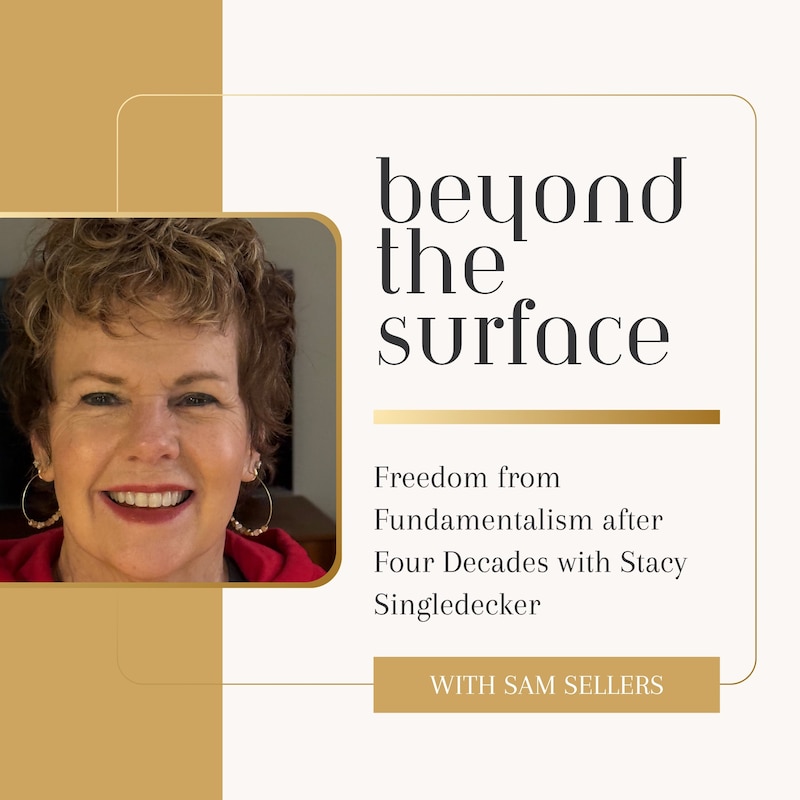
Stacy shares her long and complicated relationship with fundamentalism and evangelical Christianity, starting with a childhood shaped by strict values rather than overt religiosity, and moving into a born-again faith she found as a teenager while searching for belonging. What initially felt like connection and purpose slowly became transactional, where her worth was measured by how much she served, showed up, and stayed in line. She talks openly about the mental health toll of living under constant religious expectation, and the quiet ways doubt began to creep in long before she felt able to name it. The unraveling accelerated through experiences of betrayal in her church and the broader disruptions of COVID, forcing her to reckon with a faith that was no longer sustainable. This episode is about listening to that inner knowing, grieving what’s lost, and finding the courage to choose yourself when the system you trusted starts to fall apart.
Who Is Stacy?
Stacy is a 64 year old woman who grew up in the 60’s and 70’s with a fundamental non religious upbringing who then got involved at 19 with fundamental evangelical Christianity and stayed for 40 years! Left it all 3 years ago.
Connect
- Connect with Stacy over on Instagram - https://www.instagram.com/stacy_singledecker/
- You can find out more about Sam on her website - www.anchoredcounsellingservices.com.au
- To connect with Sam on Instagram - @anchoredcounsellingservices
- Want to contact with Sam about the podcast or therapy? Use this contact form.
- Also check out The Religious Trauma Collective
Transcripts
I would like to begin by acknowledging the traditional custodians of the land on which I live and work, the Gundagara land and people. I pay my respects to their elders, past, present and emerging, and extend that respect to all Aboriginal and Torres Strait Islander people.
I also want to acknowledge the traditional custodians of the lands on which you, our listeners, are joining us from today.
I recognize the deep connection that first nations people have to this land, their enduring culture and their commitment to the preservation and care for their country. This land was never ceded and it always was and always will be Aboriginal land. Welcome to beyond the Surface.
This is a space for conversations that sit at the edges of faith, identity, power and recovery, especially for those of us who have been shaped so stretched or harmed by fundamental religion or high control systems. Some episodes are personal, some are reflective, some are educational or curious or quietly disruptive.
All of them are grounded in lived experience and a deep respect for the complexity of leaving, questioning and rebuilding meaning.
We will be talking about religious trauma, various forms of abuse, cult dynamics, queerness and recovery, not in answers, but in honest conversations. In listening to these conversations, some parts might be heavy or activating for you.
Please take care of yourself while listening and feel free to pause or step away if you need to. I'm Sam and I'm really glad that you're here with us. Welcome.
Sam:Stacy.
Sam:Thanks for joining me.
Stacy:Thanks, Sam. Thanks for having me. It's an honor to be here speaking with you.
Sam:Beautiful.
Sam:I like to start all of my episodes with some location grounding. Where in the world are you at the moment?
Stacy:Well, I from the United States, as you can tell by my accent, and I specifically live in the Pacific Northwest, which is for me, it's Oregon, the state of Oregon. And I live in the Portland area.
Sam:Lovely.
Sam:It's always really interesting when I talk to people internationally, particularly in the US when it's like the extremities of weather. I it's weird because like, I it's like extremely hot here today and I'm imagining that it is the polar opposite for you.
So it's always really funny in the alternate seasons. It's not too bad. But you know. Yeah. When it's summer versus winter, it's a weird. It's a weird time.
Stacy:It is. I can't imagine it. And you probably can't imagine it the other way.
Sam:No. I was talking to someone just before Christmas and we were talking about the whole summer versus winter Christmas. And it was.
Yeah, it was quite funny.
Stacy:I heard that. And I heard that you liked it kind of cold?
Sam:Yes.
Sam:I'm a winter baby, so this is like I have a ring light shining on me, and it's just like heat sink city over here. So it'll be okay.
Stacy:Yeah.
Sam:I like to start all of these episodes with a really vague, broad question, which is, where does your story start?
Stacy:Well, I'm 64, so it's quite a long story. And I think that my story starts at the very beginning because, you know, I grew up in a pretty fundamental household, but I.
It was not evangelically fundamental or religiously fundamental, which I think is a little bit different than some stories, because I did not grow up in that environment.
Sam:Yeah.
Stacy:But I did grow up in a fundamental environment. Okay, so.
Sam:So what do you mean by. Because obviously on this podcast, when we use the term fundamental, we think fundamental religion, so.
Stacy:Right.
Sam:What are you referring to when you. A fundamental household but not religious?
Stacy:Well, what I mean is it was pretty strict. It was pretty rigid.
came, you know, I was born in:They didn't have a lot, both alcoholic homes, and so financially and, you know, there wasn't a lot. So to kind of have this time of prosperity, I think was really important to them. And they both came out of these sort of traumatic homes.
And so they wanted this lifestyle that they didn't have. And the way to maintain this lifestyle for them was to have these really strict morals and. And strict, just things that we did.
And I think part of it was just the culture, too. It was more like mom stayed at home, dads worked that time, that type of thing. So I, you know, like religious fundamentalism, there was a box.
So it doesn't just happen in religion. Right. It can happen in lots of different cultures.
Sam:Yeah.
Stacy:And it certainly happened with mine. I mean, no moms when I was growing up worked. They all stayed at home and dads went to work and moms raised the kids and did the housework.
And it's just what it was.
Sam: s like the traditional, like,: Stacy:Yes.
Sam:That sort of like image where it's like those old school, traditional family structures, but it's just God is not at the center or the reason for it. It doesn't necessarily mean that the same sort of authoritative rule structure isn't there.
Stacy:Exactly. And it totally was there. Like there was nothing else presented to me as the way to be. This was the way to be.
Interestingly enough, neither of my parents upbringings were that way. My dad's mother worked, my mom's parents had a business. So it was very much the culture of the time.
Like the Leave it to Beaver, I don't know if you know that show, but you know, your age. And then Australia, you know, I don't know what you guys have, but it's very. It was very much that.
Sam:Yeah.
Stacy:And that continued well into the 70s. Yeah. Okay.
Sam:And so it. Not religious. But what was your like, you know, it's baked in.
When we talk about the difference between religion in Australia and in the US we often refer to it as being baked into the water over there. Like it's just everywhere.
And so whilst you might not have come from a religious home, what was your experience as a young person of religion, like at school or in communities?
Stacy:Well, yeah, it's school. It was nothing. Which I'm glad for.
Sam:Yes, I'm glad for you as well.
Stacy:I know, right. I went to a public school. Interestingly enough. We lived in Hawaii, so. Yeah. So I was actually, I was only six months old when we. We moved there.
My dad worked for IBM, just got a job. I lived there till I was in, almost in third grade. So culturally that was very different. But religiously we did go to church.
My parents in like you say, baked in the water. Yeah, I love that. I've not heard that before, but I love that.
But we would say like, if you're born in America, if you're American, you're a Christian. Pretty much. I mean I heard that my whole childhood, you know, in. So we did go to church. We went to a Lutheran church and I.
The only thing that I remember is going. It was something we did every Sunday and I wanted to know about God. I don't have any recollection of learning about him.
I know I went to Sunday school and I remember as a kid climbing the mango trees and getting guava juice after, you know, that's. That's my only recollection. So I didn't know anything about God.
And we said a very rote prayer at night before our meals and it was just a memorized prayer that my dad would say. That was it. We never talked about God. It was very private and personal to my parents.
Sam:Yeah. So it's more cultural and community based. As opposed to, you know, having what?
You know, I'm like, it's back into my, like having a personal relationship with God or a personal relationship with Jesus or anything like that. It's not.
Stacy:Nothing. Nothing like that. Yeah. Not at all. We never talked about it.
Sam:Yeah.
Stacy:And none of my friends, none of my community or my friends at that time in Hawaii talked about it at all.
Sam:Now, I know from the message that you've sent that that changed at around age 19, I believe. So.
Stacy:Yes.
Sam:What happened and how did we go from what I guess we would call like a no Christian family.
Stacy:Yes.
Sam:A born again Christian.
Stacy:There's such a big difference, isn't there?
Sam:Yeah, it's huge.
Stacy:Huge. And so there's so much in my story. But what happened was we moved from Hawaii to California. That was a huge cultural shift for us as kids.
I have two brothers. I'm the middle. I have an older brother and a younger brother. And so we were like fish out of water.
Because Hawaii is a very, very different culture than even California. You might say, wow, that they seem so similar. West coast, you know, sun and all that. But one of the big changes was I lived in the San Francisco.
We call it the Bay Area because there's the San Francisco Bay. So we lived in a suburb of San Francisco, and it's a very Catholic community.
So I quickly learned that most of my friends were Catholic and I wasn't Catholic, and so I. I got that I wasn't a part. Right. And I couldn't be a part. And that bothered me a lot.
Sam:Yeah. I mean, and also I'm. I imagine there was also like the whole. Like, Christians and Catholics are not the.
Like depending on which camp you sit in, one is not. One typically doesn't like the other. One typically doesn't think that the other is a Christian. There' a whole thing.
Oh, so I imagine that was there also.
Stacy:Oh, 100%. I mean, I certainly got that message of being excluded early on that I wasn't a part and there was no way for me to ever be a part of this.
Sam:Yes.
Stacy:So we went to an Episcopal Church only because my parents, you know, there's like Lutheran Episcopal. They just didn't they like this Episcopal Church better? Again, Sam, Same thing went. Had no idea what we were doing.
I saw Jesus on the cross with the nails in his hand, blood. I thought, that is terrible. Why would anyone do that to somebody else? But it didn't compute. We didn't read the Bible. There was nothing like that.
So then I started in high school I started working at a Catholic nursing home as a nurse's aide. And I did not like that. There were parts of it I liked because they had a chapel.
And I would go into the chapel at times and feel peace, and I was drawn to it. But the nuns were not nice. They weren't nice to me, and they certainly weren't nice to the patients who were not Catholic. So there was a very.
There was very much a hierarchy that I saw as a teenager that I wanted nothing to do with, because I thought this is.
If you gave money to the Catholic Church and your kids, if the patient's kids, because they were old, elderly, were priests or nuns or had given a lot to the church, they were treated well, and the ones who weren't were not treated well at all. So early on, I saw. I thought, okay, I don't like this. I don't know what I like and what I believe in, but I don't like this.
So that kind of set me up till later. So my brother. My older brother, he's a year older than me in school, he got involved with Fellowship of Christian Athletes. Have you heard of that?
Fca. So he got involved in that in high school, and his friends got it. You know, they. They were born again. They. They were different. They changed.
They went away to this camp, and they came back different.
Sam:Always a camp.
Stacy:Camp, Right. Like, something happens, and then they come back and they're on this mountaintop, Right?
Sam:Yeah.
Stacy:And again, there's that thing with me was, well, I don't. I don't have that. I want that. And I had a boyfriend at the time who would be. Who had gotten involved with it.
And, like, no one was telling me about this, like, how come no one's thought, I want this? And I didn't know what it. What it was, but I just knew they were talking about God and I was interested in God. You know, there was.
I have ocd, if you know what that is, and I have anxiety and depression that goes along with that. So, you know, going back, I was always an anxious kid.
So for me to, like, want to belong, you know, I think it's a natural, human thing to, hey, what is that? I want to belong. That seems good. God. Okay, that sounds good. And so no one ever told me.
And then When I was 19, I was in college, really struggling in college, My brother shared the four spiritual laws with me, which is four simple steps and how you can know God in a personal way.
Sam:Yeah.
Stacy:You know, and so you were going back to Big difference, right. Between Knowing God in a personal way. And then this sort of religious, kind of strict part that I was brought up in that sounded great to me.
He asked me, would you like to know God in a personal way? And part of it, Sam, was, he was my older brother and I looked up to him and he was paying attention to me. And I like that.
And I was finally finding out what it was all about. I was finally getting noticed and I was getting the privilege of being told what this thing was that all these people had done.
And so he said, would you like to know God in a personal way? And I said, of course, who wouldn't?
Sam:I mean, and also like you said, it's your older brother. And like, what else are you to say in that scenario when you have no other information to go on?
Because I imagine up until this point, like you've been going to church, you've been doing all of these things with your family, but you're not actually really just getting taught anything. You're just hearing a whole bunch of things without any context or information to make sense of any of it.
Stacy:And yeah, exactly.
Sam:The logical answer that somebody is going to give there is, of course, yes. Because there would be elements of confusion and longing to just want to be a part of something.
Stacy:Exactly, yeah, that's exactly what it is. And also, you know, you put on top of that that I was so young, I went away to school for the first time. I had left home.
I didn't really like the party scene. I never really did. I wasn't that kind of kid. And so that was overwhelming to me.
And I grew up in the 70s, which sounds like, oh, sex, drugs and rock and roll. Well, that hadn't really hit yet, you know, and so, and where I live, the, my peer group, we weren't doing that.
We weren't, we weren't having, you know, we just weren't. We were still pretty conservative, even though it wasn't religiously conservative.
Sam:Yeah.
Stacy:So for me to go away to college and experience all this stuff that I hadn't experienced yet for him, you know, kind of give me this other thing that I could do that sounded good, you know, to be safe, to have a group of people that supposedly cared about me, hey, this sounds great. Especially because it was my brother and I trusted him and I wanted him to look up to me too.
Sam:Yeah.
Stacy:And you know, be noticed.
Sam:Yeah.
Sam:So 19 year old Stacy met Jesus, I'm assuming, and I did. What did she think?
Stacy:Think? Oh, I thought it was great. No, I certainly knew that I had Done something, Sam. And when I look back on it, I think. I don't. I did not know what I did.
I. I went through this four steps, you know, tracked. Turn the page, pray this prayer at the end.
And the interesting thing is I did feel something, you know, and so for so long, I thought I was born again. And what it was, was. I know now, is I was feeling noticed, accepted and loved and a sense of belonging.
That's what I had been looking for my whole life.
Sam:Yeah.
Stacy:You know, my parents were not warm, loving people at all. I never heard I love you. I didn't. They're just very strict and had their own trauma that was untreated, unmanaged, all that.
So for me to have done something great and to be noticed and be paid attention to, I liked a lot. And I had never read the Bible. So all of a sudden, you know, when my Catholic friends, you. They couldn't even touch a Bible. I mean, there's no way.
You were not supposed to read it. It was only the priests.
Sam:Yes.
Stacy:So to be told that I could have my own Bible, that I could start reading it. And here's where you start. Wow.
Sam:Yeah.
Stacy:You know, it was kind of exciting, and I felt loved. I mean, people were calling me. I got involved in Campus Crusade for Christ because my brother was.
Sam:Yes.
Stacy:He was going to ucla. Do you know what UCLA is?
Sam:I know of it, and I know of Campus Crusades. Yeah.
Stacy:Okay. You do? Yeah, they call it crew now. Yeah, I think you have it in Australia.
Sam:Yeah. Crew camps, things like that.
Stacy:Yeah, yeah, right, exactly. So. And it. I know it's still very much going on. They just changed the name. So anyway, I got involved because that's what you do.
And I think I was learning about the love of God, but I quickly, quickly learned. And I swear it was like two weeks. And then all of a sudden, I was a commodity to them. I was. I was advice president, my sorority.
And they saw that as they hadn't. They didn't have a presence in the Greek system. And so they. I. I became that person that was there into the Greek system. And I knew nothing.
I mean, I had never opened a Bible. I didn't know the difference between the Old and the New Testament. I know. So I, like, say I wasn't a baby Christian. I was a preemie.
Sam:Yeah.
Stacy:I knew nothing. And all of a sudden, I was like a leader.
Sam:Well, I mean, realistically, Stacy, some of the leaders of the church, they've not read the Bible properly either.
So it's not that Much of a stretch, but it is, it does happen, particularly if you have a certain quality of whatever they are looking for at the time. Again, groups like that find how you. How useful you can be to them very, very quickly.
Stacy:Yeah, totally. And I. I think I was so starved for love that I mistook it for love.
Sam:Yeah.
Stacy:You know, people start, like, disciples, whatever group you're involved in, you know, they have someone that meets with you on a regular basis. Right. And Campus Crusade was big on that. So these different people would start meeting with me and I thought, wow. Oh, they like me. And I had friends.
I just was a teenager. I was trying. I was finding myself. Right.
I was exploring and doing all the things that young teenagers do, and I had certainly done that in high school. But, you know, all of a sudden, these kind of people that I was looking up to were paying attention to me and I thought it was love.
I was mistaking it for love.
Sam:Yeah, Well, I mean, it's what we will often refer to as like, conditional belonging, which is that you, whilst ever you, serve a purpose for us, but usually what comes before that. I call it the newcomer effect, but technically it's just love bombing. But it is full of those.
Like, you've got a coffee here and a lunch date there and like a, you know, a chat here. And it's all of those, like, how many. How many connection points can we make with this person to true.
Like, truly and really embed them here and in this.
Stacy:Yes.
Sam:And in this group. I'm curious though, as that sort of like premier Christian, whatever we want to call it.
Stacy:Yes.
Sam:Who did you feel like God was to you at that point? Like, did you have any concept of who he was for you then?
Stacy:You know that I know that's a good question. I did feel like I. I knew him and that he knew me, but it didn't last long. Yeah.
And I think it was now, when I look back on it, I, you know, I'm still kind of going through for myself, like, what was that? What did that really mean? And I really think it was people telling me, Sam, I wasn't able to discover for myself anything.
It was all being taught to me rather than me asking questions, being learning. It was all very curated.
Sam:Yeah.
Sam:And it sounds.
Yeah, it also sounds like up until that point, like, if you were existing in spaces but not really getting taught from your parents, that, like, ability for us as humans to be curious and to ask questions was not instilled in you. It was very much. I imagine that, like, children are seen and not heard kind of mentality.
Sam:Which.
Sam:Then means that, like, you've gone from not being able to ask questions, not being able to necessarily even be curious about things, to people not necessarily teaching you how to think, but they're teaching you what to think. So you've just gone from one space to another where you don't get to utilize that curiosity part of you.
Stacy:Exactly. That's exactly what it is.
I could never be curious because life was presented to me from my mom specifically, because my dad traveled a lot, but specifically her, because she had so much fear in her own life, and I absorbed that fear. So how do you manage this very scary world? Right. You manage it by not doing certain things. Yeah. Asking questions does not guarantee safety.
Asking questions in. In their minds. Right. Got you in trouble. And maybe you were going to explore then.
And maybe you're going to explore things that would get you in trouble. So. No, I never learned that. I never learned that. So to have these people that sort of had the answers for me. Yeah.
And they certainly said they had the answers. I bet Jesus is the answer, right?
Sam:Yeah, yeah, absolutely. We're at, like. We're in this, like, crew group. How did you say?
Because also, I know, like, I know the Cliff Notes version in the sense that I know how long you spent in the evangelical space anyway. And so then it's not necessarily clicking. There is, like, all of these things. It's not necessarily what it was told to you, that it was.
How did your faith then evolve moving forward?
Stacy:Well, it very quickly evolved into transactional, conditional. Right. So I very much wanted to be a part of this because again, what felt good to me was being safe in the world, belonging, accepted, love.
So how do I get this? How do I maintain this? Right.
And this is all after year, you know, looking back, you know, this is bird's eye hindsight now, but at the time I know I literally thought, I've got to maintain this. How do I do it? And it was very much taught to me. By getting involved. Yeah. By becoming involved and by teaching others, you know, so.
So in other words, I was born again now. And, you know, Sam, I had no concept of hell. I didn't know that once I prayed that prayer, I was rescued from hell.
I don't think I quite understood and learned that for a long time. I mean, I could go into so much. I could go on for hours, like, wow, I was going to hell before I prayed that prayer. Like.
Yeah, I think that came way later because it was like, what? What the hell?
Sam:Yeah.
Stacy:So anyway, so I learned that quickly, quickly learned that I had to be like a leader, you know, because the more, the higher up you go as far as the more you give, the more you serve, the more you. The better you are, the better Christian you are. And so that's what I did because.
Sam:Yeah, I am curious about the hell aspect because in an evangelical space, it is called evangelical for a reason, because a whole core component of it is evangelizing to other people and telling other people about Jesus to save them from hell. Essentially, yes. So what. I imagine that was a core part of what you were being taught, which was how to tell other people about Jesus and to write.
So what did, like, what did you at the time think that you were doing if not saving them from eternal conscious torment?
Stacy:I know, I think at the beginning it was like, well, I have this wonderful thing, so I have to share it. I mean, that was what was being taught to me was that now, like, I couldn't just have it for myself because that would be so selfish. Right.
I had to now share it with other people, which I hated, by the way. Always hated that, like, share, you know.
Campus Crusade prided itself on cold turkey evangelism, meaning here I was in college, I would meet with my person, my discipler person, and we would go out and evangelize. Hated it. It was bait and switch, 100%. And I was always glad when it was over. So I think the hell thing was it just sort of happened. It just.
So I just sort of absorbed it slowly because it's so hard to swallow that. Right, how eternal conscious torment.
Sam:So.
Stacy:Yeah, okay.
Sam:Yeah, yeah. It's like, it's always just interesting to, to understand what people's like, motivations were at that time.
Like what was driving us to do the things that still, like sometimes we are recognition, like we are like able to recognize at the time what is driving us or what is making us feel uncomfortable and things like that. But sometimes we're not.
Sam:And it's.
Sam:I think sometimes it shows just how automated and like instinctual it is once you are, once that indoctrination process starts.
Stacy:Oh, yeah. I mean, there was no questions, you know, you just. This is what you did, you know, it's what you had to do. Otherwise. What?
Otherwise you were nominal, you were backsliding, you were all the things that you didn't want to be, you know? Yeah, so.
Sam:So I imagine if everything was centered around that sort of like transactional trying to stay within that belonging space, I imagine you did much similar to what I did. Which is. You did all of the things.
Stacy:All of them. Yeah. I was so good.
Sam:Exhausting. Right?
Stacy:Yeah. Not to mention I was in college. Right. And I think back on it, it's like I was going to college to be in college, and then.
Then I was in nursing school, so I transferred. And of course, I transferred schools and I transferred campus crusade chapters or whatever and made friends. And so that's where it's confusing too.
Right. Because I made friends. I had these core groups of friends, and we had fun, but there was always this ministry aspect to it.
I wasn't really in school or college to go to college. I was there because God had me there to save people. College was immaterial compared to.
Sam:Yeah.
Stacy:Which is ridiculous.
Sam:Yeah, Absolutely. Yeah.
Stacy:I had someone, Sam. Because we used to go to conferences.
I had this guy who I look up, up to, one of my brother's friends who was in ministry, say to me, why are you in nursing school when there are people out there dying and going to hell? Oh, yeah.
Sam:And I was emotional manipulation.
Stacy:Yeah. And I will never forget that. I mean, that lives in my brain, you know? And I was maybe 21, 22 at the time, and it was like, wow, he's right. Which is.
Yeah. Not good.
Sam:No. And I mean, it just. Guilt is such. Guilt and fear are such core components of what drives you to continue in those spaces a lot of the time.
Because otherwise the alternative feels unfathomable.
Stacy:Totally unfathomable. I would lose my place. Yeah.
Sam:But also, you would be potentially risking everybody else's place. Like, if you believe that, like, it was your responsibility to be telling other people about Jesus to save them from hell.
And if you chose not to do that, then you are not just risking your place, you're risking everybody else's place.
Stacy:Totally. I'm letting so many people down.
Sam:Yeah.
Stacy:Yeah. And that was. I was easily vulnerable and vulnerable to being manipulated that way.
Sam:Yeah.
Stacy:And I know I'm not alone in that.
Sam:Yeah.
Sam:Absolutely. And I think once that indoctrination process starts, it's very easy for people to manipulate most people in that way.
You are left in a really emotionally and spiritually vulnerable place.
Stacy:Yeah.
Sam:Where, you know, you are. They are the only answers, and they are the only people who have the answers.
Stacy:Yeah.
Sam:But I am curious because I know, and I'm gonna spoil this here a little bit, but I know that you existed, and I actually think you might. The longest that I've had on the podcast. Maybe, but I. You existed in the evangelical space for 40 years. Right.
Stacy:Yeah, it's hard to admit that, but yes, correct.
Sam:So I imagine.
So this obviously went long after college and I imagine you did the very good Christian girl thing and got married and had babies and, and you know, did all of those things. And so was existing in evangelical church life much similar or different to evangelical college life?
Stacy:Well, so I met my husband in Campus Crusade and we're still married 40 years this year. We've been on quite a journey, as you can imagine. He was involved, had been involved with the Navigators, which is another.
We're kind of parachurch, not wannabes, parachurch junkies. So because we never really were involved in church.
I mean, you know, within the evangelical space, as you know, there is a hierarchy of things like Campus Crusade, you know, they other evangelical people talk bad about other groups, other churches. Right. Like we're the best, we have the best way of doing it. We are. So, you know, which is ridiculous. However, Navigators were pretty good.
He was, you know, so yeah, I got married, worked for a little while, got pregnant. You know, we were in, we were in. We were on staff with the Navigators. So that was because that was something you did.
Like you, if you went on staff or you went into full time ministry, you were like top notch. Right. So we did that. Hated it. I hated it. You know, but at the time, it's what I had thought I had to do.
So I was really good at stuffing stuff, stuffing things down, really good at that. But when you're taught that this is it, this is, you know, I couldn't speak for myself, I couldn't advocate for myself.
The people that were above us, we were on, we went to an air force base. We were in charge of this Air Force base. I was a young mom and I had nothing. I was so lonely. So I had so much anxiety and depression.
My son had been born with a craniofacial condition. But, you know, you're taught that God is all you need.
If you have friends, it's friends that encourage you in the Lord and you can talk, but you know, when there's people dying and going to hell, you're not supposed to have any needs. You have no needs, you have no concerns or problems that can't be solved with prayer, with God, with. So I stuffed it all down.
Sam:Yeah.
Stacy:And you know, it comes out sooner or later. So it's very hard to raise support. We were poor. I hated it.
And so my husband, we were so poor, my husband had to get a job which felt like very much felt like a failure. Like, if you really trusted God, if you're really, you know, he's going to provide for you. Well, we weren't being. We couldn't pay rent.
I mean, it was ridiculous. We were both college graduates. So he went and got a job. Yeah, I had another child. Anyhow, we ended up moving to. We lived in Arizona.
We ended up moving to Oregon. And we were still very much feeling. We left the ministry. But we thought we had so much guilt about it. So much.
But he was working, making money, and it felt so good, Sam. It was like, oh, my gosh, a regular paycheck is a nice thing. Health benefits. Right.
Because when you're raising support, you have to raise a certain amount of support to get health benefits, to get any benefits. And we hardly had any. We didn't have any money. So to be able to have just kind of a regular life.
I was staying at home with our kids, which is what I wanted to do. And then he was working. But it felt if. We felt so guilty and ashamed for not being in the ministry. Yeah.
So I got involved in Community Bible Study, another parachurch organization. I don't know if you've heard of that. I know they have it in Australia, too. It's an international organization.
Its aim is to reach people for Christ through His Word. So Community Bible study. And for me, it meant being with other moms and, you know, that kind of thing. And again, same thing.
If I was to be anything, I was going to be a leader. And I put them off for, like three or four years because I was not doing well mentally, I was not doing well.
I was having anxiety attacks, I was depressed. And I was honest with them. I said, they kept asking me to be a leader. And I said, I'm not. Well, I'm not. I'm barely making it here.
And they said, oh, that's okay, that's okay. You just come and you be a leader and everything will take care of itself.
So in other words, the message I got was, if you put God first and you just trust him to provide for you, he'll take care of everything. Right. And so I finally did become a leader, and I was a leader for them for way too long.
Sam:I mean, it sounds like you didn't get given a choice, though, like, to be fair, like, it's a space that thrives on just emotional suppression and spiritual bypassing, where, you know, like, your earthly needs and commas. For those listening, your earthly needs. Needs are just, like, pale in comparison to eternal needs.
And it is on you if you are Struggling because you shouldn't be if you are truly devoted to God.
And so the guilt and the pressure and the shame that that, you know, inflicts on someone, what actual choice did you have but to step into the leadership role in that. That space, you know, because otherwise you.
Stacy:Risk essentially social annihilation completely and even eternal. Yeah, annihilation. You know, I literally did not know there was another way.
And certainly if I had pursued other ways of getting help, which I did, therapy and all that, you know, you really feel like a failure because you're not memorizing enough or studying enough or praying enough or trusting enough. That certainly was the message for a long time. And if I.
If I had said that to people now that are still in it, they would say, oh, Stacy, well, you know, of course. And again, that's just a way of gaslighting and bypassing, because that wasn't true.
I did try to speak out, you know, little, like, I'm not doing well, I'm not feeling well. I feel like I'm depressed. I feel like, you know. Yeah, yeah. Never got any really true help.
I did myself get it, but not without tremendous amount of guilt and shame and even fear that I was doing something outside of God's will.
Sam:How did that impact how you related to who God was for you then as like an adult, a mom? Like, just, you know, not that premmy Christian at the time. Like you're now well into your evangelical era.
Like, how did that impact how you were relating to God then?
Stacy:It was always transactional. Again, it's so much relates to my relations here. Right. Where my relationship with God was just like that. I mean, you know, the dreaded quiet time.
Right. It's like, oh, I have this quiet time and I'm. It's all transactional, you know, prayer and reading and reading this new book or whatever it was.
It was never good enough. Right. And I did not have peace.
Sam:Yeah.
Stacy:You know, the peace that surpasses all understanding. Didn't have that. So what I kept thinking was, I got to do more, do more, be more, be more. There's. There was the carrot that was always being dangled.
I felt in front of me that I never quite was able to catch. I just never quite got it, you know.
Sam:So after, you know, 40 years in the evangelical space, what on earth led you out? Because that is like a hefty chunk of time to devote to a particular space.
And we know how hard it is to leave that in the first place, let alone after it is, you know, now more Than what you have known otherwise.
Stacy:Yes.
Sam:What led you out?
Stacy:Yeah, well, you know, I don't like the word deconstructing. I do. It's fine. You know, it's a word that. It's a hashtag. And if you say it, then I'm like, okay, I think we're on the same page in the way it's good.
I call it, like, dis. Totally dismantling or destroying.
Sam:Yeah.
Stacy:Because what happened for me is I was always deconstructing in my mind and in my heart. Hell, the LGBTQ community. The Bible.
Sam:Yeah.
Stacy:And I'm just gonna say it here. This is my grandkids do when they want to tell me something. So it's, like, so cute, but, like, I find myself doing that too.
But it's like, I don't like the Bible, and I never did. And I spent so. Because there were so many things in it that I thought, I don't like this. I can't stand this. This is weird.
Oh, must need to keep doing more. So what happened is I was very, at this time, very, very involved in the talk group in cbs, and it was a local thing.
There's local groups just like a church, and then there's like, maybe a regional, national, and international. Right. Then there's a head of the whole organization, like a president.
But I was pretty high up there, and I had been with this group for a long time, and we were the leaders. And, yeah, I thought they were my friends. I thought I had other really good friends.
But the lady, the person who is top in this class, had all the authority, and she was what I thought was my friend. Our sons are still friends. I got asked to do a bigger role in our area.
I was going to be the area director of five classes, and I was all of a sudden going to be over her. And let's just say it did not go well because she didn't like that I was going to leave her control. And so she did everything in her power.
And part of that was really bad mouthing me to the higher ups and saying all these bad things about me. And I know it's true because she told me.
And the person that was turned out to be my boss told me that she badmouthed me to try to not get me to take this position, but I took it anyway. And it was a really hard position. I had very, very little training for it. But again, Sam. Well, God is God equips. The called. Yep. Right.
So he's gonna quit me. Magic wand. Boo, boo, boo. So it Was very hard. I had a lot of challenges. I was doing a good job, though. Really good job. I got this.
There was one lady who was being abusive. She was such an abusive, awful person in this class. We got her out. It was really hard. So anyway, my friend that was above me sabotaged my whole.
She made it. She literally, like, tripped me up every chance, every chance she could to make my job hard. And she made it so hard that I quit.
I just said, I can't do this anymore. And she knew it. And at the time, I didn't have the wherewithal to say fuck you, basically.
Sam:Yeah.
Stacy:And. But it was so incredibly painful. And it's like, I love your Wicked illustrations. I love it.
Sam:Talk about wicked for hours.
Stacy:And I'm in a choir right now. We're singing wicked songs, and I'm like, so happy. I love Wicked. But it was, you know, it was totally the Oz behind the curtain.
I had seen behind the curtain in a lot of ways, Sam. And I really got to see it in this situation.
And this is a person that was abusive to me that no one would ever believe was abusive because she presented in such a way. But the truth is she was abusive. And so I left. And then our elections are. I probably can't say, but I feel like it's a shit show over here.
Sam:Oh, yeah. It 100% is. Yeah.
Stacy:Okay.
Sam:And shit show is what I would usually refer to it as, because I don't.
Stacy:It's.
Sam:Yeah.
Stacy: rassing. It's horrifying. And:Oh, my God, I give myself grace for that, you know? Yeah. And then the. All the scales started coming off. So it was like a global thing. Covid. And I know that's very typical.
A lot of people between the elections in the US and then Covid, it was like this ability to see for the first time. Oh, my God, this is not right. Yeah. I don't like this. So I spent a few years in that. Like, I don't like this. I don't know what to do.
But Covid and being out of this ministry kind of gave me a chance to go. What? You know, so a few things.
I mean, I could go on so long, but I don't know how much time we have left, but it all just kind of came crashing down, like, almost four years ago now, where I just. Just lost it. We have, my husband and I, so if you Come out of one ministry.
You can't leave a ministry without getting involved in another ministry, because you can't be out there floundering. Certainly Satan is going to get in there. And, you know, you've got to be involved. You got to be in the Word. You got to be in fellowship.
So I thought, well, at the time, I still believed in a personal God. And so I thought, well, maybe God wants me to get involved in my church. That's a whole other story.
We got involved again, top people involved in a Bible study. And they were saying things in this Bible study that I no longer could swallow. Yeah, I just couldn't do it.
You know, things about hell, things about it just. I lost it one day and I told my husband, I can't do this anymore. I'm done. I'm completely done. And he had deconstructed a while back.
I was still very involved in things, which he was.
Sam:I was going to ask, because sometimes that doesn't go very well, especially when you are raised in it or like, you are existing in a marriage where, like, typically the man is the head of the household and the spiritual head of the household.
Stacy:Yes.
Sam:For you to go to him, I imagine they're married must have been a level of. He is not going to, like, spiritually condemn and force our household to keep doing this.
Stacy:Yeah, I mean, he. We've always had an interesting relationship because we have been pretty just, you know, equal.
But I very much had this thing where I've got to acquiesce to him to be safe, you know, because that was what taught me the man was all the things, you know, and we. We didn't have relationship like that, but I still had that indoctrination. And we still talk about it all the time.
But he was like, you know, yeah, of course, of course. Whatever you want, Whatever, you know. And I just remember yelling at him like, no, I don't think you understand what this is and what this means.
I don't want anything to do with any of this anymore. Like, I was just so.
I. I honestly was like, breaking down, and he was great with it, you know, and we talk a lot, all the time, and that's why we're still together, you know? Another thing I want to say is that my kids are in their 30s later 30s now. They. They and I. So I love millennials, Gen Xers, whatever.
They were the ones who were, like. They would say to me, mom, mom, like, you know, I have friends who are gay. I will. I will never, ever, ever say they can't, you know? Yeah.
And so they were the ones who really. My daughter's a therapist. She got out of, like, she says, her little bubble, and she works with.
With very marginalized groups of people, which I'm so proud of her for. And she would say, mom, and she would say, please open your mind. Please open your mind to this. And I finally did, Sam.
And that's when it all just kind of came like this. It all sort of came crashing down. And there's so much more in that. I. A pastor's wife became friends with me. I know you had Brandy Hadfield on.
Oh, yeah. Juice Plus. The pastor's wife had me get involved with her with Juice Plus. I was only involved with that for a couple of years that.
That honestly also, because there's so much involved in that. But I thought Juice plus and the evangelical world are very similar.
Sam:Oh.
I mean, I think Brandy and I mentioned it in the episode, which is that most, not all, but a lot of MLMs are very similar to, like, a fundamental evangelical space.
Stacy:They run 100 the same.
Sam:They have the same bones. They just do it for a different purpose, essentially. So. And a good portion of them are run by evangelicals anyway.
Stacy:So, yeah, that was 100% my. When I heard her thing, I thought, oh, I felt sorry for her because she's not evangelical. But she got drawn into that. And I. I was the opposite.
Where. And I just remember thinking, I want nothing to do with any of this anymore. I. I just can't do it. And so.
Sam:And so when that sort of, like, dismantling happened, what was that that like for you personally? Like. Because I know for, like, everybody deals and feels their deconstruction or whatever we want to call it. I call it detangling.
The ex Mormon space calls it their broken shelf. Like, it just. There's so many languages. But what was that like for you?
Stacy:Horrifying. Yeah. Hard. I mean, when I first left cbs, I felt very unmoored, unanchored, adrift in a. In an ocean. Didn't know where to go, didn't know I was.
I was so indoctrinated. If you have a problem, you go to God or you. You go to your prayer chain. Right. I immediately pick up the phone, oh, I need prayer. I need prayer.
So it was. It was just like, what do I do? Where do I go? Who am I? What am I? What. What do I even decide for myself?
And thankfully, I have a strong, good core family, and then my kids and my husband and then some good friends who are Also deconstructing. But I. I also thought I had to do it in a certain way. You know, I had to deconstruct and reconstruct.
And people would say, well, don't throw Jesus out. Don't throw the baby out with the bathwater. I felt like people were telling me how to do it. And I realized now I just say, fuck all that. I.
Whenever anyone now, sort of, I get this inkling that they're trying to tell me how to be, what to be, how to think, what. I'm like, I'm out of here because I just. So. But that took a long time, and it's certainly been a process, and it's hard and it's scary and it's.
But I am so proud of myself for doing it.
Sam:Yeah.
Stacy:And I'm. I feel so free. I have freedom and peace that I've never had. I never had in that space. Yeah. And I don't. No, I don't.
I don't want to label myself as anything because I don't like labels. But I don't know. I. I wouldn't say I have any sort of spirituality.
Sam:It almost is like, you knew I was going to ask something about that, which is because I usually ask, like, what your sense of spirituality or not is now.
Stacy:Well, I mean, when I first started, I couldn't read the Bible. It was so traumatizing. And I believe it had been used as a weapon of control for me. So I couldn't even. Because it would just be like instant. Right.
Panic attack. So I put it away. I don't even know where it is. So it was that.
But I. I slowly, like, I started reading a lot of books that were, like, not good in the evangelical space, if you can believe. Like, one of them was the Shack of.
Sam:Oh, my gosh. I remember reading that and feeling really so guilty reading it. I was like, how dare they describe God as a woman?
Stacy:I know. And like, it was so, like, non. Like I was not supposed to read it. And I felt so guilty. I'm like, oh, I'm reading the Shack. And, you know.
So it was stuff like that that now it's quite. I would say that's quite a Christian book now. Same, same. Now I'm like, okay, I don't even like that.
So I think I had to slowly give myself permission to read things I wasn't supposed to. And then I kind of let go of that. I started reading books, like, about a different kind of Christianity. And I. I couldn't swallow it.
I couldn't Swallow what they were feeding me and podcasts. Finding you finding, you know, and I've slowly let, like, most of it go. Yeah. And I. So spiritually, I don't have. I don't believe in God.
I really don't. I. I wouldn't say I'm an atheist.
I'm agnostic, and very much for humans, you know, for my whole life, practically, it was like, people are gonna die and go to hell, so that's all that matters. And now I'm like, no, like, we matter. The earth matters. People matter. People suffering matters, you know, And I love that. So I don't know.
That's what I say a lot, Sam. I don't know.
Sam:I know, but isn't it nice to be able to say I don't know, and to not feel, like, intense dread and panic?
Stacy:Yes. And it took a little while to get there, and I'm there. And it's wonderful. Yeah. To not have a place. I don't have to land anywhere.
Sam:Yeah.
Stacy:But I would say I land on love, kindness. Yeah. You know, all the maybe fruits of the spirit.
Sam:It's, you know, easy. My wife gets so frustrated sometimes, but I'm like.
I can just, like, spout off things, and I can find a Christian connection, like, the best of people out of, like, absolutely nothing. Because as you said it, I was like, oh, yeah, it's the fruit, the. Of the spirit. But, like, we don't have to call it that.
And also, just because it's written in a book doesn't mean they own the monopoly on those things and those parts of humanity.
And I think that's a really beautiful place for people to land where you can experience joy and peace and love and faithfulness and all of those things and not have any sort of religious connotation attached to them, because religion doesn't own those things.
Stacy:I know, and I love that. And I feel like I'm in the tip of the iceberg with so much of that. But it's also wonderful to be able to learn other.
Other things than just this box that I was told I had. I could never go outside the box. Yeah. And it turns out the outside the box is, like, wonderful. And then I get to choose. Yeah.
I can choose for myself and I can trust myself.
Sam:I imagine that has done wonders for your mental health also.
Stacy:Yeah, wonders. Wonders. And I. I certainly. That that could be a whole thing, too. Right. The mental health aspect in.
I mean, I was suffering with my mental health, and still in so many evangelical spaces, it's not, you know, biblical Biblical counseling is the only way. All of that, that could be a whole nother thing.
Sam:Yeah.
Stacy:And so, yeah, I start and I'm, I'm involved with mental health now and it's wonderful. Yeah. And you know, to get people the proper help. To get myself the proper help.
Sam:Yeah.
Stacy:And yeah, I'm, I would say I feel like I'm a much better person.
Sam:Yeah.
Stacy:Much healthier. Yeah.
Sam:I, I don't often get to be able to ask questions like this, but I am going to. Because how do you look back on the last 40 years of your life?
Stacy:Yeah, I, I try not to too much.
Sam:And then you willingly come on podcast to talk about it.
Stacy:I know. And like, why would I want to talk about. Because I'm older and I want to give hope to people and to kids. It can happen.
And also I look at it as part of my journey. If I look at it like regret, Regret, regret. You know, I mean, I could really go down a rabbit hole and become depressed. Right.
That, oh my gosh, you spent so much, so many of your years and you know, certainly there are things that I'm glad for in those spaces. Although, you know, if I could do it all over, I, but I can't. The reality is I can't.
So what I will do is just go forward and I will live the rest of my life just moving forward and not being afraid and, you know, all the things that I want to be and I get to discover who I am.
Sam:Yeah.
Sam:So I, I, as you well know, I like to finish some of these episodes with some encouragement for people. And so what would you say to someone?
I'm gonna sort of like give you a double barreled because I want to get two perspectives from you and two, lots of encouragement.
But like, what would you say to someone who is in a similar position to 19 year old old Stacy and someone who might be in a similar position to where you were four years ago after spending 40 years in this space.
Stacy:So what would I say to my 19 year old self? Yeah. Yeah. It's like you're stronger than you think you are. You know, more than you think you do.
And to trust your gut and to trust your intuition, they're not bad things. They're there for a reason. And then you are loved and you are lovable and, and be yourself, be your feisty, snarky self. That helped me.
And even though I was shamed for being snarky, you know, not the quiet, submissive person. Yeah. That, that is who you are and that's who you can be. And then four years ago, I would say it's okay, keep going, keep going.
You're gonna make it and you're gonna find more freedom and more wide open spaces and the world is not as scary as you think. And that you can again, you can trust yourself. You can trust your gut and your intuition and you can trust your choices.
Sam:I love that. Beautiful.
Stacy:Yeah.
Sam:Thank you so much for joining me.
Stacy:Thank you, Sam. It's been wonderful.
Sam:Yeah.
I really appreciate having a voice for, for people who might have spent, you know, a really lengthy time or who might still be in that space, who might be in a more progressive space, but have still spent, you know, decades of their life in this space, who might not be able to, to relate to someone who was born into it or who might have only spent five or 10 years in a space. And so I appreciate having a vast variety of voices on these episodes.
Sam:So thank you again.
Stacy:Thank you so much. Thank you.
Sam:Thanks for tuning in to this episode.
Sam:Of beyond the Surface. I hope you found today's conversation as insightful and inspiring as I did.
If you enjoyed the episode, be sure to subscribe, leave a review and share.
Sam:It with others who might benefit from these stories.
Sam:Stay connected with us on social media.
Sam:For updates and more content.
Sam:I love connecting with all of you.
Sam:Remember, no matter where you are on.
Sam:Your journey, you're not alone. Until next time, keep exploring, keep questioning and keep moving forward. Take care.
