Shownotes
What happens when a great power looks unbeatable—but beneath the surface, it has begun to lose its restraint?
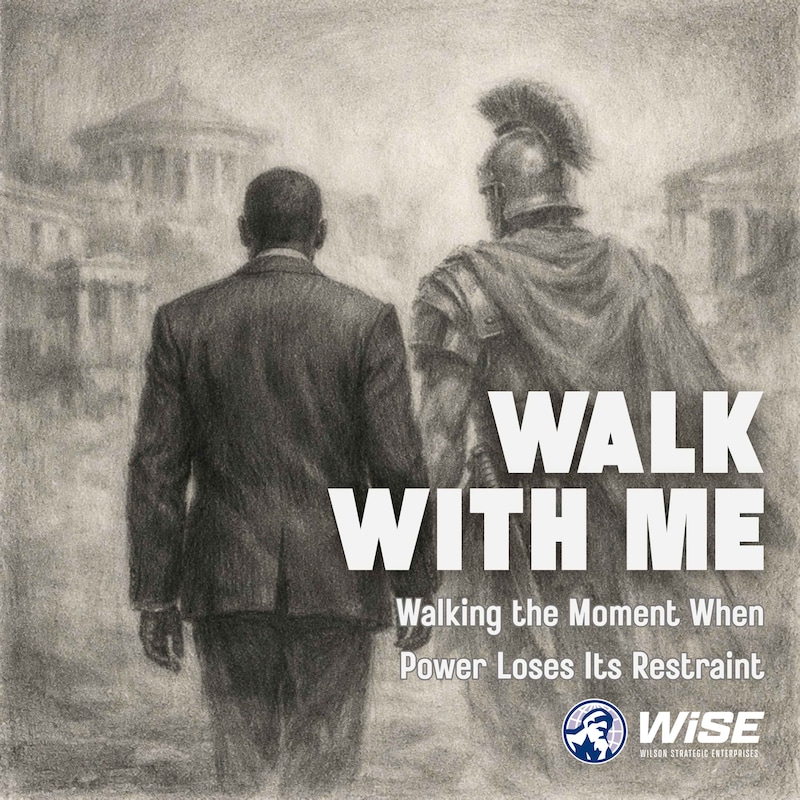
In this episode of The Civic Brief, Dr. Isaiah “Ike” Wilson III walks listeners through the Peloponnesian War alongside the ancient historian Thucydides, using Athens as a warning system for modern democracies. Between the disciplined leadership of Pericles and the catastrophic overreach of the Sicilian Expedition, this episode explores how power decays not through immediate defeat—but through the erosion of legitimacy, civic trust, and strategic restraint.
Dr. Wilson draws striking parallels between ancient Athens and contemporary America: rising polarization, delegitimization at home, coercive compensation abroad, and the temptation to mistake capability for wisdom. The lesson is not that power is immoral—but that power unguided by legitimacy becomes brittle. This episode serves as a lesson about resilience versus dominance, endurance versus ambition, and the strategic difference between winning encounters and sustaining systems.
What You’ll Learn in This Episode:
✅ Why Thucydides’s story remains essential for understanding modern great-power competition
✅ How legitimacy shocks (like plague, crisis, or polarization) can destabilize powerful democracies
✅ Why resilience—not dominance—is the true measure of sustainable power
✅ How overreach (the “Sicily moment”) reveals when capability outpaces strategic restraint
Join the Travelers Community and explore resources at Wilson WiSE Consulting, as well as at Dr. Wilson’s companion Substack Newsletter, “Compound Security, Unlocked,” where you can share insights, ask questions, and help shape the future—one brief at a time.
- Wilson WiSE Consulting Website: https://wilsonwise.com/
- Substack: https://compoundsecurityunlocked.substack.com/
Key Timestamps:
00:00 Welcome to The Civic Brief: Walk With Me through the Peloponnesian War alongside the ancient historian Thucydides
01:21 Athens vs. Sparta: two systems, two security models
02:23 Fear as the underlying cause of great-power rivalry
03:13 Thucydides in exile: realism as diagnostic
04:09 Pericles and disciplined resilience
05:01 Legitimacy as Athens’ true strategic asset
05:33 The plague as a legitimacy shock
06:34 Delegitimization and the collapse of norms
07:47 The Sicilian Expedition: hubris institutionalized
08:48 The American parallel
09:48 Power unguided by legitimacy becomes unstable
10:21 The core question: resilience or brittleness?
Key Takeaways:
💎 Great powers rarely collapse from battlefield defeat alone. They unravel when legitimacy erodes internally.
💎 Fear reshapes strategy. Rising powers provoke anxiety; anxious powers overreach.
💎 The Sicily moment is structural, not accidental. It happens when ambition outruns resilience.
💎 Legitimacy is strategic fuel. Without it, dominance decays into brittleness.
Resources & Mentions:
- Apple Podcast- The Civic Brief
- Spotify - The Civic Brief
- YouTube- The Civic Brief
- Wilson WiSE Consulting Website: https://wilsonwise.com/
- Connect with Dr. Wilson on LinkedIn: https://www.linkedin.com/in/dr-ike-wilson/
- Think Beyond War: https://thinkbeyondwar.com/
- Subscribe to the Substack Community to join the discussion, share your insights, and help defend the guardrails of democracy: https://compoundsecurityunlocked.substack.com/
Suggested Reading:
- We Are "There and Back Again
- NATO 3.0 and the Cultural Reckoning of the West
- When Civilizations Compete With Themselves
- Munich as Portent
- Shadows of Munich
- JD Vance and the Rhetoric of White Ethno-Nationalism ...
- The Real Threat Within.
- Taking the Sign Out of the Window
- The 2026 National Defense Strategy and the Perils of Muscular Simplification
- Who Counts as 'Western'?
- The Civilizational Illusion
Black Horizon, LLC. Preparing Leaders for the Unpredictable
Leadership isn’t tested in theory—it’s tested in crisis.
Founded by former U.S. intelligence officer Jeremy Boss, Black Horizon, LLC is a leadership and strategic-simulation company that prepares leaders for real-world uncertainty through immersive geopolitical simulations that put leaders inside high-pressure decision environments.
Join Black Horizon’s flagship exercise, Baltic Storm: Geopolitical Simulation on February 25th and 26th, featuring LTG (Ret.) Milford H. Beagle Jr. who examines escalation, deterrence, and alliance dynamics in today’s complex global landscape.
Train your judgment.
Strengthen your strategy.
To learn more or secure your seat, visit blkhrzn.net
Spots are limited, and registration is filling quickly. Secure your seat today
Tags:
Civic Engagement Podcast, National Security and Public Policy, Leadership and Strategy Podcast, Dr. Ike Wilson Podcast, The Civic Brief, The Civic Brief Podcast, Dr. Isaiah Ike Wilson III, Thucydides and modern politics, Between Pericles and Sicily, Peloponnesian War lessons, American grand strategy, great power competition, legitimacy and power, resilience vs dominance, Sicily expedition analogy, democratic decline warning signs, political polarization and national security, historical strategy lessons, rise and fall of great powers, governance under stress, fear in international relations, American foreign policy strategy
Mentioned in this episode:
Black Horizon, LLC. Preparing Leaders for the Unpredictable
Leadership isn’t tested in theory—it’s tested in crisis. Founded by former U.S. intelligence officer Jeremy Boss, Black Horizon, LLC is a leadership and strategic-simulation company that prepares leaders for real-world uncertainty through immersive geopolitical simulations that put leaders inside high-pressure decision environments. Join Black Horizon’s flagship exercise, Baltic Storm: Geopolitical Simulation on February 25th and 26th, featuring LTG (Ret.) Milford H. Beagle Jr. who examines escalation, deterrence, and alliance dynamics in today’s complex global landscape. Train your judgment. Strengthen your strategy. To learn more or secure your seat, visit https://www.blkhrzn.net/ Spots are limited, and registration is filling quickly. Secure your seat today: https://buy.stripe.com/3cIaEX7YE8Ad7iad9BaZi00
Transcripts
[00:00:20] Dr. Isaiah "Ike" Wilson III: Walk with me, not through a battlefield today though, there will be battles. Not through a boardroom, though every leader listening will recognize the room. Today I wanna walk with you through a decision space, a moment when a great power still looked unbeatable. But it had already begun to lose something more important than battles.
[:[00:01:21] Two security systems. On one side, there's Athens, a maritime democracy, commercial, innovative, outward facing. A city which ships money, robust allies in an empire held together by tribute and sea power. On the other side, we see Sparta disciplined, land-based conservative in its constitution built for endurance.
[:[00:02:23] Well, more precisely Sparta feared what Athens was becoming. A rising power creates anxiety in the established power in fear. Fear changes what both sides believe is necessary. That logic should feel familiar today, but here's why Lucidity matters now. He doesn't give us a story about tactics alone. He gives us a story about systems failing from within, how society can be winning and still become brittle.
[:[00:03:13] Before we go further, it's worth knowing who the Thucydides actually was. He was an Athenian general, experienced, educated, and entrusted with command. He failed in one campaign, was exiled for it, and spent years watching the war from the margins. That exile matters. It gave him distance, it stripped him of illusions.
[:[00:04:09] Pericles was not just a politician. He was Athens chief steward. He dominated Athens in Athenian politics for decades. Not by force, but by trust. Trust earned through competence, restraint, and credibility. If you want to understand why Athens was formidable, don't start with its Navy. Start with its governing logic and its leadership.
[:[00:05:01] This was a strategy built around resilience, not dominance. Para please understood a second truth. Athens's greatest danger wasn't Sparta's spear. It was a thine and fracture political rupture. Loss of civic trust, internal blame, an emotional decision making under prolonged strain. Parais strategy assumed something crucial that Athens would remain legitimate to itself under pressure.
[:[00:06:00] Sacrifice feels pointless. Trust dissolves. When legitimacy erodes at home, something else follows quickly. Authority becomes more and more expensive. It requires more coercion, more surveillance, more punishment, and the society begins to change its character. TH's rights. That norms collapsed. Not because Athenians became immoral, but because fear made short-term survival feel more and more rational.
[:[00:07:05] Fractures. No amount of power can coordinate a society for long. This is not ancient pathology. This is systems logic. Delegitimization at home inevitably becomes delegitimization abroad. Allies notice partners hedge rivals, they probe the strong, may do what they will. The weak may suffer what they must, but that truth is very short-lived because strength without legitimacy does not compound it Decays travelers are stopped.
[:[00:08:19] Too much power concentrated. Too far from the core, too dependent on optimism, too dismissive of dissent. Athens turns its adaptive strength into a single point of failure. And when Sicily collapses, when the expedition fails, everything cascades, material, losses, legitimacy, collapse. Ally defections, internal coups.
[:[00:09:14] Extraordinary capability, growing internal polarization. Legitimacy, questioned at home. Credibility strained abroad. Delegitimization begins domestically. It always does. And once legitimacy erodes internally, power must compensate externally through coercion, pressure, and assertion. That works briefly, then it breeds resistance, hedging, and brittleness.
[:[00:10:21] That was true in Athens, and it's true now. So as we walk between parles and Sicily, between disciplined endurance and reckless inevitability, the questions before us are not. Can we act? Can we win? Can we impose? The question is this, or it should be, does what we are doing make the system more resilient or more brittle?
[:[00:11:26] Narrator: Thanks for tuning into the civic brief. Uh, questions, insights, or ideas. Join [email protected] to continue the dialogue, subscribe, share, and be part of shaping the future one brief at a time.