Shownotes
How play, science, and grief come together to create unexpected community
Some freaks show up in obvious places.
Labs. Universities. Gaming consoles.
And then there are the freaks who live at the intersections — where research meets play, grief meets creativity, and community forms in unexpected ways.
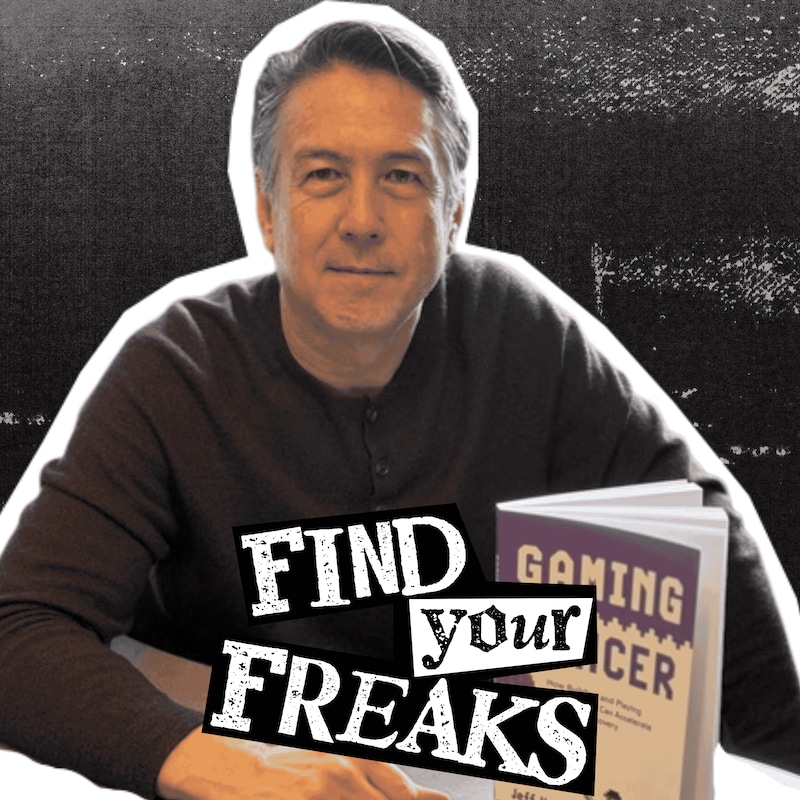
In this episode of Find Your Freaks, Tonya Kubo sits down with philosopher, cognitive scientist, and systems thinker Jeff Yoshimi, a professor at University of California, Merced, to explore how video games and citizen science can do more than entertain — they can save lives.
Jeff’s book Gaming Cancer was born out of personal loss, professional curiosity, and a refusal to accept helplessness as the final answer. After cancer touched his family in devastating ways, Jeff began asking a radical question:
What if everyday people — gamers, designers, artists, marketers — could meaningfully contribute to cancer research without needing a lab coat?
Together, Tonya and Jeff explore how games tap into our deep wiring as problem-solving creatures, why motivation works differently when the challenge is the reward, and how belonging can form when people from wildly different worlds come together around a shared mission.
If you’ve ever felt powerless in the face of a massive problem — or wondered whether your skills could actually matter — this conversation offers a hopeful, grounded, and deeply human reframe.
Episode Highlights
[05:40] Why humans are wired to solve problems — and how games activate that instinct
[10:55] How game design creates intrinsic motivation (and why homework can’t compete)
[16:30] The moment Gaming Cancer was born during a sleepless night at Stanford
[22:45] Citizen science explained: how everyday players can contribute to real research
[28:10] How the RNA-design game Eterna helped advance vaccine research
[35:20] Why designers and marketers are essential to scientific progress
[41:50] What happens when grief, play, and purpose exist in the same space
[49:05] Why trying something — even without guaranteed success — still matters
[55:40] What to do if you want to help but don’t know where to start
When Games Become a Way to Fight Cancer
Jeff explains that games aren’t just distractions — they’re beautifully engineered systems that reward curiosity, persistence, and creative problem-solving.
When scientific challenges are embedded into game mechanics, players can unknowingly contribute to real discoveries simply by doing what humans do best: trying to solve the puzzle in front of them.
One powerful example comes from Eterna, a game where players helped design RNA molecules — contributions that played a role in developing coronavirus vaccines stable at room temperature. That’s not hypothetical impact. That’s real science shaped by collective effort.
From Helplessness to Action
Cancer often leaves people searching for something they can do.
Fundraising. Awareness. Advocacy. Prevention.
Jeff suggests a fifth path: contribution through skill.
Artists can design.
Marketers can attract players.
Developers can build systems.
Gamers can play — and solve.
Instead of asking people to leave their talents behind, citizen-science games invite them to bring all of who they are into the fight.
Why Trying Still Matters (Even Without Guarantees)
One of the most grounding truths in this conversation is simple:
You don’t need certainty to justify action.
Jeff is clear — most scientific progress is incremental. But reframing problems through games can spark new perspectives, increase scientific literacy, and sometimes unlock breakthroughs no one could have predicted.
At the very least, everyone involved learns more. And sometimes, that’s how progress begins.
Meet Our Guest
Jeff Yoshimi is a philosopher, cognitive scientist, and professor at the University of California, Merced. His work spans neural networks, visualization, and systems thinking. After cancer deeply impacted his family, Jeff wrote Gaming Cancer to explore how games, citizen science, and collective intelligence can accelerate research and restore a sense of agency in the face of overwhelming problems.
Meet Your Host
Tonya Kubo is a community strategist and marketing consultant known for building digital spaces that feel like chosen family. As host of Find Your Freaks, she brings together unconventional thinkers who know “normal” was never the point — and who believe that belonging is built through honesty and human connection.
Key Quotes
- “We are problem-solving creatures — games tap directly into that instinct.” — Jeff Yoshimi
- “You don’t have to be a scientist to contribute to science.” — Jeff Yoshimi
- “Even if it doesn’t lead directly to a cure, learning more is never wasted.” — Jeff Yoshimi
- “Belonging can happen when very different worlds collide around a shared purpose.” — Tonya Kubo
Resources & Mentions
- Gaming Cancer — Jeff Yoshimi
- Eterna — RNA-design citizen science game
- Zooniverse — Citizen science platform
- iNaturalist — Community-powered biodiversity tracking
Support the Show
If Find Your Freaks matters to you, consider buying us a coffee to keep the show ad-free. Every dollar supports production so more weirdos can find their people.
Find Your Freaks merchandise is available through Abilities and Attitudes.
Let’s Stay Freaky
What’s Next
Some freaks play for fun. Others play to change the world. In this episode, Tonya explores how belonging deepens when people are invited to matter, not just participate, and what becomes possible when effort actually changes something.
Transcripts
Cancer is a fact of life, we all face it. It's this terrible random thing that kind of strikes out of nowhere and it's just so tragic. I had kids and I would watch my kids game and I was always just impressed.
They're not that excited about their homework but they are doing the most complicated and intricate things in these games. The motivation is the game itself. We are problem-solving creatures.
Our ancestors did better when they solved problems. You could take scientific problems and embed them into the mechanics of a game and get everyday citizens to try and use that open loop game, that struggling and striving how can I solve this problem energy we have and apply it to a scientific problem. Coronavirus vaccines that are stable at room temperatures were developed in part with player input from that game Eterna.
That's a real scientific achievement that had a meaningful impact that originates in part from the efforts of game players. People collectively contribute to public goods and make an actual difference all the time. We're wired for connection but most of us are faking it to fit in.
I'm Tonya Kubo and this is Find Your Freaks, the podcast that flips the script and spotlights the quirks you thought you had to keep quiet. Subscribe now and head to findyourfreaks.com for show notes and extras because around here what makes you weird makes you wonderful. Normal was never the point.
We love to talk about community, how to build it, grow it, sustain it but today we're talking about what happens when the communities you belong in don't really overlap but then something maybe forces them to. So when the academic and the researcher and the grieving loved one all find themselves in the same room something new may emerge and in this case we've got today's guest Jeff Yoshimi, a professor at UC Merced whose work spans philosophy cognitive science and neural networks and he is a researcher and a systems thinker I would say and someone who found himself deeply impacted by cancer. So Jeff I don't want to give away everything yet but I do want to kick us off with you telling us who your freaks are and why you love them.
So yeah my freaks are game designers and game players and people interested in using competitions and challenges and again video games to do good things you know. We think that these are not just tools for having fun or which is fine you know but it's more about stealing a car in Grand Theft Auto. These are actually like works of art that could elevate and empower people and lead to things like cures to diseases.
So the freaks are the people who think of games in that way. Yeah which I find fascinating because you know before we started recording you said that you don't really consider yourself a gamer but you've written a book that really is targeting gamers and game designers as your audience. So do you want to tell us a little bit about what got you to there because that might be a bit of a leap for some people.
alize things. I worked in the: ou said I think especially in: