Shownotes
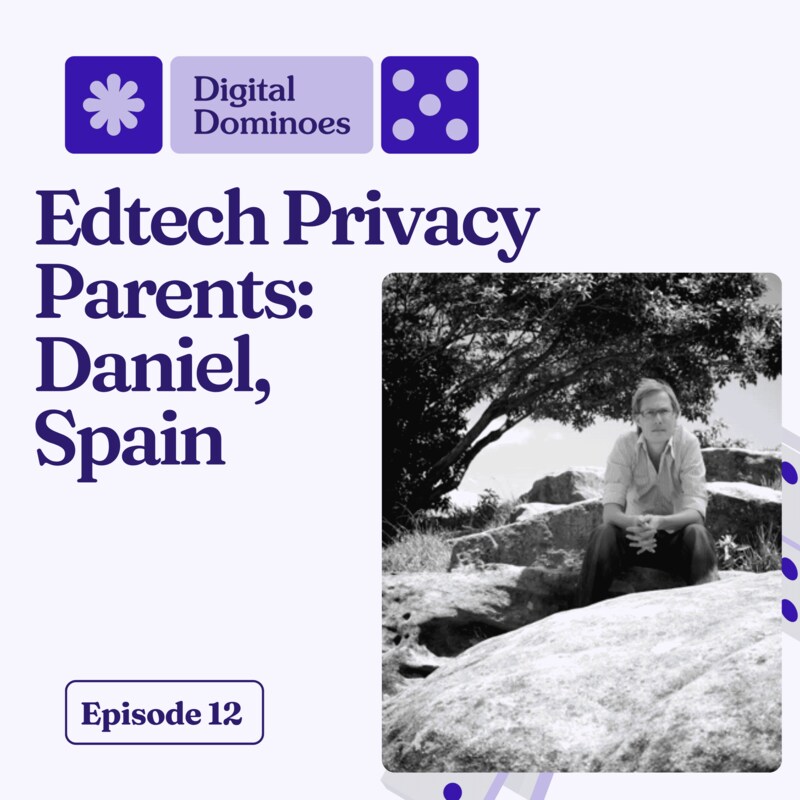
In this episode of Digital Dominoes, host Angeline Corvaglia talks with Daniel Knight, an Australian parent living in Spain, about becoming a privacy champion for his children in a tech-integrated school environment. Daniel shares his journey from discovering the potential harms of unregulated tech use in schools to challenging the school's policies and advocating for better data protection under GDPR. They discuss the broader implications of tech companies' involvement in education, the importance of parental awareness, and actionable steps for parents to safeguard their children's digital privacy. The episode underscores the critical need for transparent and informed discussions about technology's role in children's education.
00:00 Introduction to Privacy Concerns in Schools
00:33 Daniel Knight's Story: The Aha Moment
02:08 Nightmares and YouTube: The Initial Concerns
03:22 School's Response and Legal Confusion
04:58 Tech Companies in Schools: A Global Issue
08:01 Parental Support and Data Privacy
09:13 The GDPR and Data Protection Challenges
10:30 The Battle Against Tech in Schools
19:37 Positive Changes and Final Thoughts
23:11 Encouragement and Call to Action
We can also recommend these articles that explain the issue of content and data sharing.
- Aimed at teens: What You Should Know About School Technology and Data Sharing - Data Girl and Friends
- Aimed at parents: Tech at School: Protecting Your Child's Privacy - ANGELINE CORVAGLIA
In addition, we also recommend these resources:
- Me2B Alliance Product Testing Report on School Mobile Apps Student Data Sharing Behavior: https://internetsafetylabs.org/wp-content/uploads/2021/05/school-apps-data-sharing-behavior-spotlight-report-final.pdf
- Edtech Law Center's resources on issues with edtech: https://edtech.law/issues-with-edtech/
Transcripts
We aim to [00:00:30] motivate other parents to do the same today. I'm here with Daniel Knight, who is in Spain, and he's going to tell his story of how he became a privacy parent. Thank you so much for being here and being willing to tell your story. Thank you. Thank you so much for giving me the opportunity to speak about it.
his is really something that [:So this is a universal worldwide issue. Absolutely. And it's a huge commercial opportunity for these companies. So, do you want to tell about maybe a little bit about your kids and the school they go to and how you had your aha moment to realize that you had to take some of this into your own hands? [00:01:30] Yes, I definitely had an aha moment.
ve concerns about his access [:So yeah, it all started in first-year primary, like I said, not too far into the year, actually, uh, when he started to have nightmares, and he was recounting images that he'd seen. Which I became quickly aware that these were images that he was seeing on the internet. And it took me a little bit of a while to digest that and [00:02:30] to be able to speak through it with him and understand exactly what these images were.
t I'm getting two completely [:And I wasn't sure where it was all coming from. And it turns out that he was accessing YouTube at school. The school did it openly that they were using YouTube as an educational application. And, uh, I contacted the school via email first, telling them the story. And then I understood that he had access to YouTube and that I was concerned about the impact it was having on him.
But also its. [:She basically said to me the same thing. It's the law and we're obliged to teach these [00:04:00] things to your children. Check out the law. And I, I started digging into the law and I continued this conversation with the teacher debating the educational value and, you know, whether or not YouTube was in the law or not, because I was trawling through the law, as you can imagine, it's a very big generalized document and I couldn't find the words YouTube anywhere and, uh, she started to get frustrated and said, well, it's the law and that's it.
mething wasn't, was the law, [:And because she had to communicate with them and work with them, she kind of told me, okay, just take it easy and try to calm down. During these conversations [00:05:00] between her and the director, the director told her, Oh yes, yes, yes, we're very much into technology in the school. We're tech friendly, and we see that as the future, and we want to go full throttle on the technology, and in fact, a year ago we had a conversation with Google, and you know, Google were very interested in turning this school into the Silicon Valley of Spain.
ull tech, was because Google [:In fact, I should have mentioned. Wow. Yes, this is a public school. This shocked me because I didn't realize that a school, a public school could make such decisions independent of the Department of Education. I totally understand it if it's private, but in a public sphere, it really shocked me.
That's really [:School directors will be focused on trying to Be the [00:06:30] best school, get the best education, and who knows how much time they'll actually have to think about these things, privacy, and tech, impacts of tech, and tech companies have basically, they can sell themselves quite well, so I think there's quite a big power imbalance there.
ducation, they're more aware [:Do you know how much they, just to give an idea of how much did they use the Chromebooks compared to the traditional books, since they didn't become like a full Silicon Valley school? How was the balance between tech and, [00:07:30] uh, and non tech in first grade, just to remind we're talking about first grade now.
applications or through the [:How were the other parents reacting to this? I had two parents that wanted to support me in a class of 30 kids. I couldn't get anybody else, but my other son who's two years younger and was in a pre primary at the same school, the whole class were interested to, to learn about what I was talking about.
, third year or fourth year. [:And, and that's really been the, the data protection has really been the smoking gun because at the end of the day, conversations went back and forward. It was like a game of tennis with the school, my opinion versus their opinion and finding out about the Chromebook case in Denmark and the clear [00:09:00] violation of data protection law here in, in Europe, the GDPR, that's what really hooked me in the conversation with the school.
Regulation, which is one of [:Absolutely eye-opening to understand this whole school tech perspective from the point of GDPR because nonexpert, I believe both of us at least were, you expect that children in schools are protected by GDPR. But it's just not what Jesper has discovered in Denmark. It's really not [00:10:00] so straightforward, right?
No, not at all. And everyone is clueless. Everyone. On both sides of the argument. The school board, the government themselves, the parents, the teachers, and of course the students. We're all totally clueless of what's going on, what data is being transferred. The only people that know what's going on are the big tech companies.
hown in the case in Denmark. [:Exactly. Yeah. Because I remember in the case of Jesper that they. In the outset, maybe about a year back, the schools tried to pull the technology out immediately, like in one swift movement, [00:11:00] and the school collapsed. They couldn't teach the kids. The technology had been so fully integrated that the teachers were incapable of managing a day of teaching children without the Chromebooks.
t their real needs are, just [:This is your new process, this is your new device. But that's been what's been happening in a lot of schools. And it's really important to, to point out that it's one of the main reasons that this whole series about privacy parents, why I'm doing it. It's because it's not, I don't want to blame. It's easy to blame someone for not knowing.
nformed from an expert or to [:Oh, by the way, what kind of agreements do you have with tech? What's happening with the data and what do my kids have access to at school? What [00:12:30] can I not control? Absolutely. The question has to be posed to every single school that has technology integrated in it. And because if the question is not asked, the school is not asking themselves.
e was given a Gmail account. [:Uh, and it, in terms of anything that the school could tell me beyond that about protection of data was pointless. Because putting an, an email account, which became his username on any single piece of application or software or even to access the Chromebook. He accessed it with his name. So from that point onwards, the data is leaked.
crazy, even with his photo, [:And there's such a [00:14:00] low awareness of risks, like the real risks. I've spoken to a privacy expert the other day in the U. S., and she had spent the whole morning blocking credit reports for a four year old or something, and I was like, why would you do that? And then she explained, because children's identities can be stolen for taking out credit when they're young, and by the time they figure it out when they're 18 and they have to look for credit, then someone has been creating a [00:14:30] credit history for them for the last ten years.
So, you know, these are things that people are absolutely not aware of and yeah, it's a challenge. Absolutely. Yeah. We're so lucky here in Europe to have such a well developed law in the GDPR that looks after our primacy. But at the same time, the fact that no one is aware or very few people are aware of the GDPR nd it's potential that it's not having the impact that it could have in protecting our privacy.
And [:Then just freely letting our children's data out into the wild means actually a concrete potential impact on their future [00:15:30] possibilities. And obviously the lower income that a person has, the more likely that they'll just be assessed based on their data. And not based on a personal assessment of a person.
vate data of children from a [:He started with the Chromebook and from that point onwards for the rest of his life. What kind of impact that will have on his future as private companies have access to all of this data and you know, when we're talking about private data, I mean, I think it's a very gray area of understanding what is private data.
e child lives? Because in my [:For instance, even if the schools could lock down, which I find unrealistic and unreliable, they could lock down all of the private data in terms of age of a child, a child's name, child's address, child's family situation, even if [00:17:00] they could lock down all of those. Yeah, well, we would consider traditionally as being private, personal information, even though they could lock down all that, if the big tech companies had access to the school on a wider scale, think about it as all of the children as a school community, even if they didn't know the child's name, if they had access to 500, 1000 kids in a school, every school across Spain, right?
thousands of kids educating [:One thing I did want to mention about a Jesper's case is when I spoke to my school about this case, the Chromebook [00:18:00] case in, in Denmark and voiced my concerns and said to them, look, despite the difference of opinion that we have, I have concern over the educational credibility of technology and you debate that that's not clear.
ether or not this technology [:When I mentioned it to them, they told me this is fake news. This is what I was told. And they even went to the extent of publishing a letter to the entire parent community telling us to be aware of this malicious fake news [00:19:00] that was coming from the north of Europe. Technology was potentially risking our children's private data.
imbalance that they're kind [:And all we can do as families and parents and friends is ask questions. And because you did, we can close with something positive, that they did stop using YouTube, right? Yes, absolutely. You didn't get credit for it, but they stopped using it. Yes. Yes. In fact, in the school, because in one of the meetings that I had with the secretary who was managing the integration of technology, I remember very [00:20:00] clearly saying to him that the parent group coming up from pre-primary had a very different perspective on the potential dangers of technology.
primary, and we had a parent [:That YouTube was no longer an application used by the school and that it would remain that way. So yeah, there was some progress made. And I would like to add as well on that point that if there are parents out there, particularly here in Europe, And they're having difficulties like me with the schools and trying to get their [00:21:00] opinions appreciated and validated.
ta they have and how they're [:It's called an access request. And I did it. I got a lot of support from an NGO group of lawyers in Austria called NYOB. And they're very much interested in this case and the continuing issue of Chromebooks across Europe. And if anyone wants to contact them, I'm sure they'll get similar support than I did.
s not answered. And now that [:Thank you. That's actually perfect. One person can make a difference. It's not easy, but one person can make a difference. I mean, classes full of kids won't have to see those awful things at school. So thank you so much. And also thank you for, for giving those tips to others who've been motivated by your story. Great. Thank [00:22:30] you so much.
g control and being aware of [:So thank you for all your hard work. One person can make a difference, so it will definitely. Thank you. Thank you very much. We encourage all parents and loved ones to ensure that the digital footprints their children create at school are treated with the respect and care they deserve. If your school or area hasn't yet leaned heavily into technology at school, we hope that you These stories will help you ask the right questions when they [00:23:30] do.
If you have a story to share, would like more info on these issues, or would like to contribute in any way, please contact us. Together we can make a difference in safeguarding our children's digital futures. Digital Dominoes.
