Shownotes
Season 7: Episode 187
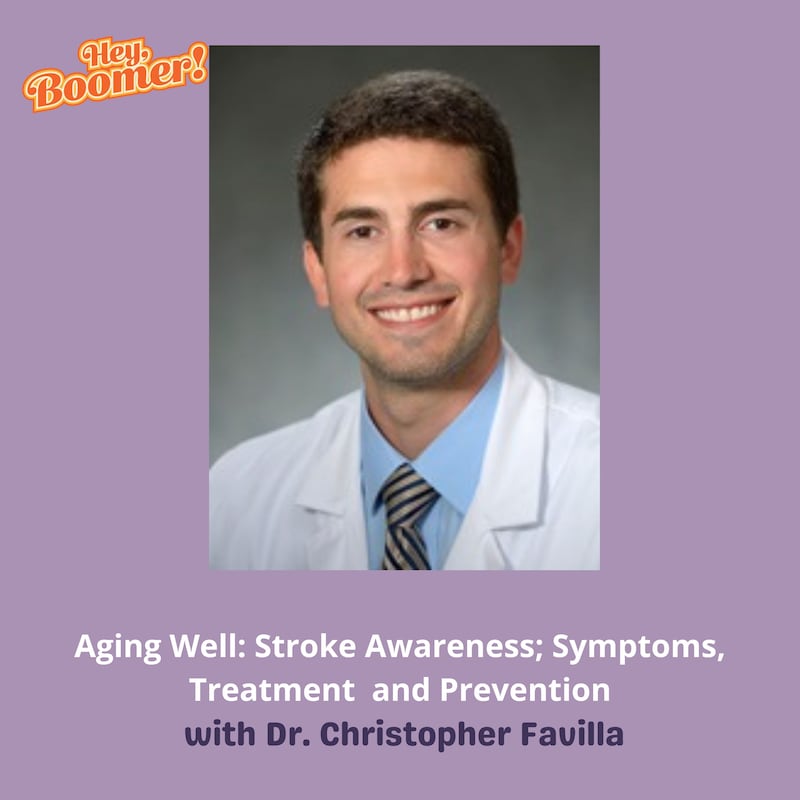
In our latest episode, host Wendy Green dives deep into the vital topic of stroke awareness, treatment, and prevention with our esteemed guest, Dr. Chris Favilla, a leading stroke neurologist.
Here's why you should tune in:
🔹 **Recognize Stroke Symptoms with "BE FAST":**
- **B**alance issues, **E**yesight changes, **F**acial droop, **A**rm weakness, **S**peech difficulties, and **T**ime to call 911.
- Early recognition and immediate action can save lives.
🔹 **Manage Silent Risk Factors:**
- High blood pressure and high cholesterol are major risk factors for stroke.
- Diet, exercise, and medications can significantly lower these risks.
- Sleep apnea, common in aging individuals, is another important factor to consider for stroke prevention.
🔹 **The Importance of Rapid Response:**
- Time-sensitive stroke treatments like clot-busting medications are critical for better outcomes.
- EMS providers play a vital role in the quick evaluation and transport of stroke patients to hospitals.
Explore Resources: Learn more about stroke awareness and prevention by visiting the American Heart Association at aha.org and stroke.org.
Join the Community: Subscribe to the Hey, Boomer newsletter for the latest updates and exciting announcements, including a big reveal in the next episode.
Spread Awareness: Share this episode with family and friends to raise awareness about stroke prevention and the importance of immediate medical intervention.
Check out Carelink360: See how you can get piece of mind and stay connected to loved ones who are far away.
Transcripts
Welcome to the hey Boomer podcast, where we go beyond the surface, sharing real talk about aging. Well, my name is Wendy Green and I am your host. So are you ready for real talk about aging? Well, do you sometimes feel confused about all the differing information about health and finances and family dynamics and all that other stuff that comes at us all day, every day? Do you sometimes worry about slowing down and feeling forgetful? Well, once a week, I share my thoughts with you on any number of these topics. I share them on the podcast with my guests. I share them in my newsletter. I source articles from some of the smartest people in the industry and from sites that I know have excellent information. And I share some of the challenges and opportunities that I experience and how I manage them. If you are ready to easily access insights to help you better navigate this challenging time of our lives, to help you feel better with everything that you see and hear, well, go to Heyboomer biz and click on connect with us.
Wendy Green [:To subscribe to the newsletter. That's Heyboomer biz. Connect with us. Get the newsletter, hear the podcast. We are welcoming all of you. So as many of you know, may is stroke awareness month. Now listen to these facts. Okay? In the United States, strokes occur every 40 seconds.
Wendy Green [:On average, stroke is the leading cause of serious long term disability. It is the fifth leading cause of death in the US. But 80% of strokes are preventable. And there are things that you can do to lower many of your risk factors, and we're going to talk about some of those things today. There are some things that increase our risk of stroke that we can't modify. Aging increases our risk. Although strokes are more common in men, more women die from strokes. Our risks are greater if a parent, grandparent, sister or brother had a stroke.
Wendy Green [:African Americans have a higher risk of stroke than Caucasians. And finally, previous strokes or heart attacks increase our risk of having another stroke. So the purpose of today's episode is to educate ourselves and do all that we can to reduce our risk of stroke. We also want to learn the signs that someone is having a stroke and the proper response. This episode is meant to give you knowledge, because, you know, knowledge is power. It is certainly not meant to scare us. Doctor Chris Favela is a stroke neurologist and assistant professor at the University of Pennsylvania, where he's also the director of the non Invasive Cerebral Hemodynamic Evaluation center. His clinical practice focuses on acute stroke care, and his research efforts are dedicated to developing new techniques for non invasively monitor to non invasively monitor blood flow in the brain.
Wendy Green [:But before I bring Doctor Chris on, let's briefly talk about Caroling 300 Sixty's digital health companion. I want to tell you a story about Rich, who is 87 years old and lives independently in his home. Rich has been diagnosed with early stage dementia and has some mobility challenges. He has four children. Three live over 500 miles away. Rich has ten grandchildren, but only one who lives close by. Rich is on seven prescription medications that require him to take them twice a day. He has a smartphone, but even sending and receiving phone calls is a challenge for him.
Wendy Green [:So the family got him Carelink 300 and Sixty's digital health companion, which has enabled him to easily have video chats with his children and grandchildren. They have set medication reminders for him and health and wellness reminders that require him to simply tap the screen to indicate that he got the reminder. This connectivity has given his family increased peace of mind and improved Rich's sense of motivation and reduced his feelings of loneliness. Win, win, win all the way around. So check out what Carolink 300 Sixty's digital health companion can do for your loved one. Go to mycarelink 360 ref heyboomer, and when you decide to purchase, use the term boomer to get 5% off at checkout. So remember that. I love to see your comments because we're live, you can ask questions in the chat.
Wendy Green [:All of those will hopefully be answered during this episode. And any that aren't, we will certainly do our best to get back to you, but let me bring Doctor Chris Villa on now. Hi, Chris.
Dr. Chris Favilla [:Hi, Wendy. Thanks for having me. It's great to be here.
Wendy Green [:I am so glad that you're here. So let's just start with the easy stuff, like tell me what a neurologist does.
Dr. Chris Favilla [:Sure. So a neurologist is essentially a non surgical doctor for the brain, right? The same way you might see your primary care doctor or your internist to sort of oversee your general well being and address any range of medical problems. A neurologist like myself, sort of very specifically focuses on diseases or disorders of the brain.
Wendy Green [:Okay. And, you know, of all the fields you could have picked, what was it about neurology that made you go that way?
Dr. Chris Favilla [:I think that's an easy one. I think to me, right as you're, there's a lot of interesting aspects of the human body and health that I think you cover through the medical school process. But to me, the brain, I mean, even before medical school, the brain was, was clearly the, the sort of final frontier, if you will, of the human body. Right. Sort of the area where we still know the least in all reality, as much as we do know, there's still so much we don't know. So I can confidently say I'll have the entirety of my career and will still have just scratched the surface.
Wendy Green [:Wow. So constantly in learning mode.
Dr. Chris Favilla [:Yeah. I think being a part of that, trying to help figure out new aspects of how we can leverage that new knowledge that we gain from year to year in ways that can really have a meaningful impact on our patients lives, is a really fortunate position to be in.
Wendy Green [:Yeah. Fascinating. Fascinating. So the numbers that I mentioned in the beginning, Chris, that strokes occur every 40 seconds on average. Fifth leading cause of death in the US. Frightening statistics. Right. So we're gonna talk about prevention and risk factors.
Wendy Green [:Start by telling me about the awareness of symptoms. How do we know when someone might be experiencing a stroke?
Dr. Chris Favilla [:That's a really important point. Right? Because I think for many of us, and the numbers you highlighted, I think are key, just to put your. For someone who has a hard time extrapolating that number of strokes per second, that highlights how frequent it is. But they're like 800,000 a year happening in the United States, or it's just a really, really common problem becomes all too common as we age. So awareness is critical because there are treatment opportunities. If we can recognize our stroke symptoms early and be aware of them, that's a big piece of stroke awareness. And to that end, if any of your listeners or viewers are familiar with the fast campaign, sast, the origin of that was exactly for this reason, trying to get the word out for patients, not patients, but rather people in the public to be aware of and recognize the symptoms or warning signs of stroke. And specifically, we can break down that acronym pretty quickly.
Dr. Chris Favilla [:Fast. Fast. The f refers to a facial droop drooping on one side of the cheek. The a stands for arm first, arm weakness. So arm weakness on one side or the other. The s stands for speech difficulties. Refers to either slurred speech or sort of inability to communicate with your speech, which sometimes can be deceiving. Right.
Dr. Chris Favilla [:That can sometimes look like someone might be confused, but if you're unable to, you know, unable to express yourself, unable to use your words or understand speech, that's a sign. And then the t in fast stands for time to call 911, which really highlights a really important feature of stroke awareness, which is what a time sensitive process it is, right. As soon as you identify one of those signs or symptoms, it's a call 911 and get right to your nearest emergency room. Because during the course of a stroke, brain cells are dying at an alarmingly quick rate. And treatments that we have available are really time sensitive, time dependent.
Wendy Green [:So they talk about the heart attack symptoms, right? You feel the pain, you feel the shortness. Do you feel as the person having the stroke, do you feel the symptoms? Or is this somebody else noticing your face is drooping, or your speech is slurred?
Dr. Chris Favilla [:That's a great point. And you're right. The heart attack symptoms, I think that's a great example where I think socially, we've done a great job of messaging that out. Most of us know that chest pain, or even sometimes left arm symptoms like numbness, could be a bit of a warning sign. The neurologic symptoms of stroke are a bit more complicated. I guess, to directly answer your question, it could be both. It could be both. The symptoms the individual experiences themselves.
Dr. Chris Favilla [:But at times, it's something that a friend or family member is witnessing. So it's sort of a joint effort in that regard. And the reason why the symptoms we may manifest with stroke are more complicated is because, in the simplest sense, almost, this requires us to take a step back for a moment and say, what is a stroke? That may simplify or help explain why the symptoms can be so heterogeneous, so different from patient to patient. Stroke is a blockage in an artery in one part of the brain. Our arteries are carrying blood flow all over our brain. Our brain is very, very dependent on things like oxygen and sugar that our blood is carrying. And the blood supply to our brain is much like the branches of a tree, just sort of branching and branching to access all the parts of our brain. And if there is a disruption in one of those branches, a blockage of one of those branches, everything downstream of that is now starved.
Dr. Chris Favilla [:Everything downstream of that now lacks oxygen, lacks sugar, and that part of the brain has a hard time functioning. So what you see or feel during a stroke is basically the loss of function of that part of the brain. And again, the brain controls so much that we do that. If that stroke were to affect the language center, let's say right over here, I might manifest the inability to speak or really slurred speech. If that were to affect the part of the brain that controls the left side of my body's strength, the left side of my body might become suddenly weak. So the symptoms we experience are really just a reflection of where in the brain there's dysfunction, of where in the brain that stroke is happening. But because the brain does so darn much, that does make it a little hard to message this out of what to look out for, right. Because there's just a wide range of symptoms that people do sometimes manifest with stroke.
Dr. Chris Favilla [:And in fact, even the fast campaign where it was a calculated simplification, maybe even an oversimplification, right. It disregards a couple of really key warning signs that don't make it into that face arm speech thought process, right. Because that's sort of a calculated effort of saying, how do we make this digestible by the lay public. Right. And I think your audience is a far more engaged group of people, so maybe we have the opportunity to even go a little bit deeper, right. To pull on a couple other warning signs that I think the more engaged person is ready for and hungry for.
Wendy Green [:Well, tell me, tell me, tell me.
Dr. Chris Favilla [:So I think maybe the easiest example of this is in recent years, there have been attempts to expand upon the fast acronym to make it be fast, befast. And that B E stands for balance and eyes. This is still, right. If you look at some of the. That has got a isn't quite messaged as much as fast is still these days, but that highlights a couple other key symptoms. So balance or inability to walk or feeling dizzy. Right. Could sometimes reflect a stroke in the balance or coordination center of the brain.
Dr. Chris Favilla [:And then eyes. The e for eyes really just refers to loss of vision or double vision. Right. If you suddenly lose vision on one side, like a curtain comes over all of a sudden and you sort of can't see half the world in front of you or a corner of the world in front of you, or if suddenly you notice that everything you're looking at is double, those would also be warning signs that there could be a stroke affecting either your eye control or your visual centers.
Wendy Green [:So that's be fast, that in the chat. That's good. Thank you.
Dr. Chris Favilla [:So the reason for that is, it's basically. Go ahead. Sorry.
Wendy Green [:No, I was going to say the reason for my question about do you notice them as the individual having the stroke is because, you know, people like me, I live alone. If I'm suddenly experiencing some of these symptoms, am I going to realize that my face is drooping and I better call 911? If my speech is. Am I going to realize that fast enough?
Dr. Chris Favilla [:That's a great point. And this actually makes. Recognizing the onset is sometimes challenging. You could imagine. Well, how do I know this just happened a minute ago. I wasn't really talking. I didn't notice my speech was slurred. That certainly presents a challenge for those of us who live alone.
Dr. Chris Favilla [:At recognizing the onsen. Most of these symptoms we're discussing are detectable by the individual. Right? I mean, we're using our limbs, we're walking around, we're sort of active creatures for the most part, that we would be sensitive to a little bit of weakness in one arm or the other arm, a little bit of weakness in one leg or the other leg. I mean, even just getting up to walk to the kitchen, a glass of water or walk to the bathroom, we would notice, I suppose speech might be the one that's. That's the challenging one. If we're at home and maybe not on the phone or not talking to folks, that could be a little more difficult to pick up until we then start to speak. But I think the important thing in all of this is more even just drawing awareness to the issue helps people to recognize that some of these things, like, hey, my left arm feels a little clumsy. I keep dropping my cell phone when I pick it up.
Dr. Chris Favilla [:That idea, right. That this is still very common, that individuals dismiss it or sort of say, ah, let me. Let me sleep it off. Let me see if this maybe gets better after a nap. Maybe I'm just too tired or something's going on.
Wendy Green [:Sure. Yeah.
Dr. Chris Favilla [:An excuse or to try to justify it. But I think the important thing, you know, the more you become aware of strokes, the more you realize that you have to take even seemingly minor symptoms. You have to take them seriously. And really taking timely action is critical again, because as we were sort of mentioning briefly before, the treatment options we have available are both time dependent and very time sensitive.
Wendy Green [:Yeah. And meanwhile, your brain cells are dying. So if I'm with somebody and I think they're experiencing a stroke, do I take them to the hospital? Do I call 911? I mean, which is the fat? Which is better?
Dr. Chris Favilla [:Calling 911 is generally the appropriate answer there. I think your EMS providers provide you with another layer of support to your point. If you see something that someone, speech is slurred or they seem like they're clumsy on one side of the body and you want to bring them to attention, part of the benefit of 911 is, again, to train providers can because of. You quoted the statistic perfectly earlier, it's so common that our EMS providers are all too comfortable with evaluating the warning signs of stroke. And those EMS providers will provide that layer of support for you, right. They'll look at your friend just like you did, Wendy, and say, you're absolutely right. I see a facial troop, I hear slurred speech. This could be a stroke.
Dr. Chris Favilla [:We're going right to the ER. So they also provide you that level of quick assessment. They also can get you very quickly to the emergency room and the place you probably don't want to be if a stroke is happening is in your car. God forbid you'd be sucking traffic or anything else, and things where symptoms were to evolve. You'd rather be in the hands of.
Wendy Green [:Trained professional, for sure. Yeah. So, okay, so then you talk to me about the treatment. So the EMS gets me to the hospital. So what happens then?
Dr. Chris Favilla [:Yeah, so as soon as you get to the emergency room, right. In fact, some of this care is already starting, as we said, with the EMS providers, where they're already taking an evaluation and doing a really quick sort of efficient examination to try to get a sense of. Of what's going on. And in fact, another nice advantage here is that many of our EMS systems are designed in such a way that they will call ahead to our emergency room and give us a warning of exactly what's about to come through the door, which also accelerates the sort of improves upon the efficiency in the care that we deliver once you actually arrive in the ER, because then your ER can get your neurologist down there or your specialist that might be relevant down at the door, so we can sort of take as quick a care as possible. The first thing that happens when you roll in the door is, again, a very brief examination from either a emergency room provider or a neurologist. If there happens to be a sort of stroke neurologist in the facility, you're talking about a very brief exam just to get a sense of what's going on. And then usually the first thing that happens is a Cat scan of the brain, which is a very quick scan of the brain, takes less than a minute and gives us a very quick picture of what may or may not be going on. And I guess that actually highlights an important distinction we haven't yet touched on yet, Wendy, which is that there are multiple types of strokes.
Dr. Chris Favilla [:We've been talking about the most common form of stroke, the ischemic stroke or clotting type of stroke, where there's a blockage in an artery that accounts for about 80% of strokes or so. The less common variety is called a hemorrhagic stroke, which is a bleeding type of stroke, where instead of there being a blockage, there is a burst blood vessel. So it's not a lack of blood flow problem, it's actually a bleeding problem. Almost the opposite. And the CAT scan, in fact, is designed, probably first and foremost, to really differentiate those two things. Blood would be very, very obvious on that CAT scan. The clotting stick. Stroke, not so much.
Dr. Chris Favilla [:So it's an important fork in the road because those two disease types are so opposite that we need to be able to differentiate them in order to deliver the proper care to those.
Wendy Green [:Yeah. You sure don't want to give stuff to break a clot up if you're bleeding too much. Right?
Dr. Chris Favilla [:Definitely. Right. And that's sort of, you know, again, to your point of what's happening when you present with an ischemic stroke or a clotting stroke, you know, if you're, if you're able to get to the hospital quickly enough, you know, the treatments we have, the sort of time sensitive treatments we have really worth highlighting. Sort of two treatments. One is a clot busting medicine, exactly like you said. And then the other treatment we can talk a little bit about is a newer treatment that's been around for a handful of years now, but is still sort of relatively new, and it's actively evolving. So that we figure out how to bring this care to more and more patients is mechanically removing the blood clot from the brain, sort of literally pulling the blood clot out to restore blood. Wow.
Wendy Green [:Wow. And so I probably find that at upenn, but might be not at some of the more rural hospitals.
Dr. Chris Favilla [:That's right. And, you know, for a long time, you mentioned clot busters as sort of one key treatment. That's still the mainstay. Right. I mean, that's still a really important, really beneficial treatment within limited time. And the timeframe I put out there for patients is that. And this is, again, a moving target. Right.
Dr. Chris Favilla [:Again, our goal is to figure out how to better use these medicines. But in current practice, we're really using a clot busting medicine within four and a half hours from the stroke onset. So, again, getting to the hospital quickly is important. Right. You wouldn't want to take a nap and sleep it off. You might miss that treatment opportunity. I'd even go a little further than that. And when I say four and a half hours, I don't mean to say that you can wait 3 hours and then come in.
Dr. Chris Favilla [:Right. Even as early as possible. The earlier you can treat patients, the better they do. Right. So id much rather treat a patient 30 minutes or 60 minutes into symptom onset than 4 hours and 15 minutes into symptom onset. That earlier patient is going to get much better benefit from the treatment. But a powerful clot buster medication, when given quickly, can help to kind of break up that blood clot to improve blood flow. And that actually is available at a lot of centers, probably more centers than wed realize, because, you know, emergency rooms recognize the need.
Dr. Chris Favilla [:They appreciate the fact that stroke is all too common, and we appreciate the magnitude of benefit of being able to treat our stroke patients properly. So emergency rooms have really adapted to this. And you'll find even. Right, if you perhaps live in a more rural area, your smaller hospital either may be quite comfortable with it. In fact, the reality is many rural emergency rooms are remarkably comfortable because they don't have the research support we have at a place like uPenn. But the other thing that we provide in stroke is right now, we're used to hearing about telemedicine with COVID I think, rolled out a lot of access to telemedicine and virtual encounters with our doctors and our healthcare providers. Long before that, we'd been doing telemedicine for stroke for this exact reason. If you present to an ER where there's not a stroke trained provider, many hospitals are, have contracted with teams like ours and other larger academic centers to provide stat emergency neurologic consultation, where we jump on a computer and can quickly evaluate you and make these treatment recommendations right there in your local facilities.
Wendy Green [:That's pretty amazing. Okay, so we want to act fast. We want to, I mean, don't sleep it off. Feel, if you think anything, go to the hospital and let them send you home if it's nothing. Yeah. So that's the better thing. But let's talk now about prevention. So we talked about, you know, obviously some of the common risk of your genetics or whatever, and also risks like smoking.
Wendy Green [:We all know that's bad for us in a. Inactivity, obesity, whatever. But there are other things that we can do to mitigate some of our risk factors. Is that right? Can you tell us about them?
Dr. Chris Favilla [:Yeah, some of the most common ones, if you want to hit the highest yield, that I think are unfortunately all too common in our world. High blood pressure is a very common one. And I think the things were talking about, and even the ones you just highlighted, I think you correctly distinguished those as modifiable risk factors. I think the real important messaging there is that these absolutely are modifiable. That's not to say that it's. It's not a cakewalk to correct or fix some of these issues, but they are absolutely modifiable. And improving upon them goes a very long way to reducing your stroke risk. In fact, as we touch on each one of these, sometimes that's what goes through the back of my mind.
Dr. Chris Favilla [:And that's often at the end of my conversation with a patient. I'll usually circle back to that and say, we talked about four of your risk factors. While for some patients, it's not like any one of those risk factors is the end all, be all. But with each one of them, you're really meaningfully chipping away little by little. Right. Chip away at the risk. Chip away at the risk. And then before you realize it, the sum total of all of that work is really, really substantial.
Dr. Chris Favilla [:So blood pressure is probably arguably the most common in our society and again, is modifiable from different ways. Right. High blood pressure can be controlled with diet, exercise, lifestyle modifications like that, but also with medications and highlights the importance of a lot of what we're talking about are sort of, maybe not so much as you highlighted things like inactivity in smoking, but high blood pressure sort of would be considered almost like a silent respect. Right. Most of us don't feel our high blood pressure, and it's a really important thing to be aware of.
Wendy Green [:Yeah. What else?
Dr. Chris Favilla [:Additional high blood pressure. And I should also highlight a lot of this. We're talking about prevention of stroke, not, this is for all of us aware of to have these conversations with our primary care doctor, really to just empower us, probably going along with high blood pressure. I always think about high cholesterol as well. High cholesterol also very much a silent risk factor. I don't think any of us can perceive our cholesterol numbers maybe even more silent than blood pressure, quite frankly. Cholesterol comes at us from a number of sources. I think we usually assume that cholesterol is primarily a dietary issue, and in large part it is.
Dr. Chris Favilla [:Thats how we get it in our body. But the way we metabolize and handle cholesterol is sometimes very individualistic. You and I, Wendy, might have the exact same diet, and our numbers might come out looking very differently at the end of the way, just the way our body handles them. And there's a lot you can do to improve upon cholesterol. Most of us. Right, our primary care doctors do cholesterol screening on us. So we should know those numbers and have those conversations with our primary care doctors. There are ways to improve upon that.
Dr. Chris Favilla [:Again, much like blood pressure, actually, there's sort of multiple ways to chip away at it. Diet and exercise can significantly reduce our cholesterol. And then if necessary, there's a wide range of medications that can dramatically lower our blood, our cholesterol. So oftentimes right. Our primary care doctor, even just being aware of this and having these conversations helps because that puts you in a position where if your numbers are a little bit higher than they should be, you've got the opportunity to, you know, really be motivated to have a better diet or better exercise. And if those numbers are really getting out of control despite your best efforts, then. Then there may be, you know, that's the time when medications may be necessary to help.
Wendy Green [:And the cholesterol is what forms the clots, right?
Dr. Chris Favilla [:That's a bit of a complicated question because there's ways those blockages can happen. But, yeah, I think in the simplest sense, right. If we think about that, cholesterol is the basis for the narrowing or hardening of our artery, right? Our arteries are like tubes, like our garden hoses in our backyards. And, you know, the cholesterol is like the calcium deposits or the crud that's kind of growing inside that hose, narrowing that hose little by little. And pieces of that can kind of break off and go downstream and cause blockages. Or if that growth becomes bad enough, it can entirely block off an artery. So you're right. The cholesterol is a really important piece of art.
Wendy Green [:Okay? Now, you also mentioned Afib earlier. That's another risk factor. Is that something that we can modify?
Dr. Chris Favilla [:It absolutely is. I mean, Afib is a. It stands for atrial fibrillation, which is an abnormal heartbeat. It's an abnormal heartbeat that becomes more common with age. So it's remarkably uncommon if you're 20 or 30 years old, but becomes not terribly uncommon by the time you're in your sixties, seventies, and eighties. It's a tricky one because atrial fibrillation, or Afib, is inherently a very difficult thing to diagnose because some people who have this irregular heartbeat feel it, and you might go to your doctor and say, hey, I'm having palpitations or heart fluttering. The problem is that most palpitations, we feel are not afib. There are other sort of benign heartbeat issues that your doctor might.
Dr. Chris Favilla [:Might need to work up, but maybe not find Afib. It's a minority, in fact, people with Afib that are always in this heartbeat, right? If you're always in this heartbeat, when you go to your doctor's visit, they'd see it, right? They'd listen to you, and they'd hear it. You'd maybe get an EKG done at your annual evaluation, and they would see it on your EKG. But unfortunately, a lot of people with Afib or atrial fibrillation are in it intermittently. So maybe that when you see the doctor, everything looks and sounds normally, but then you may come in and out of it from time to time. So it is inherently a difficult thing to diagnose. Interestingly, things like smartwatches, apple watches, or other devices that provide heart rate monitoring and things like that have a little bit of a potential to improve upon diagnosis because they may actually automatically detect that, hey, Wendy, your heart rate is always like this. And then now your heart rates sort of out of whack, and you're not exercising, you're not doing anything, and that might bring into your irregularity happening that you could evaluate with your doctor.
Dr. Chris Favilla [:So it's a tricky thing to ask actually diagnosed. But if you have Afib, if you carry this diagnosis, it's a significant risk factor. And treating Afib with blood thinners dramatically reduces the risk of stroke. It's sort of mathematically one of those risk factors that with a single pill, you can really substantially reduce the risk of stroke.
Wendy Green [:A single pill. Okay, cool. And then I also read that sleep apnea can be a risk for stroke. Are you in agreement with that?
Dr. Chris Favilla [:It is. Sleep apnea does consistently seem to be a risk factor. There's still, you know, it's still a little less clear of. Exactly. Sort of. There's a few things we can talk about about why or how that might be and sort of how to manage that. But you're correct. Right? Sleep apnea, again, common with age, even more common if we're a little bit overweight and sort of describes, you know, just to be.
Dr. Chris Favilla [:For anyone who's not familiar with the concept, basically, the most common form of sleep apnea is that when we're laying down and sleeping, part of our airway sort of gets a little. Almost collapses down on itself intermittently. We don't feel this when we're sleeping. If somebody is, you know, if we have a bed partner or anybody who's watching us or hearing us sleep, what they often hear is that in the middle of sleep, you almost notice that we would stop breathing for a few seconds and then take, like, a big gasp of air. You're listening to somebody do that is pretty striking, but it tends not to wake the person up who's doing it. So it's very hard to know you have it yourself. Unless, you know, if you're. If your vet partner or friend has told you that they've heard you sort of gasping for air in the middle of the night, that could be a reason to ask your doctor to test it for sleep apnea.
Dr. Chris Favilla [:Another good warning sign, although not a perfect one, is that if you're a really heavy snorer, heavy snorers are a little bit more likely to have sleep apnea. But youre absolutely correct that it does pose a risk factor, probably in some part due to the stress it puts on your body when youre sleeping like that. Right. In fact, id say this even goes well beyond stroke risk. I realize thats our focus here, but sleep apnea creates pretty poor quality sleep. You could imagine. If youre not breathing well and gasping frequently, the quality of that sleep isnt great. So its a really common cause of daytime fatigue and daytime headaches.
Dr. Chris Favilla [:And treating sleep apnea can dramatically improve the daytime fatigue issue. It can dramatically improve the headaches. And again, as the point of our conversation, it also could potentially reduce the risk of stroke.
Wendy Green [:Okay. Okay. Now, Doctor Chris, I have heard several people tell me that they've had the TIAs. You can tell me what that stands for. How do you know that you're having one? And does that also pose a greater risk of a major stroke later on?
Dr. Chris Favilla [:That's a spectacular question, Wendy. TIA is a transient ischemic attack, which essentially is, you'll hear people describe this in different ways. Some people may use the word mini stroke when they're referring to a TIA sometimes, but literally what it means is a temporary stroke or transient stroke. So the same symptoms we described earlier, let's take an example of somebody who has a facial droop and maybe a weak arm on the left side. In a stroke, those symptoms come and they don't go away immediately. They will typically improve with some time and some rehabilitation, but they may not go away immediately, which is why I would come to the emergency room and get help. In a TIA, those symptoms are temporary. So they may come for a few minutes, maybe a little bit longer, but they would go away by themselves without any intervention.
Dr. Chris Favilla [:So it's really an important thing you bring up because many people, because you're no worse for the wear at the end of it, right. It was a scary episode, but it's gone. Right. Many people take that as a very reassuring sign saying, well, couldn't have been that important. It could have been that scary because I feel great now and there's nothing wrong with me, and it's great that there's nothing wrong with you now. But the important messaging in that is that zoom into the brain and think about what's happening during that Tia while you're experiencing those symptoms, that facial droop bowel weakness, that was a stroke. Right. During that period of time, there was a blockage in the brain that was causing those stroke or TIA symptoms.
Dr. Chris Favilla [:Thank goodness that restored itself. Thank goodness your body broke up that clot on its own, and there was no permanent disability or stroke. Right. So that's really the only distinction between tia and stroke, is that thank goodness your body broke that clot up and got rid of it fast enough. But when the dust settles, if you think about that, you say, well, geez, I need to know why it happened. I need to know where it came from. I need to know what I can do to prevent a stroke in the future. Because the TIA, once you break it down in that way, and you say, geez, the TIA seems a lot like a stroke in that sense.
Dr. Chris Favilla [:And, Wendy, I treat my TIA patients just like, as though they've had a stroke, in the sense that they have to go through the testing to figure out what their risk factors are and where it came from so that we really have an opportunity to prevent a stroke in the future. And, in fact, one could argue that maybe we should be even most aggressive in this TIA population, because they have not yet suffered any disability and we have a great opportunity to protect them.
Wendy Green [:And in a major stroke or whatever, regular ischemic stroke, let's say your brain cells are dying. So, in a TIA, do you also have some brain cells that have died because of that?
Dr. Chris Favilla [:That's a great point. So, in a TIA, typically, we think the brain cells do not die for the most part. So that injury or that lack of blood flow is brief enough that your body gets blood flow back enough to save all the cells. So, for example, if we were to do an MRI scan on a patient at. After a stroke, we would see the area of stroke on the MRI. If we were to MRi a patient after a TIA, generally speaking, we would not see any permanent injury on the brain. Their MRI scan would look normal.
Wendy Green [:Okay. All right. But we need to. I mean, it's creating some confusion in my head because, you know, like, if I suddenly had weakness on one side and then it cleared up, I would be like, well, do I go to the hospital or do I not go to the hospital?
Dr. Chris Favilla [:Great point. The answer is still go to the hospital if you have unique access to your doctor, where there are health systems that are sort of grappling with that problem and have designed some TIA clinics that can see people the next day and get expedited workups for the TIA. But the messaging, by and large, should be if that happened, I mean, if that happened to me right now in my office, if I had five minutes of left facial droop and left arm weakness, I'm going directly to the ER downstairs. Because, again, the whole reason for some urgency in that is that Tia is a warning sign of, God forbid, a stroke to come in the future, and that risk is really front loaded. So if there's an opportunity for me to get on that quickly, figure out why that Tia happened, and then treat that problem, and then I'm not going to have that stroke. And one of the, one of the saddest things to hear is when someone had that Tia, and then maybe they didn't get to care quickly enough, or they said, oh, I'm going to see my doc next week anyways. And then, God forbid, four days later, they had the permanent stroke. That's preventable.
Wendy Green [:Okay, that's really good to know. Sheila is asking an interesting question, especially because you're at a medical school facility, research facility. Is there new science on stroke prevention or stroke treatments that we should be aware of?
Dr. Chris Favilla [:Yeah, I mean, every day all around the world, it's impressive and often sort of humbling to realize the number of people that are devoting their careers to exactly that issue. So, yes, I'd say the needle is constantly moving, which is also why the value of sort of having some regular interval annual checkups with your primary care doctor, because sometimes what your doctor is doing for your cholesterol today may not be what they're doing two years from now. The needle is absolutely moving. That's not to say I wish there was a new. Aha. Sort of a magical cure all that would say, hey, this is going to melt away the problem. That's not. Probably not the case on the prevention side, because, again, I think the name of prevention is being aware of your risk factors.
Dr. Chris Favilla [:Right. Knowing what you're dealing with so that you can meaningfully chip away at each one of those risk factors. And I think within each one of those risk factors, there is really active science that's going to help us to treat these things better. Right. When you look at blood pressure and cholesterol now, as compared to 20 or 30 years ago, it's startling to think about how much a better job we're doing managing cholesterol and blood pressure now than we were a generation ago, and that's going to continue to. To evolve in that way.
Wendy Green [:Yeah. So I want to wrap this up with two or three takeaways. I mean, you've been fantastic with explaining things in terms that all of us can understand and I really, really appreciate that. But I want to give you the platform now to say, okay, here's three or four or however many things you think are important that we need to know as older adults to mitigate our risks of having a stroke and how to respond if we are having one.
Dr. Chris Favilla [:Sure. I think on the prevention side, Wendy, it really is about making sure you have a really good working relationship with your primary care doctor. I'd much rather you engage on the primary prevention side before anything has happened rather than having me as your doctor after having a stroke. I'm still going to work with you to make sure you recover and make sure that we prevent, God forbid, a future stroke. But I'd say that clearly, I think we all would agree we'd rather never have to have that conversation. And the way to do that is to have a really good working relationship with your primary care doctor to tackle each one of these risk factors. And I think the, you know, actually, before I pivot to my point number two, I'll make, which is more about treatment and recognition, I will say the one thing we didn't really talk much about, Wendy, and I'll say it for 1 second in the interest of time, is diet and exercise. Right.
Dr. Chris Favilla [:I think we talk a lot in medicine about medicine, right. We talk about pharmaceuticals. And I think sometimes we often disregard that. And the reality is, in this space, diet and exercise are as important as medication and the simple messaging on this. Right. I'll do one for each of them. So for exercise, it's 30 minutes a day, five days a week, of sort of a moderate intensity exercise, which could be walking, it could be swimming, it could be jogging. Depends on what we all tolerate, of course.
Dr. Chris Favilla [:Course has a dramatic effect on stroke. On the diet side, it's always hard to know what the right diet is. Right. We're getting pounded with information and advertisements about different diets when the diet that has the best evidence for stroke prevention is the mediterranean diet, which is a diet that's healthy and sort of full in fresh fruits and vegetables and fish. It does de emphasize things like red meats and starches a bit. But if you, you know, there's tons of information out there now about the mediterranean diet can be a really effective and really tolerable diet. Probably the other diet that has some evidence for it in stroke prevention is the dash diet. And that's really a sort of a low salt diet for blood pressure control more than anything else, but the mediterranean diet.
Wendy Green [:Right.
Dr. Chris Favilla [:If you had to look up, one thing would be that.
Wendy Green [:Great. Thank you for that.
Dr. Chris Favilla [:Sorry to sort of sidetrack.
Wendy Green [:You said, no, that's good. I'm glad you said that.
Dr. Chris Favilla [:We already touched on, I think really, really important with stroke awareness is trusting yourself in recognizing those warning signs, those symptoms we talked about. Be fast. Earlier, if you notice those symptoms in either yourself or someone else, it's sometimes hard to take that initiative, to say, I'm calling 911. Right. You don't want to trouble someone or burden someone. You don't want to make a mountain out of a molehill. But like you said earlier, Wendy, call 911. If you're seeing that and you're aware of those signs now and you see them, please call 911.
Dr. Chris Favilla [:If the EMS provider comes out and can tell you, hey, this is absolutely nothing, here's what it is, and they can put your mind at ease, then so be it. But you'd rather have that than not respond to a stroke and sort of miss an opportunity for lifesave treatment.
Wendy Green [:Awesome. Thank you so much. Some resources for people that want to dig deeper. You can go to the American Heart association, that's aha.org. And then a subsidiary, I guess, of the American Heart association is stroke.org dot. So you can look up both of those resources to find more information. Chris, you've been amazing. Thank you so much.
Wendy Green [:So the intention of today's episode was to provide you with insight and knowledge to help you manage your modifiable risks for a stroke and to increase your understanding of stroke symptoms and the importance of rapid response. I think we did that. I think Doctor Chris was fabulous. I have appreciated all of your comments. There's a couple more comments in here that are thanking you for all this great information. So thank you for that. Chris, let me remind people about care link 360. It's a great way to stay in touch with a long distance relative, to keep them on track with their medications, to provide access for their caregivers.
Wendy Green [:So check out mycarelink three 60.com ref Boomer and see what they have to offer that might be useful to you. And seriously, I mean, we talk about this kind of stuff. We talk about so many things that are important to our age group in the hey Boomer newsletter on the podcast. So go ahead and subscribe. Tell your friends to subscribe. Hey Boomer Biz is where you go. And there's a connect with us button there. Okay, next week, next Monday is Memorial Day.
Wendy Green [:I hope everybody's having a wonderful plan for that. But plan on a short podcast from me because I have big announcement to make on that Monday. So come in, drop in at 01:00 hear what the big announcement is, and then go and continue your barbecue or whatever it is that you're doing. Each episode of hey Boomer is an invitation to listen, learn, apply the wisdom gained to your own life. The path ahead is not always easy, but it is definitely traveled best with support and shared insights. And hey Boomer is produced by me, Wendy Green, and the music that you heard at the beginning was written and performed by my grandson who is also a student at the University of North Carolina School of the Arts. Chris, thank you so much. I'm going to let you get back to all your hard, important work.
Dr. Chris Favilla [:Thank you, Wendy. I appreciate you sort of drawing awareness. Like you said, it's stroke awareness month and I think it's remarkable the way you're using your platform and your voice. Thanks for doing that.
Wendy Green [:Thank you. Have a great rest of your day.
Dr. Chris Favilla [:Thanks. Bye.



