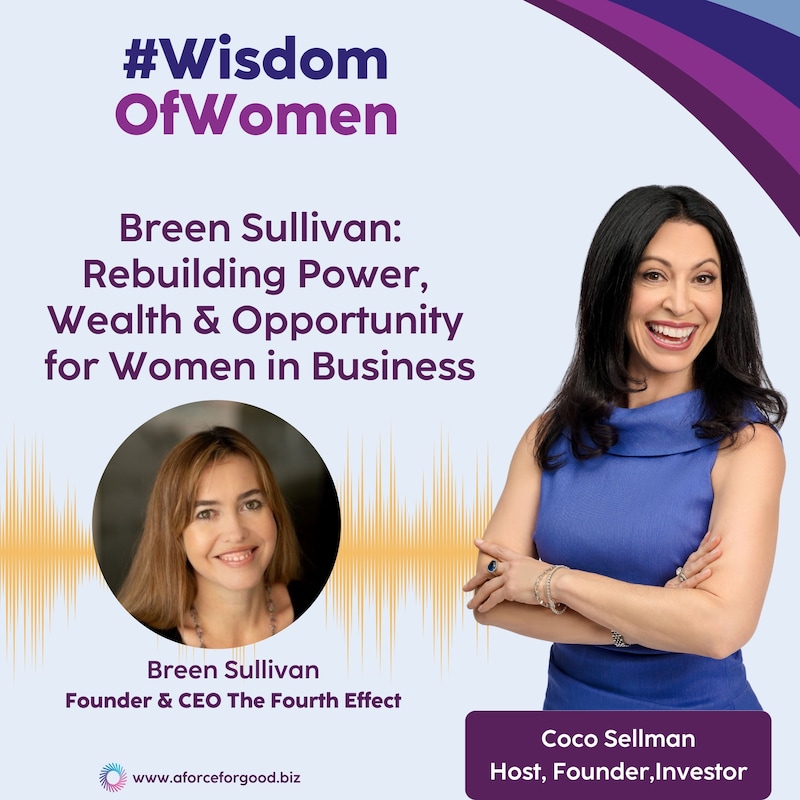
Shownotes
In this enlightening discussion, we welcome Breen Sullivan, the founder and CEO of the Fourth Effect, an innovative AI-powered platform dedicated to bridging the gender, power, and wealth gap in the private sector.
Breen shares her extensive expertise as a Yale graduate and former general counsel, highlighting her commitment to transforming how boards and opportunities are structured for women-led enterprises.
We delve into her personal journey, exploring the experiences that ignited her passion for equity and inclusion, as well as the imperative need for advisory boards that reflect diverse perspectives.
Join us as we illuminate the path towards prosperity for women entrepreneurs and redefine the landscape of business leadership.
Takeaways:
- Breen leads an innovative platform for startup governance.
- The Fourth Effect aims to close the gender wealth gap by transforming corporate board structures.
- Breen's experiences illustrate the challenges women face in gaining access to board positions and investment opportunities.
- The podcast discusses the significance of independent directors in enhancing company governance and profitability.
- The Fourth Effect serves as a resource for founders to navigate advisory relationships and maximize their potential.
Chapters:
00:08 - Amplifying Women's Leadership
05:11 - The Formative Experiences of Breen Sullivan
17:44 - The Importance of Transparency in Private Sector Governance
26:42 - The Importance of Advisory Boards in Startups
35:30 - The Role of Advisory Relationships in Startups
Burning Questions Answered:
- Why are women still largely excluded from power and wealth creation in business?
- What actually happens inside private company boards—and why does it matter?
- Why do most founders not use advisory boards effectively (or at all)?
- How can founders access the right people without spending thousands on lawyers?
- How can women build wealth and influence without being founders or investors?
Guest Offers & Contact Information:
LinkedIn: https://www.linkedin.com/in/breensullivan/
LinkedIn Business: https://www.linkedin.com/company/the-fourth-effect/
Website: www.thefourtheffect.com
Luma: https://luma.com/thefourtheffect
Instagram: https://www.instagram.com/thefourtheffect/
Follow the #WisdomOfWomen show for more inspiring stories and insights from trailblazing women founders, investors, and experts in growth and prosperity.
YouTube: https://tinyurl.com/yja3w7nh
Spotify: https://tinyurl.com/4tak8ajk
Amazon Prime: https://tinyurl.com/366syddj
Apple Podcasts: https://tinyurl.com/bdhananz
RSS Feed: https://feeds.captivate.fm/womengetfunded/
Coco Sellman, the host of #WisdomOfWomen, believes business is a force for good, especially with visionary women at the helm. With over 25 years of entrepreneurial experience, she has launched five companies and guided over 500 startups. As Founder & CEO of A Force for Good, Coco supports purpose-driven women founders in unlocking exponential growth and prosperity. Her recent venture, Allumé Home Care, reached eight-figure revenues and seven-figure profits in just four years before a successful exit in 2024. A venture investor and board director, Coco’s upcoming book, *A Force for Good*, reveals a roadmap for women to lead high-impact, high-growth companies.
Learn more about A Force for Good:
Website: https://aforceforgood.biz/
Are Your GROWING or PLATEAUING? https://aforceforgood.biz/quiz/
FFG Tool of the Week: https://aforceforgood.biz/weekly-tool/
The Book: https://aforceforgood.biz/book/
Growth Accelerator: https://aforceforgood.biz/accelerator/
Transcripts
Welcome to the Wisdom of Women Show.
Speaker A:We are dedicated to amplifying the voice of women in business.
Speaker A:A new model of leadership is emerging and we are here to amplify the voices of women leading the way.
Speaker A:I am your host, Coco Selman, five time founder, impact investor and creator of the Force for Good system.
Speaker A:Thank you for joining us today as we illuminate the path to unlocking opportunities and prosperity for women led enterprises by amplifying the the voice and wisdom of women.
Speaker A:Today we have a wealth gap disruptor in our midst.
Speaker A:Breen Sullivan is the founder and CEO of the Fourth Effect, the first AI powered platform designed to help founders build and manage high performing startup boards while creating real access to board service and angel investing for executives.
Speaker A:A Yale graduate and former general counsel to three high growth tech companies, Breen brings rare legal, governance and scaling expertise to the question of how companies grow with integrity and intelligence.
Speaker A:After noticing that her male peers were gaining power and wealth through board seats and investing while women were systematically excluded, Breen set out to redesign the system itself.
Speaker A:Today she leads the fourth effect with her business partner Kat the Hang.
Speaker A:The fourth effect is a global network of more than two 20,000 members.
Speaker A:It is closing the gender, power and wealth gap by transforming how boards, ownership and opportunity are built in the private sector.
Speaker A:Welcome Breen.
Speaker B:Thank you so much for that fantastic introduction.
Speaker B:Coco, that was wonderful.
Speaker B:Really appreciate that and it is so exciting to be here today.
Speaker A:Oh, we're happy to have you.
Speaker A:And as we always begin, what is a great book written by a woman that has significantly influenced your life?
Speaker B:I thought about it and the thing is I am a fairly prolific reader, so lots of books I've loved, many books written by women have had a huge impact on me.
Speaker B:There is one author and one series of books I do keep coming back to.
Speaker B:In my mind.
Speaker B:It's a little loaded, kind of like I don't really want this to be the one I say, but it's true.
Speaker B:When I was really like kind of 14, 15, right in that early adolescence, those years I read Anthem and then Fountainhead and then Alice Shrugged.
Speaker B:So Anne Rand.
Speaker B:And I'm certainly not someone who ascribes to her worldview overall.
Speaker B:That being said, she really gave me a language to understand creativity.
Speaker A:Huh huh.
Speaker B:As building and as agency.
Speaker B:And I do think, you know, to honestly answer your question, that has been incredibly formative because I am someone who loves the arts.
Speaker B:I love the fine arts.
Speaker B:I was a theater major, undergrad.
Speaker B:I am very creative and honestly for me in my life, this entrepreneurial Journey has been hands down, the single most creative endeavor that I've ever experienced.
Speaker B:And creative as defined by Ayn Rand.
Speaker A:Oh, I love that When I read Ayn Rand early in my teen years as well.
Speaker A:And that really resonates with me.
Speaker A:And I also consider myself deeply creative.
Speaker A:And sometimes people don't see business as like, creative, but it's artistic.
Speaker B:I agree.
Speaker B:Right.
Speaker A:And you're creating something out of nothing and often you're doing it with other people, which has its extremely unique challenges.
Speaker B:Yeah, No, I think of entrepreneurship.
Speaker B:You are spinning straw into gold.
Speaker B:It is so hard to do.
Speaker A:It is.
Speaker A:And yet it is.
Speaker A:And yet it's what we're called to do, Brie.
Speaker A:Right?
Speaker B:Yes.
Speaker A:We can't escape it.
Speaker A:Just like a painter can't live life without painting.
Speaker A:So one of the questions I always like to.
Speaker A:To ask so we can get to know you brain is a little bit more about the moments that have shaped your life.
Speaker A:So share with us three moments that have shaped who you are as a human being, as a per.
Speaker B:A person.
Speaker A:The moments that have perhaps been challenging or moments of epic discovery or transition.
Speaker A:What have been the moments that have really shaped who you are, the strengths you have today, the leader you are and are becoming.
Speaker B:So one thing that immediately pops to mind, I.
Speaker B:Most people don't know this about me, but I. I was born and raised in Alaska, so that makes me a sourdough.
Speaker B:They're not us.
Speaker B:But that it really shaped a lot, I think of how I've experienced life because frequently I've had an outside perspective.
Speaker B:Yeah, I left Alaska and I go to tropical New Haven for college.
Speaker B: s,: Speaker B:This was like, right as the Internet was starting to exist, so it was still so siloed.
Speaker B:And when you were in Alaska or Alaskan, that was a different universe.
Speaker B:I remember this is back before cell phones and this is when long distance was a thing calling collect.
Speaker B:And the operators would frequently think that Alaska was not part of the United States.
Speaker B:It just really seemed like a different universe.
Speaker B:And.
Speaker B:And then of course, Northeast, Ivy League, there.
Speaker B:Nothing is more different than Alaska.
Speaker B:So that was how I began.
Speaker B:And I've frequently felt in my adult life, wherever I've lived, I've always sought out these places that are different.
Speaker B:You know, New Orleans I love so much.
Speaker B:New York City is.
Speaker B:Hello.
Speaker B:One of the strangest, most bizarre places.
Speaker B:Really liking to live in these different places because that makes me feel more comfortable.
Speaker B:So I would say that shapes Me a lot and maybe helps to challenge assumptions or just a little counter to group think because I'm coming at it from a different angle.
Speaker B:And then another real formative experience I had right after college I moved to Morocco, to North Africa.
Speaker B:And again I date myself.
Speaker B: This is: Speaker B:So this is right before 9 11.
Speaker A:Yeah.
Speaker B:When it's not, it's it.
Speaker B:Honestly I was 22.
Speaker B:I thought Morocco would be southern France with camels.
Speaker B:I don't know what I was thinking.
Speaker B:I get there, it's not southern France with Camels.
Speaker B:911 Happens.
Speaker B:You know, I'm an American and I'm 22 and I'm in this very different.
Speaker B:It was a very different way to experience something like that and I'm so grateful for it now because it made me experience that moment in time from so many different perspectives and facets.
Speaker B:Because we were watching Al Jazeera, my students were North African.
Speaker B:My mother's cousin died in 9 11.
Speaker B:Also like being an American in North Africa, taking alternate routes to school because we were a potential terrorist target.
Speaker B:Some people left, I stayed.
Speaker B:That was a real formative experience.
Speaker B:Wow.
Speaker A:Yeah.
Speaker B:So I don't know.
Speaker A:One more.
Speaker A:Yeah.
Speaker A:Share one more, please.
Speaker B:One more would be then really my professional life.
Speaker A:Yeah.
Speaker B:Loving it so much.
Speaker B:And, and becoming a general counsel and really feeling a general counsel for kind of small mid sized high growth tech companies, which is a unique, it's its own creature.
Speaker B:And really found that to be deeply rewarding and satisfying.
Speaker B:I felt like I was really great at the job.
Speaker B:But then what started to happen, I started to get really angry and I didn't even.
Speaker B:And I'm not like people I enjoy I'm happy day to day.
Speaker B:But I had this real anger like deep down deep inside.
Speaker B:And it started small, but it was just like smoldering and it kept going and it got hotter and hotter and hotter.
Speaker B:And it was this combination of so many small things that, that really was triggered at my company number two, when I, when I just saw so clearly, okay, this is capitalism and this is great and this is so much fun and this is benefiting so many people and we are just kept out in this, in these insidious, like unbelievably frustrating ways.
Speaker B:And it led to just a million inequities.
Speaker B:And I just was so angry about it and, and so that was what it made, you know, now today, the fourth effect.
Speaker B:But it began the fourth floor.
Speaker B:It just erupted out of that anger.
Speaker B:And, and once I put that out there and anger sounds very negative and I don't obviously there's a lot of very positive things as well.
Speaker B:But that, that feeling, that challenging those assumptions resonated immediately with a large group of people and that became, you know, what now is the core of the fourth effect community.
Speaker A:Well and it says so much about these three experiences are really, I don't know, it just paints the pitch picture for me why you're a person who's come from and had different experiences.
Speaker A:I live in the in the Northeast just like you.
Speaker A:We both live in New York City, work in New York City, in New England.
Speaker A:New Jersey.
Speaker B:Right.
Speaker A:And I grew up in Iowa, so not quite as far away as Alaska, but similar in that it's different.
Speaker A:Like people think differently, people have a different viewpoint.
Speaker A:And what resonates for somebody in New Haven is different.
Speaker B:Right.
Speaker A:And being in Morocco during the 911 post 911 pre and post 911 as a young woman it makes so much sense to me that you would be somebody who is aware and sensitive to the inequities in the world and as a lawyer have had an entrepreneur.
Speaker A:Bringing it all together is so cool.
Speaker A:I love that when those things come together or experiences it's so common with women too.
Speaker A:It's not just a play on how much money can I make.
Speaker A:Right.
Speaker B:Wow.
Speaker B:Well.
Speaker B:And I don't know how you'd have the staying power to do to fight this fight if you were just doing it for the money.
Speaker B:Like that's not enough for what this is demanding.
Speaker B:Like yeah, this gotta be something bigger.
Speaker B:Yeah.
Speaker A:So tell us what is the fourth effect and why?
Speaker A:Who does it serve, what does it offer and why are you doing it?
Speaker B:Yes.
Speaker B:But luckily literally my favorite questions the planet so okay, so I know you mentioned in my bio and I just talked about being a general counsel the high growth private companies but it is a very important starting point to explain this because I was in the seat where for multiple companies I was watching while they raised money, while they added advisors or didn't add advisors, what happened with their boards or more often than not what did not happen.
Speaker B:And really what I saw was was this incredible just confusion and blind leading the blind in the private sector.
Speaker B:So people not knowing what they didn't know.
Speaker B:An absence of real strategy framework benchmarks that were generally accepted and in the in that absence of a transparent strategic resource when it's opaque, when it's very idiosyncratic, when everyone has an opinion but no one really knows when the information is gate kept behind really high hourly fees and that information isn't necessarily a best practice that results in founders just not leveraging advisory and governing boards in the private sector.
Speaker B:So they're not like systematically not getting nearly as much value right of these people relationships that they debt.
Speaker B:If there was clarity, they had a path they were following from day one.
Speaker B:So I mean from having the idea and you go to incorporate and to get to the point of now you're pre seed, now you maybe have a stock incentive plan.
Speaker B:You could think about issuing equity to advisors to okay, now I'm seed and I'm going to go and negotiate a term sheet with institutional investors.
Speaker B:I might start to think about my governing board.
Speaker B:All of that whole arc, that whole pre seed through series A.
Speaker B:Those founders are generally in the dark.
Speaker B:The one like you, Coco, who have done this multiple times, you're not right.
Speaker B:You come to the gate, if you start your company number six, you will have an idea of what to do and what how to leverage these relationships and how to get value out of these relationships and when that can help move you along as a company.
Speaker B:First time founders don't have that.
Speaker B:And even experienced founders the importance of it.
Speaker B:And so would love to have a resource that makes it better.
Speaker B:So that I saw this need because I was in that seat and able to start just actually questioning what I was seeing and challenging the assumption that everyone knew what they were doing because they didn't.
Speaker B:So that gave me that first insight.
Speaker B:And then of course the second insight.
Speaker B:I was watching male colleagues like you described in the intro about me.
Speaker B:I was watching all of this money and power just all of a sudden be created and get disseminated and I'm filing the paperwork for it, but I'm not sharing in it.
Speaker B:And it was that feeling of why?
Speaker B:What am I missing?
Speaker B:Why am I not in the loop?
Speaker B:And then of course you start to peel back that onion and you realize, oh, 98% of funded founders are men.
Speaker B:91% Of people writing checks are men.
Speaker B:Everyone who's participating in this are men.
Speaker B:This is why they are making a lot of money and they are having a great time and we're not and that and I don't think that's good for everyone, not just for us.
Speaker B:Totally.
Speaker B:So I start seeing that and then I wanted that was the other side of okay, how do I get involved.
Speaker B:And it was realizing that same opacity, total lack of a playbook, total lack of clarity around what is an advisory board, what is informal advisor relationship versus a formal advisor relationship versus an observer seat on a governing board versus an independent director.
Speaker B:I even me being A tech lawyer, general counsel, helping companies think through these things.
Speaker B:I wasn't 100% sure, like not even close.
Speaker B:And no one was.
Speaker B:So it was recognizing this.
Speaker B:There's just an absence of infrastructure in the private sector.
Speaker B:And it really, it's not even just from pre seed or Idea Stage through series A.
Speaker B:Honestly, it's Idea Stage through ipo.
Speaker B:It's that whole spectrum that this is a miss.
Speaker B:And, and one thing that all.
Speaker B:When I went on this massive, you know, five, six year journey of learning all about this, one of the things you realize is that all of the statistics that you ever hear when people talk about boards and everything you read about and all of the programs you can go sign up for and the certifications you can get and the board bios you can make, all of that is geared towards publicly traded companies.
Speaker A:Yes.
Speaker B:Less than 1% of companies.
Speaker A:Yeah.
Speaker B:Which is less than 15% of our economy and which is less than 10% of our workforce.
Speaker B:So actually 90% of our workforce and 85% of our economy and this is the silent opaque black box in the middle.
Speaker B:That is all the money and power.
Speaker B:That is why we get 80 cents on a dollar which is why we don't have maternity leave flashlight being shown in that private sector.
Speaker B:All that capitalization and all of the decision making power is with one group.
Speaker B:And I believe that the reason you know that honestly it comes down to structure.
Speaker B:And because the boards themselves have lacked the clarity and the structure and the roadmap and the strategy, they don't get built.
Speaker B:So they don't exist.
Speaker B:They're not.
Speaker B:Or if they exist, they're stagnant, they're not evolving, they're not involving, they're not including women.
Speaker B:This would be the way that women would get to participate in capitalism.
Speaker B:Because we're not getting funded and we're not the investor, but we are not able to get in and we're not on the capitalization tables and we're not sitting around those tables making decisions in the private sector out our influence in that opaque giant center.
Speaker B:I think that has a lot to do with a lot of the inequities that we see when you look at any of the downstream statistics.
Speaker B:So that's why the fourth effect, we exist because it was first, it's okay, we hate this.
Speaker B:How do we solve it?
Speaker B:Is it the women?
Speaker B:Do we educate the women more?
Speaker B:Do we match women?
Speaker B:No, that's not it.
Speaker B:It's Idea Stage through ipo.
Speaker B:These companies are not following a playbook and they don't have an Easy tool.
Speaker B:A SaaS product that's making it super easy.
Speaker B:No lawyers where they can understand exactly who to tap when, how to paper that relationship, how to vest equity, how to get value, how to pause vesting of equity, how to switch people in and out, how to mature, go grow their business, hit milestones, fundraise, etc.
Speaker B:And open up those seats and involve people and that.
Speaker B:So that's what our tool is really all about.
Speaker B:And that's what we're doing.
Speaker B:And so we're in the business of growing crops of board seats.
Speaker A:Yes.
Speaker A:It's really fascinating what you're saying.
Speaker A:So I'm listening to you.
Speaker A:And the 1% of companies are public.
Speaker A:And of course all of those have boards because it's required.
Speaker A:And then the rest mostly don't.
Speaker A:Like some regulated businesses do require it, but then it's like questions or they have investors that require it, but then it's not necessarily because it's what's best for the business.
Speaker A:It's built for reasons other than truly providing value and different thoughts and expertise.
Speaker A:Like what in your mind, what is the purpose of an advisory board or a board.
Speaker A:Okay, what's the value to a company?
Speaker A:To a founder?
Speaker B:Yes.
Speaker B:Okay.
Speaker B:So such a good question.
Speaker B:And even I just want to even just touch on a little bit of what you just said there because.
Speaker B:Okay, so before a company becomes public, because once they become public, like you said, there's all this regulation now there is transparency.
Speaker B:Now the publicly traded company has this legal obligation.
Speaker B:They're going to have a bunch of independent directors, and those people are people who didn't write big giant checks.
Speaker B:And they're not executives in the company.
Speaker B:And they're sitting around the table.
Speaker B:When we're looking at that 90, 85% of the economy that's not there yet.
Speaker A:Yeah.
Speaker B:In the United States especially, we're a nation of cowboys.
Speaker B:So we do not like rules.
Speaker B:We do not want anyone to tell us what to do.
Speaker B:We don't want trans.
Speaker B:But we don't want transparency.
Speaker B:Yes.
Speaker B:Less cowboys than us.
Speaker B:So there's.
Speaker B:It's a little like they're a little quicker to get the benefit of some sort of governance in the private sector.
Speaker B:Of course, people could argue it might slow them down as well, having more transparency.
Speaker B:But setting that aside, wherever you fall on that, if we look at this giant private sector, no one is requiring the company to do anything with this governing board that exists.
Speaker B:But what ends up happening in any company if it's really growing and scaling, typically it's taking outside capital from institutional investors.
Speaker B:And those investors are taking board seats because they want to have a hand in controlling what happens to their investment.
Speaker B:Their allegiance Is with their LPs and with their fund.
Speaker B:Sometimes that aligns with the company.
Speaker B:It doesn't always align perfectly with, you know, certainly what the founder cares about.
Speaker B:And then those are the other people sitting on that governing board.
Speaker B:It's the founders.
Speaker B:They have their own agenda and usually lines with what's best for the company.
Speaker B:But not always, not always.
Speaker A:If they're planning to exit soon, then.
Speaker B:It's, it may not right be not.
Speaker B:And sometimes what they want lines up with the investors, sometimes it doesn't.
Speaker B:So that's why there is this third leg of the stool.
Speaker B:And this is called independent director, it's called non executive director, it goes by many names.
Speaker B:It's the same thing.
Speaker B:It just means they don't have the same agenda, the same outside set of priorities.
Speaker B:Instead, that person can care only about what is in the best interest of the company.
Speaker B:And the company is not the founder.
Speaker B:The company is not the investors.
Speaker B:The company is the company.
Speaker B:So when, and there have been enough studies now that when private sector companies do have that third leg of the stool, they make more money.
Speaker B:And, and it's, and a lot of times it's really because what it's, it's risk adjusted decision making.
Speaker B:So in, in critical moments, having that independent perspective can really make a difference in terms of a company's well being and profitability.
Speaker B:It's also about capturing new markets and expanding in the market you're in because you again are have an influence or have a perspective that's free of influence and that can be tapping into a skill set that complements the other people.
Speaker B:So generally speaking, if the private company boards that have no requirement or obligation, if they actually take advantage of that third leg stool, they do better, they make more money.
Speaker B:That's also really important to note and this is just very pragmatic because 91% of the institutional investors that take seats on boards are men and because 98% of funded founders are going to be men, that this is the only way to have a different gender in the room.
Speaker B:Usually you don't have that third leg of the stool.
Speaker B:By definition that means you don't have any gender diversity.
Speaker B:To the extent you believe in the economic value of gender diversity, which that's a whole other angle as well, you miss out on that if you don't know that strategy as a founder, which most founders don't.
Speaker B:So like when they looked at private sector Companies, they've only looked at a very small number of them because mostly it's opaque and no one knows.
Speaker A:Right.
Speaker B:They looked at the majority of those companies, no women, but also no independent directors.
Speaker B:Yeah, men.
Speaker B:Those companies created the third leg of the stool because of organizations like ours that are starting to teach strategy and getting the attention of founders who aren't sexist.
Speaker B:They want to survive.
Speaker B:So they're happy to consider this started to change.
Speaker B:So there started to be women on private company boards.
Speaker B:So that's a very clear, just correlative relationship between board structure and then diverse perspectives.
Speaker B:So that's governing board, advisory board.
Speaker B:And this is totally overlooked in the private sector as well.
Speaker B:And I have, as a lawyer, I have my strong suspicions as to why.
Speaker B:I think it's because before what now is available with AI and legal tech and what we can do in a software product, before that, all of these founders were reliant on.
Speaker B:And lawyers are not created equal.
Speaker B:Many lawyers are unfamiliar with these kinds of relationships.
Speaker B:Advisory relationships in A, pre C series A, series B, how to compensate it, how much equity, how to structure it, they don't know.
Speaker B:And you might be really overcharged for someone to try and help you with this.
Speaker B:You might end up then just avoiding the contract entirely.
Speaker B:Yeah, it's really about the logistics.
Speaker B:It's about as a founder, super intimidating to know what to negotiate for, who you need, when you need them, how long you need them, how to make these terms benefit you, what name to call it, all of these things.
Speaker B:And so it's a stumbling block and you're busy and you're like, you know what?
Speaker B:I don't want to spend thousands of dollars and worry about this.
Speaker B:I'll just hire a consultant.
Speaker A:Right.
Speaker B:Realizing that consultant is an advisor, legally it's the same.
Speaker B:So you're just missing out on the arbitrage of the value for that executive getting for profit board experience at earning some equity and cash versus just cash.
Speaker B:All different types of compensation arrangements can be entered into that are mutually beneficial.
Speaker B:But I think it's the logistics barrier that has kept founders from doing this and that has kept women out.
Speaker B:Because without founders creating these seats and when they do create the seats, it's just a, hey, I'm going to tell my buddies, it's just the same people over and over.
Speaker B:And so also then those boards don't bring much value and a sense of, oh, an advisory board, it's because it's not done right, it's not fit for purpose and it's not actually bringing value.
Speaker A:Yeah, and also I want to just bring in another element of this.
Speaker A:So with my healthcare company, I was required by regulations.
Speaker A:It's was a private company, but we were required by regulations to have actually two boards, actually three boards.
Speaker A:We had an actual and a governing board for the entity.
Speaker A:Then we had what we called a governing authority which was required for our CMS certification.
Speaker A:And that was, had to have elements pointed to it.
Speaker A:They had to have finance person, legal person.
Speaker A:There had to be certain different.
Speaker A:There had to be someone on the board who, who represented the population we serve.
Speaker A:Consumers were independent.
Speaker A:And then we had to have.
Speaker A:So we couldn't, I couldn't have my, for example, my regular accountant be on that board.
Speaker A:It had to be someone from the outside.
Speaker A:And then we had an advisory board that was based on the different types of services we provided.
Speaker A:So we needed to have a nurse, we needed to have a pharmacist, we needed to have an ot, a pt, a speech therapist, a doctor.
Speaker A:We had to have.
Speaker A:And they all had to be outside, couldn't work for the company, they had to be from the outside.
Speaker A:That so that, and then we had to have this, these certain number of meetings every year.
Speaker A:And there were certain data.
Speaker A:They had to approve the budget, they had to look at our policies and procedures that there had to be like this next level.
Speaker A:And I learned so much from this experience, experience as a founder with these governing bodies in place and the accountability in the reporting, it made me a better CEO.
Speaker A:And so I'm just curious if you could add to that and what, how the fourth effect helps with that.
Speaker B:Yes.
Speaker B:And so I think that is a great question, but also thank you for sharing that.
Speaker B:And I think the, as a founder, the fact that you were in a regulated industry, there was some, some oversight, some requirement, there was requirements.
Speaker A:And every time they came in and every two to three years and they come in and they'd be like, we want to see all of your documentation, your minutes from all your meetings and we want to look at what data you showed shared and the quality assurance data you were passing along and who was looking at it.
Speaker A:And all of this, right.
Speaker A:And that, that outside compliance, none of us like has a positive effect on our decision making.
Speaker B:And when you think about.
Speaker B:So one thing that, you know, I often say, and this really is making me think of is, you know, financial governance.
Speaker B:When you are trying to get a big juicy check from an institutional investor, they're not going to hand you that money.
Speaker B:If you don't have financial governance and oversight in your organization, you have to be able to show like, okay, you're going to take this money, the structure, we have the right expertise, we have the right people to handle other people's money to that level.
Speaker B:Why?
Speaker B:It makes no sense that there would be this absence of general governance when you are taking other people's money.
Speaker B:It's really the same idea.
Speaker B:It's just, it just hasn't.
Speaker B:And I feel like it is absolutely trending in that direction.
Speaker B:And I think in 10 years and 15 years this will just be a given.
Speaker B:I think it's because of all the transition, everything that's happening and service providers like lawyers, like now it's becoming democratized.
Speaker B:So I think AI, this is a place where we'll see technology's influence, where the world's going to get smaller.
Speaker B:So I think this will happen.
Speaker B:But I think like in regulated industries that's happened sooner.
Speaker B:You have this level.
Speaker B:And one thing to get to your question, why is this so useful for a founder?
Speaker B:When you're a founder, no matter how smart, talented, no matter how hard you work, no matter how passionate you are, you don't know everything you are in every, you don't have skill sets, you're not there.
Speaker B:Working with a thousand companies and thousands of executives over the years, we've clearly identified, okay, There are these 20 advisor archetypes, super relevant for pre seed through series A.
Speaker B:Then of course there's like sub archetypes when it's life sciences, when it's different industries.
Speaker B:But you start to see, okay, these are the idealized version of a pre seed fintech company going into a seed round with this challenge in this moment, the idealized version of that startup has this roster around the table.
Speaker A:Yes, yes.
Speaker B:Your usual fintech pre seed startup in that exact same scenario, they have two people on the roster, one or one, they have a bunch of these archetypal skill sets that are missing but they don't know that.
Speaker B:They don't know what, they don't know, they don't know what's missing.
Speaker B:So they're just like, oh my God, this is the hardest job ever.
Speaker B:I just need some money so I can get someone to help me.
Speaker A:Yeah.
Speaker B:So a lot of what we're doing, especially with these early stage companies, is giving them that list.
Speaker B:We're saying, hey look, here's the roster.
Speaker B:You, who do you have?
Speaker B:You have you and you have what?
Speaker B:You have this.
Speaker B:But there's this whole beautiful menu.
Speaker A:Yes.
Speaker B:You could be tapping into this menu and here we'll make it real easy for you.
Speaker B:Just click this button and you can go get this person and can have it in a way that works for you.
Speaker B:Because of pre seed stage, you don't have cash.
Speaker B:Okay.
Speaker B:So you get these skill sets off the menu so that you can avoid your, the trademark litigation.
Speaker B:You can avoid, yes, get the angel, you can go.
Speaker B:So that's how can they help you?
Speaker B:I mean it's really about, you know, it's funny because obviously like we ourselves are a seed stage startup and we are fundraising.
Speaker B:We have to like you have to put together the deck and you have to explain what is the root cause problem?
Speaker B:What is the problem?
Speaker B:And if you break it down, down, you get to.
Speaker B:Well, it's really hard to spin straw into gold and we fail.
Speaker B:We fail because we don't have that roster.
Speaker B:We don't know what we don't know.
Speaker B:This root cause problem is the lack of being connected to the right people at the right time or even knowing that you should be and that there is something called an advisory board.
Speaker B:It doesn't even have to be called that there are people out there you can contract with that will get you to that next level so you don't die and so you can fundraise so that you can spin straw into gold.
Speaker A:I love that.
Speaker A:And it's also a lot of businesses that I founders that I've worked with over my career has, have not been venture backed or backable companies.
Speaker A:And I think there comes a moment even in a company that's like you said, like there's moments when you need to scale, when whether you need to go and get a loan from someone or some kind of financing or whatever, where you've got or outside capital like that needs to come in on an equity basis.
Speaker A:There's, there comes a moment where having these outside participants really helps.
Speaker A:And I.
Speaker A:So tell us, I want to.
Speaker A:So you say that the fourth effect is like a CARTA for advisory boards.
Speaker A:I've heard you say that, I've seen you write it.
Speaker A:Tell us what that means and for those who don't know what Carta is, explain what that is and then how this all comes together.
Speaker B:Okay, so Carta is a cap table management software solution.
Speaker B:So cap table capitalization table, you're a for profit company, you have a cap table.
Speaker B:Whether you've looked at it or not, it exists.
Speaker B:So you know, before Carta, all of these cap tables existed essentially in Excel spreadsheets.
Speaker A:Yep.
Speaker B:Maybe they never even got that far.
Speaker B:They didn't get reduced to paper, but they existed legally and they're floating around.
Speaker B:So Carta come comes along and realizes, okay, founders, they're not securities lawyers, they're uncomfortable with all of this.
Speaker B:They don't like we need to, we're not going to.
Speaker B:They're not inventing cap tables, they're inventing a solution, a platform that just democratizes it, makes it easy to navigate, easy to understand and most importantly for a founder, easy to control and get value from, you know, able to have it be an asset.
Speaker A:Yes.
Speaker B:Advisory relationships, we are not invest inventing them.
Speaker A:Right.
Speaker B:Always existed, arguably for startups.
Speaker B:These are the most critical and most important relationships for startups.
Speaker B:Whether the founder calls it a mentor or they call it an advisor, or they call it a board advisor or they call it whatever name these people go by.
Speaker B:You as a founder need to have the people around you that you can call on that help you formally and informally.
Speaker B:And so that we're not inventing that.
Speaker B:Right.
Speaker B:Those relationships today exist in email, they exist not even in spreadsheets.
Speaker B:Sometimes they're written down, sometimes there's a fast agreement of some sort that gets signed that people don't know.
Speaker B:Did I sign it?
Speaker B:Did I ever get the securities grant that's connected to it?
Speaker B:Am I vesting the equity?
Speaker B:Did it vest all of that kind of gets lost in the wind.
Speaker B:It creates a lot of confusion.
Speaker B:Founders feel anxiety because they're equity is maybe being vested but they don't even remember what they signed.
Speaker B:So we are the solution.
Speaker B:Like Carta for cap tables.
Speaker B:Yes, cleaning that up.
Speaker B:So for founders you're going to do these relationships anyway.
Speaker B:Yeah, but you might as well use a tool where you can keep track of it, where you're not giving away equity, where you're getting value, where you can see the menu of all the people you're missing and you can go get them so that you can do.
Speaker A:Yeah.
Speaker B:And then for you on the other side, it enables you to build a portfolio of wealth so you can be.
Speaker A:An advisor in these different roles and have a piece of the equity.
Speaker A:In some cases you're also being paid.
Speaker A:Right.
Speaker A:Whatever that relationship negotiated is.
Speaker A:And now you're building your portfolio and what a great way for women.
Speaker A:And your platform isn't just for women.
Speaker A:Right?
Speaker B:No.
Speaker B:So we started when this all began.
Speaker B:Obviously it is 100% mission driven to close the gender power wealth gap by fixing the systemic inequities around lack of structure in the private sector governance.
Speaker B:Okay.
Speaker B:That being said, what we realized on this journey is that it actually it is more effective if this is not in any way connected to gender or Anything else?
Speaker B:Because by fixing what's broken in the system, that inefficiency in the system, that will have the downstream impact of creating transparency and access for everyone.
Speaker A:Yeah.
Speaker B:So no, we are 100%.
Speaker A:And you guys have a platform that's online, but you have a community as well that exists offline and you have events and summits and that kind of thing.
Speaker A:And I'm always delighted to go to your events.
Speaker A:And I'm also happy to see diversity, mostly women, but many men as well.
Speaker A:And it's, it feels like it's a structural change that's happening.
Speaker A:So I love that.
Speaker A:I love that.
Speaker B:So glad to hear that.
Speaker A:Yeah, no, it's really wonderful.
Speaker A:So I'd like to move this along too.
Speaker A:We usually do a little fast fire round before we start to move to close, so I'd love for you, I'm going to ask you five questions and invite you to answer with five word or less answers.
Speaker B:Okay.
Speaker B:Challenge for me.
Speaker B:Yes.
Speaker A:So are you ready?
Speaker B:Sure.
Speaker A:What is one courageous question every founder should ask before filling a board seat?
Speaker B:Can this person defray the risk I am facing today?
Speaker A:Brilliant.
Speaker A:What attribute matters most in board members?
Speaker B:I think what matters most is that they care.
Speaker A:Yes.
Speaker A:What do founders underestimate most?
Speaker B:Power of their equity.
Speaker B:Because they're the crazy one that took the risk and built something.
Speaker A:I love that.
Speaker A:At this stage of leadership in business, what is non negotiable for you?
Speaker B:Authenticity.
Speaker A:Amazing.
Speaker A:So finish this sentence.
Speaker A:This is the last question.
Speaker A:Power becomes meaningful when.
Speaker B:When it's truth.
Speaker A:When it's truth.
Speaker A:I love that.
Speaker A:So how can our listeners find you and the fourth effect?
Speaker B:So probably the best, easiest way is the fourth effect dot com.
Speaker B:You can find us there.
Speaker B:You can easily follow us on Luma.
Speaker B:You can easily follow us on LinkedIn.
Speaker B:So if you Luma, we do lots of public events.
Speaker B:There's also private events for the private community.
Speaker B:But community authenticity relationships is critical for any board investment relationship, which is what's happening.
Speaker B:So community is never going to go anywhere.
Speaker B:We'll always have it.
Speaker B:So following us on Luma, start getting involved, come to just free public events.
Speaker B:Join our free community.
Speaker B:Follow us on LinkedIn so you'll stay apprised of what's happening and then of course come sign up, start a trial, get inside our platform.
Speaker B:Just know our new platform is launching in the next three months, God willing.
Speaker B:And so our existing platform certainly lots of value there.
Speaker B:There's a lot coming in terms of this board command center that we've been discussing today.
Speaker B:So please, if you are interested in building a portfolio of wealth serving on boards.
Speaker B:If you are a founder of any sort in that precede to ipo, please come pay attention.
Speaker B:Come join us.
Speaker B:Come start listening so you can get.
Speaker A:A 30 day trial when you go to www.thefortheffect.com and you can also find Breen on LinkedIn and you can find the fourth effect on LinkedIn as well as on Luma.
Speaker A:So I hope you all get yourselves over there and check it out.
Speaker A:The value of being able to have an advisory board and a governing board and is so missed out on so many companies and this is your chance to get in there and especially early on when you don't necessarily have all the funds, you don't have cash.
Speaker A:There are other ways to make this work and make it really valuable for you and for your advisors.
Speaker B:So couldn't have said it better myself.
Speaker B:Yay.
Speaker A:I love it.
Speaker A:So thank you so much Bryn for being here today.
Speaker A:Thank you for joining us on the Wisdom of Women Show.
Speaker A:Thank you for illuminating the path for opportunities and prosperity for all of us and bringing this new platform that allows for inequities to meld away and for us to all have our seat at the table.
Speaker A:Thank you.
Speaker B:Well, thank you.
Speaker A:Yeah.
Speaker A:And for all of our listeners, thank you for being here today.
Speaker A:Be sure to follow like and share the wisdom of of Women's show on whatever your favorite listening or viewing platform is.
Speaker A:And to infuse more of your wisdom into your business, be sure to take the Growth Readiness quiz at a ForceForGood biz quiz and uncover where your insight is needed most.
Speaker A:The world is made better by women led business.
Speaker A:Let's all go make the world a better place.
Speaker B:Thank you.
