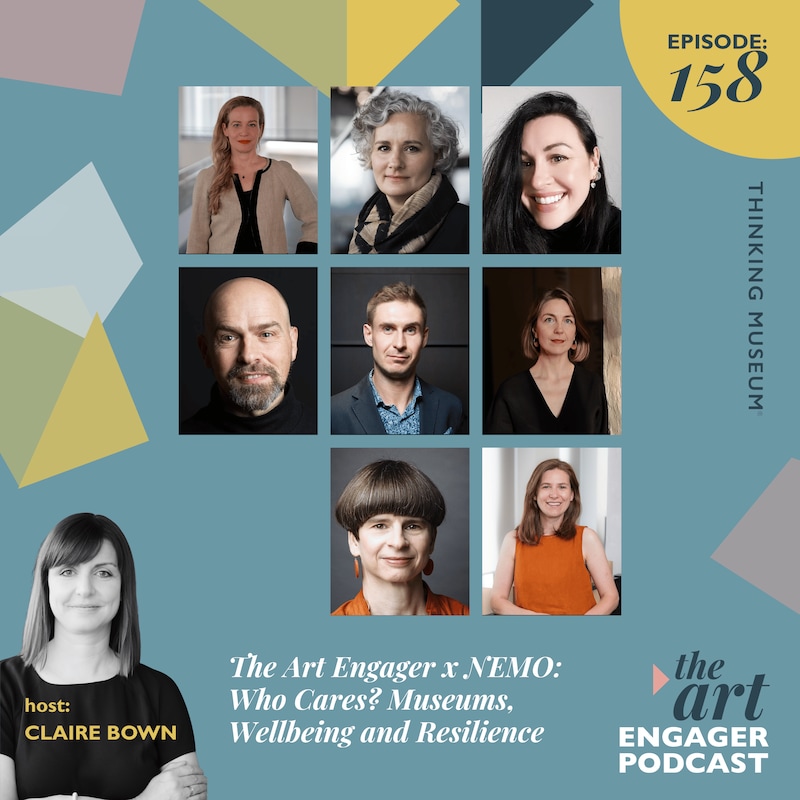
Shownotes
In this special episode created in collaboration with NEMO – the Network of European Museum Organisations, I’m sharing voices and ideas from the 2025 NEMO European Museum Conference ‘Who Cares? Museums, Wellbeing and Resilience’ in Horsens, Denmark.
Recorded during the conference itself in the unique setting of the FÆNGSLET Prison Museum, this episode features eight speakers from across Europe and beyond.
Together, we explore how museums are engaging with wellbeing and care – for their communities, their staff, and the wider world.
You’ll hear from museum professionals, researchers and cultural leaders reflecting on what care looks like in practice – from building organisational resilience to creating spaces for recovery, reflection and connection. The episode weaves together their experiences to to show how museums are finding new ways to care for people and communities.
In this episode
- How museums are rethinking their roles in wellbeing and resilience
- Practical examples of care-centred work in action
- The emotional and organisational challenges of supporting wellbeing
- The importance of caring for the people who care for others
Featuring
Julia Pagel (Germany) • Vera Carasso (Netherlands) • Elizabeth Merritt (USA) • Inga Surgunte (Latvia) • Sinéad Rice (Ireland) • Yurii Horpynych (Ukraine) • Roberto Casarotto (Italy) • Dr Nuala Morse (UK)
The Art Engager is written and presented by Claire Bown. Editing is by Matt Jacobs and Claire Bown. Music by Richard Bown. Support on Patreon
Links
- NEMO – Network of European Museum Organisations
- NEMO 2025 Statement on Museums and Wellbeing
- Conference webpage with recordings
✨ If you've enjoyed this episode, please consider supporting The Art Engager on Patreon: https://www.patreon.com/c/TheArtEngager
Or pick up a copy of my book, The Art Engager, for step-by-step guidance on creating meaningful, interactive guided experiences https://www.theartengager.com/
Buy it here on Amazon.com: https://tinyurl.com/buytheartengager
Transcripts
Hello and welcome to The Art Engager podcast with me, Claire Bown.
Claire Bown:I'm here to share techniques and tools to help you engage with your audience
Claire Bown:and bring art objects and ideas to life.
Claire Bown:So let's dive into this week's show.
Claire Bown:Hello, and welcome to a new episode of The Art Engager.
Claire Bown:I'm Claire Bown, and today's episode is a little different.
Claire Bown:Instead of one guest, I'm bringing you voices from an entire conference,
Claire Bown:the NEMO Annual Conference, Who Cares?
Claire Bown:Museums, Wellbeing and Resilience that took place in Horsens,
Claire Bown:Denmark a few weeks ago.
Claire Bown:Now one quick thing before we start.
Claire Bown:I started this podcast in 2021 thinking I'd make perhaps 25 episodes.
Claire Bown:And here we are at over 150.
Claire Bown:Creating each episode is mainly a solo endeavor, and your support of
Claire Bown:the podcast helps cover hosting, editing costs, research, and interview
Claire Bown:time, and it also helps to keep the podcast ad free for everyone.
Claire Bown:If you found this podcast helpful and would like to support what
Claire Bown:I do, you can become a friend of The Art Engager on Patreon.
Claire Bown:There are different tiers to choose from with monthly support starting from
Claire Bown:less than the price of a cup of coffee.
Claire Bown:Thank you.
Claire Bown:So in late October, 2025, I traveled to Horsens, Denmark
Claire Bown:for the NEMO annual conference.
Claire Bown:NEMO is the network of European museum organizations, and NEMO represents over
Claire Bown:30,000 museums across 40 countries.
Claire Bown:And this year they dedicated their entire conference to exploring what it means
Claire Bown:for museums to engage with wellbeing and resilience, both for communities
Claire Bown:and for museum workers themselves.
Claire Bown:This was a hugely popular sold out conference with over 328 participants
Claire Bown:from all over Europe, many of whom were at a NEMO conference
Claire Bown:for the first time, including me.
Claire Bown:Over two days, I spoke with people across this emerging field, from those thinking
Claire Bown:about policy frameworks and cross sector partnerships to practitioners designing
Claire Bown:and delivering programs on the ground to researchers examining what this work means
Claire Bown:for the museum workforce implementing it.
Claire Bown:What I heard were conversations about possibility and practice, about the
Claire Bown:profound personal impact of care work and about what it actually takes to sustain
Claire Bown:this kind of work in the long term.
Claire Bown:This is what I heard in hors.
Claire Bown:So to start with, I spoke with Julia Pagel, the Secretary General of Nemo.
Claire Bown:I wanted to understand why NEMO chose to dedicate this year's
Claire Bown:conference to the theme of wellbeing and resilience and why now.
Claire Bown:she talked about what prompted this focus, what she hoped the conference
Claire Bown:could achieve, and the unique role she sees for museums across Europe
Claire Bown:in promoting care and wellbeing.
Julia Pagel:I think that's probably the beauty of what networks are.
Julia Pagel:You feel that themes are emerging.
Julia Pagel:You hear the topic of wellbeing and resilience come up once, twice, four
Julia Pagel:times, 10 times, a hundred times, and we realize that we need some
Julia Pagel:kind of central moment to bring these projects, the ideas, but also the many
Julia Pagel:questions that come with it together.
Julia Pagel:And this is why we decided to do the conference.
Julia Pagel:And if I may add, of course, because we are a European organization and
Julia Pagel:we see the same thing happening on European cultural policy level.
Julia Pagel:So mental health and wellbeing is a strong topic at the moment,
Julia Pagel:very visible at European levels.
Julia Pagel:So this was a good moment to connect.
Julia Pagel:And I think what conferences can do is that they bring those preferred futures,
Julia Pagel:the futures that we want to get to, they bring them to the very present, and then
Julia Pagel:we really know where to work towards and how to work towards in order to get there.
Julia Pagel:So creating cooperation between museums to work on these issues.
Julia Pagel:Opening up funds, and not only in the cultural sector, but of course also in
Julia Pagel:the health sector and maybe even help to create those cross sector partnerships
Julia Pagel:that we really need to grow more.
Julia Pagel:But I'd say the inspiration that we can be these allies is the
Julia Pagel:most important for the network.
Julia Pagel:I think we have a great strategic advantage, and that is that we are large
Julia Pagel:cultural infrastructures across the globe.
Julia Pagel:There is a museum almost everywhere, and that I think gives us an amazing
Julia Pagel:advantage to really be close to where the people are, to where communities
Julia Pagel:are, to where needs are emerging.
Julia Pagel:But of course that comes along with many challenges that we have to address
Julia Pagel:and new profiles that the museum needs in order to be that place.
Julia Pagel:And I think what we also have to have very clear is that we are at
Julia Pagel:the prevention stage and making this prevention one of the say, cornerstones
Julia Pagel:of what healthcare means nowadays.
Julia Pagel:That can be translated into data and into money because it's way less
Julia Pagel:expensive to prevent from becoming ill, falling ill than to be ill,
Julia Pagel:and then having to be cared for.
Julia Pagel:So I think we, we really need to position ourselves in that preventive section.
Claire Bown:After hearing Julia outline the wider European picture, I
Claire Bown:wanted to explore what this focus on care and wellbeing means in practice
Claire Bown:for the people working in museums and for the organizations themselves.
Claire Bown:Vera Carasso is director of the Dutch Museum Association representing more
Claire Bown:than 460 museums across the Netherlands.
Claire Bown:She's also vice chair of Nemo's executive board.
Claire Bown:I spoke with her about how the conversation around care is evolving
Claire Bown:and why she believes museums need to build a true culture of care,
Claire Bown:both for their audiences and for the people who work within them.
Vera Carasso:When you see the speakers in the panel are all focusing on
Vera Carasso:wellbeing in the organization, and what I really like about the subject is that
Vera Carasso:like when you're in an airplane, you first have to put on your oxygen mask
Vera Carasso:yourself before you can help others.
Vera Carasso:And that's I think, the whole thing.
Vera Carasso:Museums play a very important role in health and society, mental
Vera Carasso:health, but also physical health.
Vera Carasso:But first, when you wanna help society, you first have to make sure you have
Vera Carasso:a healthy organization yourself.
Vera Carasso:Museums are more and more aware of their role in society.
Vera Carasso:I think 25 years ago, museums were more thinking about their collections
Vera Carasso:only and focusing on the inside.
Vera Carasso:And now they're more aware of their importance for society.
Vera Carasso:And I think they also have to, because finance is under pressure,
Vera Carasso:so we have to be relevant.
Vera Carasso:And if you wanna be relevant, you have to see what kind of
Vera Carasso:situation is there in society and how can we help society with that?
Vera Carasso:And museums can play a vital role in caring for society, making
Vera Carasso:people happy, inspire people, bring people together, but also to educate
Vera Carasso:them, for example, about history.
Vera Carasso:And in that way, make sure that there's less polarization because
Vera Carasso:people understand each other better.
Vera Carasso:The European museum sector is under a lot of pressure.
Vera Carasso:Of course, there's financial pressure, there's war in Europe.
Vera Carasso:There's a lot of polarization.
Vera Carasso:There are a lot of political shifts where also culture is sometimes used as
Vera Carasso:a political tool and sometimes really threatened by politicians and we have
Vera Carasso:to stay together to stay strong and to help each other, support each other.
Vera Carasso:Like we also do with, for example, the museums in the United States.
Vera Carasso:It's very important we stay in touch with them, but also as a group, as
Vera Carasso:a strong group in Europe, it's very important to stay together and work
Vera Carasso:together in within this Nemo network.
Claire Bown:So Vera talked about how museums need to care for
Claire Bown:themselves before they can care for others, about creating healthy
Claire Bown:organizations that can really support the wellbeing of their communities.
Claire Bown:She also spoke about the pressures museums are facing financial,
Claire Bown:political, even social, and how staying connected through networks like NEMO
Claire Bown:helps them face those challenges.
Claire Bown:These ideas link beautifully to the keynote that opened the conference.
Claire Bown:Elizabeth Merritt, vice President for Strategic Foresight at the American
Claire Bown:Alliance of Museums and founding director of the Center for the Future
Claire Bown:of Museums brought a futures perspective inviting participants to imagine how
Claire Bown:museums might play a role in health and wellbeing in the years ahead.
Claire Bown:Elizabeth outlined three possible futures, one shaped by technology and
Claire Bown:data, one focused on human connection, and one where museums become part
Claire Bown:of a new infrastructure of care.
Elizabeth Merritt:So many of us nowadays are connected to the an internet of
Elizabeth Merritt:data through little devices that live on our wrist or on our finger that are
Elizabeth Merritt:continually collecting and transmitting our blood pressure and our pulse.
Elizabeth Merritt:And as they get more and more sophisticated, they may even be
Elizabeth Merritt:monitoring our brain waves and they're giving us feedback on our health.
Elizabeth Merritt:So I can imagine a future in which I wake up and I look at my phone and it
Elizabeth Merritt:says, you've been logging so many days.
Elizabeth Merritt:When you're feeling down and your basic systems seem depressed.
Elizabeth Merritt:Maybe you need to spend some time in a museum.
Elizabeth Merritt:Because when you do that, you always feel better.
Elizabeth Merritt:So imagine a future in which people have either chosen to completely disconnect
Elizabeth Merritt:from the internet because they don't wanna share their data or they distrust
Elizabeth Merritt:how it's being used, or the companies that run these systems have collapsed.
Elizabeth Merritt:Imagine you go into a museum and someone comes up and says, hello, who would you
Elizabeth Merritt:like to be your personal guide today?
Elizabeth Merritt:We have available for checking out your personal poet or your personal musician
Elizabeth Merritt:or your personal therapist who might help you talk about your feelings in response
Elizabeth Merritt:to the paintings you're looking at.
Elizabeth Merritt:We already have such a wealth of data that's being presented at this
Elizabeth Merritt:conference about the well-known health benefits of being in the museum space.
Elizabeth Merritt:But what if that were personalized and got a little human assist so that
Elizabeth Merritt:you could go and say, I know that when I go to the museum, there're
Elizabeth Merritt:gonna be people at the front desk to sell me a ticket, and there are going
Elizabeth Merritt:to be people helping me find my way.
Elizabeth Merritt:But there they're also going to be the people there who are trained
Elizabeth Merritt:in mental health, who might be able to make most of my experience by
Elizabeth Merritt:giving me some one-on-one feedback.
Elizabeth Merritt:Our previous Surgeon General Vivek Murthy, actually declared loneliness to be a
Elizabeth Merritt:national epidemic because so many people are suffering from social disconnection.
Elizabeth Merritt:And so with that kind of social disconnection, the fact that people
Elizabeth Merritt:can and do use museums as family time to reconnect with people that they
Elizabeth Merritt:love or with friends, or even to have very light touch interactions with
Elizabeth Merritt:strangers that have been shown to have very beneficial social effects,
Elizabeth Merritt:makes them a very important place to provide this basic human connection.
Elizabeth Merritt:And this goes deeply to my philosophy, that if you put all of the burden
Elizabeth Merritt:on an individual and organization to do good work, first of all,
Elizabeth Merritt:it's expecting a lot of them.
Elizabeth Merritt:And secondly.
Elizabeth Merritt:It may not stick.
Elizabeth Merritt:So looking at me as a person and saying, you're responsible for your
Elizabeth Merritt:health and wellbeing, so you should be wearing a monitoring device
Elizabeth Merritt:and paying attention to your diet.
Elizabeth Merritt:Those whole things are, are all true.
Elizabeth Merritt:But if I'm doing that by myself, it's tremendously difficult and I'm vulnerable.
Elizabeth Merritt:And the same for museum.
Elizabeth Merritt:They may be doing good work, but if nobody is supporting them or knows to
Elizabeth Merritt:come to them or integrates that work into other systems of care, it's vulnerable.
Elizabeth Merritt:So I like to look at the biggest picture and say, what if you look
Elizabeth Merritt:at Health and Wellbeing as an entire of society approach, it should
Elizabeth Merritt:be integrated into our schools.
Elizabeth Merritt:It should be integrated into our places of socialization.
Elizabeth Merritt:It should be integrated into our workplaces, and I think museums can be an
Elizabeth Merritt:effective part of that network of care.
Elizabeth Merritt:So I posited, for example.
Elizabeth Merritt:Children already routinely go to museums for school trips where they
Elizabeth Merritt:learn about history or art history.
Elizabeth Merritt:They can be going to museums to learn about empathy and emotional
Elizabeth Merritt:response and self-regulation, social and emotional skills.
Elizabeth Merritt:These are things, museums know how to teach.
Elizabeth Merritt:And if schools thought of museums as a place to integrate that into their
Elizabeth Merritt:curriculum, that could be very powerful.
Elizabeth Merritt:One of the things I've been delighted to see at this conference is so many
Elizabeth Merritt:wonderful examples of prescriptions on demand for museums to be actually in
Elizabeth Merritt:the care system of doctors or healthcare providers, so that they would be saying,
Elizabeth Merritt:maybe you want to go to a museum.
Elizabeth Merritt:Here's a prescription.
Elizabeth Merritt:One museum visit a week for the next 10 weeks and you will feel better.
Elizabeth Merritt:And even if you weren't previously a regular museum goer, you may start
Elizabeth Merritt:becoming a regular museum goer.
Elizabeth Merritt:So I think integrating what museums can do into those formal systems of
Elizabeth Merritt:support will help what we do be more powerful, pervasive, and sustainable.
Elizabeth Merritt:I.
Claire Bown:So in Elizabeth Merritt's keynote, she imagined what the future
Claire Bown:might look like if museums became part of our shared systems of care.
Claire Bown:But what does it take to build those systems now in real museums with
Claire Bown:real policies and partnerships?
Claire Bown:So that question sits at the heart of Inga Surgunte's work.
Claire Bown:Inga is a research assistant at the Culture and Arts Institute of the
Claire Bown:Latvian Academy of Culture, where she leads the Museum's on Prescription
Claire Bown:program in Cêsis municipality.
Claire Bown:Inga is also involved in several international projects addressing
Claire Bown:the cultural sector's impact on sustainable development,
Claire Bown:including health and wellbeing.
Claire Bown:In Inga's, work is all about building bridges between culture and health and
Claire Bown:between local government and communities.
Claire Bown:In our conversation, she spoke about what's working in those
Claire Bown:collaborations, but also about the pitfalls, the challenges, the
Claire Bown:boundaries, the emotional risks.
Claire Bown:And the responsibility that comes with this kind of care work.
Inga Surgunte:First of all, I think it is, uh, recognizing and being aware of the
Inga Surgunte:professional boundaries and staying within the role of cultural, professional, or
Inga Surgunte:artist or museum educator and not trying to step into therapy or, um, healing or.
Inga Surgunte:All those, um, roles that require medical training and sometimes this,
Inga Surgunte:uh, border is very subtle and you can step over it accidentally, but I think
Inga Surgunte:this is the first place I would name.
Inga Surgunte:Then of course everything that comes with this emerging cross
Inga Surgunte:sector that we don't know yet.
Inga Surgunte:So we are constantly discovering new training that we need new knowledge,
Inga Surgunte:all these gaps, and you have to be very attentive and to develop all of that just
Inga Surgunte:by doing, by implementing the program.
Inga Surgunte:I think from my experience now working both on municipal and national levels,
Inga Surgunte:it is easier to start locally and to test small initiatives and see the results.
Inga Surgunte:That's what we did in Cêsis municipality and we were never, as
Inga Surgunte:museums required to deliver some.
Inga Surgunte:Big studies or data because the referral channels, the medical
Inga Surgunte:and the social professionals, they saw immediately the effects of the
Inga Surgunte:program and nothing else was required.
Inga Surgunte:So I think working locally and monitoring closely the programs is the key.
Inga Surgunte:Museums can play a substantial role both in management and
Inga Surgunte:treatment of certain conditions or diagnosis and also in prevention
Inga Surgunte:of disease and promotion of health.
Inga Surgunte:And I think museums have been very enthusiastic to try both
Inga Surgunte:roles and, and both directions and they are often succeeding.
Inga Surgunte:I think the first.
Inga Surgunte:Aspect when it comes to responsibility is a long-term commitment to the chosen
Inga Surgunte:audience or participants, because that will be definitely attachment
Inga Surgunte:and we should be very careful with the responsibility towards that.
Inga Surgunte:And I think sometimes museums don't think far enough and they also are
Inga Surgunte:limited in terms of resources and other possibilities and programs tend to end.
Inga Surgunte:And then there is this dependency created in the audience.
Inga Surgunte:I think we have to be very responsible with that.
Inga Surgunte:And it is also painful then for museum workers to see what they
Inga Surgunte:have created and not being able to continue offering the programs.
Claire Bown:So listening to Inga, you can really hear how complex this work
Claire Bown:is, how much care and responsibility it demands from museum professionals.
Claire Bown:At the National Gallery of Ireland, Sinead Rice leads a team that's
Claire Bown:putting these ideas into practice.
Claire Bown:As head of education and public programming.
Claire Bown:She's been exploring what a culture of care can look like inside a large national
Claire Bown:museum, not as a one-off project, but as something embedded in its everyday work.
Claire Bown:Sinéad Rice: So I suppose the National Gallery of Ireland is
Claire Bown:an old historic institution.
Claire Bown:It's one of the leading national cultural institutions in Ireland, and
Claire Bown:it's in a beautiful kind of Georgian quarter in Dublin city center.
Claire Bown:And the collection that the gallery has spans from the 13
Claire Bown:hundreds right up to present day.
Claire Bown:It's primarily European art, but it has the largest collection
Claire Bown:of Irish art in the world.
Claire Bown:And.
Claire Bown:Something I wanted to make clear today when I was speaking about the gallery
Claire Bown:was that education has been there from the very beginning, and so when it
Claire Bown:opened in 1864, it was really furthering education, both of artists themselves,
Claire Bown:but also of the public generally, and so the sharing of knowledge rooted in the
Claire Bown:collection was there from the outset, but what shifted, I guess was 110 years
Claire Bown:after the gallery opened, the first ever education officer was appointed.
Claire Bown:And then we had a change in the culture from imparting knowledge about the
Claire Bown:collection, which was very much object led, let's say, to person led programming.
Claire Bown:So thinking about the needs of diverse publics, thinking about what
Claire Bown:was needed for school children or an elderly person or someone who was
Claire Bown:potentially in a healthcare situation.
Claire Bown:And this evolved slowly, the department was set up.
Claire Bown:Then the education department was formally set up in 1990, and this enabled
Claire Bown:really for community outreach to begin.
Claire Bown:Then I joined the gallery in 2014, and so in the past 10 years, what I've really
Claire Bown:done with the team, which we've grown significantly over that period of time,
Claire Bown:what we've done is really harnessed the trust and the relationships that
Claire Bown:were built over that 50 year period of someone working consistently in education
Claire Bown:at the gallery and using that then.
Claire Bown:To further what we're doing to advance that mission of education,
Claire Bown:but really to bring it back centrally all the time to that it is a
Claire Bown:civic institution for the people.
Claire Bown:So something I became increasingly aware of when I was researching for this panel
Claire Bown:and thinking about that culture of cares.
Claire Bown:This is not achieved overnight.
Claire Bown:This is a long, slow process, especially in historical institutions and museums.
Claire Bown:And so I wouldn't like anybody to think.
Claire Bown:We have just started doing these programs, which are, you know, in some
Claire Bown:ways quite radical in terms of especially the space that we're working in.
Claire Bown:But they are built on years and years and all the people who came before us
Claire Bown:and all the projects we've worked on right up to that moment where we are
Claire Bown:establishing not only a position of trust with the people we're working with, but
Claire Bown:also that we have the capacity to deliver what we say we're going to deliver.
Claire Bown:Also, I think what's been there for so long is partnerships with other
Claire Bown:organizations where we have a shared goal.
Claire Bown:Actually, we have a shared kind of civic duty or responsibility, but the
Claire Bown:gallery can bring something to the table that the other institution can't.
Claire Bown:And that's something I think about a lot lately because I'm
Claire Bown:not suddenly a social worker.
Claire Bown:I'm not suddenly an art psychotherapist, for example, what I am.
Claire Bown:Is an art educator and a museum educator, and that's what I bring to the table.
Claire Bown:So I don't suddenly cross over into an area where I'm like,
Claire Bown:actually, that's not my expertise.
Claire Bown:I work instead with the experts in other fields.
Claire Bown:And then we create something special that maybe hasn't happened before,
Claire Bown:but it means that both of our organizations can benefit from that.
Claire Bown:And then the service users or the members of the public that we're supporting
Claire Bown:as well can also benefit in that way.
Claire Bown:So, as I said, I'm head of education and public programming, and I have
Claire Bown:a team now of eight at the gallery.
Claire Bown:And now I have a manager who is for core programming and another
Claire Bown:manager for special projects.
Claire Bown:And the rationale for that is that.
Claire Bown:It is so fundamental to our work, and it is a method of avoiding parachute
Claire Bown:programming, which I mentioned earlier on today, to ensure that we have a core
Claire Bown:welcome, inclusive, regular, flexible program of activity for all audiences.
Claire Bown:So the core program manager is essentially responsible and ensures that we are
Claire Bown:delivering across the board initiatives that anyone can attend, drop into.
Claire Bown:The vast majority are free, but also they don't require booking A lot
Claire Bown:of the time these core initiatives.
Claire Bown:That we ensure happen so that even when we're delivering a special project or a
Claire Bown:program for a particular audience, there's always something happening for others.
Claire Bown:That is, like I said, welcoming and flexible, and designed to
Claire Bown:be as inclusive as possible.
Claire Bown:The special projects manager then is responsible for just that.
Claire Bown:It acknowledges that there are areas where we need to really put.
Claire Bown:Time into developing.
Claire Bown:It really looks at research led practice.
Claire Bown:It's an area where we try to, I suppose, push the boundaries a little bit.
Claire Bown:We're looking at what's best practice like globally.
Claire Bown:Who else is doing things?
Claire Bown:Where can art and art education sit that it potentially hasn't before?
Claire Bown:What are the new conversations?
Claire Bown:And it very much deals with meaty pilot programs that move into core
Claire Bown:programming at a later stage when we have run them for a length of time
Claire Bown:where we feel very comfortable with it.
Claire Bown:And so often we'll have things that may coexist between core programs
Claire Bown:and special projects, and this is something that's really important.
Claire Bown:So even for example, with health and wellbeing, we have lighter touch
Claire Bown:initiatives such as yoga, the gallery, sound baths at the gallery, and also
Claire Bown:slow art and kind of mindfulness tours.
Claire Bown:And they are core activities that we run.
Claire Bown:But then we also have special projects initiatives such as working with
Claire Bown:children's hospices or such as our art psychotherapy, which has become core now
Claire Bown:with the appointment of the first ever.
Claire Bown:Cultural arts, psych therapist and residents in Ireland.
Claire Bown:The resident cultural art therapist then is resident at the
Claire Bown:gallery on a one day, week basis.
Claire Bown:And as I said at the session, if she was there seven days a week, we would
Claire Bown:be booked out seven days a week running the programs that we run with her.
Claire Bown:But it has changed things completely to have someone every single week.
Claire Bown:So we have dedicated our studio for one day a week for our art psychotherapist.
Claire Bown:What is wonderful about that is.
Claire Bown:She's also in the fabric of the institution then.
Claire Bown:So for example, if there's a day where she doesn't have a session,
Claire Bown:an art psychotherapy group session, she may instead go to the galleries,
Claire Bown:do some research on the collection.
Claire Bown:She may go to our exceptional library and archive and look into
Claire Bown:the records of the gallery as well.
Claire Bown:She may go and meet with some of the other staff and get a sense of something else
Claire Bown:that we may want to root into her work.
Claire Bown:She's now part of us.
Claire Bown:Absolutely see her as a member of the team.
Claire Bown:We factor her into what we're doing, but through that, then when she's meeting
Claire Bown:these people and welcoming them to the gallery and creating a safe space for
Claire Bown:them, she's very much doing it, knowing the institution all the better because
Claire Bown:we're three years into the program now, but now she has access to things that
Claire Bown:she wouldn't have had access previously.
Claire Bown:It's always been important for me over the last 10 years that as a team, we
Claire Bown:commit to working onsite, offsite, and online to ensure that we have.
Claire Bown:That push always for us not to just get complacent with the people
Claire Bown:who come in, but also go out and meet people where they're at.
Claire Bown:The programs we're doing are of such value, but again, once we go beyond
Claire Bown:the walls, anyone we're working with who may be vulnerable or anyone who.
Claire Bown:That we're working with that requires that really committed support.
Claire Bown:That has a huge knock on on a team.
Claire Bown:And actually it was really interesting because someone from the floor asked
Claire Bown:the question of what are you doing for your team and what are the strategies?
Claire Bown:And there's a couple of things for me that this is long-term solve as well.
Claire Bown:In the same way that getting to do these programs takes a long.
Claire Bown:Period of time.
Claire Bown:It's only through doing them that you realize what the impact is going to
Claire Bown:be, and it's only through realizing that impact and having come through
Claire Bown:with that, then you can start.
Claire Bown:I suppose putting preventative measures in place.
Claire Bown:So one thing that I think is really important is that people are really
Claire Bown:honest about it, that they're honest about their workload or the impact
Claire Bown:of doing the work they're doing.
Claire Bown:I couldn't say hand on heart that this work that's addressing
Claire Bown:health and wellbeing or working with vulnerable communities or
Claire Bown:underserved audiences, of course it's going to take more, not just time.
Claire Bown:A bit of yourself as well, and there are measures I have had to learn
Claire Bown:to put in place for that as well because you feel so committed to it.
Claire Bown:And there has to be a point also where you either need to outsource or resource
Claire Bown:or like I said, you work with an expert in the field and that expert will
Claire Bown:guide you on where it can go as well.
Claire Bown:Another thing that we do definitely, well, we take care of each other,
Claire Bown:so within the department, we properly look out for each other.
Claire Bown:We feel.
Claire Bown:I hope anyway, we have a space that is safe to say, I'm not doing good.
Claire Bown:I'm gonna need to take a break.
Claire Bown:I need someone else to pick this up for me.
Claire Bown:And that nobody feels judged on that because then we can put measures
Claire Bown:in place to ensure that absolutely we're still delivering for the
Claire Bown:public that we've committed to, but equally that the staff member is
Claire Bown:going to be taken care of as well.
Claire Bown:You can build resilience, but you're still human.
Claire Bown:You know, so these things hit home.
Claire Bown:There's a lot of audiences we're working with where it does hit
Claire Bown:home, but recognizing that museum work has changed exponentially, I
Claire Bown:think is one of the biggest things.
Claire Bown:And for me as a head of department and working with senior management in the
Claire Bown:gallery, that is something that I strive to bring to the table all the time.
Claire Bown:That we are not running schools programs like we did 20 years ago.
Claire Bown:Because what a school looks like, what a classroom looks
Claire Bown:like has changed exponentially.
Claire Bown:To what it looked like 20 years ago.
Claire Bown:And it's not that things are new, it's that we now know we have children
Claire Bown:coming in and they have trauma.
Claire Bown:Maybe they've come from a different country or a period
Claire Bown:where they were completely unsafe.
Claire Bown:We have the biggest housing crisis we've ever had in Ireland, and we have the
Claire Bown:highest numbers registered as homeless, and that's only those that are registered.
Claire Bown:So.
Claire Bown:All of this plus services that are at absolute capacity, health services,
Claire Bown:educational services, all of that impacts because we're working with the public that
Claire Bown:are utilizing the services all the time.
Claire Bown:So I think recognizing that what we're doing doesn't look like it did years ago,
Claire Bown:and it shouldn't look like it year did.
Claire Bown:It did years ago.
Claire Bown:Because it should be responsive and it should be iterative.
Claire Bown:It should be able to change as well.
Claire Bown:And honestly, the third piece for me that I'm trying to work towards
Claire Bown:now is programming below capacity.
Claire Bown:Because if we program to what we can deliver, we leave no
Claire Bown:space for the unexpected.
Claire Bown:And that is something I've learned very much in the last couple
Claire Bown:of years in leading programs around health and wellbeing.
Claire Bown:Or some of our deep work initiatives is that if I need to give that
Claire Bown:my time, I can't also then deal with the unexpected that comes in.
Claire Bown:And if you're in a public service, the unexpected will come in.
Claire Bown:So with the team as well, trying to recognize that only a percentage of the
Claire Bown:work should already be defined because we need to leave space for the unexpected.
Claire Bown:And I guess that's the kind of strategy I'm trying to take now as well to.
Claire Bown:Try and mitigate the burnout that can come from running these programs as well.
Claire Bown:So while Sinead spoke about embedding a culture
Claire Bown:of care within a well established institution, our next conversation
Claire Bown:takes us to a very different context.
Claire Bown:One where culture is being built under extraordinary circumstances.
Claire Bown:The National Museum of the History of Ukraine in the Second World War has
Claire Bown:undergone a profound transformation during Russia's full scale invasion.
Claire Bown:In 2024, the museum launched a cultural rehabilitation program
Claire Bown:for veterans defense personnel and their families using art therapy
Claire Bown:to support recovery and resilience.
Claire Bown:Deputy Director General Yurii Horpynych told me how this work
Claire Bown:began and how it has become both personal and profoundly meaningful.
Yurii Horpynych:As I told on the panel we opened in August, 2024, exhibition
Yurii Horpynych:War Inverse Perspective, it was dedicated to events of World War II and events
Yurii Horpynych:of modern war by eyes of artists.
Yurii Horpynych:Professional and non-professional painters and sculptures.
Yurii Horpynych:And it was one of the most successful collection, uh, exhibits, uh,
Yurii Horpynych:that year and after we opened the exhibition, I met one of chiefs of
Yurii Horpynych:police in our museum and they were surprised that historical museum made.
Yurii Horpynych:Art exhibition and they ask if they can bring some guys who
Yurii Horpynych:are on the rehabilitation in hospitals in Kyiv to our museum.
Yurii Horpynych:And in this moment, my head was fool by idea, maybe we can do something more.
Yurii Horpynych:And I propose them art therapy because we have 39 artists,
Yurii Horpynych:why we shouldn't try to do it.
Yurii Horpynych:And we started to think about what we can do.
Yurii Horpynych:And the first group we met in January, 2025.
Yurii Horpynych:Our pilot program was named, uh, rehabilitation Through the Culture,
Yurii Horpynych:and it was only in our free time.
Yurii Horpynych:From our main job in museum, but it was from our heart and
Yurii Horpynych:we believe that we can do it.
Yurii Horpynych:And this program, the main idea was to work with artists and psychologists.
Yurii Horpynych:We are working with physical and cultural.
Yurii Horpynych:Uh, programs.
Yurii Horpynych:We invite a lot of interesting persons, a lot of interesting organizations.
Yurii Horpynych:One of them is Doco Club.
Yurii Horpynych:It's Ukrainian Documentary Festival.
Yurii Horpynych:And uh, the other event was the, uh, watching of movie, uh.
Yurii Horpynych:They soldiers from hospital choose the movie.
Yurii Horpynych:There was a list, uh, we chat with psychologists if it's allowed if's Okay.
Yurii Horpynych:To show them.
Yurii Horpynych:And there was about, uh, 30 persons on this movie show
Yurii Horpynych:and it was very interesting.
Yurii Horpynych:They, uh, they guys are watching a movie and then they are speaking.
Yurii Horpynych:Chatting what, what touches them in this field mode or what they're
Yurii Horpynych:thinking in their perspective, and it's very effective.
Yurii Horpynych:And other side is work with museum stuff.
Yurii Horpynych:It was one of my ideas for strategy to work with staff because in our museum
Yurii Horpynych:works, uh, about 300 persons, not all of them are involved in work with
Yurii Horpynych:veterans and guys in rehabilitation, and girls in rehabilitation, but
Yurii Horpynych:in some way everyone should knew, should know how to work with such a.
Yurii Horpynych:People, what they can do for them and what they can propose
Yurii Horpynych:or not allow the topics to talk.
Yurii Horpynych:And we made a few events and also educational and research direction.
Yurii Horpynych:Now we are in the process of collecting our experience and method,
Yurii Horpynych:which we are working with and in as a result, maybe in a half year.
Yurii Horpynych:We want to make some manuals or maybe it'll be articles by our
Yurii Horpynych:psychologists about how to work with veterans, with people in Ukraine,
Yurii Horpynych:in, in such a way and in future.
Yurii Horpynych:As I told on the panel, I want to organize conference because it'll be
Yurii Horpynych:very helpful for us to understand how people work in Europe all over the world.
Claire Bown:What really stayed with me from Yurii's story and from his colleague
Claire Bown:Maryna Bohush, was their determination to use culture as a tool for healing.
Claire Bown:What began as a small, voluntary effort by museum staff has developed
Claire Bown:into a growing initiative supporting veterans and others in rehabilitation.
Claire Bown:The team are now documenting what they've learned.
Claire Bown:Developing training materials and hoping to plan a conference to share
Claire Bown:their experiences much more widely.
Claire Bown:It's a remarkable commitment in the middle of so much uncertainty in Ukraine.
Claire Bown:That idea of using culture to support recovery and connection took a very
Claire Bown:different form in another presentation at the conference in Italy, Roberto Casarotto
Claire Bown:has been exploring how movement and dance can help people reconnect with their
Claire Bown:bodies and with one another from young people to cancer patients to older adults.
Roberto Casarotto:So it all started 15 years ago when together with some dance
Roberto Casarotto:organization we'd explored through a project called Dance Museums supported
Roberto Casarotto:by the European Union dance in museums.
Roberto Casarotto:So we were host.
Roberto Casarotto:Stayed by Louvre, the National Gallery Gemalde Gallery in
Roberto Casarotto:Vienna, and the Boijmans Museum in Rotterdam and many other museums.
Roberto Casarotto:We were exploring how dancing or the moving body of visitors could somehow
Roberto Casarotto:bring new forms of dialogue with the.
Roberto Casarotto:Artworks that are exhibited, and we soon discovered that we were actually
Roberto Casarotto:generating some forms of wellbeing for the visitors that were coming at the museum.
Roberto Casarotto:In that frame, we started to meet some people that deal with science, and the
Roberto Casarotto:next step was of course, digging into.
Roberto Casarotto:Programs that research, dance, and the impacts that dance can
Roberto Casarotto:have on wellbeing, on health for certain groups of people in museums.
Roberto Casarotto:So what I've been exploring together with some neuro.
Roberto Casarotto:Aesthetic scientists and neurologists is to give language to these impacts,
Roberto Casarotto:to start to identify together the multi-layered benefits that dancing
Roberto Casarotto:in a museum can create for societies, and in many case, to verbalize
Roberto Casarotto:things that are quite implicit and obvious for dance artists, but
Roberto Casarotto:they're never invited to share.
Roberto Casarotto:So.
Roberto Casarotto:It was through building these kind of multidisciplinary groups where
Roberto Casarotto:you have the expertise of people that work in museums, next to people that
Roberto Casarotto:deal with science next to people, The Engager, the body in those spaces
Roberto Casarotto:and the voices of the participants, the actual people that dance.
Roberto Casarotto:In the museums that we started a long journey that brought us to work with
Roberto Casarotto:people living with Parkinson's, people living with and beyond cancer, and lately
Roberto Casarotto:teenagers dealing with psychological vulnerability and depression.
Roberto Casarotto:Dancing is a very multi-layer practice.
Roberto Casarotto:When we move, we activate simultaneously more than 21 senses.
Roberto Casarotto:At the same time, we activate what we call the soft skills.
Roberto Casarotto:And then there is of course, the possibility to develop a civic sense of
Roberto Casarotto:ownership of the heritage, the historical artworks that are held in a museum, and
Roberto Casarotto:to perceive in a different way our role.
Roberto Casarotto:In relation to a museum, our role in relation to the heritage, our part in
Roberto Casarotto:building processes of change through the arts in these institutions and
Roberto Casarotto:what we have experienced with Future Move, which is a program for teenagers.
Roberto Casarotto:Develops in partnership with AM municipality in the
Roberto Casarotto:north of Italy called Ensa.
Roberto Casarotto:In that constellation, we invite the teenagers to choose the artworks
Roberto Casarotto:that will inspire the dance and to share their interpretation of that
Roberto Casarotto:work, of what triggers their choices.
Roberto Casarotto:And what happens in those museum rooms when they start this kind of conversation
Roberto Casarotto:is that the teenagers don't leave the room at the end of the session.
Roberto Casarotto:They're so engaged that they would like to stay longer.
Roberto Casarotto:And again, this is quite exceptional in a time when it's difficult to engage the
Roberto Casarotto:teenagers and the younger generations in dialogues with our heritage.
Claire Bown:And listening to Roberto, it's clear that care in museums can
Claire Bown:be embodied, felt through movement, connection, and shared experience.
Claire Bown:But there's another side to this work.
Claire Bown:The people who are making it happen, the museum staff and the educators who
Claire Bown:hold space for others, often carrying the emotional weight of care themselves.
Claire Bown:To explore this, I spoke with Dr. Nuala Morse, associate professor at
Claire Bown:the University of Leicester, whose research examines the care work of
Claire Bown:museum professionals, the ethics of care in museum practice, and the role of
Claire Bown:museums and galleries in public health.
Claire Bown:We talked about the emotional labor involved in delivering wellbeing programs,
Claire Bown:the risks of burnout and vicarious trauma, and how museums can better care
Claire Bown:for the people who care for others.
Claire Bown:Dr Nuala Morse: So I think what we are seeing in the context of
Claire Bown:museum's health and wellbeing work is a huge spectrum of work.
Claire Bown:So some work might be about inviting people living with dementia and their
Claire Bown:care partners in the museum, and that might be quite contained and that.
Claire Bown:Is often really profoundly meaningful work for everyone
Claire Bown:who's involved and joyful work.
Claire Bown:And that can happen without really any risks to anyone involved.
Claire Bown:And museum workers and arts educators are really skilled at making those connections
Claire Bown:between people and their collections and doing that in, in a joyful manner.
Claire Bown:And I think that's where we derive the impact of museum experiences.
Claire Bown:But the programs also run all of the gambit to working in hospices.
Claire Bown:To working in care homes, to working with people with long histories
Claire Bown:of mental health challenges.
Claire Bown:And so there's, across that diversity, there's a range of different skills
Claire Bown:and competencies and museum workers without necessarily the training
Claire Bown:or the awareness or really the time to reflect on the work that they're
Claire Bown:doing, are coming into really close.
Claire Bown:Contact and quite sometimes quite intimate relationships with different individuals
Claire Bown:who might have long-term ill health, and they may, in that context be exposed and
Claire Bown:exposed quite often in a sustained way to quite traumatic experiences or difficult
Claire Bown:stories of illness and disability.
Claire Bown:And we don't quite yet have, I don't think, in the museum sector, the space
Claire Bown:to be able to debrief about all of this, all of these experiences and
Claire Bown:what we know from other formal caring professions such as nurses or doctors
Claire Bown:or social workers, because that is understood as part of the caring labor.
Claire Bown:There are far more support systems and and organizational structures that support
Claire Bown:the health and wellbeing of care workers.
Claire Bown:'cause we know from the literature that people who are involved in
Claire Bown:caregiving, there is a cost to that care.
Claire Bown:It takes an emotional toll.
Claire Bown:It can take a physical toll.
Claire Bown:So we might talk about things such as vicarious trauma or burnout.
Claire Bown:There's lots of studies for evidence this across caring professions and nurses.
Claire Bown:We don't know really what impact it's having on museum workers.
Claire Bown:So in the UK we don't quite know how many people are working in this area,
Claire Bown:but what we've seen from this conference is there's a huge enthusiasm and a
Claire Bown:willingness to take this work on.
Claire Bown:And what's been really great about this conference is that we also have
Claire Bown:this panel where we're taking a moment to stop and to think, okay, well.
Claire Bown:What does that mean?
Claire Bown:How do we prepare ourselves in order to deliver this work in
Claire Bown:an effective but also safe way?
Claire Bown:Safe for our participants, but also safe for ourselves and
Claire Bown:for the museum practitioners?
Claire Bown:So that's the area of work that I'm interested in, but I would say.
Claire Bown:Yeah, we don't quite know.
Claire Bown:So I don't wanna throw all of these words like vicarious trauma or
Claire Bown:burnout, because I won't be able to evidence that for you today.
Claire Bown:But anecdotally, and from all of the networks and conversations that I'm
Claire Bown:having with practitioners on the ground, people are telling me about this kind of
Claire Bown:emotional toll and just not always having a place to, okay, where do I take this?
Claire Bown:Where can I debrief?
Claire Bown:Where can we talk about this and work through it?
Claire Bown:So one of the things that we've heard throughout this conference,
Claire Bown:which I would completely agree with, is the importance of collaboration.
Claire Bown:So what's great about these conversations that are happening everywhere in
Claire Bown:Europe is that it's not the museum sector going, we're gonna go out there
Claire Bown:and solve a big health challenge.
Claire Bown:It's more about what is the conversation between culture and
Claire Bown:health, and how do we integrate systems and how do we work together?
Claire Bown:So I think talking to those.
Claire Bown:Health professionals or social professionals about how do they, what
Claire Bown:are their kind of systems of support?
Claire Bown:There will be things that you can adopt, so that might be about training.
Claire Bown:So we've been talking about trauma-informed practice,
Claire Bown:and it is possible to train in trauma-informed practice.
Claire Bown:So that might be something.
Claire Bown:It might also be possible to train in dementia awareness,
Claire Bown:mental health first aid.
Claire Bown:Those are the opportunities in terms of upskilling a workforce.
Claire Bown:And then I think it's also about thinking what kind of internal
Claire Bown:cultures of care can you create?
Claire Bown:So I've been talking about debriefing and that might be a formal way of, you know,
Claire Bown:talking about a session, talking about what was difficult about that session.
Claire Bown:That might be with your line manager, but it might also be with peers.
Claire Bown:Or a wider community of practice within and outside of your museums.
Claire Bown:So one of the things that's developed in the UK in order to address that need is
Claire Bown:an organization called GLAM Cares, which is a sector support peer support network.
Claire Bown:Often they meet on Zoom and it's about we have these common experiences and
Claire Bown:challenges, how can we troubleshoot them?
Claire Bown:But also how can we support each other as museum professionals to think
Claire Bown:about those particular challenges.
Claire Bown:I think there's a lot of, there's different ways to approach
Claire Bown:wellbeing in organizations and every organization is thinking about this.
Claire Bown:I know on the panel later we're hearing from the Lego group, so you know, a
Claire Bown:big multinational com organization and thinking about their wellbeing practices.
Claire Bown:So there, there are lots of different practices that we could seek to adopt.
Claire Bown:I think those have to work for your organizational culture and they have
Claire Bown:to work for the individual 'cause no, no kind of wellbeing support is
Claire Bown:necessarily gonna work for you in the same way as it as it will work.
Claire Bown:For someone else.
Claire Bown:And I think one of the challenges that I perceive it, and what I am speaking
Claire Bown:about on the panel is that we also need a greater and deeper understanding about
Claire Bown:what is this museum labor of care that is specific and that is different to social
Claire Bown:work or nursing and free understanding what the work is, what practices we
Claire Bown:can then start to better understand.
Claire Bown:Okay, well what kinds of wellbeing support can we wrap around that?
Claire Bown:So I wrote a book a few years ago called A Museum as a Space of Social
Claire Bown:Care, and the book is a way to introduce the idea of care thinking
Claire Bown:to all aspects of museum work.
Claire Bown:So it starts with a very in-depth case study of time and weir
Claire Bown:archives and museums, which is now called Northeast Museums.
Claire Bown:Their work through their outreach team around museum's, health and wellbeing.
Claire Bown:And it looks at as, at their practice as, as a form of care work.
Claire Bown:And it's about part of kind of understanding and giving it a language,
Claire Bown:but then towards the end of the book it expands out to say, okay,
Claire Bown:so what would happen if we applied care thinking to different parts of
Claire Bown:the organizations, including manage.
Claire Bown:And so what would a culture of care look like in that context?
Claire Bown:How do we create caring institutions?
Claire Bown:And there are feminist theorists that write about care ethics
Claire Bown:and caring organizations.
Claire Bown:And I think one of the common points is looking towards
Claire Bown:organizations that are probably less.
Claire Bown:Hierarchical where there is a more distributed sense of leadership and
Claire Bown:where people have kind of autonomy over parts of their work and that
Claire Bown:they're working in kind of values based organizations where everyone is
Claire Bown:agreed on what the common purpose is.
Claire Bown:So this could look differently in different museums, but I think the kind
Claire Bown:of, yeah, something about flattening those hierarchies seems to be important
Claire Bown:about creating those cultures of care.
Claire Bown:And another thing is about.
Claire Bown:The kind of support that's there being the appropriate kind of support.
Claire Bown:And so that might be about collective support, but it might also be about
Claire Bown:recognizing what individual support is needed for different staff members.
Claire Bown:So as I think back over the conversations you've heard in this
Claire Bown:episode, I keep returning to the question that framed this Year's NEMO conference.
Claire Bown:Who cares?
Claire Bown:It's a simple question, but one that sits at the heart of
Claire Bown:everything we've discussed.
Claire Bown:We've heard how museums care for their communities as civic
Claire Bown:infrastructures of belonging and support.
Claire Bown:We've heard how they care for their people, building cultures
Claire Bown:that sustain staff and teams, and we've heard how they care through
Claire Bown:their programs, creating spaces for wellbeing, reflection, and connection.
Claire Bown:So from veterans rebuilding their sense of self in Ukraine to visitors
Claire Bown:experiencing care through movement and dance to museum professionals navigating
Claire Bown:the emotional labor of supporting others.
Claire Bown:All of these stories remind us that care can take many forms, care can be embodied.
Claire Bown:Institutional, emotional, or social.
Claire Bown:It can happen through conversation, through creativity, or through
Claire Bown:the quiet act of holding space.
Claire Bown:And as we've heard, it also has a cost.
Claire Bown:Those who care for others also need time, so support and space to rest.
Claire Bown:So who cares?
Claire Bown:The answer perhaps is that we all do, each of us has a part to play in
Claire Bown:creating museums that are not only resilient, but also compassionate, where
Claire Bown:care flows in all directions between colleagues, communities, and collections.
Claire Bown:It is also worth noting that at the end of the conference, Nemo's executive
Claire Bown:Board released an official statement on museums and wellbeing developed
Claire Bown:and endorsed during the event.
Claire Bown:It affirms museums as vital parts of Europe's civic care systems and calls
Claire Bown:for their integration into health and social policy across the continent.
Claire Bown:The statement highlights collaboration between culture, health, and social
Claire Bown:sectors, and an evidence-based approach, recognizing that museums
Claire Bown:play an essential role in supporting wellbeing and resilience in society.
Claire Bown:You can find a link to the full statement in the show notes.
Claire Bown:So a huge thank you to all of today's contributions and to the NEMO team
Claire Bown:for bringing us together in Horsens for such an inspiring conference.
Claire Bown:You can find out more about the speakers and the event in the show notes.
Claire Bown:If you've enjoyed this special episode, or if any of The Art Engager episodes
Claire Bown:have helped you in your work, please consider supporting the podcast.
Claire Bown:You can become a friend of The Art Engager on Patreon or pick up a copy
Claire Bown:of my book, The Art Engager Reimagining Guided Experiences in Museums Available
Claire Bown:now, wherever you buy your books.
Claire Bown:I'm Claire Bown, and this has been The Art Engager.
Claire Bown:This episode was created in collaboration with nemo, the network
Claire Bown:of European museum organizations.
Claire Bown:That's it for today.
Claire Bown:That's it for today.
Claire Bown:Thank you so much for listening and see you next time.
Claire Bown:Thank you for listening to The Art Engager podcast with me, Claire Bown.
Claire Bown:You can find more art engagement resources by visiting my website,
Claire Bown:thinking museum.com, and you can also find me on Instagram at Thinking
Claire Bown:Museum, where I regularly share tips and tools on how to bring art
Claire Bown:to life and engage your audience.
Claire Bown:If you've enjoyed this episode, please share with others and subscribe to the
Claire Bown:show on your podcast player of choice.
Claire Bown:Thank you so much for listening, and I'll see you next time.


