Shownotes
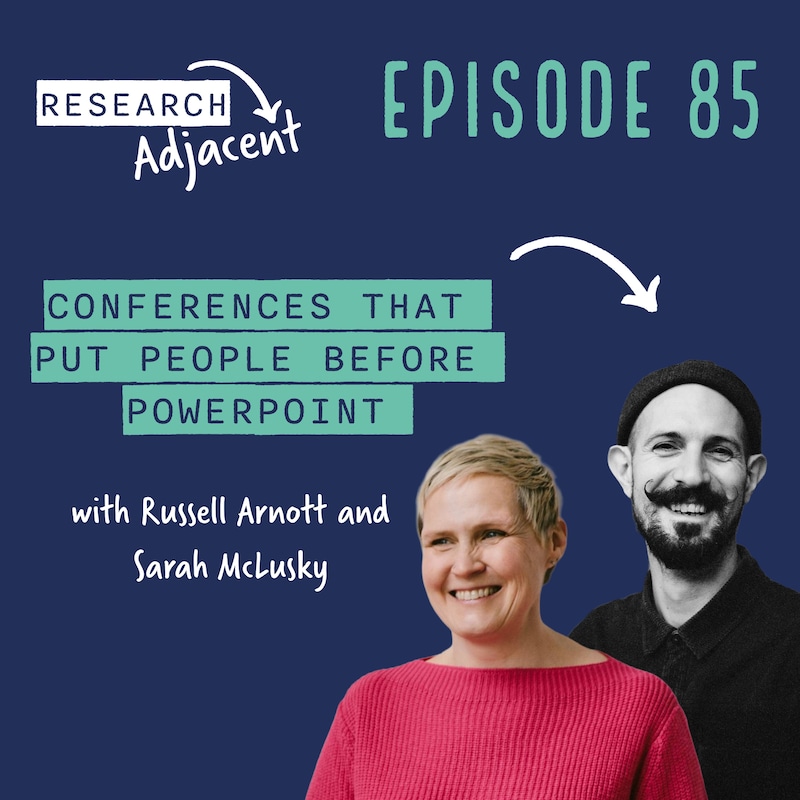
Russell Arnott is an ocean science educator, facilitator and event organiser. Sarah McLusky is a research event consultant, trainer and facilitator. Sarah and Russell are reinventing research conferences to prioritise connection and collaboration through their joint venture Re:Conference.
Sarah and Russell talk about
- Why traditional academic conferences are failing everyone - attendees, presenters, organisers and the wider world
- Prioritising people, connection and collaboration over PowerPoint and information overload
- The small changes that can make a big difference
- How Russell, Sarah and Re:Conference can help reinvent conferences for good
Find out more
- Check out the Re:Conference website
- Connect with Russell on LinkedIn or visit the Incredible Oceans website
- Connect with Sarah on LinkedIn or sign up for her newsletter Gathering with Purpose
About Research Adjacent
- Follow Research Adjacent on LinkedIn or Instagram
- Email a comment, question or suggestion
- Leave a voice note
- Post a review on Podchaser
- Sign up to the Research Adjacent newsletter
Mentioned in this episode:
Research Adjacent Directory Member of the Month: Clare Jonas, That Thinking Feeling
What do you get if you cross an academic psychologist with a research communicator? Some amazing skills training workshops! Clare offers workshops which support researchers to develop knowledge and practical skills in three overlapping areas: research communication, taking care of ourselves and each other, and career skills for academia and beyond. They’re based on Clare's professional expertise, lived experience, evidence from psychology and related fields... and love of dad jokes! Find out more at https://www.thatthinkingfeeling.co.uk/
Transcripts
You've brought all these people together.
Russell Arnott:It's such a waste of time if you're not gonna get them to actually
Russell Arnott:talk or learn from each other.
Sarah McLusky:Making a little bit more room for connection
Sarah McLusky:and conversation I think just makes such a massive difference.
Russell Arnott:This is gonna be facilitated and this is going to be
Russell Arnott:much more interesting, impactful, and you are gonna get much more out of it
Russell Arnott:than the normal conference experience.
Sarah McLusky:It's a real skill, and it's not just about, yes, there's the
Sarah McLusky:logistics, but there's also essentially the psychology behind what you do and
Sarah McLusky:the ways that you put people together.
Sarah McLusky:Hello there.
Sarah McLusky:I'm Sarah McLusky and this is Research Adjacent.
Sarah McLusky:Each episode I talk to amazing research adjacent professionals about what
Sarah McLusky:they do and why it makes a difference.
Sarah McLusky:Keep listening to find out why we think the research adjacent space
Sarah McLusky:is where the real magic happens.
Sarah McLusky:Hello and welcome to Research Adjacent.
Sarah McLusky:Today's episode is on a topic very close to my heart, and that is events,
Sarah McLusky:or more specifically conferences.
Sarah McLusky:I am joined by Russell Arnott, and on paper, Russell is an
Sarah McLusky:ocean science communicator, but like me, he's also an educator,
Sarah McLusky:facilitator, and event organiser.
Sarah McLusky:Between us, Russell and I have been organising science communication
Sarah McLusky:and research related events for decades, and we have a lot of thoughts
Sarah McLusky:about why most academic conferences are letting their audiences down.
Sarah McLusky:We're talking about information overload, poor networking opportunities,
Sarah McLusky:and key decision making delegated to inexperienced staff or even PhD students.
Sarah McLusky:In an era when we are looking to research to solve huge global
Sarah McLusky:challenges, this seems like such a wasted opportunity of all the knowledge
Sarah McLusky:and talent that get together in a room when there's a conference on.
Sarah McLusky:But we also have a lot of ideas for how we could be doing things better.
Sarah McLusky:So we are putting our money where our mouth is, and together we are launching
Re:Conference, a service, which helps conference organisers to create
Re:more engaging and impactful events.
Re:Listen on for tips on how to turn passive audience members into active participants
Re:who show up ready to contribute and connect rather than just listen.
Re:Welcome along to the podcast.
Re:Russell.
Re:It is fantastic to have you here to have a bit of a chat.
Re:Could you tell us, first of all, just a little bit about
Re:who you are and what you do?
Russell Arnott:Certainly.
Russell Arnott:Well, thanks for having me on and I'll try not to be too self-indulgent on this bit.
Russell Arnott:Like a lot of people in the research adjacent group, I wear many hats.
Russell Arnott:So I have a background, I guess in ocean science communication.
Russell Arnott:So I run a marine education non-profit called Incredible Oceans and we.
Russell Arnott:I think, excel I've gotta say that, at taking ocean content to people
Russell Arnott:that don't really care about it.
Russell Arnott:I think a lot of the time ocean content is either really depressing or quite preachy.
Russell Arnott:It's just like endless stuff about straws up whale noses and things
Russell Arnott:like that, and it's like, oh, okay, that's not what got me into the ocean.
Russell Arnott:So we do that.
Russell Arnott:I think my research adjacent part of that is that we run training
Russell Arnott:for environmental researchers.
Russell Arnott:So I think with normal science communication, the focus is entirely on
Russell Arnott:jargon busting and getting the audience to understand what you're saying.
Russell Arnott:I think within an environmental context, it's really important to not
Russell Arnott:only get it the information across, so an audience understands it, but
Russell Arnott:emotes with it, like it, they causes some kind of emotional resonance.
Russell Arnott:And if you include that, then they're more likely to, you know act on the
Russell Arnott:information that you've given them.
Russell Arnott:So that's, yeah, that's kind of what I do.
Russell Arnott:And I also do a little bit of lecturing here and there.
Russell Arnott:There we go.
Russell Arnott:So yeah, that's me.
Sarah McLusky:All sorts of stuff then around this area of how you communicate
Sarah McLusky:research well in a way that connects with the audience, I think is really important.
Sarah McLusky:And that then I guess, leads us on to our shared interest and the thing that we
Sarah McLusky:really wanted to talk about today, which is how we translate some of that knowledge
Sarah McLusky:about how to do communication well and how to connect with audiences, but how that
Sarah McLusky:is done through events and conferences.
Sarah McLusky:So why is this an area that you are particularly interested in?
Russell Arnott:I think having been in academia.
Russell Arnott:I went to my first academic conference, which was the European Marine Science
Russell Arnott:Educators Association, and it was in Valletta, in Malta, it was amazing.
Russell Arnott:And I was like, whoa.
Russell Arnott:And because everyone, there was basically a presenter and educator, and it was
Russell Arnott:this really passionate group of people.
Russell Arnott:It was just brilliant, and everyone there would stand up and they
Russell Arnott:would do tell you amazing things.
Russell Arnott:They didn't overstay their welcome.
Russell Arnott:We had these great interactive sessions where people were learning from each
Russell Arnott:other and contributing skills and and information and sharing best practice.
Russell Arnott:And I was like, oh my God, this is brilliant.
Russell Arnott:And then I went to a proper academic conference and I was like, oh this
Russell Arnott:isn't like the EMSEA conference.
Russell Arnott:This is horrible.
Russell Arnott:This is awkward and weird and so boring and useless and expensive.
Russell Arnott:And, and I'll be honest, I was like, it, it made me feel so thick.
Russell Arnott:I was like, this is my, this is supposed to be my research area.
Russell Arnott:And if I honestly.
Russell Arnott:I didn't understand what 90% of people are saying on the stage
Russell Arnott:or why, why, what is this space?
Russell Arnott:And it really made me feel, I think, quite othered and like academia
Russell Arnott:and this conference space wasn't a place I was supposed to be.
Russell Arnott:So I went from yay the EMSEA conference to, oh my God, no.
Russell Arnott:What have I done?
Sarah McLusky:Yeah, I've certainly had really similar experiences there
Sarah McLusky:where I've gone along to conferences and just been just overwhelmed by the
Sarah McLusky:amount of information, the detail, the, just too much to take in too
Sarah McLusky:many people, and then actually coming away from it wondering why I bothered.
Russell Arnott:I mean, I also, I mean, again, this was, this
Russell Arnott:was ridiculous that I did this.
Russell Arnott:I, because I had no idea really.
Russell Arnott:So I, I come from, I played in punk bands for years and I toured across Europe.
Russell Arnott:And like for me, a conference in my head was like a gig.
Russell Arnott:And I turned up, got a travel grant and I went to Portland in Oregon
Russell Arnott:for the ocean science meeting.
Russell Arnott:And I turned up and they said, I'm really sorry, we haven't got you,
Russell Arnott:you're not registered to attend.
Russell Arnott:I said, no, no, you don't understand.
Russell Arnott:I'm speaking.
Russell Arnott:'cause I didn't, I didn't realize that like everyone there
Russell Arnott:was speaking, but, and they,
Sarah McLusky:Right.
Russell Arnott:and,
Sarah McLusky:Yeah.
Russell Arnott:were like, no, no, no, that we don't care.
Russell Arnott:And like, but I, I'm speaking and they were like, everyone's speaking and
Sarah McLusky:Yeah.
Russell Arnott:I was like, well, how much is it?
Russell Arnott:And they were like $550.
Russell Arnott:I was like.
Russell Arnott:I just had to pay to speak and I was like,
Sarah McLusky:Yeah.
Russell Arnott:I was shocked.
Russell Arnott:I was shocked.
Russell Arnott:But but that's, that's what conferences do.
Sarah McLusky:Well, it's what conferences do and I think that it
Sarah McLusky:is that having organised conferences and events, you know, to some extent
Sarah McLusky:that is what they cost to run.
Sarah McLusky:If you want a nice venue and you want nice catering and you know,
Sarah McLusky:all that sort of stuff, that kind of is what they cost to run.
Sarah McLusky:But I think the main point here is that they don't always feel like
Sarah McLusky:good value for money, do they?
Sarah McLusky:That's the thing and, and especially as you say, when people are paying
Sarah McLusky:to talk, but then often, that's one of the challenges about them
Sarah McLusky:is that people won't even get permission from their organisation
Sarah McLusky:to attend unless they're speaking.
Sarah McLusky:So that's a big issue as well, and it's why you get so many
Sarah McLusky:talks and so many posters and so much information crammed in.
Sarah McLusky:It's for people to justify the reason that they're in the room.
Sarah McLusky:But then it presents such a fantastic opportunity because.
Sarah McLusky:You've got all of the experts, like you say, the the, you go to these and you're
Sarah McLusky:like, well, this is my area of expertise.
Sarah McLusky:These are in theory, these are my people.
Sarah McLusky:And I don't feel like we make the most of having all those people in
Sarah McLusky:the same place at the same time.
Russell Arnott:No and I think because, I mean, it's interesting with academics
Russell Arnott:because if you give them five minutes to talk, they'll get their point across.
Russell Arnott:If you give them seven hours to talk, they'll just fill it.
Russell Arnott:But you have the same takeaway.
Russell Arnott:So think it's very passive, just kind of sitting there.
Russell Arnott:Letting one person after another kind of speak at you.
Russell Arnott:And then the question time, everyone's really nervous to put their hand
Russell Arnott:up and ask a question publicly.
Russell Arnott:Apart from that one guy who's always like, not so much a question, more of
Russell Arnott:a comment, really, that guy, and you're like, oh God, and then he just tries to
Russell Arnott:destroy the person on stage in front of the whole of, you know, your, your sector.
Russell Arnott:And it's like, why are you doing this?
Russell Arnott:Just have a chat with them afterwards, but there's so much like
Russell Arnott:the awkward networking, like the forced networking sessions as well
Sarah McLusky:Yeah.
Russell Arnott:Where everyone just kind of stands awkwardly with a cocktail.
Russell Arnott:I dunno
Sarah McLusky:No, there's all kinds tricky things there going on, isn't there?
Sarah McLusky:There's the power dynamics, like you say, with the kind of Q and A and the
Sarah McLusky:power dynamics implicit in who gets to speak on the stage and who doesn't.
Sarah McLusky:And then, you know, I don't know about you, but I virtually never
Sarah McLusky:ask questions, partly because the intimidation of putting your hand up
Sarah McLusky:in front of everybody and potentially saying something that everybody in
Sarah McLusky:your head, you're always thinking, well everybody else knows, surely everybody
Sarah McLusky:else knows the answer to this and I'm the only one who didn't get it.
Sarah McLusky:Partly that, but also partly 'cause sometimes I need a bit of time to
Sarah McLusky:process the information or if I just had the chance to chat about it and
Sarah McLusky:then I could formulate questions.
Sarah McLusky:So I think some of that structure there is really problematic and the power
Sarah McLusky:dynamics and things that it sets up, but also the, or like you say, the networking.
Sarah McLusky:I think, we'll maybe I'll maybe park that for now and we'll come back to that later.
Sarah McLusky:But one of the, the things that's coming up here, and I think it's really
Sarah McLusky:relevant to both of us, is that that sense of just having people on the
Sarah McLusky:stage and them passively just throwing information at you just isn't good from
Sarah McLusky:a learning and education perspective.
Sarah McLusky:And that's something that both you and I have, that's the
Sarah McLusky:route that we've come through.
Sarah McLusky:I did years working in kind of STEM education and running events for
Sarah McLusky:schools and helping researchers to communicate their research to young
Sarah McLusky:people, but then also, I was actually a lecturer for seven years as well.
Sarah McLusky:So we've both trained as teachers so we know how to structure information
Sarah McLusky:and how to communicate information so that people can actually take it in,
Sarah McLusky:and I think that's something that's missing a bit as well, isn't it?
Russell Arnott:Massively I mean, being within the ocean education world, the
Russell Arnott:conferences that I tend to go to talk about how people learn of different ages,
Russell Arnott:how different people absorb information.
Russell Arnott:And it's almost like when you get into the academic world, everyone's like pedagogy.
Russell Arnott:That's not for us because we're academics.
Russell Arnott:We are above this and we are so intelligent that we learn in a completely
Russell Arnott:different way to all the other people.
Russell Arnott:So all of this pedagogical research and everything, I
Russell Arnott:don't need to apply it to you.
Russell Arnott:I can talk about it, but it could just go completely out the window.
Russell Arnott:I mean, I think, what is it, the average person doesn't take in information
Russell Arnott:after 20 minutes, so I'm like, why have we got these, even in a university
Russell Arnott:setting these hour long lectures.
Russell Arnott:I was a secondary school science teacher for the best part of 10
Russell Arnott:years, and you structure it and you have like, right, I've got a starter.
Russell Arnott:And then we get up and we do an activity.
Russell Arnott:And then I want to test that you've understood the information I've told
Russell Arnott:you or the experiment that we've done with a little wrap up at the end.
Russell Arnott:And it's, it's paced and everything.
Russell Arnott:And sitting in a conference hall, you know, with no windows and over air
Russell Arnott:conditioned and strip lighting and just being spoken at after one, after the
Russell Arnott:another with these intense dense talks.
Russell Arnott:You're like, what?
Russell Arnott:How?
Russell Arnott:Who decided that this was the format?
Sarah McLusky:I think you do wonder sometimes 'cause yeah, like you,
Sarah McLusky:when I was, when I was trained as a teacher, we were told you never
Sarah McLusky:talk for more than 10 minutes.
Sarah McLusky:And then you break up with something, and when I talk to academics about
Sarah McLusky:this, sometimes I get that reaction of like, you say, well, we are not kids.
Sarah McLusky:So that doesn't apply to us, but I think it just applies to human beings.
Sarah McLusky:That's what, to me, is so important.
Sarah McLusky:And yes, maybe you, you take things, you know, as a communication specialist,
Sarah McLusky:it's always about the audience and it's always about what does that audience need?
Sarah McLusky:So when I say you don't talk for more than 10 minutes, maybe where you break
Sarah McLusky:it up is you show a video rather than talking, or you ask a question and you
Sarah McLusky:know, get some feedback from the audience.
Sarah McLusky:It doesn't need to be the same kinds of activities that you would do in
Sarah McLusky:education, but the principle is the same, that people just can't absorb
Sarah McLusky:constant information, information, information, and then they go away.
Sarah McLusky:And I think it's always the case.
Sarah McLusky:I, I'm, I'd be interested to know if you've had the same experience, but
Sarah McLusky:when I go away from a conference I might remember little snippets and there
Sarah McLusky:might be certain things that I think, oh, I want to go away and look that up.
Sarah McLusky:But that's really all you're doing is you're just planting that little seed
Sarah McLusky:and then giving people maybe something they want to go and look up afterwards.
Sarah McLusky:Those people are not taking that information in in the moment.
Russell Arnott:I think my main thing don't like about the format is that you
Russell Arnott:have this audience of people with an amazing experience, amazing knowledge
Russell Arnott:and skills, but the, the onus is put entirely on the person on stage as being
Russell Arnott:like the expert and everyone in the audience is kind of dismissed I'm like,
Russell Arnott:you've brought all these people together.
Russell Arnott:It's such a waste of time.
Russell Arnott:Like if you're not gonna get them to actually talk or learn from each other.
Russell Arnott:I think conferences, they're so stuck in their ways that people
Russell Arnott:are like, this is just how it is and you can't see anything else.
Sarah McLusky:So I've got some thoughts on why we've got stuck in this way of
Sarah McLusky:doing things, but I'd be interested to hear what you think about it.
Sarah McLusky:How have we ended up here?
Russell Arnott:I've seen how conferences are organised, having been in academia
Russell Arnott:and it's literally a PhD supervisor walks into the office and goes, you
Russell Arnott:two are organising the conference and they're like, huh, what do I need to do?
Russell Arnott:Well, you need to get a tote bag completely covered in bad logos, and you
Russell Arnott:need to put a pen in the tote bag, and we need to have a big meal and you need to
Russell Arnott:get, get sticky pads for big posters and and you need to book some lecture theaters
Russell Arnott:so everyone can talk and it's just that.
Russell Arnott:It's like lowest common denominator.
Russell Arnott:I pass the baton over, I'm giving it to people who, who aren't events
Russell Arnott:experts or specialists, and they're told this is how I have to do it.
Russell Arnott:And the system just perpetuates.
Sarah McLusky:I think that is so true, and I think that it is, or when they
Sarah McLusky:do get somebody else in to organise it, it's often a pretty low grade admin
Sarah McLusky:assistant, essentially, and they'll be tasked with something like, you know,
Sarah McLusky:booking the hotel and booking the catering and you know, all that sort of thing.
Sarah McLusky:Maybe liaising with the speakers, and that is a really, really important work.
Sarah McLusky:So I'm not in any way dismissing that.
Sarah McLusky:A lot of that stuff is the absolute bedrock to running a successful event.
Sarah McLusky:But often those people, because as I say, they're usually on a pretty low pay grade.
Sarah McLusky:And then there's also this power dynamic again.
Sarah McLusky:So they either don't have the experience or they don't have the
Sarah McLusky:authority to put their hand up and say.
Sarah McLusky:Why are we doing it this way?
Sarah McLusky:You know, couldn't, couldn't we be doing something different?
Sarah McLusky:And I think there's this pervasive expectation that people
Sarah McLusky:think until they've done it.
Sarah McLusky:Think organising events is easy.
Sarah McLusky:They think, you know, you just book a room and people turn up.
Sarah McLusky:And that's it.
Sarah McLusky:But it's not, and I've been doing this stuff now for over 30 years really
Sarah McLusky:and, and it's a real skill, and it's not just about, yes, there's the
Sarah McLusky:logistics, but there's also essentially the psychology behind what you do and
Sarah McLusky:the decisions that you make and the ways that you put people together.
Sarah McLusky:And some of that comes from my experience of working in education.
Sarah McLusky:Some of it comes from my experience of working in academia and seeing how people
Sarah McLusky:interact with each other and bringing all of that stuff together is the way
Sarah McLusky:that you deliver an amazing event.
Sarah McLusky:You know, some of the things that I've done over the years, like the biggest
Sarah McLusky:one that I did was 6,000 kids over the course of like four days, like
Sarah McLusky:over a thousand kids coming in each day, like all these buses lined up.
Sarah McLusky:And a lot of people would take something like, I know other people who've run
Sarah McLusky:similar events and all they'll do is just get a big hall and just put all the
Sarah McLusky:kids in there and have loads of stands.
Sarah McLusky:But the thing is.
Sarah McLusky:I know that that actually doesn't, people don't learn very much from that.
Sarah McLusky:So even though it was harder work, my approach is like, no, we give them,
Sarah McLusky:we give them a bit of variety and we'll have like a kind of show and
Sarah McLusky:then we'll have some little workshops.
Sarah McLusky:And it was really important to me that we give them a variety of experience
Sarah McLusky:because everybody learns differently.
Sarah McLusky:And when we think about accessibility, it's not just about having,
Sarah McLusky:you know, lifts to get into the building and not having stairs.
Sarah McLusky:It's thinking about all the different ways that people learn.
Sarah McLusky:And so all of that experience is what you need to pull together to
Sarah McLusky:actually do an event that feels exciting and special and genuinely
Sarah McLusky:connecting people And, and I think the people that are currently organising
Sarah McLusky:conferences, it's not their fault, but they just don't have that breadth of
Sarah McLusky:understanding of what goes into it.
Russell Arnott:Exactly, and I, not going to name the conference or the
Russell Arnott:experience which I had over summer.
Russell Arnott:But it was, it was a long experience.
Russell Arnott:That was two weeks.
Russell Arnott:Two weeks.
Russell Arnott:It wasn't your normal thing.
Russell Arnott:It was 120 people assembled from 40 different countries,
Russell Arnott:and it was absolutely awful.
Russell Arnott:It like, I cried four times.
Russell Arnott:It was, it was painful.
Russell Arnott:There was no opportunity to kind of interact or learn from any of the others.
Russell Arnott:We were treated completely like children, I had an intervention with the conference
Russell Arnott:organisers and it was like, we are not children like I'm a university lecturer.
Russell Arnott:Like please let me help with this I, I was, yeah, I was
Russell Arnott:just absolutely flabbergasted.
Russell Arnott:And when it did finally fall to pieces, like a couple of days before the end,
Russell Arnott:because they hadn't done any kind of group cohesion or anything like that.
Russell Arnott:One of the organisers, I saw her and she had her head in her hands, and she was
Russell Arnott:like, oh, you know, I'm a researcher.
Russell Arnott:I'm not an events organiser.
Russell Arnott:You know, I didn't think it would be this hard.
Russell Arnott:And I'm like, yeah, it is.
Russell Arnott:What did you think?
Russell Arnott:What did you think you were gonna get this wad, wad of money, assemble these
Russell Arnott:people, fly them across, put them in a a hotel and just speak at them and
Russell Arnott:not do anything else for two weeks.
Sarah McLusky:Is, I mean, that is an incredible scenario to and, and such
Sarah McLusky:a, oh, when you add up, it's not just the cost of running the conference, but
Sarah McLusky:it's the cost of those people's time.
Sarah McLusky:It's the cost of the transport costs, the accommodation costs, all of that.
Sarah McLusky:And then, I mean, I feel so sorry for that event organiser but that's one of
Sarah McLusky:the problems is people don't know that until they're in it and she probably
Sarah McLusky:never gonna want to do that again.
Sarah McLusky:She's gonna like run screaming in the other direction.
Sarah McLusky:And then that's how we don't get things getting better either, is
Sarah McLusky:because people, like you say, it might be a PhD student or somebody,
Sarah McLusky:they just tick that box and move on.
Sarah McLusky:Another thing that happens a lot of the time as well is I think that
Sarah McLusky:these, the really big conferences are outsourced to external companies.
Sarah McLusky:And those external companies often just have a vested interest to get it done
Sarah McLusky:as quickly and efficiently as possible.
Sarah McLusky:And so for them, they just follow, like, this is the template, we
Sarah McLusky:follow the template, tick all the boxes, and then it's done.
Sarah McLusky:And because for them, the outcome is deliver a conference.
Sarah McLusky:They're not incentivized to encourage people to have those conversations, for
Sarah McLusky:people to go away feeling, you know, that they've made some connections and
Sarah McLusky:it's been a good use of their time.
Sarah McLusky:That's not baked into their contract and why they're there.
Russell Arnott:Yeah, and I, I guess a bit of me feels that now as a conference
Russell Arnott:attendee, I, I am, when I turn up, I'm expecting this passive experience, and I
Russell Arnott:think maybe people are, well, what, what?
Russell Arnott:What could you do?
Russell Arnott:You want it to be all kind of bells and whistles and like putting people
Russell Arnott:outside their comfort zones and things like, you want to be just
Russell Arnott:like, oh, we're so out of the box.
Russell Arnott:Let's like, well, what?
Russell Arnott:Go on then.
Russell Arnott:It's very easy for you guys to sit there and slag off the
Russell Arnott:conference format, but like.
Russell Arnott:Well, what are you gonna do?
Russell Arnott:And then it's like, okay, you've got these academics and let's face it, compared to
Russell Arnott:the general public, I would say academics are probably slightly more introverted,
Russell Arnott:maybe slightly more on the spectrum.
Russell Arnott:So putting people into uncomfortable situations , I think
Russell Arnott:people are like, well, I don't wanna do that with this crowd.
Russell Arnott:Let's not stress test the system or try and push people
Russell Arnott:outside their comfort zones.
Russell Arnott:Let's just keep doing it because the audience is expecting this as well,
Russell Arnott:this kind of very passive experience.
Russell Arnott:So
Sarah McLusky:Yeah, but I think that leads us on really nicely though to one
Sarah McLusky:of the reasons that we wanted to have this conversation and put it out into the
Sarah McLusky:world is that, that we've got I some ideas about how we could do things differently.
Russell Arnott:Yes.
Sarah McLusky:and, and as you say, doing things differently in a way that
Sarah McLusky:is helpful and that maybe pushes people out of their comfort zone a little
Sarah McLusky:bit, but not too much, too quickly.
Sarah McLusky:And some of those things I think are very simple.
Sarah McLusky:You could take them all the way up to completely redesigning
Sarah McLusky:conferences, but yeah.
Sarah McLusky:What are some of your thoughts about how we could be doing things better?
Russell Arnott:I think that needs to be a complete shift as the, from the conference
Russell Arnott:attendee being a passive recipient of information to being an active participant
Russell Arnott:in the community and in the conference.
Russell Arnott:And I think this idea of pushing people outside of their comfort zones.
Russell Arnott:I think if you let people know what to expect and what their expectation is
Russell Arnott:when they're coming to this conference.
Russell Arnott:It's not like they're being sprung, like, okay, I want you to stand
Russell Arnott:up and give a five minute dance interpretation of your research.
Russell Arnott:You know, it's not gonna be something like that.
Russell Arnott:Yeah.
Russell Arnott:So I think
Sarah McLusky:I do know some people have done that though, and they've
Sarah McLusky:made some very cool events, but that's an entirely different side of things.
Russell Arnott:you know what I mean?
Russell Arnott:It's like, like putting people on the spot isn't, isn't what this
Sarah McLusky:Absolutely.
Russell Arnott:about
Sarah McLusky:Definitely not.
Russell Arnott:it's, it's like in life you get out what you put in.
Russell Arnott:I think should be more of a focus on the attendees as participants
Russell Arnott:within a community bringing skills, knowledge, and experience to share.
Russell Arnott:And the conferences that I've seen that have worked really well in terms
Russell Arnott:of interactions are where people are encouraged to submit information to an
Russell Arnott:online portal or an app or a webpage where you can see who's gonna be there.
Russell Arnott:You can filter it by interests and people can basically say, this is
Russell Arnott:what I'm really good at and I'm happy to talk about, or happy to share.
Russell Arnott:And I'm interested in meeting people that are able to do this or have
Russell Arnott:conversations in and around that.
Russell Arnott:So.
Russell Arnott:Doing that small bit of prep in advance to kind of pave the way, to smooth
Russell Arnott:the way and facilitate interactions, skill, knowledge exchanges, I think
Russell Arnott:is really simple and really effective.
Russell Arnott:But that's, I think, is this, the key is that the conference
Russell Arnott:participant shouldn't be a passive.
Russell Arnott:They should be an active contributor to the community and to the event.
Sarah McLusky:Yeah.
Sarah McLusky:And I, I really hope that that making people feel like more like participants
Sarah McLusky:rather than audience members can also help to shift some of that dynamic as well.
Sarah McLusky:'cause as you say, people often go in just, you know,
Sarah McLusky:oh, clinging on for dear life.
Sarah McLusky:Like, get through this presentation or, or get through this poster.
Sarah McLusky:And it, it is often that sense of this is something that I have to do
Sarah McLusky:to tick that box on my CV or, you know, show my research with the world
Sarah McLusky:and I feel that people often don't show up to conferences feeling very.
Sarah McLusky:Like expecting very much from them, you know?
Sarah McLusky:But I think as you say, some of that, just a little bit of prep work before,
Sarah McLusky:I mean, recently for an event I was sent a delegate list beforehand,
Sarah McLusky:and it's the first time in years that I've been sent a delegate list.
Sarah McLusky:And I had forgotten what a gift that was because I knew that there were
Sarah McLusky:gonna be a lot of people at this event that I hadn't met in person that I
Sarah McLusky:knew, maybe from LinkedIn or, you know, we connected over something else.
Sarah McLusky:We had, you know, mutual connections in common, but I
Sarah McLusky:hadn't met them in person before.
Sarah McLusky:So having that list meant that I could go and look them up on, on LinkedIn before,
Sarah McLusky:remind myself what they looked like.
Sarah McLusky:And just be like, right, okay, yeah, I, I want to talk to them.
Sarah McLusky:Now.
Sarah McLusky:Fortunately, that was a, a small event, so it was really easy to find people.
Sarah McLusky:But another thing I found is recently I went to a really big conference
Sarah McLusky:where, again, I knew there were lots of people in the room that I knew in
Sarah McLusky:some respect, but hadn't met in person.
Sarah McLusky:At the end of the day, I hadn't managed to speak to any of them because I
Sarah McLusky:couldn't find them because it was a really big conference and there was
Sarah McLusky:no structured, you know, there was no kind of way to help people to network,
Sarah McLusky:to find people, like you say, maybe to have small group conversations.
Sarah McLusky:Even just stuff like, some of the things that I feel would make such
Sarah McLusky:big difference are really small, like just making the coffee breaks
Sarah McLusky:longer, making the talks shorter.
Sarah McLusky:Maybe after a talk you have people just spend a couple of minutes talking
Sarah McLusky:to the person sitting next to them about the talk and about what they
Sarah McLusky:heard, and then maybe that gives people an opportunity to frame questions.
Sarah McLusky:Some of this stuff is so, you know, like you say, we're not talking about
Sarah McLusky:interpretive dance or, you know, research based standup comedy or something.
Sarah McLusky:It's, it's just making a little bit more room for connection
Sarah McLusky:and conversation I think just makes such a massive difference.
Russell Arnott:I wanna walk away with having learnt something properly or, or
Russell Arnott:having found a, like a collaborator that I'll be able to, and not just someone
Russell Arnott:like, oh, I've got a business card.
Russell Arnott:I'll follow up with like an, an email.
Russell Arnott:Actually have a connection with someone.
Russell Arnott:Like, okay, this is great.
Russell Arnott:We're gonna walk away from this and something is gonna happen,
Russell Arnott:something's gonna gonna get done.
Russell Arnott:I think one of the most impactful things, again, going back to the EMSEA conference
Russell Arnott:was one of the founders of it, Peter Todenham, he ran this thing called open
Russell Arnott:space where you just have a map of the conference and you've got different
Russell Arnott:tables or different rooms, and if you want to talk about something, you write
Russell Arnott:it on a post-it note and you slap it on the room and everyone goes to that room
Russell Arnott:who's interested to talk about that thing.
Russell Arnott:If you, if you suggested the session, you make notes and you give it
Russell Arnott:back to the conference organisers, and then they decide the direction
Russell Arnott:of the subsequent days, I think.
Russell Arnott:I think there's this idea that, okay, well what I'm being lazy as a conference
Russell Arnott:organiser if every moment isn't filled with something, and that actually, if
Russell Arnott:it is a bit more flexible and a bit more fluid, and I can allow as things pop up
Russell Arnott:or people want to talk about something or within our community, we could be adaptive
Russell Arnott:to be able to kind of deal with that.
Russell Arnott:And similarly with open space, it's great if you decide I want
Russell Arnott:to talk about this, you go to your room and no-one else is there.
Russell Arnott:You clearly know that this thing that you've proposed isn't in
Russell Arnott:of interest to your community.
Russell Arnott:So you're
Sarah McLusky:Yeah.
Russell Arnott:there we go.
Russell Arnott:And you know, it's a great rule.
Russell Arnott:You know, you can be active within those sessions.
Russell Arnott:You can be a passive butterfly and flit around them all.
Russell Arnott:But the rule is you only stay if you are contributing actively,
Russell Arnott:or you are learning something.
Russell Arnott:And if you're doing neither of those things and none of the sessions
Russell Arnott:that are proposed are of interest to you, then just go check your emails.
Russell Arnott:No one cares.
Russell Arnott:You know?
Russell Arnott:So there you go.
Russell Arnott:It's, it's, but again, if you were like to propose that and
Russell Arnott:people are like, oh, what?
Russell Arnott:What's the conference agenda?
Russell Arnott:And you sent it through and you were just.
Russell Arnott:What?
Russell Arnott:Well these guys are lazy.
Russell Arnott:What you, you expect me to give up a day of my time for like open-ended chat?
Russell Arnott:And it's like, well, yeah, but trust in us as the organisers that this isn't
Russell Arnott:us being lazy, that this is gonna be facilitated and that this is going to
Russell Arnott:be much more interesting, impactful, and you are gonna get much more out of it
Russell Arnott:than the normal conference experience.
Russell Arnott:So.
Sarah McLusky:Yeah, I think that that sense that it is often, I often say
Sarah McLusky:that it's the content that gets people through the door, so that's where, like
Sarah McLusky:you say, who are the speakers and what's the topics and that sort of thing.
Sarah McLusky:So it's finding that balance, isn't it, between making people feel
Sarah McLusky:this is something worth showing up for and then giving them what they
Sarah McLusky:really want or what they really need.
Sarah McLusky:I mean, I think not just with the fact of, you know, now the, the push for
Sarah McLusky:interdisciplinary, interdisciplinary collaboration and the increase in
Sarah McLusky:hybrid working and you know, there's this sense that when we do actually
Sarah McLusky:get people together in a room, we need to make really good use of that time.
Sarah McLusky:So I think we've set out there all these ideas and things we've got and so we are
Sarah McLusky:pulling those ideas together into a bit of an offer for any conference organisers.
Sarah McLusky:So if there are people out there listening, thinking, yeah, I,
Sarah McLusky:I've been to those conferences that were, you know, grim.
Sarah McLusky:I want to do things a little bit differently.
Sarah McLusky:What can we offer to help?
Russell Arnott:Can we offer?
Russell Arnott:Well, I think that we both have a lot of event organisation experience.
Russell Arnott:We have been to our fair share of really bad conferences from
Russell Arnott:across different, different areas.
Russell Arnott:And I think we've been to conferences that have tried something a little
Russell Arnott:bit interesting and have developed between us a little bit of a toolbox,
Russell Arnott:which we think is applicable across all different types of conference.
Russell Arnott:It not just our own specialists.
Russell Arnott:So I know I started at the beginning talking about ocean stuff, you
Russell Arnott:know, the, the stuff which we are proposing isn't is for any conference.
Russell Arnott:so we have put together a thing, a thing, a collaboration,
Sarah McLusky:A thing?
Sarah McLusky:a collaboration.
Sarah McLusky:Yeah.
Russell Arnott:Which we are calling Re:Conference because
Russell Arnott:we want to reimagine, rethink, redo the conference format.
Russell Arnott:and yeah, if you are interested in working with me and Sarah to improve the
Russell Arnott:conference experience and we have a tiered approach depending on what your budget
Russell Arnott:or, how much trust you wanna place in us.
Russell Arnott:But we have a website, which is re- conference.org, where you can
Russell Arnott:go on there and you can see who we are and what we are proposing.
Russell Arnott:And yeah, we look forward to hearing from you
Sarah McLusky:Yeah.
Sarah McLusky:Yeah, so I'll put the link to the conference webpage in the show
Sarah McLusky:notes so people can find it there.
Sarah McLusky:We've discovered not the easiest thing to Google, but you'll be able to find
Sarah McLusky:either me or Russell as well, and you can get in touch with us that way.
Sarah McLusky:But some of the things that we're thinking of that we could offer is
Sarah McLusky:some of the things that I've found that can make the biggest difference.
Sarah McLusky:Basic level is you can just come to us with your conference agenda and what
Sarah McLusky:you want to get out of the conference and we can give you some suggestions.
Sarah McLusky:And as I say, it might be some of just those small tweaks,
Sarah McLusky:like making the breaks longer.
Sarah McLusky:Having maybe just one session that isn't quite so structured where
Sarah McLusky:you have a bit more discussion.
Sarah McLusky:Maybe it's sending out the delegate list in advance, or having some kind
Sarah McLusky:of online forum that goes along.
Sarah McLusky:You know, so there's little things that you can do around a
Sarah McLusky:workshop or a conference to, to make a big difference actually to
Sarah McLusky:the experience of the attendees.
Sarah McLusky:So you can come along and we can give you that advice there.
Sarah McLusky:Or you can get me and or Russell to come along to your event
Sarah McLusky:and run some sessions for you.
Sarah McLusky:And that might be helping to do some facilitated networking that doesn't
Sarah McLusky:feel awkward and cringy and actually gets people having natural conversations
Sarah McLusky:and finding the people that they are interested in connecting with.
Sarah McLusky:We can do that.
Sarah McLusky:We can run some of these open space type, discussion centered kind
Sarah McLusky:of activities we can help to, get people out of the conference room
Sarah McLusky:if that's what you want to do.
Sarah McLusky:You know, it's well known that sometimes you have the best conversations when
Sarah McLusky:you're not face-to-face with somebody and when actually you're maybe
Sarah McLusky:doing something a bit more relaxed.
Sarah McLusky:So we can help to organise those things as well.
Sarah McLusky:But yeah all sorts of things that help to shift the focus from being
Sarah McLusky:presentation centered, information centered to being a bit more people
Sarah McLusky:centered, and that is very much what we want to offer out there into the world,
Russell Arnott:I think this is really important, like really important for,
Russell Arnott:for science in particular, because at the moment I feel that this is a bottleneck
Russell Arnott:in scientific advancement, in knowledge exchange, skill exchange, you want.
Russell Arnott:You are there, like the stuff that I'm involved with often is trying to
Russell Arnott:save the ocean, trying to deal with climate change, these big issues,
Russell Arnott:and if people aren't collaborating as well as they can, if people aren't
Russell Arnott:sharing knowledge and information and skills as well as they can, then.
Russell Arnott:You know, we are stalling the system.
Russell Arnott:The system is, isn't progressing as quickly as it should be.
Russell Arnott:So I think this is one of the reasons that we're, I feel a slight desperation about
Russell Arnott:trying to do this and help people come together for, for the good of humanity.
Russell Arnott:And I think all this is what all science, tech, everything is, is aiming to do so,
Russell Arnott:and the conferences are, are a one chance a year where everyone comes together
Russell Arnott:to talk about or should talk about the big issues and it's not happening.
Russell Arnott:So there's a slight kind of urgency I think, in terms of what I'm trying,
Russell Arnott:what we are trying to achieve.
Russell Arnott:So yeah, there we are that get off my podium.
Sarah McLusky:We need to get you on your soapbox there.
Sarah McLusky:Oh, fantastic.
Sarah McLusky:Well thank you so much Russell, for coming along.
Sarah McLusky:For sharing your insights into conferences and yeah, and for it should be said,
Sarah McLusky:Russell is kind of the, the origin of this and managed to drag me into this scheme.
Sarah McLusky:But I think between us, we have, as you say, got a lot to offer and
Sarah McLusky:I think it, I think people might be surprised at how easy it is to
Sarah McLusky:make a really big difference to the experience to people in conferences.
Sarah McLusky:So yeah, come and come and have a chat.
Russell Arnott:Don't say that.
Russell Arnott:We have to make it like it's really difficult and people have to hire us.
Russell Arnott:To be fair, we have shared quite a lot of ideas on the podcast, so there we go.
Russell Arnott:Yeah.
Sarah McLusky:Yes.
Sarah McLusky:Yeah.
Sarah McLusky:Well, I think it's, as you say, if our mission is to actually make things better.
Sarah McLusky:Then there's more, there's more conferences out there,
Sarah McLusky:and then we can possibly help.
Sarah McLusky:So yeah, we need to get the word out.
Russell Arnott:This is very true.
Russell Arnott:Make your conferences better everyone!
Russell Arnott:Make them better!
Sarah McLusky:Thanks for listening to Research Adjacent.
Sarah McLusky:If you're listening in a podcast app, please check you're subscribed and then
Sarah McLusky:use the links in the episode description to find full show notes and to follow
Sarah McLusky:the podcast on LinkedIn or Instagram.
Sarah McLusky:You can also find all the links and other episodes at www.researchadjacent.com.
Sarah McLusky:Research Adjacent is presented and produced by Sarah McLusky, and the
Sarah McLusky:theme music is by Lemon Music Studios on Pixabay and you, yes you, get a big
Sarah McLusky:gold star for listening right to the end.
Sarah McLusky:See you next time.
