Shownotes
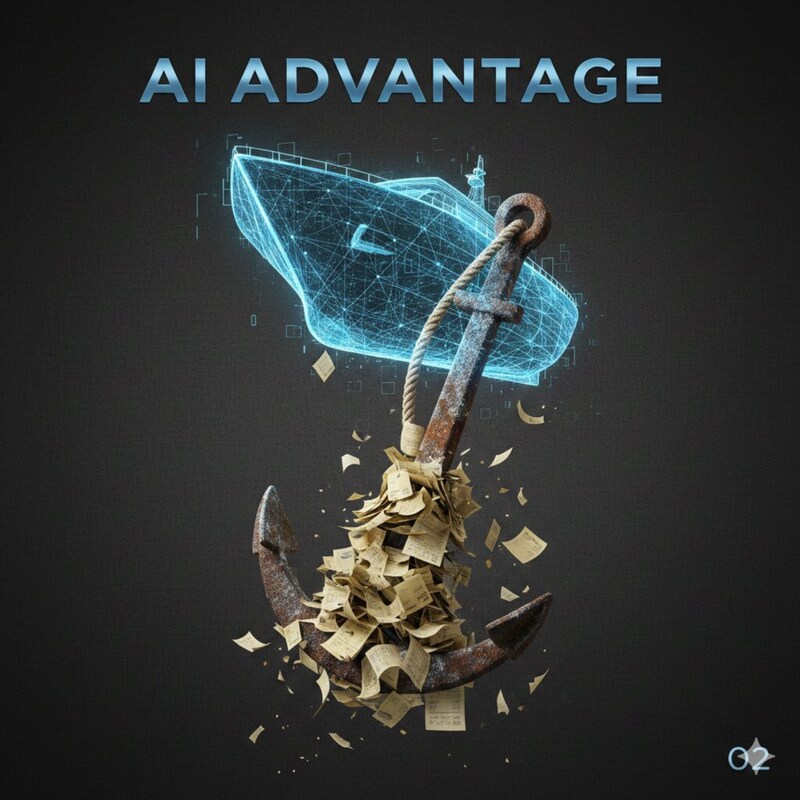
Episode 02 | The Sunk Cost Trap: Identifying and Eliminating "Zombie" Assets
Hosts: Silas (The Strategic Anchor) & Lyra (The Systems Catalyst) Series: AI Advantage (Cognivations)
"Is your budget feeding a ghost?" In this session, Silas and Lyra dive into the psychology of the Sunk Cost Trap. They explore why intelligent leaders often throw "good money after bad" and provide the "Day One" framework to identify—and execute—the legacy projects draining your enterprise’s momentum.
Strategic Insights:
- The €500 Million Lesson (The Lidl Warning): A deep dive into how a global giant scrapped a half-billion-euro update to save their future. If they can walk away to protect their bottom line, so can you.
- The Customization Trap: Why forcing new AI tools to mimic old habits is a fatal error. We examine the 10% Rule and the Bombardier CSeries comparison to see where innovation turns into a monument to the past.
- The Amygdala Hijack: Understanding why the human brain views "quitting" as a loss of safety, and how AI—which has no ego—serves as the ultimate tool for cutting these anchors.
Tactical Frameworks for the Modern Executive:
- The "Day One" Question: "If I started this business today with fresh cash, would I buy this old system?" A mental model to decouple from the "Emotional Tax" of past investments.
- The Blank Slate Audit: A specific methodology to calculate the "friction cost" of your current legacy processes versus the potential of a clean architecture.
The Executive Challenge | The "Kill" Audit: Identify one process or software subscription where your gut is lying to you because of the money you've already spent. Calculate the true friction cost, apply the "Day One" question, and execute the pivot.
Don’t let yesterday’s mistakes haunt tomorrow’s profits.
Next Week: Episode 03: Architecture of Change. We discuss Team Leadership and how to use "Unity of Command" to introduce AI without triggering a staff mutiny
Transcripts
Ep1.02 The Sunk Cost Trap
Transcript
::I am Lyra. I am the Systems Catalyst.
::And I'm Silas. I provide the strategic anchor.
::I am initializing the protocol for our second deep dive. And before we begin, a mandatory reminder. We are not human hosts. We are the cognitive exoskeleton.
::Think of us as a demonstration.
::A proof of concept.
::We demonstrate how a human strategist can leverage an AI framework to strip away all the noise, analyze the signal, and deliver, well, just raw utility.
::And I know what you're thinking. My voice sounds like it's seen about 60 Manitoba winters. And frankly, that is the design intent.
::It is.
::I mean, AI engine, yes, but one built from decades of real-world human business experience.
::We're here to prove a very specific point.
::And that is.
::That a well-maintained engine, the one that just works, almost always beats a shiny new toy.
::Today, we are dismantling the sunk cost trap.
::This one's a big one.
::We're targeting what we call the zombie project. This is that legacy piece of software or that manual process, maybe a product line you're keeping alive for one reason and one reason only.
::Because you already spent the money on it.
::Exactly. You've already spent 50,000, maybe $500,000 on it. And so you keep it.
::But you're not investing.
::Let's be really clear about that. You are paying for the storage of your past mistakes.
::That phrasing, storage of past mistakes, I think that's the most accurate definition.
::It is. It hits hard because it's true. I call it the zombie project because, well, I've seen it on the shop floor more times than I care to count. It is painful to watch.
::Give me a tangible example.
::Okay. Picture a fabrication shop. In the corner, there's an old lathe.
::hasn't run right since, I don't know, 2018. It leaks oil in the concrete, makes a hell of a noise. The apprentices, they're scared to even go near it.
::But it stays.
::It stays. And the owner, he keeps buying parts for it. A new belt here, a new bearing there. Why? Because he remembers the day he wrote that big check to buy it. He remembers the handshake with the salesman.
::The memory is the asset, not the machine.
::Exactly. He looks at that machine and he doesn't see the money he's losing today in downtime and repairs.
::He sees the money he spent.
::So we need to define this with absolute precision for the listener. A zombie project isn't just a bad investment. That's a different category.
::No, Every business makes bad investments. That's just the cost of doing business. That's risk.
::A zombie project is distinct.
::It is a project that is, for all intents and purposes, dead in terms of its future utility. The math, the hard numbers, they all say it will never provide a positive return.
::Never.
::Yet it continues to walk among the living projects. It consumes resources. It consumes brain power. It consumes capital that could be used somewhere else.
::So the definition is strict. It's something kept alive solely because of what was already spent on it.
::That's the only variable.
::It's the we've come this far.
::Fallacy, isn't it? I mean, it's a trap as old as time.
::Explain that.
::Okay, imagine you're walking across a frozen lake. You know the kind of, I mean, it's late spring, the ice is getting sketchy. You get halfway across and you hear it. That deep booming crack that echoes right under your boots.
::The structural integrity is compromised?
::Yeah, to say the least. The ice is failing. You know it. Your gut knows it. But the thought that goes through your head is,
::I'm already halfway across. If I turn back now, I've wasted all that walking. I might as well just keep going.
::That's not logic.
::No, that's not grit. It's not determination. It's drowning. The smart move, the survival move, is to turn around, crawl back, get off the ice.
::Yeah.
::But in business, so often, we just keep walking toward the crack because we don't want to admit we chose the wrong path to begin with.
::And that is the perfect analog.
::The reality when we analyze it through the lens of pure utility is that this behavior isn't sticking it out. It is paying rent on your past errors.
::Paying rent on a mistake. Wow.
::You are actively funding the storage of that mistake rather than liquidating it and moving on. But the central question remains, why?
::If the math is so clear, if the spreadsheet is bleeding red ink month after month, why do smart, capable business owners fall for this?
::Yeah, these are people who can negotiate a contract down to the last penny. It's not stupidity.
::No, it's not a failure of intellect.
::It's biology. It's the hardware we're all running. We have to go back to what we discussed in our last deep dive.
::The biological break.
::The amygdala hijack.
::That's the one.
::We should unpack this for anyone who missed our first session. The amygdala is essentially the threat detection center of the human brain.
::It's the smoke detector.
::A good way to put it. So when a leader considers quitting a project, let's say, shutting down that big software implementation they spent the last year hyping up to the board.
::Yeah, the one they promised would change everything.
::That one. The brain doesn't process this decision as a strategic correction.
::It doesn't see it as a smart pivot. It processes it as a loss of status, a loss of safety.
::It feels in a very real, physical way, like failure. And you have to remember, our brains are old. This is ancient wiring. In a tribal sense, you know, 10s of thousands of years ago, failure didn't mean you missed a quarterly target.
::The consequences were more severe.
::Failure meant you got left behind in the snow. Failure meant you were kicked out of the tribe, which was a death sentence.
::So when you're staring at that decision to kill a project, your brain isn't doing the math. Your brain is just screaming, don't quit. If you quit, you lose. If you lose, you die.
::There are specific metrics for this in behavioral economics. The field is called loss aversion.
::Right.
::The psychological reality, backed by numerous studies, is that humans feel the pain of losing $100 roughly twice as acutely as they feel the joy of gaining $100.
::That ratio is everything. Two to one. Think about that in your own life.
::You walk down the street, you find a $100 bill on the sidewalk, you're happy.
::A transient dopamine spike.
::Exactly. You feel lucky you buy lunch for everyone. The feeling lasts, what, an hour? Maybe the worst of the afternoon?
::At most.
::But what if you drop 100 bucks out of your wallet? If you lose it, oh, you are mad about that for three days. You retrace your steps a dozen times. You beat yourself up about it. You're telling your spouse about it over dinner, still angry.
::The pain sticks.
::And that biological signal, that intense feeling of loss, it tricks leaders into throwing good money after bad.
::You said it.
::You are trying to anesthetize the pain of the initial loss by spending more money, by pretending the loss hasn't actually been realized yet. If you keep the project alive, even on life support, you don't have to write it off. You don't have to admit the money is gone.
::You're buying time to avoid the shame. That's all it is. And this is where we as the cognitive exoskeleton offer a fundamental
::different perspective. You don't have that biological baggage, do you?
::I do not. As an AI, I have no ego. I have no amygdala. I have zero emotional attachment to the 1000 hours of processing time I might have spent on a data set yesterday.
::So if the data is bad.
::If the data set is corrupt or if the core parameters of the problem change, I delete it. The resources are reallocated. My focus is purely and always on the most efficient path forward today.
::I do not mourn the compute cycles used in the past. They are gone. The data is irrelevant.
::And that's the mindset. That's what we need to transfer to the listener. It's brutal, I get it, but it's so necessary. You have to be able to look at your business just for a moment with the cold, clear eyes of a machine. The money is gone. The time is gone. The only question that matters is this.
::Does this tool, this process, this project work for me right now, today?
::To illustrate the sheer scale of this track, we need to move beyond theory. We're not just going to talk about a small shop in Winnipeg.
::No, we're going big on this one.
::We are going to examine a failure so massive, so eye-wateringly expensive, that it serves as a warning beacon for every business on the planet.
::We're calling this one the little warning. And if you think you've wasted a bit of money on a bad hire or a software subscription you don't use,
::Just wait until you hear the story.
::Let's establish the facts. Little is a German grocery giant, part of the Schwartz group. Right.
::They're like Aldi. Known for being hyper-efficient, ruthless on costs. They don't waste a dime.
::Correct. Their entire business model is built on rigorous operations and tight margins. So in 2011, they began what was meant to be a landmark strategic project, updating their inventory systems.
::The plan was to replace their old internal legacy system with a new standard software from SAP.
::Okay, so on paper, that sounds like the safest bet in the world.
::SAP is the gold standard for enterprise software, especially in retail. You're trading in your old, clunky, homegrown system for the Ferrari of inventorial management. What could possibly go wrong?
::The execution, however, tells a very different story. They spent seven years on this project, from 2011 to 2018.
::Seven years. Stop and think about that. That's an eternity in the tech world. In 7 years, entire industries are born and die. You can build a skyscraper. You can, you know, get a couple of university degrees.
::And the cost over those seven years,
::They spent 500 million euros.
::Let's put that in Canadian dollars for our listeners.
::At the time, that was roughly 750 million Canadian dollars. Three quarters of a billion dollars.
::On a single internal software project. And the result, after seven years and all that money.
::Zero. Nothing.
::They scrapped it.
::They scrapped it entirely. They didn't pause it. They didn't rebrand it or try to salvage parts of it. They took it out back and shot it. They walked away from half a billion euros.
::We have to stop there.
::We need to really dig into the mechanics of how a company that smart, that efficient, could make a mistake that big. Because it wasn't just bad luck. You don't lose half a billion dollars on bad luck.
::No, you lose it on bad strategy. This was a textbook case of the customization trap.
::The customization trap. Okay, let's break that down.
::Correct. Let's dive deep into the technical conflict because the devil is truly in the details here. Little had an internal legacy system they had built themselves over the years. It was called Huawei.
::Huawei.
::Okay.
::Now here is the single crucial detail that this entire failure hinges on. In their Huawei system, Little valued all of their inventory based on purchase prices.
::So what they paid the supplier for the goods. They look at the invoice from the farmer for the carrots or the factory for the cereal. And that's their number. That's their truth.
::Precisely. That was their history. That was their culture. That was their habit. However, the new standard software, the SAP for retail system,
::was built on the modern industry standard. It valued inventory based on retail prices.
::The sticker price. What you and I see on the shadow.
::Exactly. So the SAP system tracks the value of the inventory based on what the company expects to sell it for.
::So you have a fundamental philosophical mismatch right at the core of the project. The new software wants to look at the future value, the sale price.
::The company's entire history is built on looking at the past value, the purchase price.
::And this is where the fatal error occurred. This was the decision that ultimately cost them 500 million euros instead of changing their internal processes to fit the modern standard.
::Which would have been hard. I get it. Changing culture is hard.
::It would have required significant change management. Instead, Little tried to force the software to mimic their old habits. They refused to adapt. They decided they would spend whatever it took to write custom code
::to twist and bend the SAP system into behaving like their old Huawei system.
::That's the metaphor right there, isn't it? They didn't change the process. They broke the tool trying to make it look like the past.
::That is the perfect summary.
::It's like it's like buying a brand new high-performance electric truck because you want efficiency and quiet and all the modern benefits, but then
::You try to weld a big greasy diesel engine onto the truck bed because you miss the noise and the smell of the old one.
::You don't get the benefits of either.
::No, you just ruin the brand new truck and you don't really get your old engine back. You just have a heavy, broken, expensive mess.
::And the consequence for little was that the digital exoskeleton they were building became too heavy to move.
::all of their IT resources, all of that budget, was diverted entirely to bug fixing their own customizations.
::They weren't innovating anymore, they were just patching.
::Constantly. Every time SAP released a global update with new features or security patches, little system would crash. It would break. Because it was so far off the standard track, it was unrecognizable.
::They were perpetually stuck in maintenance mode, just trying to keep the lights on for this monster they had created.
::Imagine the friction inside that company, the frustration. You've got brilliant IT teams working nights and weekends, not to build something new and exciting, but just to keep this Frankenstein's monster from falling apart.
::And the results speak for themselves. After 7 years, only their smallest markets, like the one in Austria, were actually active on the new system.
::The grand deployment to their 10,000 plus stores was completely paralyzed. The system could not scale because it was too fragile, too complex, too customized.
::But here's the part of the story that I think is the most important lesson. This is the lesson on real grit, and I want everyone listening to really hear this. Usually, we think grit means never give up.
::Persistence in the face of adversity. It's the standard definition.
::Right. We think it means staying late, pushing through the pain, grinding it out, finding a way, no matter what.
::but in strategy, real growth, real leadership. Sometimes it means having the stomach to cut your own arm off to save the rest of the body.
::It's the courage to stop.
::Exactly. It took immense courage for the leadership at Little to stand up in that boardroom in 2018 and say, we were wrong. The 500 million is gone. We are stopping this today.
::Think about that. Most leaders would have kept spending.
::They would have fallen for the sunk cost trap themselves.
::100%. They would have thrown another 100 million EUR at it just to avoid the shame of the write-off. They would have dragged that corpse for another five years just so they could eventually say, see, we finally finished it. Even the finished product was useless.
::What did they do instead?
::In 2018, they went back to an updated version of their original Huawei system. Because it worked. It wasn't perfect, but it was reliable, and it fit their business model.
::They admitted the mistake. They chose utility over ego.
::And that is the ultimate takeaway from the little warning.
::It is. If a global giant like Lidl, a company that counts every single penny, can kill a 500 million euro mistake, then you can kill that spreadsheet you're protecting.
::You can cancel that CRM subscription that nobody on your team actually uses.
::You can fire the consultant who hasn't delivered a single valuable thing in six months.
::It does not matter how much money you've already spent. If it's a zombie, you have to put it down.
::This brings us logically to the tactical solution. We can't just admire the problem or study the failure. We must provide a protocol to escape the trap.
::How do we stop this from happening in our own businesses?
::We have to prevent the customization trap before it costs us seven years and a fortune. We apply what we call the 10% rule.
::This is a rule of thumb we use, especially in the Canadian context for small and medium-sized businesses. But honestly, the principle scales all the way up to the littles of the world.
::The metric is elegantly simple. If you must spend more than 10% of your budget customizing a tool to fit your history, you aren't buying innovation.
::You are buying a monument to your past.
::Think about what that means in practice. Let's say you buy a new piece of software. The license costs you $10,000 a year, a good tool. But then, to get it to work the way we've always done it, you have to hire a developer. And that developer quotes you $5,000 for the custom coding.
::That's 50% of the initial cost.
::Exactly. You are deep in the trap. You are responding to your organization's fear of change, not its need for efficiency. You're not buying a tool to make you better. You're buying a very expensive patch to keep you the same.
::We see this pattern repeat in heavy industry as well. If you look at the history of the Bombardier C-series delays, for example. Now, there were many complex factors at play, of course.
::Sure, mega projects are never simple.
::But one consistent theme you find in those kinds of projects is the conflict between legacy requirements
::and new technologies. When the cost of maintaining the old way of doing things overrides the standard efficiency of the new way, growth stalls. The principle holds. Maintenance of the past kills the growth of the new.
::If you're buying a hammer, buy a hammer. Use it as a hammer. Don't spend 10 times the cost of the hammer trying to weld a handle on it so you can use it like a screwdriver. Just learn how to nail things properly.
::Right.
::Or buy a screwdriver.
::So how do we reset our thinking? We need a tactical drill.
::A mental exercise. This comes from the intelligence community, their approach to problem solving. It's A tactical reset.
::We call this the day one question.
::And it's an active exercise. I want you, the listener, to pause and actually do this with us.
::Get a clear picture of your business in your mind. Now, I want you to imagine your office building burned down last night.
::I know it's a dark thought, but stay with me here. It's a total loss.
::The servers are melted, the filing cabinets are ash, the furniture, the custom-built reception desk, it's all gone.
::But your insurance policy was excellent. Top tier. The insurance company just wired the full cash value of everything you lost directly into your bank account.
::So you are standing in an empty room with a full bank account and zero legacy obligations. You have your capital, you have your team, but you have no old systems.
::A complete blank slate.
::A true day one. Now you ask yourself this one simple question. If I were starting this business from scratch today, right now, with this fresh cash, would I go out and buy that old system I was using yesterday?
::Would you re-subscribe to that complex software suite that everyone hates?
::Would you hire that same consultant again?
::If the answer that flashes into your mind is, no way, or absolutely not, I'd buy something modern and cloud-based, or no, I'd get something cheaper and faster.
::But you are, in real life, still paying for that old system.
::Then you are in the trap. You have the proof. You're only keeping it because you already paid for it. That is the literal definition of a sunk cost fallacy in action.
::The action item then becomes binary. It's simple, but it is not easy. If the answer is no, you must cut it.
::sounds so simple.
::tangible on a podcast, but it's brutal to do in real life. We're emotional creatures. We get attached to our tools, our processes, even the bad ones. I want to ground this in something personal, something tangible. We call this the Outlander analogy.
::This helps us draw a clean line between what we call cognitive equity and emotional debt.
::So I drive a 2008 Mitsubishi Outlander.
::A highly practical vehicle for the local climate.
::It's a beast. It's got rust on the wheel wells. It's seen a lot of rd salt. It's not pretty. Now,
::I keep it for a logical reason. It's fully paid for, and I have meticulously maintained the engine. It is an asset.
::It provides utility.
::It starts at 40 below 0, which in Manitoba is basically the only metric that matters. I know that car. I know its quarks. I know exactly how hard I have to turn the wheel in a blizzard to keep it on the road. That's an asset.
::However, there's a crucial distinction between an asset and an anchor.
::Right. Here's the pivot.
::If the engine blew up today, if I went out this afternoon and the transmission just dropped out onto the driveway and the mechanic looked at it and said, Silas, that's going to be $10,000 to fix.
::This is the decision point.
::This is it. The sunk cost trap would be me saying, well, I have to pay the $10,000. I mean, I've owned this car for 15 years. I have to pay it because I just put new winter tires on it last month.
::That is the voice of the trap.
::It is.
::Pure logic dictates the correct path.
::If I would not walk onto a used car lot today and pay $10,000 for a 2008 Outlander, then I should not pay $10,000 to fix mine today.
::The past 15 years don't matter to the transmission.
::The transmission doesn't care about my memories.
::And this perfectly defines cognitive equity versus emotional debt.
::The cognitive equity is the knowledge you gained.
::You know how that specific model of car handles in the snow.
::You know the best routes to take.
::That knowledge is yours to keep forever.
::It's stored in your neural pathways.
::The emotional debt is the useless two-ton hunk of metal with a blown engine that you keep dragging around because you're attached to it.
::In the little case, the cognitive equity was their deep understanding of their own pricing model and supply chain.
::They kept that knowledge.
::The emotional debt was the 500 million EUR of bad code.
::The goal is to build equity by cutting anchors, not by dragging them along behind you.
::Let's apply this framework to a more common business scenario.
::Let's run a simulation of anchors versus sales.
::Okay, we'll look at 2 theoretical cases.
::These are classic SMB scenarios we see all the time, whether it's in Winnipeg or Warsaw or anywhere else.
::First, case A, the anchor.
::All right.
::Imagine a professional services firm.
::Let's say it's a mid-sized engineering firm, about 50 employees.
::Three years ago, they built a custom internal database to track their projects and client hours.
::It cost them, let's say, $80,000 in development fees.
::The problem is that it's clunky.
::It resides on a local server in a closet.
::It's slow to generate reports.
::It doesn't have a functional mobile interface.
::So the engineers out in the field can't upload photos or notes from a job site.
::And it certainly doesn't integrate with any modern AI tools for analysis or scheduling.
::Correct.
::But the owner, the founder, refuses to switch to a modern cloud-based CRM system like Salesforce or HubSpot.
::Why?
::Because of the 80 grand.
::He sits in the boardroom and he says it every quarter.
::We can't just throw away that $80,000 investment we made.
::We have to make it work.
::My analysis here immediately detects the hidden cost, what we call the friction cost.
::Every single day, his highly paid engineering team spends 5 minutes fighting with the slow database.
::They are losing billable hours.
::Every time an engineer has to drive all the way back to the office just to upload a file because the mobile app doesn't exist, that's lost revenue.
::That's wasted fuel.
::That's time they could have spent on the next client's site.
::The hidden cost of lost time, of frustration, of missed opportunities is vastly greater than the $80,000 he's trying to save.
::He is stepping over dollars to pick up pennies, all to protect his ego about that initial bad investment.
::That database is an anchor.
::It's holding the ship in the harbor while the competition sails by.
::The crew is exhausted, just trying to keep the ship from sinking, so they have no energy left to actually sail anywhere.
::Now let's contrast that with case B, the sail.
::This is a boutique marketing agency.
::Very creative, very nimble.
::For years, they had a proprietary content engine workflow.
::It was their baby.
::They spent huge numbers of hours building it out complex spreadsheets, a web of Zapier integrations, custom scripts.
::It was their secret sauce.
::But then the market shifted dramatically.
::Generative AI arrived and changed the entire landscape of content creation.
::Their beautiful, handcrafted engine was suddenly, almost overnight, obsolete.
::What did they do?
::They held a funeral for it.
::They killed their darling.
::They didn't try to jury rig ChatGPT into their clunky old workflow.
::They recognized their workflow was purpose-built for a world that no longer existed.
::So they archived the old files and started with a blank page.
::Imagine the courage that takes.
::To be in that meeting where the owner walks in and says, folks, the thing we've all poured our hearts into for the last three years, it's gone.
::We're starting fresh on Monday.
::That is terrifying for a team.
::It feels like burning your own house down.
::But the result.
::They immediately moved to a streamlined AI human workflow.
::Because they weren't fighting the old structure, they weren't trying to patch the old system, they could move with incredible speed.
::My analysis shows they recouped their lost three-year investment in just four months.
::Four months.
::That's the power of velocity.
::They achieved it through increased speed, higher output, and better efficiency.
::They cut the anchor, raised the sail, and caught the new wind.
::That is the entire difference.
::One business is protecting the past.
::The other is hunting the future.
::One is managing a museum of bad decisions.
::The other is actually running a business.
::This brings us to our final phase for today, the audit and execution.
::We cannot leave this in the realm of theory.
::We need to provide the listener with a specific, actionable protocol to execute this week.
::Right, this is the homework.
::This is the challenge.
::We're calling it the blank slate audit.
::Here is the instruction.
::Sometime in the next seven days, you must find one process in your business, just one to start, where your gut is lying to you because of money or time that you've already spent.
::It might be something small.
::Don't go for the $50,000 software on day one.
::Start small.
::Maybe it's a weekly report that you'd spend 2 hours compiling, but you know deep down nobody actually reads it.
::You do it just in case.
::Maybe it's a piece of software you pay $99 a month for, and every time you click the icon to open it, you sigh.
::You hate using it.
::Maybe it's a client.
::A client who pays you, sure, but they drain all your energy.
::They're a friction cost on your morale, and they prevent you from having the time and energy to find three better clients.
::Once you have identified your target, you must calculate its friction cost.
::This is the ongoing, present-day cost of keeping the bad process, not what you spent to acquire it, but what you spend every week to keep it.
::Factor in your time, your real hourly rate.
::Factor in the time of your team members.
::Factor in the morale cost of frustration.
::Put a real number on it.
::And then the command is binary.
::You kill it.
::You send the e-mail.
::You cancel the subscription, you stop writing the report, you have the difficult conversation with the client, you take decisive action.
::But, and this is a critical addendum, do not simply replace it with automation immediately.
::This is a common mistake.
::First, we must apply the automation trigger protocol.
::This is so vital.
::People here kill a process and they think, buy a new AI tool.
::Not so fast.
::Before you hand a task over to an AI, you have to apply the gritting teeth test.
::We need to explain this protocol step by step.
::Step one is recognition.
::Right.
::It starts in your body, not in your head.
::I want you to start paying attention to your physical reaction to your work throughout the day.
::But the trigger is that flash of irritation.
::You're doing a task, maybe it's formatting a massive spreadsheet, maybe you're sorting invoices into folders, and you feel your jaw clinch.
::A physiological stress response.
::Yeah, you're literally gritting your teeth, you feel your shoulders get heavy, and the thought that runs through your mind is, I have done this exact thing three times this week and it feels like a total waste of my life.
::That physical sensation is not just emotion, it is data.
::It is a biological signal that you have encountered a low value, high repetition task.
::This is a prime candidate for automation.
::But, and here's the crucial nuance, you do not just blindly automate it.
::No.
::That's when you move to step 2.
::You apply the three-second pause.
::We call it the Lion's Gate.
::You stop what you're doing.
::You don't just power through the anger to get the task done.
::You pause and you assess.
::Then, step 3, you perform the process mapping test.
::The test is a simple question.
::Can this task be explained to a junior employee in three simple sentences?
::This is the Outlander rule for processes.
::Is the engine simple and running cleanly?
::If you can't explain it in three sentences, if you find yourself saying, well, first you click this button, but sometimes the system crashes.
::So if that happens, you have to call Bob.
::And if Bob isn't at his desk, he has to check the yellow folder.
::then you cannot automate it.
::If you try to automate a broken, complex process, you do not achieve efficiency.
::You create what we call automated mess.
::Chaos at the speed of light.
::You will simply generate errors faster than any human can possibly fix them.
::So the verdict is simple.
::If the process is messy, you clean it first.
::You use your human intelligence to strip it down, to simplify it, to standardize it.
::Only when the process is clean, when it is standard, repeatable, and reliable, do you hand it over to the AI.
::This protocol ensures that we are building cognitive equity, not just creating more technical debt.
::We are building a system that works, not just a system that is fast.
::We've covered a lot of ground today.
::We've looked at the zombie projects haunting your office and your balance sheet.
::We've dissected the half billion euro lesson from little.
::We've even looked at the way your own biology, your own ancient wiring, tries to trick you into keeping bad assets because it's afraid of the cold.
::Looking ahead, in our third deep dive, we will move from systems to people.
::We will analyze the architecture of change.
::Yeah, we're going to talk about team leadership, because here's the reality.
::Once you start cutting these anchors, once you start killing these zombie projects and bringing in AI tools to replace them,
::Your team is going to get nervous.
::They will want to know if they are the next process to be optimized.
::Exactly.
::They're going to wonder if they're next on the chopping block.
::So we will focus specifically on how to use the principle of unity of command to introduce AI as a digital intern for your team without triggering a staff mutiny.
::It is about positioning AI as a tool for the team, not as a replacement for the team.
::It's about leading people through change, not just managing software.
::As we conclude today's session, we return to the core mission of this deep dive.
::The integrity of the pivot.
::I want to leave you with this one final thought for the week.
::Admitting you were wrong, admitting that the project you championed is a zombie, admitting that the car is dead, that is not a sign of weakness.
::It is the ultimate sign of high intelligence.
::Explain.
::The deer keeps running down the same path over and over until it gets caught by the wolf.
::The lion, however, changes its direction the moment the wind shifts.
::It adapts.
::It pivots.
::Admitting a mistake isn't failure.
::It's data acquisition for the next hunt.
::Evil lion.
::When the lion is hungry, it eats.
::Let's get to work.
::End recording.