Shownotes
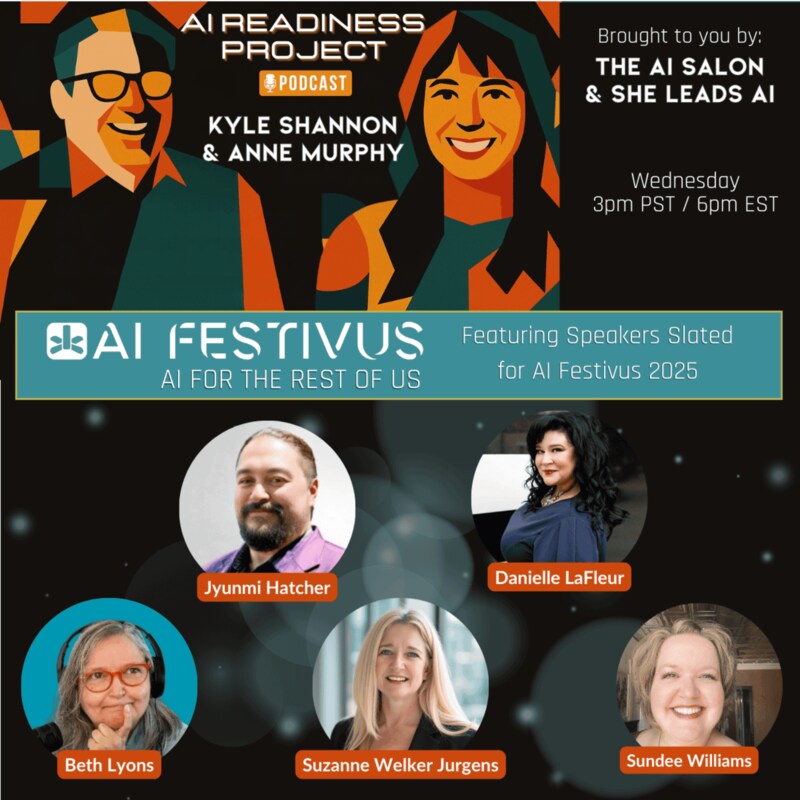
In this special AI Festivus 2025 spotlight episode, Anne and Kyle sit down with five standout voices set to speak at this year’s AI Festivus gathering on December 26–27. Each guest brings a hands-on perspective on how AI is reshaping everyday work—creatively, practically, and with a focus on real people, not just shiny tools.
𝗦𝗵𝗼𝘄 𝗢𝘃𝗲𝗿𝘃𝗶𝗲𝘄: From operations to storytelling, from enterprise content systems to small-business growth and local news, these guests are having the kinds of conversations professionals are craving right now. They’re building workflows, habits, and practice-ready approaches that help teams use AI with intention instead of overwhelm.
𝗠𝗲𝗲𝘁:
𝗕𝗲𝘁𝗵 𝗟𝘆𝗼𝗻𝘀, AI trainer, operations consultant, and co-host of The Daily AI Show, who builds practical systems that bring AI into daily workflows one repeatable habit at a time.
𝗝𝘆𝘂𝗻𝗺𝗶 𝗛𝗮𝘁𝗰𝗵𝗲𝗿, advisor, media and tech strategist, and co-founder of Synchro AI, who connects AI, culture, and storytelling—from enterprise strategy to transmedia experiments and patent-backed tooling.
𝗦𝘂𝘇𝗮𝗻𝗻𝗲 𝗪𝗲𝗹𝗸𝗲𝗿 𝗝𝘂𝗿𝗴𝗲𝗻𝘀, Adobe product manager and AI speaker, who helps teams cut through AI tool fatigue by shifting from “what’s the hottest app?” to “what problem are we actually solving?”—drawing on experience building 50+ custom GPTs and leading GenStudio pilot projects.
𝗗𝗮𝗻𝗶𝗲𝗹𝗹𝗲 𝗟𝗮𝗙𝗹𝗲𝘂𝗿, founder of EasyAsPie.ai and creator of Inbox Whisperer AI, who blends business strategy, email systems, and a bit of “woo” to help founders keep their marketing human while using AI to stay consistent and sane.
𝗦𝘂𝗻𝗱𝗲𝗲 𝗪𝗶𝗹𝗹𝗶𝗮𝗺𝘀, founder of Zoned 8 AI, whose boots-on-the-ground work with small-town businesses, newspapers, and community organizations keeps local voices strong in a tech-heavy world.
𝗪𝗵𝗮𝘁 𝗬𝗼𝘂'𝗹𝗹 𝗟𝗲𝗮𝗿𝗻:
• How AI trainers and operators are turning experiments into stable, everyday workflows
• Why media, storytelling, and culture still sit at the heart of AI adoption
• Practical ways to reduce AI tool overload and focus on problem-first thinking
• How local businesses and newsrooms are using AI without losing their community roots
• How founders and small teams can use AI for marketing and email without sounding like a robot Tune in every Wednesday at 3pm with hosts Anne Murphy of She Leads AI and Kyle Shannon of The AI Salon.
Transcripts
0:02
At the AI readiness project, we believe that in this remarkable age, AI isn't
0:06
the main character. You are. While the tech is racing ahead, it's the humans
0:11
who learn to harness AI mindfully that will win. Each week, we meet remarkable
0:16
people doing just that. Join Kyle Shannon, tech leader and AI instigator,
0:21
and Anne Murphy, fundraiser and AI consultant, as they lead the
0:25
conversation about staying grounded, growing smarter, and leading with what
0:29
makes us human. Are you ready to lead with what makes us
0:37
human? An Murphy, I am all about I am all about the human
0:44
part. I think so, too.
0:48
I read this research paper this week. Uh, let me see if I remember. I actually
0:54
read it with my own eyeballs. Wait, you didn't put it in GPT and say,
0:59
"Give me five bullet points." Huh?
1:01
No. No. This is part of the reason why I can't I can't remember it.
1:07
Exactly. But it was it was it was actually a
1:13
couple years old and it was all about the big difference between when you're
1:22
working with with a human and the AI together like smoking just AI or just
1:31
human. It was just like crushing it. Yep. Yep. There was some It might have
1:36
been that report. There was an MIT report that the headline of it was
1:40
people that use ChatePT are dumber. But what what was actually in the report was
1:44
if you use it like a collaborator, it makes you way smarter. Right? If you use
1:48
it like a dumb dumb way smarter, it it makes you a dumb dumb
1:54
was what their their study came up with. It's good that MIT took the time to
1:57
figure that out for us. Um, so I don't know if you know this. Do you this is
2:02
this is maybe not common knowledge. A week from Friday,
2:08
you and I, oh
2:09
yes, are going to be hosting a 24h hour AI education AON called AI Festivus. AI
2:16
for the rest of us. Yeah. And that's uh that's that's just over a
2:20
week out. Yeah. And let's not let's not forget
2:25
that it's not one day, it's two days of Oh, no.
2:30
of 12 hours. I'm actually I'm I'm super excited about
2:36
it. I'm you know you you you and Kate and team have put together the bulk of
2:40
run of show and a lot of the speakers and it is such an exciting lineup of
2:45
speakers and that's what today's about is we've got we've got five of our
2:49
speakers who are gonna we're going to get to meet which is going to be awesome
2:52
and they're gonna what they're talking about and it's it's super exciting. So
2:58
um you know like when we say that this is
3:02
you know unique and that our speakers are elite and that it's like eclectic
3:10
and fun and the biggest block party like you you can't do justice to it. And when
3:16
you see the lineup and you see one banger after another after another and
3:21
every single one of them has a special twist to it, you know, because I know
3:24
almost all the and I read And people are in for the biggest educational
3:32
fun festivist treat of their life unless they went last year. But this one's this
3:39
one might be even better if I know. Well, we don't we won't know
3:43
until we get there, but I'm I'm super excited about it.
3:47
Um before we bring everyone up, I I wanted to there there's been a lot of
3:50
new stuff has dropped, right? Usually after November 30th, which is when chat
3:56
GPT launched three years ago, all the other model companies try to dump as
4:01
much technology as possible to, you know, take any wind out of the sales of
4:05
open open AI. And there's there's been a lot a lot of things, you know, there's
4:09
there's been uh today there was the flash version of Gemini 3 and I think
4:15
there's a new nano banana in Flash 3. I don't know. There's new things. two days
4:20
ago it was the new chat GPT image model which is which is like uh which is like
4:26
um Nano Banana Pro uh and really good and and just you know chatbt 5.2 and
4:33
just lots and lots and lots of models. Here's my
4:38
here's here's my hot take.
4:44
I don't care. I just I don't care. I like I used to care. I used to like
4:53
care a lot. I used to care a lot.
4:57
And and here's the reason I don't care. Because in the early days when a new
5:02
thing would come out, the gap from where we were to where it
5:08
was was like palpable as as a user. And
5:13
yeah, these models are now improving at the
5:17
upper end of human cognition and of human performance. So they're getting
5:21
better up there. My brain is I don't know somewhere down here. Like it might
5:27
just be offscreen a little bit. And and so I I see these things and I'm
5:31
like, okay, great. If I'm if I'm going to solve a
5:36
new quantum physics dilemma, I I should be set. I should be excited. But I but
5:42
anyway, yeah, it brings us back to and and why why I
5:45
wanted to bring this up. It brings us back to Festivus.
5:49
The thing that blew you and I both out of the water last year because it wasn't
5:53
planned. We only had two weeks to just put it together. We put it together
5:56
really, really and every single speaker to a speaker
6:00
did not speak about technology. They talked about who they were, what their
6:04
values were, all that sort of stuff first, right? And so I just I'm super
6:08
excited about this event because I think we're at a place with AI and what's
6:13
coming in:6:17
and people are trying to figure out what they do with their lives. Um the the
6:21
human part, the human centric use of AI feels increasingly important.
6:27
And so that gets down to who are we? What are we doing? What do we stand for?
6:30
What are we trying to accomplish in the world? How are we trying to change it?
6:33
And let's just assume that the AI tools are good enough to help us do that,
6:38
right? So anyway, right. Yes.
6:43
Absolutely. So why don't people let's bring these
6:46
people up. Let's do this. Let's do this. Let me
6:49
Yep. Um we have I'll bring them up in order
6:54
from our for our banner here. We have Beth.
6:56
Oh, Juni. There's Beth.
6:59
Suzanne. We have Danielle.
7:02
Suzanne. and we have Cindy. Hello everybody.
7:07
Hello. Welcome, welcome, welcome. It's It's so
7:11
good to have you all. Um, are you are you ready for Fest of Us? I mean I mean
7:16
I I see we have some some festive holiday sweaters. So this is solid. I
7:21
like it. So what I would love to do is let's just
7:28
go around the horn. We'll just start with you, Beth.
7:31
kind of go in the order that that we brought you up and just uh introduce
7:36
yourself, tell us a little bit about, you know, what you want us to know about
7:40
what's going on and then just give us some little thoughts about what's what's
7:43
coming up for Fest of Us and we'll just go around the room and then we'll kind
7:46
of open the conversation back up. All right. So, uh my name is Beth Lions.
7:53
I am one of the co-hosts of the Daily AI show and uh the sci-fi AI show and
8:00
what's coming up is a lot more public speaking. I uh have finished uh almost
8:07
uh if it's Friday I will have finished my uh she leads AI um educator
8:14
certification. I'm very excited about that.
8:16
Congratulations. And what we're doing, um, we're doing a sci-fi, uh, kind of
8:23
segment for our festivist. Jimmy and I will both be doing that because if you
8:28
know sci-fi at all, you all know we are living in a sci-fi movie right now as
8:34
our everyday reality. It is, isn't it? It's like either that
8:38
or all the sci-fi movies of our childhood were documentaries. One or the
8:42
others. And the wild uh the wild thing of course
8:48
is that Douglas Adams got it more correct than anything because uh if if
8:53
AI were uh conscious and could talk it would be complaining about all the
8:57
idiotic questions we're asking. Amazing.
9:01
Amazing. Beautiful. Yeah.
9:03
Uh Jimmy. Uh yeah. Hi. I'm I'm Jimmy. I'm uh a
9:08
co-host uh like Beth for the Daily AI show and the Sci-Fi AI show. Uh Sci-Fi
9:15
AI show we concentrate on that ven diagram of uh science fiction and uh AI.
9:22
Uh today like Beth said um it one of the things that uh we like to um concentrate
9:31
on is to highlight things like um the philosophical or the uh humanity that uh
9:40
you're able to explore through the safety of the sci-fi genre. And so at
9:46
Festivist, these are the kind of topics and insight and uh in uh in um way to
9:54
look at the world um through that sci-fi lens in in
10:01
particular on how advanced and uh how science fiction is today.
10:07
Yeah. Ven diagram is it we're getting fairly
10:12
close to it just being a circle. Right. Right. right? Remarkably so both in the
10:17
positive and negative sides of of the genre or I should say um so sci-fi tends
10:25
to highlight a lot of the dark side of technology. So maybe that's something
10:32
that we need to spend just a little more time uh analyzing
10:36
and and taking note of. Beautiful. Well, welcome welcome
10:41
Suzanne. Hello. So, um I'm a product manager at
10:48
Adobe in my daytime life and in my after hours and all weekend um I work on a lot
10:57
of AI projects um and attend a lot of sessions with like with an like she
11:02
leads AI amazing um but my background is in marketing and creative processes. So,
11:09
I work um at Adobe on a product called Gen Studio, which is really about uh
11:14
developing the content supply chain. So, I'll be working on some projects next
11:18
year where they're adding in AI into that. And then, um which is super cool.
11:23
And then, um in my the rest of my hours, um I do a lot of AI prototyping. Um, as
11:31
Kyle mentions, often I've built a lot of GPTs, um, including, uh, one called
11:37
Manifest Your Dream Life, um, which has over 25,000 conversations, which is kind
11:44
of the idea that sparked what I'm going to be presenting at, uh, AI festivists.
11:49
Uh, I'm co-presenting with Marisol Rios and we're going to be talking about
11:54
manifesting and affirmations and a bunch of that like I think she
12:00
calls herself the AI witch. So, a lot of fun things there. And um I do uh I make
12:06
a lot of uh affirmations like uh schedule them that like reminders. You
12:10
know, we get distracted throughout the day. So, I have these mindfulness breaks
12:14
or affirmations that are super easy to set up. So I'll be showing people how
12:18
they can do that with a tool like chat GPT. And I'm also uh built um a
12:24
automation recently um as part of a class I took and I'll show under the
12:29
hood how that is like when you take go from a GPT to a larger automation. So
12:36
look under the hood but it generates um affirmations. So super cool. Yeah. Super
12:43
cool. I love I love the mix of technology like beyond human, right? And
12:48
we're into the the the other realm, the beyond realm. I love that.
12:52
Well, yeah. I think a lot of people, you know what I found? I've been doing
12:55
manifesting work since like:13:02
asking people to write them affirmations like personalized. And that's kind of
13:07
where the idea sparked from. And they would pay people all this money to write
13:11
them all these like affirmations and make recordings for them. And I'm like,
13:16
you can do that with the tools we have now.
13:18
Yeah, exactly. Beautiful. Lovely. Welcome, welcome, welcome, Danielle.
13:23
Hi. I'm I'm really curious about this AI and alien thing. That's what I want to
13:28
be on. Like, let's I like this circle thing happening. I'm I'm And then we'll
13:32
do affirmations while we're meeting the aliens. Like, we'll just like create
13:36
custom affirmations for them while we're doing that. I think that sounds great.
13:40
Um, I'm Danielle. I am the founder of Easy aspie. Um, you can easiest pie.ai.
13:46
We work in operations and so we streamline um ops for companies and
13:50
businesses that um are want to make sure that they survive the next wave of uh
13:55
the economy. Usually, I think really what I like to talk about is the end of
13:59
the world, which is really fun. We call it post-labor economics, but basically
14:03
like what happens when AI takes over your job and then where do we go? like
14:08
what does that economy look like and how do we like do that? And it really does a
14:12
lot of the conversation really does go back down to finding the humanity um
14:17
within yourself and applying that into your um economy. So that's really what
14:21
I'll be talking about. I like calling it the end of the world um keynote. That's
14:25
always my I don't think I'm allowed to actually put that as my official title
14:28
for the keynote. I think I sent like an official title, but um yeah, it's my
14:32
favorite it's my favorite topic. like and basically at the end of the day the
14:36
whole point is making sure not only that you're prepared but thriving um in the
14:41
next wave as the economy changes. Um and I think there's so many opportunities by
14:46
utilizing AI for us to really tap into our humanity which has been mentioned a
14:50
couple times. I feel like we're all on the same wavelength in this conversation
14:53
about really digging deep into what makes you you and how to become a better
14:59
version of you and a happier version of you and a more complete version of you.
15:03
And uh I think there's massive amounts of opportunity and positive things that
15:09
are coming down the pipeline that will allow us as a as a humanity, as a
15:13
society to grow into that. Um and then we'll add the aliens somehow. I don't
15:18
know. I don't know. aliens. Then we'll have aliens. I don't have to
15:21
sneak aliens into there, but No, it's it's good. And then we'll keep
15:25
good holiday sweaters. Cindy,
15:28
can I I got I have to comment I have to comment on Danielle first.
15:33
Yeah. Um because it's a tiein to one of the
15:36
things that I love about Festivist so much. It's like
15:40
Danielle just modeled the most perfect elevator pitch
15:47
for like a relational situation that could ever be on the face of the planet.
15:52
That was beautiful. You probably didn't I don't know if you you know, but I'm
15:57
going I'm doing that in the same context as I'm talking about hunting down aliens
16:04
and talking about manifesting my very best life.
16:08
It's awesome. It's awesome. And best of Us is a menagerie.
16:14
It's a menagerie. And um the other thing about it is that I think, you know,
16:20
Danielle's topic and the way she shares it is a perfect example of helping, you
16:25
know, 5,000, 6,000, 7,000 people understand what they need to pay
16:31
attention to if they own a business, which everybody's going to.
16:36
Yeah. And then people can reach out to Danielle.
16:41
Yeah. And then it's helpful to Danielle too
16:43
and it's helpful to all of us. But um Danielle, I want to be sure and you guys
16:48
other other everybody who wants to that you have a booth in the virtual expo so
16:54
that after your talk people can go connect with you and and people who are
17:01
listening. We have a virtual expo. So, put that on your dance card. It's going
17:06
to be open, I think, starting tomorrow and you can get to it on the website.
17:12
Beautiful. AI festivist.com. Beautiful. Sundy, last but not least, tell us who
17:18
you are. What's happening? Uh, my name is Sundy Williams and I am
17:23
on the same wavelength as Danielle with uh the the four courses of hell that
17:30
we're living through. Uh but my focus is main street business. So I took a very
17:36
analog job recently as advertising and business services for a printed
17:42
newspaper on paper. and I I'm helping small rural businesses in the state of
17:49
Mississippi um kind of shore up for the for the next
17:54
5 to 10 years of transition from everybody's working at W2 to like Ann
17:59
said everybody owns their own business. Um, so teaching AI skills, helping them
18:06
establish process and uh ahead of implementing AI and then helping them
18:11
not get screwed by tech bros who want to sell them all kinds of AI toys that
18:16
aren't going to work for them. Yeah. Fascinating. Beautiful. Um, let me
18:23
drop bus. There we go. What's this one look like? Oh, that was nice. Beautiful.
18:27
Um, so what I would love to do, um, and and and you teed this up and you can you
18:33
want to ask the question the the sort of first question of last year? You want me
18:38
to tee it up? What you been up to?
18:41
Yeah, that one.
18:43
That one. Okay. Yeah, that one. So
18:47
:18:53
Lot of things happened. Um and all Yeah, exactly. And all of us
19:02
have had interesting years. Uh particularly most of us being in a
19:08
repotting era of our lives, right? There's an
19:12
element of we got rootbound somewhere and now we're
19:17
going into the next era. So I'd love to hear how has that been for folks? From
19:24
last festivist to this festivist, right? From last festivist to this festivist.
19:29
What's happened? What's changed? And we can go in any order. Whoever wants to
19:31
talk first, I'll throw you in the spotlight.
19:33
I'll go first. Great.
19:35
Yay. Uh I will say that AI festivist changed
19:39
everything about what I do this year, what I have done this year.
19:43
It changes the way I share my intellectual project projects, my
19:47
intellectual product itself. And it gave me insights and confidence to actually
19:55
learn in in public and to put my ideas out there uh even when I wasn't ready,
20:02
even when they weren't ready. And to grow it organically over time and uh so
20:09
between then and now, last year I was unemployed in December and uh attended
20:16
Festivis. And uh this year I received uh I got blamed at a job and um have
20:26
implemented AI at a static newspaper at a fledgling business that needs to pivot
20:33
and meet the moment. And we've we've implemented systems, we've implemented
20:38
redundancies, we've provided breathing room for both editorial as well as
20:43
advertising using AI tools. So, had I not participated and attended Festivis,
20:50
I don't know that I would be where I am today.
20:53
Wow. I'm I'm not saying this is any other pressure on the other four of you,
20:58
but but you know, come on. We got to step it up and talk about how awesome
21:02
Festivus is. Who wants to go next? Who wants to
21:06
follow that? Thank you, Sundy. That's beautiful.
21:08
That fills my heart. You're welcome.
21:10
That fills my heart. Uh I will totally follow up. uh Sundy um
21:17
with this is my first festivus. So if I even get like half of the benefit that
21:25
Sundy got uh out of uh her first festivus, then uh I'm I'm golden.
21:33
That would be fantastic. Yeah. Uh I mean the year in recap has
21:38
essentially just been a whirlwind of you know AI growth and movement and I
21:46
mean for me personally I always like um applied right there there's a lot of
21:51
hype there's a lot of oh this could be and and you know and of course the big
21:56
companies are always pushing their latest uh latest and greatest but I
22:02
think the big takeaway for me is um in the applied world, we're seeing some
22:09
major movements. And that brings me some some hope in uh with all of the uh
22:17
darker things that have uh uh that have come through the year and and the
22:22
stresses uh of the year. And I think that's kind of what this time of time of
22:26
year um and having festivists uh around and the kind of experience that you can
22:33
get from it uh is a great way to put a positive cap on the year and a great
22:41
start for the upcoming year. So that's kind of my hopes and that's kind of what
22:46
I'm looking for from this entire experience.
22:49
That's great. Can you can you talk a little J when you say about you know the
22:53
applied space like what what what does that look like you you know how how are
22:58
like how has that shifted over the year? Sure. Sure. Um well in particular the
23:05
kind of things that I've uh I've been focusing on like AI and science is
23:10
initially the way that we had applied AI was simply to review information review
23:18
data uh and then uh that being a compression of time saving time from the
23:25
individual or in this case uh the individual scientist but now what we're
23:31
seeing is the analysis the deeper analysis of the entire data set and
23:38
providing potential next steps and that's I think the greatest growth in
23:45
applied AI and science. So now we have AI that can do the mundane or the more
23:53
tedious parts of science and encapsulate all of that, analyze it and give us
24:00
potential, you know, thousands or tens of thousands
24:04
of directions that just literal time would not allow us as, you know, as
24:11
individual human scientists to go in a particular direction.
24:16
Amazing. And so that's that's kind of the the high point and I can't wait for
24:21
next step coming. Yeah. Yeah.:24:25
the experiments just start to do themselves. Crazy. Beautiful. Uh Beth,
24:31
Suzanne, Danielle, who wants to jump on? I can jump.
24:34
Great. Go Suzanne.
24:36
So um last year I spoke about um what's the problem we're solving? And I know
24:42
I'm probably the annoying person in the room always. um asking that question
24:48
because people are immediately jumping to showing all the cool things they're
24:51
vibe coding and everything and I'm like super cool but what what are you
24:56
planning to do with them right and um so this last year I've really started
25:02
building more of a framework and speaking about it I spoke at the crate
25:05
conference um for she leads AI about kind of that that thought process from
25:12
the discovery all the way to building out your requirements
25:16
and doing that design work and then building that thing and the change
25:20
management. So, it's not especially if you're more than one person, there's a
25:24
lot of other things you have to think about. So, um that's really what I've
25:28
been focused on this year and um I started to build out um kind of a
25:33
framework. I know I've seen some templates and some other things out
25:36
there where people are like kind of I don't know frameworks for building it,
25:40
but still focused on the how and not the what and the why. So, I really am trying
25:45
to get people to start thinking about that upfront piece.
25:49
Beautiful. Love it. Love it. Love it. Love it. I think the you know what what
25:54
strikes me, Suzanne, about the however you said it, what are we trying to
25:59
accomplish here? What What was your What's the problem we're solving?
26:02
Yeah. What's the problem we're solving here?
26:04
Yeah. Is I don't think that's a question you
26:07
can ask enough. Like, I literally don't think you it's a question you can ask
26:10
enough because back in the early days of the web, it was the same thing. Oh, I
26:13
need a website. I need a website. And it, you know, you go back to that AI
26:17
because it is so much more pervasive and so much more transformative. It is super
26:22
seductive, right? And it it looks like a strategy and and it's not it's not
26:29
it's not you're right. It's just it's just like another tool, right? And I
26:33
myself and I know all of probably all of us it's easy to jump into a new tool and
26:38
build something and then but then I stop and go what am I going to do with this
26:41
thing that I built or maintain it or whatever. So uh yeah
26:46
beautiful love it. Uh Beth I think you had your hand up next.
26:54
Yeah. So, if I remember the the things that were really hitting me at Festivis
26:59
last year, um, and it happened right after Shipmas
27:03
and OpenAI dropped all of the things that felt really impactful, but somehow
27:09
you didn't really get access to them. Uh, or they were like what we were
27:14
remembering this year was, uh, can can they bring the Santa voice back? Like
27:19
that was really fun. Let's talk to Santa, right?
27:23
Um, but I think I think the promise that I saw in Festivus and the ways that I
27:30
was inspired have um sort of grown exponentially, right? I can do more with
27:37
video. Uh, there was a gentleman who talked about just download the YouTube
27:42
transcript and then be able to uh discuss back and forth with it. Now you
27:47
can upload your like add your link to your notebook LM. You can ask YouTube qu
27:53
you can ask the video questions within YouTube. There's just so much that uh
27:59
that has happened this year and I feel you Kyle in like some of it is like you
28:06
could slow down now right like you could stop you could
28:10
you could just yeah take take current state of technology and probably be good
28:14
for five years. Yes. Which is also one of the talking points for AI, right?
28:20
Like you could stop it today and we still need to have the conversation
28:24
because so much has changed that hasn't felt the impact yet.
28:29
. And Danielle, what's what's:28:35
word. Go. I was gonna say, well, we haven't said
28:39
t a lot of problems with you.:28:43
a lot. That's the best Seinfeld. Nobody said it. I was very surprised. Um, got a
28:48
t a lot of problems with you.:28:53
do follow like the woo stuff,:28:56
shedding, which is about getting rid of that nine-year cycle of just crap,
29:01
so much crap that happened in:29:05
foundation of crap happening over the last, you know, few years. And even
29:09
while there's so much good, it feels like there's this overhaul of baloney
29:13
well. And as we're ending out:29:18
,:29:22
forward and fresh starts and like excitement and joy and creation um and
29:30
So, I am super excited about:29:34
had to work internally and maybe work on a lot of like where are our ethics, what
29:39
are our boundaries, what are our values. like when we talk about AI, we were all
29:44
very excited about it, but as:29:47
learning all these things and we're like, I don't know if I really agree
29:49
with that or maybe I really want to implement it this way and not that way.
29:53
How do we make this a a place where we can all grow and really create a change
29:58
in the positive direction? I feel like that's a mantra for a lot of people who
30:02
are attracted to the f festivist AI salon and um create AI. So, or she
30:08
creates. How is it Anna? Is it she creates AI, AI creates, she leads
30:13
something. Yeah, she leads AI. So, we all it's all
30:16
e. But I feel as we move into:30:22
I've learned from:30:28
that is. Because if you don't dig down and figure out what are those blockages,
30:33
what are the things that I do not agree with? Where are my morals? Where am I
30:37
going to stand? How can I take my business? How do I take my family? How
30:43
do I take my community? How do I take myself to that next level? And if we are
30:47
going to implement technology to help us become better, if we are going to
30:52
implement technology to make our companies better, make our businesses
30:55
better, make our communities better, then you have to know what those are and
30:59
that. So, while we could say:31:04
feel like it was a great opportunity for us to face that and really come to terms
31:08
ause now that we're moving in:31:12
decision to make. You individually each get going to make a decision to make and
31:16
like how am I going to participate in the future and what do I want to see and
31:21
what am I bringing into my reality, right? And so, you can do that with the
31:25
affirmations. You can do that with, you know, looking at how you're building
31:29
your business. There's so many different avenues to take advantage of that, but I
31:33
am super excited about:31:40
and dug in and said, "We're going to deal with this. We're going to work
31:44
through this because if I don't, I can't make things better."
31:48
it's funny. I I didn't I knew:31:54
of the snake. Like my my Tik Tok feed is full of a lot of people talking about,
31:58
you know, gravitates over. I hate snakes, you know, a lot of that stuff.
32:01
And and I didn't realize:32:06
three different times, like unrelated, but it's come up really clearly, is has
32:12
been the word momentum and and
32:16
really my thought for 26 is
32:20
momentum. I want to do everything I can to keep
32:22
the the wheel like, you know, get the wheel starting to spin and keep the
32:26
momentum going. And anything that I'm doing that's going to stop that
32:29
momentum, I've got to get it out. I've got to like So, so there's something for
32:34
me about momentum that just it feels that feels so important to where we're
32:38
headed. So, you know, I love where the conversation's going.
32:42
Well, Kyle, um it's not just getting stuff out of the way. Also, it's like
32:48
where to pour in, you know? Like that feels so much like
32:53
after Danielle shar like that feels so much more. It's so much more positive
32:58
flowing. Yeah.
33:01
Choosing which which lane or which whatever metaphor.
33:07
Um well and it's also I mean I think that
33:09
be a good year. It's going to be a good year.
33:10
I think that the focus us us emerge us as a sort of I'll just
33:16
call it you know a generative AI community emerging out of the tool phase
33:21
which you know I think:33:26
that you focus on the tools that is a very fragmented world and increasingly
33:30
fragmented and even individual tools are now 20 tools they're not chatpt is not
33:36
one tool it's 30 right like every video tool now also does audio synthesis and
33:41
image generate like everyone's doing everything so there's this all this
33:44
fragmentation out there and just all of them feel like momentum busters right so
33:50
so yeah so this is I'm digging this conversation where are your mind's going
33:55
any anyone just jump in. So I think part of what we want to what
33:59
we want to sort of name in this is that this is an opportunity to engage with
34:06
the momentum because the momentum is going to engage with you. It's not like
34:11
you could just sit still. That's not how this is working. and by being, you know,
34:17
by engaging with it, by making some choices, by getting involved with a with
34:21
a simple tool, uh, or where you love it. Right? When I learned to play the piano,
34:26
they were like, "No, don't just learn to play one song that you really love
34:30
because you'll practice that until you get it." Same idea. Like, where is your
34:34
entry point here? But I love the momentum. And it can feel really scary
34:40
if it feels like you're not involved in it, right? It's just passing you by.
34:45
Yeah. Beautiful. Yeah. I think from what I'm looking for
34:52
uh I guess from the what I've started this year and what looking for for next
34:57
year is uh more of the uh self-enablement and this is kind of
35:05
connected to that that concept of momentum is
35:09
we have these tools and I think this is what vibe coding kind of resonated with
35:13
a lot of people and what made it so popular is here's a barrier here
35:19
that you know always like your the concept in
35:24
the mind of this is that oh okay well I have to invest so much time this is sort
35:28
of like learning the piano like Beth was talking about uh I have to spend so much
35:32
time and effort to learn this entire new language or languages before I can do
35:37
anything with it before I can even start
35:39
before I can even start. Exactly. And now there's with all of these tools,
35:45
with these capabilities, the concepts of I can do it myself. I can I can empower
35:53
myself to overcome that one barrier or those two barriers that I thought was
35:59
keeping myself back. It also means we don't have any excuses anymore either,
36:03
right? So we can't say, "Oh, I was waiting for
36:06
this thing or I really had to pay a programmer to build that thing." It's
36:10
like, no. No, not anymore. Uh, you can get started at it now, right? So, you
36:16
that that being able to um,
36:19
you know, ch to control one's destiny, if we're going to make it sound
36:22
grandiose, but but anything that lowers the barriers, allows us to accomplish or
36:28
express ourselves, whether that be creatively, through business, or
36:33
whatnot. I think that's for me that's the biggest takeaway, right? uh I don't
36:38
know uh who said it or who I heard it from first but AI was sort of created to
36:44
be a mirror to ourselves right to help us analyze our own humanity help us see
36:50
what kinds of things that do we like what we see uh you know is it reflected
36:55
back to us and and is there places for us to grow or anything like that and
37:02
that's the the big benefit of AI it's yes here. Here, look at yourself. Here
37:08
is where you can improve. Here is uh here's a great tool, great technology
37:14
that allows you to keep moving forward uh and keep accomplishing those goals
37:20
that you might not have thought were possible before.
37:23
It's all possible now. It's just what part do you want to start with? And
37:28
that's kind of that hop raising, you know, that uplifting uh thoughts and
37:34
concepts that I want to latch on to for next year.
37:37
I love that. I love that. Let me let me expand on that, Juni, and and put it put
37:42
it to the to the rest of the group. Um, if you're an entrepreneur, by
37:47
definition, you you ask yourself a lot, you know, what do I want and what are my
37:51
values? And if you're if if you're naturally entrepreneurial, those are
37:55
questions that are just part of being an entrepreneur.
37:59
There's a lot of people that are going to be forced into entrepreneurship and
38:02
said it before, we're all going to have a business. And so I'm I'm just curious
38:05
what all of your what of your what your what the other of you your thoughts are
38:10
on this idea of what about people that for the last 20 years maybe haven't had
38:16
to think about who they are, what their values are, what they want. They show up
38:20
at their job, they're told what to do and and they're happy with that. And all
38:23
of a sudden now they're going to be sort of thrust into this you can do anything
38:27
you want, which you know can can feel very daunting if you haven't been asking
38:32
yourself, well, what do I really want? So I'm just curious uh to reflect on
38:35
that for a bit because it seems the psychological side of this is is really
38:39
important. Oh, I have lots of thoughts on that. Um
38:44
so many thoughts on that. I think what's um what we have to also understand is
38:49
that as an entrepreneur we tend to surround ourselves with entrepreneurs
38:52
and that's how we think but as somebody who comes from a family who did the
38:57
nineto-5 the beauty of the nineto-5 was that was 9 to5 and I went home and then
39:02
that's where my value was with at home there's not as big disconnect as we
39:06
think there is oh interesting
39:08
they're already connected to who they are who they are is within the home
39:13
right and so what we are Whereas we are constantly kind of maybe working these
39:18
80 90 hours weeks and we blend this, right? We don't separate it out. Well,
39:22
they've already separated it. So, I would challenge that thought process and
39:25
say like maybe it's not going to be as a struggle as you possibly might think.
39:29
It's just they're going to nineto-five their entrepreneurship like a healthy
39:33
individual and maybe we're the ones maybe they've got it right.
39:38
Maybe they already have it. Now, I could be wrong on this. I could be wrong on
39:42
this, but the point of what we work on a lot of the times is like our goal in our
39:47
company is we want to make sure that you can expand, but your expansion doesn't
39:54
have to be profit. Your expansion could be time simply to spend with family. It
40:00
could be simply to be able to give that profit back and to grow in other ways.
40:04
Like expansion doesn't always have to be monetary. It could be simply with time.
40:08
It could be with the values that you have. We and as entrepreneurs have
40:12
constantly had this um joy where we love what we do so much we do it all the time
40:17
but we have how many people do you know have had horrifying relationships
40:22
because all they do is sit in front of the computer and like co I don't know
40:26
whatever right and so I feel
40:29
yeah computers right but I would say that
40:34
regardless of what your job is your priority on earth is to be able to
40:40
answer those questions. And it's sad when you don't have that opportunity or
40:45
take the opportunity to find out who you are and really delve into that. And
40:50
that's a struggle regardless if you're employed or not employed. That is just a
40:54
simple human thing that you have to work on. And that's going to happen
40:57
regardless of what's happening externally within the environment of the
41:01
economy. That's just simply a question that we have. What we have is an
41:05
opportunity that there's access for more people to ask that question because
41:10
we're moving out of survival mode. And that is the real caveat change that's
41:15
creating. When you are no longer in survival mode, there is this mass
41:20
opportunity that allows you to say, wait, who am I? Because when you're in
41:24
survival, it's not who am I? It's surviving. It doesn't matter who you
41:29
are. Right? That is not a question that you need to answer. But when you don't
41:34
have survival mode anymore, which is the direction that AI seems to be taking us,
41:38
then the opportunity to ask, well, wait, what do I enjoy? Who do I love? And my
41:43
point would probably be probably your family and touching grass and chickens.
41:47
So, like, have fun.
41:52
Love it. And it's true. It's it's sort of like
41:57
what social media started to do where you could find your people, right? you
42:02
could put something out there and they found you and they reflected back to
42:05
you. So you didn't it wasn't so much that you were the only one of you in
42:09
your small town. You could still find your community. That's true now for
42:15
ideas, right? AI can reflect back to you. Yes, uh you're right. We should
42:23
make unicornhorned sneakers. Let's just like do that and see what's happening
42:28
with that. Right. So there so there's um you're you get to create your own
42:33
community with all of these other ideas that you have that you didn't have
42:37
enough time or resources to go and try to find those people.
42:43
You can be that people and you like sometimes that's three hours on a Friday
42:47
night. Well, I did that. That's cool. I don't need to do it now. And sometimes
42:51
it's a really good idea you want to go and talk to other people about.
42:54
It's so exciting. there there's you know I I I call the era that we're entering
42:58
the great renaissance and and I think what it what it's going to look like is
43:02
people are going to create just weird stuff that no one would have imagined
43:07
like why would you do that but all their life they've been thinking about unicorn
43:11
sneakers or whatever it is right they're like I can do that now and they're just
43:15
going to do it right and so we're just going to end up with a world full of
43:18
weird wonderful things I think I hope right make it a place of joy Sunday what
43:24
are your thoughts I I come to it from a different
43:28
perspective and the perspective I have is more extractive. I see the technology
43:33
that's being implemented by people that lack empathy and a vision for the
43:39
future. We have the greatest technology and the ability to make the largest
43:44
change in all of human history. And Open AI is talking about how porn is
43:49
appropriate for children. and this administration is talking about making
43:54
14-year-old children uh tried as adults able to be married and and things of
44:00
that nature. So we've taken a technology that we could have provided wealth, food
44:06
and shelter for the entire global population and we are doing the same
44:12
extractive thing that we have done during the dark ages during the uh
44:17
during the great depression. all of the times that we've had this opportunity,
44:22
we as a human race, as as capitalism, as patriarchy, as all of the all of the all
44:32
the bad parts of the Bible, and we have just tossed it into the ring and said,
44:36
"Sure, we could we could, but we're not going to." And so, I come to this moment
44:42
in time seeing a number of people uh unemployed, myself included. That took
44:48
me two years to find work. Wow.
44:50
And in that two-year time frame, we're talking iteration after iteration after
44:56
iteration. And I had been laid off in the past. I had had that experience. And
45:02
my concern is for the people who have never experienced it.
45:06
The people who thought that the social contract would manage their future,
45:10
their retirement. And we are going to see an increase of wealth transfer. Not
45:17
from the boomers to the millennials, skipping Gen X entirely, screw them all.
45:23
But the the transfer of wealth from the boomers to the medical field, the
45:29
boomers to end life care to from the boomers to the um strategically built
45:36
extractive systems that have been that are operating as intended. And it will
45:44
leave a number of people disillusioned with without purpose, without the
45:49
ability to to pivot and meet the moment or identify the problem that we're
45:54
solving or move forward in a way that embraces this new technology. And I see
46:00
it in the rural south much the same way as I see um colonialism imp and
46:07
imperialism infiltrating the global south. So the US South is very much
46:13
impacted by extractive systems like Meta putting in a uh data center that is the
46:20
size of Manhattan in the poorest county of Louisiana.
46:29
That is not an isolated incident. And so that one that one data center will use
46:36
more electricity than a million homes. There is no impulse to make them make it
46:42
safer environmentally to make it more efficient for energy, for water, for
46:47
cooling, for all the things. So I do hope that we have unicorn horn sneakers.
46:53
I really really do because I do think that that that is possible. Um but I
46:59
also think in the next 5 to 10 years if we don't make some real demands and
47:05
really put forth the energy and effort there will be a number of people left
47:09
behind and that you know we saw that we saw millions of people die during a
47:15
pandemic and it will my fear is that it will be much the same and it will show
47:20
the same level of discernment um because it will it will fall along
47:26
the same lines of those who have and those who do not.
47:30
Um so so so I do come from it from a little bit less rosy kind of
47:35
perspective. Um but I but I do have hope for the
47:39
future and I see that hope played out in community. I see that hope played out in
47:44
connection in this this strangeness that we find ourselves in. This group has
47:51
talked about all of the different pieces of technology that touch our lives and
47:54
yet we see Gen Z embracing an analog life. We see them wanting to read the
47:58
newspaper and have phone free events. So I I think there's balance. I think it's
48:03
possible but I think the window of changing these extractive systems that
48:08
are working as intended. I think our window of opportunity is closing.
48:12
Fascinating. Well, and I hope I mean this is a this is a great conversation.
48:17
I hope that in a in a small way that festivists can can serve as a as a
48:22
pathway to like have open conversations, talk about, you know, what's possible
48:27
from an optimistic standpoint, but also from a here's the things we've got to
48:30
manage moving forward. You know, these tools are available for all of us. How
48:34
are we going to use them? Which I think Suzanne, that kind of tees you up to go
48:37
back to, you know, what are we going to do with these things? You know, what are
48:39
what are your thoughts? Yeah, absolutely. I mean a lot of my
48:42
approach has been tool agnostic and thinking really more about what is
48:46
it that you're doing and not worrying because the tools are going to come and
48:49
go. Um I think a lot next year what I'm going to focus my time is really
48:54
thinking as companies are moving more towards agentic workflows. What's the
48:59
value as a human I am bringing right because I think trying to understand
49:04
that out that because you know right now a lot of work is done manually or maybe
49:09
AI assisted. So what does that look as you move to AI first or um agentic or
49:16
even multi- aent workflows because it's like if you were to map that out it will
49:21
look like from the user to the input and it just went through an agent and not
49:26
all those people. So but we still have work and value that
49:31
we're bringing but I don't I think it's going to be really easy to go well the
49:34
agent's just going to do it all right. So trying to map that out to show where
49:40
in those different stages that we do bring values as the human in the human
49:44
in the loop, right? Yeah.
49:46
Yeah. May maybe we push back to more more simple connections and feeding
49:50
chickens and things like that. Yeah.
49:53
Started out before we went live, Cindy was out with her code feeding her
49:56
chickens. It was awesome. It was fantastic.
50:01
Ann, what are your thoughts? Um,
50:07
I you know what? I've just been I don't have any nothing new to add.
50:15
That's beautiful. I'll tell you what we'll do then. I'll tell you what we'll
50:18
do. Here's where we're going to go. We're going to go to the question we ask
50:22
all of our guests all the time. And what I would like to do, especially
50:26
this been a really, really good conversation. So, thank you all for your
50:28
thoughtful everything. You're just the way you're all approaching this. And
50:32
this is I mean one of the thing things that I I was excited about most for
50:37
festivist last year and then these conversations that we've had for the
50:39
past two weeks here with the speakers is this is a really thoughtful human-
50:45
centric group of people that are coming together to talk about this and and you
50:50
know this podcast the AI readiness project is about you know what what does
50:54
that mean? Let's explore what that means because I don't think any of us really
50:58
know. So I'd love to just sort of go around the horn. I'll just sort of call
51:02
uh I'll call your names out and and you uh just go. So Danielle, what does AI
51:07
readiness mean to you? My god. Uh so AI readiness um to me,
51:13
that's such a good question and there's so many different ways you can kind of
51:16
answer that. I love everything that you said, Cindy, because those are really
51:19
great. Great. I I just want to like that's so important to understand
51:24
reality versus optimism and opportunity, right? And it all goes back down to that
51:30
choice. And I think all of us in here are like we don't want what you talked
51:34
about, right? We are here stating like this is not the direction that any of us
51:38
want to go and we want to make sure to take as many people along with us that
51:41
we possibly can because it is a defunct system, right? And so many people are
51:48
stuck in this defunct system and we have the opportunity to make the choice to
51:52
choose differently and it's up to each of us to step into the game and choose
51:56
differently. So when it comes to AI readiness to that a lot of the times
51:59
when I like think about this kind of question I think about selfishly
52:04
internalizing that and say how am I going to be AI ready? What am I doing to
52:09
prepare myself for the next wave? I'm super excited about the Gen Alpha
52:12
because I think they're going to be more AI ready than any other generation ever.
52:16
Right? They're not going to put up with this baloney. Like I know we got some
52:20
rough stuff going on but I don't see Gen Alpha putting up with the baloney that
52:23
we've been putting up with for the last 10,000 years. they're going to say,
52:26
"Peace [ __ ] out. We're not doing that." Right? So, um, when I think about AI
52:30
readiness, again, it goes back to me personally, I think it's about really
52:36
digging into what are my values, what are my boundaries, what am I going to
52:41
create, who am I dragging along with me, aka am I building the boat? Ann talks
52:46
about this before where like we build the boat. And if you didn't build the
52:49
boat, that's okay. You can come on my boat, right? We're gonna we're taking
52:52
you all as many as we can with us. Um, and it's about freeing you from being in
53:00
that scarcity mindset. Freeing you from being in the survival mode. My goal is
53:07
what can I do to get as many people out of survival mode as I possibly can. That
53:12
is the mission of the company. So, that's where we go.
53:15
Beautiful, Suzanne. Amen.
53:18
Yeah. Right. I mean, if there's something to be said about the fun and
53:22
the curiosity and the willingness to try things out and explore all that's
53:26
possible, you know, play with everything and, you know, as I always focus on like
53:31
really figure out what it is that you are going to use AI for. But there's a
53:35
topic that I don't think enough people talk about, which is change management.
53:39
Like how are you currently operating today?
53:43
What's not working with that? And what's possible? like thinking through that
53:47
framework and understanding how what what are those what is that change man
53:51
whether it's yourself right or within a company it's really important to think
53:56
through like getting bringing people with you instead of dragging them or
54:00
forcing them but really helping them see the benefits of how it can help them um
54:06
improve especially if there's a lot of fear right you know like oh my gosh
54:10
they're having me do all this AI and then next year I'm going to get laid off
54:14
because AI will place me. So really thinking through again back to what I
54:19
was just saying earlier about finding the value what are freeing them up from
54:23
all those small administrative things and letting them bring real value to
54:27
their jobs. Yeah. Yeah. Everyone sort of bringing
54:31
their whole self and and expanding on that. Um Sundee, what does AI readiness
54:36
mean to you? AI readiness in terms of small towns uh
54:42
because that really is my focus right now.
54:44
um not waiting. There are so many people out there who
54:49
well is chatbt the best one well the best you know the best AI is the one you
54:56
use on a regular basis well should I wait until it's good
55:00
should I wait and like what you know and and to what Suzanne said earlier the
55:06
tools are going to change but if you what you don't want to happen is five
55:11
years from now go oh [ __ ] I should have learned chat
55:14
I should have I should have So for me being AI ready
55:19
is the ability to be agile both in the way that you learn in the way that you
55:26
you look at the world and and what you see as potential. For me um
55:35
I think that there are two two ways that I look at
55:41
AI. AI has allowed me to have the same uh assistant that a middle manager had
55:48
in:55:56
to be able to collaborate and you know augment what I don't know what I don't
56:02
know help me understand what it is I don't know. So those those modes of
56:07
learning need to to be something that people embrace in my opinion because
56:12
we're not AI ready if we are resistant to what's possible. And so that really
56:18
for small towns for me that's really where it's at. And you know I think that
56:25
there are a lot of companies out there that have changed the world for good.
56:30
They haven't necessarily made it better. And so my job in all of this is not just
56:36
to change small towns for good, but to make sure that I make them better. So,
56:42
so that's for me is what being AI ready is all about.
56:45
Love that. Yes.
56:48
Wow. Oh, you're muted.
56:54
I agree with what everybody has said. And uh for me AI readiness has a little
57:00
bit more of an external focus. So I feel very strongly that the people around me,
57:08
the people that are hearing me speak need to understand what's possible now.
57:12
Yeah, I don't know if people remembered, but
57:14
there was uh like a ship that was dressed up like a pirate ship that went
57:20
into a bridge a couple of months ago and everyone who was in the AI world that I
57:25
know went, "Wait, like are there other angles of this
57:31
accident? Are more people talking about it?" Because it seemed like such an
57:35
obvious AI video thing, right? And um you know your voice is your password. It
57:42
isn't. Don't. Nope. Right. All of those kinds of things. Um I want parents to
57:48
understand what's possible to do and what they need the kinds of
57:52
conversations they need to be having with their kids. I want us to be telling
57:56
our parents what's possible to do. Um I just I feel that that is a readiness
58:02
that even if you don't know how to use chatt you still need to know because the
58:08
the reality of the world is shifting in the same way that it shifted when
58:13
electricity electricity happened or phones happened right or cell phones
58:18
happened. I still talk to people who are talking to themselves in the grocery
58:22
store because I haven't made that shift. That's what I think is really important.
58:28
Beautiful. Juni, bring it bring us home on what does AI readiness mean to you.
58:33
So, uh I've said before AI readiness, uh you know, and and a lot of people have
58:39
said this. Um you know, you want to keep your mind open. You want to constantly
58:46
learn, be comfortable with not knowing what you uh don't know. uh and
58:54
just explore uh explore more con and that constant learning or that constant
59:00
learning mindset. Um but beyond that I think uh AI
59:06
readiness today means um definitely don't get in your own way.
59:12
Lower the barriers where you can and don't limit yourself because there are
59:19
less and less limits and you don't need to be the one that's limiting you and
59:24
your ideas, your creativity, what you want to accomplish or anything like
59:28
that. There's enough of that uh you know externally in the world. You don't need
59:32
to be the one that's putting up your uh your own barriers. So that's kind of
59:37
what I I'd be focusing on. And of course, if you want to be AI ready, join
59:43
the rest of us at AIFest.com. That's it. AI festivimus. So that's it.
59:49
Well, thank you all very, very much for your time and thank you so much. This is
59:52
awesome. I'm so excited for next weekend this Friday. Uh we begin December 26. We
59:59
start at 9:00 am Pacific. Get ready. Have your caffeine.
::Get your hydration and let's do this. Get you want Door Dash, you want many,
::many beverages. Exactly. All right, everybody. Thank you
::so much for your time. Really, really great conversation today. Thank you all.
::Aloha.


