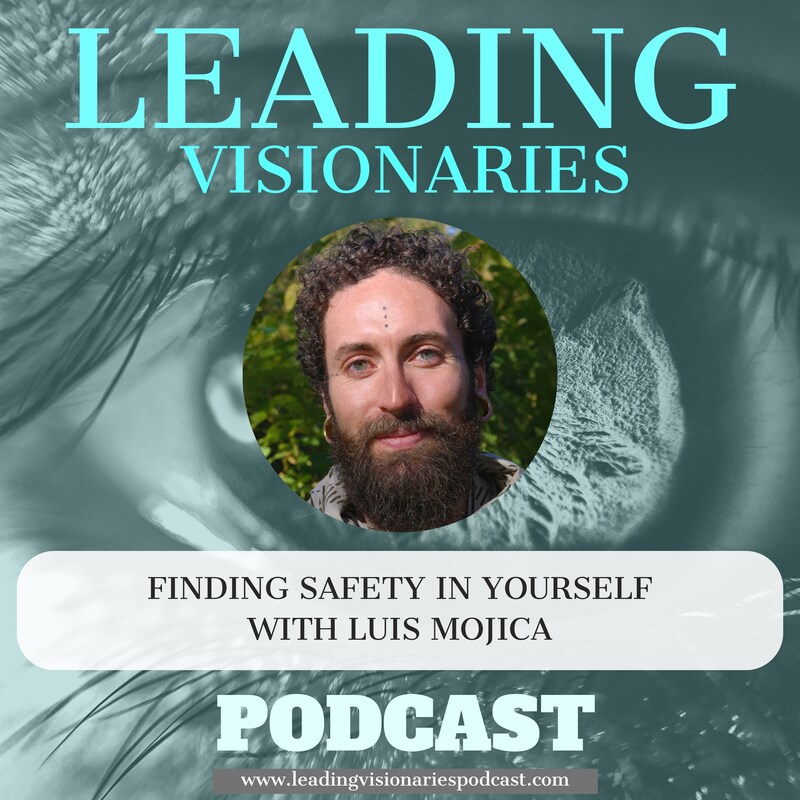
Shownotes
What if the biggest thing blocking your vision is not your strategy, but your nervous system. In this episode of the Leading Visionaries, host Anjel B. Hartwell sits down with Luis Mojica, somatic therapist, trauma nutritionist, musician, and founder of Holistic Life Navigation, for a powerful conversation about what it really takes to lead, create, and build sustainably. Luis shares how his lineage shaped his visionary capacity, why he experiences creativity as a kind of natural “psychedelic” communion, and how developmental trauma can become an initiation into purpose.
If you are a visionary who wants to create without burning out, this episode is a great place to reset.
What You Will Learn:
How Luis defines visionary leadership through lineage, migration, and the courage to leave what is familiar.
Why imagination and “psychic” creativity can be a natural lived experience, not something you have to force through rituals.
How developmental trauma can function as an initiation that shapes purpose over time.
What “capacity” means in somatic terms and why it determines how well you can metabolize stress.
How constriction in the body impacts leadership, marketing, and decision-making.
Why money can be the biggest challenge for service-led visionaries and how boundaries create healthier reciprocity.
How Food Therapy reframes nutrition as a tool for trauma recovery, anxiety relief, and stress navigation.
Why lowering stress hormones changes the quality of imagination from scarcity and urgency into spacious possibility.
How Luis grew Holistic Life Navigation by responding to need rather than following a rigid long-term vision.
Why building a team based on trust, relational fit, and shared mission can be more effective than hiring on credentials alone.
A simple leadership filter you can use quarterly: keep what you love doing and delegate what drains you.
Resource:
Luis Mojica
Join the Leading Visionaries Community
Transcripts
LVP 117 Luis
===
Ad: [:Now here's your host, Anjel b Hartwell.
Anjel: Welcome to another episode of the Leading Visionaries Podcast, where we celebrate the ingenious, the insightful, innovative, and inspired leading visionaries of our time, and provide our listeners with. World class examples of the kind of courage, clarity, and confidence it takes to bring visions into reality.
our very special guest, Luis [:Through holistic life navigation, Luis offers online courses and webinars, in-person workshops and retreats, trauma-informed support groups, a monthly membership and newsletter, a weekly podcast, and a popular YouTube channel filled with insights and interviews. And I will say that I am also. A client and member of the holistic life navigation community and discovered Luis a couple of years ago and knew that it would be an invaluable addition to the podcast to have him on.
ith me today. Welcome, Luis. [:Luis: Thank you so much for inviting me, Anjel.
Anjel: Yeah. So I wanna start our conversation about vision, because obviously you have. Stepped into being a visionary and you have stepped into being a massive leader in powerful ways. So I'd love to have you share a little bit about your experience as a visionary and was being a visionary something that came from your childhood, or is it something that comes from your lineage or is it something that kind of came along as you were developing and growing in your, in your practice and in your dharma path?
Luis: I think I wanna ask you first to tell me what it means to you. Visionary. 'cause my mind goes in a couple directions.
in their life just doing the [:Luis: Got it.
Anjel: Yeah.
Luis: I love that you asked if it comes from my lineage, because just very recently I've been feeling this kinship with some of my ancestors who left their native homes, and there's something in that about being a visionary of seeing something bigger or better or different for yourself from what everyone around you saw.
Mm-hmm. And I was specifically thinking about my mother and my grandfather, my grandfather who left Puerto Rico when he was, I think 23, 24. And my mother that left her hometown when she was 16, dropped out of high school, hopped on a plane and went to the south to live with her brother and make a new life for herself there.
ir family. And so I think. I [:You know, life doesn't have to be like this. You can always leave. You don't have to do what other people are doing. So I, I got this incredible amount of permission that's unusual from a parent.
Ad: Mm-hmm.
Luis: When I wasn't resonating with the, the norm or the culture of Yeah, that's good. Don't, you know, keep, keep tending to that in yourself.
So in a way she was she wouldn't even think of herself this way, but she was really a mentor and stoking that, that visionary ability.
Anjel: Mm. Beautiful. I love that. Well, and I also think of visionary kind of. As a psychic vision as well, kind of clairvoyance and you know, in the work that you do with somatic experiencing and you know, sometimes seeing in the imaginal realm is part of being a visionary.
So could you speak a little bit about that piece for your visionary journey?
a lot to people, not really [:So I've never really needed to get to expand my mind 'cause I was lucky enough to be born into a brain that's really naturally expansive. So I think for me, you know, when you say things about something being psychic or using imagination my mind gives me these incredible images and, and songs. You know, I'm also a musician.
A song is a big one for me in a, in a actually the most psychic way. 'cause I'll have lyrics or a song or a, a world that's being created for music that then 10 years later ends up happening that I didn't even know was happening when I was writing it. So there's some communion happening with some different realm or some collective energy that comes just very naturally.
l, what, what are your daily [:It's not, it's not dissociative. That's the best way I could answer that right now.
Anjel: Yeah. Beautiful. Well, we, we are similar in that regard. I don't need to take anything. I, you know, sometimes I sit with a rock in my hand, but I don't need to take anything to make the magic happen. So I'm, I'm really grateful for that.
of you as you grew and went [:Luis: Oh yeah. I mean, I see trauma as an initiation. So when you say a variety of initiations, I think, yeah. My developmental trauma, they were, each and every one was an initiation into this role I'm in now. And I didn't know that at the time. So what I think made me different from a lot of people was I was born intersex, so I was born with these male female hormone patterns that were essentially competing within my body.
And throughout my first 8, 9, 10 years of development, I had really high estrogen to the amount a female would have. When I went into puberty, my estrogen just kept increasing. So I had this kind of male and female puberty experience, developed breast, developed hips, felt very female, yet had male genitalia, was also developing as a man.
ciety. There was no one like [:I would not have been able to fathom that as a, as a child or as a teenager. It wasn't until actually when I was 15 or so I discovered music. And when I discovered music, it was the first time I found something that took me into myself in a conscious way. So suddenly I was able to witness sensations, experiences, parts, stories, archetypes, ancestors, all these things that lived in me were able to be witnessed by writing them on a paper and then by singing them in my room over and over again.
my thirst of quenching this [:Ad: Mm-hmm.
Luis: And that journey was years and years and years and years of being really shy and not public and really super introverted. No one looked at me hiding my body, hiding my face, hiding everything. And then after a couple years of really tending to myself with the music, this other part of me started emerging with lots of love and I mean overwhelming amounts of love.
Love that I thought was inappropriate 'cause there was so much of it. And people would feel that first. 'cause they would tell me that. And I was, remember I was working at a gas station and I had like a clientele, you know, before I had any certifications or any really let's say professional role of any kind.
ring in psychology. I wasn't [:I got certified nutrition, I studied life coaching, and then I got trained as a somatic therapist from the Somatic Experiencing Institute. So this 15 year period of kind of studying all these holistic alternative modalities, they gave me a framework to now bring this kind of innate desire to love and be with people from and with.
And then that accidentally turned into this huge business I have today. A
Anjel: huge business that you have today. Yeah. And, and you know, one of the things that your business does, like this podcast is called Leading Visionaries. And sometimes it's about the vision. Sometimes it's about the leadership.
at's just not, not available [:And and what I'm noticed, we, what I've noticed within the organization and is that there are a lot of other people that you have around you who are also visionary and also y you know, you've pre provided a, a beautiful container to support people to turn their trauma into triumph and Mm, doing it through food and a variety of other, you know, the somatic experiencing work and so forth.
In the next couple minutes before we go to the break, what I'd love to hear from you is, as you stepped into that leadership role as a business owner, like what do you think your biggest challenge has been that you've needed to like really navigate yourself either from a visionary perspective, a leadership perspective, or a business owner perspective?
e is money. Because I didn't [:So I was, you know, I was working at health food stores and they were like, my clinics. I had my certifications, but I didn't understand what private practice was, didn't really wanna go into it. And I was working out of these health food stores and so I would serve, you know, over the course of a few years, thousands of people.
'cause I was living in New York City for free. I was getting paid $7 and 50 cents an hour. So I didn't come into this with any financial lens. It was a truly a service lens. And the last two years especially, I've really had to be my edge around understanding the boundaries. Of finances and seeing money as an, a true, true energy exchange of reciprocity, as an extension of nature mm-hmm.
[:Anjel: Yeah, well, you're not the only one who comes onto this podcast and says that money is the big challenge.
It is a big challenge for anybody who's a visionary because oftentimes you are bringing in something that is untested or new or innovative, and. And it's on you as the leader and the visionary to actually articulate and command and claim the value out of the marketplace you know, correctly. Mm-hmm.
So, we're gonna take a quick break. When we come back, we're gonna talk a little bit more about your upcoming book. That's about to be. Published and some of the other work that you're doing in the community. And right now though, listeners, are you a leading visionary or in the role of leading other visionaries?
takeaways from each episode. [:The best support is found in collaboration with other leading visionaries, which is why we've created the Creative Age Leader Lab. Discover more about this [email protected] slash creative Age Leader Lab, or click the connect with Anjel button on the website to apply and qualify for a consultation.
For more personalized as access and support. Be sure to share this show in your own spirals of influence with the people who you think might benefit from our content. I wanna say a huge thank you to all of our listeners who are downloading, rating and reviewing. We're welcoming thousands of downloads from all over the world.
d we will be right back with [:Ad: The Leading Visionaries Podcast is brought to you by the Creative Age Consulting Group. Are you the one who thinks differently? Who is called to create a significant conscious change in the world? Who is seeing and dreaming of a better way for your industry, your community, human. Creative Age consulting group is hired to guide leading visionaries just like you who want to break through the static in order to clearly express and confidently enroll support for their vision in a way that makes it inevitable that it will come to pass.
release in three categories [:The book is yours by visiting gift dot Leading visionaries podcast.com.
Anjel: And we are back with Luis Mojica. You can find out more about [email protected]. Holistic life navigation.com. There you will find out also about his new book, his the upcoming book, food Therapy, conscious Eating to Navigate Stress, anxiety, and Trauma. You can also find out about his course finding Safety in Yourself, which was the first thing that I took and that's now available.
I think in a self-paced, isn't it, Luis? Yeah. Yeah.
Luis: It's a four week
self-paced and so many other [:Luis: Gosh, it's interesting because when I think of my vision, it's often in response to what's already happening.
So a lot of people I speak to that, that have their visions, or as you would call it, is, are visionaries. They have this really clear image of where they're going. I never have that, which makes my business advice some of the worst, sometimes some of the best. And, and so it, my, my vision is in response to need.
Right. So it's, you know, I started, I, I was in private practice for years and my fee was so low. Whenever someone says, what do I do? I can't get any clients. I always say, make your fee insanely low. So I was working with people for $45 an hour just to get people an understanding, and I attracted so many people because it was so affordable.
And so [:And so there was this need for my kind of work, and I thought, how am I going to get it out there? And Instagram was the way I decided to do so it was free. I could do a little snippets. It was so easy for me to write every day and just send ideas out, and that just blew up very, very quickly, very organically.
Which then turned into a podcast because I thought, well, I wanna be able to have longer form discussions. So I'm saying this 'cause it went from this private practice where I was very overwhelmed and very busy to this big company where I'm way less overwhelmed because like you were saying in the break, I have found other people to lean on.
could be making millions of [:So for me, it's always in my body. It's truly the somatic practice of how is my body experiencing the work I'm doing? And when it starts to feel confining, when I start to feel bored, when I start to feel overwhelmed, that's my signal. I need to actually expand and get support. So that's how each year, I, I, I kind of slowly grow this business just based on where I'm at with my capacity.
pacity, and for some people, [:Luis: Yeah, so when I'm talking about capacity, I'm speaking, this is somatic term. That just simply means how much room you have inside of you to metabolize stress or handle or experience sensation or emotions.
So people think about their body or even feel into their body right now, you can notice certain places where there's tension or pressure or constriction. Maybe even the shoulders are pulling up and the chest is caving in. That physical posture is a constricting one. That means there's less room, there's less space.
really quickly and I'm gonna [:And I want to, you know, invite and magnetize people that are really settled. I don't want them coming in with a lot of urgency in mania, matching my urgency in mania. So that's what I'm talking about when I say capacity.
Anjel: Beautiful. Let's talk about your capacity for writing a book. Where did you find the time to do that with all the other things that you have going on?
And if you'd like to share a little bit about, you know, what's in the book so that our listeners can get a taste, that would be great.
. Well, what's interesting is: ine is a published Hay House [:I'll give it to the main person that. Looks over new manuscript ideas and proposals and they loved it. And they said your idea is too big. Because I was initially wanting to write this kind of the spiritual animism of trauma and it being an initiation, they said, it's too big. We want to either hear about growing up intersex or food.
And I thought, I'm so tired of writing about being intersex. Let's talk about food. And so I, I made the, you know, proposal. They loved it. And I have to tell you, I am shocked how easy it was for me to write it. I was not looking forward to this because it took me years to write 80 pages, you know, this other book I was trying to work on.
But these, this book just came out of me. It was like it was waiting to be written 'cause it's the work I've actually done the longest. So in a way I stopped valuing it as interesting, irrelevant. 'cause I was so used to it. And then when I was hearing other people respond to it and how important it was, it just kind of flowed out.
ut I will say, my, my ritual [:Anjel: Wow, what a way to write a book.
Luis: I had to make it as pleasurable for myself as possible to motivate myself.
Anjel: Yeah. Well, you, you also, you primed the channel. Let's, let's call it that. Right? Right. That's how it, you primed the channel and you allowed the channel to be well supported in the delivery of the material.
xperiencing or anything else [:Luis: Yeah, well the, what makes the book unique is it's not a book about just nutrition to lose weight or be healthy. It's a book about how do you apply food as a therapeutic model in recovering from anxiety, stress, and trauma. And why that's so important is when we're speaking about leadership or being a visionary or trying to imagine something.
ind your imagination becomes [:It's multidimensional. There's kinda like endless options and it doesn't feel like I have to do it tomorrow or I'm going to die. So you have more patience. You can titrate, you can take slower steps, and that leads to usually a more sustainable goal for people who are trying to move toward one.
Anjel: Yeah, sustainability is so key and it's interesting because many visionaries, I don't know if it may not be true for you, but for me, I definitely felt when I started to receive vision.
Because I'm a vision getter, not a goal setter. Um, I would receive vision and I did feel the urgency like it's now, it's now, it's now. We need to do this now. And it led to burnout for me. It absolutely, that's right, led to burnout for me. And it did lead to you know, financial burnout, physical burnout, a lot of stress, and now everything is just better in my life as a result of applying some of the principles that you teach.
that we talk about. Holistic [:We really need a team. So if you could speak a little bit about your team building process, I think that might be helpful for people as. Again, I think I am one of the worst examples, but I'm still gonna do it and you can tell me what you think. My team has been built based on two things, the need I have, so I have to identify the thing I don't want to do or I'm not good at doing, and that's kind of my personal practice.
istant. That's what they do. [:That could always change. And in a way, there, there's times where it's been a bit of a shit show because we're learning in real time how to do something that the individual has no experience with. But we are so dedicated to this incredible work and philosophy and each other as friends, that it becomes this.
Co-regulating. Fascinating, fabulous, fun work environment to be part of. We actually like each other. Mm-hmm. And specifically the kind of work I'm doing that's really important. It might not be if I was doing some other line of work, but my work is deeply relational and it's about calling people into this almost familial space.
arter, I sit with my body. I [:What did I hate? What did I love? And whatever I hate, I give to somebody else.
Anjel: Oh, see, that is so brilliant. I mean, I totally agree with you that. Doing the work that you're not supposed to be doing actually is very erosive, and the quickest way to wreck your business is to actually continue to force yourself to do the things that you're not really happy doing.
And I love. I really love and I'm going to apply in my own business. Who do I most enjoy being around? Because I think that's like a magical key for helping people. It really is to build something bigger than themselves in, in an organization that is healthy and able to flourish. So, excellent. Well, Louise, we are already at the end.
hink of this show by joining [:You can weave your visionary thread into our fabric by opting in on our [email protected] or by interacting with us on social. Look for the handle at Leading Visionaries Podcast across all the major platforms. Thanks for tuning in. Keep your eyes, ears, and hearts open. And remember, you are here to create conscious change.
t time to welcome wealth and [:We invite your feedback and guest suggestions and invite you to subscribe to our mailing list to be notified of new episodes. At Leading visionaries podcast com.
