Shownotes
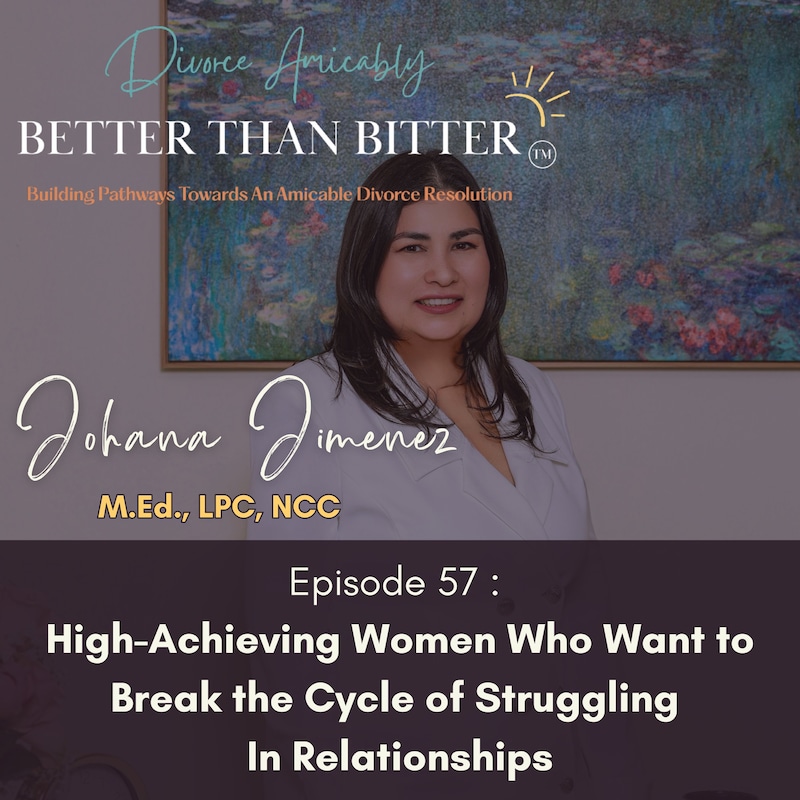
Episode 57: High-Achieving Women Who Want to Break the Cycle of Struggling In Relationships
Guest Info:
Johana Jimenez
Johana Jimenez, LPC, is a Dallas‑based therapist who helps high‑achieving adults and couples navigate anxiety, depression, identity shifts, and relationship struggles with compassion and evidence‑informed care. Using EMDR, somatic, and Gottman‑aligned approaches, she helps clients move from survival mode into emotional safety, authentic connection, and meaningful living.
Guest's Social Media Profile:
@thephoenixineveryhumanbeing on Instagram
Keywords
divorce, emotional healing, high achievers, resilience, child-centered approach, therapy, acceptance, relationships, self-worth, personal growth
Summary
In this conversation, Tania Leichliter and Johana Jimenez explore the emotional complexities of divorce, particularly for high-achieving individuals. They discuss the feelings of failure and shame that often accompany divorce, the importance of acceptance, and the need to focus on personal growth and resilience. The conversation emphasizes the significance of a child-centered approach to divorce, ensuring that children's well-being is prioritized. They also highlight the importance of emotional awareness, naming feelings, and recognizing one's self-worth. Ultimately, the discussion encourages listeners to take control of their narratives and strive for a better future post-divorce.
Takeaways
- Divorce often brings feelings of failure and shame.
- Acceptance is crucial in navigating divorce.
- High achievers may struggle with emotional expression.
- Modeling resilience can help children cope with divorce.
- A child-centered approach is essential for amicable divorces.
- Naming emotions is the first step to healing.
- You are lovable regardless of relationship outcomes.
- Focus on personal growth and self-worth post-divorce.
- Understanding past relationship patterns can prevent future mistakes.
- You have the power to control your reactions and choices.
Sound Bites
"Divorce is a loss."
"You need to throw away the why."
"You can only control yourself."
Chapters
00:00 Introduction to Healing Post-Divorce
01:13 Navigating Feelings of Failure and Shame
03:15 Acceptance and Moving Forward
04:58 Exploring Patterns in Relationships
07:05 Understanding Lovability and Self-Worth
09:01 Compartmentalizing Emotions vs. Processing Them
10:52 Modeling Resilience for Children
14:09 Breaking Negative Mindsets in Children
16:51 Creating a Child-Centered Divorce
19:21 The Circle of Control
22:24 Rethinking Emotions and Responses
26:08 Tools for High Achievers in Therapy
37:17 Introduction to Amicable Divorce
38:46 Resources for Support and Growth
On our website you'll find details and additional information on our 5-Step Gameplan multimedia course, our different types of coaching
methods, monthly memberships, events and retreats, and a whole lot more. Plus, we've got a ton of free resources, like our monthly newsletter, our private Facebook group, our Instagram channel, and a library of articles and free webinars to help you along the way. When you go to our website, you'll be able to schedule a free 45-minute breakthrough call. Remember, we're here to help you reach an amicable resolution. Find your courage and believe in your brighter future because you know what? It is possible.
At Better Than Bitter™, we measure success by what we give and not by what we get. So, let's change the divorce dialogue together. It's time to be better than bitter.
Do you want to know if We Can Help You? Book A Free 1:1 Breakthrough Call Now! Click Here
If you want to connect with a Divorce Concierge, contact Vesta Divorce Concierge here!
Transcripts
Welcome to the Better Than Bitter Podcast, episode number 57.
So many times I get asked about divorce and high achieving women. And I am one of those high achieving women. And I believe that this is a topic for discussion. So today I've invited Joanna, who is a therapist in Dallas, who primarily deals with high achieving women and divorce. And those of you who are in that category, thinking about those feelings of failure.
those feelings of not being enough or that you might feel out of control when in so many other places in your life you are in control.
divorce is not about failure. And being able to explore that is going to be an important conversation for all of us. So I welcome Joanna here today.
Johana Jimenez (:Hi, Tania. It's a pleasure to be here in the Better Than Bitter podcast. After all the difficulty and the struggle that a divorce means for people in their lives, that's what they want to be. Better.
Tania Leichliter (:Yeah,
well, I love to hear that you say that they want to be that way, right? Because if they wanted to be that way so much, then they'd really be focused more on how to be that way and how to not be bitter.
I love the fact that you said that we all want to be better than bitter, because we should all want to feel better when we wake up every morning, right? We want to have a better life. We want our children to have a better life.
but it isn't necessarily how people begin to approach their divorce. So in your experience, because I know you do deal with a lot of people getting divorced, and it sounds like you work with a lot of high achieving women. So what is that first feeling that they come or the first thought that they come into your office with once that decision is made?
Johana Jimenez (:So the first feeling usually that they experience is failure and shame and guilt. They come from a place that what did I do or what didn't I do to make this relationship work? Wasn't I enough?
wasn't all the things that I did for the spouse or the relationship or the children weren't they enough? What's the problem with me? How come I am not successful in this relationship when everywhere else I am successful? So that is the place that most of them come at.
Tania Leichliter (:how do you respond to that when they begin to come go down that rabbit hole of failure?
Johana Jimenez (:First of all, normalize what they are feeling. There's no right or wrong way to feel when you're experiencing a loss. A divorce is a loss. Whether we want to see it that way or not is a loss. We're losing a relationship. We're losing the idea. We're losing the potential of the things that could have been with this person.
When they come with these thoughts like I'm a failure, then the first thing is just accept that this is where we are, right? And it's a difficult place to be. Not where they want it to be. When we all get married, we all think, you know, that our life is going to be perfect. We found this great person. We're going to have a life. We have common values, common interests, common dreams, goals, and we're going to move forward. We're going to have children, build things together or not have children, but have a happy life.
Unfortunately, challenges happen. People begin to grow apart and the divorce happens. So it's just accepting, number one, that this is where we are. And it is okay to feel all these feelings, normalizing that stage where people are. For high achievers, it's really hard to feel because they don't, a lot of high achievers don't like to feel. They just like to think.
through the process. They like to think, well, this happened because of this. But if I hadn't done this way, this will have happened. I wouldn't be here if this wouldn't have happened. So a lot of high achievers have difficulty sitting with their feelings. They just want to push through. OK, let's check this item out of the list so I can continue with my life. I can continue performing. I can continue doing the great things I'm used to doing.
And this is the hard part because when we start sitting with ourselves, we start feeling our body, we start feeling the loss, we start feeling the sadness, the grief, you know, that's hard for high achievers.
Tania Leichliter (:What I feel is, so I would classify myself in that high achieving category. And I believe that I definitely reached a place of acceptance quickly because there was nothing I could do to control it, right? So it comes back down with, so I have two choices. I can either accept and move forward or I could say, whoa, it's me and sit in
you know, my own pity party and decide that I was going to let divorce define me. And I decided that it is what it is. And that my choice and my ability to control anything was how I was going to move forward with the re-envision of what our family could be, right? So that I couldn't change the past.
You know, when I always say it better than bitter is you need to throw away the why, you know, why you're getting divorced if you want to have a brighter future. Because if you live in the past, you'll just continue to be depressed. So doesn't mean that you don't process. I cried for a year. I cried. You know, it wasn't like I didn't cry and grieve properly around the loss of the marriage.
But I also, at the same time, knew that if I just continued to say the what ifs, what ifs, the wha- what ifs, that I couldn't change. Like, that's the past. So tell me about, because you do therapy, and a lot of individuals are wondering if their past contributed to their present, which then also might contribute to their future. Like, how do you navigate that with clients?
Johana Jimenez (:So.
In therapy, like you say, we explore the whys, right? We explore the reasons things may have happened, right? It depends on what we're doing in therapy is it could be we are trying to find a reason so we don't repeat the same pattern, right? Because this is very common. We marry the same person in a different package or we date or we look when we start dating for that person.
that is going to have the same traits but in a different package. And where do we learn these patterns usually in childhood? Usually on the relationships we saw around us. Sometimes we didn't have healthy models of what a good relationship looks like. So then we just try to find the best replacement that our brain could find and think that, this is a good relationship or this could be a good partner.
So in therapy, we focus on the patterns. Why am I choosing the person that I am choosing? Why?
Do I keep making the same choices? Because sometimes I find ⁓ in therapy with my clients that they dated some person who was very value abusive. They did it again in the next relationship, then the next one. So it is a pattern, right? So why do we do this? Why are we seeking this? So that's one of the things that we do work in therapy. Then we also work on the, what do you want to be from now on? Who do you want to be?
Tania Leichliter (:Mm-hmm.
Johana Jimenez (:what is the life that you want to create as you're healing? doesn't like failing, thinking that you fell in a relationship doesn't mean that you cannot love again, right? It means what are the things that we're going to do differently to be in a healthier relationship, to be in a relationship that is not going to be as the one we have before? Maybe there were some good things, so we use that as a baseline.
That was the good thing that was in my relationship. Okay, I'm going to take that and I'm not gonna have anything less than that. And I'm gonna move forward and find someone who we can both offer each other something better.
Tania Leichliter (:I think that's so important when thinking about yourself because sometimes people who are getting divorced, who might be wallowing in the why and that feeling of failure, they might have a belief that they're not lovable.
And what I challenge them to is that you are, everybody is lovable just the way they are, right? You are lovable, but you might end up with somebody that's not lovable, you know, and that's not something you can control. so, you know, lovable with all your, you know, different traits, just accepting who you are, knowing that
you are lovable and believing in that. But that don't have the capacity to love at the same level or that you might be desiring. Maybe they're emotionally unavailable. Maybe you're emotionally unavailable too, you know? And that's trying to figure out, especially in that world of high achieving individuals, not letting, you know, I call a lot of it compartmentalizing. And I know
sure you do too. It's like, how do you compartmentalize what you need to do every day to function? And then what the feelings are that might still be there, but you're very easily to be able to say, okay, I got to put those aside because I got all this other things I need to get done today. And then if you keep yourself overly busy and you become what I call a human doing versus a human being, you are able to very much compartmentalize those emotions. But it is important to
Johana Jimenez (:Yeah.
Tania Leichliter (:to deal with the emotions that you do have, even if you're not doing them in that same pool at the same time as everything else you need to get done. Some people have a very high capacity. I have a very high capacity for that. It doesn't mean that I am not dealing with my emotions. I just don't deal with them when I'm supposed to be getting other stuff done. Do you deal, I mean, do you work with that so people have an understanding of how their worlds are?
Johana Jimenez (:Mm-hmm.
Yes, and you mentioned something about core beliefs. In EMDR, when we're doing individual therapy, I use EMDR, which is eye movement, the syncytation reprocessing, but we don't only work with the eye movement part or the physical or somatic part. We work with the beliefs. One of the core beliefs when we are sometimes facing a difficult situation could be I'm not lovable. So during therapy, what we do is try to find the origin. Where did you learn that you were not lovable?
Where did your brain learn that? Where did your brain first hear that? That you were not lovable. To try to reframe that core belief and find the opposite, the positive belief, which is I am lovable. Because like you said, everybody is lovable. We just have to find that belief into ourselves because it's there. We just have to reframe. We just have to reprocess that negative belief into we are lovable.
And as a lovable person that I am, these are all the qualities that I have. And these are all the good things that I can do in a relationship. You mentioned that you are a high achiever, but you have the capacity to move forward, to make a decision and say, OK, I can either be stuck or I can move forward. And that's a trait that the high achievers have.
like the agency, the ability to make a decision and take action. Okay, I'm just not going to sit here and wallow in my pity and just say like, I'm not lovable. I'm going to do something about it to move towards the life that I want to build. Right. And that's one of the positive traits of high achievers. One of the many, right. It could be a healthier unhealthy, but the good thing is that we have agency and say like, okay, we're moving on.
We're going to find a resource. We're going to go to therapy. We're going to find coaching. We're going to do something. I'm going to work on myself physically, mentally, academically. I'm going to do something about it so I don't get stuck.
Tania Leichliter (:Yeah, I think it's so important. And I talked to my stepmom, you you were talking about modeling. And I believe that I come from a series of women's strength in my life, that that was modeled to me. But there was a lot of resilience that was needed.
due to a lot of life transitions. My mother actually got sick when I was 15. And my father, who was a good dad, he just didn't live near me. He lived in Colorado and I lived in Connecticut. And so I went back and forth between my mother and my father, vacation, summers. But my mother did get sick when I was 15. And that was just that first step in my life that was really about
resilience, you know, and like you said, agency. What was I going to do in the face of adversity? I could wallow in the fact that my mother was sick and I...
Johana Jimenez (:and
Tania Leichliter (:you know, or I could step it up and learn how to take care of myself and, you know, obviously help take care of her and move my life forward in a way that, you know, was going to work for both of us. Obviously I came from a mother who did not want me to be ruined my life to take care of her. Like she was very much like, I'm going to figure it out. You go work, you know, you go figure out.
your life and I'll figure out mine. Like I don't want you sitting here by my bedside till the day I die. My mother ended up living for 20 years. So thank goodness I didn't sit by her bedside. But it was, you know, and, know, completely changed the trajectory of my life. But when I was faced with divorce, you know, a lot of those models came up for me, you know, like, what do you do when life throws you curve ball?
And the only model that I knew was that model. And when I talk to my kids who say, I think we're destined for divorce because you come from a divorce family, dad came from a divorce family. And, the statistics are against, us And
hearing those words from your kid's mouth is like so hard. I say to them, well, 50 % of people who get married get divorced. So it is a bigger statistic than just ours. And the only thing that we can do is model good behavior and good relationships of co-parents moving forward and having a relationship with my ex.
But how do you approach, high achievers who seem to like be getting their life moving forward, their kids, how do you prevent their kids from having that negative mindset where they believe they're doomed
It's hard to hear. Don't you don't you hear that all the time?
Johana Jimenez (:I do what I hear a lot in my clients, from my clients, is that they don't want their children to end up like them, or they want to work on themselves so their children don't suffer, right? Or they want to be better.
for themselves and for their children. Usually it's, want to be better for my children, but during therapy we instilled the belief that they are also important. So you're going to also be better for yourself.
The problem is that
Sometimes they meet a partner that doesn't provide the same amount of love or quality time or financial resources. And this is the difficult part. And because you're a high achiever, you have learned from an early age how to survive. So your brain goes resource to that model. Like, OK, then I just need to do more. So I am just going to do more.
to make this relationship work. And this is what your children observe from you. Like, OK, mom and dad, they are having problems, but they just keep working more on their relationship. Or she keeps trying to do more, or she keeps taking more on the household. Or whatever it is they see you doing, they see those patterns and they internalize them without knowing that they are doing that.
So as parents, when they come to me, what we need to do is focus on what is it that you're doing right? What are the good things that you're modeling to your children? So they can, when they go and they have their own relationships, they can also use that. Okay, I am a very loyal person, just like my mom was, or like my dad is.
So these are good things, right? Not everything is bad. You as a person or whoever it is as a person, as an individual, you have good traits. Not everything is bad. So you got to focus on that too. Like all the good things that you're doing. When it comes to the children, usually they are the most affected, right? Because as a child, you have this fantasy, that moment that always, and in some cases it's a fantasy, in some cases it's a reality, right? That moment that always
going to be together but when a relationship is headed towards divorce obviously that fantasy is broken so the child internalizes this as this is this must be my fault right mom is doing mom job dad is doing his job in the relationship so what's the problem here it must be me right and then this is
One of the things that happens frequently they internalize it as this is my fault I must have done something that caused them to separate right and in your case when you say okay We sat with our children. We communicated. We both were amicable. So this is the best way to Transition the children, you know from the married couple to a divorced couple like telling them this has nothing to do with you sometimes as adults
You know, we don't work as we thought we would. We will work. This has nothing to do with you. We love you. And because we love you, we're doing X, Y, and Z measures to make sure that you guys are OK.
Tania Leichliter (:Yeah, and I think that's the hardest piece of it, again, is that you can't control. Like, I couldn't control my ex-husband in terms of how he decided to approach the divorce once we made that decision. But
⁓ he was right on board, you know, because we did have a child-centered divorce. We both felt very strongly that we wanted to have a family re-envisioned. We both felt very strongly that it wasn't that we didn't love each other. We just were better at loving each other apart and being in, new relationships and being able to be our authentic selves. So, the problems in the relationship,
were irreconcilable, and that when we came to that level of acceptance of what that was,
we really are going to work hard toward this family re-envisioned. two years later, we delivered on our promise and that we still share our holidays together. We still share.
all of the celebrations and accomplishments and celebratory days. And my son plays sports in college. We travel to those games together. We, like I said, had birthdays and now he's with somebody and I'm with somebody and we all celebrate together.
And that takes a lot of self love and it takes a lot of self confidence to be able to be with your ex and their new partner in a place where you're putting your kids first.
And maybe it might feel a little uncomfortable to them for a little while, but yet with more exposure to it, it becomes normalized, as you said. And that's our job, right? So thinking that you're a failure, if you go into any of those situations feeling like you failed in your marriage, the ability to sit at a table with your ex and their new partner, you aren't going to be able to get that level of comfort.
right? Because you don't feel like you were enough.
Johana Jimenez (:Exactly.
And that is the...
approach that a lot of people take, right? When they are first getting divorced is the anger. I am going to be angry about without thinking, right? It's just like an automatic response. This is what you're a middler, which is the part that controls your emotions, the fight or flight reactions. Then you go like, okay, so he left me for that person or she left me for him. He must be better than me or she must have something that I don't have. Right? So we start creating the
thoughts or beliefs or alternative universe
That's the only thing that you can control. You're never going to be able to control the other circles that are outside your circle, right? Every person is a circle and you cannot control any of them. You can influence your spouse, but you cannot control them. And once a person has separated from you,
financially, emotionally, you don't cohabitate together, it's even harder to try to influence that person. So they are going to do what they decide to do. And yes, there's going to be discomfort, right? For some people, discomfort is the best place to be rather than being angry, rather than being blaming someone about something that happened, right? So.
once you start working towards healing yourself, towards acknowledging your emotions because it's hard to name. I am angry, I am sad, I am disappointed.
you know that this situation happened. I am disappointed at my ex-husband, at myself, at how we handle things. Once we start labeling those emotions, then we're able to start moving like, okay, I am feeling uncomfortable with this situation at the moment.
What can I do to change how I'm feeling? How can I respond to this situation better so I can be a better parent for my children? So I can be a better, perhaps not friend. It sounds like you and your husband or ex-husband are friends, right? So it sounds like you have been able to move towards friendship now. Some people, if they don't want to be friends, that's okay. You don't have to be friends, but you have to be respectful.
Tania Leichliter (:Yeah, we're friends.
Johana Jimenez (:You can be as angry as you want, you cannot take it on someone else or their new partner. Yes, like you say, it might be uncomfortable at the beginning, but the more you start thinking, why am I doing this? Why am I meeting with this person? Why am I for Thanksgiving at the same table with these people? And when you start seeing that there's a bigger purpose than
just sitting across the table from that person and you see like it's because of you know we want to re-envision our family because we want to be together for the holidays because we want our children to have this experience then you start realizing okay there is a reason why I'm doing this I'm not just doing this to please someone else right or to make someone feel good about their choices I'm doing it because I have a saying I have a choice
and I'm choosing to be a better parent for my children.
Tania Leichliter (:You know, and that's the result. And I say that in order to get those types of results in your life where, you know, your kids can normalize your divorce, they don't put their head down walking through the hallways at school where they believe they can have the more people that love them, better, you know, and it really takes being bigger than yourself. And that's what I always say, you know,
Be bigger than yourself. Think through that child-centered lens. What is possible in your life if you just threw away the why and really focused on what is important in your life? And that's what you were saying. It's like, what is it that you want in your life? How do you want to feel every day when you wake up in the morning? Do you want to feel bitter and angry and resentful?
because it is our thoughts about our life circumstances that create those feelings. It's not the circumstance that creates anger. It is the way we are thinking about the circumstance that creates that anger. And so, you know, I have the hashtag rethink, refuel, because if we can re-script those limited beliefs that we have in our life.
we will feel differently. And when we feel differently, we act and we react and we behave in ways that are going to get us closer to that result that we're looking for, that family re-envisioned, the normalizing the divorce, the modeling good relationships for our kids. knowing those results is, that's the pot of gold. Because then you can work backward from there. Check in with yourself.
Am I acting and reacting in a way that's going to get me that result? And I always tell my clients, check in. You know, so before you respond to anybody, make sure that you're retracting, meaning thinking through that, you're re-scripting, you're regrouping before you respond, you know, because I think that it's important that we are not responding reactively.
when you're getting divorced. And I think that especially in high achieving individuals where things are a little bit more cut and dry and potentially direct, like you said, it's like there's all these get it done kind of things, very type A.
Johana Jimenez (:Mm-hmm.
Tania Leichliter (:I can do anything. I think that it's something that these type of techniques work really, really well. I know that I was in therapy when I first was faced with divorce and I put myself in therapy, but I would put myself in more like talk therapy, relational therapy, which I on saying, where are the tools in my toolbox? I was like, I need you to give me an instruction manual here.
Johana Jimenez (:Mm-hmm.
Tania Leichliter (:I could talk to Lumblu in the face, but I need to know what these tools in my toolbox are that I can access at any point. And that's really why I believe I gravitated towards life coaching because coaching is very action oriented tools and tool kits in your box that you can access. And you do a lot of techniques in therapy that are very similar to coaching. So it sounds like you really blend.
Johana Jimenez (:click.
Tania Leichliter (:so much of the action oriented, know, CBT, DBT, know, somatic, you do a lot of the tools in the toolbox, which I love, probably should have seen you as my therapist. But I believe that for you, you know, we go back to the title of this, we talk about, you know, the circle of control, we go back to how high achieving people can not continue to struggle in relationships.
and it comes back down to tools in their toolbox. know, like, how are they thinking based on the other around their life circumstances? Are those thoughts serving them? Are they bringing about the feelings that are going to bring them closer to the results they're looking for in their lives? And how can they begin to coach themselves? Like I said, I use this child centered lens. I find like it's like a checkbox. It's like,
Johana Jimenez (:Mm-hmm. Yeah.
Yes.
Tania Leichliter (:you know, it's more metaphoric because not everybody has children, but it's more metaphoric in the way that we look through that child-centered lens to make sure that we're acting, reacting, and behaving in a way that if we were on the receiving end as a child, you know, how would that feel? Or how would we see it? And it's just an interesting approach. I mean, we're all talking about the same things here.
Johana Jimenez (:And you mentioned therapy, right? There's different types of therapy approaches. Talk therapy is the most common one, the most that, the one that most people are familiar with, right? And you can say, like you said, you can talk until you're blue in the face, but sometimes you're not going to be able to move forward or.
Tania Leichliter (:⁓
Johana Jimenez (:being stuck in a couple of sessions, or it's gonna take a while, right? Therapy is a process where we move at the pace of the client with respect where you are, and we help you move from where you are at your pace, right? Like you mentioned, I use different approaches like EMDR, like Somatic, CVT, which...
I eclectically integrate them all to give you as a client the resources, like the tools that you can use when you're having negative thoughts, when you're feeling like your heart is racing, when you're having a memory, you know, like of the good times and then you're romanticizing that moment and then you want to go back to your partner or you want to call him or call her and say like, let's go back together. Right. So.
we have grounding techniques for those moments. Like say, okay, where is it that I am? Why is it that I am trying to do with this action? So those are some of the tools that we do have in therapy to help high achievers and every individual think or understand why they are acting the way they're acting. And of course, in therapy, we do work on the whys.
We do work on, am I feeling this? Where is this coming from? Where did I learn this? So people can actually get unstuck because sometimes how you are in a relationship comes from how you were in your childhood. Something that happens with an important figure to you. could be your attachment figure, your parents, your perhaps your grandparents or somebody who was of...
important value to you, then you repeat these same behaviors with your new partner. So this is why it's important to identify them. One thing for high achievers is that we'll, and I am high achiever in recovery. We like to feel like we have a sense of control and that sense of control most times comes in the form of performance. If I perform,
Tania Leichliter (:We're all MG for today.
Johana Jimenez (:then I can control things, then I can control the narrative, then I can control what's going to happen. The problem is that in that relationship, we cannot control a partner. We're two individuals coming together to make a life together. So the controlling part is hard for high achievers. And sometimes it's hard to let go of a relationship because we think
If we keep working hard and if we just go to perhaps couples therapy, if we go to a retreat or if we just spend more time together, our relationship can be fixed. But in reality, that's not the case. There has been a lot of things that have happened in between that have led you to be in this moment, right? So for high achievers, I invite you to think and analyze, is this something worth keeping?
holding on to or is this the moment to let go?
Tania Leichliter (:Well, that's actually a great place for us to kind of wrap this up today. I really appreciate it. And thinking through the different things that you talked about today that were so important. I loved the idea around the circle of control. The only thing you can control is yourself. And that is the only thing that you can control. So relieving yourself of the need to.
control everything else outside of yourself is only going to lead to you being stuck or feeling like you are a failure because you can't control everything. One of the other things that I really enjoyed you talking about was the idea about
we talked about it together really is the idea of being lovable, you know, and you're lovable just the way you are. And just because you're getting divorced and even if your spouse found somebody else, it doesn't mean that you're any less. And it doesn't mean that you're not good enough because the other person might just have different needs. It doesn't mean that you had anything wrong with you.
And especially with high achievers, you know, when you're really, really good at things and somebody else might not feel as good about themselves because you might be a little better at everything. And therefore some of those needs for feeling validated or, you know, it's a challenge, you know, to be in a relationship with people that are really good at stuff. And so...
Johana Jimenez (:It is.
Tania Leichliter (:It doesn't mean you need to go, you don't have to go changing. Be as good as you can be at everything that you can be, in my opinion. And it's just about finding the right person who doesn't feel threatened by that, right?
Johana Jimenez (:or want to compete with you, right? Because that's another pattern, right? A lot of competition in this kind of relationships, but yes.
Tania Leichliter (:or want to.
Yeah, because then they're just not going to be happy for you when you have good things happening in your life and everybody deserves to find a partner who celebrates the good that happens in each of their lives, right? You you want to be able to celebrate together. And the last thing that you said is just about feeling and meeting your clients where they are and the ability to name your emotions and the ability to be able to say,
I'm angry and I'm sad and I'm depressed and being able to acknowledge that those feelings exist, meet yourself where you are, but acknowledging that the most important place that you need to get to is that place of acceptance. And once you do accept, then you begin to evaluate.
the thoughts the thoughts that are triggering into those emotions, because sometimes just reaching a place of acceptance is acknowledging the thought. And once the thought is understood, is the thought a limited belief? And I love when you really went deep into talking about limited beliefs.
Johana Jimenez (:you
Tania Leichliter (:Well, do I know that thought is actually true that's causing me that sadness or frustration? If you don't know it's true, I always tell my clients, then you need to re-script it because if it's your truth versus the truth, it's something that you're making up in your head.
I appreciate your time today, all of your contact information will be in our show notes. She's based in Dallas and ⁓ all of her Facebook pages and everything else of YouTube channels. If everyone wants to follow her, highly, highly recommend it for all you high achievers out there. If you're looking for great therapy, I would definitely recommend Joanna.
I appreciate you being available to be on the Better Than Bitter podcast today. And for those of you listening in today, just a really great announcement. Better Than Bitter is growing. We have launched an incredible community and our community is going to be coming in.
multiple different levels. We have a support circle for a dollar a month. You can join our support circle no matter where you are in your divorce process, contemplating in the thick of it maybe your post divorce. So join our online community. And then we have our divorce companion. Our divorce companion is this support circle, but it also includes all of our library of resources, our articles, our webinars, our
courses. We have incredible amount of divorce resources that are on demand for our divorce companion members. And then if you're looking for a bigger type of support group, we do run Zoom support groups. And that's part of our Divorce Companion Plus membership. So in the next week, we are blowing this out. You can be paying anywhere from a dollar a month to $9.99 a month or
$147 a month, depending on your level of membership. So really excited. We want to change the divorce dialogue here at Better Than Bitter. We want to make divorce coaching affordable. And we want to make our community the biggest divorce community out there, because we really do believe, like Joanna said at the beginning, that it is important that we all want to be better than bitter.
We all want to have a more amicable divorce resolution because when you do, you will feel better every single day when you wake up. So I'm Tonya Licklider signing off. I am happy for all of you to join us today and I look forward to you all listening in at the next Better Than Bitter podcast. Please make sure you subscribe. It really does help.
us get out there and you can also find all of our videos of these podcasts on our YouTube channel. Thanks again.
Tania Leichliter (:Thanks for tuning in to Better Than Bitter, navigating an amicable divorce. Whether you are at the beginning of your divorce journey, midway through, or even done, we want the stories from our guests to give you hope that an amicable resolution is possible. If you'd like to dive deeper into today's episode, check out our show notes for a full transcript, reflections, and links to learn more about Better Than Bitter's coaching courses,
and how to connect with our fabulous guests. If you're ready for more support, you can head over to betterthanbitter.coach. Daily, you'll find details and additional information on our five-step game plan multimedia course, our one-to-one Zoom coaching, group coaching, monthly memberships, events and retreats, and a whole lot more. Plus, we've got a ton of free resources, like our monthly newsletter,
our private Facebook group, Instagram channel, and a library of articles and free webinars to help you along the way. When you go to our website, you'll be able to schedule a free 45 minute breakthrough call. Remember, we're here to help you reach an amicable resolution. Find your courage and believe in your brighter future because you know what? It is possible.
At Better Than Bitter, we measure success by what we give and not by what we get. So let's change the divorce dialogue together. It's time to be better than bitter.



