Shownotes
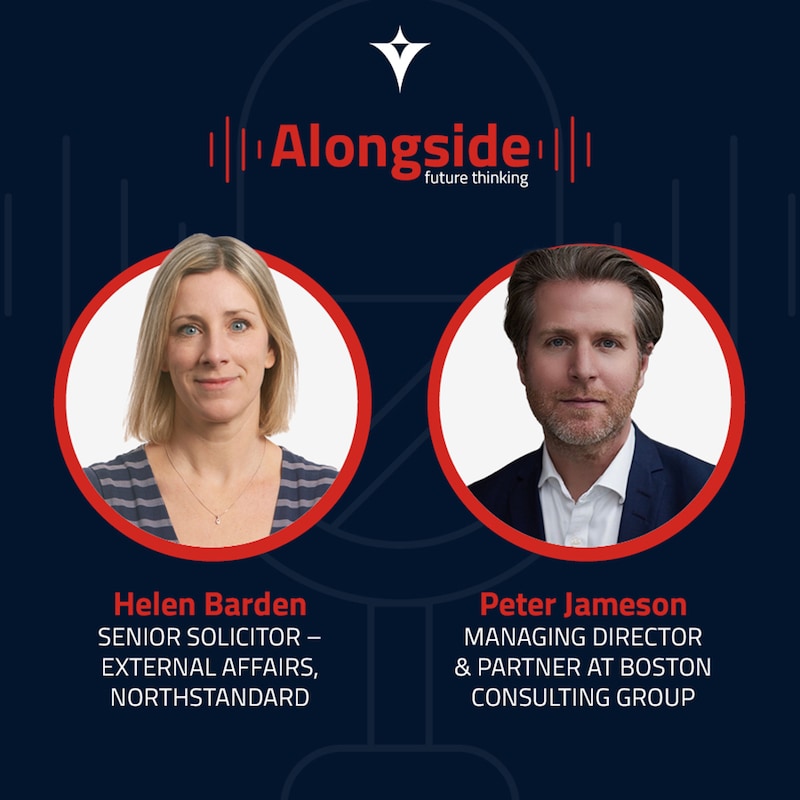
In the final episode of the debarbonisation Future Thinking mini-series, Helen Barden is joined by Peter Jameson, Managing Director at Boston Consulting Group. They discuss holistic sustainability in the maritime industry, including economic sustainability, ESG factors, and the influence of global geopolitical factors on maritime decarbonisation. Peter offers insights on how companies can begin their sustainability journey, emphasizing collaboration, smart diversification, and strong leadership.
Highlights:
00:00 Introduction to Future Thinking Mini Series
00:45 Meet Peter Jameson: Maritime Decarbonization Expert
01:56 Defining Sustainability in the Maritime Industry
04:37 Current State of Sustainability in Shipping
07:15 Geopolitical Influences on Maritime Decarbonization
12:47 Navigating Trade Disruptions and Future Fuels
16:41 Top Tips for Companies to Enhance Sustainability
19:54 Conclusion and Final Thoughts
Transcripts
[00:00:36] Welcome Peter and thanks very much for joining me today.
[:[00:00:41] Helen Barden: In this episode, we'll be taking a broader perspective of sustainability in the maritime industry and what can impact upon a company's ability to act more sustainably. Perhaps before we go any further though, Peter, I'll just ask you to introduce yourself and introduce your role within Boston Consulting Group.
[:[00:01:37] Uh, and we'll talk a little bit about that later. I think it's, it's not just about carbon. It's more about sustainability holistically. Um, so I get to, uh, I get to do a job that I'm also hugely passionate about as well, but really pleased to be here and spend time talking about this.
[:[00:02:22] So it'd be good to know from your side. What do you what do you think? What elements do you think are part of sustainability?
[:[00:02:50] Sustainability is also about economic sustainability. And actually, you need to have the two going hand in hand because you can't develop a, you know, an economy without the support of, you know, a sustainable environment as well. So I think that's very much the holistic view that we that we take on this.
[:[00:03:32] So it, it, it's almost. You know, all encompassing and it's very difficult actually for me to put this into a framework, whether that's ESG or, or what, but it's, it's very holistic, at least in our view.
[:[00:04:03] Generally speaking, how sustainable do you think Okay. The actors are within the shipping industry. We obviously have in terms of decarbonization. We've got the international maritime organization's greenhouse gas strategy Um, and there are obviously targets in that regard and we're waiting on certain regulations to help us get to that point, but Generally speaking, I suppose there's elements of voluntary sustainable practices within companies as well as the more mandated elements of sustainability.
[:[00:04:43] Peter Jameson: Before I answer that, I want to take one step back and that is to say, let's not forget that shipping as an industry is one of the most sustainable ways of transporting goods around the world. So I think that's a pretty good starting point for an industry. However, we shouldn't sit on that and not do anything and not move forward on it.
[:[00:05:29] So what is it that I can do now without taking risks, but still do something? So doing stuff there, of course, you know, abiding by regulation, but they're doing a little bit more. Um, and then we have the last group, uh, and this last group are, are the compliance bucket. They're the people that are doing the bare minimum.
[:[00:06:19] And then we can all sit back and look at those front runners that have great balance sheets, that are able to throw money at this topic, and we can look in envy. I would argue that actually, that that also may not be sustainable, So I'm, I'm actually very encouraged to see, uh, to see what's happening with this group that sits in the middle.
[:[00:06:44] Helen Barden: Yeah, there is a broad spectrum within the, within the industry when it comes to what steps are being taken and it's a very difficult topic to navigate when we are so uncertain about what the future brings, which I suppose brings me on to my next question and Obviously, companies can take steps to act sustainably, but there are external factors that influence how sustainable or, um, what steps can be taken when it comes to decarbonizing an industry.
[:[00:07:31] Peter Jameson: Yeah. So I think this is a super interesting question sitting here in June in 2024. We're in the year that is going to see probably the most decisive, uh, Elections in the democratic world taking place. Um, what we've seen happen in Europe in the last days, and I'll come back to that what we're likely to see happening in North America towards the end of the year.
[:[00:08:14] Further towards the right in European politics, and it is very clear from the rhetoric that is coming from those parties and those representing those newly elected individuals that, uh, they perceive that Europe has moved too fast with the green agenda with the sustainability agenda and too fast for the economy and for the, um, for the people to actually absorb what's changing.
[:[00:09:11] And ultimately, if we're talking about the transition of the maritime industry and creating a more sustainable space, we need capital to flow into this industry. Um, so I think that's one of the biggest, uh, the biggest risks that I see and what we're seeing at least in what evolving. And of course, I'm taking a half glass empty view of this topic, but I think that's the reality that people and decision makers are put in.
[:[00:10:01] It creates difficulties in working together and coordinating across value chains, because the maritime industry is not just based in one part of the world. You need to work with actors across the world. And if you are getting and getting an increasing geopolitical tension, then it becomes more difficult to work with these actors.
[:[00:10:50] Helen Barden: Yeah, in terms of the geopolitical landscape at the moment, there is a lot of uncertainty and like you say that is definitely not helping when already there is Significant uncertainty in terms of what you know, what might be the future fuel or what ship owners should be doing Then you've got this other other layer of uncertainty as well.
[:[00:11:38] The, the measure actually is, and that's what we're, what we're not, we're not sure about. And, and that makes it difficult because it's, you know, you almost can't really wait and see. You can't just wait until then to, to start taking steps. There does need to be some strategy in place and it, and it makes it very difficult for, for the industry.
[:[00:12:20] trend happening, if you like. So there's um, certain states where there are kind of anti ESG laws making it quite difficult for financial institutions to use ESG factors when it comes to investment. And whether we'll start seeing more of that, who knows? So I think it's, it's really interesting that, you know, there's, there's a lot that we feel can be done, but there is also all these issues that are inevitably, um, causing difficulty when it comes to making decisions.
[:[00:13:23] That side of geopolitics plays into how sustainable the industry can be
[:[00:13:52] But I think this this is part of a a a change in flows not just of where things are moving, but also what is going to be moved in the future. Um, you know, we, we are already hearing some of the, uh, liquid carriers talking and starting to grow business around moving, you know, energy vectors like ammonia and methanol around the world.
[:[00:14:45] So actually, you know, all these changes that are happening, they're not always bad things for the, uh, for the industry. And it's very much trying to work out for the industry. How does it make sure that it is on the right side of, of what's happening from a sustainability perspective? Um, and I think there are some really smart companies out there.
[:[00:15:37] Uh, I think this is coined by many as a just transition. But I think as an industry, we are at a pivotal point in being able to influence that to make sure that this transition is not making rich people richer, but is finding a way of distributing some of that opportunity around the globe. And I'm really encouraged by some nations and some pacts of nations actually voices being heard in a different way.
[:[00:16:24] Helen Barden: Yeah, there is this additional layer, as you mentioned, in terms of what will need to be transported around the world in the coming years and actually what infrastructure is going to be in place for these future fuels and where is that infrastructure going to be? And and like you say, these are kind of policy decisions that will impact upon how just and equitable this.
[:[00:17:13] Peter Jameson: That's a really good question. And, uh, And you know, I'm not going to answer this with what's my top tip. I'm going to give you a couple of things because I think the opportunity is there. Um, so I think four key things. So one. With sustainability, it is not about perfection. It's about getting started and getting moving.
[:[00:17:54] The other thing is just really about being smart about the transition and I'm not advocating for people going out and, you know, making big investment decisions. I'm talking about going out and really diversifying. Your portfolio of actions that you're taking, um, and look at it in a smart way. Um, the third thing is, and I'm a huge fan of this is around collaboration.
[:[00:18:38] You know, there are the groups around the World Economic Forum. There's the Merce McKinney Muller Center for Zero Carbon Shipping in Copenhagen. Um, there's the GMCD out in Singapore. So they're there, lean into these, uh, these ecosystems and lean into the value chain. Um, and then the other thing that I would, would say is that this topic relies upon leadership.
[:[00:19:25] Um, and that's my last drive is let's help our boards make the right decisions because they're the ones that set the direction for these organizations and help support those, uh, directions. So a little bit more than, uh, one tip, uh, Helen, but a number of measures and things that I think companies could do.
[:[00:20:13] Thank you.
[:[00:20:16] Helen Barden: And that's it for this mini series on the Alongside Future Thinking podcast. You'll find the Alongside podcast and this mini series on the North Standard website at north standard. com or wherever you get your podcasts. You can also click follow to ensure you don't miss an episode. So from me, Helen Barden, thank you for listening and bye for now.



