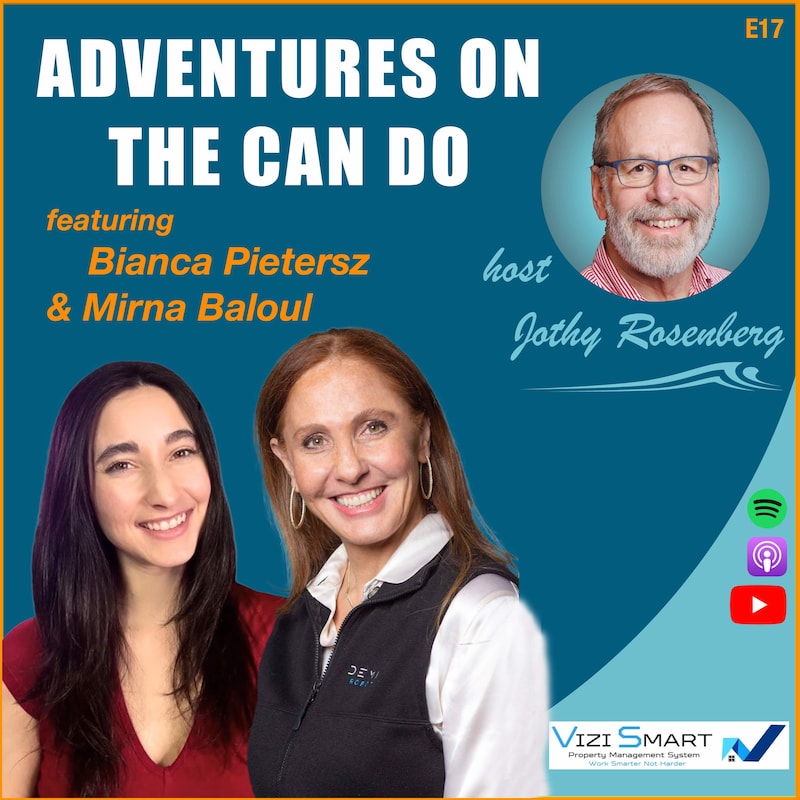
Shownotes
Summary
Bianca and Mirna, co-founders of ViziSmart, discuss their journey in creating an AI-powered property management solution. Bianca, originally an artist, became a property manager and experienced the stress and lack of work-life balance that came with it. She saw an opportunity to use AI to streamline communication and coordinate maintenance in the property management industry. Mirna, with a background in cutting-edge technology, joined Bianca in creating Vizy Smart. They are currently at the MVP stage and are looking to partner with customers for product-market fit. Bianca and Mirna discuss their property management software and their plans for scaling and growth. They talk about their target market, their use of offshore developers, and their plans for expansion. They also discuss the importance of grit and resilience in the startup world, as well as their hobbies and interests outside of work. They mention their focus on the Texas and Oklahoma markets and their plans to expand nationwide. They also mention their plans for an affiliate program and partnerships to spread the word about their software.
Takeaways
The property management software market is valued at $3.9 billion in North America and is growing due to factors like the housing crisis and interest rates on mortgages.
ViziSmart aims to streamline communication and coordinate maintenance in the property management industry using AI.
Bianca and Mirna have identified competitors in the market and believe they have a good chance of gaining market share.
They have experienced early difficulties, including IP theft, but remain confident in their ability to succeed.
ViziSmart is currently at the MVP stage and is seeking partnerships for product-market fit. The property management software aims to automate manual processes and provide a more efficient solution for property managers.
They are using offshore developers to build their software and are looking for talent globally.
They are initially focusing on the Texas and Oklahoma markets and plan to expand nationwide.
They plan to use an affiliate program and partnerships to spread the word about their software.
Grit and resilience are important qualities for startup founders.
They enjoy hobbies such as painting and spending time with family outside of work.
Links
Bianca and Mirna’s ViziSmart site: https://vizismart.com/
Please leave us a review: https://www.podchaser.com/AdventuresOnTheCanDo
The book Think Like a Startup Founder (early access): https://www.manning.com/books/think-like-a-startup-founder
Jothy’s site for speaking, podcasting, and ruminating: https://jothyrosenberg.com
Jothy’s non-profit foundation The Who Says I Can’t Foundation: https://whosaysicant.org
Jothy’s TEDx talk on why people with a disability over-achieve: https://www.youtube.com/watch?v=PNtOawXAx5A
Sound Bites
"I became really interested in things like chat GPT and AI when it came out."
"The combination of us is just, to me, it has been miraculous."
"We bring visibility, right? That's really the bottom line."
"We get to test it firsthand before anybody else does"
"It's okay for it to be done by somewhere else, offshore"
Chapters
00:00 Introduction and Background
01:20 Becoming Co-CEOs and Identifying the Problem
05:16 Working with an Incubator
06:00 Background and Motivation
08:09 Naming the Company
09:22 Market Size and Potential
10:23 Competition and Market Share
11:51 IP Theft and Overcoming Challenges
15:02 Using AI to Solve Property Management Problems
18:02 Stages and Future of the Company
18:59 Automating Property Management Processes
19:23 Using Offshore Developers for Global Talent
23:37 Focusing on the Texas and Oklahoma Market
26:30 Scaling and Expanding into New Markets
30:59 The Importance of Grit and Resilience in Startups
33:30 Hobbies and Interests Outside of Work
Transcripts
And here are Bianca and Mirna. Hi, guys.
Mirna (:Hello. Hello, thank you for having us.
Bianca Pietersz (:grateful to be here.
Jothy Rosenberg (:Oh, great to have you and I've been excited about this chance to talk to you and get all the listeners to hear your great story. So I always like to start with asking people to say, where are they from and where do they live now? So Bianca, you wanna go first?
Mirna (:you
Bianca Pietersz (:That's really fun. Yeah. So I am originally from Caracas, Venezuela, and I am currently living in Oklahoma in the United States.
Mirna (:And I am originally from Lebanon and today I live in Dallas, Texas.
Jothy Rosenberg (:And Myrna?
Jothy Rosenberg (:You guys both kind of came a long way and then you both kind of ended up in the middle of the country. Okay, so I would love to talk about, have you guys talked about, I mean, the problem that you saw and that led you to...
Mirna (:us.
Jothy Rosenberg (:to create your startup. And you guys are going to have to figure out who's going to talk first each time. Are you guys actually officially co -CEOs? That's so rare. That's really rare.
Mirna (:Bianca goes first on that one.
Bianca Pietersz (:Yes.
Mirna (:I agree.
Bianca Pietersz (:It really is.
Mirna (:It's worked out beautifully, actually.
Bianca Pietersz (:Yeah, we both.
Jothy Rosenberg (:Well, you'll have to talk a little bit about that too. So, okay, so back to the problem.
Bianca Pietersz (:So I am a property manager. I didn't necessarily start out wanting to be a property manager in life, but it is something that was kind of bestowed upon me. And as we invested in property, we started...
having to deal with problems and complaints with tenants and maintenance emergencies. And it led to so much stress that I would be talking back and forth with people all day and scheduling things and solving these issues. And I wouldn't have any bandwidth when I went home that day for my family or for any creative endeavors or anything else that I had to do.
So I became really, really interested in things like chat GPT and AI when it came out. And I just started playing with it and learning as much as I could. And that's when the idea kind of started formulating. Like, oh my gosh, this is a real world use case of this. This is something that can completely help me.
almost replace myself, which would be amazing.
Bianca Pietersz (:And then I had some early difficulties in starting this company, early IP theft and other situations that actually led me seeking to find a solution for that. And I met Mirna looking for an IP lawyer. And the more I told her about the story where I came from, the company, the mission of it,
Mirna (:Okay.
Bianca Pietersz (:the more we organically started talking and she at some point she just came on board and she said you know what this is worth it you're worth it and I am 100 % with you.
Mirna (:Yeah, so my background is very different from Yonka and that I come from a serial of cutting edge technology, you know, started out at a college Y2K, moved into Bluetooth, was part of the Tivo at Nielsen Media, ventured from there, been doing AI, worked on Nextrad for the government. Then from there,
I went to Texas Instruments was part of the analog, 80 % of the analog portfolio for the IP portfolio for TI came through my desk for strategy. I have been part of so many cutting edge technology and repeat Bluetooth with Motorola, like it's been nonstop. And so whenever I got this really visionary young lady, she's talking to me and she's talking about IP. And the more we talk, the more I'm just like,
You know, with a little bit, this can go a long way. And we mesh together so well, I always joke around that I'm a square and she's the circle in the relationship. And the combination of us is just, to me, it has been miraculous. And as we venture into working with an accelerator, they actually view us like that. They actually confirm that our combination is actually very beneficial.
Jothy Rosenberg (:That's cool. And what is the incubator you guys are talking to?
Bianca Pietersz (:We're with the Bridge 2 program. There's a program called I2E in the state of Oklahoma, and it's funded by OCAST and Plain Ventures, and we have partnered with them.
Mirna (:And kudos to the legislatures in Oklahoma. They're trying to bring in all of the innovation and trying to instigate startups to kind of branch out. So we are very thankful for what they're doing and very impressed. Maybe more states would do the same.
Jothy Rosenberg (:Well maybe you guys will have to become, I don't know, the Silicon Planes?
Bianca Pietersz (:Yeah.
Mirna (:Yeah, there you go. Nice. Nice. Yeah.
Jothy Rosenberg (:So are there other things that, you know, in your careers that kind of led you to this? I sort of think you kind of, Bianca, you kind of explained that Mirna's background in IP was really important to what you needed. But you didn't actually say why did you end up in property management? You just said,
It sort of fell on you or something. So, well, can you explain that?
Bianca Pietersz (:Yep, it was. So I'm actually an artist. Yeah, I'm an artist. So everything I have behind me is just art that I've made. I'll just kind of show.
Um, that is, that was my focus in life. It's something that I adore doing something that I long to do every day. And when we bought some properties, um, we didn't want to offload the management and we wanted to take it on ourselves. And so it was up to me to manage them. And, uh, it's been a wonderful learning experience so far. I've learned so much about.
management about people, about psychology, and about trying to keep everyone happy. It's been, it's been wild.
Jothy Rosenberg (:You have a couple of daughters, right? Young daughters.
Bianca Pietersz (:I do. Yeah, I have one who just turned four and one who's about to turn two.
Jothy Rosenberg (:And.
Jothy Rosenberg (:And do they, are they good at art?
Bianca Pietersz (:You know, they are very creative. They are amazing and they both have different talents. One of them is very active. The other one is very, very intelligent. And we're just gonna see where life takes them. They're really young right now. So I'm not gonna push them in any direction. It's up to them to decide.
Mirna (:Yeah.
Jothy Rosenberg (:Yeah.
Jothy Rosenberg (:Okay, where did the name Vizy Smart, is that right? Or am I saying it right? Vizy Smart. Where did that name come from?
Bianca Pietersz (:Yeah.
This one was, we were originally Automagic AI Solutions. And after going through this program and really recognizing that AI was somewhat of a redundant term, that it's not something that we really needed to focus on, we just needed to focus on the actual solution that we were providing. We started strategizing. And Myrna, would you like to answer as well?
Mirna (:Yeah, I think the bottom line is we bring visibility, right? That's really the bottom line. You're going to end up and Bianca will talk about, you know, this property manager sitting at the beach, you know, just enjoying their drink. They get a thing that pops up and they just say, except and everything is at their fingertip right there as they're holding their, you know.
They're nice daiquiri in their hands, right? And so that's kind of the visibility that we get. And then not only this, we came up with the slogan where you're working smarter, not harder. So in that, Visi Smart is a natural name.
Jothy Rosenberg (:Is there a, do you have a sort of an estimated size of the market of property management?
What does that look like?
Mirna (:It's the so the actual in North America is 3 .9 billion dollars the value of the property management software. So it is in the trillions property manager of its own. So we're kind of looking at the property management software market, which is where we sit and that is huge and it's growing for several real reason. One of it is the housing.
crisis in the United States and people not being able to afford. The young generation cannot afford buying homes. So now they prefer to rent and those numbers keep increasing and that's also related to the interest rates on mortgages. So the combination is a growing market, people shifting into software, growing market, people utilizing AI, growing markets. And so they were looking for exponential growth.
Jothy Rosenberg (:And do you see yourselves being able to replace or displace a significant portion of that? Assuming you're just wildly successful, could you actually replace all of that software that's being used for property management?
Mirna (:when we are successful. Yeah. Go ahead, Bianca, sorry.
Bianca Pietersz (:I think we have a good chance of getting a good market share.
Jothy Rosenberg (:Ah, yes.
Bianca Pietersz (:No, you're fine. I'm sorry. So yeah, I think we really have good chances, especially looking at our competitors and just seeing what they're actually offering. We've actually taken demos of all of them and we've been able to kind of see where strategically we would be placed in the market and then see how we could get some of that market share, which I think is highly likely.
Mirna (:Yeah.
Mirna (:And it doesn't turn out we had IP council in -house. So with that, we have been monitoring also their IP portfolios. We're looking at what markets they're targeting. We're looking at what they're trying to do. And we have seen that many of our competitors, they claim that they own AI tools. And then once we are in front of them saying, I'd like to buy it, they basically say, we don't have it, which actually confirms what we have. You know, what we have is actually going in the right direction.
and we hope to empower them in the future to adopt it through us.
Bianca Pietersz (:Mm -hmm.
Jothy Rosenberg (:Yeah. Bianca, you mentioned earlier something about IP theft. How did that happen?
Bianca Pietersz (:Early on, I'm actually a part of one of the biggest AI learning communities. It was started by a YouTuber named Liam Ottley. And I was part of their initial, before they started their little accelerator program that they have on there. And everyone was just sort of getting to know one another. There were great people there. There still are phenomenal people there.
However, I also met one bad actor and he offered fulfillment services. I was doing it myself at that point and I realized it was gonna take me too long to do everything myself when I was learning it initially. And he was able to do it very quickly. So after partnering with him, it took about three months.
Mirna (:. .
Bianca Pietersz (:before he asked me a very interesting question. The initial partnership, in a sense, was, OK, you handle the entire business aspect of it, and I will do the technical aspect. I said, OK, sounds like a good plan. And he asked me, why do you have your own company? And this is a really weird question to me, because that was the whole point.
Mirna (:you
. .
Bianca Pietersz (:And I had paid him already for his services. He asked for upfront payment and I knew that it was going to take a lot more. And so I paid him and he made something that was very basic that did not include any feature or anything that we had discussed. I gave him personal leases, personal conversations, personal just how...
the property management worked, how it was supposed to go, everything that had to do with what we were making. So instead, he gave me something that did not function, and he made something for himself on the side with all of that information. And then he posted it on YouTube as something that he just made for himself.
Jothy Rosenberg (:Hmm.
Bianca Pietersz (:Yep. It was.
Jothy Rosenberg (:So did he actually abscond with anything of significant value to you? Or are you going to be able to work around it? Because he doesn't know the business, so you're going to blow past him. Because that's sort of silly if he thinks he can ask a few questions and he can come up with something that's actually going to win customers.
Mirna (:you
Bianca Pietersz (:Mm -hmm.
Bianca Pietersz (:I've noticed that the people who need to steal ideas, they're not going to be able to bring it to market.
Jothy Rosenberg (:No, no, they won't. So OK, can you talk a little bit without divulging IP how you are using AI? I guess if you would just state it in the sense of here's a problem that we're able to use AI to solve. And that way you're not describing exactly what it has to do.
Bianca Pietersz (:No problem. So we're streamlining communications and coordinating maintenance.
Jothy Rosenberg (:Okay. So from a property management standpoint, what does coordinating maintenance mean?
Bianca Pietersz (:It means talking to the maintenance provider, making sure that they're scheduled in the calendar, making sure that they're there on time, making sure that they can have that visibility with the landlord while also just having everything run smoothly. If there are complaints or verbal abuse or anything that goes on, there's a buffer between the manager and the tenant. So it's not so stressful.
And also the landlord is going to get to see everything that's going on all in the palm of their hand.
Jothy Rosenberg (:So there are multiple entities involved with your system. So there's the manager, there's the landlord, and then there's going to be the renter, and then these service providers. And so is it the manager who's using the software?
Bianca Pietersz (:It's all of them.
Jothy Rosenberg (:Oh, really? OK. So they get different views into the information.
Bianca Pietersz (:Yes.
Bianca Pietersz (:Yes. There will be different permission settings. And what we offer maintenance providers are automated leads that are immediately scheduled for them. What we are offering tenants is immediate response times and that they're heard any time of the day, any time of the night, whenever something happens.
Mirna (:. . . .
Bianca Pietersz (:And what we offer managers and landlords is full visibility, full reporting.
Mirna (:you
Jothy Rosenberg (:It reminds me, except it's way more sophisticated in just what you're saying, to Airbnb. Except, you know, it's got way more constituents than Airbnb. And you've probably studied carefully how valuable Airbnb is now.
Mirna (:Yeah.
Bianca Pietersz (:Yeah, amazing. They're huge.
Jothy Rosenberg (:All right, so can you describe what you see as sort of the stages for the future of the company? Like, what stage would you say you're at right now? Are you sort of, is this, you've got some software, you're testing it. Okay, so kind of what's the, what's success look like at this stage?
Mirna (:We are.
We are at the MVP level and we're hoping to have many people partner with us for us to do product market fit. We have done, we have the expertise internally in that we, you know, Bianca, as you heard, she's a property manager, owns a property managing company. We have actually interviewed many prospect customers and they kind of welcomed us with a smile and are willing to do the pilot program with us. So we're hoping for more people that will be willing to just kind of give it a shot. The idea is to make this accessible.
and convenient and intuitive for quick adoption. That's kind of what we're shooting for.
Jothy Rosenberg (:So Bianca, your property management company is sort of like your built -in lighthouse customer.
Bianca Pietersz (:Yep. It's amazing because we get to test it firsthand before anybody else does, right? Like we get first dibs.
Jothy Rosenberg (:And are you having this built locally? Are you going outside the states to have your developers working on this? I mean, it's a SaaS application. So there's a lot of talent that you can tap into that knows how to build that kind of thing.
Bianca Pietersz (:Mm -hmm.
Mirna (:Yeah, we're going globally. We have many local resource in the United States. We have a CTO. We have quality controls within the United States that sit here. We're looking for data engineer as well that will sit here. And then we have other areas, you know, being able to just kind of bring to life some of the screens that Bianca is creating and putting together. So we're kind of outsourcing that to maximize where we keep IP close to the chest and then bring in more things that are not so IP heavy.
It's okay for it to be done by somewhere else, offshore.
Jothy Rosenberg (:You know, Myrna, a few years ago, well, actually, it's more like quite a few years ago, but in 99 and 2000, I outsourced, I used an unusual place as my outsourced development team. It was Lebanon.
Mirna (:Oh, that's not unusual. They're very smart people out there. No.
Jothy Rosenberg (:I know there's very smart people, but it's just a challenging place. I think it's the university up and running and fully safe these days.
Mirna (:Yes.
Mirna (:Mm hmm. Yeah.
Mirna (:It is. As you know over there, they have war protocol. That's what they kind of do. Basically they'll just say, hey, get the kids into their homes by 1 .30 p .m. We're intending to bomb each other by then. Everybody's like, oh, okay, let's get the kids out. That type of protocol. So now in the south of Lebanon, you'll know there'd be a lot of turmoil. However, the rest of the country will function because they have functional, I don't know, functional protocol.
It's not pleasant for anybody, but at least you have universities, you have projects, you have outside people coming in for resources because they're multilingual with a lot of resources that can't find job internally.
Jothy Rosenberg (:What about your place of origin, Bianca? Are you using any developers in Venezuela? No.
Bianca Pietersz (:No, unfortunately, I don't think the situation there has become very difficult for people. Everybody who was able to get out did, but there was hyperinflation. There is a lack of running water at times. There is lack of internet many times. And the technology over there is quite frankly outdated. So it would be very difficult to hire from there.
Mirna (:. .
Jothy Rosenberg (:So what are your favorite places to find good developers outside the US right now?
Mirna (:I think India is good. We're working with Indians. The resources are available. They have a technical experience pretty broad. Cost per output is pretty efficient. Their legal system is common law. English, right? So we can speak the same language and be able to protect ourselves locally in their court systems.
And they have strong IP, they're very inviting to international markets. So they have our IP legislation that's very much in line with the rest of the world, in the advanced world, I should say.
Jothy Rosenberg (:OK, so before we got to product market fit, and then what would your plans be for scaling? Oh, by the way, are you tending to stay as you're working on product market fit? Are you mostly staying somewhat local to your Texas, Oklahoma kind of axis?
Bianca Pietersz (:Yeah, exactly. So we're actually focused on the Texas and Oklahoma market and we're segmenting for our pilot studies. And then we plan to expand after that to the entire United States.
Mirna (:Yeah, it was too.
Jothy Rosenberg (:And will you go, I'm sorry, go ahead.
Mirna (:So I was let you know like 15 % of the property managers in the United States sits in Texas. No surprise, right? With this growth. So it's a really great location for us to concentrate as initial stab. And then also Oklahoma. I don't know if you've ever been to Oklahoma, but if there's ever a place where you don't, you know, you're new into a market, that is a great place to start.
It is easy to work with a lot of Oklahomans. You know, they call them the good people of Oklahoma for a reason. So it's been a great start for us as well.
Jothy Rosenberg (:I've been, I don't think I've set foot in Oklahoma. I'm sure, I mean, I've been into Texas and I've driven across country through Nebraska, but somehow, there aren't that many states that I've not set foot in. So.
Mirna (:You're missing out, my friend.
Bianca Pietersz (:I know you'll have to come. This is so nice here.
Mirna (:Yeah.
Bianca Pietersz (:you'd be surprised. It's actually amazing. It's a little bit boring, but it's so peaceful. There's not much traffic at all. There's so much beauty. It's a very clean place, very clean city. The people are so, so nice. Like when I say genuine, it doesn't even begin to describe it. You remember how when you are...
Mirna (:Yeah.
Mirna (:Thank you.
Bianca Pietersz (:maybe in elementary school or like kindergarten and you go up to someone and you say like, hey, will you be my friend? And then the other person says, yeah, I'll be your friend. Literally, that is how adulthood is here. It's crazy. It's so easy to be happy.
Mirna (:Okay.
Mirna (:Ha ha ha ha ha.
It's a little old school in its culture, which is lovely. It's a fresh sometime.
Jothy Rosenberg (:Love it.
But then you must have just tons of friends because you can just walk around all the... Of course, unless they're trying to steal your IP, then not so much.
Mirna (:Yeah.
Bianca Pietersz (:Yeah, that guy was in Canada.
Jothy Rosenberg (:OK, so I keep allowing myself to be distracted, but you guys are fascinating. OK, so I'm curious how you're going to scale. Are you going to work through any kind of distributors or is there some sort of aggregator type of situation? Or once you are confident that you've got it right in your local markets, how are you going to go from there?
Bianca Pietersz (:I think we're going to plan an affiliate program or a partner program where we have our initial pilot study members that we have retained spread the word. We have national conferences of property managers and other conferences that we can source from, as well as social media. And you know how it's huge nowadays. So I think we can get a pretty good run with all of that.
Mirna (:you
you
Mirna (:Yeah, I think our differentiator is that most of our competitors, I'm going to say all, which is uncomfortable saying it, but it's actually we interviewed them and we know it's all. Our competitors, a lot of their tools offer, they still require a lot of human interaction and they still require very outdated manual processes that we are automating.
Bianca Pietersz (:Myrna, would you like to chime in?
Mirna (:So we know that we bring in an advantage to the users that right now is lacking. As we start, we are hitting a market. A lot of the tools that exist today require that the property manager, the managing company or the landlord own at least 50 properties or more, leaving a nice gap for somebody like us to come through and accommodate the maybe not so wealthy.
Right? Not 50 properties, you know, we are good with 123, whatever number you have. And the whole idea is we want to empower people to be able to have more time, be able to be more efficient, be able to be paying attention to better resources of revenue rather than the mundane things that an AI agent can do for them. And so in that, once we empower those folks, then we can actually extend that same tool.
through the partnership channels to more accomplished and larger scale towards one -to -many relationship.
Jothy Rosenberg (:I think it's really smart to work from the small size up because with their manual stuff, they probably can't possibly touch the low end of the market. And then you can go in and you can own it. And then word of mouth that this is better. I can see the Super Bowl ad already of people managing the properties from the beach.
Mirna (:Okay, good.
Mirna (:Thank you.
Mirna (:Yes, I mean that visual is so fresh in my mind because of how well Bianca describes it It's really like what she says. I was like, oh that sounds fantastic, you know, we own properties as well So what she describes I'm like, I'm loving this. I'm loving it for us, you know
Bianca Pietersz (:great idea.
Jothy Rosenberg (:OK, so what do you guys like to do outside of work? Bianca, you like to paint.
Bianca Pietersz (:I do, I love painting and drawing. I love my children, I love playing with them and going places. We love to travel as well. We're pretty avid travelers. What about you, Myrna?
Mirna (:My hobby is my children as well. I have three kids myself and it just ranged from 13 exciting teenage years, right, all the way down to seven. She still thinks of me like the best thing ever and I'm trying to keep that, you know, hold on to it. But also I have been very fortunate to have a very exciting career path and I have learned so much in many diverse areas of my life.
to where it's like my biggest joy is to be able to work with other ladies and help them do well. So I do all types of mentorship and coaching in hopes to share.
Jothy Rosenberg (:Great. That's wonderful. So one area that I really like to touch on with all guests is the concept of grit. So every startup founder, by definition, if you're going to do a startup, you've got to have grit.
and you know it, but not everybody knows exactly how they came by that grid. And maybe you guys could talk a little bit about that.
Mirna (:I'm just kidding.
Mirna (:Would you like to go behind, can you?
Bianca Pietersz (:Yeah, I'll go. I think being able to withstand and you know, you get thrown a lot of punches. So when you fall, you have to get back up, you have to dust yourself off, you have to keep going. Being able to do that over and over and over and over is at least my definition of resiliency and grit.
For me though, it really came from becoming a mother, which is, I know it's a little bit backwards, but I found an expansion of capacity, tenfold, 20 fold. I had never handled so much in life as I did from then on. And each year it just expands even more.
Jothy Rosenberg (:Before we switch to Mirna, so Bianca, how much of the taking punches and falling down and getting back up, how much of that is just, okay, everybody that's doing startups deals with that? And how much of that was because you're a woman, a woman founder, a woman CEO?
Bianca Pietersz (:Mmm.
Bianca Pietersz (:I have a double, double, something that I've noticed, just a little bit. And that's, people may not initially, when they meet me, respect me because of my age, and maybe because I'm a woman. I am a little bit oblivious. I don't really see those things. For me, I'm kind of like a happy -go -lucky kind of person, and...
Jothy Rosenberg (:Because you're from Oklahoma.
Bianca Pietersz (:I moved here two years ago. It wasn't the case before then. I came from LA, which is actually much different. But ever since being able to, oh man, I lost my train of thought. Yeah.
Mirna (:You're saying that what you're like, you ignore, or you don't even see it.
Bianca Pietersz (:Oh yeah, yeah, yeah. Yes. So.
Jothy Rosenberg (:Hang on, I'm gonna do this, I'm gonna do this. Because that allows me to see it when I'm editing and I can cut out a little portion of this. Yep.
Bianca Pietersz (:Oh, thank you. Awesome.
Bianca Pietersz (:So initially, I can notice these things, but I don't let it affect me because I would rather show them over time that I am valuable. And within one to two to three months of knowing me, they're already on my side. So I know that those little instances of people looking down on me or people just thinking I'm here to note take, that won't last long.
Jothy Rosenberg (:No, no, I don't think so. That's good. That's good. How about you, Mirna?
Mirna (:experience was a little bit different because my generation, I think, it was a bit unspoken or unnoticed as much. We all felt it. And for the longest time, when I first started, I used to think, oh, it's in my head, you know, type conversation. And through time, I just started realizing, oh, wait, it's not in my head. I'm noticing that I repeat offenses. Right. And then quickly I started realizing as well that there are...
intentional and unintentional biases. And in those, I had to be able to react to those appropriately. And then also teach those that are younger than me to where, you know, there are some things that require to speak up. You have to be polite. But if it's an intentional bias, you have every right to defend yourself. And then if it's unbiased, and then I always remember the story. There's a picture that I have from a New York bar.
It's in black and white that it was taken back in the 60s. And there's about five or six women. And at the time, ladies were not supposed to sit at the bar. And these ladies got dressed on their finest and they ended up calling the news and saying, hey, the media just saying, hey, we are going to go to that bar, ordered their drinks and they were getting ready to get arrested. They took a picture of that.
And that's always a reminder for me that they are kind of ones I love having a drink and I love the atmosphere and the community that it brings together. And in that, I'm really appreciative for the effort that they made that possible for me. And I hope that I can contribute to whoever it is sitting in a boardroom or being a CEO among 99 % male trying to ask for funds when it's 2 % of VC funds is coming to a woman.
and be able to just say, that's okay, if they can get arrested to sit at a bar, I should be able to keep up with myself sitting at a table and keeping up and teaching and bringing people to our side. So yes, it is, it's very different. However, it's welcome. We're ready for the next step.
Jothy Rosenberg (:So speaking of investments, do you see yourselves needing to get institutional investors, VCs, or corporate strategics to invest as you scale?
Mirna (:Yeah, we're moving with that strategically, right? Our first path is going to be trying to boost traffic a bit and we're leaning more on grants and leaning more on convertible nodes types of things. There will be a time when the cap table allows to where we will go and lean on VCs and kind of go and put fuel on the fire, kind of, so to speak.
what time that will come. At this time we're kind of trying to lean on grants and anybody that sees the power in our duet.
Jothy Rosenberg (:So at some point in the future when you are looking for that, there is a relatively new firm in Boston called X Factor Ventures that is 23 female partners. And you have to be a woman to be a partner in this firm.
And they invest, they don't only invest in women, but they invest primarily in women run firms. And one of the partners was just a guest on this podcast two weeks ago.
Mirna (:That's amazing. That's amazing and makes me very proud. I have met with this executive and I was telling her about mentorship and stuff like that, which I try my best to contribute. And her answer to me, she said, you put your effort in the wrong place. A lot of these ladies has been ready and they've been ready. They just need somebody to invest in them. So that is very much what, kudos to X Factor.
Jothy Rosenberg (:Let's see.
Jothy Rosenberg (:Yeah, yeah, it's cool. It's cool. And I was so upset to find out that I couldn't join that firm.
Mirna (:Oh, I bet you can still empower them. Here you are. That's what they need.
Jothy Rosenberg (:Hope so. Hope so. All right, well, is there anything else you guys would like to add about your journey and before I stop the recording?
Bianca Pietersz (:If anyone is interested, you can go to our website, vizysmart .com, and you will be able to sign up for our pilot program there.
Jothy Rosenberg (:I have show notes and I will put the link to it in the show notes.
Bianca Pietersz (:Amazing.
Mirna (:Thank you so much, Jothi. We really appreciate your time. This is a great show and best of luck to you, especially on your new book.
Jothy Rosenberg (:Okay.
Jothy Rosenberg (:I'm going to stop recording and we can...
Bianca Pietersz (:Yeah.

