Shownotes
Is doing your own marketing a source of pain rather than pleasure? Today's guest is here to guide you through her top tips for marketing, as well as key advice for making it work for you, rather than being another of those weekly chores.
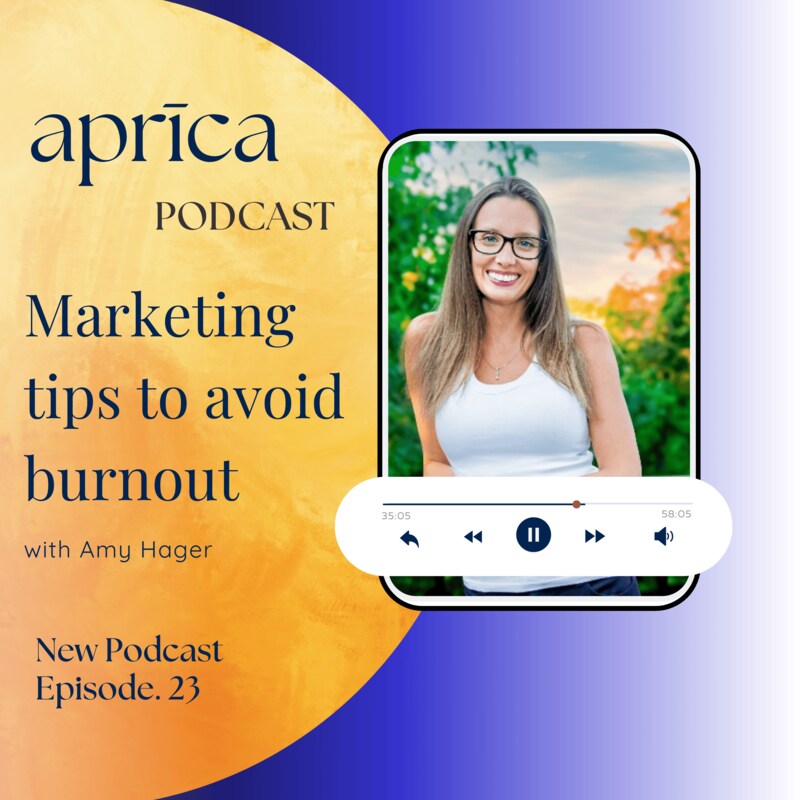
With Amy Hager - Amy Hager, a true marketer, community builder, and Co-Founder of Marketing uses her years of experience and expertise to help service-based business owners around the world grow businesses they love. - Amy's Website - Amy's Facebook page - Amy's Facebook group - Amy on YouTube
And your host:
Eleanor Marker - Therapist and life coach - eleanormarker.com
Some links mentioned in the episode:
Find more about the 6 types of marketing here: https://joyfulbusinessrevolution.com/profitmessaging/
The Content Personality Quiz: https://joyfulbusinessrevolution.com/quiz/
19 Ways to get off Social Media paid download: https://joyfulbusinessrevolution.com/offsocialmediapayment/
Transcripts
Welcome to the Aprica Podcast, because a little advice goes a long way.
Speaker A:Hello and welcome to another episode of the Aprica Podcast, where every week we send you away with a little piece of life advice for you to try out.
Speaker A:And today, today I'm joined by Amy Hager and we are talking about marketing when you're a small business owner and particularly that, that fear around marketing and also the real sense of burnout that comes with marketing where it just feels like it's perpetual and it sits there on your to do list like this big ominous kind of sword of Damocles over you, doesn't it?
Speaker A:Maybe that's just me.
Speaker A:Amy, thank you so much for coming on the podcast today.
Speaker A:Do tell us a little bit about yourself and then talk to us about this sense of burnout when it comes to marketing.
Speaker B:Yeah.
Speaker B:Thank you so much for having me today, I'm Amy Hager.
Speaker B:I'm with the Joyful Business Revolution.
Speaker B:And we really believe deeply that everyone can be a marketing superstar.
Speaker B:And we really love to empower business owners to take over their own messaging and their own marketing and make it fun and simple.
Speaker B:And I think a lot of times as business owners, we end up shoulding ourselves when it comes to marketing.
Speaker B:Right.
Speaker B:We should do this.
Speaker B:We have to be on social media.
Speaker B:We need to have a website, we need to be a speaker.
Speaker B:We probably have to have a blog.
Speaker B:There's this laundry list.
Speaker B:There's like 172 ways you can market your business.
Speaker B:You don't have to do all of them.
Speaker B:And so I really am excited today to kind of talk about how to figure out what works well so that you don't burn out in your marketing, how to let things go and really embrace the strengths that you have and connecting deeply with your audience.
Speaker A:So tell us about the purpose of marketing.
Speaker A:Let's go right, right back to the beginning with it.
Speaker A:What is the point of marketing?
Speaker A:Why do we even bother as business owners with it?
Speaker B:The main goal of your marketing is to create conversation.
Speaker B:And some people are like, oh, marketing equals sales.
Speaker B:It absolutely doesn't.
Speaker B:And so if you're creating marketing that is forceful to sales, that could be the first step that you feel like is out of alignment and isn't working for you.
Speaker B:If you look at marketing as an opportunity to have conversation about what you do and how you help in the world and your amazing products, that is the goal of the marketing.
Speaker B:And so when you're creating those opportunities for conversation and you're creating content around that, are you providing an experience for someone to really be invited into a conversation with you or are you using your marketing as just a platform to project?
Speaker B:And so it's a completely different shift in mindset of how you look at creating conversations versus how you project your messaging.
Speaker A:So you're talking there about a two way conversation rather than this one way projection.
Speaker A:And I know that one thing that really annoys me is when I just feel like I'm just consuming things from somebody that is trying to lead me towards purchasing something or doing something.
Speaker A:I don't like that sense of manipulation.
Speaker A:When you talk about the two way conversation.
Speaker A:What are some of the barriers to having that two way conversation when it comes to marketing?
Speaker A:Because I know that if you put me in a room full of people, I'll happily talk about my business.
Speaker A:That's absolutely fine.
Speaker A:But when it comes to marketing social media, I feel like there's a inauthenticity that I struggle to get over there.
Speaker A:Other barriers that you notice when it comes to that two way conversation.
Speaker B:Right.
Speaker B:And I think that you know that that desire to be educating, be, be informational and to really showcase your thought leadership or your expertise is usually that underlying drive, but it is what are the words that I say is what people really get hung up on.
Speaker B:And so one way that I really like to break this down and make it a lot easier is to think about the six types of content that you can create that are more conversational versus just the direct offer.
Speaker B:And actually a direct offer content is one of the six in the messaging ecosystem.
Speaker B:But when we think about the other pieces, one is your mission driven messaging.
Speaker B:Why do you do what you do?
Speaker B:Why did you create this business?
Speaker B:How did you get started?
Speaker B:Why are you choosing your offerings or your products?
Speaker B:Letting people understand the thinking that is going on in your brain to your larger mission so that people can really get on board with that.
Speaker B:And you know, I always say your marketing is only working when it attracts as much as it repels.
Speaker B:And so again, one of our missions here at the Joyful Business Revolution is to empower you as the business owner to be your best messenger.
Speaker B:There are others in the marketing world that believe they can do your marketing better for you.
Speaker B:And so it really depends on who you are, how you feel about the world and especially about the world of business and whether you're going to be the one who wants to be empowered for your own messaging or if you want to just give that, I guess that power away to someone else.
Speaker B:So your, your mission is going to land and resonate and build that bigger following of a community behind that big thinking of why you created your business.
Speaker A:And that must be where you get that kind of authenticity coming through.
Speaker A:So rather than offshoring it to somebody else who maybe isn't new and doesn't have your own purpose behind it, if you take charge of your own marketing, you can make sure that you're getting your personal why and your personal purpose out there.
Speaker A:Right?
Speaker B:Exactly.
Speaker B:And I think then this leads into the next one that is really important, which is the connection content.
Speaker B:So as humans, we want to buy from other humans.
Speaker B:We don't love to buy from robots.
Speaker B:Don't get me wrong, we love a good deal.
Speaker B:But that isn't how you need to lead with your messaging.
Speaker B:If you really think about your values for your brand and your business and yourself, lead with those values.
Speaker B:And so we do a really beautiful exercise here at the Joyful Business Revolution to help you identify your lifestyle values, if you haven't already done that.
Speaker B:But my top three are travel, health and wellness, and food and drinks.
Speaker B:And so a lot of my connection content is around that.
Speaker B:I'm always posting something that I'm trying to cook in the kitchen, whether it's a flop or a success.
Speaker B:You know, I. I teach yoga once a week.
Speaker B:I go to a lot of classes.
Speaker B:I talk a lot about being in nature and going for walks.
Speaker B:I love to chop down trees and, you know, cut wood and stuff.
Speaker B:And, you know, travel is of our brand.
Speaker B:We do retreats.
Speaker B:And so talking about the places I'm traveling, what does travel bring to me that helps me as a messenger and helps me and my business.
Speaker B:And so therefore, a lot of the people that we attract into this brand love those things too.
Speaker B:And don't get me wrong, when I work with someone who doesn't love travel that, you know, loves being at home, has created that space where they don't want to leave.
Speaker B:It's still a joyful experience experience working with them, but really to get those people who see the world through a similar lens but enjoy the things that we enjoy really brings those ideal customers to us and those ideal conversations.
Speaker B:When I can talk about a trip that we were just on or talk about something that I'm making, it just really opens and invites people to get to know me more as a human.
Speaker B:And again, that human connection is super key.
Speaker A:And so I suppose what you're saying there is to cycle back to what you were saying about repelling and attracting, that what you're actually wanting is people who are fundamentally kind of aligned with your core values.
Speaker A:And so it's not the pile and high, like just get them all in the door.
Speaker A:It's very much about the right ones.
Speaker A:Accessing your content totally.
Speaker B:And when you get more of those ideal clients instead of those clients who you have to force or have to really, you know, convince.
Speaker B:And those are two words that I don't love to use in marketing or sales.
Speaker B:You know, that alignment isn't there and usually the success of the transformation or the enjoyment in the product isn't going to be there for that person.
Speaker B:I think another beautiful way to really again attract or repel is to really share your stance.
Speaker B:What is it about your industry that you really take a stake in that ground and stand for?
Speaker B:And I'm going to go back kind of to that mission content.
Speaker B:One of the things that we really take a stance for is you are your best messenger.
Speaker B:And if you can't do the messaging on your own, which a lot of people can't, it is best to partner with someone who can pull this out of you and help you put it into a beautiful package so that when you're introducing yourself to someone new, you know exactly what to say and how to captivate them so you can be in conversation.
Speaker B:So if you decide to create a video on YouTube or social media, you know exactly what to say to connect to their heart so that they feel like you're speaking directly to them and you're almost in their mind.
Speaker B:It's things that they're thinking.
Speaker B:And so when we can co create that through your heart and through your messaging so that you're very confident in putting that out there, that's where we really make the difference in the industry.
Speaker B:But again, there are other people in this industry who believe they can do it better for you.
Speaker B:And if that's what you stand for and that's what you truly believe, then I want you to work with someone like that.
Speaker B:But if you want to take over that control of your messaging and your marketing, you would come to us.
Speaker B:So that is an example of the share your stance type content that we really, really create.
Speaker B:And so I'm curious, sorry to put you on the spot a little bit, but is there a share your stance statement or idea that you have for your business and your brand?
Speaker A:That's really interesting because in actual fact it's, it's funny as I listen to this podcast because I actually don't do any marketing, so I literally don't do any.
Speaker A:I just have, I have clients that come to me through directories that I'm on as A therapist, and then also through word of mouth.
Speaker A:I don't do any marketing at all.
Speaker A:The closest is this, and actually this isn't for marketing.
Speaker A:This is to allow other people to come onto my podcast because I like connecting with people.
Speaker A:So if I was to have a stance, I believe that in an ever complicated world, one to one, personal therapy is one of those sacred spaces that we are allowing ourselves as a form of self care, particularly women.
Speaker A:And I think that there is an ever increasing push towards very outcome focused solutions like CBT and EMT and things like that, which are very.
Speaker A:They put quite a lot of pressure on the client.
Speaker A:And, and also with the AI revolution, you know, where you put your questions into ChatGPT and it goes, yes, you're completely right.
Speaker A:Y right on everything.
Speaker A:Congratulations.
Speaker A:So I think probably if I had a stance, it would be, yes, that the, the sacredness of the personal space and allowing yourself to have that every single week with somebody that you trust and have a connection with.
Speaker A:Yeah, that would be my stance.
Speaker B:And I think that is your stance.
Speaker B:And even though you're not actively out there marketing, you know, your business is a referral business.
Speaker B:And I think that is the first place everyone needs to start before they think about doing a ton of marketing.
Speaker B:If you're not getting referrals from your networks and from your current clients, there may be a misalignment in your offer or how you're showing up, and that that could be a really good thing to explore.
Speaker B:But even though you're referral based right now and you're not doing, I'm going to say, outbound marketing or creating content, there are still stances that you share with your clients that help them really say why you're so great at what you do and why they're referring their friends and family to you.
Speaker B:So that usually is one that comes out really strong in your referral type business.
Speaker B:So I love that you were able to recognize that.
Speaker B:I love it.
Speaker A:Yay.
Speaker A:I love that you asked the question because just thinking about the question really helped me kind of pick out a uniqueness that I perhaps hadn't realized that I had.
Speaker A:Okay, so what is number four on our, on our list of content?
Speaker B:Love it.
Speaker B:So number four is the thought reversal content.
Speaker B:And there's a few ways that this content can come about.
Speaker B:One, I think the, the most trusted way to start with this is actually your clients and your friends when they say they think you do something that is absolutely not what you do, that is beautiful content to create.
Speaker B:And so a lot of Times I will get from my friends.
Speaker B:Oh, you create, you just create things for social media.
Speaker B:And yes, am I on social media?
Speaker B:I love Facebook.
Speaker B:That is my jam.
Speaker B:And I get it.
Speaker B:It's not everybody's jam.
Speaker B:And that's okay.
Speaker B:You could to pick one platform that's part of not being burnt out in marketing.
Speaker B:Pick the platform that you love to show up on because there's millions of people on all of them.
Speaker B:And so when I get to, when I hear that, oh yeah, Amy, you're just, you're, you're a social media content creator.
Speaker B:I love to be able to explain why it's so much more than that.
Speaker B:And so when people say that to me, yo, I'll say, well, I hear you, because you probably see me the most on social media.
Speaker B:But really what I'm doing is getting to the heart of why people are in business and so that way they can feel confident and comfortable sharing that.
Speaker B:And some people choose never to be on social media.
Speaker B:We have plenty of people who only speak at stages and networking groups.
Speaker B:They don't have a social media presence.
Speaker B:We have plenty of people who only write.
Speaker B:They love writing ebooks and blogs and showing up in magazines and newspapers.
Speaker B:We have other people who are like yourself who have this amazing podcast.
Speaker B:And so they love to do audio type content.
Speaker B:And so it's not just that I create social media content.
Speaker B:I help people figure out where they want to show up and the words that they want to say that's going to connect most deeply to someone.
Speaker B:So when I get the opportunity to kind of debunk that, Amy just creates social media content, it lights me up.
Speaker B:And so I think the thought reversal content sometimes can be the most challenging because it's frustrating that people think of you that way.
Speaker B:But also I love to embrace that type of content.
Speaker B:So thought reversal is number four.
Speaker A:I like that.
Speaker A:I really like that idea that when somebody says the opposite of what you do, it really, it consolidates in your mind.
Speaker A:Actually, no, but you mentioned there, and I don't want to go off on too much of a tangent, but you mentioned there about non social media marketing.
Speaker A:And I know that a lot of therapists that I'm connected with, but also other business owners, they don't really, they don't really love social media.
Speaker A:And a lot of them say, okay, like, but what else?
Speaker A:Like what else is there?
Speaker A:Like how else can I get my word out there?
Speaker A:And you mentioned the written words, so blogs and articles, and then you mentioned audio like this or possibly YouTube.
Speaker A:Are there other non social Media marketing things that you would recommend.
Speaker A:I'm guessing an email list would be up there.
Speaker B:Yeah, an email list is definitely up there.
Speaker B:We actually base most of our foundation of our marketing and messaging on an email list and how get that started and then to utilize other ways to get yourself out there.
Speaker B:And I think the biggest thing is, you know, marketing and figuring out where you want to show up is just a big experiment.
Speaker B:Play with it.
Speaker B:When you find something that you love, even if the messaging didn't land, then you know, you just have a messaging problem.
Speaker B:And we need to work on the words that are coming out of your mouth or that you're typing or that you're thinking.
Speaker B:Right.
Speaker B:And so there isn't no hard and fast rule.
Speaker B:And like I said, there's different avenues and those were a few examples, but I think there is no limit.
Speaker B:And so if speaking in public scares the crap out of you, don't do it.
Speaker B:Let's find another way.
Speaker B:And I think the one thing about social media that I just want to remind people about, it was created to be social.
Speaker B:We as humans decided to start start selling our business stuff on it.
Speaker B:It was never created for that purpose.
Speaker B:Right.
Speaker B:You think about it, it was created to stay in contact with those that you had met.
Speaker B:And we have turned it in a way to meet new people all over the world.
Speaker B:And so if you are going to do social media, the thing that I want to encourage you to think about is how can you be social?
Speaker B:How can you show up as your authentic self?
Speaker B:And maybe, you know, on social media I have some people that all they post is mission on social media.
Speaker B:Their bigger why and it's very interesting because they get a lot of cheerleading, a lot of like and some conversations starting.
Speaker B:And again that is the goal of your marketing because when you can get people in conversation with you, that gives you that better opportunity to flow them into a sales conversation if they're an ideal person, but you don't know that until you're in conversation with them.
Speaker B:I think that my best advice is to listen to your heart.
Speaker B:Try what sounds super fun.
Speaker B:And if it was still super fun, but it didn't land, then you know, you need some help with messaging.
Speaker B:But you do not need to be on social media.
Speaker B:Like you said, email lists, speaking, podcasts, YouTube, video creation, writing and magazines and blogs and ebooks and things along those lines are all different ways that you can kind of give it a shot.
Speaker B:And we do have this really great 19 Ways to Come off social media.
Speaker B:Download the that I can go Ahead and share the link in the show notes.
Speaker B:So that way, if anyone's interested, they can grab that.
Speaker B:My biggest advice is play with it and experiment with it first.
Speaker B:That's going to actually this lead you're.
Speaker B:It's like you're in my brain right now.
Speaker B:That leads me to the fifth content piece, which is the fifth messaging ecosystem is thought leader and client result content.
Speaker A:I'd like to pause the podcast for a moment to thank you for listening.
Speaker A:I'd love to hear from you.
Speaker A:So please send me a comment under this podcast or on our Instagram channel, Aprica Podcast, like subscribe, download and share with family and friends.
Speaker A:And thank you for taking the time to listen to the show.
Speaker B:So this is where you get to really share your expertise.
Speaker B:And the way that I love doing this is I do interviews with our clients once a week on my social media and I share, share that out.
Speaker B:And it gives them a platform and a place to practice their messaging.
Speaker B:It gives them a chance to be introduced to my audience, but it also gives me a chance for them to share their story about the progress that they've made, about what they've discovered about themselves and some of the playful experiments that we've done with their marketing.
Speaker B:And so when you can really do your thought leader content and your client result content and have fun with it, that's really showing that leader that you are.
Speaker B:And so finding the fun way, I would say, besides just asking your clients for testimonials or asking your customers to give you a recommendation, how can you play with that?
Speaker B:And again, that one sometimes really scares people and it's the hardest one.
Speaker B:And others are easily to embrace it.
Speaker A:That's quite a difficult one for me as a therapist because obviously most of my work is very anonymous.
Speaker A:And even with my testimonials, I really anonymize them.
Speaker A:I really anonymize them.
Speaker A:So how would you recommend somebody who's working in an industry where maybe their clients don't particularly want their want to show their face, or they don't want to talk about their service and maybe even don't particularly want to tell their friends or family, you know, so you don't even get that word of mouth.
Speaker B:Yep, exactly.
Speaker B:And we do a lot of work with like the government and the military, a lot of therapists as well, and even financial people.
Speaker B:And so what we really find, some of the best ways is to utilize storytelling and to really double down as a storyteller, as the business owner.
Speaker B:And so when you're telling stories, you're Able to change the situation enough so that the person or the story that is in or the person that's influencing the story isn't given away.
Speaker B:And another thing too about this is to talk as the therapist about your experience leading people, about your experience creating those safe spaces and how your clients really react to that.
Speaker B:And I'm sure there's some themes around the experiences that your clients are having.
Speaker B:And so even to kind of take it a little bit, I don't like the word vague, but to take it a little bit more broad and to talk more in that.
Speaker B:So you don't need your client to vouch for you.
Speaker B:You don't need to bring your client on an interview like I do.
Speaker B:But you definitely do have those opportunities to talk about what is happening in your world, what you're seeing as a therapist.
Speaker B:And again, if you're.
Speaker B:If you have clients that have told you amazing things of the work that you're doing, but they don't want to be recognized as the person who said it, you know, share with them.
Speaker B:Thank you so much for that compliment and for what you just said.
Speaker B:It really resonates with my heart.
Speaker B:Do you mind if I use that as the foundation for a story?
Speaker B:But keep your situation out of it.
Speaker B:So that way, if they do hear you talk about it or they do see it somewhere, that they're not.
Speaker B:Not completely shocked because they're gonna know probably that it's them.
Speaker B:But you're gonna change enough of that so that it's not recognizable to be tied back to them by someone on the outside.
Speaker A:That's great advice.
Speaker A:We have got the mission and explaining your whys.
Speaker A:We've got connection and core values.
Speaker A:We've got your stance and what you stand for.
Speaker A:We've got the thought reversal and debunking people's wrong ideas about you.
Speaker A:We've got the thought leader and the client result alongside storytelling.
Speaker A:So that leads us to the final one.
Speaker A:So what is number six on the list?
Speaker B:Number six is going to be the direct offer content.
Speaker B:And so the reason why we created this is because there are.
Speaker B:Usually it's either A or B.
Speaker B:Usually all you do is direct offer content, or B, you never do direct offer content.
Speaker B:And people don't know how you actually help.
Speaker B:They know who you are, why you do what you do, they know a little bit about what you do, but they're not quite for sure exactly how you can help.
Speaker B:And so making sure that you do have direct offer content in your mix, and so that can be.
Speaker B:I like to frame it as an invitation, my direct to offer content.
Speaker B:I want you to feel like I'm inviting you over to my house for a barbecue.
Speaker B:And so a beautiful one that we have coming up is we.
Speaker B:Well, right now I'm in a workshop that we have five really lovely entrepreneurs and the invitation for them was if you feel like there is a bottleneck in your business but you cannot put your finger on it or maybe you know what it is but you don't know what to do about it and you're at that revenue space between 200 and $750,000 a year.
Speaker B:Let's come together as a small group and talk through this because we know through community and collaboration a lot of things in business can become clear.
Speaker B:But if you're sitting there spinning and trying to figure this out on your own, that is frustrating and preventing you from moving forward in your business.
Speaker B:And so that was the invitation to our offer to this workshop that we're doing.
Speaker B:So again, you want to make it sound like an invitation that you're inviting someone into your home, you're inviting them over.
Speaker B:It isn't just come to my profitable, profitable revenue.
Speaker B:Oh, now I can't even think what we named the thing.
Speaker B:I think it was profitable revenue workshop.
Speaker B:You know, that would just be, I don't know, a fall flat offer.
Speaker B:So when you can create it like you're making the invitation, that's how I love direct offer content to, to be really framed.
Speaker A:Are there any marketing.
Speaker A:No nos or maybe things that have become old fashioned or things that we've become very jaded with?
Speaker B:Yeah, I think there's, there's quite a few out there.
Speaker A:It.
Speaker B:I remember probably 10 or 15 years ago it was show up everywhere.
Speaker B:You really have to show up everywhere so that you can get in front of the most eyes because you're just gonna catch a few people.
Speaker B:And that is where I see burnout happen all the time.
Speaker B:And so I'm gonna go back again.
Speaker B:If you, I think the secret formula is if you can show up on one social media platform, if you can create an email list, that is the easiest way to execute a marketing strategy for you to show up.
Speaker B:But I want you to show up on a social media platform that you enjoy, not where you think your ideal client is hanging out.
Speaker B:Because again there's, there's 60 year old men hanging out on TikTok, y', all, even though it was created for the younger generation.
Speaker B:So know that the people are out there, but you can only connect deeply with them when you're enjoying what you're doing.
Speaker B:And so again, if speaking is not your jam, don't make yourself do it.
Speaker B:I say embrace your strength and let your weaknesses go when it comes to marketing, because you will get so much further and showing up consistently, speaking from your heart and feeling confident by doing that versus trying to improve your weaknesses and really challenging yourself to do something that you do not love.
Speaker B:So double down on what you're great at and what you love and let the rest go.
Speaker B:And I think that's the biggest thing.
Speaker B:We have a hard time of letting things go as humans.
Speaker B:And I'm sure you work with a lot of your clients with that, right?
Speaker B:It's the same way when it comes to your marketing.
Speaker B:It is okay to not be a great writer.
Speaker B:So therefore you're not writing articles when you get invited to do so and when you get invitations like that and it's something that you do not love, I think down the line you can figure out a way to hack it.
Speaker B:And I'm going to use myself as a beautiful example here.
Speaker B:I went to journalism school, was a reporter for years and could not figure out why I was always the last reporter to get my stuff in on deadline.
Speaker B:Sometimes I would miss my deadlines even.
Speaker B:I loved the interview process.
Speaker B:I loved finding people to interview and I loved the creation of that.
Speaker B:But sitting down and writing, I'm terrible at it.
Speaker B:And it finally, we do have a content personality quiz that we'll put in the show notes that you can figure out what your content creation strength is.
Speaker B:When I took this quiz and realized I'm live in person and not at all written, written is probably the lowest thing on my content creation list.
Speaker B:I gave myself permission to stop writing.
Speaker B:I stopped accepting, you know, invitations to write articles in blogs and in magazines and papers.
Speaker B:I stopped being a written reporter and really focused on doing the things that are live in person, which are teaching, which are speaking on stages.
Speaker B:I love doing podcasts like this because we have our camera on so I can see you smile and nod and really engage with me.
Speaker B:And so it's that person to person energy that really aligns with me that I can show up with.
Speaker B:But if I have to sit there and write something on my computer, I figured out ways to kind of hack it.
Speaker B:Now with AI and everything that's out there and the technology at our fingertips.
Speaker B:But really doubling down on what I'm strong at has helped our business grow substantially and letting go what we're not good at is okay.
Speaker A:So your advice to try to minimize that kind of marketing burnout would be to do the stuff you enjoy.
Speaker A:Don't necessarily have that kind of, oh, if it's difficult, I probably should be doing it.
Speaker A:Approach and choose one platform to focus on.
Speaker A:I heard you say about consistency, and that's often the thing that I hear as well about marketing.
Speaker A:That can bring a pressure, can't it?
Speaker A:That can bring a kind of sense of burnout, that, okay, I've chosen my one platform.
Speaker A:I'm going to be on Instagram.
Speaker A:Oh, no, I need to post something every day.
Speaker A:Like, are there ways that you would avoid that?
Speaker A:Does consistency look different for different people?
Speaker A:Would you use scheduling?
Speaker A:Like, how do you, how would you approach that?
Speaker B:You're so nailing this on the head.
Speaker B:It consistency is defined by you, my friend, no one else.
Speaker B:And so again, the algorithms of the social media and technology space, they're always going to change, let's be honest.
Speaker B:But what always wins is really thoughtful, quality content.
Speaker B:And the other thing too about your content is it's okay for you to get bored with it, but your audience needs to see sometimes the same message 20 to 30 times.
Speaker B:So if you had something that really performed really well, meaning it got people into conversations or it got you opportunities to start conversations with people, don't be scared to reuse that.
Speaker B:And so when you decide what can be consistent with your lifestyle, your business, and you can then show up that way, if it's once a week on Instagram, make it a super fun, enjoyable post that you're making and make sure you build in time to reflect and track what's working and what's not, what messaging is landing versus what isn't.
Speaker B:Make sure that you're in conversation with your ideal clients.
Speaker B:And when you are, you're really listening to the words that they're saying so that you can connect deeper with them.
Speaker B:When you're creating content to post on social media, and so I say you get to drive the consistency train.
Speaker B:You decide what is your consistency and how, how much can you show up?
Speaker B:How much do you want to show up?
Speaker B:Again, keep it in mind.
Speaker B:Social media was made to be social, so you can't just post and ghost.
Speaker B:You can't just post and run away.
Speaker B:You want to be able to have that time and space to maybe come back a day or two later, or for some people, it's an hour or two later.
Speaker B:So really you define that consistency.
Speaker B:Make sure you're being social and make sure you're showing up in a way that you really, really enjoy.
Speaker B:That is the first step of any marketing efforts right There, my friends, that.
Speaker A:Sounds really solid advice.
Speaker A:Very.
Speaker A:Lastly, before we finish, for somebody who perhaps is starting a new business or just completely hates the idea of marketing or doesn't like the idea of social media marketing, but feels like they want to do it, like you say, choose one platform, that kind of thing.
Speaker A:If that person wanted to go from basically zero to hero, what would be the main piece of advice you would give them?
Speaker B:I actually would tell them to hold off on anything on social media and go to their personal network first and have connection and reconnection conversations with people.
Speaker B:We have a client right now, she just left a 30 year corporate IT job and she is working on finding joy in midlife for women.
Speaker B:And you know, that is a complete different space, different people.
Speaker B:But she's going back to her connections that she's had over her career, whether they're family, whether they're friends, their past, past co workers, and she's reaching out and having coffee chats with people.
Speaker B:Whether it's on Zoom or actual coffee just kind of depends on where there's they're located.
Speaker B:And she's, she's finding out what's going on in their world, especially if they're within that age demographic that she's looking to attract.
Speaker B:She's asking them very thoughtful questions to hear more about how they describe their lives, how they describe what their situations are.
Speaker B:And she's talking a little bit about how she's showing up and what she's doing.
Speaker B:So through that she's found two other women who have started businesses who also talk to the same audience, but they do very different things.
Speaker B:One does, like helping you as an older woman figure out if you want to use AI and if so, how do you want to use it.
Speaker B:She's been collaborating with these two women and they've been doing workshops together and they've been showing up in the community together because one is physically in the same space with her.
Speaker B:It's been really interesting because through having those conversations first, finding collaborators within her own network so people that she knows that she trusts, that she believes that she can partner with and then creating something to show up together in this world has become so easy for her.
Speaker B:And so it's taken her about, she started this, this in June, so it's taken her about four months to get to this point.
Speaker B:She's hosted two or three workshop webinar type situations and she started to grow her own email list this way.
Speaker B:And she's having conversations and sales conversations with people.
Speaker B:So far her sales conversations though, haven't Resulted in sales.
Speaker B:Because the people who are coming to her sales Conversations are younger, they're in their 20s or 30s, they're just starting their career, but they want to make sure that they don't burn themselves out in the career.
Speaker B:And what she was saying was resonating with them.
Speaker B:And so now we're thinking, okay, what do we need to shift in the messaging so she can attract the people that she really wants to work with.
Speaker B:But it's also got our mind spinning.
Speaker B:Maybe she starts a smaller group of younger career women and has that conversation with them about the things that she's learned over her lifetime that she wished she would have known in her 20s and her 30s.
Speaker B:So it's a playful experiment it and we're giving it a shot.
Speaker B:So if you are just starting your business out, don't feel like you need to be the marketing generator of the world and creating all this content on social media.
Speaker B:Go to Conversations.
Speaker B:Conversations bring clarity, they bring sales.
Speaker B:And it is the best way for you to really start talking about your work.
Speaker B:And when you start doing that work and getting the referrals and really seeing what clients you love and what clients you don't love, because we all have those clients that we don't love and we, we realize, wow, that was a mistake.
Speaker B:Maybe I shouldn't have worked with them.
Speaker B:But we wouldn't have known if we wouldn't have taken that chance.
Speaker B:Right.
Speaker B:So as you experiment and find out who you love to work with and who isn't right for you, that's when you're starting to get really informed, to have quality organic marketing and messaging, to go out on social media, to go out in an email list and things along those lines.
Speaker B:And I'm going to throw one more thing in because this is the other biggest mistake that I see new business owners make is they go straight to buying advertising.
Speaker B:I really don't think that's a good idea.
Speaker B:I think once you have organic marketing and messaging working for you, then you are ready to start buying ads.
Speaker B:But it is the biggest waste of money to market a business that you don't clearly know the positioning and what's going to connect with ideal clients because you don't have the experience yet with working with clients.
Speaker B:So I say paid advertising is the last stage in your marketing journey.
Speaker A:So for somebody maybe who quite liked the idea of offshoring, you might actually suggest rather than paying the money for advertising, they pay somebody to do this stuff that you're suggesting they should do.
Speaker B:Yeah, if that's what they feel that they want is someone to try to do it for them 100%.
Speaker B:But again, I really, truly believe that offshoring your marketing, especially early in your business, is a big mistake because again, you're spending money on someone taking action when you don't really know the real answers yet.
Speaker B:Like you probably haven't worked with enough clients to decide who's good and who's bad.
Speaker B:And you know, I know that sounds horrible, but it's true.
Speaker B:We want to work with more of the right fit clients for us because otherwise you're building a business that you hate.
Speaker B:And there is nothing worse in this world than seeing a business owner build a prison and not something that they really enjoy.
Speaker B:So again, I would say double down on the referral marketing and deeper connection first before you even think about doing any true marketing.
Speaker B:And then you can decide do you want to really embrace and empower yourself to be the best marketer possible or do you want to hand off at least what you know at this point to someone else else to do it?
Speaker B:But I do think that is where people end up losing the most money in bankrupting their businesses is they double down on someone or they double down on spending money on marketing well before they're ready for it.
Speaker A:Well, that's a good tip because it saves us all money with Google Ads and everything else.
Speaker A:Always good, right?
Speaker B:It's always good.
Speaker B:And especially when you have a physical space, of course, like take advantage of the free things like getting your Google business listing up, which again can be a headache within itself and sometimes, sometimes hiring that out for someone to manage it.
Speaker B:I totally get that.
Speaker B:But really, really be cautious on spending money before you're really ready.
Speaker B:Because throwing money at a marketing problem to get new clients when you don't even have clients yet I don't think is the right solution.
Speaker B:And that is a share your stance statement right there.
Speaker B:I do not think it's the right solution to throw money at marketing when you don't have clients.
Speaker B:I say double down on building deeper relationships, having connection calls with people and really looking for the referrals to come in to be your clients.
Speaker B:So that way you can have some experience first and decide what is the right client for you versus what isn't.
Speaker A:And as you said about your client who was teaming up with the other women and so she was having a collaborative fun experience which is joyful in itself, but also she was then getting the feedback about actually maybe there's a different demographic that need her help.
Speaker A:So without her doing this, she wouldn't have had that feedback as well.
Speaker A:So there was a value in it, wasn't there?
Speaker B:And that was never on her radar.
Speaker B:And I don't know if that demographic is actually what's going to light her heart up or exploring it.
Speaker B:And so, you know, she had conversations with, I think, three women over the last couple weeks.
Speaker B:And so I told her, invite the three of them to a, I'm gonna say, coffee chat type style conversation with you, ask them some questions, see how they engage with you, engage with each other.
Speaker B:And if you like that and you think it's fun, then, yes, let's make a little mini offer where we have a tiny, little younger women's, you know, group call, you know, once a month or something like that, so that you can show up and serve this demographic that you just learned that you enjoy.
Speaker B:But let's do little tiny experiments to see is it actually something that you enjoy or is it something that you don't enjoy.
Speaker B:And, you know, I have a ton of different examples when we've done experiences in our brand where we thought we would really enjoy it, we thought we were really capable, and then we got into it and I was like, oh, this is not joyful for me, my friend.
Speaker B:And being able to realize that and identify that was really, really key.
Speaker A:That is really fundamentally important.
Speaker A:I often say to my clients that it's the, the days that don't go well that give us all the how we need to make sure our days go great in future.
Speaker A:Well, Amy, thank you so much for joining me today.
Speaker A:I know I'll be putting all of your links in the show notes and the downloads that you mentioned, but for any of our listeners who would like to find out more about you, could you let them know where they could find you?
Speaker B:Yeah.
Speaker B:The best place is to go to joyfulbusinessrevolution.com from there, you can figure out if you want to find us on Facebook or LinkedIn.
Speaker B:My business partner, M. Shannon Hernandez is over on LinkedIn.
Speaker B:I'm mostly over on Facebook as Amy Hager.
Speaker B:A M Y Hager.
Speaker B:H A G E R. But the best place to really find us is joyfulbusinessrevolution.com perfect.
Speaker A:Well, Amy, thank you so much for coming on the podcast today.
Speaker A:I would say that I'm motivated to go out there and start marketing and I kind of am a little bit.
Speaker A:So that's pretty good because I was going to take it.
Speaker B:I'm going to take it, my friend.
Speaker B:Yeah.
Speaker A:Amy, thank you so much.
Speaker A:It's lovely to have the conversation today.
Speaker B:Thank you for having me.
Speaker A:And there's so many fruit flies.
Speaker A:Oh, no.
Speaker A:It's like something from the Bible.
Speaker A:So I had to change room for the last minute.


