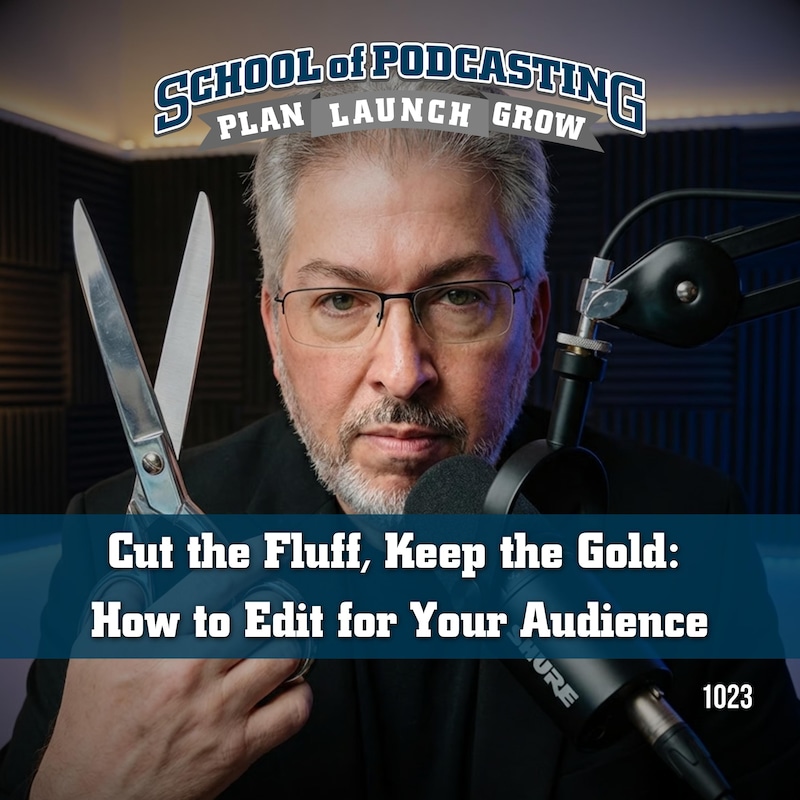
Shownotes
In this episode, I’m walking you through why great podcast editing doesn’t start with software, plugins, or secret shortcuts — it starts with knowing your audience. Once you’re crystal clear on who you’re talking to and what they value, editing becomes a lot easier: you simply remove anything that wastes their time or doesn’t deliver value.
Editing For Content
I’ll share examples from real interviews (including Amy Poehler’s “Good Hang” and conversations with my friends Daniel J. Lewis and Katie Krimitsos) to show how to tighten up questions, trim rambling answers, and keep the pace moving so your listeners stay engaged from start to finish.
If you’ve ever listened back to your show and thought, “It’s fine…but something feels off,” this one’s for you.
---
Where To start?
Editing starts with your audience, not your software
- Why the first question is, “Who am I talking to and what do they want?”
- How knowing your audience’s problems, language, and attention span guides every cut.
- The “vegetarian at dinner” analogy: if you know who’s coming, you know what not to serve.
Did they actually answer the question?
- Using Amy Poehler’s friend and Jennifer Lawrence as an example of a non-answer answer.
- How to spot when guests talk *around* a question instead of answering it.
- When to follow up, when to re-ask more simply, and when to just fix it in the edit.
Cut the fluff, keep the value
- Trimming long-winded questions where the host gives too much backstory.
- Shortening guest answers that wander, repeat, or add no value to the listener.
- Why you don’t need to include your guest “thinking out loud” to get to the point.
Friends, comfort, and wasted time
- How being comfortable with guests (friends, colleagues) can lead to bloated conversations.
- Why “fun to say” isn’t the same as “valuable to hear” for your audience.
- The discipline of deleting entire questions and answers that just don’t land.
Content editing vs. cosmetic editing
- Why removing bad questions is more powerful than removing ums and uhs.
- When it makes sense to leave in human imperfections for a natural feel.
- The mindset shift from “How do I make this cleaner?” to “How do I make this stronger?”
Basic audio cleanup that actually matters
- A practical order of operations: repair first, then shape the sound.
- What plosives, noise gates, compression, EQ, and de-essers do in plain English.
- Why “listenable” beats “perfect,” especially for guest recordings.
Testing popular cleanup tools on bad audio
- What happened when I ran intentionally bad audio through different tools.
- How tools like Voice Regen, Auphonic, Descript Studio Sound, Adobe Enhance, and others compare in real use.
- Why the cheap, simple option sometimes wins for everyday podcasters.
Know your audience, know your cuts
- How hanging out where your audience hangs out (YouTube, Facebook groups, Reddit, etc.) tells you what to keep.
- The simple question to ask of every segment: “Does this deliver value to *my* listener?”
- How better audience understanding leads to faster editing and stronger episodes.
Key Takeaway:
Editing isn’t about showing off your software skills. It’s about respecting your listener’s time. When you know exactly who they are and what they care about, the decisions of what to cut — and what to keep — almost make themselves.
Links Mentioned In This Episode
This content may contain affiliate links, meaning I earn a small commission if you purchase through these links at no additional cost to you. I only recommend products or services I trust and believe will provide value to you. Thank you for your support!
How to Pitch a Podcast Show (submit your show)
Good Hang Jennifer Lawrence Episode
Check Your Loudness at https://loudness.app/en
YouTube Demonetizing Shows (30K Goodbye!)
Big Lash Energy's Jayna Marie is Next Week.
Mentioned in this episode:
Question of the Month
This might be harder question to answer because when I ask people, the sometimes freeze. The question? How do you measure success for your podcast beyond download numbers? I need your answer by June 26th, 2026. Don't forget to tell us a little bit about your show and your website address so I can link to it in the show notes.
Help Us Fight Back Against Spam and Get Some Exposure
How to Pitch a Podcast is a show I'm launching that NEEDS your stories of good/bad pitches. Read your bad/good pitch (I'll remove the guilty names) and explain why it's good or bad. Then (if it's bad) explain what your perfect guest would be, tell us about your show and your website. Don't over-think it. I need your stories by 2/28 to launch. Go to pitchapodcast.com/story
Join the School of Podcasting
Mark from Practical Prepping had been podcasting for a while, but after joining the School of Podcasting, his podcast grew at a faster rate. His Facebook group has over 30,000 members! Join the School of Podcasting and get access to: Step-by-step tutorials An amazing podcast community Unlimited One-On-One Coaching Join today worry-free with a 30-day money-back guarantee!
Transcripts
All right, let's be honest. How many times do you
David Jackson:feel like your episode sounded like, okay, but you kind of
David Jackson:still felt like something was off, maybe the energy or the
David Jackson:pacing, or, I don't know, your voice sounded okay coming out of
David Jackson:your head, but you're listening back and you're like, Well,
David Jackson:today we're gonna go past cutting out the boring bits into
David Jackson:editing that actually keeps people listening. We're going to
David Jackson:talk about smarter cuts, cleaner sound and a few simple tools
David Jackson:that can make your podcast feel instantly more professional
David Jackson:without turning you into a full time audio engineer. Hit it
David Jackson:ladies, the School of
David Jackson:The SOP Singers: podcasting with Dave Jackson,
David Jackson:podcasting since 2005 I am your award winning
David Jackson:Hall of Fame podcast coach. Dave Jackson, thinking you so much. I
David Jackson:mean that for tuning in, I realize you could be doing other
David Jackson:stuff. I greatly appreciate it, and this is where we help you
David Jackson:plan, launch and grow your podcast. The website is School
David Jackson:of podcasting.com and today was inspired by the show good. Hang
David Jackson:with Amy Poehler. Now, Amy just won a Golden Globe, so I was
David Jackson:checking out her show, and I've checked out Amy show before. Amy
David Jackson:is a comedian from Saturday Night Live, then later, Parks
David Jackson:and Rec and other things, and she was interviewing Jennifer
David Jackson:Lawrence. And Amy has a cute little thing she does, and so
David Jackson:kudos for being creative, and that is, she finds someone who
David Jackson:is a very close friend to the person she's going to interview
David Jackson:and ask that person, what should I ask the famous person? And
David Jackson:there are a couple things that I was just like, Oh man, what a
David Jackson:bummer. Number one, this is a video first show. And one of the
David Jackson:things I like about Amy is, you know, she kind of introduces the
David Jackson:guest who's going to be on what they're going to talk about, and
David Jackson:then she does an ad read. And what I love about it, Amy
David Jackson:doesn't even pretend to read a teleprompter. She's basically
David Jackson:looking at you're watching her read this off a piece of paper.
David Jackson:I think that's actually kind of like all right, let's not even
David Jackson:try to hide the fact that I'm reading this. Let's just show
David Jackson:you that I am reading this. And so what I thought was
David Jackson:interesting is, in this case, Jennifer Lawrence's friend knows
David Jackson:that the call is coming. And there are a couple things that
David Jackson:I'll put a link to the video. Number one, don't put the camera
David Jackson:lower than your nose, because it's a great shot right up the
David Jackson:old nostrils, and you better have your Phillips nose trimmer,
David Jackson:handy, you know. So there's that. And then the fact that at
David Jackson:times when she talked, she would tilt her head back, giving you
David Jackson:an even better look right up her nose, and the fact that she was
David Jackson:using the built in microphone. Now, I realize she's not a
David Jackson:podcaster. Why should she have a microphone, because her friend
David Jackson:is Jennifer Lawrence, who probably has bazillions of
David Jackson:dollars in the bank. And you could go, Hey, Jen, can you loan
David Jackson:me 100 bucks so I can go get a decent microphone. But that's
David Jackson:not why she's here, but we will clean up her audio a little bit
David Jackson:later. But this is one of the things that I see so many times
David Jackson:when I talk about people editing interviews, the first thing you
David Jackson:have to listen to is, Did they answer the question? And so this
David Jackson:is Amy explaining, you know, hey, you're such a good friend.
David Jackson:I'm dying to hear what question you think I should ask her, but
David Jackson:let's pay attention to her answer.
Unknown:You know her really well. You know, sometimes we ask
Unknown:people to talk well behind our guests back and they've worked
Unknown:with them, or they kind of know that. But you, you know her
Unknown:really, really well. You've known her for a really long
Unknown:time, and you're deep partners in in work, and you're loving
Unknown:friends in life.
David Jackson:And so Amy's throwing in a lot of background
David Jackson:there that we don't need. And now she's finally going to ask
David Jackson:the question,
Unknown:what do you think I should ask her today? What do
Unknown:you want to know about, hear about, or what do you think
Unknown:she'd want to talk about, or a story she'd want to tell?
Unknown:Oh, man, I mean, with Jen, it's funny, because she is so, like,
Unknown:transparent in these spaces, like, I don't think that she's
Unknown:somebody who, or there are, like, a ton of subjects that are
Unknown:off limits.
David Jackson:So she answered the question, but she didn't
David Jackson:answer the question. So Amy kind of comes back again with another
David Jackson:version of the question.
Unknown:Well, it's okay. This is really helpful, because I've
Unknown:been prepping for the interview, and I don't want to put her in
Unknown:an uncomfortable position ever to ask her something she doesn't
Unknown:want to talk about, but she also feels really well aware of what
Unknown:she feels comfortable talking about. I guess
Unknown:I think she is, and I think she'll also like, tell you,
Unknown:like, I think that she has. I think, like she'll pivot if she
Unknown:needs to.
Unknown:You never have to answer a question if you don't want to
Unknown:answer and it is, and it's a magic trick to not answer it,
Unknown:and people often forget that what question they asked. I
Unknown:mean, this isn't a good thing to tell a guest. Probably, this is
Unknown:probably not a good thing to get but anyway.
David Jackson:But anyway, getting back to the fact that
David Jackson:you still haven't answered my question, and now Amy's gonna
David Jackson:kind of dumb it down. She's like, look, this is what I'm
David Jackson:looking for.
Unknown:Do you have it doesn't have to be a heavy question. It
Unknown:can be something small, anything that you think we should ask her
Unknown:today.
Unknown:I mean, gosh, like, maybe because she's in a position of
Unknown:constantly being asked questions, and she is never in
Unknown:charge of what is being asked. Like, maybe it's asking her,
Unknown:like, what would you like to talk more about that you don't
Unknown:feel Whoa. That's a good friend to declare. You know, maybe,
Unknown:maybe she has a big announcement, or just something
Unknown:that she'd like to, like, reflect on.
Unknown:You know what? That's a really good friend. Because what you're
Unknown:basically saying is, just check in with her and see if there's
Unknown:anything else she wants to talk about. Yeah, it's so true. She,
Unknown:like is tired of talking about you know that too. Yeah.
David Jackson:So her question that we should ask Jen is, Hey,
David Jackson:Jen, what do you want to talk about this from the person that
David Jackson:knows her the best, and for me, I was like, that even Amy's
David Jackson:like, oh yeah, you're a good friend. Well, you're a good
David Jackson:friend, but you're a horrible question comer upper with her,
David Jackson:holy cow. So I went back and looked from the beginning of
David Jackson:that question to the shortest answer. It was almost two
David Jackson:minutes, and yet I took that and boiled it down to 18 seconds.
Unknown:What do you think I
Unknown:should ask her today? Maybe because she's in a position of
Unknown:constantly being asked questions, and she is never in
Unknown:charge of what is being asked. Like, maybe it's asking her,
Unknown:like, what would you like to talk more about that you don't
Unknown:feel
Unknown:Whoa, that's a good friend
Unknown:to declare,
David Jackson:you know. And if I had separate tracks, I could
David Jackson:have muted out Amy going, Whoa, that's a good friend and let her
David Jackson:finish her answer. So that's an example of, did they answer the
David Jackson:question? We got a couple more of these. Yeah. What can really
David Jackson:mess things up is when you know the guests really well. And so
David Jackson:these next two examples are two friends of mine that I
David Jackson:absolutely just love to hang out with. They're good friends. And
David Jackson:the first one here is Daniel J Lewis. Now this comes from an
David Jackson:old interview. When Daniel had released pod engagement, that's
David Jackson:a great tool. He recently launched pod chapters. So if
David Jackson:your media host doesn't allow you to put in chapters, you can
David Jackson:use pod chapters for that. But in this case, we're talking
David Jackson:about pod engagement. And I asked him, what's coming in the
David Jackson:future? Nice, what else is coming? Because it's already
David Jackson:Daniel J. Lewis: pretty handy. Yeah, there are integrations
David Jackson:that now?
David Jackson:So he started to answer the question, and then he
David Jackson:took a little tangent
David Jackson:Daniel J. Lewis: that I've built this myself, which my heart is
David Jackson:really in every line of this code, like 10s of 1000s of lines
David Jackson:of code that I've written for this my podcast reviews was
David Jackson:programmed for me by another guy, and he did great work, and
David Jackson:he was really good to work with. But now I did this myself. I've
David Jackson:learned how to program since then, and I did this myself. So
David Jackson:that means that at the slightest whim, when I get the idea of how
David Jackson:to improve something, I can do that myself.
David Jackson:So Daniel is explaining because he made it.
David Jackson:He knows what's going to be coming in the future, but he
David Jackson:still hasn't answered that question. And sometimes when
David Jackson:somebody gives you information that's not exactly the answer,
David Jackson:like this isn't bad information. But sometimes you can summarize
David Jackson:this at the end of the interview and summarize what might be a
David Jackson:longer answer down to a condensed version. But at this
David Jackson:point, Daniel starts to answer the question.
David Jackson:Daniel J. Lewis: So there are all kinds of things that I am
David Jackson:planning.
David Jackson:So if we go back now and put the question and the
David Jackson:answer together, nice, what else is coming?
David Jackson:Daniel J. Lewis: So there are all kinds of things that I am
David Jackson:planning to build into this and tweaking along the way.
David Jackson:And so one of the reasons I wanted to bring up
David Jackson:that these are my friends, are those of the people that you're
David Jackson:comfortable with and you're kind of just having a conversation,
David Jackson:which is what you want it to sound like, but on the other
David Jackson:hand, you don't want to waste people's time. So my next
David Jackson:example here is from the lovely, the talented. Don't be fooled by
David Jackson:cheap imitations. Katie SOS from the Women's meditation network.
David Jackson:And here's the question, like, let's say you're trying to grow
David Jackson:your audience. I'm going to do this new strategy, right? How
David Jackson:long do you give it before you go and it's not working
Unknown:well, I would love to tell you I'm I, you know, have
Unknown:the spreadsheets of all the tracking and all of that stuff.
Unknown:I it's only been recently that I have started to actually get
Unknown:really serious about that stuff.
David Jackson:And so she's giving me an answer. But the
David Jackson:question was, how long do you leave a test in? And she hasn't
David Jackson:really started answering that yet.
Unknown:Some of it, you see right away. I mean, aha.
David Jackson:And there she is. She starts to answer the
David Jackson:question. So when you take out, and really, there's a part of
David Jackson:that beginning of that question that I could take out where I'm
David Jackson:like. So you're trying to do this, you're trying to do this.
David Jackson:And then I asked the question. We don't need the background of
David Jackson:my question either. How long do you give it before you go?
Unknown:That's not working. I don't know. It depends on what
Unknown:the strategy is. It depends on who the people are. It depends
Unknown:on what you're seeing. I mean, with some strategies.
David Jackson:And so there you go. Now, what does this do? It
David Jackson:keeps the pace moving. I don't really think it's necessary for
David Jackson:me to listen to someone think it through, like, gosh, was it
David Jackson:Tuesday or Thursday? I don't know. I think, let's see, I had
David Jackson:a coffee on Tuesday and then, no, just get to the answer. Now
David Jackson:there are times it's not 100% as always with all even heard Katie
David Jackson:say it, it depends, but many times for me, I give people a
David Jackson:lot of background on why I'm asking a question, I cut that
David Jackson:out, and then I listen to their answer, and even if they answer
David Jackson:the question, the next question is great. They answered my
David Jackson:question, does it deliver value to my audience? So those are
David Jackson:some quick examples of how do you edit for content, and it all
David Jackson:starts with knowing your audience. Because how do you
David Jackson:know what stays and what goes? Because you know your audience,
David Jackson:and that's where you want to go. Hang with them, whether that's
David Jackson:on a YouTube channel, reading the comments, hanging out. Well,
David Jackson:when you can tell me your audience's eye color, you're in
David Jackson:the right spot. But the more you can spend in Facebook groups and
David Jackson:Reddit and things like that, seeing what they're looking for,
David Jackson:that's how you know what to edit. A little later, I'm gonna
David Jackson:play with some tools to clean up some bad audio, because we all
David Jackson:know not every guest has spent that 80 bucks on a Samson Q to
David Jackson:you and their audio sounds like caca, the School of podcasting.
David Jackson:Yeah, yeah, yeah. All right, we're gonna kind of get slightly
David Jackson:nerdy here. This is a little too deep. We do have chapters. You
David Jackson:can skip to the next one, and we're going to talk about the
David Jackson:different tools. But here's the thing in the too long didn't
David Jackson:read, better known as TLDR. Tweak a knob. Does it sound
David Jackson:better, good, then keep it if it sounds worse, don't it really
David Jackson:comes down to that. But what should you do first? Well, I
David Jackson:read about six different articles on this, and it is the
David Jackson:ultimate It depends. But what they say, and I'm kind of
David Jackson:summarizing these, is try to repair and clean up before you
David Jackson:try to, like, shape it so remove bad takes, obviously, mouth
David Jackson:clicks, plosives. What's a plosive? That's where here.
David Jackson:Let's see if I can just make one. I'm going to take my
David Jackson:windscreen off my Rode pod mic, USB, and I will say, directly
David Jackson:into the microphone, please bring Pizza Pronto. There you
David Jackson:go. Here, all those P's there, and the bees. And we're just
David Jackson:we're jarring. Yeah, that's a plosive, and that's why now,
David Jackson:with my windscreen on, I am, if this was 12 o'clock, I am now
David Jackson:pointing my mouth at 10 o'clock, I'm talking across the
David Jackson:microphone. You know, any kind of hum, you know, because you've
David Jackson:got bad electricity, anything like that. Cleaning that up
David Jackson:first. Then there's, if you want to get totally nerdy, gain
David Jackson:staging. Some people call it normalization. And what this
David Jackson:does, from what I understand, if the maximum level was minus 12.
David Jackson:And it's weird, because we go up to zero was minus 12 and the
David Jackson:lowest was minus six. It basically looks at the top and
David Jackson:the lowest, and then kind of makes the every not so much
David Jackson:everything, but the lowest one go up to minus nine, it splits
David Jackson:the difference. And so what this does, why you want to do any
David Jackson:kind of leveling of audio, whatever it is first, is this
David Jackson:gives all the other things we're going to play with, a nice kind
David Jackson:of consistent input. And it also has what they call headroom,
David Jackson:which basically means a little room to boost things up. And
David Jackson:then there is your EQ. And what a lot of people don't realize is
David Jackson:they look at, what can I turn up? In some ways it's better to
David Jackson:turn the other thing down. So if I want to make things a little
David Jackson:more clear. Accent, my S's and T's. Everybody grabs the treble
David Jackson:and cranks it. It might make more sense to take the base and
David Jackson:turn it down, usually anything beneath, especially 80 hertz, I
David Jackson:guess is what we're talking there is just a rumble. It's
David Jackson:stuff you don't even feel, so you'll hear, and this is always
David Jackson:confusing. A high pass filter is saying that we're going to cut
David Jackson:out the low end. So whatever it is, high pass means just that,
David Jackson:if it's high end trouble stuff, you get a pass. If you're not,
David Jackson:if you're really bassy, you can you're not. And so it's going to
David Jackson:cut out the low end. And so what this does is it keeps, in
David Jackson:theory, the useful sound, so you're not trying to compress
David Jackson:things that are too bassy or too trebly. There's a thing called a
David Jackson:noise gate, and this is always one of those, if needed, because
David Jackson:sometimes you don't need it. But what this means is, you know,
David Jackson:you've been to the apart the amusement park, you must be this
David Jackson:tall to ride the ride. We're saying you need to be this loud
David Jackson:to make it to the listeners ears. And so if you have the
David Jackson:sound of the dryer in the background, that's only, you
David Jackson:know, a foot and a half tall, but when you talk, it's four
David Jackson:feet tall. So you can say, Oh, well, the dryer is one and a
David Jackson:half feet tall. Let's set the gate for two, meaning my voice
David Jackson:is loud enough to get over the two foot wall, but the dryer at
David Jackson:one and a half feet and I'm just using feet, just so we can
David Jackson:visualize this is not tall enough to get over the two foot
David Jackson:wall. Thus the dryer sound won't make it into the audio. However,
David Jackson:when you talk, if you have the dryer running in the background,
David Jackson:you're going to hear it while you're talking. So that's one of
David Jackson:those. We always just want to make things as good as they can
David Jackson:before we hit record. So that's something you might do here.
David Jackson:Another one is compression. And in a nutshell, a compressor
David Jackson:makes the loud things a little softer and the soft things a
David Jackson:little louder, but that may make things like breaths, room tone
David Jackson:more audible, because that's noise that shouldn't be there,
David Jackson:and especially if you use something like all phonic off
David Jackson:phonic, I've had people that are somewhat loud breathers. They're
David Jackson:a little, maybe a little too close to the microphone, and,
David Jackson:you know, and then so it sounds all of a sudden. You're like,
David Jackson:Well, Mr. Vader, tell me about your you know, whatever. So that
David Jackson:can be bad. A de Esser is, if somebody has a really clear mic.
David Jackson:They really boosted the trouble. And it's kind of just it cut. It
David Jackson:makes you blink when you hear it. It's so clear a de Esser
David Jackson:goes up to the very, very bright settings and just backs them off
David Jackson:a bit. And then overall EQ is again. Now that we have
David Jackson:everything, we have it compressed. We've removed the
David Jackson:noise things like that, a gentle a gentle boost to kind of warm
David Jackson:things up, maybe clear things up. That's where you would do
David Jackson:this. And then the last thing you want to do is work on your
David Jackson:loudness and what you're looking for, the current standards in
David Jackson:podcasting is, if you're doing a stereo file, you should be at
David Jackson:minus 16 luffs. And we don't really care what that stands
David Jackson:for. That's just the way we measure minus 19 luffs if you
David Jackson:are mono. Now, I'm a rebel.
David Jackson:I go minus 14. Why? Because I've been walking on a street with
David Jackson:traffic, and I can't hear my show. So it's one of those,
David Jackson:again, where the minus 14, it's a smaller number, and yet that
David Jackson:makes it louder. So I go up a little more for that. Now we're
David Jackson:going to talk plugins here in a minute. So if you're like, Wait,
David Jackson:how do I do all that stuff? And also, there is a site you can go
David Jackson:to to for free, have it tell you How loud is my file. One is
David Jackson:loudness dot app. And almost all of these, they're free. So you
David Jackson:know you're probably going to have to put in some sort of
David Jackson:email address or something of that nature. But for me, I'm
David Jackson:sitting here in Hindenburg, and almost everything I do is in the
David Jackson:yellow, because that's where I want it. That's a good volume.
David Jackson:Occasionally I get a little excited and it's a little too
David Jackson:loud. But basically, if it's in the yellow, you're probably
David Jackson:pretty close to being loud or loud enough where you need to
David Jackson:be. Now the bottom line on all that stuff I just said is, as I
David Jackson:said at the beginning, tweak it does it sound better? And what
David Jackson:you also want to do is I listen through my computer. Computer
David Jackson:speakers, I will record something before I upload it, I
David Jackson:listen to it through earbuds, because that's how a lot of you
David Jackson:are now going to hear it is through earbuds. And then you
David Jackson:ask yourself, Does it sound better or worse? Because so many
David Jackson:times we make changes, and I think we're making changes just
David Jackson:to make it different, and we're not asking ourselves, are we
David Jackson:making it better? Because sometimes you can kind of go
David Jackson:crazy, losing your mind over this stuff, and then it's like,
David Jackson:okay, so I'm going to use the noise reduction. But does the
David Jackson:noise reduction come after the compressor? Or when do I do the
David Jackson:EQ switch it around? The thing I love about Hindenburg is I can
David Jackson:look at all the things I have turned on and go like I use a
David Jackson:thing called the Sheps omni channel. It is a compressor,
David Jackson:noise gate, de Esser and EQ all in one, and I can move it before
David Jackson:the compressor even that's built into Hindenburg, or just just
David Jackson:play. I know it sounds weird. I There are times I work at pod
David Jackson:page, and one of the things I tell people all the time,
David Jackson:because we make websites for podcasters, is just go play.
David Jackson:What does it look like if you do this? Do you like it? Keep it.
David Jackson:If you don't, don't, you're not really going to break anything.
David Jackson:And the same is goes for your audio. So in a second, we're
David Jackson:going to hear some tools that clean up bad audio the school of
David Jackson:podcasting.
Unknown:Yeah, yeah, yeah.
David Jackson:All right, so I made some bad audio that sounds
David Jackson:like this. All right, so this is me recording on a Mac laptop.
David Jackson:I'm going to turn up a fan noise. There we go, and I got a
David Jackson:little music in the background. So this is some pretty horrible
David Jackson:audio right now. And so here is that same thing run through a
David Jackson:new service called Audio regen. It is from waves, so it's called
David Jackson:Voice regen. It's $5 a month for 300 minutes, all right. So this
David Jackson:is me recording on a Mac laptop. I'm gonna turn up a fan noise.
David Jackson:There we go. And I got a little music in the background. So this
David Jackson:is some pretty horrible audio right now. So it's a little
David Jackson:muffled, but it took out all the noise. Here's all phonic All
David Jackson:right. So this is me recording on a Mac laptop. I'm gonna turn
David Jackson:up a fan noise. There we go, and I got a little music in the
David Jackson:background. So this is some pretty horrible audio right now.
David Jackson:And here's audacities built in noise reduction, all right. So
David Jackson:this is me recording on a Mac laptop. I'm gonna turn up a fan
David Jackson:noise. There we go, and I got a little music in the background.
David Jackson:So this is some pretty horrible audio right now. And the next
David Jackson:one from accent eyes. It's called, it's a plugin called dx,
David Jackson:revive Pro. All right, so this is me recording on a Mac laptop.
David Jackson:I'm gonna turn up a fan noise. There we go. And I got a little
David Jackson:music in the background. So this is some pretty horrible audio
David Jackson:right now. And here is descript studio sound, all right. So this
David Jackson:is me recording on a Mac laptop. I'm gonna turn up a fan noise.
David Jackson:There we go. And I got a little music in the background. So this
David Jackson:is some pretty horrible audio right now. Next up the free
David Jackson:version of Adobe enhance, which is in Adobe podcasts. All right,
David Jackson:so this is me recording on a Mac laptop. I'm going to turn up a
David Jackson:fan noise. There we go. And I got a little music in the
David Jackson:background. So this is some pretty horrible audio right now.
David Jackson:And so I upgraded, paid the 10 bucks a month to have a little
David Jackson:more control over this, where you're able to say how much
David Jackson:background you're eliminating. And so I left a little bit of
David Jackson:background in because it made my voice a little clearer in Adobe,
David Jackson:and it sounded like this. All right. So this is me recording
David Jackson:on a Mac laptop. I'm gonna turn up a fan noise. There we go. And
David Jackson:I got a little music in the background. So this is some
David Jackson:pretty horrible audio right now, and that seemed to be the tricky
David Jackson:part was adding noise in the middle of something. And for me,
David Jackson:the one that sounded the best was the one that cost the least,
David Jackson:which is the new one from waves the voice regen. Now, this
David Jackson:doesn't take out any UMS or your no. Knows there's no settings.
David Jackson:You upload it, it does it, and then you get what you take. And
David Jackson:so if you wanted more clarity, I would think I would go with
David Jackson:Adobe, because it's $10 a month, where descript, which would
David Jackson:probably be my number two, is who knows a month, because they
David Jackson:keep changing their plan, and nobody can figure it out. I am
David Jackson:paying 35 ish dollars a month, and of course, that comes with
David Jackson:remote recording, not just the studio sound, and that whole
David Jackson:thing that descript is, and I will say that when I logged into
David Jackson:it today, I haven't been in descript in a while, and I don't
David Jackson:recognize it at all. I don't know what they're doing over
David Jackson:there, but enjoy the learning curve, because it never ends. So
David Jackson:as always, it depends the accent ice plugin, the one I talked
David Jackson:about that is $300 and I bought that because I got tired of
David Jackson:paying off phonic and these other people, and I had a client
David Jackson:that just kept handing me horrendous audio, and so it
David Jackson:saved me so much time that it was worth that. But the voice
David Jackson:regen for five bucks a month, if all you're getting is bad audio
David Jackson:with room noise, and you can clean up the ums and your nose
David Jackson:later. You know that one for me for five bucks is a great deal
David Jackson:of links to all of these in the show notes. And my apologies,
David Jackson:because I realize listening to like an audio test like that,
David Jackson:that's real close to falling into cruel and unusual
David Jackson:punishment, which, of course, is against the law per the
David Jackson:Constitution of the United States. The bottom line of all
David Jackson:this stuff is, if you can take the time to have a good mic,
David Jackson:have good mic placement, have a decent area to set up that's not
David Jackson:surrounded by glass or things like that, the better the
David Jackson:recording, the less time you have to spend trying to make
David Jackson:something that doesn't sound very good. Sound listenable, and
David Jackson:that is my goal. Listenable. Yes, I would love pristine
David Jackson:audio, but when it comes to guests and other things, I'm
David Jackson:just going for listenable, because, again, it's going to be
David Jackson:heard through earbuds in computer speakers and maybe in
David Jackson:the car, if you're lucky. Yeah, one of my favorite people is
David Jackson:coming back soon with a new podcast, the one and only Eric
David Jackson:Kay Johnson. You might know him as the podcast talent coach, and
David Jackson:I was digging through these old episodes and such, looking for
David Jackson:editing examples, and I found Eric talking about editing
David Jackson:Erik K. Johnson: should you go in and take out questions that
David Jackson:flopped? I would spend more time doing that than I would cleaning
David Jackson:up the ums and the UHS and the lip smacking and everything. If
David Jackson:you ask a question and it doesn't go where you intended it
David Jackson:to go, it doesn't give you a great answer. If it wastes your
David Jackson:listeners time, then go take that question and answer out
David Jackson:completely. I would spend more time doing that because it's
David Jackson:going to make your interview stronger than spending time
David Jackson:taking out the stammers, because that's not going to make your
David Jackson:interview stronger. That's just going to make your audio a
David Jackson:little cleaner.
David Jackson:Amen brother Eric and I'll put a link out to his
David Jackson:stuff in the show notes. Just go to school of podcasting.com/
David Jackson:1023 but when it comes to editing, the key ingredient is
David Jackson:not the software. What? Yeah, it's not the software. How do
David Jackson:you know what to cut is based on your audience. The more you know
David Jackson:your audience, the better you can edit. I always like to take
David Jackson:podcasting out of podcasting, and I always compare it to, in
David Jackson:some cases, a meal. If I know I've got a vegetarian coming,
David Jackson:I'm not serving meatloaf. So the more you know your audience, the
David Jackson:better the content, and the less time you spend on editing. I
David Jackson:remember once I interviewed somebody about storytelling, and
David Jackson:they were from the video side, but I wanted to talk to them
David Jackson:about storytelling, and I told him, I said, Look, if you start
David Jackson:talking about F stops and lenses, that's going to end up
David Jackson:on the editing room floor, and he's like, Okay, I got it, but
David Jackson:that was kind of his jam. And he started talking about cameras
David Jackson:and lenses. And you know what? You never heard it. Why? Because
David Jackson:back in whatever 2010 11, we weren't really interested that
David Jackson:much in cameras and lenses. Today, maybe I saw the guys from
David Jackson:Thinkific, and they had a link to the lens they were using, and
David Jackson:it was $2,000 for the lens, not just the camera, just the lens.
David Jackson:And those guys are doing IT pro, but that's why, yeah, holy cow.
David Jackson:Speaking of them, I'm gonna put a link to their episode. Yeah,
David Jackson:because they talk about how, and I guess this isn't new, but they
David Jackson:talk about two channels that were making $30,000 a month from
David Jackson:YouTube, income, like from YouTube, and they got
David Jackson:demonetized. And so the video was talking about how it's kind
David Jackson:of funny. YouTube, apparently, is using AI to find AI. And the
David Jackson:interesting thing was, in this one example, it wasn't really
David Jackson:AI, and so they talk about what you can do to not be
David Jackson:demonetized. Now, they didn't lose their channel completely,
David Jackson:although I know people that have done that, they just were like,
David Jackson:Yeah, you know how you're making this money from YouTube. Not
David Jackson:anymore, so that'll be in the show notes again. School of
David Jackson:podcasting.com/ 1022 next week, I'm looking forward speaking of
David Jackson:editing this episode, because I talked to this guest for
David Jackson:probably close to two hours, because she's just that
David Jackson:interesting. It's Jana Marie from the big lash energy, and I
David Jackson:had her do humble brag theater.
Unknown:Yes, I won eight signal awards. I've been nominated for
Unknown:one ambi and I was nominated for two Podcast Awards as best
Unknown:female host and best storyteller, most inspirational
Unknown:podcast, the one that I'm the most proud of is I won gold for
Unknown:Best Writing in the comedy category, and I actually beat
Unknown:Barack Obama's speech writer.
David Jackson:And the interesting thing is, it's a
David Jackson:solo show, and you'll find out some unique ways that she's
David Jackson:using to grow her audience and her unique attitude in the fact
David Jackson:that, at least right now, she's not trying to make money.
Unknown:I was making radio shows for fun. What?
David Jackson:What? What can you do? Wait? Is that allowed?
David Jackson:Wow, never miss an episode. Go to school of
David Jackson:podcasting.com/follow. And that, of course, is the page that is
David Jackson:automatically made because I am now using pod page Hooray for
David Jackson:the School of podcasting website. For more information,
David Jackson:check out tripod page.com and when you're ready to start plan
David Jackson:grow, or if you want to monetize your podcast, go over to school
David Jackson:of podcasting.com click on the Join Now button and get access
David Jackson:to our courses, our coaching and our amazing community. And it
David Jackson:comes with a 30 day money back guarantee. I'm Dave Jackson. I
David Jackson:help podcasters. It's what I do. Can't wait to see what we do
David Jackson:together until next week. Take care. God bless. Class is
David Jackson:dismissed.
Unknown:If you like the show, please share it with a friend.
Unknown:If you like the show, pretty, pretty. Share it with a friend
Unknown:right
David Jackson:now. Audio regen, what's the name of it? Survey
David Jackson:says, Where did it go? This is now a blooper. Voice regen.
David Jackson:There we go. Voice regen, links in the show notes. School of
David Jackson:podcasting.com/ 1000 and now I don't know what the number is,
David Jackson:great, wonderful, and it's 1023 phenomenal show prep. Just check
David Jackson:your show notes. Yeah.





