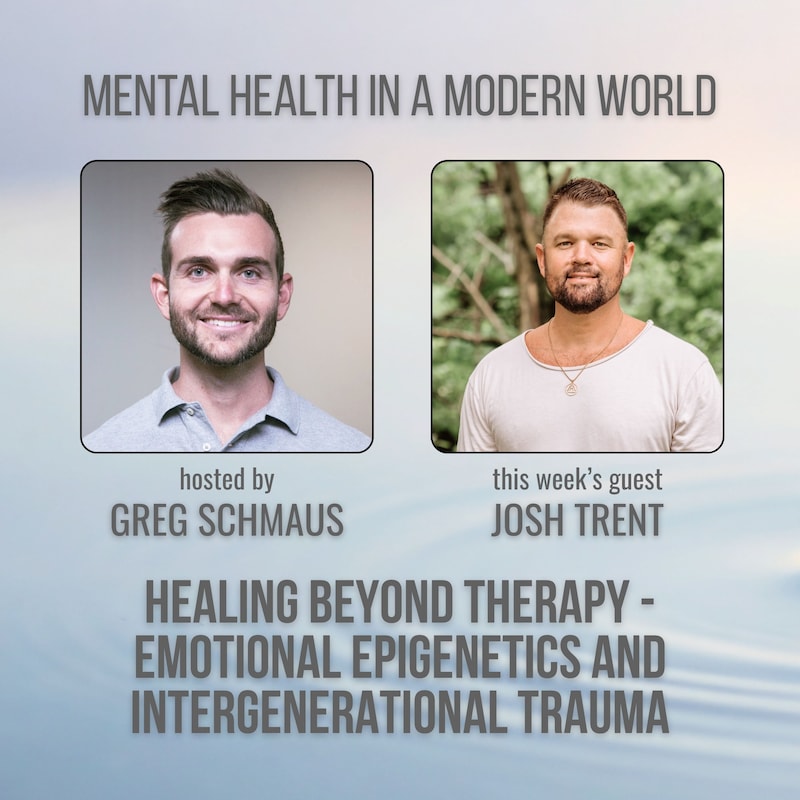
Shownotes
📺 Watch on YouTube and Spotify
“Until you make the unconscious conscious, it’ll rule your life and you’ll call it fate,” says Josh Trent, host of the Wellness and Wisdom podcast, who joins Mental Health in a Modern World to illuminate what true mental health really means in an era of speed and disconnection. Josh shares how his own early childhood trauma, from witnessing his mother’s struggle with mental illness to feeling abandoned and unsafe, became both his great wound and his eventual gift—fueling a lifelong journey to wholeness and authenticity.
In today’s episode, Josh traces his evolution from soul-numbing corporate work and addictive coping strategies to helping thousands through integrated healing that honors mind, body, and spirit. He reveals why so many symptoms of “mental illness” are actually threads pointing to deeper stories of self-abandonment, inherited trauma, and the masks we’re forced to wear to survive. Josh unpacks “emotional epigenetics,” explores the liberation that comes from radical self-responsibility and integration of all parts of self, and issues a clarion call for the return of true elders and embodied wisdom in our culture.
Tune into this compelling conversation to discover why chasing the “why” can be a fool’s game, how to break cycles of generational pain, and how presence, curiosity, and authentic connection are the bedrock of both personal and collective wellness.
5 Key Takeaways
Transforming your mental health starts with practical steps—let these actions guide your integration and healing journey.
1. Identify and Integrate Abandoned Parts of Self
Trace your symptoms and patterns back to the inner parts you may have exiled or rejected, then work to accept and reintegrate them for authentic wholeness [13:40](/timestamps/820).
2. Stop Excavating for "Why" and Focus on "What Happened"
Shift your healing inquiry from searching for reasons to clearly recognizing what occurred, allowing you to integrate lessons and move forward [23:01](/timestamps/1381).
3. Use the Liberation Loop Model for Transformational Change
Map your beliefs, thoughts, feelings, and actions (BTFA) in reverse to uncover core limiting beliefs, then consciously cultivate new beliefs through trust, faith, and consistent evidence-seeking action [01:02:40](/timestamps/3760).
4. Seek True Elders and Community for Support
Find guidance and healing within genuine community and elders—those whose embodied wisdom, humility, and presence can support your transformation [43:01](/timestamps/2581).
5. Make Curiosity and Self-Responsibility Daily Practices
Adopt a radically curious mindset and embrace ongoing self-inquiry; celebrate mistakes and remain open to growth instead of defending beliefs or identities [51:31](/timestamps/3091).
Start your journey today: pick one takeaway and put it into practice—your path to integration begins with a single, authentic step.
Memorable Quotes
"We are coming to a high point of consciousness that does not rely on us stuffing down emotion or ignoring what has happened. When we can identify what happened, we can understand how we can integrate deeper parts of ourselves without abandoning or rejecting them."
"The quality of my life is dictated by the authenticity of my being, because when I'm authentic, I'm at peace. Yet these parts of self are very subtle—at some point we abandon a part of ourselves, and most often it's the younger version of ourselves."
"True freedom is the result of when your biology and your reality are no longer at war. Your biology—who you are—and your reality—who you think you are—are one and the same. And then you can be free."
Connect with Josh
Website - wellnesswisdom.com
LinkedIn - https://www.linkedin.com/in/joshtrent
Instagram - https://www.instagram.com/joshtrentofficial/
Facebook - https://www.facebook.com/WellnessF/
X - https://x.com/wellnessforce
Resources Mentioned
It Didn't Start With You: How Inherited Family Trauma Shapes Who We Are and How to End the Cycle by Mark Wolynn - https://amzn.to/4i9ofqS
No Bad Parts: Healing Trauma and Restoring Wholeness with the Internal Family Systems Model by Dr. Richard Schwartz - https://amzn.to/3JU9JzY
How to Know Higher Worlds by Rudolf Steiner - https://amzn.to/44DaI28
Outwitting the Devil by Napoleon Hill - https://amzn.to/3VJ5Rbh
Connect with Greg
Website - https://www.healing4d.com/
Instagram - https://www.instagram.com/4d_healing/
YouTube - https://www.youtube.com/@gregschmaus
LinkedIn - https://www.linkedin.com/in/greg-schmaus-22929589/
🎙️🎙️🎙️
Podcast Production & Marketing by FullCast: https://fullcast.co
Discover the best podcast services in the world at The Podosphere: https://www.thepodosphere.com/
Mentioned in this episode:
Embark on The HTM Journey
Embark on The HTM Journey
Transcripts
We're coming to a high point of consciousness that does
Speaker:not rely on us stuffing down emotion anymore
Speaker:or ignoring what has happened. It's not important that I excavate for why.
Speaker:Why I believe is a fool's game, but what is very
Speaker:intelligent because when we can identify what happened, we can
Speaker:understand how we can integrate deeper parts of ourselves without
Speaker:abandoning them or rejecting them. Otherwise, if we don't, and this
Speaker:is the really sad part, until you make the unconscious
Speaker:conscious, it'll rule your life and you'll call it fate. In a world moving
Speaker:faster than our minds were designed to handle, mental health is becoming one of the
Speaker:defining challenges of our time. Welcome to Mental Health in a Modern
Speaker:World with holistic health practitioner Greg Schmaus. After
Speaker:overcoming severe anxiety and OCD in his own life, Greg
Speaker:dedicated the past decade to helping others heal. Through a fully integrated
Speaker:approach to mental health, combining lifestyle coaching, psycho-emotional
Speaker:healing, mindfulness, and archetypal work. Over the years,
Speaker:he's facilitated thousands of sessions, guiding people back to peace,
Speaker:clarity, and a deeper connection with themselves. Each week,
Speaker:Greg shares powerful solo insights, conversations with leading voices in
Speaker:holistic healing, and immersive live coaching sessions that take you
Speaker:inside the healing process itself. New episodes every Friday.
Speaker:Follow the show and start reclaiming sovereignty over your mind in a modern world.
Speaker:Here's Greg. Josh, my brother, welcome to the podcast, man. Thank you
Speaker:for having me. I am so excited to have you on the
Speaker:show. And one of the reasons is
Speaker:I want to express some gratitude to you before we get started.
Speaker:My business wouldn't be where it is if it wasn't for you.
Speaker:And, you know, back in, just giving people a little background, back
Speaker:in, when was it? 2020, when you and I first
Speaker:podcasted, and then I went to seek
Speaker:out business mentorship and coaching, and you were the guy.
Speaker:And all of the things that you taught me and guided me through, how to
Speaker:build programs, how to podcast, how to do all the things,
Speaker:everything that I have business-wise now, whether it's the
Speaker:podcast, my programs, I owe so
Speaker:much to you. And so I just wanted to start by
Speaker:thanking you for that. Feels so good to receive that
Speaker:from you, Craig. Thanks. So welcome. And so
Speaker:I'd love for you to share a little bit with our listeners about
Speaker:your personal journey, anything you want to share about your own healing
Speaker:journey, because this This podcast is Mental Health in a Modern World. And I
Speaker:know you've gone through some of your mental health challenges,
Speaker:challenges with addiction. So anything you want to share just about your
Speaker:own journey and kind of what brought you to the Josh Trent that we're
Speaker:seeing and hearing today? For whatever
Speaker:reason, I'm having a memory when I was somewhere between
Speaker:9, 10, or 11. And I watched my mom get carried
Speaker:out of the house on a stretcher. Hmm. And I remember
Speaker:somatically what that felt like and how much that
Speaker:projected into the rest of my life. This
Speaker:experience as essentially a young boy who really
Speaker:needed to know that his environment was safe and how much that impacted his own
Speaker:emotional and mental health. Flash forward, it actually
Speaker:created an incredible business and podcast and my ability to
Speaker:sit here and speak with you. So encapsulated in that
Speaker:traumatic event was also a real gem. Yet
Speaker:when I think about the real understanding and/or definition of
Speaker:mental health, I believe that the definition of mental health is
Speaker:a sound and clear grounded mind that is connected to the body
Speaker:and all the different aspects of self such that we're
Speaker:integrated in a way that our mind doesn't hold us hostage.
Speaker:that our emotional patterns don't hold us hostage, that our
Speaker:unconscious beliefs as it pertains to mental health don't hold us
Speaker:hostage. And so my life has been layer after layer
Speaker:of understanding 3 big things. First of all,
Speaker:who actually am I? This discovery of self. Who
Speaker:am I not? Can I release and liberate myself
Speaker:from that which I'm not? And then third, can I give myself permission
Speaker:and joy to celebrate the authentic self of who Josh is?
Speaker:And I think that mental health is a, quote, crisis, if you want
Speaker:to call it that right now, because so many people are living out of alignment
Speaker:with their soul calling, their purpose, and really living
Speaker:someone else's story. And, you know, we can only hold the mask up for so
Speaker:long before our biceps starts burning. At some point, we have to take the mask
Speaker:off and look in the mirror at The life we created for ourselves. And
Speaker:so that's been my story going back to personal training, then
Speaker:leaving personal training, going to corporate America, committing what I called
Speaker:soul suicide or spiritual suicide, doing something for just
Speaker:money because I didn't have the worth or self-love to
Speaker:trust myself to be able to lead a mission. And then catapulting
Speaker:into the past 11 years of podcasting on the Wellness and Wisdom
Speaker:podcast, Which is essentially where we go to understand, like,
Speaker:how do we celebrate who we really are? And when we
Speaker:celebrate who we really are, it's such a deep question as it
Speaker:pertains to mental health, because a lot of the mental stories we've
Speaker:created about our life and even about other people and God and society as
Speaker:a whole are really just projections of the past. They're
Speaker:essentially packets of information that we've absorbed through emotional
Speaker:epigenetics. That keep recycling and living out.
Speaker:But the thing that stops it, and when we become a cycle breaker, is actually
Speaker:the moment, much like Neo did in The Matrix, where he put his hand up
Speaker:and the bullets fell. It's not about fighting the past. It's not about blaming
Speaker:parents. It's not about pointing the finger at who created the
Speaker:life and the mental health that we have. It's actually about taking a
Speaker:deep exhale and having an emotional inventory to ask
Speaker:ourselves the most deep question, I believe. And that is, how
Speaker:can I celebrate the authentic self? How can I really
Speaker:know who I really am? And these are very fundamental
Speaker:questions as it pertains to mental health, because, you know, as Jung says,
Speaker:uh, children are tasked with the unfinished business of their parents.
Speaker:And so that's the case for all of us, whether we know it or not.
Speaker:I always say that whatever's being felt in a space and not being said is
Speaker:still being felt. So These are some of the things that I've
Speaker:been leaning on, that I've been exploring in my own journey from
Speaker:traumatic events in childhood, which I think most of us experienced that in some way.
Speaker:I'm not, I'm not that. And then this
Speaker:uncovering or really remembering process of who we really are
Speaker:and the ability for us to celebrate who we really are. That's, that's been the
Speaker:journey up until now. I'm sure it'll continue
Speaker:quite like that. But have different turns and twists.
Speaker:That's beautiful. What I'm, what I'm hearing from you is
Speaker:as children, we, we experience trauma, we feel unsafe, whatever it
Speaker:might be. And then as a result, we, we have these
Speaker:adaptive strategies and those adaptive
Speaker:strategies move us further and further and further away
Speaker:from the authenticity of our being, of
Speaker:our, you could say, soul blueprints. And what I'm hearing
Speaker:from you is that is when these symptoms of mental
Speaker:illness start expressing themselves. Is that correct? Absolutely.
Speaker:And then you said it perfectly, symptoms, right? The
Speaker:symptomology is really a thread on a sweater, but
Speaker:we're all wearing the sweater and we can all decide if it's the right fit
Speaker:or not. But yet what happens is people want to clip
Speaker:the thread. They want to address the symptom. And this goes for all
Speaker:branches of development, whether it's mental, spiritual, physical,
Speaker:emotional, even financial. The, the itch
Speaker:or the thread that's loose is really a clue that points us
Speaker:into what's really going on underneath the surface. Mm-hmm. And
Speaker:everything underneath the surface, a good analogy would be this, you know, when we're
Speaker:kids and we held a beach ball in the pool and you'd like get down
Speaker:there and hold, you can only hold the ball for so long. Eventually the ball
Speaker:has to pop up. To the top of the surface. Well, we are the
Speaker:pool and our emotions are the ball. And so
Speaker:to the degree that we can release emotion or energy in motion,
Speaker:then we don't have to have so many adaptive coping strategies to which you speak
Speaker:of, because we can really lead life with an open heart and a grounded
Speaker:being and experience emotions that are intense,
Speaker:that can sideline us for a while. But we can become
Speaker:resilient, much like a bamboo reed or a strong tree
Speaker:where if there's a storm, it bends, but it doesn't break. And I think
Speaker:for many people, when there's a break, that's actually the most
Speaker:beautiful moment in their life. Doesn't feel like it.
Speaker:But when, when we're broken, we're not actually broken.
Speaker:We are being forced to look at a part of the self
Speaker:that's not been integrated. And I think there's real beauty there. It
Speaker:doesn't mean it's always going to be clean. It actually is most times really messy.
Speaker:Um, but there, there's real gems there. Yeah.
Speaker:And one of the,
Speaker:one of the words that you're using is parts of self. So,
Speaker:you know, I'm a big fan of parts work. I'm curious, has that
Speaker:been a part of your healing journey in terms of working with the self as
Speaker:a multiplicity as a collection of some of these different
Speaker:parts playing different roles, some of which have not been fully integrated?
Speaker:It's a yes. And I, I interviewed Dick Schwartz, the founder of
Speaker:IFS, and he actually did a live session on my podcast and
Speaker:I had a huge release. And, you know, this concept of
Speaker:IFS is fascinating, right? We have the firefighters that
Speaker:cover for the protectors, but essentially We all have this part
Speaker:of a psyche that is in exile. In his
Speaker:work, um, No Bad Parts, he talks about the exile. And I think really
Speaker:the exile is the one that doesn't get enough attention
Speaker:in most work, because like you said, symptomological-wise, there's
Speaker:such a focus on the firefighter or the protector. Mm-hmm. Even some parts of
Speaker:CBT therapy and many branches of talk therapy, they're, they're talking about the
Speaker:behavior or the action. But I actually think it's much deeper.
Speaker:I think it's much deeper. And it's been an evolution of understanding, Greg, where,
Speaker:you know, I went through talk therapy. I did plant medicine and breathwork
Speaker:and float tanks and microdosing and
Speaker:inner child work and IFS and just this kind of graduated
Speaker:experience where, quite frankly, recently in the past couple of months,
Speaker:I did some very deep work with a gentleman called Mark Wolin.
Speaker:And he wrote a book called It Didn't Start With You, um,
Speaker:about intergenerational healing. Mm-hmm. And in the sessions I've been
Speaker:able to, uh, sit with him, it's been profound
Speaker:because he and all of my other mentors— I'm up to
Speaker:850 episodes now. And you know what the through line is, Greg,
Speaker:at the crux of your question that every guest that sits across the table has
Speaker:encountered? It's this one deep question of
Speaker:Am I abandoning a part of myself when I feel
Speaker:afraid? And what is the cost when I abandon
Speaker:a part of myself that my life is
Speaker:beared fruit by? In other words, the quality of my life is dictated by
Speaker:the authenticity of my being, because when I'm authentic, I'm at
Speaker:peace. You know, I can be, I can be Josh.
Speaker:Yet these parts of self They're very,
Speaker:they're very subtle at times. You know, we've, we've heard the phrase maybe, um,
Speaker:the ego is a subtle foe. The ego sometimes can be a
Speaker:snake or a whisper or sometimes a sledgehammer, but
Speaker:typically the ego has one language and it's the language of fear.
Speaker:False evidence appearing real or for everyone's attention
Speaker:responsibly. I like that one because a lot of times,
Speaker:just because something might be consciously false. Yeah. does not mean that
Speaker:unconsciously or somatically that it feels false.
Speaker:Many times these emotions or these beliefs that are locked
Speaker:into our tissues or into our unconscious mind, depending on
Speaker:if you follow IFS or if you follow Bessel van der Kolk, or
Speaker:even the smooth muscle theory and the latch theory from Michael Edward Johnson,
Speaker:they're all pointing to the same thing. And this is why I love podcasting because
Speaker:we can, we can go in so many branches of science and models.
Speaker:And we can ask ourselves, what's the through line? And I believe, Greg, that the
Speaker:through line is that at some point we abandon a
Speaker:part of ourselves, and most often it's the younger version of
Speaker:ourselves. For me, it was little Joshy. He
Speaker:didn't have the type of support that he needed, even though his
Speaker:parents did all the best that they possibly could with the level of
Speaker:consciousness they had in their development at that time. Yeah.
Speaker:Sometimes our parents' consciousness isn't enough to make our neural
Speaker:system feel safe because our parents essentially do one thing.
Speaker:They reflect onto us a reality of safety or
Speaker:a reality of fear, and they do it based on what they were taught.
Speaker:So it's this epigenetic transfer that happens. If you look at the Native American
Speaker:theory, it's, they call it the 7th generation principle. 7 generations
Speaker:back and forward are healed when we integrate all parts of
Speaker:self. I do believe it's that one through line though, of us
Speaker:learning that when we abandon our inner child, when we
Speaker:abandon that young version of self, we may feel safe
Speaker:for a while, but the exile is still in the closet
Speaker:banging on the door, asking to be held. And that exile will
Speaker:operate in projection, in relationship, in business,
Speaker:in quiet moments, in friendship, and in literally all parts of life.
Speaker:Because it's asking for peace. It's asking for integration. And so
Speaker:that's the through line that I've seen over the past 11 years and all these
Speaker:podcasts is, can we exhale and be in
Speaker:peace or be in union with the part of ourselves that we've
Speaker:abandoned, that we've rejected? And a lot of times that part that we've abandoned and
Speaker:rejected was a learned behavior because we saw our parents do it.
Speaker:Beautiful. What it was bringing up for me as you were
Speaker:sharing is something that, uh, Gabor Maté talks
Speaker:about, which is
Speaker:the dilemma between authenticity and attachment,
Speaker:and how we forego authenticity to secure attachments,
Speaker:which is a form of self-abandonment. Yeah.
Speaker:And so I guess the healing journey is as we're
Speaker:healing those attachment wounds and we're securing more internal
Speaker:attachments, then we can return to our authentic
Speaker:self. I would love to dive into emotional
Speaker:epigenetics. As soon as you said that term,
Speaker:something lit up inside of me and said, we need to go into that a
Speaker:little bit. So what is emotional epigenetics?
Speaker:The way I understand it now, which it's always evolving, but the basic definition
Speaker:is that the epigenome sits on top of the genome. And so our
Speaker:genome is fixed, but our epigenome are essentially dials
Speaker:that turn up the volume or down the volume on a gene's
Speaker:expression. And so knowing the scientific model, I
Speaker:really have a hypothesis that I'm going deeper into. And that
Speaker:hypothesis is that when we understand the science and
Speaker:the spirituality of why some people heal and some don't, we
Speaker:find that emotions, unconscious beliefs, and
Speaker:environmental expression are passed down through lineage.
Speaker:That's the, that's the top level of emotional epigenetics. And,
Speaker:you know, I'm a big fan of Mark Wolynn's work. Um, I
Speaker:love his book, It Didn't Start With You. I also, I come from a family
Speaker:of Holocaust survivors, so his work really hit home for me.
Speaker:Oh yeah. And so I've done a lot of work also. I did a
Speaker:year of training in family constellation, which I know he does a lot of
Speaker:constellation work. Yes. Um, so this has all been very real
Speaker:for me. And so with this,
Speaker:you could say, intergenerational transfer,
Speaker:how have you noticed that show up in your life? And
Speaker:how have you been able to begin identifying, wait a
Speaker:minute, this pattern didn't start with me?
Speaker:Because there's been a lot of times in my life where I'll play something out
Speaker:or I'll act something out. I'm like, wait a minute, That so
Speaker:resembles how I experienced my father, or that
Speaker:so resembles a dynamic that I experienced in
Speaker:my original constellation. And even finding,
Speaker:replicating the constellation from our family of origin with
Speaker:other people, other partners, other relationships. So I'm really
Speaker:curious what your experience of all of this has been, because it's such a,
Speaker:such a huge but probably underexplored topic. Yeah.
Speaker:Ever since I was a little boy, I felt this hot
Speaker:air bubble in my stomach and I couldn't figure it out why.
Speaker:And like I said, in my healing journey, I listed out a bunch of practices
Speaker:and modalities that I did. Breathwork was a very significant one that
Speaker:where I was actually able to start sensing what was in that hot air bubble.
Speaker:But how I learned about Mark Woollens' work was actually through a
Speaker:friend named Mark Groves. Hmm. And, um, Mark
Speaker:is a human connection specialist and he, he nudged me in
Speaker:Wolynn's area. And when I looked back, when I
Speaker:started to understand the models and the frameworks of It Didn't Start With You
Speaker:and intergenerational healing, I started to connect dots
Speaker:from my past about literally, Greg, no, no
Speaker:exaggeration, every single relationship I'd ever been in,
Speaker:the way I treated my mother. my father, my brother,
Speaker:my friends, most importantly myself,
Speaker:were all a fabricated story
Speaker:based on a coping mechanism that I felt that I actually
Speaker:acted out because I saw my parents act their own out. Hmm.
Speaker:Now, what I mean by this, I'll go a level deeper, is when I was
Speaker:born, I was born 4 pounds,
Speaker:11.5 ounces. And for the first 2 weeks of my life, I was in an
Speaker:incubator. So I was being hovered around by
Speaker:strangers. I don't know how much my mom or dad held me. And
Speaker:when I talked to them, they don't remember. Think about how
Speaker:incredibly—
Speaker:think about the necessity of human touch, especially
Speaker:mother to baby. Think about the importance of that, that we've been
Speaker:learning through science for so long. And then I reflect,
Speaker:okay, if my neural system was actually coming out of my mother's womb
Speaker:early, well, then obviously I didn't feel safe inside of my mother. I had
Speaker:to come out early. And then not only did I feel unsafe
Speaker:in the womb, in utero, I then was under an
Speaker:essentially hot plastic glass that was keeping me warm,
Speaker:kind of a pseudo-comfort, but not the real thing.
Speaker:And I can look back on that and go, wow, that must have been so
Speaker:hard for this young— Human being. baby, you know, fetus then turning into a baby.
Speaker:And then I look at the ways in which my father left home right after
Speaker:I was born. My mom was struggling with manic bipolar disease at
Speaker:that time, still is. And then I
Speaker:graduate into school and being in the system, and I was
Speaker:bullied and overweight and chronic sinusitis and just the
Speaker:ramifications that actually started when I was
Speaker:inside the body of my mother. And then I started to
Speaker:look into the trauma language of my mother and going into Mark's work
Speaker:and relaying that to the past and thinking, okay, I'm going to go back and
Speaker:excavate, Greg, but I'm not going to go back and excavate to blame.
Speaker:I'm going to go back and excavate to know what happened, not
Speaker:why it happened. Yeah. This is the big question in my work
Speaker:and in the answer to your question of how has this unfolded for me?
Speaker:How it's unfolded for me is in the beginning of my journey, I was doing
Speaker:it all wrong. I was excavating the past to find why
Speaker:something happened and what meaning I can make as
Speaker:to why it occurred. And I'm going to be the one to heal my family.
Speaker:It's like, that was actually the ego being subtle. Mm-hmm. That
Speaker:was me trying to hide away from the emotion that I was feeling,
Speaker:which was inherently grief and sadness. That's the hot air bubble.
Speaker:And so my journey has been starting out backwards and then remembering
Speaker:forwards. And so when I look at my
Speaker:mother and what she was struggling with, and then I go to my
Speaker:grandfather and my grandmother, who were the product of my
Speaker:great-grandparents who came over from Sicily and landed
Speaker:on an island and had a number written on their clothes. And then the
Speaker:great-greats who lived in Sicily during famine and
Speaker:wartime, and even World War II. We are the product of a very
Speaker:traumatic society, but our ancestors and our lineage did not
Speaker:have the luxury that you and I have now. This is an
Speaker:extremely luxurious moment that you and I have, and
Speaker:an extremely luxurious lifestyle for everybody listening. Like, the fact that
Speaker:you're doing the healing work and that you're interested in this conversation is
Speaker:only because you have the capacity to do so. You don't have to be working
Speaker:for 12 hours like our lineage did. So
Speaker:on a 30K view, what I'm really saying is when I looked back and also
Speaker:when I looked at my father's side, the challenges he went through with
Speaker:rheumatoid arthritis, my dad's skin peeled off when he was in high school.
Speaker:My grandfather had shoes with holes in them walking through
Speaker:the fields in Wyoming. And I look back on maternal and paternal
Speaker:and I can see the spider webs Of all the emotional
Speaker:patterns, all the unconscious beliefs, and all the
Speaker:environmental expression that essentially what I like to call
Speaker:bioenergetically burdens people. When we're
Speaker:bioenergetically burdened with these unconscious beliefs, these
Speaker:emotional patterns, and these environmental expressions,
Speaker:we get burdened and we have to adapt. You cannot carry a
Speaker:backpack filled with 100 pounds of concrete without kind of
Speaker:Postural subluxation, right? You, you have to adapt in order
Speaker:to carry the load or in order to carry the burden. And then I
Speaker:thought in our society now, what's really happening is we're, we're
Speaker:coming to an awareness moment. We're coming to a high point of consciousness
Speaker:that does not rely on us stuffing down emotion
Speaker:anymore or ignoring what has happened. It's not important that I
Speaker:excavate for why. Why, I believe, is a fool's
Speaker:game. But what is very intelligent, because when we can identify
Speaker:what happened, we can understand how we can integrate
Speaker:deeper parts of ourselves without abandoning them or rejecting them.
Speaker:Otherwise, if we don't, and this is the really sad part,
Speaker:until you make the unconscious conscious, it'll rule your life and you'll call it fate,
Speaker:which is what Jung said so eloquently in the early 1900s. What
Speaker:he's saying is emotional epigenetics. He's just saying it from
Speaker:his lens of psychoanalysis. And so I think about my role
Speaker:and my passion now, it's to bring lightness and also
Speaker:sacredness to the personal development realm. It's such a
Speaker:serious world, Greg, and levity and humor and lightness is
Speaker:needed so much in our healing. If we don't bring that, then we can get
Speaker:mentally stuck in the excavation. We can get mentally stuck in the mental
Speaker:models. And I speak from experience. That was my journey. Remember, I did
Speaker:it backwards. I went mental first. I went why
Speaker:first. And then I released that and I started to do the real
Speaker:deeper work that's very complicated and contextual of
Speaker:how do I love and integrate all parts of self such that I don't carry
Speaker:on this genetic expression and I don't give it to my children
Speaker:because that's not theirs to carry. That's mine to heal. That's mine to
Speaker:integrate. Beautiful. I was
Speaker:gonna ask, how has becoming a father
Speaker:impacted your personal healing,
Speaker:and then also your sense of purpose and mission in the world?
Speaker:Because you're handing the world over to this next generation.
Speaker:So how has stepping into fatherhood really impacted those 2
Speaker:areas?
Speaker:Wow. The deepest impact for me
Speaker:has been on a continuous basis,
Speaker:realizing where I'm not free, where I'm still
Speaker:in the process of shedding the emotional
Speaker:patterns and unconscious beliefs, where I'm shedding the
Speaker:environmental expressions that exacerbate into physical symptomology.
Speaker:My children are the deepest, most crystal clear
Speaker:mirror into the truth of who I am.
Speaker:And of course, right next to that, my wife, she's a powerful mirror as well.
Speaker:And so, yeah, to the degree that I'm being
Speaker:present with my children, they're going to teach me so much
Speaker:more than all these books in my studio, because that is the
Speaker:ultimate report card. There, there,
Speaker:there is no greater report card on planet Earth than if your
Speaker:children and your spouse enjoy being around you.
Speaker:That's the report card. And then the final frontier
Speaker:is, do you love and enjoy being with yourself? And one could even
Speaker:say that that interchanges with all mirrors. So if there's 3 mirrors,
Speaker:self, children, and spouse,
Speaker:Then all of those mirrors, actually, I'm in the middle of them like a funhouse,
Speaker:and they're all just kind of shining on me at all times. So I don't
Speaker:know if one comes before the other. I think, I think our integration
Speaker:and our peace and our power comes from the viewpoint of all 3 of these
Speaker:mirrors that allow us to see who we really are. We could put a mirror
Speaker:of friendship in there as well. We could also put a mirror of business
Speaker:and of how we get feedback from people that we do business
Speaker:with or our friendships. So I think those, those 5 mirrors are,
Speaker:um, been very, very intense for me at times, but also very
Speaker:revealing and very joyous. Ultimately, my children teach me
Speaker:more than anything, and they bring me the greatest amount of joy.
Speaker:Beautiful. I love what you, you
Speaker:mentioned about the mirrors, because what that creates is really radical
Speaker:self-responsibility. It feels radical.
Speaker:And way less projection. Right.
Speaker:Beautiful. And how about your— yeah, go ahead. I was going to
Speaker:say the projection. The projection is a tricky one
Speaker:because the most dangerous place to
Speaker:be is when someone says out loud, I'm fully
Speaker:healed, I'm projection-free. That is the most—
Speaker:that's like you're walking on thin ice there. Okay. Um,
Speaker:because that's when the ego is actually gearing up to project again.
Speaker:And so I just, I'll leave that there. Absolutely.
Speaker:Absolutely. There's a good dose of humility in there.
Speaker:Right. Yeah. Um, and how about your,
Speaker:your work, your mission, your purpose? Like what, what
Speaker:you're here to do? Because when you step into fatherhood, you step into a
Speaker:new archetype. It's a very different archetypal
Speaker:landscape, kind of like you could say maybe going from the warrior to the
Speaker:king or, you know, any way you
Speaker:want to kind of frame it. But how has that
Speaker:archetypal shift impacted your sense of mission
Speaker:here? The mission when I started,
Speaker:it was Wellness Force Radio. That was 2015. Yeah.
Speaker:And at that time, I had a pretty severe
Speaker:sex addiction, porn addiction. I think it's severe.
Speaker:Um, and the reason I say that is because that was
Speaker:my ultimate coping strategy that my
Speaker:soul knew was no longer serving our evolution.
Speaker:But I chose the vehicle of podcasting to do self-work
Speaker:and self-growth in public. To
Speaker:consequently keep myself accountable.
Speaker:And in 2022, after 7 years, I shifted
Speaker:from Wellness Force Radio to Wellness and Wisdom
Speaker:because I was done being forceful. I was done trying to force
Speaker:things. And as you know, from Hawkins' work, Power Versus Force,
Speaker:the only way we can really be powerful is from a place
Speaker:of embodied peace. Anytime I take something from you
Speaker:or I take something from anyone else by force, there's immediate
Speaker:resentment that's created. Now, that also applies to me.
Speaker:So if I, in my early entrepreneurial journey, I would force
Speaker:things, I would force productivity, I would force
Speaker:12-hour days, I would force not going to sleep, I would
Speaker:force, uh, compulsatory working hours.
Speaker:And it's because I was afraid. I was afraid of not being successful. I was
Speaker:afraid of failing. I was afraid of bankruptcy. So you can see that. Yeah.
Speaker:There again, my, my knowledge and wisdom were, were
Speaker:backwards. If, if I could put a note in my
Speaker:pocket in 2015,
Speaker:I would have told myself to focus primarily on the parts of myself that I've
Speaker:rejected. And I would have said to myself, and I
Speaker:think he would have listened, you know, sometimes you ask people that question, hey, if
Speaker:you can go back and ask your younger self one thing, do you think he
Speaker:would listen? I say absolutely. I think, I think I would know how to talk
Speaker:to that 35-year-old version of Josh. Yeah. And
Speaker:I do think he would listen because the same pain he felt then
Speaker:carried on up until about 2024,
Speaker:2025. It took another, Greg, solid
Speaker:2 to 3 years for me to integrate the
Speaker:wisdom that was knocking on my door. So it's been,
Speaker:it's been a genuine evolution and it has not been easy. I'm not
Speaker:going to powder cake it. It's been really, really challenging. So now,
Speaker:The fuel source that I pull from has been, how can I be
Speaker:intelligent in the way that I do my work? And also,
Speaker:how can I be in union with this young part of
Speaker:Josh that needs rest, that needs recovery,
Speaker:that needs time with his children and intimacy with his wife?
Speaker:The only way that any of that comes is the ultimate
Speaker:paradox, because the part of myself that I was ignoring, that I
Speaker:was repressing, and that I was suppressing, you know, conscious and
Speaker:unconscious, was this young version of Josh that just wanted to
Speaker:know that I've got him, that I'm here for him,
Speaker:that no matter where we go or what we find ourselves in, that I'm
Speaker:going to listen to him and I'm not going to silence him
Speaker:and I'm not going to put him in a closet and I'm going to let
Speaker:him know that I've got him and I've got us. That's the
Speaker:turning point. There is no PDF, there is no weekend
Speaker:workshop, and I would argue there's no one psychedelic ceremony
Speaker:that can get people to what I believe only happens through
Speaker:learned and lived experience. I don't think it has to be as
Speaker:long. That's part of my mission in the world is to shorten that suffering curve
Speaker:because I went through such a long one. When you transition to wellness and
Speaker:wisdom, I'd love to
Speaker:unpack those 2 words a little bit.
Speaker:I'd love to start with wisdom, actually, because we have
Speaker:this world that's full of information, as much
Speaker:information as you can gather and consume in a
Speaker:moment's notice, but not a
Speaker:lot of wisdom. Yeah. There's a lot of information.
Speaker:Oh yeah. How do you differentiate
Speaker:information, and you could say knowledge, sure, from real,
Speaker:real wisdom? Wow, such a deep
Speaker:question. Um, can— if you don't
Speaker:mind, can I just share something that I had written down? Is that all right?
Speaker:Please. I love this because— and then I'll answer personally after this.
Speaker:Yeah, this is, this is an excerpt from a book called Outwitting the Devil,
Speaker:and It'll be a 60-second passage.
Speaker:Um, he was in, uh, he was interviewing the devil, which is essentially just
Speaker:his shadow, right? Yeah. Outwitting the Devil, a very famous book. He said, what is
Speaker:wisdom? Wisdom is the ability to relate yourself to nature's
Speaker:laws so as to make them serve you, and the ability to
Speaker:relate yourself to other people so to gain their harmonious, willing
Speaker:cooperation in helping to yield whatever you demand of it.
Speaker:Time is nature's seasoning experience. Through which the human
Speaker:experience may be ripened into wisdom. People are not born with
Speaker:wisdom, but they are born with the capacity to think, and they
Speaker:may through time think their way into wisdom. Wisdom only comes
Speaker:through the lapse of time. It cannot be inherited,
Speaker:and it cannot be imported from one person to another except through the
Speaker:lapse of time. Wisdom comes only to non-drifters
Speaker:who formed positive thought habits as a dominating force in their lives.
Speaker:Drifters and those whose dominating thoughts are negative never
Speaker:require wisdom except of a very elementary nature.
Speaker:Accumulated knowledge is not wisdom. If knowledge were wisdom, the
Speaker:achievements of science would not be converted into implements of
Speaker:destruction. What is needed to convert knowledge into wisdom?
Speaker:Time plus the desire for wisdom. Wisdom is never thrust
Speaker:upon one. It is acquired, if at all, By positive
Speaker:thinking through voluntary effort. The majority of people who
Speaker:acquire wisdom do so after they have passed the age of 40.
Speaker:Prior to that time, the majority of people are too busy gathering knowledge and
Speaker:organizing it into plans to spend any efforts seeking
Speaker:wisdom. And he ends with this: adversity and failure are
Speaker:nature's universal languages through which she impacts
Speaker:wisdom to those who are ready to receive it. Oh,
Speaker:I mean, that to me is the
Speaker:summation of all that I believe and all that I
Speaker:actually know. All that I actually know. Because
Speaker:when I think about true wisdom, it's the
Speaker:ability to know thyself and to have others
Speaker:cooperate with you in that harmonious law that he described.
Speaker:And I do resonate with adversity and failure and
Speaker:roadblocks being the seasoning that are afforded to somebody
Speaker:who's seeking wisdom if they're ready to receive it.
Speaker:I also remember reading a book from Rudolf Steiner, How to Know Higher
Speaker:Worlds, and he said in the beginning of that book that when a
Speaker:student has a pure heart, a pure
Speaker:intention in their heart to seek wisdom, Then the master that
Speaker:holds that wisdom cannot not share it with them. They have to
Speaker:share it with the student, but only if the intention is pure.
Speaker:And I think those, those 2 passages I can
Speaker:repeat, they're not just regurgitations. They're,
Speaker:they're recapitulations in, in my own life experience because I have actually
Speaker:lived those, those passages. And I believe in those
Speaker:passages because That's been the topography of my,
Speaker:of my journey. That's, that's how it's unfolded for me.
Speaker:Incredible. Incredible. I really also loved how
Speaker:in the passage you said that if,
Speaker:if knowledge was wisdom, then science wouldn't misuse
Speaker:it in the way that it has. That's right. Really, really
Speaker:beautiful. Yeah. Look at all the wars that are started in
Speaker:this world. under the clenched fist that their God is better than yours.
Speaker:Yeah, or religion. Look at, look at science saying,
Speaker:stay 6 feet away from each other and put a bag on your face,
Speaker:and you'll be safe. Look at all the ways in which science has become
Speaker:literally a god that people pray to. Yet
Speaker:we have Fauci pleading the Fifth Amendment over
Speaker:100 times when we all know he's a liar, even though he was exalted as
Speaker:a god of science. So I'm here to tell y'all, your god of science has
Speaker:failed you because you were the one that put it on the pulpit,
Speaker:because you outsourced in a coping mechanism your own safety and
Speaker:security to be a good little boy and good little girl.
Speaker:That's not wisdom. Amen. You know, I was
Speaker:about a— I think it was a week ago, actually. I
Speaker:was at a fire ceremony.
Speaker:With, um, it was, it was run by this organization up
Speaker:here in upstate New York that is connected to the Huichol tradition
Speaker:of northern Mexico, of firekeepers and medicine
Speaker:keepers. Ooh. And it was one of the first times
Speaker:where I felt like I was truly
Speaker:around elders. It was the first
Speaker:time that I really felt like I was truly around what
Speaker:we would call wise elders. Hmm. And they
Speaker:sat there with so much joy,
Speaker:such a light heart, and so much delight
Speaker:in just sharing presence. And
Speaker:I could see like this look in their eyes
Speaker:of like, I really see you and I have this desire to
Speaker:really know you. And it was the first time that I
Speaker:actually felt in my body this full
Speaker:exhale of, I could just be,
Speaker:I don't have to perform. Ooh. And there's nothing that I
Speaker:have to do to really earn their connection
Speaker:or earn their blessing or whatever it might be. How much
Speaker:that differed from my childhood. And I
Speaker:realized how much we're
Speaker:missing these wise elders
Speaker:in our modern worlds. Yeah.
Speaker:What has the impact of that been from your perspective,
Speaker:whether it's our generation,
Speaker:current generations? What has the impact of not having
Speaker:the wise elders that maybe we once did, um, in
Speaker:the past? Because that goes along with
Speaker:the wisdom. Yeah. Whew.
Speaker:I was looking across the podcast studio when you asked that question,
Speaker:and I have this super old-school book over here. It's called Vitology.
Speaker:It was the album cover from Pearl Jam. I don't know if you've seen it.
Speaker:It's— I think it was written in like 1904. And they were
Speaker:so certain that everything they wrote in that book was true. And
Speaker:actually, many of the things in that book were true. But you see, these
Speaker:people that write these books and these people that dedicate their lives
Speaker:to an elevation of consciousness or an understanding of the
Speaker:human condition, they inadvertently
Speaker:become elders, or they
Speaker:unconsciously become just information information
Speaker:givers. And so I think in order for somebody to be a
Speaker:true elder, they have to balance the art
Speaker:of knowing themselves, knowing
Speaker:what they've learned, and knowing what the world most needs in the
Speaker:current moment they're teaching it. There are some elders
Speaker:that I've seen that speak as if they're an elder, but they're
Speaker:teaching things only from the past that don't necessarily relate
Speaker:to modernity, to where we are now. So I wanted to have that
Speaker:preframe before I really answer your question. The
Speaker:impact that I've seen is that many of us
Speaker:have a deep father wound, that we will
Speaker:unconsciously seek out other wounded men who have the
Speaker:same father wound, and we'll get teachings from them because they're
Speaker:presenting themselves as an elder, but they're not truly an
Speaker:elder because they don't have an integration of all parts of themselves.
Speaker:But they're great at speaking. They're great at marketing. And with the rise of
Speaker:social media, they're great at clips and marketing and reels.
Speaker:Yet the best elders I've ever found could give a
Speaker:shit about marketing. They don't care.
Speaker:They know exactly who they are. They know the wisdom that
Speaker:they've learned from their past, and they know exactly what the world needs right now.
Speaker:And they're unapologetic and completely unabashed to
Speaker:sharing that wisdom to the students that have a pure heart,
Speaker:that have pureness of heart. And so I think it creates this
Speaker:bifurcation where when we have essentially a gaping
Speaker:Grand Canyon of the loss of eldership, it's because
Speaker:first and foremost, we've been trained to look for quick wins,
Speaker:quick information, and get rid of the pain we're feeling as fast as possible.
Speaker:And social media feeds this hungry ghost more and more and more. I
Speaker:just saw some research that we now officially as a society
Speaker:have less attention span than a goldfish. I think
Speaker:goldfish have 8 seconds and we have 7 seconds now. That's
Speaker:why on Instagram you have to have so much pressure on hooks and
Speaker:marketing and visuals is because people are doom scrolling. And even
Speaker:that phrase is interesting. They're doom scrolling because they feel like they're in doom.
Speaker:They feel an impending doom and they're thinking that social media can be a coping
Speaker:strategy for them. A real elder comes into
Speaker:a space and flushes the slate clean of
Speaker:everything I've just described. Literally just their presence in a space
Speaker:is healing. Like you said, you were sitting at the fire and you just felt
Speaker:so seen. You felt like you could really exhale. A
Speaker:true elder comes into a space with no judgment, with
Speaker:no projections and with pure, honest lived
Speaker:experience. And then when they share that experience,
Speaker:it's so refreshing and it's so
Speaker:healing. And really, you know what it is? It's so transform— it's so
Speaker:transformative to the people that are in a space with a true elder
Speaker:that then those elders finally get the attention and the respect they deserve.
Speaker:And so I think it's a very complex situation as to why
Speaker:true eldership is not being practiced in the scale that it used to be
Speaker:is because I actually feel like it's all part of the plan. Hmm.
Speaker:I think there's a very nefarious plan on earth to, um,
Speaker:provide pseudo-comfort, pseudo-sexuality,
Speaker:pseudo-wisdom, pseudo-everything. Pseudo being
Speaker:false or fake, like a hollow shell of something that could actually be.
Speaker:And I think that the way I've seen it play out is I, in the
Speaker:past, I used to seek out mentors that had a father wound. I used to
Speaker:seek out People like the David Goggins that are obviously so deeply
Speaker:wounded that they're preaching from that wound.
Speaker:And then when I started to do the deeper work on myself, and of course
Speaker:it goes without saying that I still have more work to do as we all
Speaker:do. I'm not, I'm not exempt from doing more work just
Speaker:because I'm at this stage of consciousness. Now, the type of mentorship that I
Speaker:seek out is I ask myself 3 questions. Do I
Speaker:want the life that this elder has? Hmm. Or
Speaker:do I want some part of their life? For example, if I'm seeking out
Speaker:physical nourishment, do— does this— is this person physically nourished?
Speaker:Is— are they fit? Are they healthy? Are they well? If I'm seeking out emotional
Speaker:nourishment, do I look at the way in which this person processes
Speaker:emotion and their family enjoys being around them? If
Speaker:it's a spiritual nourishment, do I genuinely feel in my bones
Speaker:that this person has a direct relationship with their creator?
Speaker:And the same thing with mental. Do I feel that this
Speaker:person is mentally sharp or do they have acuity? Can they
Speaker:articulate their wisdom in a way that it's easy to understand?
Speaker:These are the ways in which I seek out mentorship, specifically
Speaker:eldership. And those are the questions that I ask myself,
Speaker:but I think it's a real, it's a real challenge to society that
Speaker:there's such a lack of, of true elders. Yeah. And I do think
Speaker:it's by design, personally. I don't doubt it. And just having
Speaker:that experience recently was just, it made things
Speaker:very, very clear in terms of where our culture is right now.
Speaker:Yeah. I'd love to shift over to the
Speaker:wellness side because we're
Speaker:living from my perspective in a world that
Speaker:yes, there is processed food. There's, you know, all these things. But there's
Speaker:also like the world of biohacking. There's the world of, you
Speaker:know, functional medicine, which, you know, is beautiful, but also
Speaker:sometimes can be a little mechanical.
Speaker:And I've fallen into the trap recently. Something I've been exploring in myself is
Speaker:like, I eat well, I exercise, I meditate, I, you know,
Speaker:sauna, all the things. But it was coming from
Speaker:this energy of like, micromanagement.
Speaker:Yeah. And I was just recently
Speaker:exploring this within myself, and I realized how much
Speaker:in this micromanaging energy of my wellness,
Speaker:I wasn't really listening and attuning.
Speaker:And so it's been a practice for me to really
Speaker:restructure my relationship with my
Speaker:body, my relationship with wellness, Really
Speaker:listening and attuning more, less of like this
Speaker:micromanaging energy, which funny enough, given a lot of our conversation,
Speaker:goes back to a lot of the energy of my
Speaker:mother that I experienced as a child. You could say like
Speaker:the loving but smothering or loving but
Speaker:micromanaging. I was like, oh, I actually internalized that
Speaker:and started to manage my body and my health in the same way. Yeah.
Speaker:Wow. And so I'm really curious, how do you define
Speaker:wellness and how has that evolved over the years for yourself?
Speaker:Yeah, the, the alt— I'll give 2 definitions. There's one
Speaker:definition that is holistic and scientific, and then there's one
Speaker:that's deeply personal to me. Great. So the holistic scientific
Speaker:of wellness is that when You,
Speaker:you understand how to nourish all parts of yourself.
Speaker:And that understanding turns into wisdom, physical, mental,
Speaker:emotional, spiritual, and financial nourishment of self
Speaker:is ultimately the, the stasis of wellness.
Speaker:It's the, I believe it's the nourishment of those 5 sides. And those are both
Speaker:scientific and spiritual. But on a personal note, I think
Speaker:that ultimately wellness for me Is when I am focused on
Speaker:the we instead of just the I. You know, think
Speaker:about the word illness. It starts with I. When I'm
Speaker:so focused on my victim stories and
Speaker:my life being against me, and he did this to me, me, me, me, me,
Speaker:me, me, me, me, that promotes illness. When I start
Speaker:bridging out and I start remembering that, oh, wellness is
Speaker:actually both singular and collective. Wellness is deeply
Speaker:personal, but wellness is collective. Then it gets to the real,
Speaker:ultimately highest form of wellness, which is that I've
Speaker:integrated all the parts of myself that allow me to show up authentically.
Speaker:And when I celebrate my authentic self, it gives permission for people to do the
Speaker:same. That's wellness. Now, the complexity there is
Speaker:vast because, as you know, just because I'm
Speaker:nourishing these 5 parts of self, My bills don't stop. My
Speaker:responsibilities don't stop. And my projections and
Speaker:my work and my attunement to those and my awareness of those don't
Speaker:stop either. And also throw in children, right? And
Speaker:friendships and personal goals and business. Like,
Speaker:there's a lot that we carry in this world. And so I do not
Speaker:believe that it's possible to be well.
Speaker:Unless we make wellness a passion and a hobby and something that we
Speaker:love learning about and saturating ourselves in.
Speaker:The moment that we get pulled out of— I,
Speaker:I'll just say this word, like being a nerd. I like, I'm a nerd. Like
Speaker:I, I really nerd out on things like whether it's the brain or
Speaker:the body or emotions. I like to know all the moving
Speaker:parts. So I'm a dork. I'm a nerd. And I like celebrate that.
Speaker:You know, I think it's a great part of being passionate. Look at all
Speaker:the nerds that have created all the things like these, these phones that we all
Speaker:carry. Those were created by nerds, y'all. Those were
Speaker:definitely created by nerds. And so the things that we most value, we
Speaker:become passionate about. And unless we are really
Speaker:passionate and we have a hobby and we saturate ourselves
Speaker:in understanding our own wellness and exploring our own wellness,
Speaker:Then our attention is currency, and we're going to spend that currency on
Speaker:television or porn or shopping or unhealthy food or
Speaker:unhealthy people or current events or news. And
Speaker:society is just sitting there, you know, licking its chops,
Speaker:ready to monetize our pain whenever it can. Oh, you don't
Speaker:like your body? Do this GLP-1. Oh, you think you're ugly?
Speaker:Get a facelift. Oh, you think you're still ugly? Get liposuction. You know,
Speaker:it's like It never ends. It fucking never ends.
Speaker:The hooks of modernity that are sitting there drooling,
Speaker:waiting to monetize our insecurities and
Speaker:essentially our lack of authenticity in ourselves.
Speaker:Incredible. Beautiful. A couple of things that really
Speaker:landed for me was when you were talking about the nerd. I,
Speaker:I love that. And one of the things I really value,
Speaker:and it's, it comes off so much on your podcast when you're interviewing,
Speaker:is the depth of curiosity that you have.
Speaker:And for me, curiosity
Speaker:is one of the most important energies because it
Speaker:keeps you open to possibility. Yeah. It keeps you
Speaker:adaptive to change. And it's, you could say the
Speaker:opposite of certainty. And to me, like,
Speaker:certainty is death. Like you were saying, like the guy that's like, yeah,
Speaker:I'm fully healed. I have no more projections. Like that's certainty. That's
Speaker:dangerous. Yeah, it's dangerous. But curiosity is like, oh, I
Speaker:wonder if I'm still doing that. You know, curiosity
Speaker:really keeps you energetically open. And so
Speaker:I really appreciated that. Yeah. What, like, I don't
Speaker:know the etymology or the exact definition of curiosity.
Speaker:But I had some friends over this morning, and I was reflecting back to
Speaker:biblical times when, when Jesus would give a speech,
Speaker:he would sit the children right in the front of the sermon.
Speaker:And he would tell everyone, you can only receive what I'm sharing in
Speaker:this wisdom if you have the heart and mind of a child.
Speaker:Hmm. I don't mean that you're not
Speaker:mature. I don't mean that you need to be reckless. But
Speaker:think about children. Like when I read, oh my gosh, Greg, when
Speaker:I read to my children and I just happened to glance over at them,
Speaker:they are so present. They're like reading this book. They're imagining. It's like,
Speaker:it's one of the most beautiful things. Yeah. It's so
Speaker:beautiful. Like it honestly brings up emotion in me just to talk about it.
Speaker:I was just reading to him last night and I'm like, wow. The
Speaker:heart and the mind of a child is so
Speaker:open. You know, kids, 0 through 7,
Speaker:the neurology is basically on drugs, right? The hemispheres are open.
Speaker:There's a bunch of neurogenesis happening at all times. I think it's like, I don't
Speaker:know the exact figures, but it's somewhere around a million new
Speaker:neurokinetics happening every day. And so
Speaker:these children are such great teachers because They, they
Speaker:bring us back to inherently the core of what you said,
Speaker:which is curiosity. The curious
Speaker:heart is one that's just there for the observation and for
Speaker:the learning. The certain heart
Speaker:is one that is fixed on knowing the outcome and having a crystal ball
Speaker:of some sort. And I don't think that it's really possible to live
Speaker:a really beautiful life. Hmm. Without
Speaker:genuinely practicing curiosity as a skill set. I think it's a skill set.
Speaker:All the— everything we've talked about today are skills.
Speaker:Yeah. And these skills, just like, you know, you put a
Speaker:barbell on your back, it's all the same. It's the
Speaker:repetitions that you do it in that yields the result. That's, that's what I believe.
Speaker:Yeah. I also love how you talked about the, the I
Speaker:versus the we. You know, the, the less, the less healthy we are,
Speaker:the more self-focused we become, especially like if
Speaker:that autonomic nervous system's in survival, it's always my
Speaker:survival. It's always, you know, fight or flight. It's me.
Speaker:Um, the healthier we get, the more we expand out
Speaker:into the interconnection. What's interesting is the word
Speaker:wellness has the we in it, and the word illness has the I
Speaker:in it. I know. So cool. So interesting. So cool. You know
Speaker:what? I interviewed this guy named Nir Eyal recently, and he held up his book.
Speaker:It's called Beyond Beliefs. And he's like, look, the word
Speaker:lie is inside of belief. I
Speaker:found that fascinating because I'm like, oh, beliefs are just a
Speaker:story. They're just a story that we tell ourselves.
Speaker:So if I grew up in an environment where I was told lies to
Speaker:believe in, Well, then those lies become pseudo-truth as an adult.
Speaker:And then my, quote, beliefs are essentially just
Speaker:packets of information that I've attached to as a coping strategy for
Speaker:what my soul knows is a lie, but what my conscious mind is acting out
Speaker:through a mask. Yeah.
Speaker:And beliefs always feel like they need to be defended.
Speaker:Of course. True truth never needs to be defended.
Speaker:You know what's interesting about what you said? And this goes for people in religion,
Speaker:people that have dogmatic views about anything. The best
Speaker:way to believe, you know, somebody's belief is embodied
Speaker:and they have a true connection to their belief
Speaker:when they can state their belief and they're not triggered
Speaker:and they don't try to change someone else's. Absolutely.
Speaker:That's when somebody has a real embodied belief that,
Speaker:like, for example, I hold a belief that men are men and
Speaker:women are women. And to some people, that's really triggering. And
Speaker:I'm like, okay, well, triggering to these people, it's because they want me to
Speaker:believe what they believe. They want me to believe their
Speaker:beliefs as if they were mine. But it's the ultimate paradox of
Speaker:the ego. Because if you think about it, if you have somebody that was
Speaker:born a man and they went through trauma and now they think they're a woman,
Speaker:Um, and I refuse to
Speaker:speak to someone as if they're a woman because they're not. Um,
Speaker:they— it brings up anger in them. Why won't you believe what I believe?
Speaker:Well, I'm, I'm happy to allow you to have your
Speaker:belief without telling you you're wrong. I'm happy to have my belief
Speaker:without you telling me that I'm wrong. But if your belief rests upon
Speaker:me believing as you believe, Then what are we really talking about here?
Speaker:It's not actually belief. It's a packet of
Speaker:information that was accumulated through, I believe, in many cases,
Speaker:trauma. And that trauma projecting out
Speaker:with anger and with forcefulness that if
Speaker:I don't believe what you believe, then somehow I'm a victim.
Speaker:Or I'm sorry, then somehow I'm a villain and they're a victim. It's essentially the
Speaker:basics of the drama triangle. Right. right? Yeah. The, the, the victim,
Speaker:the villain, and the hero. It's Stephen Cartman's work from the early
Speaker:'60s. And also, I just interviewed a beautiful woman inside and out. Her name is
Speaker:Kylie Ryan. And she has a heart alchemy model that she describes,
Speaker:and she goes deep into this work as well. That's a whole nother podcast, right?
Speaker:The drama triangle. All of this stuff is
Speaker:happening because Christ consciousness is at the center of it.
Speaker:And I believe that Christ consciousness would say, hey, if that
Speaker:belief makes you truly happy, which I would argue that it doesn't,
Speaker:then by all means, live your life and you will not receive any judgment from
Speaker:me. But if you demand with a clenched fist that I believe
Speaker:exactly what you believe and you make me a villain just because I don't believe
Speaker:what you believe, one has to then wonder, am I
Speaker:creating a victimhood vibration for myself? Yeah.
Speaker:Yeah. To me, anyone that, and I've seen this in myself in the
Speaker:past, anyone that needs to defend a belief is
Speaker:living on very shaky ground. Very. You know, very
Speaker:unstable ground. Someone who's really rooted in truth,
Speaker:there's nothing really to defend, you know? And I feel like, 'cause I've
Speaker:explored a lot of this internally, where my
Speaker:desire to defend belief is really
Speaker:my unconscious desire to belong.
Speaker:And in a very
Speaker:mind-oriented culture, belief is where we find
Speaker:belonging. Absolutely.
Speaker:And that goes back to that, you know, core wound, the trauma.
Speaker:I remember, you remember that show Brain Games with Jason Silva? Yeah.
Speaker:It was on Discovery Channel. Yeah. He, there was one
Speaker:episode where he went into the neurology. We have this certain part of our brain.
Speaker:that is wired for acceptance from tribe. And
Speaker:we're, we haven't really evolved that much from millennia, right?
Speaker:Like we're still wired for tribe. We're still wired for acceptance.
Speaker:I have this phrase that I've been milling on for a while and it
Speaker:relates to emotional epigenetics. And I wonder how you feel about it.
Speaker:The belief that I have is that true freedom is the
Speaker:result Of when your biology and your reality are
Speaker:no longer at war. Your biology,
Speaker:who you are, and your reality, who you
Speaker:think you are, are one and the same. And then you
Speaker:can be free. Then you don't have to abandon yourself. You don't have to
Speaker:eat terrible food. You don't have to have any coping strategies at all.
Speaker:I think I think really what. It could be described as simply as
Speaker:there is this part of our biology that craves that tribal connection, you know,
Speaker:tribalism. But we can actually transcend our biology
Speaker:with our mind and with our consciousness. We can transcend it. I
Speaker:genuinely, wholeheartedly believe that we can transcend that part of
Speaker:our brain. Because if you think about it, all the people that
Speaker:created magical, amazing things, They've all
Speaker:been outliers. They've all been ostracized. You know,
Speaker:it's like we've heard that the truth goes through 3 stages. First,
Speaker:it's rejected. Then it's accepted by few. Then it's
Speaker:wholeheartedly regarded as the truth. Well, the people that have the
Speaker:courage to be completely rejected are the ones that shift consciousness
Speaker:and reality, not just for themselves, but for all.
Speaker:And those are the people that endure. the suffering
Speaker:to be able to have their ideas and their reality brought forth. And then
Speaker:we see people like Bruce Lipton or Joe Dispenza or Paul
Speaker:Chek or Gregg Schmaus or Josh Trent. Like, we're all doing our
Speaker:best to project a reality that we believe is most loving and most authentic.
Speaker:And then we learn who we are in the process of it. We learn if
Speaker:we can take the bludgeoning. We learn if we can take these burdens.
Speaker:I remember I saw a clip of Paul on stage once. I think he was
Speaker:accepting an award and he started bursting in tears. He's like, it's been such a
Speaker:long road to get here. And I could feel his sincerity, you know, I
Speaker:could feel how much he's been through to be able to get there.
Speaker:And I think for, for many people that are changemakers,
Speaker:the path is not easy. They're going to face those 3 stages of
Speaker:truth. And a lot of that is
Speaker:around shifting beliefs and not just in themselves, but
Speaker:in everyone that they're, they're sharing it with. And that's really hard.
Speaker:Yeah, absolutely. The last
Speaker:stop I'd love to take on this beautiful journey together
Speaker:is what you called the liberation
Speaker:loop. Yes.
Speaker:Incredible term, which I'd love to hear more about,
Speaker:because it seems paradoxical because a loop seems like something
Speaker:that you get stuck in. Sure. Liberation is something you free yourself
Speaker:from. So Please, please share with us this
Speaker:liberation loop. All right. Well, think of it like this.
Speaker:I'll set the frame. Before being, right,
Speaker:which is identity, there's knowing.
Speaker:And the difference between knowing and being is trust and faith.
Speaker:Well, how is trust and faith built? It's built by evidence.
Speaker:So if you want to have a new life, if you want to have a
Speaker:new identity, You have to first go into the depths of yourself and
Speaker:know and believe in who you actually are. And then one
Speaker:must go out into the world and create evidence that is a
Speaker:reflection and their own projection of the love
Speaker:and of the integration that they feel in themselves. So that's the frame for
Speaker:what I'm about to share. The Liberation Loop is essentially a
Speaker:previous model that I upgraded, and before it was the BTFA model.
Speaker:Belief, which turns into thought, which then goes into feeling,
Speaker:and then creates outcome or action, BTFA. And
Speaker:the more that I worked with this model, I thought, okay, if I'm triggered,
Speaker:if I'm in a life that I don't love, if I'm in a body that
Speaker:I don't accept, if something in my life is going not how I want it
Speaker:to go, how do I get out of this? I like built it for myself.
Speaker:Because I just— now granted, it's a
Speaker:mental model, But I'll get into the emotion as we go through. So
Speaker:BTFA, belief, thought, feeling, action. What does this actually
Speaker:mean? Well, let's run it in reverse. I find it so funny, Greg,
Speaker:that I've shared with you on this podcast that I, I start things
Speaker:many times in my life backwards, and then I live them forward and remember. Well,
Speaker:the BTFA is the same. The way you get to healing and the way you
Speaker:can have the liberation loop serve you is actually by running
Speaker:the BTFA in reverse. So it's A, B,
Speaker:right? Start like this. I'll just do a practical example and I'll make it
Speaker:personal so we all can understand. If I have an action,
Speaker:let's just say in my past, right? I had an action of using pornography,
Speaker:right? That action I can trace back. Okay.
Speaker:BTFA. All right. So then
Speaker:what is the feeling that I'm experiencing that
Speaker:created that action? Well, the feeling I'm experiencing is a
Speaker:hot air bubble in my stomach. I feel alone. I feel
Speaker:sad. I feel grief. All right, let me be with that for a moment.
Speaker:Now let's run the mechanism. What was the thought that
Speaker:came before that feeling? Well, the thought was,
Speaker:nobody's going to be there for me. I'm all alone. What does
Speaker:it matter anyway? But really, if we trace it
Speaker:deep down, Right? BTFA, AFTB. Now we're at the B, which is
Speaker:the most important part. This is where the difference between knowing and being
Speaker:really happens. If we really can jot this down, and I recommend that
Speaker:people do it actually with a pen and paper, there's something
Speaker:neurophysiology-wise that it's really beautiful when you actually write with a pen.
Speaker:You can also do it with an app or you can do it on the
Speaker:computer. Either way, you're going to get there. When you get to the B, if
Speaker:you're really honest with oneself, and I remember doing this in the past, The belief
Speaker:was, well, it doesn't matter anyway.
Speaker:It doesn't matter anyway because
Speaker:relationships don't work out. And this is all a big
Speaker:one for me. Well, this is all that I'm worthy of. These
Speaker:beliefs are so low density,
Speaker:so low frequency. You know, on the Hawkins scale, these beliefs are grief and
Speaker:shame, shame being 20. Yeah. The lowest vibrational beliefs that
Speaker:we can have about oneself. Lowest vibra— I'm sorry, lowest vibrational states. States.
Speaker:Yes. But beliefs create the state, right? BTFA, AFTB.
Speaker:When I really got down to it and looking at the beliefs, then I actually
Speaker:did the secondary. And the secondary was, okay,
Speaker:is this true? And I got this from Byron Katie, but I also got this
Speaker:from Kryon, and I got this from Charles Duhigg, and I got this from BJ
Speaker:Fogg. They all use this self-introspection inquiry.
Speaker:And it was, okay, is this belief 100% true?
Speaker:Okay, it's actually not 100% true. Okay, can you
Speaker:know 100% that this belief is true?
Speaker:Well, not really. I mean, it happens all the time, but okay.
Speaker:All right, cool. If you know that this belief isn't true and you also know
Speaker:that this belief isn't 100% true, who would you be? What
Speaker:freedom would be created? without this belief? Oh my
Speaker:God. Well, like, even I can feel the exhale now.
Speaker:Yeah. Wow. If I know that
Speaker:these beliefs that I'm holding aren't actually true and they're just lies that
Speaker:were packets of information that have been epigenetically expressed in my psyche,
Speaker:then I can say, okay, cool. What would be possible? I could go on
Speaker:a dating app. I could go talk to that cute person at the coffee shop.
Speaker:I could go— for me now, I can go to my wife and give her
Speaker:a hug. I can go play with my children. Great. Now
Speaker:turn it around. What is it about you
Speaker:that actually believes that the results of your life—
Speaker:like, let's say you're angry at your wife, you're angry at the pornography, you're angry
Speaker:at these things— turn it around on yourself. Oh,
Speaker:I'm the one that actually is projecting out the belief that life
Speaker:isn't worthy, that it's going to break anyways, that people can't be trusted.
Speaker:that I'm all alone. Wow. Well, what kind of a person
Speaker:would I have to actually reconcile with when I get to that point of turning
Speaker:it around on myself to then take, as you said before, radical
Speaker:responsibility of taking action,
Speaker:that my new belief of, am I— I am worthy, I am
Speaker:loved, I can go create the thing that I want. I don't actually need a
Speaker:screen at all. Then it breaks down into the new paradigm. And the new
Speaker:paradigm is The new belief times trust
Speaker:times faith times action. Because when you have a
Speaker:new belief, the new belief is great. Like we've all felt this, right, Greg?
Speaker:I want to make sure I understood that I, that I have the audience understanding
Speaker:the loop, right? It's not a loop that you get stuck in. It's a loop
Speaker:that you get unstuck out of. That's what the liberation loop is for.
Speaker:It's for using the BTFA and the FATB to go deep into
Speaker:Slowing your mind down, turning down the volume on your
Speaker:reticular activating system, turning down the volume on the amygdala
Speaker:response and getting into the truth of introspection. Then once
Speaker:you go BTFA, AFTB, then you start doing your new belief
Speaker:set, which is called the secondary loop. Then you go into belief, trust,
Speaker:faith, and action. I believe at the end of that is freedom. At the end
Speaker:of that is liberation. But here's the kicker. And this is where most people and
Speaker:even myself Even to this day, I still get lost in it. That's
Speaker:why it's a, that's why it's a practice, man. Just because I create this model
Speaker:doesn't mean that I'm perfect in the way that I embody it 24/7,
Speaker:365. Am I a lot better? And am I like really in
Speaker:black belt status? I would say yeah. Like non-egoically, I'm in a
Speaker:black belt status, but I still use the loop because I need it. Here's the
Speaker:thing to look out for. This model can change your life. It
Speaker:really can. But what you have to look out for is when you form
Speaker:the new belief and you've done the work to get to this beautiful belief,
Speaker:one has to have trust in themselves that they can go out and have
Speaker:faith in action. You have to go out, you have to go
Speaker:out and you have to seek out the evidence that the new
Speaker:belief you've created is real. Hmm. Otherwise, those, those
Speaker:neuroplastics aren't going to shift. Right? Think about our beliefs
Speaker:as if you and I were walking in a field and there was the same
Speaker:track in a field where people always walk this way.
Speaker:Changing a new belief is hard. Yeah. Because you might get super inspired. You
Speaker:might have a psychedelic journey. You might go to Tony Robbins, you might listen to
Speaker:Greg's podcast and you're like, I'm changing my life today. I've
Speaker:done my liberation loop. I have this new belief. Guess what's going to
Speaker:happen? The inertia of the old identity is
Speaker:going to come full front and center the next time that an
Speaker:attachment style or an archetype or some kind of wound makes
Speaker:itself clear. Then that's when you really start multiplying
Speaker:the trust in yourself, the faith in your creator, and the
Speaker:actions that are predicated on that new belief. So an example for me
Speaker:might be like, I'm going to journal about how beautiful real
Speaker:intimacy is. I'm going to journal about how fun it is
Speaker:to joke with my wife. I'm going to be saturated
Speaker:in collecting all this new evidence for this new belief. And I'm
Speaker:going to fortify my mind such that I no longer
Speaker:walk on that trodden path in the field. Now I walk the new path
Speaker:that I've actually carved out myself. That's how neuroplastics work.
Speaker:We have— and interrupt me if I'm going too deep here, but this is a
Speaker:deep question you're asking. This is a fundamentally I think this is
Speaker:the, the, the deepest work we can do on planet Earth. And
Speaker:everyone's got their model. This works for me. And if it resonates for you,
Speaker:great. And if it doesn't, find the model that works for you. This
Speaker:model has worked for me and many people. When you go in the field and
Speaker:when you start carving out your new path, guess what's going to happen?
Speaker:You're going to get sticker burrs. You might step on a snake. Yeah.
Speaker:There's going to be all kinds of stuff that wants to— the inertia of the
Speaker:past identity is going to fight against the new identity.
Speaker:Such that it's going to test your resolve about how much you love yourself and
Speaker:how much you're committed to creating this, this new belief. And
Speaker:I'll say it really clearly, based on the evidence that you consciously
Speaker:go out and retrieve. That's it. That's really it. And this
Speaker:is the part of personal development or positive thinking that isn't
Speaker:talked about. And there hasn't been a real deep framework that I've seen
Speaker:that allows people to Start going through the challenging
Speaker:process, Greg, of forming a new identity. But without that
Speaker:foundation first of the liberation loop, you could
Speaker:positive think all day. You could look in the mirror and say you love yourself.
Speaker:If you haven't done the deep soul inventory first, then
Speaker:I don't think it's possible to go out and collect the new evidence because you're
Speaker:going to collect evidence that has nothing to do with the new belief.
Speaker:You're going to collect evidence for the old belief. That's, that's the liberation loop.
Speaker:I fucking love it. Fucking love it. Is
Speaker:this a program that you're offering? It's a program that I'll
Speaker:offer in the future. Right now I'm actually honoring my own
Speaker:process of coming out of the descent and spending the next 3
Speaker:months cultivating the curriculum and
Speaker:getting it to a place where it can really be for
Speaker:everyone. Because I think the shared journey, the
Speaker:universal human journey, of suffering and pain
Speaker:is fundamental to us all. And I think that
Speaker:change is a really big process. When we turn a battleship, sometimes
Speaker:it takes a long time to turn a battleship around. And
Speaker:the only way we do it is through tools. And the one thing I'll say
Speaker:is that tools are nothing without community.
Speaker:You get wounded, and you get traumatized in
Speaker:relationship. So the way the pain comes in is the way the pain comes out.
Speaker:You only heal in relationship or in
Speaker:community as well. So community is the perfect place to
Speaker:fortify and practice the individual learnings and tools,
Speaker:because then you'll get reflections about your projection
Speaker:and your community will mirror back to you if they feel embodied in
Speaker:you, this new belief that you've created or not. Or they'll
Speaker:challenge you to go through the BTFA-AFTB and then
Speaker:the secondary process. I don't, I haven't
Speaker:seen it personally. I think that a lot of people, even when people go to
Speaker:psychedelic ceremonies, they're still being either
Speaker:facilitated or they're being housed in a setting
Speaker:with other people. Community is 2 or more, right? Where we
Speaker:communicate in unity. And I think that's a real
Speaker:missing piece that also has to be part of the liberation loop or honestly
Speaker:any model that resonates for anyone. Beautiful. Josh,
Speaker:thank you for your wisdom. Thank you for,
Speaker:you know, one, one thing I want to share is
Speaker:one of the things I really appreciate is how obviously you've
Speaker:interviewed so many people. You've had the
Speaker:opportunity to connect with some, some of the most brilliant minds and
Speaker:hearts on this planet. But I, I
Speaker:see this I think the word that you used
Speaker:most over the last hour plus of
Speaker:our time together is integration. Hmm. And I could
Speaker:see, feel, and hear the integration that you've done
Speaker:and how the wisdom that you speak is really a
Speaker:result of the integrated self. And,
Speaker:um, I just have deep appreciation for that.
Speaker:And so if people want to learn more about your
Speaker:work, um, hear about what you're up to,
Speaker:any of your offerings, where would you like to send our listeners?
Speaker:Well, first of all, man, thank you for sharing that. And I'm
Speaker:wise enough to know that I still have integration to do.
Speaker:So I received with total open heart.
Speaker:And gratitude, your blessing. Also, you know, you, you can only see
Speaker:that because you've integrated so much of yourself as well.
Speaker:Mm-hmm. Um, so I'll say that, but I,
Speaker:I have created a space that's safe and it's not a monetized
Speaker:space. It's just a space that's, that's free. But, um,
Speaker:I've created what I call, and it's not going to be a surprise to you
Speaker:because I think we all need these blueprints. So I've created the
Speaker:Self-Liberation Blueprint. It's over at liberatedlife.com.
Speaker:And in this free community and free training, you can find
Speaker:over 30 videos going very deep into these topics. And the
Speaker:reason I have it free, at least for now, is because I'm using it
Speaker:as a testing ground to figure out how I can support people in the way
Speaker:that they most need the support. And so for a
Speaker:limited time, y'all can go there. It's free. The community's free.
Speaker:We have a lot of people that are getting exceptional results. There's breathwork
Speaker:involved, there's self-inquiry involved, there's deep teachings involved. So
Speaker:head over to liberatedlife.com. Beautiful.
Speaker:Josh, thanks for coming on the show, brother. Thanks for having me. This was super,
Speaker:super nourishing and fun.




