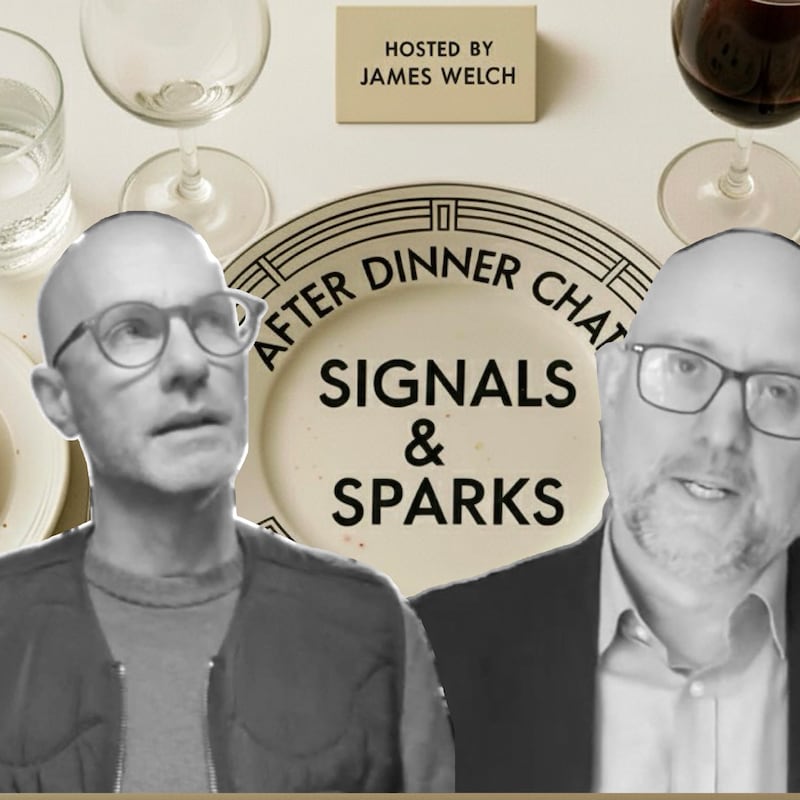
Shownotes
Are AI tools signalling the death of creative agencies as we know them today?
On the second anniversary of his consulting business, Spark AI, the regular guest lecturer on the Advanced Diploma for AI in Business at Saïd Business School, University of Oxford, Jules Love joins me to discuss how the agency landscape is shifting fast.
He even wrote the book on the subject, SHIFT.
Yes, our host James Welch chats with Jules to break down exactly how Generative AI is upending the agency model. And what he's helping agencies do about it
In this session, we’ll explore a bunch of topics, in the usual format. What's caught your eye, what are you up to then the quick fire 'high five' round that is never as quick as that as it's so interesting to find out what makes people tick.
Key Takeaways:
- The End of Project Pricing: Why agencies are shifting towards monthly subscriptions by selling AI-powered capabilities rather than human time.
- The Bottleneck Shift: How speeding up asset creation with AI forces structural bottlenecks further down the pipeline into governance and quality control.
- Future-Proofing Talent: Why forward-thinking companies are overhauling graduate programmes to focus less on technical skills and more on client relationship building.
Transcripts
[00:01:05] Jules: Hi, nice to be here.
[:[00:01:15] Jules: Yeah, great question. Something that I forwarded onto our clients the other day was I saw Martin Sorrell in the press talking about Monks. We've been talking to agencies for a long time about how AI starts to put the traditional time and materials pricing model under a lot of pressure, and how you can move to outcome-based pricing or value-based pricing and other ways of valuing your work. It was interesting to see that at Monks now, a quarter of all of their work is based not on a project basis, but based just on a monthly fee. His insight, which I thought was super interesting, is he's looking to move that to 75% by the end of the year. He sees the value to clients actually compounds over time, which I thought was quite interesting. We all know that AI tools learn from context, and he's saying, "If you work with us on this way, as we start to build workflows and systems that support your marketing, we learn more about you, the AI learns more about you, and actually you get better outcomes and better outputs the longer you're with us because we build up that historical context." So, I thought that was kind of interesting—a nice little subtle lock-in there for clients as well.
[:[00:02:54] Jules: Yeah, you didn't pay for creative in the old days, it was just a percentage of the media buy, right? I think what's interesting with AI and what we're seeing, and what I talk a bit about in my book, is how for some agencies—and Monks are at the forefront of this actually, so perhaps we're not surprised to see it there first—is AI on the creative side starts to move the conversation from instead of delivering a bunch of assets as the result of a project... instead what you start to deliver is the system that creates the outputs. So you say actually, what are we building for you? We're not building for you all the assets to run your campaign. We're building a creative workflow that means anytime you run a campaign, you can put in the brief and it will generate the assets for you. And that's where that subscription model, which is the word Sorrell used, starts to make a lot more sense, because actually what you're buying is a capability, you're not really buying people's time anymore.
[:[00:04:31] Jules: And that's a large part of what we find ourselves doing at Spark. Adopting AI in an agency is only a little bit about the tech; most of it is about changing the way people work, and that's a change management problem, and one that some agencies aren't really set up to do, they haven't really done it before. I think what's interesting when you start to put AI into workflows is actually you create bottlenecks in other places. You speed up one thing, but it creates the bottleneck somewhere else, and governance and approvals is exactly where you start to see a bottleneck happen quite quickly. You give creatives access to powerful AI workflow tools like Weve or Flora, and they're suddenly able to generate hundreds of assets in the time they used to take to generate ten. And then you say, well if everything needs sign off before it goes to a client, you've now got to sign off a hundred things instead of ten things. And actually your bottleneck becomes quality control, not asset generation. So it throws up all sorts of things then around roles, skills that you need in your agency, org design, and all sorts of stuff that's nothing to do with the technology anymore.
[:[00:05:43] Jules: That's right. Yeah, so AI's sort of been this melding of my sort of management consultant brain and my photography brain. I've spent my career been kind of half consultant, half advertising photographer. And now I've finally found something that uses both sides of my brain at once, which is great.
[:[00:06:17] Jules: Yeah, great question. We help agencies adopt AI. We have programs that we take agencies through to do that, and the great thing about that is we spend a lot of time in offices, in agencies, talking to them about this stuff. And so we're very connected to clients, so I still go along to a reasonable number of the workshops and meet clients and hear what's talked about in the room. And there is nothing better than hearing what a client is trying to do, what they're trying to achieve, what they're getting success at, what they're struggling with, to really shape your view of how this is starting to change the way people work. What's going to change quickly versus what's going to change slowly, what are the conversations they're having with their clients, what are the ones they're excited about, what are the ones they're frightened about. And that's how I connect the dots, is staying close to our clients who are trying to do all of this stuff and learning from their experiences. It's kind of interesting, our clients are hungry to learn from us about how they can be working differently, how they can move forwards, how they can build AI powered workflows, but actually we learn as much from our clients as they learn from us I would say.
[:[00:07:25] Jules: Well, the value of being specialized... we only work with agencies and brand teams, and the advantage of being specialized like that is your knowledge compounds over time. The reason why people want to work with us and are happy to pay good money to work with us is because we've worked with 50 other agencies, and we know the kinds of things that work and don't work, and we bring all of that experience to every engagement and we get better and better at it every time we do it because we've learned more. So, you know, that's what we learn from them, will help us with the next cohort of clients.
[:[00:08:00] Jules: Yeah, that's really fun actually, I've got one coming up in a couple of weeks. So the University of Oxford Business School, the Saïd Business School run a program called the Advanced Diploma for AI in Business. It's a year long program, they get a cohort of about 60 odd executives from mostly from large corporates from all around the world, it's very international. They run the program over a year going through that program, and they do four weeks residential actually in Oxford, split one week a quarter, and then they get a bunch of homework in between. And I'm fortunate to be one of the guest lecturers on the program. So I go along once a quarter and I lead a day of the program, and it's all about how to build an AI strategy for your business, how to really mobilize the use of AI in your teams. And then we run a bit of an AI hackathon for different industry sectors where we get people to collaborate, come up with ideas, use AI to help them explore that idea and pitch it, and we have a little Dragons Den pitch session at the end of the day which is great fun. So yeah, really enjoy those days, and that's, yeah, got one coming up on the 11th of March I think.
[:[00:09:15] Jules: Yeah, so mostly on the creative side, we're not doing much on the more media side and performance marketing side at the moment. I think we're seeing the pressure on the creative side of the industry is intense right now, and the desire to understand how to adapt to this tech and how to use it and how to use it for client work is really strong. So we're getting a lot of demand from that part of the industry I guess. And that's also where our experience lies, you know, my background is working as a consultant, I was part of the marketing and customer insight team at Accenture, so I worked a lot with marketing teams, and then as a photographer I worked a lot with brand teams and agencies and creative agencies. So I guess that's our experience and where a lot of our coaches come from as well.
[:[00:10:28] Jules: Yeah, I mean it's very difficult to predict anything, especially the future. I'm not going to pretend I've got some crystal ball and can see how all this is going to map out, there's a lot of very interesting dynamics. Is it going to be disruptive to graduate intake and school leaver intake in the short term? Maybe. I think a lot of agencies are probably saying, "Well let's not hire too many young people whilst we wait and see how this plays out." I think we're starting to see companies adapt to that already. So not in our sector, but perhaps a comparator, Deloitte are the largest graduate recruiter in the UK, they recruit about 1500 graduates a year. And their graduate recruitment has only declined very slightly, and they say that's more to do with market conditions than anything to do with AI. But what they have done is their graduate program is changing, they're changing the skills they teach people. You used to take three years to complete your accountancy qualifications, learning on the job with clients and all the rest of it. They now accelerate that, they expect you to complete your accountancy qualifications within two years, and the skills they teach you are less technical tax and audit skills, and more focus on client relationship building, on team working, and other things. So I think that's a really forward thinking of Deloitte, and I think perhaps agencies need to be thinking a little bit more like that. We should be training people up to do the jobs of tomorrow, not the jobs of yesterday.
[:[00:12:01] Jules: I did my best to wing it.
[:[00:12:11] Jules: Yeah, so it says, who do you admire for their ability to spot signals or create sparks? And I would say anyone who is not following Ethan Mollick on LinkedIn is missing out. He's a professor of business and innovation at Wharton Business School in America. He spends a lot of time exploring how AI supports innovation, how it's developing, and he sees it live on the way that his business school students explore with it, and he's very experimental with it himself. He's got a great book out called "Co-Intelligence", highly recommend it. And yeah, always eye-opening to see where he's at and what he's thinking about.
[:[00:12:51] Jules: Starting Spark. I think absolutely, as I mentioned before, it's kind of finally it seems like these two separate lives that I've led for the last 25 years have come together and reinforce each other. So yeah, and it's an exciting journey.
[:[00:13:05] Jules: Yeah, for my health and my free time, probably starting Spark. I think right now demand for the kind of thing that we do is just through the roof, and we're busy scaling the team, and all of those usual founder headaches are hitting me big time right now. I keep telling myself it's just the next three months and then things will stabilize, and ask me again in three months.
[:[00:13:36] Jules: Sure, I'll get AI to screen them. Yeah.
[:[00:13:41] Jules: In a work related context, funniest moment is one of the programs—so we run a bunch of different programs for agencies—one of those is our creative program where we work with designers and illustrators and creatives, and we show them how to create cool things using AI, we take them from the basics all the way through to super advanced workflows for image and video production. And we were trying to think of a... what's a great case study that we can use to show people how these tools progress, and that's kind of industry agnostic, it doesn't really matter what their specialism is, but it's something everyone can relate to. And our lead creative coach Matthew was like, "We'll just do a dog on a skateboard." I was like, "What? You've got to be joking." And no, we now run it with a dog on a skateboard, and everybody absolutely loves it. So there you go. We show people how to build the perfect dog on a skateboard and turn it into a film, and change the breed of the dog, change the shape of the skateboard, change whether it's skating down a street in LA or in London, and all that kind of stuff, and it's a lot of fun.
[:[00:15:00] Jules: Yeah, so one of the most interesting people I've met in the last six months or so is Robin Bonn. He's a brilliant consultant working with agencies. He's got a book out called "Market of One", and his great point of view, which I think is very true, you know we all know it's been a tough few years for agencies, but his point of view is there is not a lack of demand for agency work, and there is not an oversupply of agencies. There is simply a lack of differentiation. And most agencies aren't clear enough about what they really do, why they're different to anybody else at it, and then actually being able to prove that through their real capabilities and not just some clever words on their website. So he's all about finding the thing that you're brilliant at and then proving that you're brilliant at it in ways that other people can't imitate. And so if that's an interesting topic for everybody on this pod, then I think he'd be a great guest for you.
[:[00:16:00] Jules: Sounds like they might know each other, yeah.
[:[00:16:06] Jules: Thanks for having me on.
