It’s the Feast of St. Titus, 3rd Class, with the color of White. In this episode: the meditation: “The Daily Schedule”, today’s news from the Church: “Interview with the Superior General of the Priestly Society of Saint Pius X”, a preview of this week’s episode of The Sacred Restorations Series: Pompeii Rising, and today’s thought from the Archbishop.
Have feedback or questions about the DD or our other shows? podcast@sspx.org
Sources Used Today:
- “The Daily Schedule” – From Epiphany to Lent
- “Interview with the Superior General of the Priestly Society of Saint Pius X” (FSSPX.news)
- “Sacred Restorations Series: Pompeii Rising” (SSPX Podcast)
- The Spiritual Life – Archbishop Lefebvre (Angelus Press)
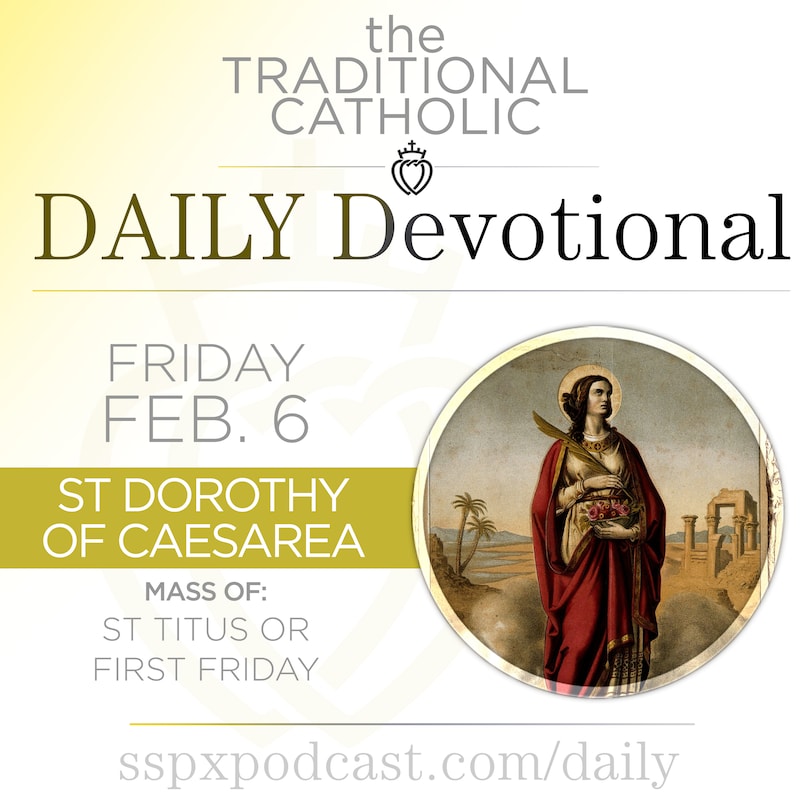
Saint Dorothy is one of the early virgin martyrs whose story blends quiet courage with a striking sign of Christian hope. She lived in the early fourth century, most likely in Caesarea of Cappadocia, during the persecution under Emperor Diocletian. Dorothy was a young woman who had consecrated her life to Christ, choosing virginity not as withdrawal from the world, but as total belonging to God. In a society that valued marriage as social duty and security, her choice marked her immediately as different, and eventually as dangerous.
When she was arrested for professing Christianity, Dorothy was subjected to pressure rather than immediate violence. Authorities attempted to persuade her to sacrifice to the Roman gods, offering her freedom, honor, and the chance to live peacefully if she would comply. Dorothy refused calmly, explaining that she was already betrothed to Christ and awaited a greater kingdom than any Rome could offer. Her serenity unsettled her judges. They ordered her to be tortured, hoping pain would succeed where persuasion had failed. Ancient accounts describe her endurance not as defiance, but as quiet steadfastness rooted in trust.
As she was being led to execution, a lawyer named Theophilus mocked her faith. Scoffing at her talk of heaven, he asked sarcastically that she send him fruit and flowers from the paradise she claimed awaited her. Dorothy answered without anger, promising that she would. She was then executed for her faith, sealing her witness as a martyr.
The most memorable moment of her story followed her death. According to tradition, a child appeared to Theophilus carrying a basket filled with roses and apples, fruits entirely out of season in the depth of winter. The child delivered them to him in Dorothy’s name and vanished. Theophilus was shaken to the core. What had begun as mockery became belief. He publicly confessed Christ and was himself put to death shortly afterward. Dorothy’s final act of charity became the seed of another martyr’s faith.
Dorothy’s cult spread widely in late antiquity and the Middle Ages, especially in Europe. She was honored not only as a martyr, but as a witness to the joy of heaven and the reality of God’s promises. Artists often depicted her holding a basket of fruit or flowers, symbols of eternal life and the beauty that lies beyond suffering.
Traditions surrounding Saint Dorothy associated her with hope amid hardship. She became a patron of gardeners, brides, and those facing ridicule for their faith. Her feast on February 6 reminded the faithful that Christian joy is not naïve optimism, but confidence rooted in resurrection.
Saint Dorothy teaches the Church that fidelity borne with gentleness can outlast cruelty, and that even death cannot silence a promise spoken in faith.
Saint Dorothy, virgin and martyr, pray for us.
- - - - - -
- - - - - -
Explore more:
What is the SSPX Podcast?
The SSPX Podcast is produced by Angelus Press, which has as its mission the fortification of traditional Catholics so that they can defend the Faith, and reaching out to those who have not yet found Tradition.
What is the SSPX?
The main goal of the Society of Saint Pius X is to preserve the Catholic Faith in its fullness and purity, to teach its truths, and to diffuse its virtues, especially through the Roman Catholic priesthood.
Authentic spiritual life, the sacraments, and the traditional liturgy are its primary means of bringing this life of grace to souls.
Although the traditional Latin Mass is the most visible and public expression of the work of the Society, we are committed to defending Catholic Tradition in its entirety: all of Catholic doctrine and morals as the Church has always defended them. What people need is the Catholic Faith, without compromise, with all the truth and beauty which accompanies it.
https://sspx.org