Shownotes
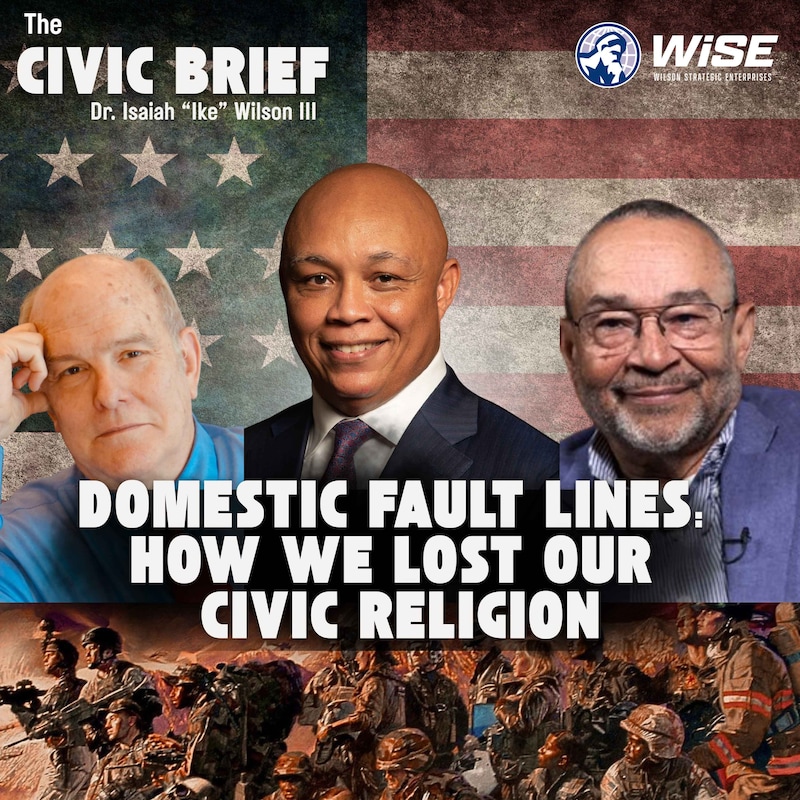
In this expansive and deeply reflective episode of The Civic Brief, Dr. Isaiah “Ike” Wilson III is joined by retired U.S. Army Colonels Fred Black and Dr. Jay Parker to explore a foundational question: What happens to a republic when its civic religion begins to fracture?
Moving beneath surface-level politics, this conversation examines the moral and cultural architecture that once unified Americans across differences—shared civic myths, constitutional reverence, institutional trust, and a common understanding of national purpose.
Drawing from their experience as West Point professors and military leaders, Black and Parker unpack the erosion of trust in institutions, the collapse of shared civic meaning, the tension between constitutionalism and cultural polarization, and the strategic implications of domestic fragmentation.
This conversation argues that America’s deepest vulnerability is not external—but internal. When civic religion weakens, national resilience follows. Power without shared belief cannot sustain a republic.
What You’ll Learn in This Episode:
✅ What “Civic Religion” Really Means: Not theology—but shared constitutional faith, ritual, and narrative.
✅ How Institutional Trust Erodes Gradually—Then Suddenly: Why delegitimization is cumulative and dangerous.
✅ Why Domestic Fragmentation Is a Strategic Threat: Internal division weakens national resilience and deterrence.
✅ What Renewal Would Require: Civic virtue, leadership restraint, and renewed constitutional literacy.
Join the Travelers Community and explore resources at Wilson WiSE Consulting, as well as at Dr. Wilson’s companion Substack Newsletter, “Compound Security, Unlocked,” where you can share insights, ask questions, and help shape the future—one brief at a time.
- Wilson WiSE Consulting Website: https://wilsonwise.com/
- Substack: https://compoundsecurityunlocked.substack.com/
Key Timestamps:
00:00 Welcome & Framing the Terrain Beneath Politics: Dr. Wilson introduces the concept of “civic religion” and sets the intellectual stakes.
08:45 What Is Civic Religion? Foundational Meaning & National Myth: Defining America’s shared moral vocabulary and constitutional faith.
18:30 Institutional Trust: Where the Fracture Began: Examining erosion in public trust across military, academia, government, and media.
31:10 Polarization and Identity: When Shared Language Collapses: How factionalism replaces common civic narrative.
47:25 Military Culture and Civic Cohesion: Lessons from West Point and professional military education.
1:02:40 Civic Virtue vs. Political Tribalism: What happens when constitutional loyalty becomes partisan.
1:18:55 Domestic Fault Lines as National Security Risks: Internal fragmentation as strategic vulnerability.
1:32:10 Can Civic Religion Be Rebuilt? Possibilities for renewal and institutional reform.
1:42:30 Final Reflections: Meaning, Identity, and the Republic’s Future
Key Takeaways:
💎Civic religion is the invisible architecture of a republic. When shared meaning collapses, governance becomes brittle.
💎Polarization is not just political—it is epistemic. Without shared truth frameworks, collective action falters.
💎National security begins at home. Internal delegitimization shapes external vulnerability.
💎Rebuilding civic cohesion requires restraint, humility, and institutional integrity—not performative outrage.
Resources & Mentions:
- Apple Podcast- The Civic Brief
- Spotify - The Civic Brief
- YouTube- The Civic Brief
- Wilson WiSE Consulting Website: https://wilsonwise.com/
- Connect with Dr. Wilson on LinkedIn: https://www.linkedin.com/in/dr-ike-wilson/
- Think Beyond War: https://thinkbeyondwar.com/
- Subscribe to the Substack Community to join the discussion, share your insights, and help defend the guardrails of democracy: https://compoundsecurityunlocked.substack.com/
📚 Recommended Reading & Listening
For listeners who want to go deeper into civic religion, legitimacy, and American grand strategy:
Books:
- The Federalist Papers
- Democracy in America
- The Fractured Republic
- Political Order and Political Decay
- Why Liberalism Failed
Related Civic Brief Episodes:
Frederick H. Black is a retired U.S. Army Colonel and management consultant specializing in leadership and organizational assessment. A Distinguished Military Graduate of Howard University, he later served as Associate Professor of Political Science at West Point, overseeing the American Politics program. A combat veteran and National War College graduate, he has earned numerous military honors. He remains active in veteran, civic, and faith-based leadership initiatives.
Dr. Jay M. Parker is an Adjunct Professor at Georgetown’s Walsh School of Foreign Service and former Distinguished Professor at National Defense University. A retired U.S. Army Colonel, he served over 26 years in command, staff, and academic roles, including leading international relations at West Point. He holds a PhD from Columbia University and has taught at Columbia, GW, and Georgetown. A Council on Foreign Relations member, he co-authored Restoring Thucydides.
Shattered Sky (7–8 March 2026) is a two-day immersive geopolitical simulation offered by Black Horizon LLC, in partnership with the Intelligence Training Center, placing participants inside a fast-moving Indo-Pacific crisis where every decision carries consequence. Teams assume the roles of national leaders navigating military escalation, alliance politics, cyber operations, economic pressure, and strategic messaging — all under real-time constraints and incomplete information. This is not a lecture; it’s a live, unscripted decision exercise designed to sharpen judgment, strengthen communication, and test leadership under pressure. If you’re a defense professional, corporate leader, student of strategy, or aspiring analyst ready to experience how real decisions unfold in complex environments, email [email protected] for details. Seats are limited.
Tags: Civic Engagement Podcast, National Security and Public Policy, Leadership and Strategy Podcast, Dr. Ike Wilson Podcast, The Civic Brief, civic religion, American civic religion crisis, domestic fault lines America, constitutional legitimacy, institutional trust erosion, national resilience, American polarization, civil-military relations, West Point leadership philosophy, Dr. Isaiah Ike Wilson, constitutional republic stability, civic virtue in America, strategic implications of polarization, American identity crisis, rebuilding civic trust, domestic fragmentation national security
Transcripts
[00:00:19] Exactly. The, the military was more consciously aware and focused on negotiating those changes and negotiating that rebuilding, but we were just a reflection and an extension of the society in which we shared and were
[:[00:00:35] Jay Parker: Absolutely. Absolutely. And whenever we restructured or expanded the base or reduced the base of who served and how and why that was an extension of what was going on, uh, in, in the country.
[:[00:01:05] Dr. Ike Wilson: Welcome to the February experience of the Civic Brief. I'm Dr. Ike Wilson. Now this month we're gonna step directly into the terrain beneath politics, those domestic places, the places in the places where trust, meaning, and identity once converged, uh, into something we used to call America's civic religion.
[:[00:01:49] In laissez-faire, we now find ourselves divided on all five. In the past, Americans have always argued passionately over how. The [00:02:00] how tos, right? How to achieve the American dream. But today we're also disagreeing over what that dream is, why it matters, and perhaps more chillingly we're arguing over for whom that American dream is to exist.
[:[00:02:44] Those, uh, four uh, fault lines each reinforcing each other. Now, let me run through the fault lines, at least as I see it. The first fracture lies in economic imbalance. Once prosperity rose with the fortunes of the middle class, [00:03:00] and I don't wanna be pollyannish about this, or a cockeyed optimist in retro retrograde or retrospective, but broadly speaking, relatively speaking, once upon a time, not that long ago, prosperity did rise more often than not, and in more ways than not with the fortunes of what we still call the middle class in America today.
[:[00:03:48] They've all broadened during that time period. They've broadened America's story for all of us. Yet they've also, uh, sparked anxieties among those who fear [00:04:00] losing the cultural world. They once knew. And were comfortable in these fears of cultural displacement. Now, threaten and redefine our politics. Folks, this is a cyclical thing in American politics.
[:[00:04:36] A growing revolt of the working class against perceived elite dominance across all spectrums, across all spectrums. And fourth, cutting across all of these is the divisive communications. Media landscape fragmented into echo chambers that allow every citizen to choose not only their own opinions, but more worrisome ly.
[:[00:05:19] And more importantly, we, the people, we have failed them. We've neglected our civic duty to hold power accountable and to safeguard the constitutional balance designed for our republic. Let me run through the institutions, uh, each, each individually. Our legislatures, our Congress at the highest end of our government, our federalist system surrendered much of its policymaking power to the increasingly imperial executive, our judiciary.
[:[00:06:10] Our military long trusted above politics, risk being drawn into the currents of a liberal power. What, what I'll call a pretorian, uh, a pretorian relationship in seeding civic command of our institutions. American Americans creep more and more every day towards becoming a market state rather than a nation state, or more pointedly an a liberal democracy, a lib, an illiberal, democratic wolf, perhaps cloth in liberal sheep's forms and clothing Now to, to reverse this trajectory.
[:[00:07:07] Now today, we're joined by leaders who have lived at the front lines of civic formation, military officers, educators, institutional stewards, who have watched our civic fabric fray from the inside. Let me introduce both of them briefly. First, Colonel retired JM Parker, PhD, former professor and chair of International Security at the College of International Security Affairs National Defense University in Washington, DCA 26 year veteran of the United States Army.
[:[00:07:54] Now, Jay has also held distinguished appointments at Georgetown University, Columbia University, and across [00:08:00] the National Defense University system, bringing more than three decades of teaching leadership and policy experience to the study of global security, a Columbia University, PhD, Naval War College graduate, and visiting research fellow at Princeton.
[:[00:08:35] Jay is recognized nationally and globally, frankly, for his lifelong commitment to advancing the practice and understanding of international security leadership. Colonel Frederick H Black is a retired US Army officer, educator and executive leadership consultant whose distinguished career spans more than five decades of service to nation and community.
[:[00:09:18] Now after a time from military service, he founded and led FHB Consulting Incorporated advising Fortune 500 companies and government leaders, and later served as senior vice president at Black Star Strategies. Fred's a recipient of numerous honors, including the Legion of Merit, bronze Star, and multiple civic awards.
[:[00:10:01] Former soldier scholars who served as academy professors and the directors of program for American politics, international relations, public, public policy and strategy. Within West Point's, again, storied Department of Social sciences. We taught, mentored, in, LED at every institution charged with forming the civic, ethical, and strategic judgment of future military leaders.
[:[00:10:41] More pointedly and more profoundly, uh, about the current fidelity trustworthiness. That is rigor and civic seriousness of joint professional, professional military education. Not as critics from the outside, but as institutional stewards who understand what is at [00:11:00] stake when civic formation, academic freedom, and professional military education come under sustained strain.
[:[00:11:33] I'm gonna give you both the microphone grapple with the large frame framing question. Use that time to put your own frame out there, fence and fence with the foil that I've put on the stage for us, the stage set that I've established, fence with that challenge that if you will, and if you choose to. And then also, uh, take advantage, opportunity to add anything or correct anything that I probably got terribly wrong with, uh, your, your very robust, uh, bios.
[:[00:12:17] Sorry, about the decades ago. We're all, we're all wise and young still, but again, decades ago. Uh, I'm gonna leave it to you. Whichever one of you want to jump on, on that, on that hand grenade first. Uh, please go for it. And, and thanks again. Looking forward to the conversation.
[:[00:12:33] Ike. Uh, when I came into the military almost 60 years ago, we were an army at war. And what was different is if I were to ask my dad about being in an army at war, he could share experiences from something called World War ii.
[:[00:12:59] Fred Black: And [00:13:00] say I was in a declared war and something called Korea, which I think we called a police action.
[:[00:13:11] Fred Black: And then. His son's in a place called Vietnam, and I don't know what we called it, but euphemistically. We said, Hey, we're at war. So I was in the army at war, and what looked so differently to me was reading about the police action in World War II and how the American people embraced those who were serving versus this thing called Vietnam.
[:[00:14:09] It just didn't matter. There was always something being protested. So to leave that environment and go into an army at war, the world seemed very different to me.
[:[00:14:24] Jay Parker: first of all, again, thanks for, um, bringing us together, Ike. And, uh, it's a particular pleasure to be with this group, uh, since one of the things I've found to be an anchor of whatever success I've had for the last 40 years has been, uh, waiting to hear what Fred Black has to say and then, uh, and then, uh, deciding how to proceed from there.
[:[00:15:35] Um, so a lot of the things that, uh, that Fred mentions are things that are certainly vivid in my memory. And, uh, at about the time Fred was in Vietnam, uh, I was, uh, on campus. Listening to rock and roll music and talking bad about my country as the saying goes. Um, [00:16:00] but my commissioning was, uh, almost 10 years after Fred's in a very different army, serving a very different country.
[:[00:16:50] Um. We were, uh, in the midst of, uh, the Iran hostage, uh, crisis. [00:17:00] Um, and we had just gone through Watergate, uh, which was also a vivid memory for me. I served, uh, on the hill. My first, uh, real job out of college, uh, was not the Army, uh, but it was some years before that working as a staffer in Congress during the year leading up to Nixon's resignation.
[:[00:17:53] But at the time, we thought this was something that was gonna stretch on far, far longer. Uh, in fact, any [00:18:00] conversation that involved, gee, how will the Cold War end, uh, quickly just kind of, uh, trickled out because, uh, short of, uh, full fledged nu nuclear exchange, uh, and a winner take all, uh, hot war, no one could really envision, uh, how this would come to a close.
[:[00:18:45] Narrator: Oh,
[:[00:18:46] Narrator: yeah,
[:[00:19:14] Right,
[:[00:19:15] Jay Parker: Um, uh, Fred, I know you used to, because your former students who would later become my faculty would quote you over and over, and one of the things they said they learned from Fred Black was always to ask. Compared to what? According to whom. Um, and, and that's what I think kind of underlined what was going on with the civic culture.
[:[00:20:14] The point at which traditionally you would think it would, uh, would, uh, come together and tighten and, and be more cohesive. Um, and that was, uh, nine 11, which, which happened while I was at, uh, at West Point. It was part of my experience. Yeah, a lot of that unraveling, uh, came out of kind of the not nine 11 itself, but out of the post, uh, nine 11 reaction.
[:[00:21:13] Narrator: Yeah,
[:[00:21:32] Fred Black: Good. Good points. You're making Jay, and if someone were to ask me what word could I use over a 26 year career to describe the United States Army, and I suspect both of you would agree, because it didn't matter when you jumped on the train, the word was rebuilding.
[:[00:21:57] Fred Black: We were always rebuilding, but yet the [00:22:00] nation didn't seem to express what was going on around them as rebuilding. Mm-hmm. We had revolutions. We had all sorts of, many and major revolutions occurring in this country, but we never talked about, we were rebuilding the nation as we talked about rebuilding the army.
[:[00:23:00] Well, if you compare that to the nation that was experiencing all sorts of unrest. Was there that commitment to rebuilding and making fundamental change, it wasn't easy, but I think what we experienced in the military was a more controlled mechanism to bring about rebuilding. And we saw that at West Point, when I got to West Point in 76, the president of the United States was the first ever unelected president.
[:[00:24:05] From where they came at the time and their upbringing, their family or whatever, had a really difficult time with this change. And therefore it shaped the institution, it shaped the army itself. And here we are rebuilding.
[:[00:24:26] Fred Black: And, uh, you, you talked to those cadets from 76 to 80, uh, we were living in the shadow of a cheating scandal that seemed to go on and on in terms of rebuilding the institutions.
[:[00:24:44] Fred Black: And we had the integration of women the summer of 76, which fundamentally changed the institution and the army rebuilding once again, we're asking questions about how does this work? [00:25:00] And yet the nation was struggling. What this also meant for those things that you were referring to, Ike, the fact that women demanded to be treated equally in the workplace.
[:[00:25:16] Fred Black: Something that we didn't see expressed years before, but now was being expressed with all sorts of protests. And you remember the always live ERA amendment process. Yeah. It never would quit. It never,
[:[00:25:36] Fred Black: Ever came to fruition, but it was a focus point. So we're dealing with all of those kinds of things while we're rebuilding and we're teaching the young people who are gonna go out and lead the nation's military in years to come.
[:[00:26:29] Jay Parker: One of the the things that just really struck me about what you were just saying too, Fred, all three of us had fathers who served in, uh, the uh, second World war. The post war, uh, Korean War army.
[:[00:26:43] Jay Parker: Um, and as I look back at my dad's career, and he was always very open about what was, you know, going on at work, uh, and became even more so later when my brother and my wife and I all served.
[:[00:27:22] Um, you know, one of my favorite, uh, examples is the chief of staff of the Air Force in the 1950s, uh, who in a public speech on record said, uh, all we need now is a navy big enough to man the presidential yacht, uh, an army to guard the tomb of the unknown soldier, and the Air Force will take care of everything else.
[:[00:27:45] Jay Parker: right. So, um,
[:[00:27:48] Jay Parker: And he was serious.
[:[00:27:49] Jay Parker: yeah. And, uh, so the army was rebuilding, but frankly, you know, the, the, the Air Force was new. They were kind of defining themselves. The Navy was trying to, uh, still get [00:28:00] over. Uh, sort of the battleship hangover and, and what was this new, uh, kind of navy that was at odds with everything?
[:[00:28:46] And the nation may not have been aware, uh, to the level that, that we were. And there are all kinds of k clai and. Explanations for this about the, the Eternal Trinity and all those other things we won't bore [00:29:00] the listeners with, but read your Clausewitz. Exactly. The military was more consciously aware and focused on negotiating those changes and negotiating that rebuilding.
[:[00:29:16] Fred Black: we were structurally committed to the rebuild.
[:[00:29:48] You're doing a PowerPoint briefing, you gotta have two slides. You gotta have one for Article one, one for article, one for Article two, uh, that says what Congress does and what the executive's responsible for.
[:[00:30:00] Jay Parker: you. That was just an extension of, uh, of our pre-colonial experience.
[:[00:30:05] Jay Parker: The British Civil War, which was exported to America, uh, which was so brutal that in fact, uh, as a percentage of the overall population, um, the, the casualty figures, the, the blood cost of that Civil War was literally double what the American Civil War was.
[:[00:30:47] Constantly being tied to for good or ill comfortably or uncomfortably to, uh, the changing dynamics in American society. Uh, and [00:31:00] on the one hand, uh, I go to sleep at night grinding my teeth and I wake up in the morning and reach my phone wondering what breaking news I'm going to read and despairing about the state of the nation.
[:[00:31:45] Um. But the dynamics of having to, uh, understand and assess and, and being inexorably tied to the changing dynamics of, of the nation. And let's be clear, because I [00:32:00] think a lot of Americans forget about this, the changing dynamics in the world, the challenges to democracies, to constitutional states, to the, to the rule of law, to, uh, to order in, in an international society are absolutely global right now.
[:[00:32:24] Dr. Ike Wilson: right?
[:[00:32:43] Dr. Ike Wilson: Yeah.
[:[00:32:44] Dr. Ike Wilson: yeah,
[:[00:33:05] Fred Black: Yeah. And of course, we always remember that the American soldier comes from America.
[:[00:33:28] Narrator: Vola,
[:[00:33:41] Jay Parker: Mm-hmm.
[:[00:33:52] Steal a car.
[:[00:33:54] Fred Black: Rob a drug store or whatever. And the judge told [00:34:00] them that instead of going to jail, you could join the army. And there they went and they were on my roster as Voluntolds, basically.
[:[00:34:10] Fred Black: Mm-hmm. And we had those who enlisted for whatever reason, and those who were drafted, then we said, no more draft.
[:[00:34:39] Jay Parker: Mm-hmm.
[:[00:34:48] We had a lot of voluntolds. But the point I'm trying to make is that was a reflection of our nation.
[:[00:34:56] Fred Black: And as Ike said, one of those things that was [00:35:00] important is you could not distinguish between those young men and later young men and women from the culture, the background, the households from which they came.
[:[00:35:21] Dr. Ike Wilson: Yeah,
[:[00:35:23] Dr. Ike Wilson: You both, you both mentioned structure. Yeah. That, that this is, this rebuilding is a structural thing. I'd love both of you to speak to that more for our, for our listeners, for our watchers, our travelers, I call them, we call ourselves from a sociological representation deliberately that our, particularly with our service academies, we talked our, our services themselves.
[:[00:36:08] Fred Black: And how many times
[:[00:36:10] Fred Black: spin
[:[00:36:12] Fred Black: our precious moments with those cadets. Reminding them that they were gonna be the officers leading American sons and daughters who did not always have the same advantages they had, did not have the same education, obviously had not been trained to lead formations.
[:[00:36:38] Jay Parker: right? That's
[:[00:36:55] Where they went to a unit for the summer.
[:[00:36:58] Fred Black: And this young [00:37:00] cadet, and I'm not gonna call him because you'll know him when I tell you the name, but this young cadet came back from a summer at Fort Hood now that you ought to get hazardous duty paid to spend any time in Texas in July. Okay.
[:[00:37:16] Jay Parker: That's where I did
[:[00:37:21] Jay Parker: was,
[:[00:37:28] Fred Black: mine in Capitol Hill that summer because we didn't have to do a unit.
[:[00:37:35] That's why me and Jay, uh, always,
[:[00:38:00] I had people who had high school diplomas, but could not read or write. Mm-hmm. Right. I had people that could not speak English. Mm-hmm. I had people who were. Pretty good at turning a wrench, but you could not tell them how to do it. You had to show them how to do it
[:[00:38:25] Fred Black: I can't believe that that's the army where I'm gonna go in and be the platoon leader and eventually the company commander.
[:[00:39:02] Dr. Ike Wilson: gma.
[:[00:39:19] Fred Black: Well, structurally we did something very important.
[:[00:39:36] Dr. Ike Wilson: that's right.
[:[00:39:37] Jay Parker: that's right.
[:[00:39:59] So [00:40:00] you talk about a structural solution to a recognize a problem. Right. Well, there it goes. Money. Now why would you be attracted to this $10,000 bonus? Because probably you or your parents had never seen $10,000 before.
[:[00:40:17] Fred Black: And that was one of the things we did.
[:[00:40:32] Living, living with the middle of the nation. East me, west, north, meet south. Mm-hmm. Right? Mm-hmm. Um, all echelons of socioeconomic, socioeconomic strata being bridged and we're all living together, all of a sudden towards, as part of an institution designed for repetitive, looking forward for rebuilding.
[:[00:41:03] Jay Parker: Mm-hmm.
[:[00:41:16] Mm-hmm. But we never lock into any particular solid static moment, which at any given time, if we lock into one static moment as the way it is, at least 49% of the rest of us are gonna be unhappy and, and probably, uh, part of the, the disenfranchised. Right. So, thank goodness it's always an arc that is bending.
[:[00:41:38] Dr. Ike Wilson: But perhaps never fully reaches. Right.
[:[00:41:56] Dr. Ike Wilson: There you go. Yeah.
[:[00:41:59] Yes. The [00:42:00] names as the names associated with it are familiar to us. Jason Dempsey, one of my
[:[00:42:04] Jay Parker: clues, uh, some of the Yes. And, and one of mine and, uh, and, uh, uh, Aton of internal chapters written by, um, by, uh, folks who are, uh, who, who we taught or who, uh, and or who taught with us.
[:[00:42:22] Jay Parker: Um, that book interestingly sold out its first run on the first day.
[:[00:42:30] Jay Parker: Now that, that should tell us something about how salient these issues are.
[:[00:42:36] Jay Parker: Um, to the, to the broader, uh, uh, public, or at least the policy rule. Mm-hmm. That a, that a book about, first of all the origins and the, and the foundations of the all volunteer force, but about the future of the all volunteer force.
[:[00:43:08] Dr. Ike Wilson: Yeah.
[:[00:43:31] Uh, and, uh, the, all the struggles of how that was defined and then what that army eventually became. Uh, it's an extraordinary story, but if you, again, if you look at how the military evolved over the course of 250 years, there were moments where we had some sort of an adjustment that, that had to, uh, had to take place.
[:[00:44:22] And then the volunteer force. My, when I became a platoon leader, uh, I had, uh, all Vola enlisted, uh, privates and specialists, but almost every single one of the non-commissioned officers I. Had been a draftee, were not volunteers, but it had to been a draftee to include several who the judge said, son, you got two choices here.
[:[00:45:12] Who we were as a nation at the time. Mm-hmm. Where we thought we should go, what kinds of things we thought we needed to correct, uh, and, uh, and adjust or at least give some serious thought to in the broader social order. Um, one of the things that struck me is every time we go through one of these, you'll get some political leader who will get up and say, well, the defense of our nation is not a social experiment.
[:[00:46:02] Dr. Ike Wilson: Exactly.
[:[00:46:25] Um, you know, our, our friends in the history department used to love that, you know, out of the 22 battles won in the American and in the American Civil War 21, uh, were commanded by graduates. West Point. Graduate of West Point West, yeah.
[:[00:46:41] Jay Parker: But the parentheses, the asterisk was, and the leaders who lost on the other side were also West Point graduates.
[:[00:46:49] Jay Parker: The, the volunteer Army was, and certainly Fred and I, and I'm sure, uh, Ike, you, you still got some of the tail end of this, especially in a technical branch like aviation [00:47:00]
[:[00:47:00] Jay Parker: Was traumatic and dramatic. Mm-hmm. Um, but, uh, you, I grew up, uh, around Fort Chuca and Old Cavalry post in the Southwest, uh, which had been home with the Buffalo soldiers for many years and, and was part of the, the, the, uh, the settlement of the frontier.
[:[00:47:46] Back then it was, they speak German. Uh, yeah. Or they have these stick Irish accents or they speak Italian. Um, and, and how is it that we put them together, uh, as a force that is committed [00:48:00] to number one, that civic religion that you talk about, Ike and number two, uh, more to the point defending that, uh,
[:[00:48:07] Jay Parker: uh, that common civic religion to include people on both sides who argue about compared to what?
[:[00:48:22] Fred Black: look at another structural issue. Yeah,
[:[00:48:24] Fred Black: That was so important. In that seventies timeframe.
[:[00:48:30] Fred Black: We saw a shift in the makeup of the legislative branch, less so in the Senate, but more so in the house. And that shift was reflected in the downward trend in the numbers of members who had military service.
[:[00:48:52] Jay Parker: absolutely. When I was on the hill, 73, 74, almost every single representative and Mo and, [00:49:00] and the Senate as well, um, to include my boss, Morris Udall, had served.
[:[00:49:07] Jay Parker: Yeah. Yeah. And, and that started to chip away. Uh, years later when I was working on political campaigns before I came in the Army, that that was flipping very dramatically.
[:[00:49:41] But, but it was, you know, it was a, an empty cabinet there for about 30 years. And
[:[00:49:59] Jay Parker: Mm-hmm.
[:[00:50:10] Some of this legislation being pushed to change the structural nature of the army. And we all know you can buy all the equipment you want, all the weapons, everything you want, but it still comes down to the soldier who's gonna operate it. The soldier's gonna fly it, drive it, turn the switch or whatever.
[:[00:51:05] The response was he was only able to do that because the people who had to pass the legislation got it. Mm-hmm. Other presidents had proposed such things, but it didn't happen. And that gets to that divide that we see, the ebb and flow of that divide. Right now it's real popular to say, let's pay our military more really popular.
[:[00:51:42] Jay Parker: Yeah.
[:[00:51:45] Jay Parker: mm-hmm.
[:[00:51:57] Dr. Ike Wilson: Yeah.
[:[00:52:03] It makes you very popular to say you support, yeah. The men and women in uniform.
[:[00:52:10] Fred Black: But support is more than just give them more money.
[:[00:52:14] Fred Black: And you also mentioned something, I think just ties into what Jay was just saying. Working on the hill, we did not always know what was being done. By whom and for whom Because we didn't have the communications network that would tell us.
[:[00:52:51] Jay Parker: right here, right.
[:[00:52:52] Jay Parker: Everybody has a podcast. Yeah. Everybody's got a
[:[00:53:02] Let me give you a story. Yeah. That kind of tells how we learned to live with this During the administration of General Palmer as superintendent at West Point.
[:[00:53:16] Fred Black: Every cadet had a computer, some brilliant person. I don't know if they were a vice president or not, but they invented something called the internet.
[:[00:53:35] Dr. Ike Wilson: Yeah.
[:[00:53:42] Jay Parker: chats.
[:[00:54:05] You've heard that term before. Slam book was nothing but a way of expressing yourself about somebody or something, either anonymously or with your name in it, but it expressed an opinion. And you would pass the book around and other people would make comments and the book would come back to you. Right.
[:[00:54:30] Dr. Ike Wilson: Yeah.
[:[00:54:54] Mm-hmm. And then. Calm, found out that his element of West [00:55:00] Point was no different. They were doing the same thing.
[:[00:55:03] Fred Black: And all of a sudden we had to suppress free speech.
[:[00:55:09] Jay Parker: And that suppression lasted for another several decades. I re, I was, my incoming instructor cohort was the one that came in, uh, when they were issued the computers for the first time.
[:[00:55:51] Uh, and it, and it's what the internet eventually became. They were saying things and responding to things that face-to-face they [00:56:00] would never do, that were not just violations of good order and discipline. Yeah. And Article 1 34 of the UCMJ, they, they were violations of everything your grandmother taught you about how to be a good person.
[:[00:56:17] Jay Parker: That was, that was part of the problem. The other problem that we discovered was we sat there watching it and then all of a sudden John looked up and said, oh my God, do you know we've been doing this for two and a half hours? Yeah. And uh, uh, later, when I came back in 94.
[:[00:57:10] And it wasn't all uplifting literature. Um, uh, but on the other hand, if you wanted to be an education institution, uh, and keep up with your peer institutions and serve your, uh, your student population well, to be able to do the research and all those other things, you, but be connected, you could not survive with it, uh, without it so.
[:[00:57:39] Dr. Ike Wilson: Yeah.
[:[00:57:58] And you go nationally where everybody [00:58:00] has their own algorithm, uh, and, and you can, yes, you have access to phenomenal nuts of information and phenomenal outlets, but, uh, there is still selective searching. The algorithm is going to feed you stuff that reinforces what it is you already believe. Uh, and, uh, it, there are, it's an information revolution, but everybody's got their own revolution.
[:[00:58:28] Dr. Ike Wilson: How does this change what we just had a conversation on the goodness of all, all volunteer force, because we have these mechanisms that are volun, volunteerism. We're all volunteering into these separate algorithmic silos that are not necessarily moving us in a direction of what Fred talked about early on of a, of a collective rebuilding towards us.
[:[00:59:04] Jay Parker: What
[:[00:59:07] Jay Parker: I recall, you know, having officers come in from grad school, getting ready to, to start teaching, sitting down with them, kind of assessing.
[:[00:59:38] It's not a complete breakdown in isolation, but it's a restructuring and it's very tribal. Um, and, uh, this is, uh, you know, not to go completely cosmic here, but anytime there has been a major change and, uh, in an industrial or technological capacity, anything that is. [01:00:00] As Marsh McLoan said, an extension of the human, uh, capabilities and human senses.
[:[01:00:06] Jay Parker: It just had enormously disruptive effects. You know, the most famous being, of course, Gutenberg, inventing movable type. Hey, good news, we can sell more Bibles and print them faster. Bad news, we're about to go into 500 years of bloody religious revolution. Uh, a complete restructuring of the political and economic, because you
[:[01:00:27] Jay Parker: You could read the Bible for yourself and say, wait a minute. That's not what I thought you told me it said. Yeah. But, you know, a breakdown of the, of the gilds, all those kinds of things. That's what we're going through now. And yeah. Uh, yeah. I, I would argue, uh, that the difficulty, the, the hard thing about chasing after this, this cat and, and grabbing onto its tail is the, uh.
[:[01:01:20] It's those who do come in to serve. What are their expectations of what the Army or the Navy or the Air Force is? What is it that they think they're going to do? Yeah. What is it that they believe they're going to defend and who they take orders from and, and what orders they do and do not have to follow.
[:[01:02:06] What is it that they expect they're going to do and that they're going to be asked to do? What is it that the, the, the culture, uh, of, uh, uh, of the current world has kind of prepared them for and to, you know, the, the, the current, uh, the recent declaration that the, the Army and and Harvard are gonna see other people?
[:[01:03:06] And as is happening now in the professional military education world that we were all a part of when the syllabus is becoming narrower and narrower and narrower and has to be pre-approved. And, uh, the definition of anything that the three of us thought a, uh, resembled teaching critical thinking has been flipped on its head.
[:[01:04:04] And yet as Fred has pointed out, have very little experience in the military themselves. And if they do, it's down at the micro tactical level for a few years. Yeah, yeah. Which doesn't translate into making, uh, comprehensive, viable strategy. Yeah.
[:[01:04:36] Jay Parker: Well, the, the, the secretary, uh, announced that, that, um. We will no longer send officers to, uh, to Harvard for, uh, for graduate school.
[:[01:04:49] Jay Parker: That, uh, in, in, in his statement that, that Harvard is a woke institution.
[:[01:04:56] Jay Parker: Um, and this is part of a larger view [01:05:00] that what colleges and universities do is indoctrinate students as opposed to exposing them to a wide range of difficult and contentious ideas, whether they're from the left or the right.
[:[01:05:13] Jay Parker: And, and, and teach people how to think through the way they, they confront them. And, uh, that's a dramatic change from, uh, the, the experience that we had for the benefit of our listeners. When the three of us were on the senior faculty, every year we would sit down with a stack of files and, and Fred, you were the personnel officer for a while, as I recall.
[:[01:06:21] And, uh, and how those people who were their classmates at, at Harvard and Syracuse and Cornell and Columbia, uh, uh, and then 20 years later, uh, they're gonna be saying. Yes. Madam Secretary. Yes. Uh, yes, Mr. Chairman. Um, that, that they serve with, uh, and the relationship with, uh, certain schools has always been testy, uh, particularly, uh, when you had that period of time when ROTC
[:[01:06:52] Jay Parker: uh, was kicked off campus and we
[:[01:06:58] Jay Parker: Right. Although, [01:07:00] as our friend, Dan Kaufman reminded me in an email yesterday when the Chairman of the House Armed Services Committee made that declaration, uh, it was shortly before he and Jack Reed and a host of other SOC guys were told, go to Harvard. But, you know, keep your head down, maybe grow your hair, uh, and uh, and, uh, don't wear your, your uniform on the yard.
[:[01:07:38] Dr. Ike Wilson: Yes.
[:[01:07:47] And Cornell grad. Well, Cornell I don't think ever gave up. Its ROTC.
[:[01:07:51] Jay Parker: Probably so and nor did Princeton. That's right. But, uh, Columbia, in fact, uh, Jason Dempsey we mentioned earlier, was a big part of this [01:08:00] had, had rebuilt their relationship, um, with, uh, with ROTC. Mm-hmm. So, uh, ironically that civil military link is as robust as it's ever been.
[:[01:08:23] Fred Black: Right. Yeah. But let me put a point on what you're saying there, Jay Harvard is just the opening. Volley.
[:[01:08:30] Fred Black: There will be more. Yeah, absolutely.
[:[01:08:32] Fred Black: will be. When each of us sat at that table during our time structuring the class of faculty for two years out, or in some cases only one year out.
[:[01:08:46] Fred Black: We looked at what the person said they were interested in, and we said Harvard, MIT, Princeton, Colgate, Syracuse, [01:09:00] university of Arizona, Michigan, UNC.
[:[01:09:30] 'cause they wanted us, right? So let's bring them here. But we also wanted a faculty that came back two years afterwards and had different experiences at different institutions. Yes,
[:[01:09:58] One of the faculty [01:10:00] members did not lunge across the conference table, uh, ready to strangle one of their, their, uh, compadres, yelling, die heretic. If that did not happen, I, we have failed. Failed in my job.
[:[01:10:14] Jay Parker: Exactly. And, and keeping that kind of diverse range to include, because I was a beneficiary of this as was you Fred, as were you Fred, the idea that the faculty was not going to be all West Point graduates, let alone all West Point graduates who just went to Harvard.
[:[01:10:31] Jay Parker: There were gonna be some University of Arizona and Howard University, and we had more than a few individuals who turned out to be extraordinary faculty members who went on to be extraordinary senior leaders.
[:[01:10:44] Jay Parker: Who had, you know, I'm thinking one individual, the late Mike Kamel, who, uh,
[:[01:10:50] Jay Parker: Ike knows. Who joined the Army because the mine shut down and he didn't have a job anymore.
[:[01:10:57] Jay Parker: that guy. And then over the years, he cobbled together six credits [01:11:00] here and another dozen credits here, and a couple of clip tests there. And number one, when we looked at his file, I remember my reaction looking as we always did at how they had done as a leader, what kind of an of, of an officer they were before we looked at their academic credentials.
[:[01:11:24] Fred Black: Right.
[:[01:11:51] Somebody used to always raise this issue every year in the graduate admissions meetings, and he would say, you admit this person, number one, [01:12:00] it's no skin off of us because the Army's paying for him. And it, and, and it frees up a, a ta uh, uh, you know, award that we can give to somebody else. But I guarantee you, no matter what you think their academic record is now end of first semester, they're gonna be at the top of their cohort.
[:[01:12:17] Jay Parker: And Dick said he never had to pay up on that bet. And so we were, we were, uh, partnered in that effort by those colleges and universities and, and Fred, when they, uh, went through one of those kind of periodic things of, uh, well, we gotta get more low cost schools, and what about the university of whatever, um, the, the, my phone started ringing off the hook, and I'm hearing from people at Columbia and Princeton and Harvard saying, okay, how low do we need to get the tuition to come in under the cap?
[:[01:13:16] Fred Black: what made all of this possible.
[:[01:13:24] Jay Parker: Yep. Well, yes,
[:[01:13:33] Jay Parker: it's
[:[01:13:45] Trick interpretation of somebody's memo.
[:[01:13:51] Fred Black: But we were able to make things work.
[:[01:14:05] Dr. Ike Wilson: and dare I say, and dare I say, it wasn't ideological
[:[01:14:09] Dr. Ike Wilson: It was, it was not. It was bringing, it was bringing a small c emphasis on small C conservative organization called the military, all about order and stability. Bringing that type of organization into a small l liberal academic institution.
[:[01:14:27] Dr. Ike Wilson: And putting them into a marketplace of contestation and competing ideas.
[:[01:14:33] Jay Parker: Exactly. Because that's what we knew
[:[01:14:38] Jay Parker: And we knew that when they became senior leaders and were working in the, in the five-sided puzzle puzzle palace and having to hammer out national strategy and react to real crises. Yeah. That kind of an intellectual crucible was what they were going to have to operate in.
[:[01:15:16] The definitions of national interest and national strategy and taking them back to the force and explaining them to, uh, to uh, the members of the military who are going to be the ones to implement and
[:[01:15:40] Jay Parker: uh, I am still answering nasty letters from Why did you let that communist, Pete Seeger, uh, come and speak, uh,
[:[01:15:49] Jay Parker: At West Point and poison the minds of our
[:[01:16:04] Jay Parker: right
[:[01:16:10] Happened to be a Harvard professor in his earlier day and later day, and he came to West Point. And uh, after the speech, you know, we let the press do a interview and a lady from one of the local papers says, well, Dr. Kissinger, how much is West Point paying you to come here and speak? And fortunately, I had briefed Dr.
[:[01:17:09] That will require brilliance and vision. I can't say that about every school I go to.
[:[01:17:20] Fred Black: And she printed that.
[:[01:17:49] Mm-hmm. And these were very, very accomplished, uh, officers and senior diplomats. Um, uh, who then went on to, uh, you know, I have former [01:18:00] students who I advised on their thesis, who were, went on to be the, the vice chairman of their JCS, uh, or their permanent rep to the un. Um, and very early on in the curriculum, we would, we would have a class and we would talk about, of course, that fundamental issue.
[:[01:18:30] Dr. Ike Wilson: capability.
[:[01:18:32] Dr. Ike Wilson: Right.
[:[01:18:47] Because if you're going to carry out a national security strategy, especially in this changing world, you better have people who are, who are smart enough to be able to do it. What's the state of your healthcare? What's the state, [01:19:00] uh, of early childhood, uh, social support for young families, all those kinds of things that.
[:[01:19:23] Fred Black: Right?
[:[01:19:34] Um, but it was a real insight into why this is important and how the rest of the world, the world in which we live and have to interact, um, understands, uh, uh, capabilities, understands, uh, and interprets, uh, what it is we may be happening to do at the moment.
[:[01:19:59] Jay Parker: Absolutely. [01:20:00] Absolutely.
[:[01:20:15] Jay Parker: we were just getting started.
[:[01:20:16] Dr. Ike Wilson: well, I'm happy to go further, you know, we'll leave it to Jose after I have to commitment
[:[01:20:21] Dr. Ike Wilson: up,
[:[01:20:23] Dr. Ike Wilson: blocked. Yeah. Let, let me, let me, uh, let me, um, I mean, such a rich conversation. I knew it would be, and I counted on, and it's come true that no plan survives first contact, especially with, with the Oracles that I have in front, in front of me here.
[:[01:21:01] We kind of come natural and organically to the role of the military, certainly to fight and win America's wars. Of course, of course. But where, where those, where those to what ends of when we use force for power purposes for the nation. And when we declare those things, as Fred talked about early, um, towards what end, the use of force for power purposes, that it always needs to, for particularly for a small l small d, small r liberal democratic republic to begin and end.
[:[01:21:59] [01:22:00] Um, it almost seems in sounds pollyannaish, but we've lived this, we know that this is, this is what this has been about. And the fact that as an institution, the military has served this role of social experimentation, a, a micro lab, if you will, of the nation. I'm still trying to figure out, um, in my youth, right, I'm still trying to figure out whether that institution of social experimentation, that laboratory is a leading indicator or a lagging indicator.
[:[01:23:00] The shock and awe first few months was against academia writ large civilian academia and more pointedly within the military, beyond the senior leader purge of certain leaders seen ideological not fit. Right. Um, going into the PME institutions service academies and our war colleges and our intermediate level education, um, institutions, our schools and colleges and universities, schoolhouses within that enterprise, we call the Joint Professional Military Education System and doing exactly what.
[:[01:24:10] Um, curtailing changing pressure to change titles of research programs and agendas, right? Because they, those titles were too, quote unquote woke, right? Um, too much about DEI, et cetera, et cetera. Going in the libraries and basically doing the digital equivalent of book burning, pulling off select pieces of works and walking past others when Tony Morrison and Angela Malu can be pulled off the, the library shelves, even in our.
[:[01:25:03] We were a nation in arms. We had an army first before we had a nation. Right? That's why the armies in the Navy celebrated our 250th anniversary last year. And that was vital and critical for us to have a birthday to celebrate this coming summer.
[:[01:25:23] Dr. Ike Wilson: you're, and the story you all have in the story you all have told is, is that same story.
[:[01:25:26] Fred Black: there's a simple answer to what you're saying,
[:[01:25:30] Fred Black: And the answer was, if you have four years to prepare an agenda and you have a think tank. Puts together an action plan with several hundred. Yeah. Agenda fulfilling points.
[:[01:25:51] Fred Black: Then day one, we're talking
[:[01:25:53] Fred Black: Day one you come up with, with your stack of executive orders that you've already had [01:26:00] prepared.
[:[01:26:02] Fred Black: And you've decided based on the input you were given, that you don't wanna waste the time trying to do this stuff legislatively, because they're always slow. Plus they ask questions and want to go into the weeds on the details.
[:[01:26:23] Fred Black: You rule by executive order. And so my executive order is we're not gonna teach this anymore.
[:[01:26:53] I
[:[01:27:01] Fred Black: And you know what the, what the issue was, how can we be a serious institution if we're teaching courses like that, that are a waste of the government's money and the time of the cadets, that they would learn something about how these parts of our culture intersect.
[:[01:27:35] Dr. Ike Wilson: We have professors at Columbia University and Harvard University in everywhere in between, and Stanford University and everywhere in between building their own models off the exemplary model that Jay built off the house that Jay built in this respect.
[:[01:28:12] Jay Parker: I remember,
[:[01:28:28] Jay Parker: That's right
[:[01:28:28] Jay Parker: those. That individual, by the way, is now a tenured faculty member at one of the leading law schools in the country.
[:[01:28:35] Dr. Ike Wilson: of course she is. Of course
[:[01:28:37] Dr. Ike Wilson: is. And brilliant.
[:[01:28:57] Dr. Ike Wilson: Right.
[:[01:28:59] What are we [01:29:00] doing? We understood our mission. We were not accomplishing our mission. If we sent leaders out of there who didn't understand that world, where they were gonna lead soldiers and didn't understand that well, we were kind of modest about it. Everything's about politics. Mm-hmm. We kind of said that as a under the breath comment.
[:[01:29:31] Dr. Ike Wilson: right. That's right.
[:[01:29:32] Dr. Ike Wilson: But
[:[01:29:46] Mm-hmm. I had a seminar where, you know, there were usually 16 people in the seminar and just like the overall course. Mm-hmm. Four Army, four Navy slash Marines, four Air Force. [01:30:00] For civilians.
[:[01:30:03] Fred Black: and I don't know how it worked out, but I had three guys sitting in that seminary sym seminar,
[:[01:30:14] Fred Black: who later in their military careers were Chiefs of Service, army, Navy,
[:[01:30:24] Fred Black: Air Force.
[:[01:30:36] Dr. Ike Wilson: Right
[:[01:30:58] At a critical part point [01:31:00] in my career to understand things that no one else had ever taught me in all of my professional military education.
[:[01:31:10] Fred Black: Yeah. Not what to think, but how to think and how to understand the world in which I was supposed to lead.
[:[01:31:20] Fred Black: Now we did that at the same, in the same way at the level of cadets.
[:[01:31:27] Fred Black: And when we look at our cadets who've gone on as successful young men and women, whether in the military or in civilian life, there's a constant thread that I see when I talk to them. Mm-hmm. That the foundation got them off on the right start.
[:[01:31:46] Fred Black: Now
[:[01:31:47] Fred Black: Undo the foundations and what will we have.
[:[01:31:52] Fred Black: I understand that. The fragmentation that exists in this country right now. [01:32:00] What should be taught, what shouldn't be taught? Where should it be taught? Where should people get their education? I understand all of that, but it doesn't change the real bottom line. Without the right people properly prepared, you're not going to send out the right people properly prepared.
[:[01:32:22] Fred Black: Absolutely.
[:[01:32:43] To, to the people. So I'm gonna just give each, each of these in one word as best if you can answer in one word or, or a couple words, maybe No more than I've never had a problem with one words. Okay.
[:[01:32:55] Dr. Ike Wilson: You all, you all know both. This is the hardest question for me ever. You all know me for a long time.[01:33:00]
[:[01:33:06] Jay Parker: Fractured
[:[01:33:11] Jay Parker: Uh, fearful.
[:[01:33:20] Fred Black: Education.
[:[01:33:25] Dr. Ike Wilson: Love it. Most over trusted institution. Hmm
[:[01:33:35] Wow.
[:[01:33:40] Jay Parker: I, I, I would like to hear your answer. Maybe that will help me sort through. Uh. Through mine. 'cause I'm not sure every institution always needs to be fully trusted. After all, we structured our government under the assumption that there you go.
[:[01:33:56] Dr. Ike Wilson: you go.
[:[01:33:59] Fred Black: line, why the [01:34:00] sun never sets on the British empire. You can't trust them
[:[01:34:03] Dr. Ike Wilson: There you go. Remember Phil?
[:[01:34:13] It's, uh, that we're overtrusting the executive, but
[:[01:34:18] Jay Parker: But that doesn't mean that's, that's the permanent case.
[:[01:34:24] Jay Parker: uh, religion. Yeah.
[:[01:34:37] I won't do that. I'll be, take the way
[:[01:34:39] Dr. Ike Wilson: I'll be very, no, I'm gonna be very honest with you all and say the reason why we're struggling with this question, because it's a bad question. So poorly worded question. You all gave the, the, the right constitutional answer con shared power through separate institutions.
[:[01:34:59] Dr. Ike Wilson: [01:35:00] Yes. So I
[:[01:35:01] Dr. Ike Wilson: There you go. Okay. You can still at home you can, you're
[:[01:35:11] Dr. Ike Wilson: Yeah.
[:[01:35:21] Jay Parker: That's right.
[:[01:35:22] Jay Parker: Oh wow.
[:[01:35:31] Narrator: Mm-hmm.
[:[01:36:03] You knew what you were talking about.
[:[01:36:08] Dr. Ike Wilson: I'm gonna ask you all three more questions real quick. One civic virtue. We need most
[:[01:36:17] Dr. Ike Wilson: Okay.
[:[01:36:22] Dr. Ike Wilson: Yeah. And I'm gonna join you in chorus here on that one. Um, one book or text every citizen should read or reread.
[:[01:36:33] Jay Parker: Well, um, you know, I'm obviously, uh, biased about this.
[:[01:36:39] Jay Parker: The, the, the Constitution of the United States. Absolutely. Yeah. And I'm surprised at how many people don't realize that you can sit down and read that in about 15 minutes.
[:[01:36:51] Jay Parker: Yeah. Because there's, you don't,
[:[01:36:58] Jay Parker: Yeah, yeah. Exactly. Gutenberg. [01:37:00] Exactly. Gutenberg, I mean. Amen. Amen. Uh, it's, you know, normally I would go on a great length about how it's important to read all of Thucydides in multiple translations. And Marcus. Yes, sir.
[:[01:37:13] Jay Parker: you can actually read Constitution. You
[:[01:37:15] Jay Parker: the long version.
[:[01:37:19] Fred Black: and other. Essential documents of American democracy, which, you know what they include. Correct. Right. Correct.
[:[01:37:32] Dr. Ike Wilson: on my list. Yep.
[:[01:37:38] Fred Black: Well, my,
[:[01:37:40] Fred Black: Franklin Roosevelt said the cities 1941, the Four Freedoms.
[:[01:37:46] Fred Black: Yes. Because that was fundamental for getting us through the war.
[:[01:37:51] Fred Black: And how many Americans still remember those four freedoms and why they're important. Right. And how they've been fragmented [01:38:00] and, uh, you know, a lot of other things that have changed in our life, like I would've never, ever in a previous life, ever thought that what happened at halftime in a Super Bowl was so fundamental.
[:[01:38:23] Dr. Ike Wilson: Yes.
[:[01:38:28] Dr. Ike Wilson: Yeah.
[:[01:38:29] Dr. Ike Wilson: Um, okay. Agreed. Let me, uh, lemme leave you all with this one. This is a good one to end on. What gives you the most hope?
[:[01:38:50] Dr. Ike Wilson: Oh. Luck.
[:[01:39:16] Whenever I walk out of that classroom, I, I walk out with hope.
[:[01:39:32] Dr. Ike Wilson: There you go.
[:[01:39:44] I think there's always a tipping point where they come back and say, wait a minute.
[:[01:39:53] Fred Black: I'm not gonna put up with that. Mm-hmm. I'm not gonna stand for that. And that's what elections are [01:40:00] supposed to be about. But even outside of the electoral system, we govern by public opinion nowadays. We govern by, yeah.
[:[01:40:38] Dr. Ike Wilson: Given the role that we've talked about that our military has played over the course of American political development and where the military and our JPME institutions are today, what do you all in this context, and we'll end on this, I promise.
[:[01:41:06] Fred Black: For me, that duty is to. Preserve and protect the fundamentals that have gotten us to 251 years as an army and lesser for others. But what got us here, yeah, we've been in hurricanes and typhoons before and we came out of them.
[:[01:41:46] Jay Parker: Mm-hmm.
[:[01:41:48] Jay Parker: Okay. I, I will kind of echo that the, boil it down to the first general order. We must guard our posts in a
[:[01:41:58] Jay Parker: and the li and the limits [01:42:00] limits of our post.
[:[01:42:04] Fred Black: Oh, oh my goodness, my goodness. In a military man saluting all officers in all colors. Not cased.
[:[01:42:12] Fred Black: We any colors?
[:[01:42:16] Dr. Ike Wilson: My goodness. Thank you so much for that. And on behalf of our whole listenership and wa watcher ship, the Federal Travelers, I wanna thank you for your service, past, present, and future and continuing.
[:[01:42:46] So
[:[01:42:47] Dr. Ike Wilson: Go
[:[01:42:58] Jay Parker: Oh, no. [01:43:00] I thought we would get through this without one of Fred Black's dad jokes, but I should have known better.
[:[01:43:10] Fred Black: tell you, but he didn't see that Well.
[:[01:43:20] Jay Parker: It is
[:[01:43:21] Fred Black: about it.
[:[01:43:24] Jay Parker: I swear about once a week there will be something Fred will do online and I'll show it to Kareen and she'll go, where does he get this
[:[01:43:32] I love it. I love it.
[:[01:43:36] Dr. Ike Wilson: Absolutely.
[:[01:43:39] Dr. Ike Wilson: Yeah. And same to Sylvia. Lauren says hello to all of you and uh, thanks so much and we gotta get
[:[01:43:46] Dr. Ike Wilson: Absolutely.
[: