Shownotes
How much of what matters most are you missing while you're listening? Not the words themselves (you're good at capturing those) but what's underneath them, between them, beyond them.
Here's the uncomfortable truth: most of us believe we're better listeners than we actually are. We're busy preparing our response, managing the future, or distracted by the ping of the next urgent thing. Meanwhile, the people in front of us (the ones we're meant to be leading) are telling us everything we need to know. If only we knew how to truly hear it.
In this conversation with Oscar Trimboli, we explore something deeper than communication skills. We venture into the territory of how we show up, what we say no to, and why the foundations we've already built might matter more than the future we're chasing. This is about the shift from hero to host, from infinite ambition to the surprising lightness of a ‘tour of duty’, and from listing ingredients to sharing the story of the meal.
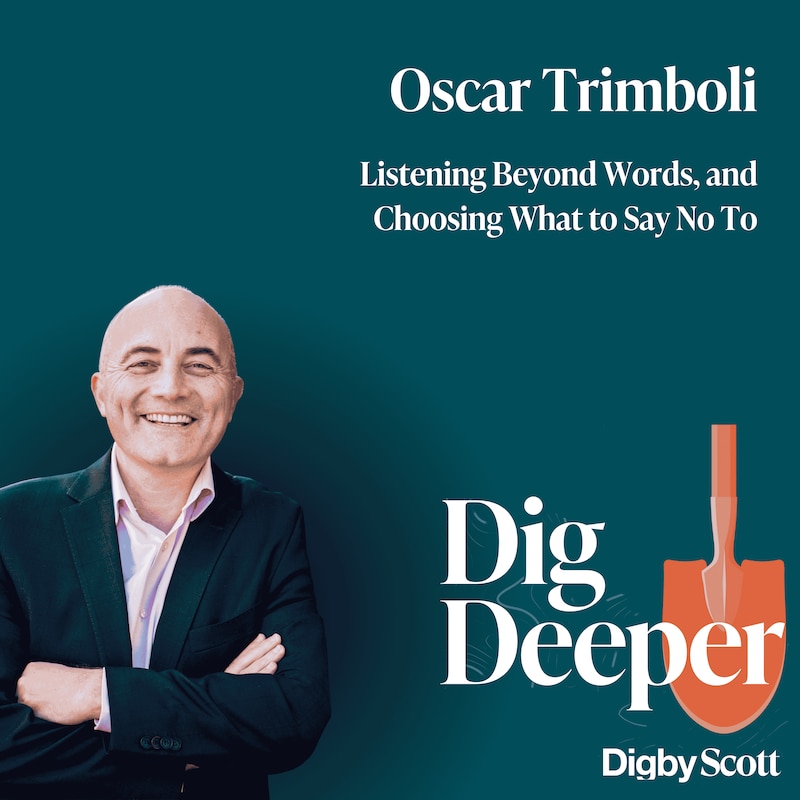
Oscar Trimboli is on a quest to create 100 million deep listeners in the workplace. He's spent decades discovering that the gap between speaking and listening isn't just about paying attention. It's about understanding that how we frame something can change what happens next. His work helps leaders see what they're missing when they focus only on the words.
In this conversation, you'll discover:
• Why the legacy you're creating might already exist in ways you can't yet see, and how acknowledging your past builds the foundation for what's next
• How setting boundaries isn't about limitation but about the strategic clarity of knowing what you choose not to do
• Why corporate funerals (literally burning what no longer serves) can create the trust that moves organisations forward when change initiatives get stuck
• How the "tour of duty" mindset releases the weight of infinite responsibility and brings unexpected lightness to leadership
• Why effective leaders operate as hosts rather than heroes, facilitating learning instead of performing expertise
• How metaphors become mental shortcuts that help people understand the unfamiliar through the familiar, and why food and music work better than sport
• Why distraction isn't just about devices but about the stories we tell ourselves when our attention wanders, and what choices we have in those moment
• How "getting over yourself" enables you to serve the work rather than protect your ego, and why this shift makes everything else easier
Timestamps:
(00:00) - Introduction
(06:39) - The Importance of Boundaries
(10:32) - Navigating Change and Acknowledging the Past
(19:11) - Corporate Funerals: Letting Go to Move Forward
(24:41) - The Power of Rituals in Leadership
(32:46) - Navigating Distractions in Conversations
(42:59) - The Impact of Metaphors in Communication
Other references:
You can find Oscar at:
Website: oscartrimboli.com
LinkedIn: linkedin.com/in/oscartrimboli
Take the Deep Listening Quiz: listeningquiz.com
Check out my services and offerings https://www.digbyscott.com/
Subscribe to my newsletter https://www.digbyscott.com/subscribe
Follow me on LinkedIn https://www.linkedin.com/in/digbyscott/
Transcripts
Sunday at lunchtime our family gets together and at 10 o'clock I prepare my nonna's pasta al forno otherwise known as lasagna and everyone kind of arrives anywhere between half past 11 and 12.30 and there's many different cheeses inside it and the smell by 11 o'clock is permeating our kitchen area which is right next to where we all eat and it's a gathering ritual.
It's a way to celebrate the past. It's also an opportunity to discuss the future. Now Digby, is your mouth salivating, right?
Digby Scott (:What's the difference between just listing the ingredients for lasagna?
and describing the experience of what cooking it and eating it mean. Context, story, and meeting people where they are. My guest today, Oscar Trimboli, has spent decades discovering that the gap between speaking and listening isn't just about paying attention, it's about understanding that how we frame something can change what happens next. He's on this quest to create 100 million deep listeners in the workplace, but not simply
Digby Scott (:teaching techniques, his magic I reckon is to help us see what we're missing when we focus only on the words. So this is a conversation about things like the legacy of living versus the legacy you're leaving. It's about the metaphors that connect us and move us and it's about why sometimes the foundations you laid decades ago matter more than the future that you're chasing.
And as you'll hear, this conversation really stretched my comfort zones in more ways than one, it might do the same for you too. Hi, I'm Digby Scott, and this is Dig Deeper, a podcast where I have conversations with depth that will change the way you lead.
Digby Scott (:Oscar, welcome to the show.
G'day, Digby. Looking forward to digging deeper with your questions today.
Let's go. First question. What are you learning at the moment?
is the foundations that I dug decades ago, building a really solid platform for what I want to achieve in the next decade of my life. And I think what I learned was too often we're so future focused, we forget about acknowledging our past and understanding that sometimes the legacy you create already exists and you may be living it rather than leaving it.
How are you learning that? What's happening that's helping?
Oscar Trimboli (:In the work I do, there was a person who I saw in an event this week who heard me in a workshop as part of 11 years ago. They pulled up their phone with the notes from that event on that day, which is pretty, wow. A, it's organized, B, it's a bit confronting. like, my goodness, I wonder what notes they wrote down. In between that time, they had a stroke, which was a whole
parallel path where I told them about my dad who had a stroke and we started comparing notes about patient agency and the role of carers to help the patient drive their own journey forward. But in that moment where Arthur showed me his phone with the notes on it and then starts to tell me how he had applied that in his workplace pre-stroke and post-stroke was a bit of, wow, I've learned that.
Seeds that have been sown in the past may be blooming even if you can't see them. So for me, sitting in a very deep place doing research as an example, I don't see that. I don't learn that until I start interfacing with workshops and keynotes and conversations with other people. I learned that my work has impact and has had impact already.
And sometimes the, to use, perhaps the metaphor of a stone in a pond, it's a big pond and takes a while for that ripple to come back to you, yeah?
And that's why we chose it for the front cover of the book.
Digby Scott (:Perfect. How about that? I'm curious about realising this, that your work has impact. How does that make you feel?
I can dial in very easy to this conversation with Arthur as a proxy for that conversation. It gave me great moment of pause. It made me feel very curious about what it was about how I said what I said and how it made me feel was, I don't know if curious is a feeling, but it made me feel.
Like there's an opportunity to just acknowledge that to myself and feel confidence and pride in the work that I've already done, knowing that what's possible in this next decade will be very powerful, different, maybe even in a slightly different direction as a consequence of that. And it made me feel like the flock of self-doubt evaporated kind of flew away in that moment.
because the language he was using and the kind of positive affirmation he was using about how he had used certain things that I'd said with his team and seen impact for them and inside their organisation and their system. Yeah, pride.
It's a powerful word and you used the word earlier, foundation. When I asked you what are you learning, it feels like pride is a foundation for what comes next that's coming from inside you. There's all the stuff out there that you could call foundations, yet you've got to have an inner foundation. It sounds like something was solidified when you heard that feedback.
Oscar Trimboli (:I sense it was a bit of a telescope coming into focus, something that was distant and fuzzy, historically. All of a sudden, Arthur was able to dial the aperture right in and focus on something that was relatively distant and give it precision, give it a brightness, give it a vibrancy and an energy, which again, it's like, I spend way too much in the future.
rather than just taking the time to acknowledge what have we done, what have we created. And when I say we, I'm talking about the deep listening ambassador community. It's a really loose group of people who are signed up to trying to make a hundred million deep listeners in the workplace. And there was someone from that community that I bumped into last week and they flew from Melbourne to Sydney to see me speak in event, cause they got sick of seeing me virtually and realised I was speaking at a public event and
You know, it was brilliant because we were able to have a rich conversation around Test Match Cricket that we'd never had before, which just opened another door to this amazing relationship with someone who's absolutely at the top of their field in medicine and does very complex work. And really, he's the person that kind of encourages me and pushes me to be much more ambitious with my work and the impact it's already had. So.
Sometimes you've just got to have these serendipitous kind of conversations that maybe in a group setting or maybe in that example was a one-on-one. After I jumped off stage and we all went for a meal afterwards, he kind of come up to me and said, you don't know me? I said, no, I definitely know you, Martin. Hello. Please don't tell me you flew from Melbourne to Sydney just to look at this. And he said, of course I did.
And it was like, that's another moment where you go, wow, that's a big commitment.
Digby Scott (:Yeah and a vote for you right and probably more importantly a vote for your work.
Yeah, I would say vote for my work always. I'm not that arrogant to think it's my idea. It's just an idea that's come through me and I've happened to catch it and someone else will pick it up and keep it going. And I think again, just before COVID, there was a great shift for me and a lightness about getting over myself and getting on with the work. And that made a lot of other decisions much easier. It made
conversations whether people were going to take the work into their organisation or not. They weren't saying no to me. They were saying no to the impact of the work. Whereas in the past, I would kind of overly personalise that and get in either a rage or a bit of darkness. like, why didn't you let it work? That's not fair. And now it's like, yep, let's keep going. Okay, they said no now, but I've...
somebody who said no to me in:because I came from tech and they wanted a tech thing and I said, look, I know the perfect person and it's not me. And I'd get really excited and lit up about it. And they did, they hired them and they did a great job. But because I was clearer with them about what I do and what I don't do, and for any leaders out there, know, the definition of strategy is not what you do, it's what you choose not to do. That sometimes can make a bigger impact there as well.
Digby Scott (:There's a lot of threads to pull on here, mate. I want to pull on the one right in front of us. Well, in my mind anyway, around this strategy idea. We've known each other. We've had some really great conversations over the years. I've also observed you and made up stories about how you're wired, right? And they're all stories, of course. One of them is that you probably since a baby have really embodied this idea of knowing
Tell me one of them.
Digby Scott (:what you're about and what you're not about, what you do and what you don't do. And I, know, a little bit cheeky around something since a baby, but out of all the people that I know, and I know a lot of people, it feels to me as though you embody this, this sense of boundaries, the sense of what, where you want to play and why you play there in a super clear way and a super strong way. And
You know, I look at myself and I make up a story that I'm porous and I'm, I'm bendy and I'll, and I look at you and I, I really, really admire the way that you come across as this is what I'm about. And I'm curious, a is that accurate in terms of that story? What am I missing? B is if we're on the point somewhere, how have you developed that? Cause I suspect a lot of listeners would be curious about that.
Here's how I roll and how do I create that way of being.
I for probably the first four decades of my life, I was probably the opposite of that. I was the ultimate people pleaser to the extent that I remember getting the shingles with a boss who didn't matter what I did. They just pushed me even further to the point that I literally broke. I can still remember lying down at home, don't get the shingles as an adult. It's not much fun. It's basically attacks your nervous system and I lost.
think I was 12 kilos in about three weeks. That was an awesome moment of learning for me. If I had to pick the moment where the boundaries and the clarity around the boundaries and the consequence of lack of boundaries came about was right there. And that manager would ring me every week when he coming back to work. And I kept saying when I'm ready and more importantly, when the doctor says I'm ready. He never asked me how I was. He never asked me anything about any
Oscar Trimboli (:element of my recovery, you know, what is the doctor? None of that. It's like, hey, we're running, you know, we've got some big goals for the quarter. We've got some big goals for the year. You know, you're a crucial part of the team. And I was running a big portfolio at Microsoft at the time, and I just stopped. It was just a perfect moment for me to take stock and go, where else is this showing up? And I could...
see it in my relationship with my parents. can see it at that time in my relationship with Jenny, my wife, see it in a relationship with kids. In my direct reports of work, in the charity work that I was doing, I invested a huge amount of time into a running group that we built from zero to raise a million dollars and get 500 people through their first run to half a full marathon or ocean swim.
Of all these things I was saying yes to, the only person I wasn't saying yes to is me. I think back to your story, it's important for all of us to realise that we intersect with people at a point in time when we start to build up a version of them that you kind of develop. When we go to the back story, probably nothing could be further from the truth. I'm grateful to that boss. I'd love to name him, but I won't. He knows who he is.
Yeah, it's awesome.
Oscar Trimboli (:And I think it's in moments of adversity that we make decisions about nos and yeses. And I realised that I was taking my own health for granted in my 40s. Don't get me wrong, at that time, I'd probably run in that previous year about 25 half marathons and three marathons and four ocean swims because of that charity stuff I was doing. But I had a big job at the same time.
On the one hand, I would say I was never fitter. I was never slimmer. And yet I hadn't decided what was the conscious choice I was making. I just thought I was bulletproof and invincible. That's when I started to make the choices about what to say no to. And an interesting sidelight is when I present my research in presentations, the first thing I say, this is the boundary conditions and limitations of what you're about to see.
So I'll list out five things that you could critique the work I'm doing with so people understand the boundary conditions or what it isn't. I'm very clear about that. That's even before I've told them what the research is.
What does that do when you set those boundaries?
The reason I set those boundaries is I find people who present a way of doing things, if they're super clear on what it isn't as well as what it is, and they understand when it's effective or ineffective, because it makes a choice easier for people if they want to play in that game. The other thing I do and want to signal to the room is I don't have all the answers. Here's how I would critique myself.
Oscar Trimboli (:And I want to highlight that I'm bringing some serious intellectual rigour to my work and also the intellectual humility to go, this is what's wrong with it. And if you're trying to use it in these conditions, it's not device, instrument, assessment, whatever you want to name the artifact for you. And I remember presenting to a group of academic professors on the topic that I was working on and we didn't even
get to the rest of the presentation. We just stayed on slide one about the boundary conditions and limitations of this. And that became a much richer discussion because I asked them, do you start your presentation like this? They all explained how they'd get ripped apart in an academic setting if they did. And there's a really interesting power differential and H index. And if you live in that world of paper presentation and all of that, it's tough.
it's really tough, particularly if you're publishing regularly and stuff like that.
Sounds like you're front footing it in a way to say, here's the territory.
There's a jungle, there's a desert, there's an ocean. Today we're the ocean. The reason I'm not going in the desert is because of this. reason I'm not going in the jungle is because of that. Should we continue? And that's what I loved about the academic presentation. was like, we didn't even get to the stuff. And we had a really rich conversation about like a listening in academic context, which I won't bore you with. But it became a richer conversation because I put up the no case, the case opposing the idea first.
Oscar Trimboli (:I think it takes a lot of courage, takes a lot of authenticity, takes a lot of humility to kind of start there. And it also builds trust with the people you're working with really quickly. They can quickly decipher not just about the work, but is that the person behind the work? Is that the kind of character I want to be dealing with? Don't get me wrong, there are audiences that hate that approach and I know they're not interested in me.
The other end of that is a intellectual arrogance, I suppose you could say, that around my role is to tell you what you need to know sort of thing. And here's me as the expert. And I often talk about hero versus host as two mindsets of leadership in any form, including giving a presentation. And what I'm making up about that story is you're in host mode, which is I'm going to facilitate some learning here.
while at the same time showing you some information and some ideas that potentially you wouldn't have come across elsewhere or otherwise. But I want to help bring it to life for you in a way that works. And there was a willingness to go where they wanted to go, which I think often in my work with leaders, I feel like there's too much script. There's too much we need to go here.
And often that's the future. Well, the leaders are paid, have incentive systems to create change and move forward. But a lot of change initiatives get stuck because people's work from the past hasn't been acknowledged. Like we have not enough funerals and too much futures. That's what I would say as leaders. So a funeral is a wonderful way to acknowledge the past two ways.
Tell us more. What does that mean?
Oscar Trimboli (:What do we need to bury or burn or leave behind that's unproductive for that future state? And then what are the things that are really important to us that we need to carry forward? If you don't do that, your change initiatives get stuck because you're listening permanently to the future and you haven't listened and taken the time to go to the past. A lot of inertia in those change initiatives are because people go, I don't trust you to move forward because you don't even know what I've done already.
They just need to be cautious about that.
There's this great song called Welcome to Your Barbecue by ALO, Animal Liberation Orchestra. there's a line in it, it's where we toast all the, or roast, toast or roast, all the dreams that never came true. There's a sentiment in that, you know, welcome to your barbecue where we toast all the dreams that never came true. So it's not the full picture of what you're saying. There's something about just to go, hey, we can let this go now. I'm also hearing you say.
And we want to acknowledge again, we're standing on the shoulders of giants, meaning the giant effort that we've put in to date and we're going to build from there.
and I'm to build on your barbecue. So I've worked with a client on this corporate funeral thing, a very complex system of national and state affiliations and then departments all sit under all of that. For the first time in a long time, they brought together all the leaders from all around the country, 150 of them, all representing different constituents and sometimes competing and sometimes collaborating. The point of this story is you don't even have to know
Oscar Trimboli (:what they want to acknowledge or burn or bury. So in advance of them getting together, we sent them out a red envelope, a green envelope. In the green envelope, put in there what we need to acknowledge and bring forward. And if you need more green envelopes, like one idea per envelope. And the reason we wanted to do that is we wanted to see visually how much people focused on acknowledge and bring forward.
versus Burn and Barry in the past. So I'm gonna play a little game with you here. Cool. So green envelope bring forward, red envelope, Burn, Barry, leave in the past. What percentage do you think, which colour dominated the most?
I'd say red dominated. Yeah. Because we're, it's more what we know. We're closer to it. Whereas this green place is all amorphous and unknown and potentially a bit scary to even venture into. That's where my mind goes around my rationale for that.
So was interesting, the longer the tenure, the more the green and the less the red and the shorter the tenure, the higher the percentage of red. The point back to your barbecue is we literally organized with the hotel to find a place where we could light a fire and literally burn the red. And people still talk about that today because we didn't ask them to open their envelopes and declare it. We just showed them.
how many envelopes they were and that was enough. For some systems it's not enough. You do have to kind of read it out while you burn it kind of thing. But with 150 people that was just not gonna logistically work. Otherwise we would have had a nine day workshop given the amount of people and the amount of envelopes that turned up. And it's back to what we talked about originally. About two months ago, I bumped into somebody in the city.
Oscar Trimboli (:And they kind of crossed the road to come and see me. And honestly, I couldn't place them because there's 150 people in this workshop. I didn't get to meet them all. They're all tables in a hotel room. And they said, you probably don't remember me. I was at the workshop, blah, blah, blah, where we did the barbecue on the roof and we burnt everything that we wanted to leave behind. And I thought, okay, great memory. But the point that got me was when they went back into their organization, they did
the funeral exercise themselves. And they got people to read it out while burning it. And he said, I don't know what it is about a fire that created a sense of closeness. I don't know what it is about a fire that helped everybody to say what they truly meant. But driving the change was so much easier after having the fire.
That's so powerful. It gets me thinking about we're circumventing the prefrontal cortex stuff and we're going straight to the primal. The bringing together of people around something like a fire is so deeply embedded in us. I've just got back from nearly four weeks of doing that every night in the middle of nowhere with a bunch of mates. There's something so powerful about that. The other piece.
in that story is how they remember you, but what felt more powerful is they remembered and acted on the ritual. And that was the thing that carried forward. They didn't need you to carry it on. And I want to go there. You earlier, earlier on, said you kind of lightened up and, you know, these are ideas that come through you rather than you're the one who holds the idea. You kind of midwifing it, maybe.
How do we make a shift to become people, regardless of the role that we're playing in leadership, to become someone who is a bit more of that, it's coming through me, but it's not about me, sort of energy. I'm curious about how that's happened for you.
Oscar Trimboli (:For me, I just thought about it as a tour of duty rather than something that was infinite. You know, it's for a period of time that I'm hosting the idea of effective listening in a workplace. Back to the Shingle story, I thought everything was infinite back then. It's like, I can keep giving, my energy's infinite, my fitness is infinite, my health is infinite. Whereas with a tour of duty, it's for a fixed period of time, you're in it.
fixed place on your tour of duty and you know that you'll move on. It's not permanent. So when I approached all of this, it's like, I was working with a leader about a year ago, they were approached for a role in a completely different geography to where they were. And they made up this whole story, why, why not? Couldn't work because of all of these reasons. And I said,
It's a fixed term contract. You've never done one of those before. How does a fixed term contract make it different for you? And as you could just see in that moment, tour of duty, they went, and literally they said nothing more. I want to say for two minutes where you could see them processing this idea. And when you go, it's a tour of duty. It's for a fixed period of time. I can pull out early if I want to, I can extend it if I want to, but
There's a sense of impermanence about it. For me, it makes it lighter. I was like, yeah, okay. And if it doesn't work, it doesn't matter. And if it does work, it doesn't matter. There's another tour of duty coming somewhere else. My current unexpected tour of duty is primary care responsibility for a dad who's moved into aged care. Did I anticipate that? Probably should have, given state of health and all of that.
But again, I always say in the winter season of my dad's life, I have to play a different role for him. And literally parent and child roles are flipped. It's so weird to be making decisions with your father that you kind of wondered, you know, how it was like for him. So I didn't approach it early on. It's like, oh, you know, the weight and the burden and it's so difficult and it's my dad and it was like, and I was just a tour of judiosque.
Oscar Trimboli (:It's gonna stop.
Language is so powerful, isn't it? How we frame what's happening, this idea of a tour of duty. I just want to mark something. Actually, there's a couple of things that are rattling around my head. There's a teachable moment right here in the space of listening. So I'm going meta for a bit, right, about what's happened in the last three or four minutes in this conversation. Listeners may not have heard it. You may not have heard it. But down to my right, the printer has just started printing.
No one’s not going to mention that. It's not my printer.
There's no one going, that Oscar's printer? So what happened for me, you're starting to tell your story about tour of duty and I'm, my brain is on who the hell is printing something in the middle of a podcast recording. So you can imagine my presence to you was not a hundred percent. And I was just feeling like, geez, this is not great. And of course my brain is going all over the place with that.
I reckon this is really common.
Oscar Trimboli (:Distraction from electronic devices is the number one barrier to listening in the workplace, by far.
And usually it's not a printer.
Occasionally it's a printer, but yeah, I know what you mean. And I want you to talk us through what you think the impact of that has been on where you can take the conversation rather than ripping the rip cord and going, I'm going to go meta and make this a teaching moment because I didn't actually hear all of Oscar's or whatever what happened for you.
So I still think it's a teaching moment, but let's make this the teaching moment, right? What happened for me was, A, where's that coming from? My attention was, okay, what's going on? What is that noise? Where's this coming from? Then a story about this is not very professional and it makes me look bad. That went through my head. Then I'm like, hang on, I've lost the thread of the conversation. How do I pretend that I'm still with you?
And then there was, I hope it goes away. And all of this is paying attention to stuff rather than pay attention to you.
Oscar Trimboli (:What's a few choices you had that you chose not to take? Because I know the choices I made.
Great question. So the choices could have been to completely focus on you, notice that it was there, but completely focus on you and choose not to have any other stories in my head besides being present to what's happening with you and me. Did not make that choice. I could have paused the recording, got up and going, who the hell is printing or turn the printer off or something like that. So actually let me be fully present, but I need to sort this so I can be fully present.
That could have been a valid choice. And I chose to have this other kind of middle ground of, we'll just muscle this out. What did you choose?
think you had another choice as well, which is just break the fourth wall or whatever it's called and talk to the audience. Hey, we're digging deeper and there's printer printing in the background and let's just deal with that right now. I'm sure this happens in your workplace and it's happening for us right now. Rewind if you're watching this versus listening to this, you'll still notice when you're listening, there was a deliberate pause on my part to see where Digby was actually going to go, acknowledging that.
He wasn't going to do anything about it. I just, okay, let's speak a lot, slightly louder. The good news is the software Digby's using will mean if they want to, they could literally erase it in the background and you would never know the difference, but we would miss a very, very big moment. And I think as leaders, when those moments of disruption take place, we spend too much time
Oscar Trimboli (:wanting the conversation, like what was the distraction, blah, blah, as opposed to how do we want to deal with it and just have the dialogue about how we want to deal with it, which we kind of did after you let me finish the story about tours of Judy.
Yeah, and there was potentially a values conflict for me around letting you finish the story versus there's something about the wanting to sort out the problem.
Yeah. And I was pretty lied about it. Yeah. Because I think you were focused on me, whereas I'm just moving my orientation straight to who's listening to this. And there's like, yeah, whatever, let him talk kind of thing. Like if I was listening to that on a pod, it didn't go for too long. And if there's enough trust between the two participants and that's a good conversation, you're going to put up with that because it's just real life.
Yeah, worth talking about that, I reckon.
Boringly, I have 42 step procedure before I log into an interview and one of them is turn off the printer. I'll send you my checklist.
Digby Scott (:That'll be handy. Mine's pretty long, too, but it doesn't have that. will now. Let me ask you a question. What haven't we explored that's come up for you that you'd like to dig deeper on?
Ha
Oscar Trimboli (:Maybe I'd reframe that question, what do you think the audience would like to hear from us that we haven't discussed? Because in any conversation or dialogue, there's always a third entity in it and it's not the participants. And if you can focus on that, then I think that will have a bigger impact.
Coming back to the power of framing, as we've been talking, I've written down these words, telescope, foundation, ripples, conduit, desert, jungle, and ocean, and barbecue. And they're all either metaphors or analogies for making a point or telling a story through. All of us use these metaphors or analogies
often without even giving it a lot of conscious thought. Yet it can really be so powerful if we think a little bit about how do I help someone understand or hear an idea through a metaphor or analogy? What's your take on the power of these concepts and how we deliberately can bring them forward more, bring more into our consciousness?
I'll definitely answer that. And I'd like you to explore if that question is coming from you or it's coming for the audience.
Yeah, so the reason I paused and thought about that is because the audience that is listening tend to be people in positions of influence and leadership shaping what happens, playing their part in that. And I know a lot of people ask me the question around influence and how do do this well? And I often come back to words have weight.
Digby Scott (:And so how we shape and frame those words can determine what happens next. It's in service of that question, essentially.
Listening is a simultaneous equation. Listening is like a trampoline. Are you bouncing to create energy or are you sitting on the trampoline? Are you listening in colour or black and white? These are all ways to express a very ethereal idea. Yet each of those metaphors can help you consistently tell a story over time in the moment.
refer back to, refer forward to, and apply in multiple contexts. The opposite is true too. Listening is like comedy and sex. We all think we're better at it than we actually are. The last one's memorable, but it's not useful because its ability to apply itself in multiple contexts. So I'm working with a leadership team in a manufacturing.
facility that does highly complex, very regulated things. I was asking them, in this change initiatives, are we doing a moonshot? Are we building rocket ships here? Are we a Formula One team changing ties that wants to improve incrementally each time we go? Are we a team that needs to consistently change positions on a sporting field? Are we an orchestra playing classical music or jazz? They eventually come up.
with their own way to express their idea inside their own team. And then I ask them, is that transferable into the manufacturing capability? The power of the words in metaphors is they're a mental shortcut for everybody to something they know, to something that they don't know. And if more leaders spent more time, and we talked about earlier on, a funeral as a metaphor.
Oscar Trimboli (:or the barbecue for the Animal Liberation Organisation? Orchestra. ALO. Okay. Forget the metaphor. What I say to leaders is whatever they pick, the leaders always come back to me and go, I am so sick and tired of saying this thing over and over and over and over and over and over again and nothing's happening. When a metaphor works, other people in your organisation will pick it up.
and contextualise it to their department, their division, their customer set, whatever it is. You just might not have the right metaphor for your organisation. So I would say try many before you understand which one works and lands.
Makes me think also listen for metaphors that are already there and where they're serving the purpose and mission and where they might be hindering. You know, so it's not just you sharing a metaphor, but it's listening for a metaphor.
I'll bring it to life with a client I was working with and I said stop stop stop let me describe something to you in two completely different ways and she said okay I said mincemeat tomatoes onions garlic oil what am I making so what am I making Digby with that
Well I'm going to Bolognese but I put a few other things in there too. Well if you added an egg you could make a burger patty.
Oscar Trimboli (:What else could it be?
Oscar Trimboli (:You can make nachos, you can make curries, you could do all things with that. What I see with ineffective leader communication, they talk about a whole bunch of ingredients to their organisation, which they do what we just did and take whatever ingredient they want and make whatever dish they want out of it. Now let me flip it. Let me show you what's on the menu. Let me tell you about the recipe and then I'll show you the ingredients. I just used a metaphor by the way. Every Sunday,
At lunchtime, our family gets together and at 10 o'clock, I prepare my nonna pasta al forno, otherwise known as lasagna. Everyone kind of arrives anywhere between half past 11 and 12.30 and there's many different cheeses inside it and the smell by 11 o'clock is permeating our kitchen area, which is right next to where we all eat. And it's a gathering ritual. It's a way to celebrate the past.
It's also an opportunity to discuss the future. Now Digby, is your mouth salivating right now?
It is.
Now, I just described mince meat, onions, garlic, exactly the same thing, but I contextualised it in a very brief story, 90 seconds, and its purpose. Universally, food, music, and if you have to, some kind of sport, are probably the metaphors you start to need to be able to become really good at spotting and using. You know, if I'm doing stuff in India, you can't.
Oscar Trimboli (:do anything without talking about cricket and that's relatively universal. But I don't. I talk about curry. And the reason I talk about curry, and I don't talk about curry by the way, because there's no such thing as curry in India, I talk about regional dishes and I always joke that the Kerala version of this is much better than the Mumbai version of that. like when I go to the US, it's like Chicago Deep Dish pizza, always better than New York pizza. And people get very passionate about food.
And food triggers memories and food triggers connectedness. food is really the ultimate universal. If you're in a very complex global system, go to food and try and find the metaphor in food. Music, working with a completely different leadership team, I say you are given sheet music by your global organization, but your market conditions say you have to play jazz. And you're turning up with violins and oboes and
big kettle drums to a battle where you need to be turning up with guitars, very small piano, and you need to be playing with a very narrow drum set, and you need to improvise, and you need to be able to riff off each other. I said, that's not the metaphor for this team, but you will be able to reuse a version of that, because it's music, and music is another universalism. Too many leaders that I work with go straight to sport.
and that disenfranchises probably two thirds of the room. So as we've been discussing metaphors, what's going on for you,
The idea of meeting them where they are in their world to me is such a fundamental idea and the way you've described how particularly India story, you're using metaphors that show you're meeting them where they are, at least attempting to, and to build a bridge, to make a connection. I don't think I'd ever thought about metaphors in that way before. You know, I know the power of a metaphor.
Digby Scott (:yet the appropriate one where you're standing, helping them see that you are attempting at least to get their world.
The leader will always give you ingredient hints if you're going with food, particularly in a rational sequential and the highly numerate systems, they go ingredient, their recipe, their menu, and nobody knows what's on the menu and they're checked out because it's not contextually relevant to them. But if you're working with them, they'll give you a thousand clues what the metaphor should be with all the ingredients they're throwing at you.
As we begin to wrap this conversation up, I'm wondering what's going on for you. What's emerging for you or what's rattling around or resonating?
Do we spend too much time talking about a printer? That's what's going on for me. It's like, was that in, could we have done that shorter or done that different? I don't know. What's going on for me as I, as you create the space for me to continuously acknowledge the impact of my work historically, you've provided a great gift to me that goes, My wife always jokes, you know, I'll be.
doing a thing to New York at 3am in the morning and we'll get up and have brekkie the next morning kind of thing. She goes, how were you? And I always go, I was world class.
Oscar Trimboli (:But if you asked me that three years ago, you would get a completely different answer. Because I'm asking the people before they get off whatever thing we're doing, what's the impact of that for you? And they're telling me. Again, that's not because of what I do, it's what's coming through me at the time because I'm open to it, because I'm just on a tour of duty and I've just got to do my best in this moment and the rest will look after itself. Keep the lightness.
and keep the focus on what you say no to is what I'm taking away from this.
I reckon a lot of people listening will be like, I want to learn more about this work of Oscar's. How do they do that?
Just go to listeningquiz.com and take the 20-question assessment and connect with your listening and it will generate a very specific report for you and your listening barriers and more importantly what to do about it in what sequence. And you'll benefit from the wisdom of 35,000 other workplace listeners who've helped to contribute and make that a really effective tool for you to improve how you listen to yourself, to your teams, to your departments, divisions and organisations and ultimately to listen to your legacy as well.
Brilliant. Oscar, a lot for me to sit with now. So thank you for challenging me. I feel challenged in a good way from this conversation. Expect nothing less. And for sharing your story and your ideas so articulately in a way that I think will reverberate for many, many people here too. Thank you.
Oscar Trimboli (:Thanks for listening.
Digby Scott (:Hey, just a quick reflection before we finish up. That printer situation, I reckon, is such a good example of how we can get distracted so easily. So we're gonna keep that in there. I guess the challenge for all of us is, as Oscar asked us, or asked me, is what choices did I have? And how aware are you of that when...
A distraction comes in when you deepen conversation or deepen anything and a left field thing comes in. How do you respond? How do you notice and deal with what's happening there? There's probably no wrong choices, but how mindful are you being? I reckon that's something to sit with for all of us, certainly for me. If you like this, there's a piece I wrote called We're All Fixed Term. The idea that nothing is permanent, which is what Oscar and I talked about, this idea of having a tour of duty.
and that we are not the answer to anything, really. We are just a contributor. I really like that idea, particularly when we're thinking about our leadership role. Check that out. I'll put it in the show notes. And please share this if you find that this is something that you're thinking, so and so could listen to this. Please forward it on to them. That'd be great. For more, you can subscribe to the podcast in your favourite app and also get all my written stuff at digbyscott.com forward slash thoughts.
Until next time, I'm Digby Scott, this is Dig Deeper, go well.



