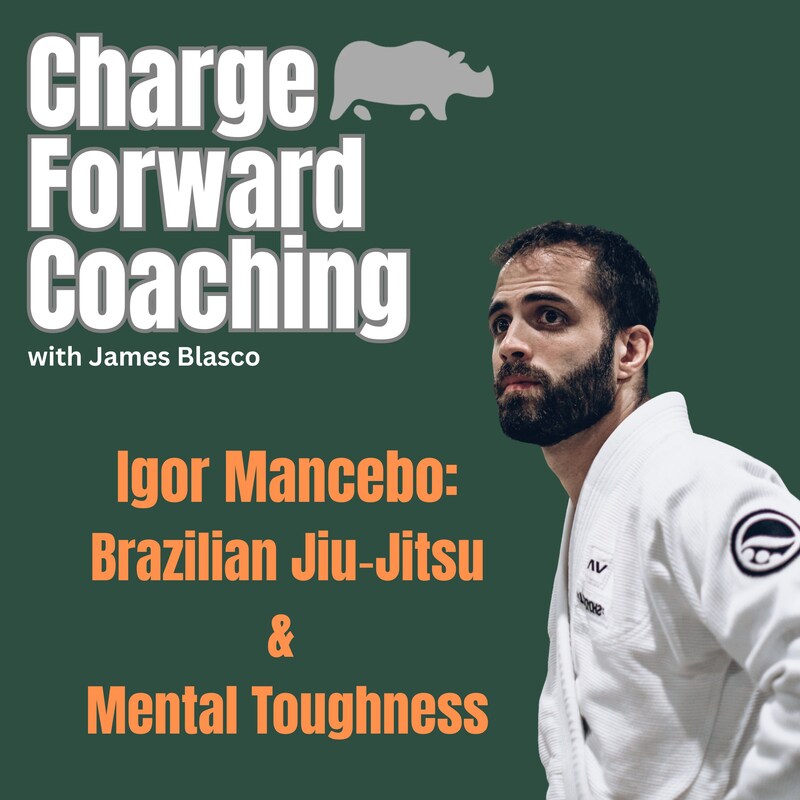
Shownotes
In this episode of the Charge Forward Coaching Podcast, host James Blasco sits down with Igor Mancebo, a Brazilian Jiu Jitsu black belt and owner of Spartan Academy in Palm Coast, Florida. They explore Brazilian Jiu Jitsu through the lens of mental toughness, discipline, and personal growth. Igor shares his journey from Brazil to the U.S., how he fell in love with Jiu Jitsu, and the commitment, routine, and emotional control required to excel. He explains how resilience is built on the mats, teaching athletes to handle adversity, stay composed, and push through difficult moments. Igor also discusses his coaching philosophy and the family‑driven culture at Spartan Academy, where athletes of all ages can thrive. He breaks down how he prepares young competitors for high‑stakes tournaments, emphasizing performance over results and blending technical precision with mindset‑based coaching. Founded by the Mancebo family, Spartan Academy has grown into one of the most respected martial arts schools in the U.S., known for humility, resilience, and personal development.
Affiliated with the Renato Tavares Association, the academy carries a strong lineage and technical heritage. Under Igor’s leadership, Spartan Academy has become a community rooted in discipline, family values, and the belief that martial arts can transform lives. This episode offers a powerful look at the intersection of sport, mindset, and personal development.
Takeaways
"The discipline will be more important than how much you like it or the excitement of being there."
"If you do that, the results will come. It's a long-term thing."
"The resilience that Jiu Jitsu teaches is good for life."
"Nobody trains more than you. They might train the same, but they don't train more than you."
"Winning or losing, I want to see you perform the moves or the strategy that we practice in class."
Sound bites
"Everything is new, everything is exciting."
"The more you know, the more calm you'll be."
"Hard work brings results."
About the Guest: Igor Mancebo is a Brazilian Jiu Jitsu black belt and the owner of Spartan Academy, a family‑built martial arts school in Palm Coast, Florida. Founded by the Mancebo family, the academy has grown from a small vision into one of Palm Coast’s most respected training centers, known for its culture of humility, resilience, and personal growth. Spartan Academy is affiliated with the renowned Renato Tavares Association, giving the school a strong technical lineage and deep sense of heritage. Igor carries forward this tradition with high‑level technique, strong fundamentals, and the values passed down by Master Renato Tavares. As both a competitor and instructor, Igor blends technical precision with mindset‑driven coaching. He teaches students to stay calm under pressure, build emotional control, and develop the mental toughness needed to succeed on and off the mats. Under his leadership, Spartan Academy has become a true community rooted in family values, discipline, and the transformative power of martial arts.
About the Host: James Blasco is a CTA Certified Coach, and a Certified Functional Mental Toughness and Resilience coach, and a Certified Neuroscience Coach based in Ormond Beach, Florida, with a rich background in sales, media, and entrepreneurship. Throughout his career, James has excelled in sales and sales coaching for some of the largest media companies, owned three successful businesses, and worked in media relations in the NFL. His diverse experiences have equipped him with a deep understanding of leadership, communication, and the drive needed to achieve success. James is also trained specifically to coach to all aspects of mental toughness and resilience.
Resources:
Website: www.chargeforwardcoaching.com LinkedIn: https://www.linkedin.com/company/chargeforwardcoaching/ Facebook: https://www.facebook.com/ChargeForwardCoaching/ Instagram: https://www.instagram.com/chargeforwardcoaching YouTube: https://www.youtube.com/@ChargeForwardCoaching Spotify: https://open.spotify.com/show/ChargeForwardCoaching Apple Podcasts: https://podcasts.apple.com/ChargeForwardCoaching Spartan Academy: https://www.spartanpalmcoast.com/
Transcripts
and welcome to another episode of the Charge Forward Coaching Podcast where we dive deep into the world of mental toughness and the four C's of mental toughness, confidence, commitment, control and challenge. And today we're going into the world of Brazilian Jiu Jitsu and we have just the guy to help us do it. Igor Mancebo is not only a black belt, he's a phenomenal teacher, has a great career of his own and he's here to...
Igor Mancebo (:Thanks. .
James Blasco (:explain not just the sport, which is one of the fastest growing sports in the United States and around the world, but the mindset it takes to participate in this
specific sport. So Igor, welcome to the program.
Igor Mancebo (:Thank you, thanks for having me. I hope I can help you guys out with some of my experience.
James Blasco (:Yeah.
Yeah, no worries. I'm sure you will. Looking at your background, I'm thrilled to talk to you. You have a great background, but I'll throw an easy question at you at first. Why don't you share a little bit of your background and how you got into the sport to begin with?
Igor Mancebo (:Okay.
Okay, so I started practicing Brazilian Jiu Jitsu. I was 14. I was back in Brazil. I used to live in Brazil. I'm from Brazil. I lived there for my whole life and When I was 14, it looked it kind of sounds funny, but I was into video games a lot. I was playing a lot of video games and And through the video game I was doing those ⁓ Fighting games and then I saw one of the fighter status says Brazilian Jiu Jitsu and then I look up on Google
And I fell in love, just watching YouTube videos, like this is really nice, I really wanna do that. At the time I didn't do any fighting, I was a swimmer, I used to swim. And I was like, I really need to do this. And then after like three, four months looking for schools, then I finally joined, I was 14 years old. And then I never stopped, I quit everything else that I was doing, I quit swimming, I quit everything else, and I kept going, I fell in love right away.
James Blasco (:I can tell you fell in love with it with the commitment and the career you've had so far. And in Brazil, it's a massive sport, right? It goes back, you know, 100 plus years and has become one of the powerhouses in the sport. But you came to the United States in, I think it was around 2020 or so and got involved with Spartan Academy. How'd that come to be?
Igor Mancebo (:Yeah.
t now. So I got my black belt: And then right away, like: James Blasco (:Yeah, and you've
done a hell of a job. We'll get to all the success with Spartan Academy and little Palm Coast Florida here in a second. But I want to kind of dive into the mindset it requires to be really good at this sport. What do you see in the great fighters, the great competitors that separates them from folks who are just
Igor Mancebo (:Thank you.
you
James Blasco (:you know, trying to be good.
Igor Mancebo (:Like any other activity, it's something that when you start, you're gonna fall in love right away because everything is new, everything is excited. You learn new things every day. And then everybody helps you out to grow. The community is very nice. The way that we are...
doing our workout without actually doing our workout is very nice. Like we're hanging out with each other, we're helping each other. The beginning is very nice. And what I tell everybody is that phase goes away. Eventually, the things that you learn, you're not gonna learn new things anymore. You're just gonna have to improve the things that you already know. And once you get on that phase, the discipline will be more important than how much you like it or the excitement.
of being there. So what I tell everybody in the beginning, when you start hitting that phase of, this is not new anymore, I'm not enjoying it anymore, that's when you gotta have a routine. So you build your routine and then you gotta be very strict with your routine. If you're gonna train the X amount of days per week or every day or three, four times a day a week, you stick with your routine.
because everything's gonna start working in waves. You're gonna have downs and you're gonna have ups, you're gonna have days that you're gonna be very, very excited and you're gonna have days that you don't wanna go. Well, I think the guys that achieve the high level are the guys that they go even the days they don't wanna go. know what mean? They go because they know they have to do that in order to get better. And the results come. What I tell my students, like,
If you do that, the results will come. ⁓ So it's a long-term thing. Jiu-Jitsu is something that you've got to do for a long time. And you've got to be consistent on that. And that comes with a lot of mental toughness. Some days that you don't want to go, the days that are a little cold, or it's raining, ⁓ or your family wants you to stay at home that night, but then you go anyways. And what I tell the guys is, it's all worth it.
After you get good, everything starts being more fun again. Yeah, exactly,
James Blasco (:Yeah, it's always fun when you're doing good, right?
Yeah, you touched on so many things there. One that stuck out to me was commitment to be good at anything. You have to be committed. It's not just setting the goals, right? It's actually following through and putting in all the practice and preparation. How about from an emotional standpoint? Because like you said, you sometimes things go good. Sometimes they don't. In the heat of a battle, ⁓ things cannot be going your way. How important is it in this sport to maintain your emotional control?
Igor Mancebo (:Yes.
Thanks.
So what I believe and something that I always teach that in class is when you learn, the more you know, the more you learn skills, higher level is, more calm on bad situations you're gonna be because you know you've been there before and you know they're gonna pass or you know you're able to get out of that situation, you know what mean? So...
The thing that I my students is I know in the beginning you might be desperate, might be... might, you know, some techniques are suffocating you, like somebody's trying to strangle you and you're underneath a guy that's way heavier than you. And first thing I say is like, this is gonna pass. Either if you win or you lose, this is gonna pass. So put this in mind, this is a temporary status. And then you have to work your skills.
to that the amount of time they're gonna spend in bad spots will depend on you and not on the other guy. I think that's the thing that people need to understand the most when they do Jiu Jitsu. you, more you train, more those bad spots will depend on you, like on your capability of getting out. You know what mean? So more you know...
more calm you stay on those situations, you know what I
James Blasco (:Yeah, and you
work with so many ⁓ different types of athletes. work with world-class athletes. You work with beginners, kids even. How do you manage to do that in terms of, you know so much, you know what it takes, but you have people at so many different levels. Is it easy for you to adjust from a world-class athlete to a...
Igor Mancebo (:I don't know.
Yes.
James Blasco (:a 10 year old or does it really have to reset and reset your focus to do that?
Igor Mancebo (:no, I think this is the hardest part of the job though. ⁓ The hardest part of the job is when I get the... I have all that knowledge, but I cannot throw all that knowledge to a beginner. They're not gonna understand everything that I have to say. So you gotta break down that in pieces, know, and give a piece at a time to that beginner. And...
On the other hand, when you train high level athletes, the technical aspect is very easy because they are already good. You just have to think about the physical aspect and the mental aspect, strategy aspect, things that go ⁓ around just the technique. You know what mean? But this is the hardest part of the job. This is what a lot of coaches struggle with, is being able to navigate through different levels. And I think that's one of the things that I do the best.
I studied a lot for that. I went to college in Brazil. I studied like ⁓ kids pedagogy. I studied sports science, all of that. So ⁓ I think that's why I know what I'm doing on that part.
James Blasco (:Yeah, I think so because recently I think
this past year you had kids go over to Italy and I think win some championships there. You had another kid go to Long Beach and did really well out there. You know, I spoke to a sporting director for a soccer club not too long ago. He's on a podcast and he had worked with a lot of the premier teams and other teams and he said one things they do over there with the young athletes is they they have them practice with the.
Igor Mancebo (:Yes.
I don't
James Blasco (:pros with the best of the best. That's the only way you're going to get better. Do you see the same thing in this sport or is it different?
Igor Mancebo (:and
I agree. agree. So I have a, ⁓ I think a good thing in my, my school is like everybody trains kind of together. So I have the guys doing the high level thing on the same mat as the hobbies and the same mat and the kids see them and the kids train with them on the weekends. And I think when you have a high level athletes at the room, it definitely elevates everybody. Okay.
But it's important for the beginners to have a path until they get there. If you just throw a beginner with the pros right away, they're just going to get, in Jiu Jitsu, they're just going to get beat up and they might like make them quit eventually, you know what mean? So you got to be able to build them with technique, with strategy, with exercise. We do a lot of like different fighting exercises so the beginner can fight with the high level.
in the same room, you know what mean? I plan a lot of exercises for this. So we do like, okay, this day we're just fighting from this position or we're just doing this type of thing. We have a focus on this ⁓ technique right here. And it definitely helps. think I agree with the soccer coach that you said, it definitely helps training with the pros, but I think it has a path until you get there. If you only train with the pros, I think it would be...
It might be discouraged sometime.
James Blasco (:Yeah, absolutely. And he did
point out that those are the best of the best young athletes that they're trying to encourage to do that to your point. yeah, absolutely. So what about these kids? They're young and they're going overseas to compete. ⁓ How do you coach them? How do you coach them mentally to be prepared for such a big environment?
Igor Mancebo (:Yes, yes, yes.
Mm-hmm.
Mm-hmm.
haha
So, to mentally prepare, what I always tell them, you gotta train, you gotta trust where you are. So they trust me, they trust my system, on my school, they trust that I can provide them the best training for them to win. So that's one thing. So once they trust that, they trust the system, I try to make them as high level as possible, as high as the level as possible. So they know, even though...
they're gonna have tough fights over there, they are capable to win and they believe they are capable to win because they are. I'm not trying to say something that's not true, you know what mean? I make them technically ready and I tell them, hey, you guys are technically ready and they see, they prove themselves by doing small competitions here and there, you know what I mean? And that's one of the ways that I prepare them.
to go to these big tournaments in Europe. had kids going to Japan as well last year. It's by training them at the highest level as they can, and then we go to smaller tournaments where they can have good fights and to prove that the system works, you know what mean? So they believe in my work, I believe in their work. They have a lot of work ethics too, something that I always talk about in class to them. like, you gotta have the work. When you come here,
you come here to work, you have an objective, you gotta check all those boxes before you leave and then come back the next day, you know what mean? And they do, and because they believe in me, they believe if they do what I tell, it will work, and they do and then it works.
James Blasco (:Yeah, it's funny. I'm reading a book on Nick Saban and the one theme that comes out, the only way to be the best is to practice, practice, practice, work, work, work, and give 100 % in everything you're doing to prepare. And that he made a ⁓ very crystal clear point to say that.
Igor Mancebo (:Yes. Yes.
James Blasco (:You brought up the word fighting. I mean, essentially that's what this is. There's a lot of ⁓ technical aspects to it, but it's fighting and somewhere along the line for some competitors, fear has to play a role and they have to overcome that fear. Do you have a way of coaching ⁓ your competitors around fear, especially from injury or so forth?
Igor Mancebo (:Yeah.
So each athlete will be different, I think it's part of coaching, especially my sport is individual sports. So we don't fight as a team, like a soccer team or a basketball team. Each fighter goes and do their own bracket and their own fight. So each student will be different. Some of the students...
What they like and what I feel works better is for them to know a lot about their opponents So they know how to expect like what to expect so more the things they have in control better So I try to give them the sense of okay when you get there nothing that you're gonna face is new Because a lot of the things that we fear is things that we don't know we fear a lot of the things that we don't know
So when I give them, okay, this opponent is going to do this type of thing or this type of thing, and that's kind of the path that the fight will be. And they have that already, nothing that happens is new, so they are less afraid of doing that. I think that's what some kids work better this way. Some of the kids, they have more anxiety, for example. So if they know too much, they overthink too much.
So what I do is trying to create that path that they can control so I tell them okay on the first 15 seconds on the match that's what you're gonna do and they focus on that first 15 seconds on the match and try to take the control over that short amount of short period of time that will make difference on the whole match that's something that I always ⁓
Sometimes I have to think that way and I try to make them think less about the opponent as possible If they have too much of an anxiety, so you gotta you gotta talk to your students. You got a few Each one of them gonna react different in different approaches You know, but in general for the whole group what every class I tell them and every class before competitions, of course what I tell them is like Nobody trains
more than they train. They train. They can train the same, but they don't train more. Our kids train a lot. Like they train every day, one, two, three, sometimes three hours a day. They train a lot, you know. So that's something that I say, like nobody trains more than you. They might train the same, but they don't train more than you. And the other person is also, everything that you're feeling, the other kid is also feeling the same thing.
They also feeling the fear of losing, also feeling the anxiety, they also feeling those little butterflies on the belly before the competition. You both are feeling the same thing. What's gonna determine who's gonna win and who's gonna lose is who can direct those feelings into the strategy of the fight, into the plan that we have for the match.
James Blasco (:You
Igor Mancebo (:or things like that. know what mean? That's the thing that my approaches around the mental area of the fight. Of course, like I said, you gotta feel each student to be different. So you gotta feel what they need the most. And it's a lot of tasks too. Sometimes I task one approach with a kid and then on that tournament, oh, that doesn't work. So I have to.
James Blasco (:Right.
Igor Mancebo (:no shift to a different approach on the next time.
James Blasco (:Yeah,
that makes perfect sense because everybody is different and especially in situations where there's more pressure, more uncertainty, that's when you really kind of understand where that person is mentally at least. I was, guess, yeah, go ahead. Yep.
Igor Mancebo (:It is.
Yeah.
Yeah.
Just one thing, sorry, I forgot to say that, I'm sorry.
One thing that I think I try to do with the kids, I try to let them know that the results, if they lose or they win for me, the way that I'm feel for them, like my feelings for them, won't change at all. Like if they win or they lose, I'm still gonna coach them the same, I like them the same.
I'm not mad at them if they lose and I try to focus on that performance. What I tell them is like Winning or losing I want to see you going there and perform The moves or the strategy or the techniques that we practice in class Okay If I see you doing things I'm gonna be so happy that the result is not What's gonna matter at the moment? You know, I mean it's the performance. They're gonna matters the most
And especially for the kids, I know sometimes the parents, they put the pressure that they have to win and that kind of bothers me sometimes. But for the kids, I think on the long term plan, I want to see them performing good skills and good techniques as a kid. So when they get on the adult level, they're ready to face the adult level division. Of course.
when you perform good, most of the times you win. Of course, most of the times you win, that's a consequence. my goal as a coach for kids is to elevate their level on every competition, no matter the result that much. Once they get adult level, and I'm going to talk about the kid that went to Long Beach to compete at Worlds. ⁓
James Blasco (:That's right.
Igor Mancebo (:That's when the things that matters for him. That's when his career can change, when he becomes older. So that's what I try for the kids to focus. I don't want them to focus too much as a 10 year old, 11 year old, how many gold medals they have, how many silver medals they have. I want to see them like, okay, on this day I did this technique, on this day I was able to perform and I did this move. Because the result...
itself as a kid for Jiu Jitsu in the sport that we do the result as a kid it's good but what really matters is when you get adult black belt that's what really matters and that's what I'm aiming for you know what mean I'm aiming on the future I'm not aiming on what's happening right now
James Blasco (:Yeah, that's such an important perspective, especially for kids because they watch sports on TV and obviously everything's about winning and losing and you know, they see the winner celebrating and getting all this stuff and and sometimes they lose sight of all the things that lead up to that, which is probably a lot of defeats, right? And trying to learn the skill of that sport. So you brought up the future and I know you were being specific to the sport, but.
Igor Mancebo (:Mm-hmm.
Mm hmm.
Yeah. A lot, yeah.
James Blasco (:How important or what role does Jiu Jitsu play in just a positive development of a human being? What can they take away from the sport that they can apply in their life in general? Because not everybody's going to be a world champion. They're going to go on to do other things. What do they take away from the sport?
Igor Mancebo (:Yes, of course.
Okay, so Jiu-Jitsu can be the tool. think the sport itself, it can be tools for many things, for good things, for bad things. If you use the Jiu-Jitsu correctly, like if you have a good coach that coach you well, not only to win matches, but how to succeed in the sport, I think the biggest thing that you take away is the resilience.
You understand the game, you understand that you're gonna work very hard and that hard work is gonna give you results. you have that already on your mind that, hard work brings results. But not every time. Sometimes not. But you understand that this relation between if I...
If I don't work hard, I have zero chances of good results. If I work very hard, I still don't have 100 % of chances, but I have more chances of result. And then those, that time that you don't have the result that you want, you know you're gonna go back to the gym or you're gonna go back to your studies or you're gonna go back to your job and you're gonna do it all over again, trying again to achieve that result. And I think that...
The resilience that Jiu Jitsu teaches, ⁓ like, be able to navigate through ups and downs and be okay with it. I think that that's good for the life. That's good for my life. That's how my life works. That's one of the things that Jiu Jitsu brought to me. ⁓ And of course, everything that comes with martial arts, the confidence, it grows. You know that you can, when you know that if you work hard,
you can achieve or you can do closer to achieve, that's already give you like a comfort to work hard.
James Blasco (:Yeah, absolutely.
And you hit the nail on the head because I talk to people all the time and end coaching and I remind them, said, listen, go ahead and fail fast. In fact, feel as fast as you can. Just don't give up because you're going to learn from that and you're going to get better. And that resilience is huge throughout life, not just in that sport. And speaking of sports, so you brought up that you gave up swimming and some other things so you could focus on jujitsu.
Igor Mancebo (:Yeah.
Okay.
James Blasco (:Do
you find that some of the kids or even adults that you're coaching, do they tend to play other sports or do they focus just on Jiu Jitsu?
Igor Mancebo (:Even when they are little, like between 5 and 10 years old, a lot of do other sports too. And I think it's important to do so. ⁓ But what I tell them, I tell the parents and I tell the kids that if you want to be on the top, like win tournaments like the one in Europe, like the one in Japan, like the one in Long Beach, if you want to be on the top, you got to a focus on one thing.
So a lot of them, they start out like doing soccer, do jiu-jitsu, doing football, doing wrestling, many other sports. And once they fall in love with jiu-jitsu, naturally they just want to focus on jiu-jitsu because they don't want to be good at one thing. I had kids like before that decided to not focus on jiu-jitsu, they decided to focus on soccer. And they're like great in soccer, you know what mean? What I tell them like it's...
I know you do soccer, but I know you learned how to train with me. I know you learned how to work hard, all that. I know you learned from Jiu That's what I the kids. So yes, if you want to achieve the highest level, yes, you should focus only on one thing. But in the beginning, when you're very young, five, six, seven year old, it's okay to do other things, to test. You don't know if...
James Blasco (:Yeah.
Igor Mancebo (:Jiu-Jitsu be your thing or maybe swimming will be your thing. ⁓ I think naturally you're going to naturally start doing more what you like the most and what you... We like what we're good. So if you start being good in one thing, you're going to like more that thing. I always tell this to the kids. The kids come to the training like, ⁓ coach, I just started, I'm not good, I'm not liking. Wait until you be good.
James Blasco (:you're definitely going to latch on.
Igor Mancebo (:And then you're gonna like it because everybody that is good likes what they do.
James Blasco (:Absolutely, right? It's funny how that works. Well, speaking of training with you, again, as I mentioned a little bit earlier, Spartan Academy here in Palm, I say here because I don't live too far away. I'm in Ormond Beach, Florida, but in doing my research, there was publicity from all over the country about what you're doing with this Academy. And I even understand that.
Igor Mancebo (:Yeah.
James Blasco (:when there are some of these world-class athletes in town or anywhere near Palm Coast, they'll come over and train at the Academy. How does that make you feel and what, if there's somebody out there listening to this and they're considering Jiu Jitsu or just learning about it now, what would you tell them about yourself and Spartan Academy and why they should go there?
Igor Mancebo (:Yeah. Yeah, did.
I think my style, the way that I build the culture around my school is a place that we can achieve the highest level, but it's still a friendly and a family environment. So we're gonna have the, when you walk in, you're gonna feel welcome right away. You're gonna feel like everybody gonna welcome you. And that doesn't mean that we're not tough training. We're tough training.
We train hard, we try hard to defeat each other in training as a way to practice, right? ⁓ But I... People come and they still feel like, ⁓ I can train here, I can be good, but I can't bring my family here, I can't bring my kid here, I can't bring my wife here. And they're also gonna feel welcome. They're also gonna feel ⁓ part of the... Like part of a big family.
if you know what I'm saying. So that's one of the things that I try to tell people. And even the ones that train with us that don't want to be the highest level, they don't want to be pro athletes or nothing. I still stimulate them to be the best they can. So I wanted them to achieve the highest level they can with their own limitations, with their own jobs and the family and you know.
all the other things that goes around a human being's life. But I still wanted to do as best as you can do with what you have. So I think what attracts people here, and that was in the beginning, that was surprising for me too, that a lot of people come into me and say, hey, I really like the train here. I would love to come here more. And people from other cities, they drive to come train with me.
I think it's because of that, because we have really good training, the highest level I can give, but we still have that family and friendly environment. know what mean? The person will come and they're not going to feel challenged. They're going to feel the challenge technically, but they're going to feel they're welcome. You know what mean? They're going to feel that the person is trying to help them. The person, everybody cares about each other's growth.
not only a bunch of people trying to demolish each other in certain ways.
James Blasco (:Right.
Well, your
work speaks for itself. think everything that's being said about the Academy, about yourself is perfectly accurate and it's great. And we're glad to have such a great facility in the community. And it's cool that you're getting so much national recognition as well and putting out champions. We really, really are proud of you. I want to thank you for your time, Igor. That was...
Igor Mancebo (:Thank you.
James Blasco (:That was awesome. I'd love to have you back on. There's a lot more in a way of questions I want to ask about not just the sport, but your personal career and other things that you're doing. But thank you for being on the program.
Igor Mancebo (:Okay.
No, thank you very much. Thanks for having me. And let me tell my story a little bit.
James Blasco (:Yeah, absolutely. We'll
let you tell more the next time around. For those of you out there who are watching, thank you for tuning in. Remember, if you want to learn more about mental toughness, you can go to chargeforwardcoaching.com. You can even give me a call. I'll be happy to sit down with you for free for about 30 minutes. So you can learn a little bit more about mental toughness. I can learn more about you and we could go from there. But in the meantime, remember to keep charging forward.
Igor Mancebo (:Okay.