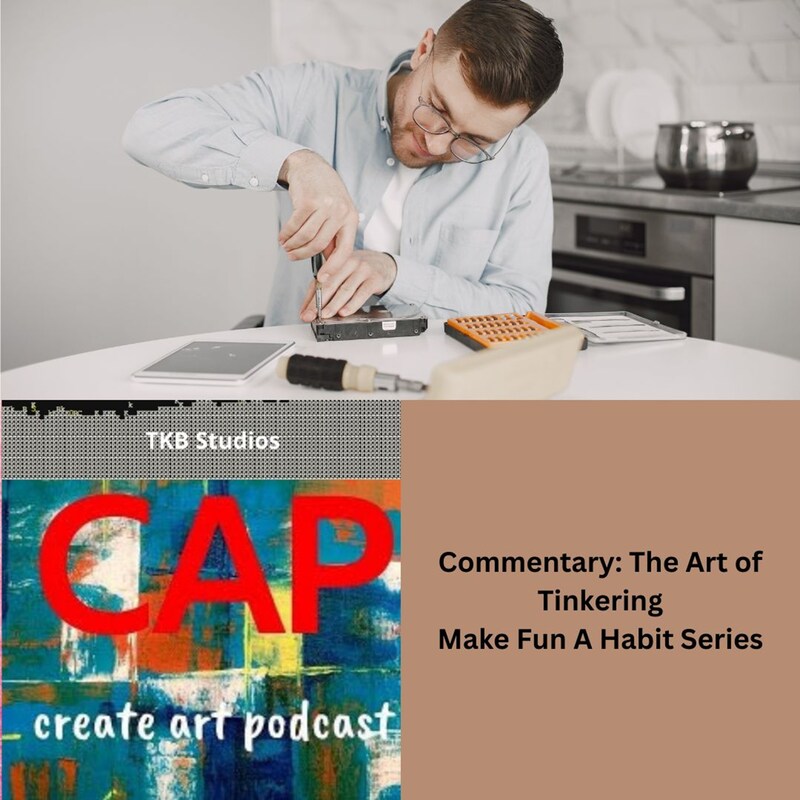
Shownotes
Today, we’re diving into the art of tinkering, and trust me, it’s not just for the DIY enthusiasts or that friend who can fix anything with duct tape! We're chatting about how to bring the fun back into our creative lives with insights from Mike Brennan's book, "Make Fun a Habit." I mean, who doesn’t need a little sprinkle of joy while navigating the wild world of creativity? We're sharing stories that’ll make you chuckle, like Mike's childhood escapades with model cars and milk bone sculptures (yes, you heard that right). Plus, we’ll tackle some thought-provoking questions to help you unleash your inner artist, whether it’s watercolor or something a bit more... avant-garde. So grab your favorite snack, kick back, and let’s get ready to make some artistic messes together!
Making Fun A Habit Series
30 days to add fun to your creative practice. I will be going through Mike Brennan's Make Fun A Habit workbook and help you make fun a habit. I had the pleasure of interviewing Mike on my other podcast Find A Podcast About and talking about his podcast Creative Chats. This workbook leads you through steps to rekindle the fun in your life and get you into a space where you are your most creative. This is a 30-day book and I will tackle each day as if it were a week and provide insights on how to use his ideas in your creative practice. Each chapter is broken up with a short story, questions to ponder, action items, and tips.
Assignment
Questions
- How can you incorporate some of the Savanah bananas creativity into you own life and work?
- Who is your audience or fans?
- What would it look like if you put your fans first?
Action Items
- Make a costume contest
- Have a sing along
- Have a dance party
- Have a talent show
Tips
- Be creative and innovative
- Have fun
- Be interactive
- Don't be afraid to fail
Takeaways:
- In this episode, we dive into the art of tinkering and how it can unleash our inner creativity and help us make fun a habit in our art-making journey.
- Mike Brennan's book is a 30-day workbook designed to inject fun back into your creative process, making art less about perfection and more about joy.
- We discussed how childhood experiences with model cars and sculptures can teach us valuable lessons about experimentation and embracing mistakes in our artistic endeavors.
- The importance of asking questions and learning from others in your creative community is highlighted as a way to overcome challenges and improve your skills.
Links referenced in this episode:
Companies mentioned in this episode:
- Create Art Podcasting
- Mike Brennan
- Creative Chats
- Make Fun a Habit
- Find a Podcast
- TKB Podcast Studios
- Bob Ross
- Tia Sunshine
How do I get such great guests?
PodMatch I use Podmatch to get the best guests on the show. Check out PodMatch if you want to guest on other podcasts or if you have a podcast and need guests for your show. Guests from Podmatch
Make Sharing your podcast easier
Use Podcast Beacon for the best NFS products to share your podcast while out and about or at conferences.
Reach Out To The Podcast
To reach out to me, email [email protected] I would love to hear about your journey and what you are working on. If you would like to be on the show or have me discuss a topic that is giving you trouble write in and let's start that conversation.
- Email: [email protected]
- YouTube Channel: Create Art Podcast YT Channel
- IG: @createartpodcast
- Twitter: @createartpod
Create Art Podcast Newsletter
Special Message
If you have found value in this podcast, please share it with a friend as that is the best way to discover new podcasts. I want this to be a 5-star podcast in your eyes so let me know what you would like to see.
Speaking about sharing with a friend, check out my other podcast Find A Podcast About where I help you outsmart the algorithm and find your next binge-worthy podcast. You can find that podcast at findapodcastabout.xyz.
For all of my projects check out my portfolio website TKBPodcaststudio.com where I help my clients through quiet professionalism lead through the noise.
Special Ask
Let me know what you think about the podcast by taking a survey. 2024 Listener Survey yes it is 2025, but hey I am late to the game on this. Thank you ahead of time to help me make this more of what you are wanting to hear.
This podcast uses the following third-party services for analysis:
OP3 - https://op3.dev/privacy
Transcripts
Create Art Podcasting commentary the Art of Tinkering, part of the Make Fun of It series. Hello, friend.
This is Timothy Keem o' Brien, your head instigator for Create Art podcast where I bring my over 30 years of experience in the arts and education world to help you tame your inner critic and create more than you consume. So we're continuing on with our Make Fun of Habit series. And that's done by.
That's brought to us by Mike Brennan, who runs the Creative Chats podcast and is the author of the book Make Fun a Habit. Now, I had the pleasure of talking with Mike Brennan on my other podcast, Find, a podcast about which you can find@findapodcast about XYZ.
And that's where I go go out and find podcasts for you and help you outsmart the algorithm and find your next binge worthy podcast. So let's talk a little bit about this book, Make Fun a habit.
It's a 30 day workbook that does just what the title suggests and helps you put that fun back into your creative process. And what I've done is to take each chapter and make it into an episode. And, and in each chapter there's a story that Mike tells.
He gives us questions to think about, tips and action items, and we'll go over those for today's episode. Now, this episode we're talking about the art of tinkering. And he starts off this chapter with a couple of different stories.
The first story he talks about is his fourth grade birthday party where he received a model car. And he was, you know, a little bit perplexed at that and discovered that he had, you know, a lot of stuff to do to get this car put together.
So it was an actual project for him to do. And I really related to the story because when I was a kid growing up, we did model airplanes.
You know, first we did the snap tight ones where you didn't need any glue. And then we progressed into the ones where you did need glue for, which were really messy, but it was a lot of fun for me to do.
Then he talks about a project that he was working on in school where he did a sculpture, a skeleton sculpture, out of milk bones. And he called it Mike Bone. And he talks about all the trials and all the things that he had to learn in order to make this sculpture.
And it was shown at the Whitney Museum in honor of Basquiat in New York City. And all the things that he learned from using milk bones to create a skeleton sculpture is very fascinating. I would have never thought to do that.
And he got a nickname, Mike Bone, and he uses that in some of his social media.
So that just kind of shows you that, you know, when we experiment and when we go out of our comfort zone and try new things out and ask those around us, who may know a little bit better than what we do about how to use these materials and techniques, how that can lead us to a great experiment, maybe a, I would say, artistic mistake, a creative mistake, or, you know, a happy accident, as Bob Ross likes to say, you know, for us to be open to those kind of things. So let's dive right into the questions. And the first one is. And the questions for this. This chapter in this episode are.
Well, each question has multiple layers in it. So first question is, what do you want to learn? What do you want to know about how things work and what skills do you want to develop?
So for me, I'm a big one.
And if you've listened to any of my episodes in the past, I'd like to learn watercolor, because every time I try to do, it turns out into a big, you know, picture of mud.
And I was just actually talking to one of my kiddos today, and they were talking about Bob Ross and how he makes these great pictures and how they want to be able to do that, and all they make is a big old pile of mud. And I said, hey, you know, I BETCHA his first 200 paintings looked like a big pile of mud. And he, you know, experimented with a lot of things.
He learned a few new techniques, and now we can see the recordings that he's left us, some great works of art. So that's what I'd like to learn is watercolors, because I know I'm not good at it, and I want to know how it works. I. When I did theater in. In.
In high school and in college, it kind of took the magic away from me. But now I can go see a show, which actually I'm going to do after I get done recording this episode.
We're going to go see a local production of To Kill a Mockingbird. So I know how the lights work. I know, you know, what to look for in the acting and the costumes and the sound design.
So the magic is a little bit taken away from me, but I know how all those pieces go together. So for me, the challenge is to see how they're going to put those pieces together, and that's where the magic lies for me.
Mike's next question is, what do you have available? What materials do you have access to, and what tools do you have and what space do you have to work in?
Well, normally, I work in my man cave, which is also my studio, which is also where I have, you know, my tv, my turntable, all my comic books. So it's a nice cluttered mess. But what tools do I have? What materials do I have? I have access to everything.
And in this day and age, we all have access to just about everything. And now some of the stuff may be too expensive for us, and that's a. Okay. There are substitutes for that.
So just kind of look around and see what you have available for yourself and start working with what is on hand versus ordering it from Amazon or going over to a art store and trying to find something there to be inspired by. Just look with what you have around you. I'm looking at what I have around me. I've got cotton balls. I've got paintings.
I've got markers and colored pencils and all that. So obviously, I can, you know, utilize whatever is around me. I've got different keyboards, different synthesizers.
Obviously, I have my computer here, so there's a lot of things that I can create. I don't even have to go out of my house, or I can go in my backyard and pick up some sticks, some rocks, growing a garden, you know, stuff like that.
Different plants you can pull out and do different things with. So look around your area and see what you have. The third question is, what kind of challenges are you looking for?
Do you want to build something simple or complex? Do you want to solve a specific problem? And do you want to explore your creativity? So, yes, yes, yes, and yes and yes.
So what challenges am I looking for? I'm looking for a new way to get my ideas, get the pictures in my head onto a canvas. And that's why I'm interested in watercolors specifically.
And I've talked to watercolor artists. Tia Sunshine comes to mind, and she was a fabulous person to talk to, and very encouraging.
And I really need to get the watercolor thing going on, because I told her I would, and I haven't done it yet. So that's my challenge. I need to just, you know, bite the bullet and go ahead and do it.
I'm not solving a specific problem, except for I'm not familiar with the technique and the tools. And, you know, I'm realistic.
I want to do something kind of simple to start off with, because I think with quick wins, quick, small wins will really encourage me to keep on elevating and evolving My techniques. So question number four is, how much time do you have? How much time are you willing to commit to tinkering?
And that's always interesting because I work full time job, I've got kids, I've got family, I've got responsibilities around the house. So my time is very limited and I have to be very cautious with my time, and I have to be very selective with my time.
So how much time am I willing to learn how to do watercolors? Probably an hour or two a week is all I can feasibly have time for and still give my best to everything else that's around my world.
So that's, you know, even an hour a week is enough time to get you start to tinkering. Then the last question is, what are your goals? What do you hope to achieve by tinkering? And do you want to learn something new?
And do you want to create something useful? And do you want to have fun? Well, yes, I want to have fun.
My goal is to, you know, actually do a series of paintings probably around my house, because it's very easy to get to. I can just step outside and there we go. We've got trees, we've got grass, we've got bushes, we've got a garden.
So I think, you know, just stepping outside my house and learning how to do this and, you know, just making these watercolors and hanging them up on my wall, I don't need to sell them, per se. I mean, hey, if you want to pay me a million dollars for them, I'll take it.
But that is my goal is just to, you know, paint the house, paint the trees around the house, paint the garden, paint the yard, see what comes of it.
And then maybe I can learn some techniques in watercolor so that I can apply it to acrylic, I can apply it to oil, I can apply it to my drawings, to my colorings with marker and crayon and whatnot. And just, you know, add that little feather into my cap. All right, we're going to move into action items. And I really like this one.
So his action item is take apart a broken toy to see how it works. And you can get that anywhere you can go if you don't have a broken toy in your house. And Lord knows I've got kids, so I have broken toys.
But if you don't have that, you can go to a thrift store, grab a toy off the shelf, take it apart, see how it works, then you can always try to put it back together. See if you can, you know, after you take it apart, you put it back together, try to remember how you took it apart in the first place.
Maybe you can even fix it and use that as a gift to a kid in your life. And if you can't put it back together, see if you can use the parts to build something new.
And this can be, you know, a low cost kind of project that you do for yourself.
But try it out and see if you can take apart a toy and turn it into something that a kid would enjoy or something you can put on your wall or your mantel and go, yeah, that used to be this and now it's this. You know, take pictures of it, you know, before you take it apart, and then after you put it back together or made it into something new.
Okay, we're going to move on to tips here. The first tip is to gather a variety of materials and experiment and play with them.
So again, you don't have to go to a store, you don't have to go to a thrift store. Just look around your house to see if you have things there that you can tinker with and you can try out and experiment with.
The second tip is set aside time each day for tinkering. Again, with all my responsibilities, that can be kind of difficult to do.
Maybe it's 15 minutes a day, maybe it's one hour a week on a Sunday, or, you know, after the kids go to bed. But definitely set some time aside and tinker with that. The third tip is ask questions and experiment.
So you might be trying something new, a new technique. Luckily for me, I have, you know, I have people around me that do watercolor so I can ask them questions on, hey, what brushes should I get?
What paint should I get? You know, what kind of easel should I get?
And is there a way to, you know, take a picture of a flower and go, so what would be the best way to capture that flower? You have the availability to ask those questions.
And you can go through my back catalog here and find somebody that deals with watercolors or deals with painting or deals with music or whatever it is. And you can reach out to them because I have their contact information in the show notes and ask them questions. They'd be happy to help you out.
The fourth tip is to learn how to use new tools. And whenever you're starting a new art form or whatnot, there's going to be tools that you're not familiar with.
So, you know, maybe take time to learn how to use those tools first before you Go into that project or just experiment with them. You know, grab the new tools and just play around with it. Have, you know, no design or intention with it.
Just, hey, I'm going to play with this brush or I'm going to play with this palette knife, or I'm going to play with this, that or the other thing. Just, you know, grab the tool, play with it, get it in your hand, get a feel for it, and then, you know, ask people, hey, how do I use this tool?
But play with it first and then ask the question. And the last tip that Mike gives us is find people who know how to do something you're attempting and ask for their input and advice.
Again, with the watercolors, I can go right back to Tia Sunshine and go, hey, how do I do this? How do I capture that? Is there a way I can put some shadow here? Or how much water do I need for watercolor? Do I really need water for watercolor?
I don't know. What kind of paper should I be using?
So we have those experts that are around us and if you don't know of any that is in your immediate area, again, go through my back catalog, find somebody in my back catalog and then reach out to them, let them know I sent you, let them know I gave you permission to do that because they already gave me permission to do that. But find people who can help you with that. And you may strike up a brand new friendship, a new relationship or a new partnership with that person.
And who knows, you may be the next Basquiat, you may be the next David Bowie, or whatever you're interested in, whatever art form you're interested in trying out, give it a shot for yourself. You never know what's going to happen. I look at my walls here and I look at different things that I've tried out.
I tried out string painting once, really loved how it turned out. I've tried collage. It works for me. You know, it's a nice challenge for me to put a collage together. But what are you interested in again?
You can check through my back catalog for people that have already done what you're interested in and definitely reach out to them. Alright, well, that is the episode here for today.
I want to thank you for listening and for taking time out of your day to listen to me and to listen some of my ideas. And I hope you have some ideas after listening to this episode.
And if you do, feel free to email me [email protected] I love to hear what you're interested in and if you have any questions or if you're like, hey Tim, I don't want to go through all, you know, 300, 400 episodes. Can you find somebody that has done this, let me know. I'll get you that episode, get it emailed straight to you.
ave started a new business in:It's called TKB Podcast Studios and that's where I help you start up your podcast if that's something that you're interested in doing. And I help, you know, lead you through all the noise with quiet professionalism.
You can go to tkbpodcaststudio.com and take a look at everything that I've done in the past and the services that I provide for you now. I also run a another podcast called Find a Podcast about.
I mentioned that earlier in the episode and that's where I help you, you know, find your next binge worthy podcast now and Smart the algorithm. You can find that at findapodcast. About XYZ and lastly, I do run a newsletter.
So a lot of times I'll you know, let you know through the newsletter, hey, this episode is coming out. And then after the episode comes out I'll have my Google Notebook LM AI do a deep dive into the episode.
So you can always get that through my newsletter. That's at timothy.brian b r I e [email protected].
actually there is no sign in there so you can go to timothy.brian.substack.com and subscribe to that newsletter. So we're almost done with Find Make Fun of Habit. And we're on chapter. This is from chapter 27. There's 30 chapters.
So once we are done with Make Fun of Habit, I am developing a new series of conversations with other artists and we're going to be tackling different topics, probably two a month and we'll do a series of that for about six months to see how that goes. And if you're interested in doing that in joining me with that, email me and I will send you a list of the topics that I'm going to be talking about.
And I'd be happy to have you on board for that. You don't have to be an expert at this.
You can have some ideas about it or you can have some questions about it and we can have you on the show and do that. So email me timothyreateartpodcast.com and I'll be happy to send out that list for you. Okay, that's all we have here for today.
Again, I want to thank you for listening in. And if you got something out of this, make sure you share it with a friend on whatever app you're listening to this on.
Or if you're on the website, definitely you can share it from there. Not a problem. So go out there, tame that inner critic. Create more than you consume.
Find something around the house that you can tear down and build up again. I give you permission. Not a problem. And go out there and make some art for somebody you love. Yourself. I'll talk to you next time.
