Shownotes
What if healing isn’t something you force but something you create space for?
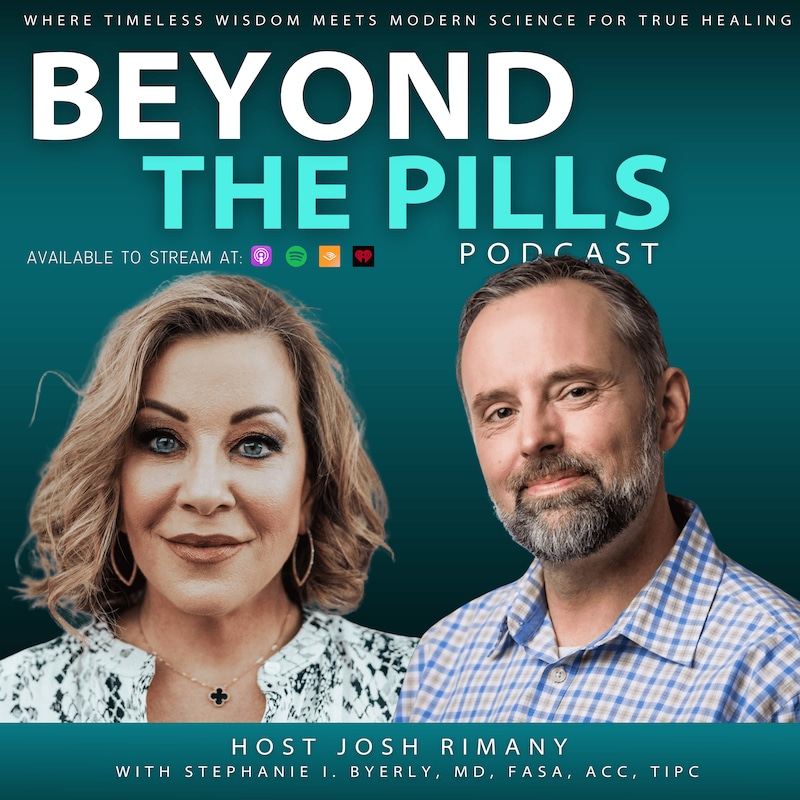
In this powerful episode of Beyond the Pills, we sit down with Dr. Stephanie I. Byerly, physician, educator, and advocate for human-centered medicine, to explore what happens when healthcare treats the body but misses the person.
Dr. Byerly challenges the prevailing model of “fixing” symptoms without addressing the deeper conditions required for healing. As she shares in the episode, “The body doesn’t heal when it feels rushed, pressured, or unsafe—healing requires regulation, not just intervention.”
Together, we unpack why so many people feel dismissed or unseen in conventional medical settings, even when they’re doing everything “right.” Dr. Byerly explains how chronic stress, overwhelm, and constant performance—both in life and in healthcare—keep the nervous system locked in survival mode. And when the body is stuck in survival, healing becomes almost impossible.
One of the most striking moments of the conversation comes when she reminds us:
“You can’t out-supplement, out-medicate, or out-discipline a nervous system that doesn’t feel safe.”
This episode also explores the hidden cost of speed in modern medicine—for patients and physicians alike. Dr. Byerly speaks candidly about the pressure clinicians face to move quickly, follow rigid systems, and prioritize efficiency over presence. “When we stop listening,” she says, “we lose the most important diagnostic tool we have—the patient’s lived experience.”
Rather than offering another protocol or checklist, this conversation invites a reframe. Healing isn’t about doing more. It’s about restoring connection—within the body, within relationships, and within care itself. As Dr. Byerly beautifully puts it, “Healing happens when the body feels supported enough to stop protecting itself.”
If you’ve ever felt frustrated by a diagnosis that didn’t fully explain what you’re experiencing…
If you’ve followed all the health advice and still feel stuck…
Or if you sense that true healing requires more than treatment alone—
This episode offers a compassionate, grounding perspective that makes sense of what so many people feel but struggle to articulate.
At its core, this conversation is a reminder that medicine works best when it remembers the human at the center of it all. Healing is not just biological—it’s relational, emotional, and deeply human.
🎧 Tune in to hear how stepping Beyond the Pills opens the door to deeper regulation, resilience, and real healing.
Connect with Stephanie + Support her work!
www.stephaniebyerly.com
FB/Li/IG: @stephaniebyerlymd
💊 Join The Beyond The Pills Community Today, Unlock True Healing Tomorrow!
Transcripts
115_Stephanie_Byerly
===
Josh: [:Join me and other practitioners as we guide you towards vibrant health, body, mind, and spirit, and move beyond symptom management into true healing. Welcome back folks to Beyond the Pills. My name is Josh Rimini, pharmacist Turn Healer, and your host. And today we have a special guest, Dr. Stephanie Bierley.
years [:Barley has numerous leadership roles, including Chief of Staff, chief of Anesthesiology, chief of Obstetric and Anesthesiology, and Chair of the American Society of Anesthesiologists Committee on Women Anesthesiologists Beyond the Medicine. This is the Beyond the Pills podcast. She is a certified life and professional coach with an associate certification and coaching designation from the International Coaching Federation.
e, and authentic leadership. [:Today through her private coaching practice, she guides women to heal, feel. Lead from wholeness because as she says, life is beautiful when you can feel it again. Welcome to the show, Stephanie.
Stephanie: Thank you. Great to be here.
Josh: Oh, it was great. I, I love reading these 'cause it's such a great primer for me. Like even that, that place around like.
Your, your patterns, helping you move to where you, who you've become and all that. We'll get into all that.
Stephanie: Yeah. Uh,
of people that have kind of [:But before we talk about coaching and awakening, like. Let's talk about your story and who you were before you realized you had been living in this emotional anesthesia.
Stephanie: Yeah. Thank you so much. Um, excited to tell my story because I think it, it helps people understand that, um, there's so much that we don't know that's going on in the background and how will we start to understand our life and the impact that it's had.
hcare workers as these noble [:And I think I, my nervous system sensed from the day I was born that I was in a very unsafe environment. And, um, this is no blame to, to my mother. I know, you know, she did her best, she had her own struggles, but it put me in harm's way. In a lot, a lot of the time. Um, but there was a student nurse and I, I wish that I, I could knew her name or who she was, but she befriended me.
And we would go around, I was four years old, uh, at night and we'd fill the oxygen tents with ice in the pediatric ward if you had to sleep in this oxygen tent. And I re I remember that, um. Um, she would come find me and we wheeled a little card around and a year later I had to have a tonsillectomy.
plastic stethoscope and the [:Then, um, things got drastically worse in my childhood and my mother had separated my sister and I, and we moved to Florida. And during, uh, one of her marriages there was a lot of, uh, abuse including sexual abuse for me, abuse for my mom, and just, just a lot of things. And if you know about the Adverse childhood experiences survey, the ace.
. To [:And that was a blessing in disguise because it really helped me with my work ethic, but also I think really started my passion for helping women because I went to work at a national fast food chain and I told them I wanted to be a cook. And they said, women don't cook. They're only cashiers. And I said, well, you just watched me.
And so I became the first female cook. Um. Then, uh, and, you know, followed my passion and became a physician. Um, thought I had met, you know, this most wonderful individual got married and that was another form of, um, severe abuse that occurred. Uh, and I didn't know, you know, really that a lot of it stemmed from previous trauma and how I, you know, didn't understand what healthy relationships were, um, were.
, um, a younger daughter who [:I didn't understand why. I was like, what is wrong with me? Right? Like I, I've achieved all these things. I decided that my life was not gonna look anything like what I saw growing up, and that my children's lives were not gonna be anything like what I experienced. And then I was like, goodness, I have to figure this out.
And so. I knew my Altman younger daughter had was gonna have a lot of struggles. And so I went on this journey and met some amazing practitioners and started doing something called Psychodrama. Have you ever heard of that? Yeah. And so, yeah, so imagine spending three days with a group of trusted individuals who've all experienced a lot of trauma.
we are recreating our trauma [:And I, I said, Shirley, I guess, I don't know. Can you please tell me? 'cause by now I'm like, you know, I don't know. Right? She's like, you have been numb every day of your life. So what do you do? You make people numb every day when they're having the most horrific things done to their body. And if you wanna talk about a light bulb moment where my mind was blown, I was, I thought back and it was like this cascade of memories and I was like, oh my gosh, I am physically present but mentally never present.
d I just realized, I'm like, [:And so continued on my healing journey. And then when my daughter, well, we had to do an intervention for her, for her addiction. It was an intervention for my life as well. And they told me. During her recovery that I had some of the most severe trauma they had ever heard about and that I needed to have trauma therapy, and that was the next piece that was life altering for me.
I had EMDR therapy with an amazing, yeah, amazing practitioner and that changed my life. And then I, I thought there's gotta be something more. Because I've gotten through burnout as a physician. I've had so many life experiences. I wanna help women in a different way. And I specialize in taking care of really sick, pregnant women.
o to Africa and take care of [: And this was in:And so I got certified as a life coach and then. The momentum just started even more and more and I published, uh, many papers about women anesthesiologists and women physicians, and it just cut started to steamroll and that's when I, my advanced feminist coaching certification and learned about all of the, um, I.
alization of women, women of [:So I wanted to get this coaching certification and then that opened a whole new world of being a trauma informed coach. And then, um, really, uh, wanted a deeper understanding for women. So I'm in this long mentorship with a woman named Dr. Claire Zammit, who is amazing. And so it's just, it's kind of a steamrolled into this.
on bringing back some of the [:Josh: I love it. Um. The journey, right? The mm-hmm. There's so much, like, I had all these questions for you, but you've already, like, you've piled through most of them, like ace experience, the connection of that. Um, thank you for sharing all of that, because when we move a lot of, there's a lot of talk about trauma now, like it's been open, like there's, and there's many ways to, to work with it rather than just be a buzzword.
bout healing here, we're not [:Sick care medicine. This is a healing modality of like taking trauma and heal. Like, not, not, not eradicating it like we do with diseases, but like we're healing it so we can live, we can heal it so we can wake up that body and wake up to be living in this world. And I love how you had that, those few moments.
It's that there's something else here. I'm learning it. I'm leaning in, I'm, I'm. I'm saying yes to these things that are, are calling me and mm-hmm. I, I've, I've talked through this with a lot of people that have gone through the, like the traditional medical route in different ways and have sort of become coaches and become like moving towards healing modalities have studied them all over the world.
at get into like medicine or [:Stephanie: Yeah. It's really fascinating to me because, um. If you think about, is medicine a calling or are you called to medicine? So is it something innate and you, or is it a combination? And so, um, when you look at ACEs, the ACEs survey. People who have a score of four or more are more likely to go into helping professions.
um, right. You look to help [:And you're more likely to go into academic medicine. It's so interesting. But the other pieces of this, which are fascinating, which more studies need to be done, but it also shows that if you have an ACEs score of four or more as a physician, that you are more likely to become burned out. Yeah. And so, you know how it is like, wow.
y, you know, as you know, we [:Yeah. And so I think there's a mindset that so many of us have that it is built in, that that's what we're supposed to do. That is a big part of what's harming healthcare workers, in my opinion. Um, but I really think that, um, medicine call calls us rather than really, it's a calling for us, per se. There's something that draws us to these helping professions.
ing, like the medicine comes [:Mm-hmm. You're, you're answering the calling because the medicine found you, and I love how you kind of brought it into the, the, it is, it's the wounded healer's journey, right. We, we've become, but I love your aspect on that. I'm like. That, the nature versus nurture component of it, because, yeah. The other side of it is you go to pharmacy school, you go to medical school, you go to nursing school, like you're taught, like you're wired.
Like there's a wiring that happens in our, in just in our education that says like, if, if you're not on the edge of burnout, you're not gonna make it like the residency programs. Right. We're built, burning them out to share that. So it's almost like that double-edged sword you got into it because you were already wounded and you don't really have the mechanisms which, which, you know, at some point too, it's like, it's almost like a blessing and that curse thing, right?
It's like if you're wired to [:It makes us good practitioners, even in medicine because we can be empathic to people and we have to, we can only do it from a place of self fullness. Right. And, and, and when our, when our batteries are charged and our were overflow, then we can serve. And that's been. Practice of journey and discovery for me.
So I'm glad that you're enlightening that towards this whole process in your light, in your way.
ost an entire day, you know, [:Um, and I don't think we talk enough about the traumatization of healthcare workers and what we see every day and what we do to people every day. And. I'm grateful that I am a, a trauma-informed coach and have a group to process things with because there's things that happen, vicarious trauma where I might not even see a patient, but I hear about their history.
And when, even if it's not happening to you, but you hear it, your brain processes it as if it's primary trauma happening to you. And so the whole cycle starts. And so even just hearing about a patient, let alone seeing what has happened to them gets imprinted on us as primary trauma, and we don't understand that and what that does to our nervous system.
the day, which also affects [:Josh: Well, I love this part. I had this maybe six months ago, like this download, this epiphany that I had around, 'cause I've, I've, I, my A score's pretty high.
Like I've had traumas throughout my whole childhood from two through. Through almost adulthood. And so I've, I've been very curious on that space. This has definitely enlightened me. But like that's when I had this thought, I was like, you know what? I've worked in a pharmacy since I was 15 years old and knowing more about energy work and energy medicine and where the body keeps the score and all these things that we know in the scientific world now, this isn't just woo.
itive and you can bring, but [:And so I'm was thinking about, it's like. Being empathic and understanding people on a deep level and pulling in all of that type of thing. In, in, not in the conscious realm, but like in going like, oh my gosh, how many thousands of people have I just, it's not their fault, but like, I've, that part takes that toll on you.
And I was like, whoa. Right. It's not just me, it's the my, my environment of Matt. That's why I think the, the question I had was rooted around that, but it was more of like. The burnout in medicine is so high because we also are taking on everybody else's, you know, energetics to it, which then, which you and I both know, there we're, we're, we're not quite there where we're addressing that yet in the workplace.
Right. But it, [:So I'm glad you're bringing this to your light. It's really, it's really helpful for me.
Stephanie: Yeah. I, um, I really saw so much of this recently. Um, you know, I get called to the emergency room when there's a trauma that comes in, in case they have to come to the operating room emergently and I, I intentionally do not look in the room when.
onders and they see horrific [:And I just look at them and I just think. It really hurts my heart to really think about the walls that they must have to put up and the armor to be able to go in and do the things they do and see the things that they see and how they function in their lives and have any kind of, yeah, just
Josh: to function.
It's, it's a formula. Yeah. It's pt, it's trauma. Right. It's a big, yeah. And yeah, I have a good friend that's been been a paramedic. We're just, we're talking physical trauma here, like things that are, you know, most humans should not be able to witness or experience and they're the ones saving those people, right?
I really am hopeful and, and [:'cause they've chosen this path or maybe the path's been chosen for them. It's up to them. But it's not just, I go to work every day, deal with some tough stuff, and then I go home. It's like it, there's a carrying of that weight that I think what we're talking about now is solutions based. Mm-hmm. Um, where I hope it just becomes a standard of.
Care for, for these people that are in these professions, paramedics and first responders and drama, you know, er and, and everybody that's in this space because, yeah, this is, this, there's an, there's an empathy here for this kind of work that we now know takes a bigger toll than we thought, and now here you are helping people in this space and moving through that.
ible way. And you've, you've [:The person you were, right? Like I love men's work. I love helping men go into their divine masculine, moving from their head into their heart, and it's like. If I really look at it, I love that. Again, same thing consciously or subconsciously, but from that like the, almost like the regenerative side of it is like you work well with women because that's what you went through, so you can be empathetic.
drawn to me and I can, I can [:Stephanie: So if we look at, you know, women in general, and, and I'm just gonna start by saying women of color or any woman with any type of marginalized identity, everything that I'm gonna say is amplified for them in ways that you and I can't really. Understand, but when we talk about women, um, in general in the workplace, we have to realize how women are socialized.
ight? All the things we see. [:Actually, I call it because you, when you were a carefree little girl running around and there was no, there was no labels yet. You didn't worry about how you looked or how much you, you would talk or you know, things like this. But by the time you're nine or 10, you already know I should be smart, but not too smart.
I should be pretty, but not too pretty. I should be this, but not this. 'cause you've already been told. And so really thinking about that programming and you also start to be, um, indoctrinated into women are not good leaders. Women are not good with money, women are not good with investing. Women are here.
So if you think about that, [:This is. Discussing the waters that we swim in the program. Men are, yeah, men are socialized to believe that women are not good leaders and that they're all about their body and that they're not good with money and that men are supposed to protect women. So all these things are going on in the background and we don't realize that so often.
The way it shows up is this unconscious gender bias, but. Some objective things in the workplace. So for women physicians, women physicians in general make less than men. I was on the hugest study in the committee of women anesthesiologists and with everything controlled for in the study every possible variable, women anesthesiologists make $35,000 less a year than male anesthesiologist and, and all women physicians make less money, especially in the primary care setting.
Women get promoted less [:And I had, um. A patient, I, I walk in the room every day, introduce myself the same way. I'm Dr. Byerley, I'm gonna be your anesthesiologist. And this patient said, are you a nurse anesthetist? And I said, no, sir, I'm a physician. And he said, are you a physician assistant? And I said, sir, I am an md. Do you have any other questions about my credentials?
you can imagine why there's [:And so it becomes your identity. And, um, I'm just gonna say this. Um, I love what I do every day, but I do think that medicine is an abusive relationship with healthcare providers and mm-hmm. I think that COVID really showed that we will go to extreme lengths to care for others and put ourselves at risk.
and it. Some other examples [:I would say not all, but in general, there are studies to prove this, and so what happens is they. Overburdened as well, and the A nurse might say, Hey, can you see this patient? Please just fit this patient in one more patient. And then, you know, they're like, okay. Because they feel like if they actually voice, no, they're gonna be criticized as being the B word.
es. So the, the, the current [:Of suicide women physicians, it's, it's like just so much higher than for male physicians. It's very, um, it's, it's just devastating and, you know, when you start to think about this, it's, it hurts your heart.
Josh: Yeah. And it is deep too. And you talked about epigenetics and I've, I've studied and experienced like.
rationally, how do we unfold [:The proper signals so we can move our way towards a more conscious driven, a more higher, higher consciousness, higher vibrational community. Because I feel like that's where we're heading. But like in this instance, it's not just the physicians, it's women, it's people of color, it's, it's all people that have had some levels of generational issues where we're kind of now under, under underscoring, like there's this.
Kinda weaving of like the science we're seeing, like the studies and the epigenetics and all these tools we use. But now we're also understanding like how it's imprinted into our coding and how we can kinda, what are your thoughts about unraveling that?
Stephanie: I think the first piece is for. For people to under actually understand this and start to really think about, okay, this is real.
Like it isn't just that [:You know, maybe vicarious. You're looking through social media, right? You're doom scrolling. We don't understand that all that gets processed as primary trauma. And so what we see nowadays, right? We see things that 20 years ago we never would've been able to see 24 7, the wars, you know, the all the things in politics, all of the racial issues, COVID, all these things.
radical empathy for yourself [:You're not being othered and there's not something wrong with you that you're part of the bigger collective. Right? Because we started in tribes, so we wanna be accepted by other people. But when we, when we get othered or we think that we're different, you know, we automatically look at ourselves as broken.
And so it's normalizing. We've all had trauma. Can we look into this in a nonjudgmental way? We're not going back and blaming parents, it's your fault I'm this way. 'cause. Until I was about 40, I think I lived in the past of this is all my mother's fault. If my childhood would've been different, then we have to take radical, radical responsibility for ourselves as individuals and how we can start this healing journey.
Because when you actually [:Bruce Perry, which I think is a great book for people to start to understand trauma. 'cause it's all through storytelling. But they say, can we look at individuals and maybe think what happened to that person rather than what's wrong with that person? Hmm. And that. Brings back the humanity between two people because none of us can really understand when we come from, you know, certain walks of life, what other people's lived experiences are every day.
certain way because of their [:Josh: Yeah, that's, I love, I love those, those touch points that you've enlightened with because, you know, it is, you know, I think a lot of times people feel like they, they're. They've been, they've had trauma to them, like something's happened to them and then they're, then that labeling comes in there like, there's something wrong with me.
ty if you almost like of the [:Right. And normalizing it means that like we take the. We take that heaviness out, like, yes, trauma work is deep work. It's not easy to come out, and sometimes you don't need to pull it all out. Sometimes there's ways to do it now that you can, and we're moving closer to this, but the human experience is full of.
I love how you said it may not have happened to you may even have witnessed it to somebody. Yeah. Still rings an imprint, so I love where you see, like normalizing it, making it less heavy. Talking about it is just, and then yes, I'm a firm believer of tribes. Like when you have. A cohort or people in your pod that you can talk with that aren't going to judge you or say what's wrong with you, that person's been traumatized.
no, we all have in some way. [:Somebody major thing may have affected them in very different ways. This is why I've been the down many rabbit holes of the manifestations of these things happen in different ways. So not just stress and trauma, but like we're all adapting in different ways. And so yes. Get a deeper understanding. But I love the, that curiosity almost like you're, you're, you're more inquisitive of how you can almost look at it from their lens so you can relate to them more.
ike what, what would it take [:Stephanie: Yeah. It's cultural humility and I have to say that, you know, I learned so much of this, um, from one of my mentors, Dr. Kimia, RAF, who started loadstar Executive Coaching and Consulting, and this is a huge trauma group. Um, and we go into very large. Healthcare organizations to, to teach trauma-informed leadership because how different would it be every day when you came to work if people around you were all on the same page as far as this?
sn't make them bad. And, and [:The trauma response, the fight flight freezer, submit. You didn't choose your nervous system. Chose what response was gonna be your primary response. And so when we think about that, when we go to work, what if there's somebody who seems like they're not interested with what's going on and they're not motivated and we call them lazy and all the things we do well, maybe they were in some kind of trauma response.
uation at work that you were [:And so what does that do to your nervous system when you know you're walking into that situation every day? It puts you on high alert. You're scanning for danger, right? You misinterpret signals. Things that are, you may be responding to things in a way that people are like, what is going on here? Like that?
What just happened didn't warrant that response? Well, maybe it's because that person's nervous system was activated.
Josh: Well, and that's that. Sympathetic drive, right? The sympathetic is, you know, we say autonomic, it's automatic, right? Yeah. We can't, we can't real, we can learn to regulate, we can do to rewire these things, which is beautiful.
m. Especially with your, the [:Like what, what are the things that, are the tools that you're, you're using in your practice now that that can be helpful so people are aware of them.
Stephanie: So I, um, combine several modalities and when I first start working with a client, we talk about their personality type. Um, and they've been, you know, judged and maybe told they're too much and they need to tone it down and all these kind of things.
happening to you as a child. [:It's gotten me really far in my career, you know, my life. But I need to now look at all the things and say, Hey, maybe there's things I need to change. And then we. Go into the life piece, life coaching piece where I give tools, something called a thought model where we actually realize our thoughts are creating our reality.
I teach 'em about the neuroscience, about, you know, your 60,000 thoughts a day, and most of them are stories and your brain is deciding if you're safe or not, right? So we talk about a strategy to actually work through what's happening every day with your thoughts and getting a hold of that. And then we talk about the trauma.
s system. And we say, how is [:And then I bring in my women-centered coaching where Dr. Claire Zat talks about, um, every woman, the first three filters that every woman looks through are shame, lack in isolation. Then there's these 21 inner barriers that we actually operationalize in our life. And the first four are, I'm not enough. I am alone.
I'm not visible, or the one that I live in, which is I am too much. And how, you know, that rules our life every day. So we, we kind work with all of this and we say, okay, so now we get all of this. What is the area in your life? What vision area? Is it purpose? Is it prosperity? Is it health? Is it relationships?
ho you think you are through [:And so we go in. You get to decide now who you are and we create the new story. We break through the barriers. And for women it has to be intentional actions, intentional habits, and we just, we build the new story and the new way of being. And then we say, okay, so what's the next area that you really wanna start working with?
Because once it starts the momentum you, because women start to feel like, okay, I can get some control of this. I can become this person. I'm not stuck in this cage of who I've been told I'm supposed to be anymore.
Josh: I love that. Um, [:Um. What are, what are some ways that people can connect with you and in the ways that work and, and resonate?
Stephanie: So my website is stephanie byerley.com. Um, I will mention that I'm going through a big rebranding right now. So the website is kind of, um, a, a, a little bit in the making, but there is an, an area to schedule a breakthrough call, which is an hour long complimentary call to talk about, uh, how I can help.
u as well. Um, and my social [:I'm really excited about a TEDx talk about trauma that I'm gonna be doing in June. Um, so lots of stuff. Exciting stuff. Yeah.
Josh: I was gonna, I was gonna probe you on that, so you beat me to it. I love the synergies when, when people answer the questions naturally that I already gotta ask them. It's like, I love this episode.
Thank you. Um, thank you. I know that I, I've got, I've been going through this Ted Talk philosophy. I've been interviewing. I've got past second and third, like rounds, like I'm close too. So tell people a little bit about your idea. Where's spreading?
ing to the point where that, [:And it's a, it's really understanding and how trauma comes back as a reaction. It's not a specific memory. Um, and how we can begin to feel again and how that is freedom in your life and how when you become alive again. You can feel life is completely different and, and it's, it's joy. You start to feel joy again and pleasure and that you are mentally as well as physically present and you can develop connected, true relationships and you're not in survival mode all the time.
to feel again. It's um, it's [:Becoming an anesthesiologist and then connecting it back into the, the solutions, the formula for moving out and, and know the only way forward is through and moving it through that. And so I love that you're rebranding. I love that you have this now, you know. You know, the, this, this beautiful wounded healers journey where you're now helping people at the highest level.
and sharing your story, uh, [:And so,
Stephanie: absolutely. Yeah.
Josh: So that we have this conversation today. Go check her out. Go check out her website. Use Step Lee Barley, um, md, step lee barley.com. Check her out if it resonates. I love that you gift that hour, an hour of your time is precious. And having that this isn't a 15 minute check in to just get you like an hour is a, is a, is a lot like for in this day and age, especially for someone that's a busy anesthesiologist working and coaching and all this thing, so, mm-hmm.
You know. Thank you for the [:Stephanie: Thank you. And, and, and, um, I feel honored to be on your podcast and thank you for what you do as well, right?
It takes, it takes a herd of all of us to keep moving.
Josh: I firmly believe it. It's these conscious avengers that are coming out that are. Moving through this new paradigm of not humanity and our healthcare system is moving towards these things like really getting to the human experience because when you can feel we're divine beings, living a human experience feeling is literally an emo emotion.
orld in the way that we can. [:Thanks so much for, for all that you are and all you're doing. Thank you so much. All right guys. We could probably talk for hours, but right now that's a wrap. Until next time, stay well.
Thanks for joining me today on Beyond the Pills. If our mission to de-prescribe 10 million unnecessary medications resonates with you, share this episode, subscribe and leave a review. Whether you're a practitioner or someone ready to reclaim your health, visit rx to wellness.com For free resources to begin your journey together, let's go beyond the pills and co-create a world of vibrant health and true healing.
Until next time, live better and stay well.





