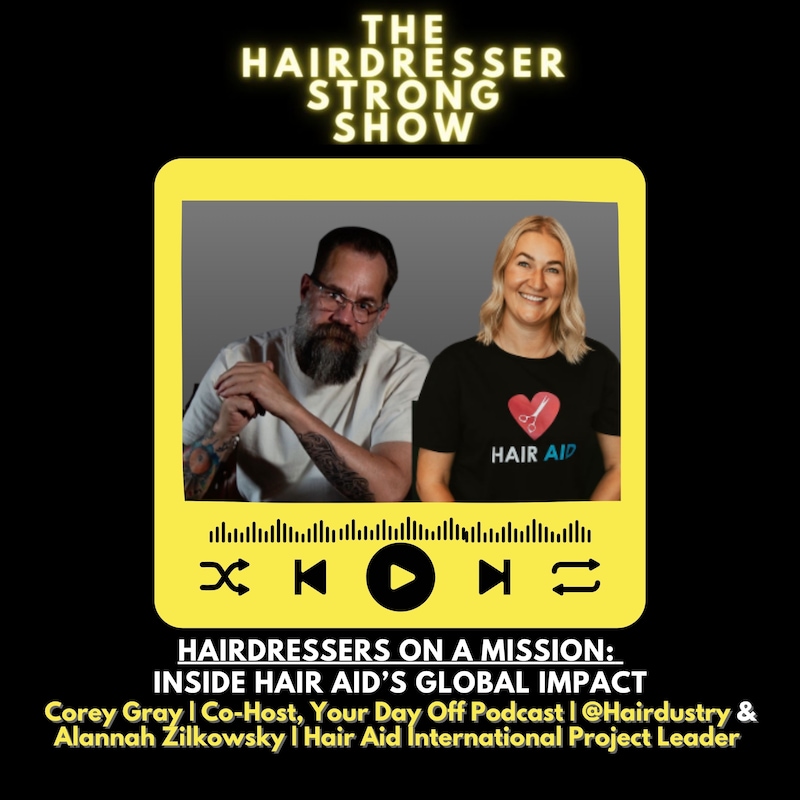
Shownotes
In this episode, Corey Gray and Alana Zylkowsky share what it’s really like volunteering with Hair Aid, a global charity teaching haircutting skills to break the cycle of poverty. From Cambodian prisons to women’s shelters, this conversation explores service, resilience, and the power of education.
Follow/subscribe to be the first to know when new episodes are released. Like what you hear? Leave us a review!
Key Takeaways:
🔅Get involved through Hair Aid - They train people in developing countries to cut hair for micro-businesses and provide free community haircuts by volunteer hairdressers. Hair Aid works with trained hairdressers who volunteer to teach in partnership with local NGOs. Stylists can apply to volunteer, donate, or support through awareness and fundraising.
🔅Education breaks the cycle - For many trainees, this is their first formal education, creating opportunity where there previously was none.
🔅Community is the real impact - Graduates go on to train others, open salons, and place stylists across their cities, creating ripple effects throughout entire communities.
🔅Relationships matter more than travel - Volunteering is not tourism. Cultural immersion, humility, and relationship-building are what make the work meaningful and effective.
🔅Service transforms you, the volunteer, too - Volunteers consistently report renewed purpose, personal growth, and healing from burnout through service.
🔅Corey’s experience wasn’t just professional, it was personal - He describes Cambodia as deeply emotional, perspective-shifting, and centered around surrender, humility, and presence
RELATED LINKS
👉Learn more about Hair Aid & get involved on their website
👉Follow Hair Aid on Instagram & Facebook
👉Connect with Alannah on Instagram
👉Connect with Corey on Instagram
The Hairdresser Strong Show is all about Salon Owners, Rising Stylists, and Seasoned Stylists sharing their experiences, successes, failures, and advice to inform, educate, and empower their Fellow Hairdresser. We won’t stop until we are all: Hairdresser Strong.
CONNECT WITH US
📬 Subscribe to our free newsletter
The views and opinions of our guests are theirs and important to hear. Each guest's views and opinions are their own and we aim to bring you diverse perspectives, career paths and thoughts about the craft and industry so you can become Hairdresser Strong! They do not necessarily reflect the positions of HairdresserStrong.com.
Transcripts
Lana Zielkowski is an 18 year industry veteran.
Speaker A:She's been a salon owner for nine years and she's one of the international project leads for Haring.
Speaker A:Corey Gray is a 30 year plus industry veteran independent colorist host and the host of your Day off podcast.
Speaker A:Today is a special day because Corey just took, took a trip to Cambodia and I've been asking him to tell me all about it.
Speaker A:And so we decided to get together on a podcast and talk about it.
Speaker A:And we're here with Alana who was there with him and is going to tell us so much more about hair aid.
Speaker A:I'm super excited to hear all about it and everything else.
Speaker A:So welcome back to the Hairdresser Strong show.
Speaker A:My name is Robert Hughes and I am your host and today I'm with Alana and Corey.
Speaker A:How are y' all doing today?
Speaker B:What's up, Rob?
Speaker B:What's up, buddy?
Speaker A:What's up?
Speaker B:You know what, I'm so, I'm so glad that we chose to like do it in this format, you know, just to talk like raw about, about the experience because you don't know much about it.
Speaker B:But, but, but I also asked Alana to come on because she's such a great lead for, for the actual project.
Speaker B:You know, I was just kind of a guest of hers, to be, to be honest.
Speaker B:I guess it was like, like last summer, not this, not three months ago, but you know, whatever that was 15 months ago.
Speaker B:Alana reached out to me.
Speaker B:She's like, hey man, if you, if you want to come to Cambodia, we should, you should sign up to do it.
Speaker B:And, and, and I did.
Speaker B:So welcome my friend Alana.
Speaker B:Man.
Speaker C:Hello.
Speaker C:Hello.
Speaker C:Thank you so much for having me on today.
Speaker C:I'm so excited to chat about my and Corey's experience in Cambodia and tell your listeners a little bit more about Harried and what it is and what we do.
Speaker A:Awesome.
Speaker A:Well, let's jump right in.
Speaker A:So Alana, tell us like a little bit about yourself so the audience gets to know you a little bit.
Speaker A:And how did hair aid come into like your, your life?
Speaker C:Awesome.
Speaker C:So I am up in Edmonton, Alberta, Canada, hairstylist for 18 years and I traveling internationally.
Speaker C:I've been to 39 countries on six continents.
Speaker C:I've got my two little rescue dogs at home with, well, they're not that little with my husband.
Speaker C:And I found Harried about seven years ago.
Speaker C:I saw it posted on Facebook through Tabitha Coffey, who we all know and love.
Speaker C:She did a volunteer project with Cambodia about eight years ago and I was like traveling, hairdressing, my two loves.
Speaker C:Let's combine them together.
Speaker C:And from there I just kind of kept my eye out for a project that worked with my timeline, signed up and hit the ground running.
Speaker A:Nice.
Speaker A:Awesome.
Speaker B:Cool.
Speaker A:Awesome.
Speaker A:So what exactly is Harried?
Speaker C:So Harried is an Australian charity that's been around for about 15 years.
Speaker C:And what it is is they do volunteer led projects in Cambodia, Indonesia, Philippines, Guatemala and Thailand.
Speaker C:And we teach women basic haircutting skills so that they have the ability to go back to their communities with a way to earn money and put food on their family's table.
Speaker A:Awesome.
Speaker A:Awesome.
Speaker A:That's awesome.
Speaker A:So how many countries are Yellen?
Speaker C:So we're in five countries right now.
Speaker C: ing Thailand back up again in: Speaker C: Covid shut down the world in: Speaker C:So we're excited to be adding that back to the roster.
Speaker C:So five countries total.
Speaker A:Awesome.
Speaker A:This is so cool.
Speaker B:So.
Speaker A:So you said that helping women with, with skills, but Corey told me that he was working with some young so men inside of a jail.
Speaker C:Yeah, you know.
Speaker C:That is true.
Speaker C:So the original was just typically women, but in the last couple projects we have expanded into men's jail and we welcome men into the training as well.
Speaker C:It just is typically the women that are lacking in the skills are able to provide or we're working often with protected women escaping domestic abuse, sex trafficking, where they're learning new skills.
Speaker C:But yes, we do, we do teach everyone, especially depending on the location.
Speaker A:That's awesome.
Speaker A:So how do you, how do you.
Speaker A:Well, I, I'm curious like I guess because you're one of the international project leads, so I don't know how involved you are, but like, I just had a curiosity like how does this like the jail stuff there people are concentrated in one place.
Speaker A:So that I'm assuming that means working with the jails and the.
Speaker A:In the government.
Speaker A:What about.
Speaker A:How can you tell us a little bit about like these other groups of people that you know, do.
Speaker A:Are they.
Speaker A:Do you work with local charities and local organizations that bring the women together?
Speaker A:Can you tell us a little bit about how the structure works?
Speaker A:And then like, and then I'll.
Speaker A:I'm gonna ask Corey, like what was the experience kind of showing up into the.
Speaker A:Showing up into the space?
Speaker C:Yeah.
Speaker C:So we work and partner with on the ground NGOs and charities not for profits.
Speaker C:So Hair Aid doesn't come in and liaise directly with the people that need training.
Speaker C:We partner with local groups that already have those connections in the community with people in need, depending on the country.
Speaker C:For example, the Philippines, which I've done.
Speaker C:So I've done five harried projects.
Speaker C:Now these, the last one, I was in Guatemala in October, and that was our 51st project with Harride, and I was the lead for that one.
Speaker C:We are newer into that country, so we're partnering with a lot of charities on the ground.
Speaker C:Whereas the Philippines, we've been there for 13 years, they have an MOU, so a memorandum of understanding with the government, so legal documents with the government, so they partner directly with them.
Speaker C:So it kind of depends on the country and how established Harriet is and how much partnerships and connections we're able to have and build over the years.
Speaker A:Awesome.
Speaker B:So.
Speaker A:So maybe, needless to say, but just for clarity for the audience, Harry, not only we're gonna kind of learn more and more about it as we go until we can experience.
Speaker A:Understand what the experience is like, both for the.
Speaker A:For the beauty professional as well as the person who is getting this opportunity to learn.
Speaker A:But I want to just point out that it's not just hairdressers showing up and teaching people how to do hair.
Speaker A:Like, there's a huge operation behind that that is mobilizing and putting in tons of time to, like, build these relationships and these connections.
Speaker A:So this isn't just a really great.
Speaker A:I mean, yeah, it's great, cool opportunity to show up and travel and do hair and feel good and see another part of the world and.
Speaker A:But, like, you know, we.
Speaker A:What we like to talk about is, like, what goes on behind the scenes that people don't see on social media.
Speaker A:So thank you for.
Speaker A:For giving us a little insight to all the moving parts with international bodies and stuff.
Speaker A:So it's pretty big deal.
Speaker A:Awesome.
Speaker A:Okay, so, Corey, tell us a little bit about, like, you're.
Speaker A:You tell us a little bit about your experience.
Speaker B:You know, it's so cliche to say life changing, but.
Speaker B:But Rob, it really was life changing.
Speaker B:I think that for a few reasons.
Speaker B:You know, my first.
Speaker B:My first couple days that I got into camp that I landed in Cambodia, the first two days I visited, I was in Phnom Penh, but I visited both the.
Speaker B:The Genocide museum as well as.
Speaker B:As the Killing Fields.
Speaker B:And I think we have to kind of step through that.
Speaker B:You know, their genocide was very, very recently.
Speaker B: y lifetime, but it started in: Speaker B:But most importantly, anybody that had any kind of like status in the old government, so that means like any kind of teacher was killed first.
Speaker B:The, the, the, the, the police officers, politicians, you know, anybody that looked like establishment would kill.
Speaker B:And I only bring that up because the lack of education in the country is like, is mind blowing, you know, certainly like whatever, whatever.
Speaker B:Like par, that we think about education, it's just not really available there.
Speaker B:Not, not, not throughout the entire country.
Speaker B:I, I never got this, and maybe Alana knows better, but that there is a nationalized education system and that.
Speaker B:And so when you go into, when, when you go, when you're educating these people, like there's just a different level of either even understanding what education looks like.
Speaker B:You know, like, like you brought up the prison, like when we were in the prison, like, you know, some of the guys couldn't even, didn't even understand that like letters meant their name.
Speaker B:You know, some of the guys didn't know if they were left or right handed because they'd never held like a writing utensil, you know.
Speaker B:So this, this is a different level of like illiteracy.
Speaker B:Like we hear about illiteracy, but until you kind of experience it in that, in that sense, it's like, it's different, you know, and it's kind of hard to, it's hard to, it's hard to comprehend with like, with like a US understanding of what, what education is, you know.
Speaker B:But however, all that being said, I'm so glad it was.
Speaker B:When I was in Phnom Penh, it was, you know, the, the, the tough, it was a tough two days.
Speaker B:But I'm so glad that I did it because it gave me so much perspective, it gave me so much perspective about the country and how incredibly resilient the Cambodian people are.
Speaker B:It's a very, very young population.
Speaker B:There's very few people that are alive past probably the age of 60.
Speaker B:Well, I'm damn close to 60.
Speaker B:So you know, to, to kind of like when you see somebody that's a little bit older, you honor them a little bit differently, I think.
Speaker B:You know, you give them an extra nod or you give them an extra understanding, you know, because there's not one person in that population that's over the age of 60 that hasn't lived through hell, you know, and because, because if you weren't, if you weren't killed, you worked in, you worked in these, these, these camps or you Worked in, in these agricultural type stuff.
Speaker B:And you know, a lot of the people, certainly the people that were evacuated out of Phnom Penh, you know, on Sunday he's an accountant, on Tuesday he's a farmer, you know, and he's like, I don't know how to be a farmer.
Speaker B:You know, I'm an accountant kind of thing, so.
Speaker B:But again, you know, you just honor those people a little bit differently, I think.
Speaker B:And then when you meet the people, because there's not one person, not one person that we met in Cambodia that isn't directly impacted by the genocide.
Speaker B:It's just impossible to be.
Speaker B:It's.
Speaker B:It was too close.
Speaker B:It was, it was too close to go.
Speaker B:You know what I mean?
Speaker B:So there's also a different understanding with that and how incredibly resilient, how incredibly nice, how incredibly warm the people are.
Speaker B:And I'm not just talking about the hospitality people, like, they're, they're the easy people, you know, but almost everybody, like reach you with a, with a genuine smile and happy to kind of see you, you know, so it was, it impacted me in that sense too.
Speaker B:It's like, what are we holding on to, you know, as far as whatever.
Speaker B:When you see an entire population of people who have literally been through hell within a generation ago and just see how, how warm and open hearted they are.
Speaker A:Wow, wow, wow.
Speaker A:Talk about some gravity right there, man.
Speaker A:Oh my God.
Speaker B:I mean, my entire time, dude, was about surrender, you know, like every time, every time that I started to feel a little bit of like the ick or the whatever, A you realize that 99 of the ick that you're feeling is your own ego, you know, so totally it's a different conversation with your ego.
Speaker B:About two months before I went to Cambodia, I had a guy on the podcast named Light Watkins.
Speaker B:Light Watkins is Meghan Markle's meditation coach.
Speaker B:And because he's a meditation coach, he's traveled a lot through Southeast Asia alone.
Speaker B:And I asked him for his advice is like, you know, give me something, you know, give me something.
Speaker B:How.
Speaker B:What should I prepare for?
Speaker B:And he said that.
Speaker B:He gave me a very like, thoughtful 10 second pause.
Speaker B:And then he goes, well, my advice to you is to know that you're going to be on two journeys.
Speaker B:The first journey is the, the airports, the, the excursions, the, the, the, you know, the, the actual like hair aid project that you're going to go on.
Speaker B:He goes, but the real journey that you're on, the one that God needs from you, the one the universe needs from you, the one that.
Speaker B:That the world needs from you is the one that's going to happen between all those plans.
Speaker B:And he says a lot of times it shows up as stress.
Speaker B:And he says.
Speaker B:He says, I.
Speaker B:My recommendation is that in those moments, you stay present.
Speaker B:Now, what Light didn't tell me, and what I learned on the trip is that there is no presence without full surrender, and that's full surrender to everything.
Speaker B:You know, it's full surrender to your ego.
Speaker B:It's your full surrender.
Speaker B:Like I was saying, like, even just being an American in the way that things are supposed to be, you know, I gave up everything away that it's supposed to be in those moments.
Speaker B:And whenever I felt stress, then my reaction was to kind of fall back into, like, just surrender to it and be present in it.
Speaker B:And that.
Speaker B:And that's.
Speaker B:That's.
Speaker B:That's definitely the way that I lived that the entire time that I was there.
Speaker B:Because.
Speaker B:Because all that other stuff just gets in the way.
Speaker B:It just makes things, quote, unquote, worse, you know?
Speaker A:Wow.
Speaker A:Wow, this is.
Speaker A:This is so good.
Speaker A:Okay, so we got, like, the setup.
Speaker A:So, Alana, can you tell us a little bit about, like, what are you doing?
Speaker A:You're showing.
Speaker A:I'm assuming you're.
Speaker A:I mean, and correct me if I'm wrong, and I'm only assuming this because of something that was said before we started the.
Speaker A:The episode.
Speaker A:But.
Speaker A:You show.
Speaker A:Are you showing up early to, like, get things ready for folks to arrive?
Speaker A:Can you tell us a little bit about, like, what your part is kind of like, on the.
Speaker A:On the.
Speaker A:On the front side of this thing?
Speaker C:Yeah, absolutely.
Speaker C:So as a volunteer, you.
Speaker C:Harriet, has everything set up for you.
Speaker C:So if you're listening to the podcast and you're like, I want to get involved.
Speaker C:What is it?
Speaker C:What does it take?
Speaker C:What do you need for me?
Speaker C:We can touch on that in a little bit, but basically know that Harriet has everything set up for you.
Speaker C:We've done 51 projects.
Speaker C:You need to just kind of show up.
Speaker C:The hotel's sorted for you, your breakfasts are sorted, your transportation to and from the airport.
Speaker C:Like, it is a full package deal where, like, you do not need to worry about any of that.
Speaker C:And all of that runs super smoothly because there are people behind the scenes like myself, who really enjoy spreadsheets and who really enjoy emailing back and forth and having trello boards and everything set up of, you know, all that coordination.
Speaker C:So we are emailing nine months in advance, six months, three months, one month beforehand, with all the on the ground charities Talking to the NGO leads about how much need there is in their community, how many people that they're looking to host, getting all the transportation organized, everything like that.
Speaker C:So typically the project lead shows up five days to a week beforehand.
Speaker C:When I was in Guatemala in October, so I was so fortunate this year to actually do two harried volunteer projects.
Speaker C:I was with Corey in Cambodia and then a few months later I was in Guatemala, which as a North American is just a much, much shorter, quicker flight.
Speaker C:But Southeast Asia has a special place in my heart.
Speaker C:It is worth, it is worth the long flight and the, and the time difference.
Speaker C:But I show up early, I'm liaising on the ground.
Speaker C:I do tours through each of the location to make sure that the facility has what we need, which is very basic.
Speaker C:We need a couple tables and a roof overhead is ideal in case it rains.
Speaker C:But we don't need any electricity, anything like that, because we are teaching with tools and skills that the trainees are going to have.
Speaker C:Often we are teaching very impoverished people who may not have running water or electricity.
Speaker C:So we make sure that we're giving them skills that they can use realistically with their current life circumstances.
Speaker C:Tours of the location set up at the hotel.
Speaker C:I will check out some restaurants in town, do a market research that way so that we've.
Speaker C:We're having some great food experiences in the evening and typically we set up a few cultural experiences as well.
Speaker C:So in an.
Speaker C:In Cambodia we went to Angkor Watts.
Speaker C:In Guatemala, we had a cooking class and a walking tour of the city.
Speaker C:So, yeah, a lot of that logistical stuff to make sure it runs smoothly.
Speaker B:Robbie, I want to jump in there too.
Speaker B:She was talking about the restaurants and, and I'm embarrassed to say, but I didn't even realize it until like, I think it was like Thursday of, of the project, which starts on Monday, but maybe it's Wednesday, it doesn't matter what day it was.
Speaker B:But every restaurant that we went to in Cambodia was also an ngo.
Speaker B:So they're not just like, they're not just like walking the walk, they're living it.
Speaker B:Right?
Speaker B:So like the restaurants that we went to, it was, it was, it was people being trained how, you know how to work in, you know, a restaurant or in some kind of hospitality.
Speaker B:And that to me was, was very, very cool as well.
Speaker B:And the restaurants were killer too, by the way.
Speaker B:But, but that, that was really cool.
Speaker B:When I finally realized, I go, oh, like we're, we're really doing the thing.
Speaker B:We're really trying to make a difference in in this culture.
Speaker B:It's not like, it's not like we're just showing up and there's some kind of like humanit, you know, at moments.
Speaker B:And I recommend that you kind of like take experience that as well.
Speaker B:You know, if you're going to go, if you're going to fly, you know, literally halfway around the world, you should experience some of that.
Speaker B:But actually the week, the week of the project, I was blown away that, that the efforts that went into supporting, you know, not just our NGO, but, but the NGOs around Siem Reap, I was, I was really touched by that to be honest.
Speaker A:This is awesome.
Speaker A:So let me.
Speaker A:So give me a play by play of what it's like to kind of like show up and.
Speaker A:What like maybe like day one is so kind of like I can kind of envision it and the audience can too.
Speaker A:So I get on the plane, I fly to destination.
Speaker A:You could talk.
Speaker A:You could use Cambodia as the example since you were both, I mean, obviously Alana, you know, but Corey, you were, you were there as well.
Speaker A:So like.
Speaker B:Yeah, I mean, so I got there.
Speaker B:I flew in the Monday before.
Speaker B:So the project from Monday to Friday.
Speaker B:I flew in the, the Monday before.
Speaker B:So I was there for about a week before the project for a few reasons.
Speaker B:One is that I really wanted to, I really wanted to enjoy the culture A and then B, you know, it's an 11 hour time change for us, you know, so it was also like to get adjusted to the time change before the work actually starts.
Speaker B:Yeah, the first week that I was there, you know, emotionally tough, but it definitely was like for me it felt vacationing because I was trying to take in as much culture as I possibly could.
Speaker B:Now that being said, when I arrived in Siem Reap on Thursday, when I arrived on Thursday and I got to meet up with Alana, that it was really nice to see, to see a Westerner as well, to kind of hang out and a lot.
Speaker B:And I have been friends for, for a couple years now, so it's really nice to actually like actually meet up.
Speaker B:And she was the first one to really feed me because when I was in Phnom Penh I didn't really want to eat.
Speaker B:But when I got to see him reap, we have, we had an amazing lunch at a, a pooled noodle place and I think our, I think Alana, Gino and I ate lunch there and I think our bill was $12 or something like ridiculous, you know, and, and.
Speaker A:What is the food like?
Speaker A:Just since we're talking about mentioned food a couple times, I feel like, what is the Cambodian food?
Speaker B:Like, it's extraordinary.
Speaker B:You know, it's so good.
Speaker B:It's so incredibly fresh.
Speaker B:You know, it's kind of tropical.
Speaker B:We, like, I said we had like, the, the pulled noodles with.
Speaker B:I had it with tofu, they had it with chicken.
Speaker B:And then we.
Speaker B:Which again, it's like this little hole in the wall that's on this corner.
Speaker B:But everything in Cambodia kind of feels like a hole in the wall, to be honest.
Speaker A:Thai food a little bit.
Speaker B:Where it's.
Speaker B:So where it's located.
Speaker B:It's.
Speaker B:It's kind of located between Vietnam and Thailand.
Speaker B:So sometimes when you went in the restaurant, they would ask you, like, how spicy you want it?
Speaker B:Like, do you want to tie spicy or do you not?
Speaker B:Like, I was like, I'm not all about.
Speaker B:I'm not about, like, belly issues here in Cambodia, so I'm just going to stick with, like, as, as.
Speaker B:As plain.
Speaker B:I put that in quotes.
Speaker B:As plain as possible.
Speaker B:But listen, the food is amazing.
Speaker B:I don't think.
Speaker B:I don't think I had a bad meal, you know, and then Alana, she messed us up.
Speaker B:Because on Friday night, which was kind of like our celebration dinner, you know, after the project, we went to this restaurant called Spoons, which I literally could have eaten there every single night because it was the best food I think I've ever had in my life.
Speaker B:And actually, this is funny, Rob.
Speaker B:So it's Friday.
Speaker B:We'll back up and get into the project.
Speaker B:But it was Friday night, and it was definitely our celebration.
Speaker B:Like, the project's over.
Speaker B:We graduated, graduated 127 students.
Speaker B:You know, you're feeling high on yourself, you're feeling really good.
Speaker B:Everyone's feeling good.
Speaker B:So, you know, we go out for a celebration dinner to Spoons.
Speaker B:And when we arrived, there was literally people waiting at the door that are walking you to your table.
Speaker B:Like, they take the napkin out, they put it in your lap, they're reading the menu to you and stuff.
Speaker B:And, like, I'm like, holy.
Speaker B:What is this meal gonna cost me?
Speaker B:Right?
Speaker B:Like, because it was the end of the trip.
Speaker B:I was out of cash.
Speaker B:Like, I was like, what.
Speaker B:What is this trip gonna cost me?
Speaker B:Well, I can.
Speaker B:Or what's this meal gonna cost me?
Speaker B:Because it felt like a 500 meal.
Speaker B:You know what I'm saying?
Speaker B:Yeah, I think it was 17, you know?
Speaker B:Yeah.
Speaker B:And that was.
Speaker B:That was definitely the most expensive meal that I had.
Speaker B:It was like, 17 was the most expensive meal.
Speaker B:And, and, And I definitely indulged a little bit.
Speaker B:You know, it just.
Speaker B:I can't even explain to you how like, fancy it felt, you know.
Speaker B:Although that also being said, I do want to, to be honest, you know, all the restaurants are outside.
Speaker B:You know, the hotels that we stayed in were outside.
Speaker B:You know, you, you, you, you.
Speaker B:The hotels very much felt like White Lotus to me.
Speaker B:You know, how it's kind of like this outside thing and then you kind of go to your.
Speaker B:Is that, is that fair, Alana?
Speaker C:Yeah, well, to be clear, the hotel rooms are inside.
Speaker C:Like, you do have four walls and a room.
Speaker B:Yeah, the hotel rooms are, but the.
Speaker C:Hotels are like, it's almost like indoor outdoor living.
Speaker C:Right?
Speaker B:Like, yeah, it's almost like an internal, like, motel.
Speaker B:Right.
Speaker B:Like, it's kind of like you just kind of walk to your room, but you're pretty much outside the, the whole, the whole time there.
Speaker B:But, but that also being said, the accommodations were great and the hotel is an ngo.
Speaker B:Same thing.
Speaker B:Right.
Speaker B:So, you know, they're walking the walk with.
Speaker B:I don't even know how I got here.
Speaker B:Okay, so.
Speaker A:Well, well, I wanted to say I, I was curious.
Speaker A:I just wanted to take a little detour real quick to give a little bit of context.
Speaker B:Yeah.
Speaker A:Which I think you definitely delivered on.
Speaker A:Was there something else you wanted to say before I asked my next question?
Speaker B:Well, I was just going to walk into like, what, what my experience was, but.
Speaker A:Yeah, please.
Speaker A:Perfect.
Speaker A:Thank you.
Speaker B:Okay, cool.
Speaker B:So the following Monday, Monday morning we get up and, well, we have a debrief or a pre brief, I should say we have a pre brief on Sunday night.
Speaker B:Alana will walk you through what the expectations are for the weekend or for what the week is.
Speaker B:I, I will say this.
Speaker B:You have to maintain.
Speaker B:You have to be fluid.
Speaker B:You know, it is a third world country.
Speaker B:Certainly, like Cambodia is a third world country.
Speaker B:You know, you ha.
Speaker B:You must remain fluid the entire time.
Speaker B:You in.
Speaker B:Whatever happens or whatever comes, comes, you just kind of go with it and you move on.
Speaker B:So I was very, very fortunate.
Speaker B:Like, Alana doesn't know me that well, but my home location was, was a, was a village school and community center.
Speaker B:But there was lots of kids there.
Speaker B:It was this great community center.
Speaker B:It was a villa.
Speaker B:It was, you know, I looked it up on a map.
Speaker B:Alana.
Speaker B:It is in the middle of nowhere.
Speaker B:There's no civilization around it.
Speaker B:It's just the people that live there.
Speaker B:Like I said, I, you know, your nerves going into it is like starting a new job, I think.
Speaker B:You know, like, you're just like, okay, what Is this going to be.
Speaker B:But you're also.
Speaker B:Once again, your head is like, I'm here to serve.
Speaker B:Because I'm not, like, traditionally a haircutter.
Speaker B:I had a little bit of those nerves as well.
Speaker B:But Georgie, who was my lead there, was absolutely extraordinary as far as managing me, because, you know, the one thing that I didn't want to do is I didn't want to be a student.
Speaker B:You know, I wanted to be there, and I wanted to be able to teach the skill that we were teaching on that day.
Speaker B:Hair Aid does an incredible job is the night before we go out, they have a video series that they put together.
Speaker B:This is.
Speaker B:This is the haircut that we're cut.
Speaker B:This is the haircut that we're doing, and this is how we do it.
Speaker B:I think it's really, really important, too, to point out that we know.
Speaker B:Robert, we know that you're a great haircutter, but there is a way to teach the haircuts.
Speaker B:They've done 51 projects.
Speaker B:There's a way that it's learned.
Speaker B:We know that you can.
Speaker B:We know that you can do a better haircut, but that's not.
Speaker B:That's not what's going to serve the people.
Speaker B:What's going to serve the people is to get.
Speaker B:Is to get through the skill set, the way that we're teaching it.
Speaker B:And also, it lessens confusion, too, right?
Speaker B:Because, you know, once you have a language barrier and you have a couple of students and you have a couple educators in the room, like, you can't be talking about different stuff.
Speaker B:I mean, you.
Speaker B:You teach haircutting, you know, certain.
Speaker B:Like, take that at the most basic thing, and I'll do it as a.
Speaker B:Now do it as a.
Speaker B:As a second language, right back to the community center school.
Speaker B:The school teaches English.
Speaker B:So almost all the.
Speaker B:All of our help that was.
Speaker B:There were teachers at the school, so they were able to translate for most of it.
Speaker B:Now, what I didn't.
Speaker B:Well, what I learned on Friday as well is that the actual location that I was in, a lot of the students spoke English as well.
Speaker B:They just didn't speak it enough to where they were conf.
Speaker B:And they wanted to kind of learn it.
Speaker B:And the language is Kamar.
Speaker B:They wanted to learn it in Kamar, just so they had a better understanding of how to do it.
Speaker B:But then it was so weird, like, on Friday, where you've been using a translator the whole time, and now you're having conversations with the classes all over, and I'm like, when you tell me you spoke English, you know, like, it was bizarre.
Speaker B:But, you know, that was.
Speaker B:That was super.
Speaker B:Like I said, super fortunate to be in a school.
Speaker B:There were just.
Speaker B:There were little kids there the entire time.
Speaker B:And because we're a community center, and I don't know if it's because we were there because, you know, being six foot one and white, you know, you certainly are on display there.
Speaker B:But I don't know if it was because we were there or what it was, but as the day went on, there were more and more students that were just kind of hanging out at the community center.
Speaker B:And again, I don't know if it's because, you know, we were the circus or because it's a community center, if that's what they did.
Speaker B:I don't know.
Speaker B:You know, but like I said, everybody was warm.
Speaker B:All the, the kids were warm.
Speaker B:This, The.
Speaker B:The.
Speaker B:The.
Speaker B:The.
Speaker B:The educators were warm, and they just.
Speaker B:They really, really appreciate your time there.
Speaker B:We taught six.
Speaker B:Is it six haircutting techniques, Alana?
Speaker C:Yeah.
Speaker B:So we talk.
Speaker B:We taught six haircutting techniques over about, they say, five days, but really it's four days, because one day is graduation.
Speaker B:Like, I don't know if we can teach six haircutting techniques in the US in six months, you know, but they learned them in four, and they learned them in four days.
Speaker B:You know, and the quote that I came up with and that and that I live by is that when Strat.
Speaker B:When.
Speaker B:When, oh, I'm gonna mess up my own quote now.
Speaker B:That happened.
Speaker B:But when.
Speaker B:When opportunity is your only distraction, you learn, you know, there was no.
Speaker B:It was.
Speaker B:It was such a weird.
Speaker B:Not weird.
Speaker B:It was such a.
Speaker B:Welcomed experience where nobody was really.
Speaker B:Everybody was really focused on their mannequin and how they did their technique.
Speaker B:They weren't looking about, over, about like, oh, what are they doing over there?
Speaker B:Or how are they doing it?
Speaker B:They really own the space that they were in because.
Speaker B:And I would guess because they knew we weren't going to be there the next week, like, this is the time to learn out of those six techniques, we, Each student had to do it twice.
Speaker B:So they had to do.
Speaker B:And there's no mannequin, so it was all done.
Speaker B:A live model.
Speaker B:So, you know, each student did 12 haircuts in four days.
Speaker B:Think about that for a second.
Speaker B:Think about your first week in hair school, and they're doing 12 haircuts.
Speaker B:And by the way, some of them absolutely murdered it.
Speaker B:Like, some of them did incredible.
Speaker B:Some of them.
Speaker B:Certainly when we were at the.
Speaker B:When we were at the community center, there was A handful of them that I could have gone and opened a salon with.
Speaker B:You know, after four days, like just, just.
Speaker B:You're blown away by the talent and, and the desire.
Speaker B:It's just, it's just I, I was blown away by it, you know, like, I can't believe this.
Speaker B:You know, they were teaching me by the end of the week, to be honest.
Speaker B:So my experience.
Speaker B:So the, the first two days I was at the community center and then on Wednesday.
Speaker B:You brought it up, but I worked in a prison for the day.
Speaker B:And it couldn't have been a more opposite experience, right?
Speaker B:Like there's no translation.
Speaker B:There's no, we had no guards.
Speaker B:We had no translation.
Speaker B:We had, or I should say minimal translation, but.
Speaker B:And the people that you're teaching are again, undereducated on all levels.
Speaker B:It was absolutely, positively, probably that I'm gonna say absolutely, positively, probably, but absolutely, positively the toughest day of my life.
Speaker B:But also absolutely, positively the most rewarding day of my life.
Speaker B:I learned more about Corey and the shoes that he stands in in those eight hours then I, I could have in a lifetime.
Speaker B:You know, there's a lot.
Speaker B:We were put in a room.
Speaker B:I think there was 12 students.
Speaker B:Gino and I fight about this.
Speaker B:I keep saying nine, he keeps saying 12, but he was there for five days.
Speaker B:So we'll go with 12.
Speaker B:So students, you know, all, all of them, you know, had a shear in their hand, you know, so every prison movie that we've ever watched is about like, you know, are you going to get shanked and you know, or getting a shank?
Speaker B:And here we just gave, you know, 12 guys like you know, six inch shanks in their hands.
Speaker B:So.
Speaker B:And it's also, it's not a hair salon, right, but it's this long.
Speaker B:The room that we're in was this long thin room with no mirrors, right?
Speaker B:So like you're teaching a haircutting technique and luckily for that day we're teaching like a long layer.
Speaker B:And, and, and you know, again, I had 12 guys behind me who I couldn't see all with all with scissors in their hands, you know, so it took me about, honestly about two hours of like high level stress.
Speaker B:About like, oh my God, is this my day to die?
Speaker B:You know, or.
Speaker B:And I mean I, I did have a co teacher and a lead there.
Speaker B:That was Jerry.
Speaker B:Jerry is a 69 year old woman who's about 5ft tall, basically.
Speaker B:Like if they were like, you know, she was gonna be much protection to protect me.
Speaker B:And by the way, I wasn't gonna Be much protection to protect her either.
Speaker B:But so, you know, this.
Speaker B:And again, you know, not.
Speaker B:Not a lot of language, not a lot of cultural crossover.
Speaker B:And again, for about two hours, I was pretty.
Speaker B:I was pretty stressed out.
Speaker B:Where I landed was that Gina's been here for a couple days and he's still alive.
Speaker B:So now my goal is not to piss him off, A.
Speaker B:And then B, I also was like, you know what?
Speaker B:I'm here to serve, man.
Speaker B:Get.
Speaker B:Get myself out of the way.
Speaker B:It just took me about two hours to get myself out of the way.
Speaker B:I knew that I had to.
Speaker B:And then.
Speaker B:And here's what I realized, Rob, on the.
Speaker B:On the.
Speaker B:On the ride back during lunch was that not one of those guys made me feel that way.
Speaker B:Not one of those guys made me feel insecure.
Speaker B:Not one of those guys felt like I was in danger.
Speaker B:Not one of those guys made me feel, you know, any of those feelings.
Speaker B:I brought all those feelings to the room, and then I. I had to think, like, how often have we brought, like, these.
Speaker B:These brought your feelings to the room?
Speaker B:And then blame the room for it, you know, for.
Speaker A:Totally.
Speaker B:Because for about the first hour, like, this is where I was.
Speaker B:And then after the two hours, I was like, I was able to kind of let all that energy go.
Speaker B:And then fortunately, unfortunately, went out.
Speaker B:We went to lunch after that, we had to clear the prison for about two hours for lunch.
Speaker B:So we cleared out.
Speaker B:And then when.
Speaker B:When I went back that.
Speaker B:That afternoon, it was just a completely, completely different experience because I had kind of removed my head from it, and I was no longer, like, you know, worried that I was going to die or.
Speaker B:Or, you know, get shanked out there or anything.
Speaker B:Also, another magical, magical thing that happened was the guy started teaching me the words in Kamar to teach them, you know.
Speaker B:So, like, again, kind of on my ride home that evening, like, it dawned on me that, like, on.
Speaker B:On our most raw, basic human experience, we're designed to communicate, and we figured it out, you know.
Speaker A:That's awesome.
Speaker A:Awesome.
Speaker A:Well, I know we're coming up on our time here, so I want to be conscious of that, and I want to make sure I get Alana, you to tell us everything we need to know for.
Speaker A:For those of us that are interested in.
Speaker A:In.
Speaker A:In applying or.
Speaker A:Or joining or whatever.
Speaker A:But before that, I was.
Speaker A:I wanted to hear from you since you've done other projects and you mentioned working with women who are in various situations around and the different locations.
Speaker A:And I imagine that experience will be a little different than Corey's So maybe you would like to tell us a little bit about that experience.
Speaker A:Experience and then kind of end up in kind of, kind of as you finish up that tell us a little bit about what we need to know to get involved.
Speaker C:Yeah, absolutely.
Speaker C:So I have my five projects that I've done.
Speaker C:I've done the Philippines twice, Guatemala, Cambodia, and then back to Guatemala.
Speaker C:So when I was in the Philippines, I.
Speaker C:The locations, some of the locations I was at was a drug rehabilitation center for women.
Speaker C:And what I had found, you know, it wasn't, it wasn't my place to be asking their experiences and why they were there.
Speaker C:But after a couple days, they do.
Speaker C:They do get to know you, they do trust you, and they do open up.
Speaker C:And what I had learned myself, you know, we have our preconceived judgments of drug use, especially in Canada and the US and something I also want to say here is like, the, the people that we're teaching, they are in base level poverty.
Speaker C:Like, like you and I have seen poverty and maybe experienced it ourselves.
Speaker C:But these are people who often live, no running water, no electricity, dirt floors, corrugated rooftops the size of a standard salon suite would probably house five families.
Speaker C:Like, it is a very, very different level.
Speaker C:And for most of these women that I was teaching in the Philippines, this was actually their first formal education they'd ever had in their life.
Speaker C:And what I learned was most of the women that were in there were in there.
Speaker C:Via addiction from their pimps, from sex trade work.
Speaker C:So, you know, at the end of the day, we're teaching them skills that they're able to, you know, now put food on their family's table.
Speaker C:We're teaching them, you know, you're not, you're not charging a hundred dollars for a haircut, but maybe now you can trade your neighbor for a bag of rice.
Speaker C:And that's a skill they didn't have at the beginning of the week.
Speaker C:And, you know, teaching them that they have, you know, they have the capacity to learn.
Speaker C:And teaching them that confidence.
Speaker C:And you really honestly see that at the end of the week, a lot of them are very shy, they're very quiet.
Speaker C:And at the end of the week, they, you're teaching, not only teaching them skills, but teaching them that they have the ability to learn, which is so powerful for me is just helping show someone their value in that way that some of these women are, you know, their 40s, 50s, 60s, and at the end of the week on graduation, graduation, the party, not the haircut, they get what's called when.
Speaker C:So graduation isn't a given.
Speaker C:They have to complete the whole program.
Speaker C:So they have to be there for the five days they have to get their haircut signed off.
Speaker C:But when they successfully complete the program, they get what's called a business in a bag.
Speaker C:Now, Harriet is a charity and 100% of everything that we do is donations.
Speaker C:So we ideally would like to get more corporate sponsorships to get bulk donations of like clippers and cape.
Speaker C:No, not clippers, capes and combs and scissors and clips and things like that.
Speaker C:But as it is, everything's donated, generally individually.
Speaker C:But they get what's called a business in a bag.
Speaker C:So it's a pencil case with four clips, a comb and a pair of scissors.
Speaker C:And with that they can immediately go with the next day and start making money.
Speaker C:And that's an ability they didn't have at the beginning of the week that you, by leaving your family and your friends and your salon and your job, flying to the other country, like, you've, you've helped teach them that and that.
Speaker C:It's just phenomenal.
Speaker C:It's, I, it's an amazing experience.
Speaker A:That's amazing.
Speaker A:And I want to also on, on just to ask a question that came, that came to my head when you were talking, Corey.
Speaker A:The people I remember, if you told, and maybe I'm, I'm misremembering this, but the people that you were teaching.
Speaker A:To Alana's point, were these people violent criminals or.
Speaker A:I feel like you told me that a lot of them ended up in where they are for things that they might not end up in jail here.
Speaker B:No, no, to be honest, we don't know.
Speaker B:You know, I don't know.
Speaker B:Nor did, nor was it a conversation that I wanted to have.
Speaker B:Like, like, no, yeah, you know, you know, it was like I was there to serve these individuals, not I wasn't there to serve their, their past mistakes or I wasn't there to serve, you know, anything.
Speaker B:I mean, I, I, I may have said, you know, it's a third world country.
Speaker B:You don't know why they're, why they're there, you know, like, like, But I don't.
Speaker B:We hit and there wasn't even enough, Robbie, There wasn't even enough, like, English to even, even if they were to tell me, I wouldn't know, you know what I mean?
Speaker B:And, but I wasn't going to ask either because again, I, it's not why I was there, you know, like, like, certainly when you're at home at night, you're like, you know, wonder what that guy was there for, you know, those kind of thoughts that are.
Speaker B:Go through your head.
Speaker B:But when you're there serving, like, your mindset is just to serve these people as individuals.
Speaker B:Certainly when I was in the prison, I. I wanted to make sure that each one of those guys were seen and believed in, because to Alana's point, I got the sense that they had never kind of been celebrated as individuals.
Speaker B:I got the sense that.
Speaker B:That they had never really been seen as individuals again.
Speaker B:And that was more my goal even than my haircutting technique is like, how can we.
Speaker B:Like, how can we honor them as humans?
Speaker B:You know, because it does feel like maybe they haven't been honored as humans.
Speaker B:That might be way too.
Speaker B:Too much to even think.
Speaker B:And by the way, I also admit that probably 99 of this I'm making up in my own head.
Speaker B:It might be my own story that I'm telling.
Speaker B:But.
Speaker B:But again, I was there to serve and, And.
Speaker B:And.
Speaker B:And to.
Speaker B:To worry about why they were there, totally.
Speaker A:And incarceration and drug addiction are two things that we all know.
Speaker A:I mean, I don't know if we all know, but I feel like if we don't know, we probably know somebody who knows somebody who's dealt with one of those things, if not both.
Speaker A:And we understand that there's an.
Speaker A:A life on the other side of that stuff as well.
Speaker A:And.
Speaker A:And they still are human.
Speaker A:And so I love this, like, real human experience that y' all are talking about, whether it's what Corey's talking about or what you, Alana, or you're talking about going in and like, like.
Speaker A:Like helping somebody be able to go out and make money for the first time doing something new only after being with them for a week.
Speaker A:That sounds so fulfilling.
Speaker A:And I love the.
Speaker A:Like, this.
Speaker A:This has been great.
Speaker A:So.
Speaker B:All right, so hold on, Rob, though, I do want to add something into this as well, because I think.
Speaker B:I think we have to talk about this.
Speaker B:And whenever you do humanitarian work, whenever you do this kind of thing, you know, there's always this thought in your head is, are you making a difference?
Speaker B:You know, are you really making a difference?
Speaker B:And.
Speaker B:And, you know, I think a little bit of that is ego.
Speaker B:A little bit of that is imposter syndrome.
Speaker B:Well, I will tell you that.
Speaker B:On Thursday, I was able to work in this hair salon that was there, and they.
Speaker B:They close down every year, and they invite Harry to come in and teach at the hair salon.
Speaker B:A woman that started that.
Speaker B:Her name is Safran.
Speaker B: And, um, Safran is a: Speaker B:Graduate of Harried.
Speaker B:So, you know, as you're standing in that salon, you go, am I making a difference?
Speaker B:And then you watch, like, first off, you see her, you know, and you see that she's actually built a business out of nothing.
Speaker B:Where, again, she would have never had that opportunity.
Speaker B:And I talked to her about it.
Speaker B:She said she would have never had the opportunity without Harriet.
Speaker B:And as a payback to Harriet, she shuts down her salon for a week every year that Harriet is there, and she opens it up to the community for the community to come in.
Speaker B:To come in and train.
Speaker B:She continues to train hair aid techniques with her staff.
Speaker B:Now two of her staff that she's trained, she's also placing people all around.
Speaker B:Siem Reap.
Speaker B:So, you know, they leave her salon, they go to different salons.
Speaker B:So that's helping the community.
Speaker B:And two of the people that she trained have actually gone.
Speaker B:Gone out and opened their own salon.
Speaker B:So it is.
Speaker B:It's these ripples that are really, like, growing and getting bigger.
Speaker B:And like Alana was saying, we've been in the.
Speaker B:Harry's been in the Philippines for so long, that's.
Speaker B:That they have their own, like, training systems and stuff there as well, which I. I find absolutely remarkable.
Speaker B:And, and that's the real impact that.
Speaker B:That you're making, and that's the community impact that you're making.
Speaker B:So it's not just the.
Speaker B:You're not just like, impacting the people that you're training, but there's the potential to, To.
Speaker B:To.
Speaker B:To.
Speaker B:To help the entire community.
Speaker B:And.
Speaker B:And I got to see that.
Speaker B:And that was as emotional as anything is to watch the success that's there, not just the people that you're training.
Speaker A:Awesome.
Speaker A:This has been so good.
Speaker A:So, Alana, is there anything else that you'd like to share before you tell us how we can.
Speaker A:What we need to know to get involved?
Speaker C:Yeah, just that the.
Speaker C:Corey's right.
Speaker C:There is so many success stories from Harried.
Speaker C:Having been back to the Philippines twice, in Guatemala twice.
Speaker C:I have met people in Philippines that had been so.
Speaker C:In the Philippines because they've been there for so long.
Speaker C:They actually have previous Harry trainees who have been successful and maybe gotten jobs in salons.
Speaker C:Maybe they have a salon out of their house, they come back and they act as our translators for our projects, which is just so cool.
Speaker C:So you get to hear so many stories of people who, you know, they've put their kids through school because we all know that education is how you break the poverty cycle and that's something to touch on there, just really quickly, is that in a lot of these places, the government is investing in education, at least from like a K to 6 kind of thing.
Speaker C:And it's all uniformed, so there is a dress code, especially for boys.
Speaker C:Hair doesn't touch the ears, hair doesn't touch the neck.
Speaker C:A very military style.
Speaker C:And the families know the importance of school.
Speaker C:So if there is a choice between getting your kid a haircut and buying a bag of rice to feed your family, the family will get the kid a haircut so that they can go to school and hopefully better their life for the entire family.
Speaker C:So even just having people in the community who know how to do a very basic little boy's haircut and then cut the community's hair so that the kids can go to school like that is literally this what we are teaching and the difference that it's making.
Speaker A:Wow.
Speaker A:Wow, that's amazing.
Speaker A:Thank you so much for sharing that.
Speaker A:This has been such a. I mean, I got goosebumps a couple of times just during this conversation.
Speaker A:The gravity of your experience plus the impact that you're making, it just sounds incredible.
Speaker A:So what do we.
Speaker A:What do we need to know?
Speaker A:What does the audience need to know in order, like, if they're interested and curious for what you know, how to get involved?
Speaker C:So the first thing you need to know is that you have the capacity to do it already.
Speaker C:You could still be in hair school right now.
Speaker C:We have had people in Guatemala who, they had graduated hair school two weeks earlier, and for their kind of graduation, they came and volunteered with their teachers.
Speaker C:So you have the capacity.
Speaker C:You do not need to be an educator, you know, not to be.
Speaker C:You do not need to be a.
Speaker C:In your mind.
Speaker C:I mean, we're.
Speaker C:We're all our own worst critic.
Speaker C:You don't need to be a fantastic haircutter.
Speaker C:You don't need 20 years of experience or professional educator training.
Speaker C:You already have the capacity to do it.
Speaker C:What you would need to do is pop online to the harried website.
Speaker C:I'm sure you'll put those in the show notes and see what our upcoming projects are and put a deposit on and, you know, throw your hat over the fence.
Speaker C:Then you have to go get it.
Speaker C:And if you ever want to chat to someone about it, I'm here.
Speaker C:Corey's here.
Speaker C:It's out of your comfort zone, especially if you haven't done any international travel.
Speaker C:So don't get me wrong.
Speaker C:I understand that it's intimidating and it seems crazy to do, and you're not sure if you want to, but get a friend, bring her with you, bring them with you.
Speaker C:But just know that you have the capacity to do it.
Speaker C:And the difference that you will make, not only in the lives of the people you will teach, but in your own life is something that you can't comprehend until potentially years down the road.
Speaker C:But I just do it.
Speaker C:That's my advice.
Speaker A:That's awesome.
Speaker A:So, so are the trips like, are they, do they range in the, in the cost, the amount of days it is, and how many are female only vs male only?
Speaker A:Can you give us a little bit of that information?
Speaker C:Yeah.
Speaker C:So the trips are all ballpark the same price.
Speaker C:It kind of depends a little bit based on the hotel that we're staying at.
Speaker C:So all the hotels are tourist grade.
Speaker C:So there's air conditioning, there's hot water showers, breakfast is included.
Speaker C:You are safe.
Speaker C:You're in a safe, clean environment.
Speaker C: Typically it's about: Speaker C:Logistics like, like the translator costs, things like that.
Speaker C:And then the cost of your flights yourself as well is a separate cost.
Speaker C:And most people who volunteer with Harry do fundraising, whether that be a GoFundMe, whether that be a raffle in the salon, whether that be an event that you host, things like that.
Speaker C:But for the vast majority of people who do harried, they get their clients involved.
Speaker C:Your clients are going to really want to support you and help you with this.
Speaker C:So most people do fundraise for it.
Speaker A:Awesome.
Speaker A:Cool.
Speaker C:And daytime.
Speaker C:So the project is from Monday to Friday.
Speaker C:But we do recommend that you fly in no later than Sunday morning and don't leave ideally late Friday night, early Saturday morning at the.
Speaker B:Just go with Saturday.
Speaker B:You don't want to miss the Friday meal, man.
Speaker C:And it's nice to come in a couple days early and get to know people, but the, the official project is Monday to Friday.
Speaker A:Awesome.
Speaker B:I would definitely fly out on Saturday.
Speaker B:Like for one, you kind of want to be, you want to be with your new family a little bit, you know, like, like.
Speaker B:And Robbie, there's no doubt about it.
Speaker B:And Alana, don't kill me for this, but it's a tough week, man.
Speaker C:Oh, it's not, it's not a vacation.
Speaker B:No, it's not.
Speaker B:It's, it's, it's a tough week.
Speaker A:How many hours are you like engaging in the work?
Speaker B:It feels like, it feels like a work day.
Speaker A:Okay.
Speaker B:Like when I was in the village, you know, that was about a 40 minute ride.
Speaker B:So you know, we were definitely the first ones to leave and the last ones back when I was at the prison, we got back way early and we had way early to what it felt like being in the village.
Speaker B:And we.
Speaker B:And we had like a two hour lunch that was at the prison.
Speaker B:But that was.
Speaker B:I assume that was all mandated by the prison about the hours that we could be there, um, for that.
Speaker B:Um, but.
Speaker B:But back to, back to my original point is that I think you need that time to celebrate with the people that you just spent the week with.
Speaker B:And because now you're celebrating in glory and you're not, you know, it's not, you know, because we debrief every single night like what were the wins of the day kind of thing.
Speaker B:But to really be able to bond with the people.
Speaker B:I mean there were some people there that, you know, although we were together for a week, I didn't talk to until Friday.
Speaker B:And it was just because you're just so busy with, with the activities there that, that and you know we had 21 people.
Speaker B:So you know, you just.
Speaker B:We kind of jumped around a little.
Speaker B:Would definitely recommend, you know, flying out on at least at Saturday.
Speaker B:But I'm also a big fan of like you stay an extra couple days certainly if you're gonna fly to, you know, Southeast Asia, enjoy it a little bit, you know, while you're there on the after hours.
Speaker B:And there's so much culture and stuff that, that, that I got to do, you know, both with Harade and, and adjacent to Harride as well.
Speaker B:It's just it, it's mind blowing the emotional journey that you go on, you know, both, both in like celebration and in like time to get time to do some work, you know, both of those.
Speaker B:But anyways, yeah, def.
Speaker B:I would definitely try to stay as long as you can.
Speaker A:Awesome.
Speaker A:And are there.
Speaker A:Are most of the trips female only or they are there some male.
Speaker A:Male would like.
Speaker A:Can you give us a little.
Speaker A:Tell us about that?
Speaker C:Yeah, so no, all of the, all of the projects are open.
Speaker C:Open to male and female.
Speaker C:We would always love to have a couple more barbers on the trip because it is.
Speaker C:It's always great to have someone who has a little bit more experience in that.
Speaker C:Specifically in Bali there's actually a men's jail that we go to regularly.
Speaker C:We've created a separate barbering program for that and that the Philippines wants to launch as well.
Speaker C:So that would be actually not the basic five haircuts, you know, like the straight, the layer, everything like that.
Speaker C:It's a strictly five day barbering program so would love people for to come in on that.
Speaker C:But it's totally open.
Speaker C:The only stipulation is sometimes we have a situation like in Cambodia where one of our locations was a protected location of women who had been rescued and male males were not allowed on that site.
Speaker C:So from a logistics standpoint of the back end of the project lead, we just had to make sure that that was respected and coordinated.
Speaker C:But we've never had any projects that aren't inclusive to welcoming boat.
Speaker C:Both male and female hairdressers.
Speaker A:Got it.
Speaker A:I know we have some, some things, some stuff that happens here in D.C. and it's only for.
Speaker A:Only women can participate for the same reason.
Speaker A:They're protected spaces and domestic abuse.
Speaker A:So that's why, that's why I asked that question.
Speaker A:Awesome.
Speaker A:Cool.
Speaker A:Well, this has been amazing.
Speaker A:Is there anything last, last remarks you want to say before we sign off?
Speaker B:Yeah.
Speaker B:Robert, when are you signing up?
Speaker A:That's.
Speaker A:I was just thinking about that.
Speaker A:You know, I was just thinking about that.
Speaker A:I have to, I would have to plan like two years out.
Speaker A:So I guess 27.
Speaker A:27.
Speaker C:I, I think, I think we should, we should put it out there.
Speaker C:Corey, are you with me?
Speaker C: January: Speaker C:We can make that work.
Speaker B: January: Speaker C:Yeah.
Speaker A:What is January?
Speaker C:We're gonna do Thailand.
Speaker C: Thailand, January: Speaker C:I mean, I mean put a pin in it.
Speaker C:Just think about it.
Speaker B:Let's, let's, let's definitely pin that.
Speaker B:Yeah, yeah, yeah.
Speaker B:I would definitely.
Speaker B:I thought my next trip would be Guatemala but you know, maybe, maybe Thailand might be in the way.
Speaker C:Maybe.
Speaker A:Yeah.
Speaker B:Yeah.
Speaker B:And you know, I could always stay a couple weeks there as well.
Speaker C:All right.
Speaker A:So Sammy and I are having conversations about when we're going to start trying for kids.
Speaker A:So that's the only reason why I hesitate.
Speaker A:But we're.
Speaker B: d start trying in Thailand in: Speaker A:Well then we would need to.
Speaker A:That actually timeline might be exactly.
Speaker A:We're talking about November, between November and January of next year to start trying.
Speaker A:So There you go, 27.
Speaker A:So yeah, there you go.
Speaker C:That's something too.
Speaker C:Like spouses are welcome if they want to join the trip.
Speaker C:We, we have people used for admin work.
Speaker C:We can teach you how to cut hair.
Speaker C:We, we've taught.
Speaker C:We can teach someone to help us cross check.
Speaker C:So occasionally, can I ask you how.
Speaker B:Does that work out?
Speaker B:How does that, how does that work?
Speaker B:So like if like I wanted to bring like a non hairdresser spouse with me.
Speaker B:Do they.
Speaker B:Do they pay the.
Speaker B:Like, how does the money work out with that?
Speaker C:Yeah, it's still.
Speaker C:You still pay the same volunteer cost because that covers the.
Speaker C:All of the accommodation and translator and things like that.
Speaker B:And insurance and all that good stuff.
Speaker C:Insurance, Everything like that.
Speaker B:All right.
Speaker B:All right.
Speaker B:Cool.
Speaker A:Cool.
Speaker A:Well, shoot.
Speaker A:I guess that's what we're doing.
Speaker A:So.
Speaker B:Better.
Speaker A: ing our calendar together for: Speaker C:Perfect.
Speaker C:Well, I want to say thank you so much for having us here today, like, and being.
Speaker C:Giving us the opportunity to share, as Corey and I just say, the gospel of Herod.
Speaker C:Share the good word.
Speaker C:And to your audience who potentially has never heard of it before, because it is.
Speaker C:It is a phenomenal organization.
Speaker C:And let me tell you, if you are experiencing burnout, if you're experiencing troubles at home, if you're experiencing imposter syndrome, anything like that, this will fill your cup in a way that you can't explain.
Speaker C:So I really appreciate having the opportunity to come in here and.
Speaker C:And chat about it with you and with Corey.
Speaker A:It's been an honor.
Speaker B:I.
Speaker A:And a pleasure.
Speaker A:So I appreciate the work that you're doing.
Speaker A:You know, I can see pic.
Speaker A:Look at pictures and see it looks awesome.
Speaker A:But, like, hearing the contact and the back end, all the work that goes into it, the feels that come out of really definitely kind of like I feel like it landed the plane for me.
Speaker A:So thank you so much, Rob.
Speaker B:Thank you, man.
Speaker B:Thank you.
Speaker B:Thank you, brother.
Speaker B:Thanks for always looking out, man.
Speaker A:Absolutely.
Speaker A:All right, well, until next time, I will talk to you before Thailand.
Speaker A:All right.
Speaker A:See y.

