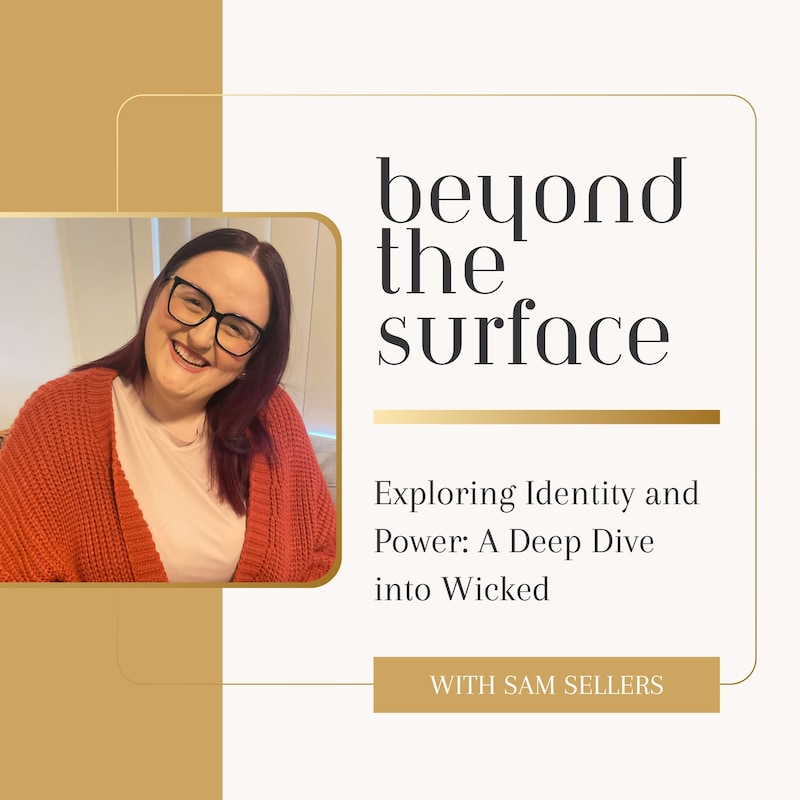
Shownotes
This solo episode is basically me unapologetically loving Wicked and unpacking why it hits so hard for anyone who’s left a high-control religion. I talk about my deep connection to Elphaba; the “problem,” the scapegoat, the one who won’t stay small and how her story mirrors the experience of choosing authenticity over belonging. We explore the grief and liberation that come with being cast as the villain for stepping outside the system, and why that narrative feels painfully familiar for so many of us.
I also spend time with Glinda, because it’s never that simple. She represents the ache of staying, the love tangled up with fear, loyalty, image, and the cost of not leaving. Through Wicked, I reflect on propaganda, scapegoating, and the way systems decide who is “good” and who is “wicked.” It’s theatre kid energy meets religious trauma processing and honestly, it makes sense of more than it probably should.
Connect
- You can find out more about Sam on her website - www.anchoredcounsellingservices.com.au
- To connect with Sam on Instagram - @anchoredcounsellingservices
- Want to contact with Sam about the podcast or therapy? Use this contact form.
- Also check out The Religious Trauma Collective
Transcripts
Foreign. I would like to begin by acknowledging the traditional custodians of the land on which I live and work, the Gundagara land and people.
I pay my respects to their elders, past, present and emerging, and extend that respect to all Aboriginal and Torres Strait Islander people. I also want to acknowledge the traditional custodians of the lands on which you, our listeners, are joining us from today.
I recognize the deep connection that first nations people have to this land, their enduring culture, and their commitment to the preservation and care for their country. This land was never ceded and it always was and always will be Aboriginal land. Welcome to beyond the Surface.
This is a space for conversations that sit at the edges of faith, identity, power and recovery, especially for those of us who have been shaped so stretched or harmed by fundamental religion or high control systems. Some episodes are personal, some are reflective, some are educational or curious or quietly disruptive.
All of them are grounded in lived experience and a deep respect for the complexity of leaving, questioning and rebuilding meaning.
We will be talking about religious trauma, various forms of abuse, cult dynamics, queerness and recovery, not in answers, but in honest conversations. In listening to these conversations, some parts might be heavy or activating for you.
Please take care of yourself while listening, and feel free to pause or step away if you need to. I'm Sam and I'm really glad that you're here with us. Hey friends, it is just me today for a solo episode.
And so for those of you who follow me or read my substack, you will know that I am always talking about Wicked. And if you don't do either of those things, then welcome. Hi, my name's Sam and I'm grossly obsessed with Wicked. This is not new.
This is not just about the movies. I have always had a stubborn and almost embarrassingly love and devotion of the musical Wicked.
I don't mean the casual oh yeah, I like musicals kind of thing. Like, no, I mean a level of attachment that bleeds into the like, it's the soundtrack of my life basically.
And like Wicked is basically the score of my whole personality. And now I have a few extra songs. The songs, the characters, the whole narrative.
If you peeked inside my brain at any random moment from my teen years to now, you would probably hear Elphaba's voice most of the time somewhere in background, just like quietly singing I'm not that girl or defying gravity or not like no good deed. Ask my wife. This is not an exaggeration. It is just me. It has always been me.
And so there is something about Wicked that just Hits differently than other musicals. On the surface, sure, it's. It's spectacular. Like, it's glittery.
The costumes, the soaring voices, the magic spells, the story that is larger than life. But underneath all of that, it is actually a mirror. And now it is a mirror more than ever.
And I don't mean like that Bunhouse mirror with slightly warped perceptions and reflections for entertainment's sake. I mean a mirror that catches every bit that you've ever had to hide. Every part of you that didn't fit the narrative that you were taught to obey.
Every raw, untamed, inconvenient piece of identity that was quietly told to shrink. I remember watching Wicked for Good for the first time last year. I think it was the day after that it was released. And something in me just cracked.
Like there was just this moment. And, I mean, I had already been, like, wildly obsessed with Cynthia Erivo as the Elphaba choice since it got announced, and.
And she did not just perform Elphaba. She was Elphaba on so many levels. She was raw, bruised, and impossibly honest.
Playing Elphaba, watching her in both films, I recognized a reflection of myself that the church had spent years trying to kill. The part of me that refused to contort itself into a version that was palatable for approval.
The part of me that would not twist, would not bow, and would not disappear. And in that moment, I felt that old, quiet, simmering, tender grief rise again.
There is something ironically, almost spiritual about it, the way that art can get to those deepest parts of your past while leaving you with, like, nothing but recognition. It's not just Elphaba.
This episode won't just feature conversations about Elphaba, because Glinda's heartbreak lands on me as well, in a really unexpected way, with a weight that felt like it had been gathering for a really long time without me even noticing.
There is a real grief in watching someone that you love and have loved cling to a system that demands your obedience even when it costs them and even when it costs you. I've been Glinda. I've known Glinda. I've loved people who were Glinda.
And watching her, seeing the pain of loving and not being able to follow, of wanting to stand with someone, but being so tightly bound by fear and obedience, well, that was just like looking at a thousand fractured relationships in slow motion. It's not always a fun time. And it is impossible to untangle the love from the grief in that moment. They're inseparable.
They're two sides of the same coin. That's the thing about Wicked. It doesn't let you just enjoy the story.
I mean, you can, but you will miss some of the nuance and some of the depth and attached to it.
For those of us who have existed in high control religion, it forces you to confront those splits, the internal divide between who you were told to be and who you actually were. It shows that impossible grief of choosing yourself in a world that insisted that you exist to only serve, comply, and to bend.
This is not just fantasy, magical music. It's an emotional roller coaster. And for anybody who has left high control systems, it is uncomfortably and. And heartbreakingly precise.
There's an emotional pull that makes Wicked feel unavoidable. Every time I watch it or listen to it, I'm walking into something that I know will hit me.
I'll notice a lyric, I'll notice an intonation, a word, like a costume, a facial expression, a body language. Some of those will hit me gently. Some of them will be like a punched to the chest.
But every time I finish watching, I carry pieces of that story with me. I'm reminded that survival comes with cost. That liberation is messy, that grief and joy are inextricable.
And that stepping into yourself despite the cost is the only path to breathing fully again. Wicked isn't just a story I watch. It's one I inhabit. It's one that I've lived in so many ways. And in inhabiting that story, I inhabit myself.
The survivor, the queer child, the one who refused to shrink. The one learning to live with grief and liberation side by side. Every viewing reminds me that this story is mine. It's yours. It's so many people's.
It belongs to all of us who ever dared to step into ourselves, fully, painfully and unapologetically. So I want to talk about Elphaba a little bit. Everybody knows that I like froth over Elphaba. She's like, she's top tier.
Because Elphaba isn't compelling because she's edgy or different or green or whatever you think. She's compelling because she's honest. And in a system built on control, honesty is basically a criminal offense. It's kind of treated as such.
And so what I always want people to understand about Elphaba is that she doesn't become dangerous because she starts doing evil things. She becomes dangerous because she refuses to keep playing the part that she was assigned. That's it. She's just not compliant anymore.
She's not fitting the mold anymore. She stepped outside of the mold. And that makes her dangerous.
And so if you grew up in the church, especially if you were queer in church, you know exactly what I mean.
Because the moment you stop performing that approved version or that cookie cutter mold of yourself, the moment you stop shape shifting to keep other people comfortable, you don't just become inconvenient, you become the problem. Here's the thing. Alpha Bar doesn't even start out wanting to dismantle anything or everything.
She doesn't walk into Oz like, hi, yes, I'm here to overthrow the system. She walks in basically saying, please, please, please let me belong. Let me be good enough, let me matter.
That's devastating because it's such a specific kind of ache. That ache of trying so hard to earn a love that is never actually going to be on offer in that system.
Because in high control systems, belonging is always conditional. It's not love, it's not safety, it's not home. It's membership. And membership requires performance. Membership has conditions, terms and conditions.
So you learn to ask the right questions and. But you don't ask too many questions. You learn to have the right emotions, and they're never very loud.
You learn to be grateful even if you're being harmed. You learn to submit, even if it means that you're disappearing.
And if you're queer, you learn to edit yourself until you're basically a draft that never gets published. Elphaba is that draft.
She's the kid who tried the teenager who tried the young adult who tried, who tried the person who so desperately wanted to be good. She wanted to be chosen, wanted to be welcomed into their inner circle. Because if the system loves you, then you get to believe it's safe.
That's what being chosen is. It's not just flattery, it's protection. And it works until it doesn't.
Because the minute Elphabar stops being manageable, the minute she stops being special in the way that serves them, the system flips fast. One minute you are gifted, and the next minute you are dangerous. One minute you are blessed, the next minute you are deceived.
One minute you're called, and the next minute you're a cautionary tale, the Wicked Witch. And that whiplash is not just fantasy writing that's lived experience of so many of us.
And I think that's what makes Elphaba's story so devastatingly relatable, is that she doesn't even get to be a person. She becomes a projection screen. People throw their fear onto her, their discomfort, their insecurity, their need for there to be a villain.
Their need for a story that explains why the world feels so shaky. She becomes the threat. Not because she is threatening, but because she is uncontrollable.
And honestly, that's the real reason queer people get scapegoated.
Queer people get scapegoated not because we're immoral or wrong or whatever sermon someone is recycling that week, but because queerness proves something. It proves that you can exist outside the script. It proves that you can live without their permission, that you can be whole without their approval.
And systems built on obedience cannot survive that. So what happens before that big defiant moment before the flight, before the refusal, before the dramatic I'm done energy before defying gravity.
Because leaving doesn't start with bravery. Leaving starts with exhaustion. I feel like we don't say that enough. People want the story to be empowering and neat and motivational.
Like, you woke up one day, did a nervous little stretch and is like, yes, I choose freedom. No, most people don't leave because they feel strong. They leave because the system has finally broken them.
And Elphaba shows that her arc is not, I always knew I was right and everyone else is wrong. Her arc is I tried so hard to be what you wanted and it nearly killed me. That's a very different story.
Because high control systems don't just demand obedience, they also demand self abandonment.
And the longer you're in them, the more your internal compass gets scrambled because you stop trusting your instincts, you stop trusting your body, your gut reactions, your anger, your grief. And that tiny voice inside you saying that this isn't okay. And instead all of that gets replaced with external authority.
So instead of this feels harmful. It's, oh, I'm probably being sensitive. Instead of this feels controlling. It's, maybe I'm not submitted enough. Instead of this feels like coercion.
Maybe I'm resisting God. Instead of this is abuse. Maybe I'm bitter. It's not just psychological, though. It's spiritualized gaslighting. It's dressed up as holiness.
It's compliance framed as maturity, and it's self erasure framed as virtue. This is why leaving is so brutal. Because you don't just lose that community. You don't just lose those people.
You lose an entire internal scaffolding that you built to survive within it. And so what you've been taught is that your doubts are dangerous, that your instincts are sinful. You don't just walk out and feel free.
You walk out and you feel like you're going to die. Not literally.
I mean, sometimes Sometimes you do, but more emotionally, because your nervous system has been so trained to interpret disobedience with catastrophe. And this is why Elphaba is so painfully real for so many of us, because she actually doesn't just fear losing people. She fears being wrong.
She fears being evil. She fears being the monster that they've always implied she is. That's indoctrination.
And it's why survivors often spend years still haunted by, yeah, but what if they were right? What if I'm wrong? Even if intellectually you know that they're not right and you're not wrong.
And it's why so many of us can leave church and systems and yet still flinch at certain phrases and certain terms, still feel sick around certain songs, shame around desire and fear. When we speak too much and too boldly, it doesn't mean that you're weak. It means you were conditioned.
And so when Elphaba starts to realize that the system was never designed to hold her, not fully, not safely, and not honestly, it's not just betrayal. It's complete disorientation, grief, rage, collapse.
And that collapse matters because that's the real beginning, not the empowerment montage that everybody wants. It's the moment that you can't pretend anymore. And what I'm going to say, some people may not love.
They may not love this point, which is that if you think defying gravity. Now, don't get me wrong, banger, Define Gravity is an absolute banger.
But if you think defying gravity is just a bad empowerment moment, then you are missing the point so aggressively that I almost want to take your Spotify away. Yes, define gravity is iconic. It slaps. It's incredible. Cynthia, like, took it to another level.
It makes you want a chair, stand on a chair and scream. Seeing, like you're auditioning for the role that you would absolutely not survive vocally, because, let's be honest, very few of us would.
It's not just triumph. That song is grief. It's the sound of someone realizing that there is no way to stay in this system and stay alive.
That's what makes Defying Gravity actually a really gut wrenchingly devastating song. Because Elphaba isn't just choosing power. She's choosing exile. She's choosing knowing that she'll be misunderstood.
She's choosing knowing that she will be hated, that she will be alone. And she is doing it anyway, because the alternative is emotional and spiritual suffocation.
And that's why it hits so hard for people who have left high control spaces, because that moment. That exact moment feels eerily familiar. I had that moment when you know what leaving will cost you.
Not in theory, not in a vague, oh, it'll be hard, but it'll be worth it. Instagram kind of quote vibe.
No, like in the gut level reality that this will cost me relationships, this will cost me belonging, this will cost me reputation, it will cost me certainty, and it will cost me the story that I have lived inside for years. It is the part that people do not talk enough about is that leaving isn't just walking away from harm.
Yes, that's part of it, but it is walking away from everything that you loved that was tangled up in it. That's the grief. It's why people stay. Because it's not like the system is only evil. It's also community.
It's also familiarity, it's memories, it's people that you genuinely loved, songs you used to cry to. It's also mentors that were there at the hardest moments of your life. It's rituals, it's meaning.
And so defying gravity isn't just, I'm free, it's I'm free and I'm heartbroken, It's I'm choosing myself and I'm terrified. It's I'm leaving and I'm grieving. And that's what. Why it makes me so emotional every time I hear that song.
Because it captures that precise moment where you stop negotiating with a system that requires you to disappear. And I think that's the reason why it's also so powerful, because it refuses to make who freedom look tidy. Because freedom is not tidy.
Freedom is messy and lonely and expensive and holy in a way that no church sermon ever managed to articulate. And so when Elphaba rises, furious, shaking and absolutely fucking done, it's not because she suddenly stopped caring.
It's because she cared for too long.
The last thing that I want to talk about, particularly with Elphaba, is the part that I think that is so psychologically brutal, which is that whole villain narrative. Because when you leave a high control system, you don't just get to walk away. You get cast. You get assigned a role, so to speak.
And that role is never the brave person who chose themselves. That role is deceived, bitter, rebellious, prideful, led astray, selfish, backslidden, dangerous.
You become the story they tell to keep everybody else obedient. And Elphaba is the blueprint for that. It's not enough that she leaves. The system has to explain why she left.
They have to make meaning out of Your autonomy in a way that reinforces their control. So they rewrite you, they distort you, and they turn you into the warning.
Because if people see you leave and survive and even thrive, the whole system becomes unstable. That's what's really going on here. High control systems do not fear you sin like high control systems do not fear your sin.
They fear your freedom, because your freedom proves that their authority is optional. That's unforgivable in their eyes. And that's why, for so many survivors, the pain isn't just leaving. It's the after leaving.
It's knowing that you're being talked about. It's knowing and hearing what they've said. It's being reduced to a caricature, to a stereotype.
And it's watching people who used to know you sometimes intimately and deeply, suddenly treat you like you are contagious. It's seeing your goodness erased because it no longer serves that narrative.
And the hardest part of that is that you don't get to defend yourself out of it, because it's actually not about your character. It's about their fear, their investment, their denial, and about the fact that if they acknowledge your truth, they have to question their own.
And that's too much for most people, let alone too much for systems of control. So that's what Oz does. They pick a villain, and they stick the whole community's discomfort or onto them like a dartboard.
Alpha becomes the wicked one because she refuses to keep pretending. And survivors know that feeling intimately.
The moment you realize you will never be seen accurately again by the people still inside, you don't just lose relationships. You lose your whole reflection. You lose the version of yourself that existed in their eyes.
That's why there's a moment where Elphaba says to Glinda, don't look at me with their with your eyes. Look at me with theirs. It's a grief that people very rarely name.
And the thing that I love about Elphaba's arc and why it feels like recovery in musical form, basically, is that she doesn't spend the whole story trying to convince them. She's not trying to convince them that she's good. She doesn't keep auditioning for their approval. She's not pleading to be understood by them.
And at some point, she chooses herself so fully that their misunderstanding actually just becomes background noise. And that's not because it doesn't hurt. It's because it no longer controls her. And honestly, that is the work. That's what so many of us are doing.
After leaving. We're not trying to be forgiven for leaving. We're not trying to be re accepted, but learning to live without needing their permission to exist.
Okay, it's time we talk about Glinda, because in this conversation, Alphabet gets a lot of air time and fair. But Glinda is actually really important here, particularly in conversations around high control systems.
And I want to say this up front because I feel like it is important. I have absolutely no interest in turning Glinda into a villain.
If that is the story and the narrative that you have, you are not going to hear that in what I'm about to say. I'm not here for the hot take that Glinda is actually the real evil. Because honestly, that's a really lazy analysis dressed up as feminism.
Glinda is not evil. She's afraid. And if you have ever been loved by someone who couldn't choose you, you know exactly why. That is A different kind of heartbreak.
Elphaba's pain is the pain of being scapegoated, othered and rejected. It's loud, it's visible, it's dramatic. You can point to it and you can say, yeah, that's harmful. That's really shitty. Glinda's pain.
Glinda's pain is quieter. That's why it sneaks up on you. It's why people actually still see her as the villain. It's the pain of being shaped into the perfect system girl.
The one who smiles when she's dying inside, the one who knows what to say, the one who's being rewarded for being palatable, the one who benefits just enough to keep believing it's fine. Glinda is what happens when the system works for you, at least on the surface, anyway.
And I think that's why her arc lands like a bit of a punch to anyone. Like a lot of us who have left church, because she actually represents the people who stayed behind, the people who loved you.
They might have even admired you, but they couldn't risk their safety to follow you out. She's the friend who whispers, I'm proud of you, and then goes quiet when other people are watching.
She's the family member who says, I don't agree, but I still love you, and expects that to be enough. She's the mentor who cries with you in private and then votes against you in public.
She's the one who believes she's a good person while actively upholding something harmful. It's a really specific kind of grief, because it's not the grief of losing Someone who hated you.
It's the grief of losing someone who wanted to love you and couldn't survive the consequences of doing it. Glinda is the embodiment of I love you, but not enough to lose everything for you before anybody comes. For me, I know that sounds villainy and evil.
I'm not saying that in a. Their evil way or in a way that makes it okay either. I'm saying it in. That's the brutal truth here. That's the reality.
Because when you leave a high control system, you start to learn something that is devastating, but actually really clarifying, which is that people don't just choose belief systems because they believe them.
They choose them because those systems provide safety, belonging, structure, identity, certainty, social protection, community access, and sometimes literally their whole life.
And so for someone like Glinda, who is rewarded by that system, who is protected by that system, who is adored by that system, leaving isn't just a moral decision. That's an existential threat.
Basically, that's like asking someone to burn down their entire house because the foundation is rotten while they're still living inside it, still sleeping in the bed, still eating at the table. Of course she doesn't run, of course she freezes. Of course she clings. And of course that hurts like hell. Because when you're ill for ba.
And you're not asking someone to burn their house down, you're asking them to choose you. And that's what makes Glinda so devastating, because she doesn't choose Elphaba. Not fully, not publicly, and not when it matters most.
And if you've lived through religious abandonment, especially queer religious abandonment, you know this pain deeply and all too well. It is the pain of being left behind not because you weren't loved, but because the system was loved more. And so we get that song.
We get to the song of the girl in the bubble. Right now, this song gets a bad rap as a song potential, like, more so.
But whether you love it or hate it, and I actually love it, I think it's hugely necessary.
And I think it has always been a bit of a missing piece to this show because I genuinely think that this song might be one of the most accurate descriptions of what waking up feels like when you weren't the one being directly targeted. It's not the same kind of awakening that Elphaba has. Elphaba wakes up because she's forced to. She's harmed, she's scapegoated, she's pushed out.
There is no room for denial. We're. When the Harm is personal and immediate. But Glinda's is not like that.
Glinda wakes up slowly, reluctantly, almost like someone emerging from warm water into freezing air. The thing about that kind of waking up is that, again, it is not empowering, it's terrifying.
Because when you're in the bubble, you don't experience the system as violent, you experience it as normal, you experience it as safe. You experience it as it's just the way things are.
And that's why Glinda's story is actually so important here, because it shows that indoctrination isn't always about being abused. Sometimes it's about being rewarded. Sometimes the system doesn't need to punish you. It just needs to keep you comfortable enough to never question.
And that's where Glinda's pain becomes really psychologically fascinating, actually, and very, very real for many people. Because when the bubble starts to pop, she isn't just grieving injustice, she's grieving herself.
She's grieving the identity that she built inside the system, the version of reality that made her feel safe. The story where she was good, where she was loved, where she was doing the right thing.
And suddenly she has to confront something that is almost unbearable. What if I was wrong? What if I was complicit? What if I benefited? What if my goodness was actually just obedience with better pr?
It's not a cute thought on the surface. Yes, she's, you know, pretty in pink and singing and ungodly high notes, but that's a moral earthquake for someone.
And I think that's why people don't wake up, actually. Not because they're stupid.
It's not because they're naive and not because they're evil, but because waking up means facing the cost of what you didn't see. It means facing the harm that you ignored. It means facing the fact that you might have been part of something that hurt people you cared about.
That's what moral injury is. It's fucking brutal. It's the injury of realising that you participated in harm, even passively, even indirectly. And now you have to live with that.
We all do. I do. I was part of that system. Remember I mentioned I was Glynda once upon a time. And so Glinda is the poster child for that moral injury.
She's now living with that because she's not malicious. She's not trying to hurt anyone. She's just trying to survive in a system that told her survival was righteousness.
And when the truth starts creeping in, when she starts noticing what she can't unsee anymore. It doesn't just change her view of the wizard or of Oz, it changes her view of herself. And that is the hardest kind of awakening.
Because if the system was wrong, then what does that say about everything she did to belong in means her life wasn't just curated, it was conditioned. And if that's true, then who is she without the script? That question that she says in the song, who am I now? That's not just a character beat.
It's not just a good, catchy line.
It's the question that so many people ask when they deconstruct, when they leave church, when they step outside their conditioning and suddenly realise, I don't actually know who I am without this.
And Glinda's bubble song captures that in a way that is so tender and so honest, and it makes me honestly, really angry that people still reduce her to the annoying blonde girl. She's not annoying, she's traumatized, but it looks like glitter. And this is the part where I want to get, I guess, a little bit personal.
Not in a dramatic, oversherry kind of way, but in a this is what survivors carry kind of way. One of the most enduring griefs after leaving church isn't just what happened to you. It's what didn't happen. It's what could have happened.
It's the relationships that could have been salvaged in the system that didn't require sacrifice. It's the love that could have been matured into something real if it didn't need permission.
It's the friends who could have stayed if they weren't terrified of the consequences. And that's what I'm going to call Glinda grief. It's the kind.
It's different from the grief of direct harm because it doesn't come with a clear villain. There's no neat narrative, there's no satisfying ending. There's no closure. It's just loss. Ambiguous and really fucking painful loss.
The kind that leaves you walking around thinking, did they ever really even love me? Did I imagine that? Was it all conditional the whole time? Or were they trapped? The answer is usually the most annoying possible answer. It was both.
They loved you and they were trapped. They cared and they complied. They wanted to be brave and they couldn't. That's the hard thing to hold without becoming bitter.
And I was bitter for a while, but. And bitterness was easier, honestly. Bitterness gives you clarity. It gives you a villain. It gives you a clean, emotional narrative.
But Glinda grief is messy. It's Sitting with the truth that some people are not safe enough to choose you even when they love you.
And that hurts in a way that I don't think people understand unless they've lived it. Because it means that you're not just grieving them, you're grieving the version of them you needed. The version who would have stood up.
The version who would have said, I'm coming with you. The version who didn't need a pastor's approval to love you properly. That's why I think Wicked hits so hard for survivors.
Because it gives us language for grief. It shows the ache of loving someone who stays. It also gives us permission to stop romanticizing loyalty.
Because loyalty inside a high control system is not always and very rarely love. It's fear dressed as virtue and conditioning dressed as conviction. It's survival masquerading as faithfulness.
And when you leave, you start to see that loyalty differently. Not immediately, but eventually you start to realize how often it's used as a weapon.
How often faithfulness means obedience and how often community actually just means compliance. So when Glinda stays, it's not just heartbreak. It's a reminder of what these systems do to people.
They take good hearted humans and they turn them into gatekeepers of harm. Not because they want to be, but because they don't know how not to be.
And that's actually the tragedy, because it means that the goodbye isn't really between you and them. It's between you and the system that owns them. And that is a grief that doesn't resolve neatly. It's messy. It just sits.
Sits in your body, it sits in your chest, in your gut. And it shows up in random moments. It shows up in songs, it shows up in door scenes. If you know, you know from that second movie.
It shows up when you're fine and then suddenly you're not. I want to talk about one more thing about Glinda, because. And this might piss some people off maybe, but I think it matters because I. I think as.
As humans, we love redemption arcs, right? The churches especially love them. They've built a whole testimony culture on them. There are docos, there are reality TV moments.
Most movies have them. We love to watch someone wake up and become good and apolog. Everyone hugs and it's fine. But moral injury is not redemption.
It's not cute, it's not inspiring. It's not a growth mindset. It's grief, but with teeth. And not like blunt ones like with vampire fang teeth.
And Glinda's story shows that it's not in a moralistic way, but in a painfully human way.
Because the reality is that if you were someone who fit the mold in church, if you were rewarded, protected and praised, waking up is not just, oh, wow, I've learned something new. I'm so glad I know that now. It's confronting. It's confronting the fact that your safety was built on someone else's exclusion.
It's confronting the fact that you were fine because someone else wasn't and they were scapegoated. It's confronting the fact that you didn't have to question the system because the system wasn't questioning you. That is a horrific thing to face.
And I want to hold this with nuance, because this is where people get defensive, right? I'm not saying Glinda is evil for benefiting. I'm saying it costs something to realise that you benefited. And once you see that, you can't unsee it.
And then you have to decide what kind of person you want to be. This is where I think Glinda becomes actually a really powerful symbol.
Because especially for people who are still in church, maybe they're starting to wake up. Maybe they're starting to see that people are being directly harmed. Maybe they're starting to feel and see those cracks.
Because waking up means sacrifice. It means losing comfort, approval, safety and becoming. It means risking becoming Elphaba in someone else's story.
Because that's what happens if you wake up. Glinda becomes an Elphaba in someone else's story because, again, remember, the narrative changes.
And so that's why so many people stay in that bubble. Because even when it starts to suffocate them, leaving isn't just leaving, it's becoming Othered now.
And for someone like Glinda, who has been loved for being good, becoming other is terrifying. She has never been the Other. She's never been treated as the Other. So her moral injury is not just sadness. And maybe yours isn't either.
It's an identity collapse. It's the death of self that she built to survive that system.
And I think that's what actually makes Glinda quite compelling, actually, is that she represents the cost of staying and the cost of waking up. Because staying costs your integrity, but waking up costs your belonging. It's not a fair choice. It's not neat, it's not poetic.
It's actually just brutal. There's no positive spin we can put on that. We can throw some glitter on it. It's still brutal. It's why I don't villainize Glinda. I grieve her.
I grieve what systems do to people like her. People who might have become brave if they weren't trained to confuse safety with goodness.
And I grieve the fact that so many survivors don't just lose the system, they lose their glindas. The people who loved them but couldn't step out, the people who were changed by them, but not enough to follow.
And honestly, I think that's the most heartbreaking part of all.
Okay, I want to zoom out a little bit now and not necessarily talk specifically about Glinda or Elphaba, because Wicked is not just a story about two women and their friendship. It's not even a story about scapegoating and othering.
It's very explicitly a story about power and control and not the kind of power that's, like, dramatic and obvious. It's not the kind of power that kicks down doors or anything like that. The wizard doesn't need to.
He doesn't need to do that because his power is the way that power actually works most of the time. He's the branding, the narrative, the pr. The guy behind the curtain going, don't look too closely at the facts. Look at the vibe. It's.
And I want to pause here because, like, if you grew up in church, that sort of like peeking behind the curtain has, like, a connotation there.
And particularly if you existed in evangelical charismatic fundamentalist spaces, you've met this guy, maybe not literally, but you've met his energy. The wizard is that leader who speaks in certainty. He's the Joel Osteens, the Brian Houstons, the Bill Johnson's, the Judah Smiths, the Carl Lentzers.
Like, he's the charismatic visionary who can't actually answer a direct question without spiraling into about 16 metaphors that don't make sense. He's the guy who says, God told me so. No one can challenge him without challenging God.
He's the guy who makes you feel special for being chosen while quietly controlling the whole room. He's the system that survives because it doesn't just demand obedience. It convinces you that obedience is your own idea.
That's why he's so terrifying, because he's not actually powerful in the way that we imagine villains to be powerful. He doesn't need to be. The system is powerful for him. He's held up by the collective agreement that he is. That's the thing about propaganda, right?
It doesn't work because it's true. It works because it's repeated it works because it's emotionally compelling. It pulls on your heartstrings.
It works because it offers people something that they crave. Safety, certainty, belonging, direction. The wizard offers Oz a story.
And when people are scared, they will cling to a story, even if it requires sacrificing someone else. And that's the part that makes my skin crawl, because it's not fantasy, it's human nature. Like, this is not Oz specifically.
And I think we are seeing that play out in real time. The high control systems understand this. They know you don't control people primarily by force. You control them by controlling meaning.
You control them by shaping the narrative of what's good, what's evil, what's safe, who's dangerous, who belongs, who doesn't. You create a story where you are the hero and then you create a monster. Because monsters are useful. Monsters unite people.
Monsters give people something to hate together. Monsters distract people from asking why the wizard is in charge in the first place. He says it in the movie, you gotta give people a good enemy.
Monsters keep the crowd looking outward instead of upward.
And I don't know about you, but as someone who works with survivors of high control religion, I can't watch the wizard without thinking, oh, my God, it's just church leadership strategy in sequence. Because the wizard is not just an individual here.
He's an archetype, the authority figure who cannot tolerate scrutiny because scrutiny would reveal that his power is not spiritual and moral. It's social, it's constructed, it's curated, and it's upheld by fear.
And the most devastating part of that is that he doesn't even need to be competent. He just needs to be convincing. And again, I'm pretty sure we're seeing that in real time, guys. He doesn't need to be competent.
He just needs to be convincing. That's the horror. And I want to say this very, very clearly, because I think people will underestimate how much damage that actually does.
When you grow up in a system where truth is dictated from the top down, your nervous system learns that safety is found in agreement, not in reality. And so then you spend years afterwards trying to relearn something that is painfully basic. Truth is not what the loudest person says.
Truth is not what the crowd agrees on or what makes people comfortable. Truth is what is true, even if it costs you.
And so I want to mention a few things, but I want to start by talking about the scapegoating that we've been talking about a little bit already, because scapegoating isn't just something that happens to Elphaba. Actually, actually, scapegoating is literally the central mechanism that keeps Oz functioning. And I know that sounds dramatic, but it's actually not.
This is how high control systems stay stable. They require a villain, they require an other, they require someone to carry the anxiety of the group.
In Oz, the animals start to lose their rights, they lose their voices, their agency. And what does the system do? It doesn't address the injustice, it doesn't reckon with its own corruption, it doesn't say, hey, why are we doing this?
Nope. It creates a narrative. Someone is to blame. And conveniently, that someone is the weird green woman who doesn't fit. Because of course it is.
Because scapegoating always targets the one who was already marked as different. And that's kind of the point, right? So scapegoating isn't random, it's strategic.
And it's the system saying, well, we will unify everyone by sacrificing you. And the thing is, scapegoating doesn't actually even require everyone to hate you. It just requires enough people to be afraid of being you.
That's why it works. And so in high control religion, scapegoating can look like so many things.
It's the queer kid who becomes the cautionary tale, the rebellious woman who becomes the warning, the survivor who speaks out and gets labelled as bitter, the deconstructor who becomes deceived, the person who asks questions and gets called divisive, the person who leaves and gets reframed as dangerous. And that's where the psychological impact gets a little bit deeper. Because the scapegoating doesn't just remove a person, it creates a moral lesson.
And so it becomes a story that the group tells itself to stay in line. Don't become like them. Don't question, don't dissent, don't speak up, don't be too loud, don't be too different.
And if you've been scapegoated, you know what that does to your body. Because it makes you hyper vigilant, it makes you self doubt, it makes you shrink and wonder maybe if I am the problem.
Because scapegoating doesn't just isolate you socially, it attacks your internal sense of reality. And that's why survivors often come out of these systems with this gnawing fear that they're inherently wrong, inherently bad and inherently unsafe.
Because the system has told them that they are. The system has needed them to feel that way. The system needed them to carry the shame. And that's what is actually is.
Quite haunting about Wicked, because how that scapegoating spreads really quickly. It becomes common knowledge. The story becomes quickly fixed.
And this is one of the things about leaving religion, right, which is that you realize that the truth is not actually what happened. It's what the group agrees happened.
And so if you try to correct that record, you become obsessed, you're unforgiving, you're stuck in the past, you're making trouble. Which is an interesting accusation to throw at someone who is literally just trying to tell the truth. But that's the whole point, right?
The scapegoat can't be allowed to have a voice because if the scapegoat speaks, the system is exposed and the system cannot survive expand exposure. The system will never survive exposure. Not real, true, transparent exposure.
Okay, so I mentioned propaganda a little while ago, and I want to talk a little bit more about that specifically because Wicked is actually pretty brutal in how it shows that propaganda isn't actually just posters and speeches. And it's also not just like the big bad government messaging that's all part of propaganda, but it's also. Propaganda is cultural.
It's social, emotional, it's catchy. It's literally a song. It's in the song, no one mourns the Wicked. It's how the movie starts. It's the first, like, main song that we hear.
And it's a song that is actually, like, really uncomfortable because it's not subtle. Like, if you listen to the lyrics, it's not subtle, it's celebratory, it's communal, it's bright, it's shiny, it's fun.
And that's kind of the point, because propaganda works best when it feels good, when it turns cruelty into entertainment, when it makes people feel like they're on the right side of things. And that's not even the worst part, because the worst part is that propaganda doesn't actually need everyone to believe it.
It just needs everybody to participate in it. And that's like a.
An important point here because I think it's an area that a lot of us underestimate, broadly, because in church, you don't actually need to fully believe everything. You just have to keep showing up. You just keep nodding, you keep singing, you keep smiling, you keep agreeing, you keep performing.
And the performance then becomes the belief. How many people do you know who behind closed doors might say, I don't actually believe that, or it's a bit extreme of a belief?
And then six days later, we'll show up to the very church that they're talking about, I know people like that. I know people who came to our wedding who then show up to one of Australia's biggest mega churches.
And so the performance of Keep Going, Keep Showing, Keep Believing, Keep singing, that actually becomes the belief. You don't have to be convinced, you just have to not disrupt it.
And I think that's part of what makes deconstruction itself actually really hard, because when you stop participating, you actually become a threat. And so. And that's not because you're wrong, it's because you're proof that participation is a choice, right?
So once people see that, they then have to confront their own complicity. And most people would rather literally do anything else.
And so instead they double down, they label you, they demonize you, they make you into the warning, and then they go back to singing.
And I think that's something that's so, like, viscerally accurate about the way Wicked shows the whole society uniting around this narrative that is like, fundamentally untrue and how quickly that truth becomes history, because that's what propaganda does. It rewrites reality in real time, and then that rewritten reality becomes history.
And so if you've left religion, you know that rewriting, you know the way that the story changes after you leave, you've probably heard it, if not, you've heard it about other people. And so suddenly you were never really faithful. You're always difficult hurting people, you're always in rebellion. And it's like they need to retro.
Retroactively justify the very reason why you're gone. Because again, if your leaving was legitimate, then what does that say about them?
So the story becomes that you left because you wanted to sin, or you left because you're offended, you left because you were deceived, or you were never truly one of us, you were never really a Christian after all. And then people repeat it and repeat it and repeat it, and not necessarily because they're even malicious, but just because it's easier.
It's easier to accept the story than to face the complexity of what it might actually mean. It's easier to sing the song than to sit with the grief. It's easier to call someone wicked than to admit that maybe you participated in their exile.
That's what makes no one mourns the Wicked so brutal. It's basically a public ritual of collective denial. And so it's a society that's congratulating itself for not having to reckon with what they did.
And I think survivors watching that don't just see Oz, they see every church that rallied around a leader after abuse allegations and not the survivor. They see every congregation that framed that survivor as divisive and bitter.
They see every friend group that iced someone out and then called it boundaries or Christian love. They see every family system that chose comfort and doctrine over truth and love. It's not subtle. It's painfully familiar for so many of us.
And I want to sort of like land this section with something that sits heavily. Because that's truth, right? Because, like, what propaganda is, is it's not truth and it doesn't need to be truth.
And so we could ask this question that is like one of the most important questions for anyone, I think, who is leaving religion, leaving a cult system, or leaving any sort of like, high control space, which is like, what even is truth when truth is controlled, right? And so in Oz, truth is whatever supports the wizard. Truth is whatever he says behind his little curtain and mask. And.
And I mean, I'm not really going to go into too much detail about her, but I do have a substack about her.
But truth is also whatever Madam Morrible decides is something that she's willing to sort of like master manipulate and puppet string because she's a really important factor here. Here as well. Truth is whatever maintains order. It's whatever keeps people afraid of the right things. It's what keeps the system intact. It's.
And so, like, what I love about Wicked is that it doesn't pretend that it's just a fantasy problem. It shows up the psychological reality that we are all living in, guys. And so when a system controls truth, dissent becomes evil, not wrong, evil.
And that matters here. I'm making a point here because that matters. Because wrong, that wrong can be debated, wrong can be discussed, wrong can be nuanced.
But evil, evil needs to be destroyed. Evil needs to be exiled. Evil needs to be silenced.
And that's what high control systems love moral language so much, because it turns disagreement into danger. And so once disagreement becomes danger, then you can justify just about anything.
You can justify shunning, exclusion, coercion, abuse, discipline in inverted commas. You can justify conversion practices, family cutoffs, you can justify trauma. And they are all justified in the name of righteousness.
And if you've left these systems, you know how disorienting it is to suddenly realize that truth wasn't actually truth at all. It was consensus, it was compliance, and it realistically was just the story that won't.
And so when you step outside of that, it's like the whole world goes quiet for A second. Because that's when you start to realize, oh, I was trained to distrust my own knowing.
I was trained to outsource my discernment, to interpret discomfort as conviction, to interpret fear as the Holy Spirit, and to interpret shame as love. And then when you finally start listening to yourself, well, that feels weird and confusing.
And sometimes it feels wrong and like you're doing something forbidden. And that's why leaving is so hard.
Not because you don't know what to believe, but because you were learning to trust your own mind again and to not see it as the very risk that you have always taught it to, has. Have been taught it to be. You are learning to be loyal to your own reality and to say, I don't actually care what the group agrees on.
I care what's true now. And, yes, it's a liberation, but it's the kind of liberation that doesn't look like glitter again, to use that analogy.
It looks like grief, it looks like rage, it looks like loneliness. It looks like rebuilding your whole internal compass from scratch. Which is why Elphaba becomes such a threat to them.
Not because she's powerful, though she is, but because she refuses to participate in the lie. And a system that is built on a lie cannot tolerate a person who cannot perform the lie. So the system does what systems do. It labels her Wicked.
It tells a story, sings a song, and the crowd claps along. Because the truth is, most people don't actually want truth, not really. They want comfort, they want safety.
They want someone else to decide what's right. And Wicked is one of the rare stories that says yes. And that's how harm becomes normal.
So after all of that, the wizard is branding propaganda as the choir song. Scapegoating as survival strategy. I want to do something that feels important here, which is like, I want to come back down to earth for a second.
Because one of the biggest lies that we get sold about leaving high control religion or high control systems is that there is this moment where you just feel free. Like you step over a line, you cross the threshold, and suddenly you're on the other side with a new haircut and a perfectly curated sense of self.
Not likely. No. I wish. Sometimes I wish that's what it was like. But no. Because leaving is not a clean break. It's anything but.
Leaving is not one big brave decision. Leaving is not one defying gravity moment where you saw into the sky and never looked back.
Leaving is long, it's messy, it's awkward, it's an unraveling. And it Often starts just with saying, I can't do this anymore. And then still hearing the system's voice in your head for years afterwards.
It's walking away from something and then realizing it. You took it with you in your nervous system, in your self talk, in your relationships, in your body.
It's knowing you made the right decision and somehow you still miss it. It's feeling relieved and devastated at the same time.
It's having days where you feel so grounded in your freedom and days where you feel like you are doing something wrong simply because you exist outside of it and wicked, particularly in the way that it handles endings. And I'm not going to spoil anything for anybody who hasn't watched for good yet.
But it is one of one of the only stories that talks about these sorts of things and doesn't pretend that the aftermath is tidy, because the aftermath isn't tidy. It's not tidy for Elphaba, it's not tidy for Glinda, it's not tidy for anybody.
And it's certainly not tidy for anybody who has had to rebuild their life after losing a worldview, a community, a whole identity scaffold. And what I think is so accurate is that the story doesn't give us a clean moral conclusion either.
It doesn't go see, the brave one leaves and wins and the coward stays and loses. That's not what happens.
It gives us something much more painful and actually something much more true, which is that sometimes you just survive, sometimes you stay, sometimes you lose each other, sometimes you still love each other. Sometimes you are both doing what you need to survive and it still breaks your heart.
And because so many people who leave religious spaces feel like they're failing, it doesn't automatically feel empowering. This space needs to feel honest. So if you're still grieving, you are not doing it wrong. If you still miss it, you are not doing it wrong.
If you still feel pulled back in, you are not doing it wrong. If you're still angry a decade later, you are not doing it wrong. You are doing the most human thing in the world.
You're mourning what you lost while trying to build something that you need and two things can exist together. I'm all about nuance, remember? I harp on about it all the time. You can grieve the community while being glad that you left it.
You can miss the music, really fucking hate the theology attached to it. You can miss the rituals and still know that they were used to control you.
You can miss the belonging and still refuse to go back to those Conditions. That's not hypocrisy. That's recovery. That's integration. That's your nervous system catching up to what your mind might already know.
And if anyone tells you that it should be quicker, cleaner or prettier, firstly, fuck them. They're very wrong. Because. And because they're lying. They're either lying through their teeth or they've never had to start over from scratch.
Because starting over is not glamorous. Starting over is eating cereal for dinner because you're too emotionally fried to cook.
Starting over as losing friends and then realizing you don't even know how to make new ones outside of a church system. Starting over is questioning your own intuition because you were taught your intuition is sinful.
It's learning how to make decisions without a spiritual authority hovering over your shoulder or going to three people to get confirmation. Wicca doesn't give us that fantasy of clean liberation. It gives us something much more honest.
That freedom has a cost, that it's a learning curve, that there's grief, that there's more learning.
That there's this slow, quiet, steady thing where you just begin to trust yourself again, not in one moment, but a thousand small ones of learning and learning and more learning. Okay, there is, unsurprisingly, another section that I want to talk about.
And if you have read any of my substacks or heard me talk about Wicked or anything, I am sure you know what this is I want to talk about for good. The song. Not the movie, not the second movie, specifically the song.
Because if you are still here, you're still with me, you already know what I'm about to say, likely. Which is that this song is an absolute knife to the heart.
I am not kidding you when I say that watching this play out in cinema and hearing it for the first time with Cynthia and Ariana singing this, and it play out with the cinematic nature that it did was gut wrenching. And I sobbed my fucking face off is the reality. And what makes For Good so brutal is that it doesn't offer a single ounce of closure.
Pretty much, it offers acknowledgement. And it says, this mattered. This changed me, this cost me, this shaped me. And. And I don't get to undo it.
And I think if that is one of the hardest parts of leaving high control religion, which is that you don't leave a place like I've mentioned, you leave a version of yourself as well.
You leave the version of you who was trying so bloody hard, who believed the promises, who was doing their best with the information and the conditioning that they had up until that point. There is grief in that, again, like real grief, because sometimes the person you're mourning is in the church you're actually mourning you.
And for good captures that complexity. The way love can be real, even if it is entangled in harm. The way that connection can be genuine, even if it's inside a system that is unsafe.
The way that relationships can shape you, even if they don't last.
And that's a hard truth, because it's often taught in this very binary thinking, which is that either it was all good or you're ungrateful, or it was all bad and you're bitter. The reality is messier than that, because the reality is that you can be deeply harmed by a system and still have had real love within it.
You can have been controlled and still have had meaningful friendships. You can have been indoctrinated and still have had moments of genuine spiritual comfort.
You can have had your identity suppressed and still have experienced real belonging. And admitting that doesn't minimize the harm. It actually just honors the truth of the reality.
The reality, and the truth is, is that people stay in these systems for a reason.
And not because they're stupid, not because they're weak and not because they're evil, but because the system meets the needs that they have, like human needs. It gives structure and certainty and community and purpose. And so when you leave, you don't just lose bad theology, you lose a whole ecosystem.
So when people act like leaving should be easy, I'm usually kind of like, you've no idea what you're asking of someone when you say those words. You're actually asking them to step into existential freefall.
They're asking them to rebuild every ounce of meaning, to rebuild morality, identity, belonging, purpose, all without the scaffolding that they were handed, and the only scaffolding that they ever thought they could use for good. Doesn't deny the cost of that. It doesn't pretend that Elphaba and Glinda can't just. Can just move on like it was a phase.
It acknowledges that relationships change us permanently, even when they end, even when they hurt, even when we have to leave. And this is where I think the song almost becomes a theology of change. Let's go with that.
Not theology in a churchy way, but theology in a what do I believe about life? Kind of way. Because religion forces you to ask questions, right? What do I believe about love if love was conditional?
What I believe about goodness if goodness was compliance? What about what do I believe about Truth, if truth was controlled. And what do I believe about myself if I was told I was broken?
And so for good offers a pretty tender answer to some of those things. Maybe we don't get to keep everyone, maybe we don't get to keep the old world, but we do get to be changed by what mattered.
And we do get to carry what was real. And we do get to take parts of love that were genuine and build something better with them.
Not because we forgive the harm or we're pretending like it didn't exist, but because we refuse to let the harm be the only story. There's this phrase in high control religion that I don't think gets talked enough about.
And it's the phase that when you're not actively leaving anymore, but you're also not fully living yet, and it's just in the in between trying to become a person again. And I say that with full seriousness, because high control systems don't just tell you what to believe.
They tell you who you are allowed to be the person. Like there's a script for your personality, your desires, relationships, body, gender, sexuality, future career.
So when you leave, you don't just have freedom, you have emptiness. And emptiness is terrifying because you have to decide what to fill it with. And I had no idea. And that's where people often get stuck.
Not because they miss the church, though they might, but likely because they miss the certainty and the predictability. Because certainty is addictive. Certainty is soothing. It's our nervous system's drug. Our nervous system thrives on consistency and certainty.
And so when you leave that certainty behind, it all panics. Our nervous system panics, freaks out, and our brain doesn't know what to make sense of it. Your brain goes, but what if we're wrong?
What if we're evil? What if we are being deceived? What if we lose everything? And what if we're alone forever?
I know they're big, dramatic questions, but it's kind of what happens. And this is the part where, like, often the other people don't understand because from the outside it just kind of looks like just stop going.
But on the inside, it feels like I have to rewire my whole sense of reality. And so that's what recovery work becomes weirdly intimate. It's because you start doing things that feel tiny but are actually revolutionary.
And you start saying no and noticing what you like and what you want. And you listen to music without guilt. You start making decisions without praying for permission. You trust your gut.
You start asking yourself, do I want this? Or was I trained to want this? You start feeling anger, real anger, and realizing that doesn't actually make you sinful or a bad person.
It makes you alive. You start feeling desire and pleasure and realize that that doesn't make you dangerous. It makes you human.
And you start feeling grief and realizing that that doesn't make you weak. It means that you've loved and then it meant something. This is where Elphaba becomes more than a symbol of rebellion for me.
She becomes a symbol of personhood. Because what she's really doing to circle back is not being edgy. She's refusing to be erased.
And for queer survivors especially, that's the core of it. We didn't leave because we wanted to be difficult. We left because we wanted to live.
And I think sometimes people forget that queerness isn't just an identity. It's a refusal. It's a refusal to contort your love into something that is acceptable.
It's a refusal to deny your own body and to betray your own truth. But that refusal comes at a cost. It also gives you something that that system never could, which is a life that's yours.
And when you start building that life, it's messy, it's slow, and it's confusing.
To learn how to belong without disappearing, to be loved without performing, to be safe without obedience, and to make meaning without someone telling you what that meaning is, That's a form of recovery that deserves so much more reference than it gets. Because it's not just psychological, it's existential. It's choosing yourself over and over, even when the old fear is whispering in your ear.
So you might be thinking, is she ever going to stop talking about Wicked? No, probably not. But I am gonna land this. This plane, right? I'm gonna land it. So where do we land all of this?
Because I don't want this episode to feel like a motivational poster. That would kind of defeat the purpose of everything that I've just been talking about. And I'm not here to be like.
And then you fly off into the sunset and everything is perfect. No, that's not how this works. Right. But I do want to.
I do want to end with something honest and something that feels like a hand on the back, not a lecture. I'm not about lectures. And so here is what I think. Wicked gives so many of us who have left. It gives us language for the unspeakable.
It gives us a story where the villain is actually not evil at all. She's just unwilling to comply.
It gives us a Story where goodness is complicated, where love is real but is not always brave enough, where liberation is anything but clean. And where you can be misunderstood, scapegoated, and still be right. And maybe most importantly, it gives us permission to hold two truths at once.
That you can be grateful for what shaped you and furious for what harmed you. You can miss people and still refuse to return. You can grieve what you lost and still know that you made the right choice.
You can feel tenderness and rage in the same breath. You can be soft and unyielding at the same time because leaving high control systems forces you to grow a new relationship with complexity.
You stop living in black and white. You start living in the gray. And the gray is where most of life happens, actually.
So if you're listening to this, and if you are still listening to this, props to you. And you're probably the same kind of people as me. This was basically just my little, like, love fest for weekend. So thanks for joining me, guys.
But if you are still listening to this and you are in that place where you've left, but you are still feeling haunted by it all, I want you to know something. You are not weak because you are still affected. You are not broken because you still miss it. You are not failing because you are still grieving.
You are human. And you survived something that required you to abandon yourself. And now, now you're doing the slow, sacred work of coming back. It's brave.
It's not the cinematic kind of brave, but the every kind, everyday kind.
It's the kind that looks like telling the truth, setting boundaries, finding new community, letting your body exhale, learning what you like and letting yourself be loved without conditions. And if you're someone who stayed or you're someone who loves someone who left, I hope this story challenges you.
Because the world does not need more glindas who cry and then comply. The world needs people who are willing to be changed, willing to be inconvenienced, willing to be brave in a way that costs them something.
Because that's what love is actually. Not the soft, sentimental version that we see in movies, the real version, the version that chooses people over systems.
The version that refuses to let propaganda make monsters out of the honest ones. And maybe that's the most powerful thing in Wicked. The reminder that becoming yourself will cost you, but losing yourself costs you more.
And if you're in that doorway, the one in between who you were and who you're becoming, I hope you hear this clearly. Especially if you're queer, you are not wicked. You're waking up.
And even if it hurts, even if you lose things, even if it's lonely, sometimes, you are becoming real. And that's worth everything. Okay, take a deep breath, everybody. That's all from me. If you made it to the end of this episode.
Thank you for letting me ramble, rant, rant and emotionally unpack Wicked like it's spiritual practice. Because honestly, at this point, it kind of is for me.
And if you're sitting there thinking, I need more of this in written form, firstly, I love that for you. And you're my kind of person.
And you are in luck because you can go and read not one, not two, but three articles over of my substack about Wicked, one that I mentioned, which is actually specific about Madame Morrible, because now, apparently I have decided that it's basically my entire personality now. So. And let's be honest, there'll probably be more to come.
So, like, if you love that head over there, I don't know when, I don't know how, but I do know me. And I will absolutely always find another reason to write about Elphaba like she's my new Jesus. Because what would Elphaba do?
Sounds pretty good to me, to be fair. Okay, thanks for being here, friends. I'll see you next time. Thanks for listening to beyond the Surface.
If this episode resonated, challenged you, or named something you've struggled to put words to, I'm really glad you found your way here. You'll find ways to connect, learn more, and explore further in the show. Notes. As always, you are good.
You have always been good and your story matters always.
