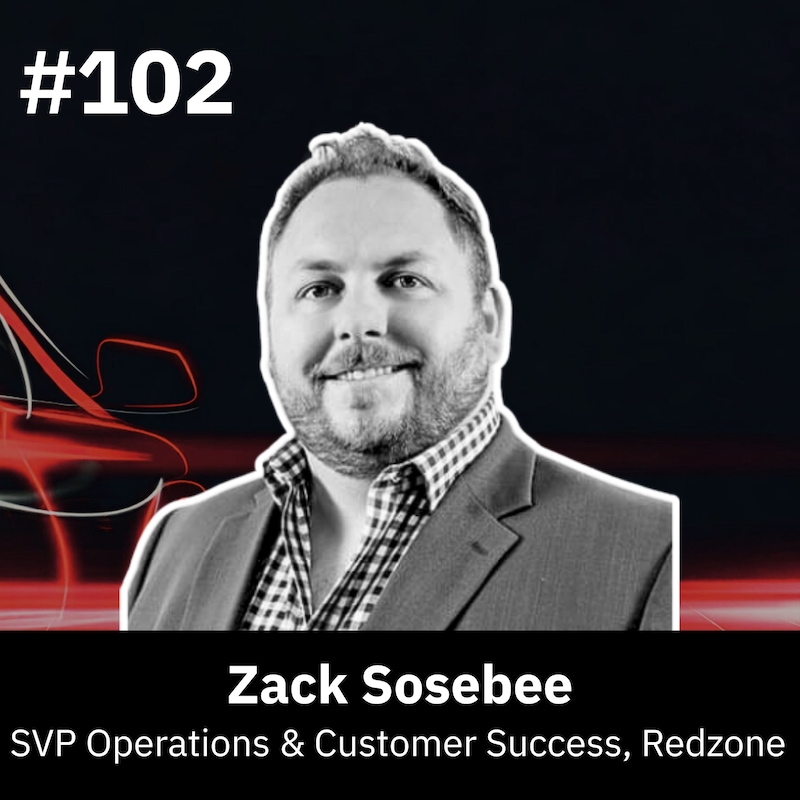
Shownotes
Manufacturers do not have a data problem. They have an execution gap. The dashboards exist. The reports are generated. The KPIs are reviewed. Yet too often, action stalls between insight and impact. In this episode, Jan Griffiths and Tom Roberts sit down with Zack Sosebee, SVP of Operations & Customer Success at Redzone, to explore what changes when data moves beyond visibility and into the hands of the people closest to the work.
Zack shares a clear and practical vision of the connected workforce. Not as another layer of software. Not as another reporting system. But as a system of action. By giving frontline operators simple, real-time visibility through red, yellow, and green performance signals, manufacturers create clarity in the moment decisions are being made. That clarity builds accountability. And accountability drives results.
What makes this approach powerful is its simplicity. Instead of overwhelming teams with endless metrics, Redzone focuses on a few meaningful signals that operators can influence hour by hour. When teams see performance in real time, they respond in real time. Maintenance is called sooner. Problems are escalated faster. Peer-to-peer competition becomes a positive force. Execution accelerates because ownership shifts to the frontline.
But technology alone does not transform a factory. Coaching does. Zack explains how culture change happens when leaders reinforce new behaviors, close feedback loops, and respond quickly to issues raised by operators. When a long-tenured employee logs a safety concern and sees it fixed the same day, trust is built. When a retiring expert captures knowledge that strengthens the next generation, pride returns to the shop floor. These are not software wins. They are human wins.
This conversation is a reminder that digital transformation is not about collecting more data. It is about empowering people to act with confidence and clarity. When operators think like supervisors and supervisors think like leaders, performance improves. More importantly, culture evolves. And in today’s manufacturing environment, the companies that win will be the ones that move from reporting yesterday to deciding what happens next.
Themes Discussed in This Episode
- What “connected workforce” really means in manufacturing
- Why digital transformation often stalls at dashboards
- Overall Equipment Effectiveness explained in simple terms
- Red, yellow, green real-time visibility on the shop floor
- Coaching vs training in culture change
- Turning skeptics into champions
- Eliminating paper logs and manual downtime reporting
- Using simplicity to accelerate adoption
- Technology as an enabler of ownership, not oversight
- Empowering operators to think like leaders
Featured Guest
Name: Zack Sosebee
Title: SVP Operations & Customer Success, Redzone
About: Zack is Senior VP of Operations & Customer Success at Redzone, where he leads the entire customer experience across coaching, implementation, and support, with a clear focus on delivering measurable results. A member of the early Redzone team, Zack helped build the company’s coaching organization and drives a people-first, customer-focused approach that empowers frontline teams and creates sustainable operational impact. Prior to Redzone, he held operations leadership roles at Ignite Solutions, Lockheed Martin, Porsche Cars North America, and Ford Motor Company. Zack holds both a bachelor’s and a master’s degree in Mechanical Engineering from the Georgia Institute of Technology.
Connect: LinkedIn
About Your Hosts
Jan Griffiths
Jan is the host and producer of the Auto Supply Chain Champions Podcast and The Automotive Leaders Podcast. A former automotive manufacturing and supply chain executive, Jan is recognized as a Champion for Culture Change in the automotive industry. She brings direct, grounded conversations to leaders navigating execution, disruption, and transformation across the global automotive ecosystem.
Tom Roberts (Co-host)
Tom is Co-host of the Auto Supply Chain Champions Podcast and Vice President of Strategic Industry Development at QAD. He works closely with automotive and industrial manufacturers to close the gap between insight and execution, helping leaders move from visibility to systems of action that drive real operational outcomes.
Episode Highlights
[01:30] Data in the Right Hands: Jan challenges the idea of simply “moving data to the shop floor” and raises the deeper issue of empowerment. Technology alone is not enough. Culture must enable action.
[03:11] The Connected Workforce Vision: Zack explains Redzone’s founding vision: take critical executive-level data and put it directly in the hands of operators so they can think like supervisors and leaders.
[04:42] Speed to Value Over Analysis Paralysis: Instead of overwhelming teams with data, Redzone focuses on just a few signals that drive immediate decisions and measurable operational gains.
[09:33] Red, Yellow, Green in Real Time: Operators see hour-by-hour efficiency through simple visual scoring, creating healthy competition, faster decisions, and higher performance across lines.
[11:33] Coaching Changes Behavior: Technology is only half the equation. Redzone coaches push teams to act on data, raising expectations and building sustainable cultural transformation.
[13:52] Goodbye Paper Logs: Manual downtime sheets and whiteboard reports are replaced with real-time digital visibility that eliminates guesswork and false reporting.
[16:27] The Skeptic Who Became a Champion: A long-tenured operator resistant to change logs a safety issue on day one. It gets fixed immediately. That moment transforms him into an advocate.
[18:07] Legacy Over Retirement: A veteran employee planning to retire stays on after using Redzone to document his knowledge, leaving a lasting operational legacy.
[19:58] Training vs Coaching: Zack clarifies the difference between learning which buttons to click and building new behaviors that fundamentally change how factories operate.
[20:16] Culture Is the Real Business: Redzone is not just about software deployment. It is about coaching change and driving ownership at every level of the plant.
Top Quotes
[03:28] Zack: “And our view is that every worker in the factory should be there for a career, should care about their role, should be making decisions that help influence the factory to be better.”
[11:22] Zack: “It's not about more data. It's about better decisions with the data you have.”
[18:55] Zack: “When people feel like it's more than a job, all of a sudden, like it's fun to work.”
[20:16] Zack: “If we have easy software and we have a simple deployment, we look at a few things. Now we coach in change and drive culture change, which is what we're really in the business of doing.”
Follow the Auto Supply Chain Champions Podcast for real conversations with leaders who are making hard choices, focusing their bets, and leading with intent.
🎧 Follow the podcast:
🔗 Learn more about QAD Redzone: https://www.qad.com/
Transcripts
[Transcript]
[:[00:00:30] Tom Roberts: Great to be here, Jan. What I see every day is simple: manufacturers don't have a data problem, they've got an execution problem. This show is about how artificial intelligence, systems of action, and empowered teams can help close that gap.
[:Hello, and welcome to another episode of the Auto Supply Chain Champions Podcast. Let's check in with my co-host today, Tom Roberts. Tom, how are you doing?
[:[00:01:09] Jan Griffiths: I know. Well, I gotta tell you, Tom, you know, I was in a conference last week and there's so much conversation around putting the data in the hands of the people moving the data to the shop floor.
And as I think back on my career, Tom, that's a nice idea, but I don't know of anybody who's actually doing it. Do you?
[:[00:01:43] Jan Griffiths: I think there's two pieces to this. There's the actual technology part of it. How do you get data to the hands of the people on the shop floor and what does that even look like? Because you know, clunky green screens aren't gonna cut it. There's that part of it. But the other part of it is the culture piece of it.
And if you can put data in somebody's hands, great. But are they empowered to actually do something with it? And that's why, I am thrilled today that we are bringing on the show Zack Sosebee, and Zach is the Senior VP for Redzone. So Zach, you are Senior VP of operations, which we love 'cause we love operations people.
Zach, welcome to the show.
[:[00:02:34] Jan Griffiths: So Zach, we hear it a lot now. We hear IT leaders and we hear operations leaders talking about wanting to get data into the hands of the shop floor people. You've done that and you've been doing that. Now, a lot of it in the food industry, but you're also branching out more into heavy industry and automotive. So take us through Zach, just very high level concept. What is this thing, what's it called? I know you call it connected workforce, but what is it, and how do you put data in the hands of the shop floor frontline workers?
[:And our view is that every worker in the factory should be there for a career, should care about their role, should be making decisions that help influence the factory to be better. And if we can help give them the metrics, the visibility, the red, yellow, green, that drives actions and behaviors and decision making.
So the decision making at the very top goes down a level at a time so that operators think like supervisors. Supervisors think like senior leaders. We can have a massive impact. And the funny thing is most of us actually came out of either automotive, aerospace, defense, electronics industries before we even got into food.
But the concept was the exact same. It was how do you get people managing their own performance and taking ownership of their own factory rather than waiting to be told by, you know, an engineer, a supervisor somewhere and that's really kind of the key behind red one.
[:A lot of LinkedIn profiles have it on there. It can sometimes sound abstract. Can you break down in concrete terms for us the key measurable value, whether it's OE improvement or reduction in unplanned downtime, something else? What is it that manufacturers see or are looking for when they are first looking at connected workforce solutions?
[:And so the way we get there, the way we do that is, the first thing we do is, try to separate kind of signal from noise. So many people wanna do the analysis paralysis thing. They'll put in like an MES tool or they'll do a SCADA tool and they'll have all data for all human beings. And that's too much for an operator.
That's too much to make decisions on. That's just like more data to let the leadership team sit in meetings, sit in conference rooms, crunching numbers and doing math. We're about how fast can you get access. So we actually only take a couple of signals on the floor. We keep it to a very small scope of things that quickly can be impacted quickly, make a difference.
And how will people recognize that? It depends on the factory. So some factories that are producing at fairly full capacity. They might get margin expansion by getting more throughput with the exact same cost, right? So if you can be more efficient and not hire more people, you'll actually make more product with the same costs.
You just put more money in the pockets of the, of the business. Other places can decrease overtime and get the same product out. If they can't make more, they can't sell more, they can just work more effectively and schedule less overtime shifts. So there's different ways they can get it, but it's usually driven at the nuts and bolts level by getting, more product out every hour.
That could be getting the machines running at the right speed, that could get operators and maintenance working more closely together. So decisions are made faster, problems to solve faster and therefore less. Unplanned downtime, fewer surprise, downtime instances and all that leads to more product out the door.
And so is it, do you find the money in saving overtime or getting more capacity? It kind of depends on the business model, but usually it goes right down to the nuts and bolts of the right speed, running at the right amount of time and making decisions that keep the equipment running up more often.
[:[00:07:14] Zack Sosebee: Jan, you just made my day. You're gonna laugh at this, but one of the premises behind Redzone is anything we do has to be simple enough that you could explain it to grandma. Our founder had this big thing about is it simple enough that you can explain it to grandma? So for anybody that isn't technical, that's listening in.
We take a production line in a production
[:[00:07:37] Zack Sosebee: I knew you were gonna,
[:[00:07:43] Zack Sosebee: I was referring to Tom as grandpa, my grandma.
[:[00:07:49] Zack Sosebee: So take a production line. A production line is a series of processes and equipment that takes raw materials and converts them from whatever they start with to like something the consumer buys. Maybe that's a box of something or a pallet full of equipment that's gonna ship out the door. Along the way, different processes happen.
Now, where Redzone might differ from, other tools on the shop floor, is that we're gonna collect only one or two of those processes. We're not gonna get every 15 pieces of equipment. We're gonna get the heartbeat at the front of the line. It tells us where the line's running, and we're gonna get the total units out the door at the back of the line.
With those two numbers, we can help clarify what OEE is. OEE is Overall Equipment Effectiveness. It's basically efficiency, the efficiency of the line. If you don't run really well or do a lot of changeovers, it might be a 40% efficiency, right? But if you run really well, you're very effective and not a lot of change.
You might be at 80, 85% efficiency, and what we do is we help operators understand hour to hour, day to day, shift to shift. How is the line running in real time with an efficiency measurement and we use red, yellow, and green. So we might take a customer that runs at, let's say 60%. Typically when they start Redzone.
If the hours below 60, they might see a red bar, but if the hours at 70 or 75, they might see a green bar. So there's this inherent drive to get green hours instead of red hours, because that's displayed on TVs all over the factory. Every line sees how they compare to the other lines. So the more green hours you get, the higher your score.
So there's this social drive to be number one, this competition to be number one, and you want to be green. So people push for green hours. You put an effort when you can visually see the impacts of the decisions you make. So say, do I call maintenance and fix this, or do I put up with this problem? I want a call now because I want that green hour and I wanna beat the line next to me. I wanna compete with them.
And so just those two simple data points allows us to get red, yellow, green coating on how efficient they're being in real time. And every time they start a new product run, they choose, you know, I'm running the driver's panel version versus the passenger panel version.
They'll change that run, they'll change that SKU and you know, different SKUs have different target rates depending on the equipment. It stays there just based on those two simple sensors. So we only grab a couple of data points. We're able to track the full efficiency and give the operator something tangible.
And the next thing I would say is a lot of the world is trying to do this digital transformation thing and get all the data humanly possible. And we're like, no, we've got those two data points. Who cares about getting the other 15? Let's do something with those two. So the first thing we wanna do is actually push people to use that and make a decision to say, Hey, the last time we ran this product, we ran, you know, we had a problem with the the decoder.
So let's like proactively get maintenance up, set that up right, and make sure we don't have that issue this time. Those are things that your production manager, two floors up, may not know, may not be able to figure out, but let's not wait for two hours of pain and troubleshooting and call them in.
Let's have the operators making those decisions at the front and seeing the impact of their decisions on their numbers. After we do that for 90 days, we coach, by the way, so another big difference with Redzone is I'm sending someone in there that's a manufacturing expert. We hire people from all walks of manufacturing, opex, continuous improvement, plant management.
They work for us and they help drive change and culture change. They're tired of working for the big company, right? They wanna come in and help companies make change. So companies that want transformation and we help them understand it's not about more data. It's about better decisions with the data you have.
So our coaches actually go in, they spend time, they hang out with them, and they give them feedback on, Hey, you know, you did this huddle meeting where you pulled a maintenance tech, you pulled a quality person, and you had your operator, and you looked at the data and you made some decisions. But you know, you were down seven times over the last four hours because of that decoder.
And nobody said anything. I'm your coach. That's not good enough, right? If I told Michael Jordan missing 4 out of 10 for Ether, if is okay, he wouldn't get any better. I'm gonna tell you missing seven downtime events that happened in the last two hours. This is not good enough. Let's call him back.
Let's make the play call and we're gonna raise the bar on what we expect. Come outta these huddles so we can make faster decisions, and if you do that for 90 days, the plants suddenly figure out how to run themselves much more effectively and get more productive.
[:I can tell by the look on your face that you know exactly what I'm talking about. You mean this is all real time visual digital on TVs around the plant.
[:[00:12:45] Jan Griffiths: I have.
[:And like, the best thing you do is actually send a high five. So the production manager, the owner tell somebody they did a good job. That's what they really want. They don't want the green, red pen, they want to make decisions, but yeah we try to get rid of, all those manual downtime collection sheets.
I don't know, I've been so many factories where they just, like, people write down and they're all bs. They're all fake. That felt like about 10 minutes of downtime. That was only 30 seconds. I'm not even gonna write that one down. But it happened 27 times. Yeah. So like, we're not even collecting the things that actually happened, but no, we get rid of all the paper logs.
We try to remove all that and make it a lot easier for people. So that our view, and it's not like we, you know I love trees, don't get me wrong, but our business isn't to save trees. Our businesses get people thinking more about decisions. So it's cool if we can both save trees and also like give people time back to spend more time improving rather than filling out paperwork.
[:Okay, now I get it. Now I understand what happened. I understand what this is doing for the floor. This is great. Let's keep pushing forward. It just that story out there that where it really hit home for someone.
[:That one, the grumpiest nastiest operator that said, I don't care against you. I don't want anything to do with this. And you flipped them, Zach. Tell us that story. Yes, Tom's right.
[:So the success plan, we always ask the boss, we said, who's gonna be the most difficult person? It's always like, I hate to be stereotypical. It's always the old person. They're always like, oh, well, old Johnny's been here for 37 years and he doesn't even have a phone. You know, it's clockwork. We actually track miracle stories where people transform.
We track 'em internally. I've got a whole list of these and almost every deployment has, the first one that pops up is this guy that nobody thinks is, but it's like, this guy's been working there for 28 years or 37 years. Clearly they're doing something right. You know, this is no problem.
And they'd be gone long ago. So what happens, generically, I'll give you two specifics. Generically, this person is against it until they realize it's not the flavor of the week. And when they realize it's not the flavor of the week and they put a little effort into it, all of a sudden life gets better.
And then people watch, there's this idea of a first mover in leadership. Very important. People watch these folks that they expect to never get on board. And when everybody sees the person, you expect to not get on board, get on board. All of a sudden it's a flood of people jumping on the ship.
You know, they're all ready. So one example, there's this guy, and I can't remember the customer name to be honest. It was a food plan of some sort, Tom. But this guy, and I love this story because it's so real. We've all been there. This guy had this pet peeve. There's something that he thought was a safety problem on, I wanna say it was, it was like a slicer, but you could actually put your hand in and get hurt and this operator's, you know, pissed off, like really unhappy because for 10 years he'd been working there and nobody ever fixed that problem. Nobody ever listened to him. It was always, they call it the black hole of thing and you write it on the notepad that just falls into a black hole somewhere
[:[00:16:28] Zack Sosebee: This operator is really upset and so he tells him Redzone's not gonna work basically in no uncertain terms. Well, the first thing he did during go live week. He found out how to have an action logged and he logged in action to maintenance to have that thing fixed and they fixed it the same day and you would not believe that guy.
Complete transformations. He's been waiting 10 years, but because it went in Redzone, and that's a cheat code. So if anybody's in manufacturing, we make sure the leadership team fixes all the issues first week, so everybody learns. He must have figured out, but we, we fixed it. The main, the maintenance team fixed it and like.
Became, you know, kinda like the key guy carried his iPad everywhere. Always got a tablet in his hand, so that was really cool.
[:[00:17:14] Zack Sosebee: 100% creates an action. Snaps a photo. Draws an arrow. Okay. You know, types and lines. A safety issue and like. It's one thing if you mention it to a supervisor who's busy running seven other lines and their hair's on fire and they never make it to maintenance, and when they do, they can't describe it properly. But if you snap a photo with an arrow point of the thing mm-hmm.
Highlighted it, go straight, maintenance box. It's hard to look at that as a maintenance person, an engineer and be like, oh yeah, somebody could lose a finger, but eh, I can wait until next week. You know? Right. So all of a sudden, like the power of of photograph is there.
The other example I'll give you, one of our modules at Redzone is a learning module and it's about training and engaging people. And we have this awesome guy who was kind of been there for a long time, burned out at one of the factories, and he was actually retiring and the factory was scared because they were seeing some of their baby boomers retire.
And so like seeing this guy go, he was like the most skilled technical operator in the factory. Well, before he went, they launched Redzone and they leveraged this guy to, I forgot his name, but they recorded all the plays. The play is like a on the floor video, 30 seconds of the smartest way to change film, or how to clean and inspect this piece of equipment before you have to call maintenance, like, every two runs. And so they had him go around and record all this stuff and then he started building the skills matrix, the actual skills needed for each role in the factory based on his perspective.
And he loved it, and the guy actually decided not to retire. He literally decided to stay at work and leverage Redzone 'cause he felt like what he was doing is leaving a legacy in the factory. And for me that's cool. I love because that, you know, I've worked with all these people and it's like nobody ever feels like it's more than just a job.
And so when people feel like it's more than a job, all of a sudden, like it's fun to work. And that's what I'm about, that's what I want users of Redzone to be about.
[:[00:19:16] Zack Sosebee: Well, yes and no. So we very much use iPad technology. We also are launching Android. So our Android software launches in about two months. So May of this year we'll be live with Android, everywhere. And so the the Redzone platform's a a blend of tablet and phone, but also web so you can kind of access it several ways.
We started on the iOS platform because so many people, use it and it's so easy to adopt and it's easy to pull the executive leaders on 'cause they can see it on their phone. It was birthed out of a need for simplicity and ease of interface. But what we've done is we've replicated that same interface now over to Android.
I actually have my own personal Android device now as we test and validate before it goes to customers in a couple months. But yes, it's meant to be intuitive. It's meant to be easy, and very simple, not overly complex. We train people in no time. And then it's funny 'cause customers are like, why do I need all this coaching?
Didn't you say it's easy to use? And I have to remind 'em, there's a big difference between training on what buttons to click and coaching and behaviors that change how you run your factory.
[:[00:20:16] Zack Sosebee: If we have easy software and we have a simple deployment, we look at a few things. Now we en coach in change and drive culture change, which is what we're really in the business of doing.
[:[00:20:37] Tom Roberts: Absolutely.
[:[00:20:39] Tom Roberts: Thanks, Zach.
[:
