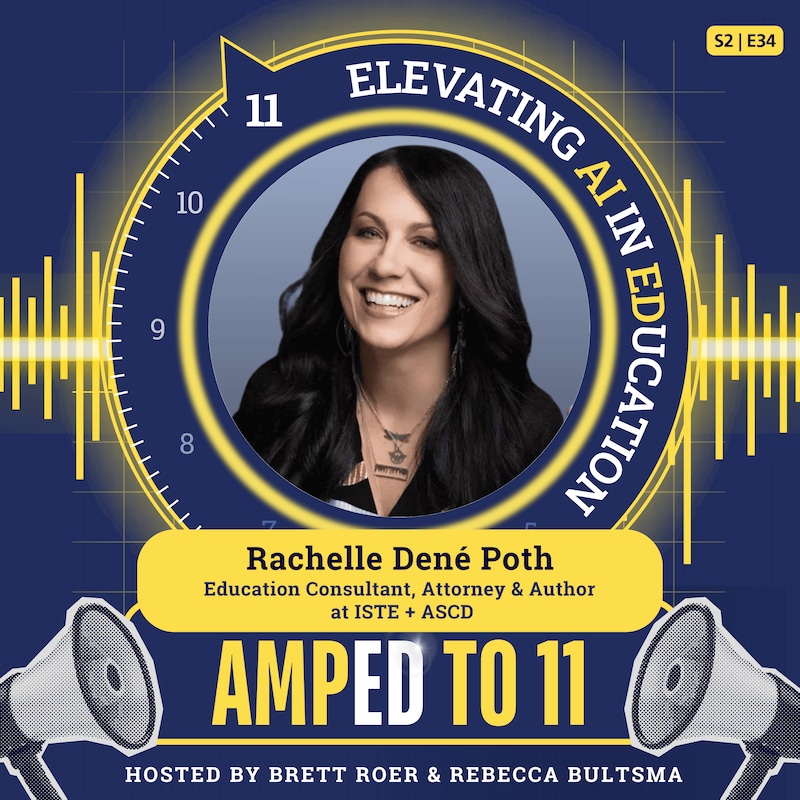
Shownotes
What does it look like when an educator refuses to stop growing?
For Rachelle Dené Poth, it meant going to law school while teaching full-time, not to escape the classroom, but to understand it more deeply. Today she's a Spanish and STEAM teacher, practicing attorney, author of 10 books, and an AI grant coach guiding 12 schools across the country through one of education's most transformative moments.
In this episode of AmpED to 11, Brett and Rebecca sit down with Rachelle to unpack what sustainable, high-impact teaching actually looks like in practice. Rachelle's story challenges the idea that doing more means burning out. Instead, she's built systems, voice-to-text workflows, AI-assisted writing routines, and intentional boundaries, that let her scale her impact without sacrificing her wellbeing.
Together they dig into:
- How law school made Rachelle a sharper, more empathetic classroom teacher
- The productivity systems she swears by that actually hold up under pressure
- Why student voice has to be at the table when schools build AI policy
- Her unconventional writing workflow that turns neighbourhood walks into book chapters
- How she supports schools navigating digital citizenship, digital wellness, and ethical AI
Whether you're a teacher trying to find your footing in an AI-accelerated world, a leader designing policy for your school, or someone who just needs a reminder that unconventional paths often lead somewhere extraordinary, this conversation is for you.
Subscribe to AmpED to 11 for honest, energising conversations about education, technology, and the humans making it all work.
Transcripts
Rebecca Bultsma: I think that as part of every assessment or every assignment, there should be clear expectations about how AI is to be used for that assignment as part of what's written in the assignment.
Rebecca Bultsma: And I also think, um, upon like, as part of the assignment, students should discuss how they used AI in the creation of it.
Rachelle Dene Poth: What is the best way to encourage educators? To not be afraid of AI
Brett Roer: Alright. Welcome everyone to the AmpED to 11 podcast. I am so excited for today's amazing guest Rachelle Dené, Poth who is joining us using acclaimed educator, author and attorney. Welcome to today's podcast, Rachelle. How are you doing today?
ere and have a chat with you.[:Brett Roer: Amazing. And as always, I'm joined by my incredible co-host, Rebecca Bultsma. Rebecca, how's everything going with you these days?
Rebecca Bultsma: Just living the dream. Excited to hear from Rachelle.
Brett Roer: Yeah, and I will say for our listeners, and I think I shared this with Rachelle, when we had the opportunity to meet in person.
Brett Roer: Just a few weeks ago here in New York City, you authentically reminded me very much of Rebecca in your passion and your career trajectory and transitions and the winding road that took us to getting into this, to this podcast today. So without further ado, I'd love it if you can share with our audience kind of what you shared with me just in a friendly conversation, your journey, how did you get to where you are right now and.
Brett Roer: These multiple career paths you took to get here. So please take it away. Rachelle,
Rachelle Dene Poth: you're asking me like my, my favorite question to ask other people because I'm always invested in this story and it's, it's so fascinating when you talk to educators to hear like their journey and you know, who would've thought that you ended up where you are doing what you're doing today.
le Dene Poth: And so for me. [:Rachelle Dene Poth: I substitute. Taught, which I loved doing. But during that time, in full transparency, I was a very big John Grisham novel fan and, and did some courses in becoming a translator like legal translation. So I decided I had this interest in the law, and after five years of teaching. In Pittsburgh there is, there are two universities that are law universities, but one of which has an evening program.
in education had it not been [:Rachelle Dene Poth: So I never got a master's. I waited a little while to get that also from Duque University in Instructional Technology and waited a few more years after that and got my doctorate two years ago now. Also in instructional technology, also from Duquesne, and just decided to dive into the world of, you know, consulting and teaching and, and doing all the things that we'd like to do so much because it really does give you a lot of opportunities.
Rachelle Dene Poth: To not only grow on your own personally and professionally, but to bring so much back to those that you're working with, whether students or colleagues. And I like to say, you know, learning and leading or leading and learning with or learning and growing with. So I like to do all, all the different things because it just brings more opportunities for learning.
rything he has ever written, [:Rebecca Bultsma: But good for you. That's, I dunno how you have the time because you're also. A published author. How many books have you written?
Rachelle Dene Poth: I, on my own, I've written 10, so, so.
Rebecca Bultsma: Where do you find the time is my question? To have all these careers plus write books and still you're in the classroom still? As I understand,
Rachelle Dene Poth: this year is the first year that I'm not in the classroom.
ut the opportunity presented [:Rachelle Dene Poth: And I, I thought, you know what? I'm gonna take this leap and try it. And it has been absolutely amazing. Also, keeping me very busy, but getting to work with other educators and share those stories of those schools. But prior to that, I, I was keeping pretty busy with, you know, full-time teaching, getting the doctorate, and also doing the consulting.
Rachelle Dene Poth: But I think it just. It came about when I developed the work ethic in law school because I was gone from six 30 in the morning until 10 o'clock at night and the weekends, and it was just go, go, go. And I don't think I could do that today, all these years, 20 years later. But very valuable experience. But you just, you have a good workflow and I have some different hacks for getting things done quickly.
I would go for a walk in the [: m a talker. I would have like:Rebecca Bultsma: I love that we all ended up here. 'cause it sounds like we're very similar. You sound like you have similar kind of drive and.
Rebecca Bultsma: Ambition and endless sources of energy. Kind of like Brett here. I'm always amazed at what he's able to do in a day, and we're both big, uh, voice to text and walker and talker people. We actually connected and became friends and ultimately bird this podcast through some of our walk and talks. So I love that about you.
Rebecca Bultsma: Highly recommend. Uh, do you use something like Whisper or Super Whisper now in your computer?
just. Talking and then done [:Rachelle Dene Poth: But a lot of times it's, it's Google Docs and there are some other things I've, I've tested out, I think it was, and I'm blanking on the name of it now, I can see the icon has an orange icon. It audio pen was something that I had used before and there's some other ones that are on my list to try out. So, but I just go basic, like whatever the format is, document or email,
Rebecca Bultsma: well friendly recommendation just from, you know, one.
Rebecca Bultsma: Soul Connection to another, I swear, live, breathe, and die by an app called Super Whisper that lives on my computer and it's just one button shortcut. No matter if I'm in Chrome or Google Doc or Word or anywhere on my computer, it does 100% perfect voice to text transcription and it can tell if I'm writing an email in a form, it's like an email.
Rebecca Bultsma: I do it for LinkedIn, I do it for anything that I wanna make sure it sounds like me, and it's my most used tool. Throughout the day.
Rachelle Dene Poth: Well now I'm gonna, that'll be my afternoon
Rebecca Bultsma: to ask, try [:Rebecca Bultsma: I was, um, using my iMessage with my Claude code and the Siri functionality after using something as good as whisper super whisper is devastating. It's just not even close to as good as some of these other tools. So enjoy.
Rachelle Dene Poth: Right. I will. Thank you.
Brett Roer: I just recently resumed using Super Whisper again, and I am constantly blown away by it.
Brett Roer: Like in the last week I started really using it again for almost everything and I'm just like, so impressive. But yeah. And, but I think what we're all hearing is, you know, once you know how you work and obviously it's, it sounds like. The working style has remained similar and now like trying to find the tools that now do that work even more effectively or impactfully for you is like next journey on these.
iatus from the classroom and [:Brett Roer: Maybe share with our listeners a little about what that feels like after being a lifelong educator moving into this new role Briefly. Also, if you could share with everyone this work you are doing with ISTE ACSD and I, if I recall, it's around the country, so yeah. Sharing a little more about what you're really, what you're focused on.
Rachelle Dene Poth: Yeah, so it's an initiative that's funded by Pinterest for this year, created for 12 different schools and schools applied for it. And I am serving as basically like the grant coach. So I work with each of the different schools. Each school developed a task force comprised of varying roles of educators in their.
udent voice in there, and so [:Rachelle Dene Poth: We use policy, digital wellness, creating any kind of activities or just getting them involved to look at like how they're using technology. Uh, sometimes I get to go to classroom visits, which is a lot of fun, especially when I see the elementary students just starting to learn about AI and using different types of technology, but doing it in a safe, ethical, supported way by their teacher.
Rachelle Dene Poth: And then I get to kind of interact with them. And so that has been. A really great part of it and being able to work with each of the schools. And for me, I love teaching. I love helping educators. I love learning, and I've always said if I, if I left the classroom, then the reason would be to do something like I'm doing right now where I could work with more schools, I could share those stories.
d it off at the end of July. [:Rachelle Dene Poth: Well engaged some of the, the schools, like their families and the parents are, and what they're providing for them. Especially with so much conversation happening around, you know, cell phone bans was big a few months ago and now it's, you know, screen time is coming up again and I spoke about screen time and so there's a lot of things that I'm doing some research on.
because I see the impact on [:Rachelle Dene Poth: So it's been great.
Rebecca Bultsma: I'm curious about where you're seeing kind of your legal background and your experience with the law kind of intersect with what we're seeing happening in schools today. What issues are top of mind for you?
Rachelle Dene Poth: Well, the data privacy, ethical use. And it's interesting because I've been asked so much over the years like, why aren't you using your law degree?
Rachelle Dene Poth: And I said, oh, but I am, because it has helped me to think differently, especially when you're in a classroom. And I've had so many funny stories over the years of like kids say, well, I didn't do that. And I said, look, I studied forensic sciences. I can tell the angle at which. I said, tell me if I'm right.
Conversations. Uh, I've been [:Rachelle Dene Poth: Then I thought, you know. Chat GPT the first thing I wrote was like, oh, cheating. And you know, it, it's the, I'm like, people have been able to cheat since I went to high school, and it's not anything new. It's just causing us to really think about what we're doing in our classrooms. And so it got me to thinking like there are bigger issues out there.
not share, store, buy, sell, [:Rachelle Dene Poth: Somebody asked me that and I said, no. And she said, wait, seriously? And I said, no, because. You don't know what else is behind that system, like if it's, if they're collecting payments or anything. And I said they need to be transparent in that and have that listed. So I just spoke in at EdTech Day in Ithaca College last week, and I did a session on AI in the law.
Rachelle Dene Poth: And there were students, high school students in there, and some of them were very concerned about. Legal things about, you know, educators using AI to generate feedback for assessments and putting their information in and their concern for their own privacy. And then other issues too about like the environmental impact and, and I said, you know, and this is not just education because there are companies out there that for a while have been using AI to go through and analyze resumes and, you know.
ich is no surprise how I was [:Rachelle Dene Poth: Well, I should say a lesson that I teach when I teach was teaching my students about, you know, legal things. But it's also a fun session that I do because of different scenarios and, and I love getting the pushback and, and the hard questions too. And I. Always necessarily have the the answer because even the attorneys that are out there working on it don't all have the answers.
Rachelle Dene Poth: So it's evolving for everybody.
Rebecca Bultsma: I do, uh, my research in AI ethics, uh, in the uk so I, I work a lot with the ai. AI act and, uh, see some of the things that they're putting in place there that we don't necessarily have over here. But you're right, nobody has all of the answers and it's different everywhere you go.
take on, uh, something that [:Rebecca Bultsma: I'd just love your take on what you're seeing or hearing or your initial thoughts on something like that.
Rachelle Dene Poth: Yeah, it has been interesting in the work that I've been doing this year visiting the different schools in different states because I just saw, I found, I was doing some research yesterday on screen time and finding articles and surveys and a lot of information about that, and cell phones was involved in it as well.
ool and, and everything like [:Rachelle Dene Poth: Where do you draw the line? And you have to have the guidelines in place, but it is, it is kind of a scary but interesting thing to think about. The capabilities that we have with technology. I, I, when I was in New York last week was in the Uber and we were talking about AI because people always, oh, you know what brings you here or something, you know, what do you do?
ou know, buildings, like the [:Rachelle Dene Poth: Two people helped me carry all the things that I would need for what I could do on my phone. So, uh, we've been in some of the conversations talking about, you know, any type of device use, like not being on it so much, and I know even the American Pediatric Association kind of is shying away from the hours.
Rachelle Dene Poth: The bands like the age levels and the time limits on that a little bit too, but it, yeah, there is that concern. And even I spoke with a, a group of students that were fifth graders and they're talking about using like Google lens on, on their tests. And I'm like, and you're in fifth grade. And, and they know so much, so early on and so.
e like the boundaries and to [:Rachelle Dene Poth: Involved in some type of situation or be captured if you take an image using something or generate an image of somebody. So it's, there's, there's a lot of things that we can talk about when it comes to education. It does not get easier the longer that you're in the educational system in Newark that you're doing.
Rachelle Dene Poth: That's for sure.
Brett Roer: You, you said something, and just more for our listeners who maybe are in that gray area of what to do next. And we'd love to hear, I'm giving you an obviously like a dichotomy here, but I would love to hear you, how you would explain to our listeners this idea of like, you start with making sure there's rules in place, like what you said, like some places are banning everything and then gradually releasing backend things and there's like a trade off to doing that, especially for students that have accessibility needs or.
feeling of like, while we're [:Brett Roer: What, what's the guidance you've given to districts and obviously Rebecca, you're doing this work too, so would love to throw this up to both of you. How do you guide districts that are, they're ready to work, they're ready for help? What's the first steps you, you usually lay out for them?
Rachelle Dene Poth: Yeah. One thing that I think is really important, and actually somebody at a session here in Pittsburgh that I had done on AI in the law, a superintendent at a school district came over and said to me that what they were working on, 'cause my question to them was, do you have policies or are you working on a policy related to AI in your school?
Rachelle Dene Poth: Like is there something on your website? And there were very few hands that went up in the room and. He came over to me later on and he said, you know, we're really struggling with with policies because we feel like the time that it takes to write out this full policy, by the time we get it done, everything's gonna be changed, especially when it comes to ai.
lines. Something else that I [:Rachelle Dene Poth: And so when I've spoken with the task forces or just even at conferences or other events talking about it, it's. Looking at the school, having different people in the conversation and finding out like, are there specific issues that need to be addressed? What are teachers seeing? And also having families involved.
Rachelle Dene Poth: Like having, I've been at community events where families come in because some things that are happening, you know, families aren't necessarily aware of because like one thing that was a shocker to me back in September, they were talking about fourth graders using Google Docs to have conversations with each other in class.
evision history, but it's so [:Rachelle Dene Poth: So starting with, I say, I always say start with a conversation, you know? What is the big question? Is there an issue? Okay. Cell phones have become a problem. Okay. Why is it a problem? What can we do? Or should we not have any devices in our classrooms? Okay, well why? And what is that? Is that gonna solve a problem?
Rachelle Dene Poth: Well, maybe, but it's also gonna create a problem where then you don't have students that are prepared to use technology, which. To be successful in the future because technology's not going away. So my answer was kind of convoluted off the cuff, but e essentially, I always recommend having a conversation.
and I'm anxious to hear what [:Rebecca Bultsma: I've been approaching this a bit differently lately.
Rebecca Bultsma: Um, and I just got back from working for a couple of days with the district and I've realized that they already have grounding. Guiding values, right? For their district. So I try and just help them think about AI through those existing things. And then what I'm doing is helping them build a very thin AI policy that basically just points to other things that exist, right?
Rebecca Bultsma: Um, when using ai, they will adhere to everything as outlined in see this policy about data privacy. Uh, students will adhere to the guidance of their teachers when it comes to ai. Uh, the default is. Not to use AI unless teachers direct, like keep it very, very short and grounded. My rule of thumb is if the technology is going to change what you have in there, it doesn't belong in there, right?
a lot under student code of [:Rebecca Bultsma: And then I recommend three big branches, um, that take the very specifics that are agile and easy to adapt based on new capabilities. A, a student community, like a student handbook, a staff handbook, and like a community handbook that can be adapted and updated in real time as use cases change. And that way you can have them in very student friendly language.
Rebecca Bultsma: Very parent friendly language with parent friendly links and parent friendly topics. And then a master kind of staff reference handbook that has things very specific to them. And I'm finding that's working really well. It's less overwhelming for districts to put together. Um, I get, you know, like these stripped down policies cover everything legally that exists.
a new model. Like they say, [:Rebecca Bultsma: But then those handbooks can be really agile and updated and relevant to each group. And I'm finding that's working really, really well. Um, a good friend of ours, uh, Roberto Vargas has put together like an excellent community playbook for his school community in Chicago. And, uh. I just think something like that is a great idea and it's proving to be very, very useful and a little more adaptive, and they can all still be rooted and grounded in those guiding values that are almost the root of the tree, uh, at every point throughout that process.
Rebecca Bultsma: So that's kind of where I'm leaning lightly, that instead of trying to build a policy that is all things to all people, uh, that students would never read and that parents would be overwhelmed by. So that's kind of where my thoughts have been on that lately.
. I like the tree, and yeah. [:Brett Roer: I I wanted to ask both of you, but coincidentally, uh, Rachelle, a week from today when we're recording, we're gonna, I'm gonna be in the greater Pittsburgh area at, at IU one, and we're doing this with eight of the districts in that surrounding area, how to build community playbooks.
Brett Roer: So Rebecca, what you kind of just said, and then Rachelle, I want to hear your insights. So getting that policy, like you just left this district and it sounds like they now have the, the trunk of the tree built. How do you help them move the mind shift to like, and maybe this is what you've already done, or like now maybe they take that and now they're either building those three different branches for those three different stakeholders.
Brett Roer: And like Rachelle said, you get survey insight data. How do you then get it? How do you make it stick and be like part of the community? Because that's an area where a lot of these districts, as we're building their playbooks, we help them a lot think through like. Okay, now here's how you make sure that it's utilized.
, it becomes ubiquitous with [:Rachelle Dene Poth: I'll give you an example. Like the work that I'm doing this year. Each school at the beginning looked at their acceptable use policies or responsible use policies to look for, you know.
Rachelle Dene Poth: Was it up to date? You know, did it still save pagers in it or things like that? And, and some, some did. And that's other schools I've looked at too. I was just curious. I went on local school districts, I'm like, oh my goodness. It does still say like pagers and, okay, we might wanna update that a little bit.
Rachelle Dene Poth: We, the way that it, it worked was some of the schools would look at their policies and the language was so, it was either confusing. Or it was inconsistent in what was being shared with like the educators and then with students and with the families also. It was very lengthy and then a lot of it was very negative.
privacy whatsoever, and you, [:Rachelle Dene Poth: Models of it, actually putting it in place where it's like an all in one almost, where it stays consistent. So it's like educator expectations, student expectations, any definitions and things like that. And building that out because I think I said this before, like the, there was a lack in common language of what it means for any, you know, for.
y. And then making sure that [:Rachelle Dene Poth: That it's like there's reminders that are, are set up or sent out that the practices, that it's, well, that it holds. Like, you know, don't be on your phone when your teacher's talking. That's just a random example, but that educators are modeling those same practices because even when we don't think that they're looking, the students are looking at us and we're the ones that are guiding them.
Rachelle Dene Poth: And so. I think getting people involved, making sure that families are able to get the information they need, but having that consistent kind of looking at it, auditing it, updating it, and making sure that people don't just like sign the name to it, that it's actually like been read through is really important.
Rachelle Dene Poth: Because if not, that's when, that's when the issues arise.
king about this, we helped a [:Rebecca Bultsma: And since then I found the best way to get student feedback actually is to. Use your outgoing seniors 'cause they got nothing left to lose. They will tell you how kids are using AI to cheat. They don't want the kids younger than them to have any advantages that they didn't have. And so if you have them tell you honestly about what works and doesn't work, I'm finding that is probably the most valuable insights I've ever gotten.
Rebecca Bultsma: We do that at my district. Um, I would also say one thing that surfaced when we were working with a school we worked with initially was. Like you mentioned, making it visible, and so I think that as part of every assessment or every assignment, there should be clear expectations about how AI is to be used for that assignment as part of.
assignment, students should [:Rebecca Bultsma: You may have to articulate, well, I'm gonna use AI here because. Then it forces you to think about why you're using AI there as well. So I think having it in both elements of the, uh, assessment, uh, is, I think it's important to kind of bring it to top of mind for everybody all the time. Uh, and that part of making expectations clear also helps the teachers think through and understand that there might be good ways to use AI with this assignment.
generative AI be used at all [:Rebecca Bultsma: Right? So I just think the more we talk about it, the more we're a little more open-minded and bring it to the front. I think that's gonna be the most important. Part of kind of getting everybody thinking about things differently.
Brett Roer: Now. I think this is, you know, we, we've been giving you some really hard hitting questions.
Brett Roer: I'd love for you to turn it around and this is a great conversation. You have the opportunity to be the host of the M two 11 podcast. What's a top of mind question you're, you have that you might want Rebecca and I to answer that might be really insightful or helpful for, for our audience out there?
Brett Roer: What's something you've been hoping you could ask today? Yeah.
ve been asked before or it's [:Rachelle Dene Poth: I, I refuse because I have had a couple of experiences like that, very funny ones that I share in sessions and I, I, I always say, I never wanna change somebody's mind and be like, oh no. You absolutely have to, you have to love it. It's the greatest thing ever like's. No, every, you're entitled to how you feel about it, but have, I am sure that you've had people say something similar to you like, Nope, I'm not gonna do it.
Rachelle Dene Poth: And so how do you work with, or what are your suggestions for anybody who is listening that has educators, that they want them to learn about ai, but they're coming up against that, like, Nope, I'm good.
tions about essentially just [:Rebecca Bultsma: Uh, I have this all the time and you probably do too, Rachelle, if you speak, you have people. You can tell during a keynote, let's say they're just sitting there with their folded, they're not into it, but if you get the chance to work with somebody one-on-one or show them things after that is something that shows them that they can use an AI in a way that really alleviates a huge pain point for them.
Rebecca Bultsma: I think it just might be a matter of understanding. Maybe they think AI is just. Writing everything for you so that you never have to think, but they may not recognize that it can make your slide deck in 30 seconds so that you have more time to do the parts of the teaching that you love. Or the best one I've seen lately, uh, that one that always raises eyebrows for teachers is showing them there's, there's a woman named Kelsey that I met in Ohio.
Rebecca Bultsma: [:Rebecca Bultsma: Like I had a teacher yesterday be like, yeah, I, by the time I have to put together a sub plan, I'm like, forget it. I'm just gonna go to school sick. Like I just, I can't. But as soon as they say, oh, AI can help me with that. Okay, well I'll use it to help me with that. Well good. Then you're using AI and that's helpful to you.
Rebecca Bultsma: You don't have to use it in every possible way or the limited ways you think that it operates and what you think is cheating or doing your work for you. I think we can all agree that, um, you know, a sub plan is probably a great use that you. Don't necessarily, we wouldn't necessarily consider to be cheating, you know, or you know, too much cognitive offloading.
st spending time and helping [:Rebecca Bultsma: That's the best way I've found around it. Brett?.
t week, I started teaching in:Brett Roer: And there was one person who, like I kept saying, we don't, we definitely do not need to talk about ai. But he was persistent. He wanted to talk about it, but from a viewpoint of like why he doesn't need it. I'm like, then you shouldn't use it. I said, if you can't come up with one, this is the term I use.
ul task in your job that you [:Brett Roer: And this isn't the conversation. Let's talk about anything else. Tell me how you're doing that. Like, I love to listen and learn. Uh, you're, you know, you're teaching five sections of English in Brooklyn, like how are you doing that? And you still have time for everything. That's what I find is most people, as Rebecca said, once you get to them to acknowledge one thing and then you show them just the one thing and how quickly it can change that one thing, it doesn't have to be more than that, and then it's okay.
Brett Roer: What's the safe version of this in your school? Like, oh, I use Claude. Oh, you have, you know your Google School? Yeah. You can do the exact same thing in Google. You're Microsoft School, you do the same thing in copilot, and then it's like, oh, show me how to do that one thing. As Rebecca said already, like that's.
can use a voice memo tool to [:Brett Roer: I'm doing this at the next PTA meeting. I'm doing this at the next student government meeting. I'm doing this at my next board meeting. You know, that's the difference. Once they see it's a transferable skill and it just takes away the part of someone having to type the notes so everyone's more present and engaged, then the sky's the limit.
Brett Roer: So like that, just find that one thing, and then if it's transferable, great. If it's not and it just solves that one thing, sometimes that'll be enough to get their curiosity of like, well, if it can do this, I'm sure it can do that, and maybe take some longer than others. But that's the goal.
Rachelle Dene Poth: Yeah, I, I love those answers.
a house there at this point, [:Rachelle Dene Poth: Came up next to me, said, oh, are, are you the person that's training today? And I said, yes. And she said, well, I just wanna let you know I have absolutely no intention whatsoever of using AI or I, I said, we're in here for three hours. And she said, I know, and I have this bag of all of these things I need to work on.
Rachelle Dene Poth: Okay. So she'd also never used Chacha B tea. And I, I was finding that even, you know, almost three years out and so forth, it's like, and not. Anything else at all? So I started with what, what is a challenge that you have in the work that you do in elementary, working with young students? And she said, glue sticks.
ys for kids to remember this.[:Rachelle Dene Poth: And I just watched her face as it did all the things that it does. And then I asked it to generate an image, which I mean, chances are the kids couldn't actually read it. And so the image where it said don't, and it had like a kid with like glue stick, like the kids eating it. Kid look at that and say, oh, eat the glue stick.
Rachelle Dene Poth: No, no, no. Not eat the glue stick. But she had no idea. And there are some other people that same thing where they see it, and I had one, one man that I trained like two years ago. In the summer virtually, and I popped into the Zoom room and it was just a moment where he threw his hands back on his head and slid back at his chair and he said, do you have any idea the number of hours that I have spent over the past five years doing the thing that this thing just did and this amount of time I went, yeah.
ust to connect and, and, and [:Rachelle Dene Poth: But yeah, that's a big question that I like to ask. And then I get asked a lot as well, so I was curious on your takes. So thank you for sharing.
Brett Roer: One other question we definitely like to ask is, and you know you've done a great job, you've spoken about some of these districts. You know when people, you know, find someone like yourself, right?
Brett Roer: Hopefully they listen to this podcast and they start checking out all the books and where you're speaking at, and hopefully they find ways to follow you. Who are other people that you get really excited by that? Whether our listeners have heard of them or not, maybe they're really mainstream, maybe they're not.
ke yourselves who are taking [:Brett Roer: Anyone like that come to mind that you think we should be highlighting?
Rachelle Dene Poth: Uh, yeah. Well, I, I will start with Tom Vander Ark, who is the CEO and founder of Getting Smart, because that's what I started to learn AI and about a lot of other interesting topics like Metaverse and blockchain, and, and he started to call me RDP years ago, like something new.
Rachelle Dene Poth: I got to write an article, do research on GPT years ago, and I was just like. Wow. So I, I give a lot of credit to him just for my own learning. The learning I, I brought back to my students other people, Dr. Sarah Thomas. Who was the founder? A great educator, speaker, founder of Edgy Match Community, brought so many educators together, had people collaborate on books, and also Ken Shelton is another person that I love having conversations with Ken Shelton.
in LA back in September. We [:Rachelle Dene Poth: There's so many people that I could name. I'm like, who do I talk to all the time? Like, who's my go-to? You know, there's different, different communities that are really great to be connected in and just even at conferences, like getting a chance to hear people speak and even, even if only briefly like. I got to hear Sava speak, the learning and the science and the brain conference back.
Rachelle Dene Poth: Well, I guess it was a few months ago. I think it was in February. It's hard to say, but, and I've heard her speak before, but not, you know, in a longer period of time and just getting different insights and perspectives from different people. I just, I really, and also being able to go to those people and ask questions about, you know.
Rachelle Dene Poth: What they're seeing and their experiences and just to learn from them. It's just nice to have that network. So those are a few,
e named some of our favorite [:Rebecca Bultsma: I think it was fantastic.
Brett Roer: Almost a year ago, and it's still one of my. One of those moments where especially listening to Rebecca and Ken and you're like, this is a real, like, truly like a pinch me moment. You're like, I can't believe I get to do this. How exciting this is to listen to you feel like you're on the cutting edge of like technology, ethics, morals, values, society.
Brett Roer: It's all intertwined in a conversation. So yes, those are, yeah. You need some really incredible folks out there. That's, that's who people should go out and check out. So thank you for that. That's, that's perfect. That's what people need to be doing. Yeah. One last note, when people wanna learn more about all the amazing work you've been leading, where would they go to find out more about you and your work and how to get in touch?
At this point. Something is, [:Rachelle Dene Poth: Why not? So it, that's where I am, RDA 9 1 5. And then I have a blog which has other, uh, it's a website and you just put the www and the.com around the RDA nine 15. So very consistent. Also partially the reason why I'm often called Renee, because my email, when you look at it quickly, it does look like Renee, but it's refreshing because for years, you know, Rachel, Rachelle, Renee, I answered to all of them.
he first time you're meeting [:Rachelle Dene Poth: And it's, it's just a great opportunity to have those spaces available.
Rebecca Bultsma: Just as a, a quick like wrap up up, Pierre, I don't know if you saw one of the announcements from Google this week was that you can finally go in and edit your email address. And so if it was, um, something like, you know, dragon Slayer 85 at gmail com, you can now go in and your same email account and everything and edit that first part to be something that you want and it will still, uh, go to your.
Rebecca Bultsma: Inbox and, and won't mess everything up. You don't have to start something brand new. Oh. So there you go.
Rachelle Dene Poth: So I could switch to Dragon Slay, right?
Brett Roer: That that would've helped. You know, I was, I was a college and career advisor for many years and that was like one of the things we started teaching students is how do you create your professional one and you know, your school account's gonna sunset.
Brett Roer: So that would've been incredible if they could have just taken the. The fun ones in like middle school and then turned it into those. That's
Rebecca Bultsma: now you can,
Brett Roer: [:Brett Roer: We hope our audience reaches out to you and still gathers this wisdom and checks out all your books and all the amazing things you're doing across the country in service of education and innovation. So again, we just wanna say thank you so much for being part of the AmpED to 11 community today. For our listeners out there, we wanna make sure that you check out Dr.
Brett Roer: Poth and all the work she's doing. And as always, we hope that you live your life to the fullest and you have today, and every day is a jumbo cannoli day. Go earn that and thanks for listening. Have a great day everyone.