Shownotes
If you're a poet, artist, photographer, writer or budding creative of any kind then you might like to listen extra closely to this one!
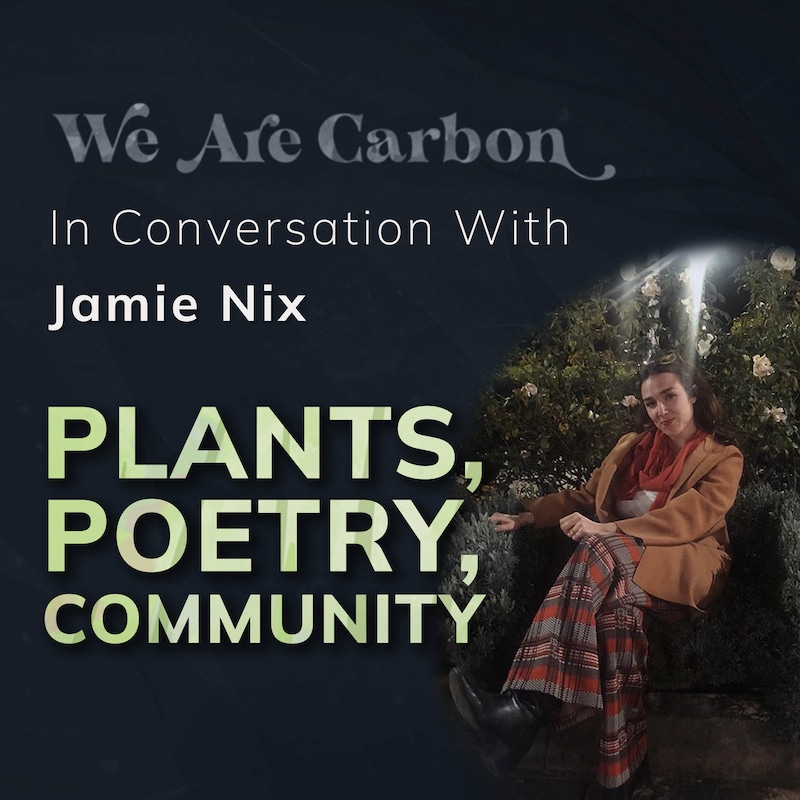
Jamie Nix is the co-founder of Plants & Poetry whose work shares and nurtures connection to the natural world through a collaborative approach to curating published works. Alongside her poetry Jamie's career is focused on agroforesty and soil health and she has a keen interest in supporting regeneration through place based learning.
We talk about:
- Weaving plants, science and poetry
- Connecting to place & community
- The role of sharing story (for regeneration)
Learn more about Plants & Poetry here: https://www.plantsandpoetry.org/about
I'm excited by an emerging co-creation between Plants & Poetry and We Are Carbon.
We'll be creating an inspiring anthology together and I'd love to invite you to help us to fill the pages!
It's very early on but if you head over to the website you can subscribe to email updates from We Are Carbon and I'll keep you updated! https://www.wearecarbon.earth
Timestamps for this conversation:
00:00 - Intro
04:55 - Weaving plants, science and poetry
11:54 - Connecting to place & community
19:20 - The role of sharing story (for regeneration)
24:07 - Next steps for Plants & Poetry
30:30 - Collab with We Are Carbon?
34:12 - More from Plants & Poetry
Transcripts
When I moved into this new community,
it was
2
:I was speaking a different language.
3
:I was surrounded by plants I wasn't
familiar with or had never seen before.
4
:And so that also helped me
sort of discover
5
:the land around me and like, connect
with it on different ways.
6
:And like, what were the uses of this plant
like medicinally or culturally?
7
:So a lot of those pieces
sort of came into the poem to,
8
:to make.
9
:Yeah, a plant poem.
10
:At the end of each of these collections,
11
:we would have prompts for the readers
and the contributors to do.
12
:Maybe it was encouraging them to get out
and their community, or in their garden,
13
:or their yard or neighbourhood,
and identify plants, or
14
:ask them to look at the wildlife
that's around their area.
15
:I think it was 40% of the people
that responded said that it did inspire
16
:some kind of environmental action
for them.
17
:After reading these prompts,
and 80% of them
18
:actually share the poems
that they wrote with their community.
19
:That's really been like a big inspiration
for us to keep going and explore
20
:different themes and
and then asking writers
21
:and scientists and artists
to share their perspective on that theme.
22
:If you're a poet,
23
:artist, photographer, writer,
or budding creative of any kind,
24
:then you might like to listen extra
closely to this one.
25
:Jamie Nix is the co-founder of Plants
and Poetry,
26
:whose work shares and nurtures
connection to the natural world
27
:through a collaborative approach
to curating published works.
28
:Alongside her poetry,
Jamie's career is focussed on agroforestry
29
:and soil health,
and she has a keen interest in supporting
30
:regeneration through place based learning.
31
:I'm excited by an emerging co-creation
32
:between plants and poetry,
and we are carbon.
33
:We'll be creating
an inspiring anthology together,
34
:and I'd love to invite you to help us
to fill the pages.
35
:It's very early on,
but if you check the description,
36
:you'll find details
for keeping up to date on the process.
37
:I'm Helen Fisher.
38
:This is we are carbon.
39
:And throughout season four,
you'll find new weekly conversations
40
:as we keep digging deeper and explore
what it means
41
:to step into regenerative actions
within our own place,
42
:creating health and vitality
for ourselves, our communities,
43
:and the natural world around us,
and really
44
:igniting a new zest for life.
45
:Be sure to subscribe to keep up to date
and check the description
46
:for more opportunities
for becoming involved.
47
:Enjoy the conversation.
48
:Hi Jamie,
thank you so much for joining us.
49
:I'm really, really excited
to have you here.
50
:If you could maybe get us started with
just a quick introduction to yourself.
51
:Yeah. Thank you for having me here.
52
:Jamie Nix and I'm based in northwest
Arkansas.
53
:I grew up between Oklahoma
and northwest Arkansas, and,
54
:my day job.
55
:I work for a non-profit
and agronomy crops and soil science.
56
:And then on the side, I have
a small business called Plants and Poetry,
57
:where we connect writers
and poets, scientists through our,
58
:literary journal that we published
59
:back in 2019.
60
:So we've been working on building
the small collection of different
61
:anthologies, publishing independent poets
based on different themes.
62
:So it might be aquatic plants
focussed on water or,
63
:soil,
64
:plants. It's really,
65
:really, really dear to my heart.
66
:And, and then I'm also an agro
forestry scientist by training.
67
:I got my master's degree
68
:from University of Missouri
in Agro forestry and natural resources,
69
:and then got my bachelor's
degree in international relations.
70
:Beautiful. Thank you so much.
71
:I'm. I'm really inspired
by the work that you do.
72
:I think something that I find really,
73
:really interesting
is how you're weaving the world of,
74
:art and science and community
and education
75
:and recognising
that that lines very blurred.
76
:So you're bringing this
77
:lovely, beautiful, heart centred
78
:artwork through the word.
79
:And then on the other side of
that is this,
80
:you know, the, the science
and the agri forestry.
81
:And do you have any, any thoughts
82
:of how that,
that sort of works for you in your mind?
83
:Do you find that
that's important to have those two sides?
84
:Yeah.
85
:And honestly, like,
it kind of came to us really organically.
86
:You know, back in 2019,
87
:I hadn't even started
really my science career.
88
:And it was actually with my roommate.
89
:She was more of the plants,
and I was the poetry.
90
:Like, I really leaned in to poetry as
91
:a way to heal, a way
to process my emotions
92
:when I couldn't really articulate them
to some of the people closest to me.
93
:And so I found myself not even being able
to write within my own voice.
94
:I would sort of look to either
those around me for inspiration.
95
:You know, my community.
96
:And then with my roommate
being the plants,
97
:she was,
she had a really great green thumb.
98
:She could bring any plant back to life.
99
:And she has a real gift.
100
:And we had all these plants in our house.
101
:And so I started to write
from the perspective of the plant
102
:through my own feelings and like,
sort of trying to relate to those plants.
103
:So I had all these plant poems and I'm
like, what am I going to do with these?
104
:And so we actually signed up
to this lavender festival,
105
:where we brought these plant poems,
and then all of her plants,
106
:we didn't really know
what we were going to do with them,
107
:just her being a gardener, me
being the poet and the writer.
108
:We wanted to share them.
109
:And then we had
people come up to us asking us if,
110
:we had
111
:a certain plant poem, like,
do you have an Iris poem?
112
:Do you have a rose poem?
113
:And we didn't.
114
:We just have,
115
:you know, the ones that were in our house,
which were more like house plants.
116
:And so we just like, saw this need from
those that were interested in plants.
117
:And that's sort of how they came
118
:together, like, really just naturally.
119
:And then, you know, eventually
the Plant Journal was the Plants
120
:and Poetry Journal was born. But,
121
:it was just holding space for people
that were interested in
122
:both those elements of their lives,
you know, whether it was their house plans
123
:or their garden plants
124
:and then bringing them to life
through a poems
125
:that they could connect
with it on a different level.
126
:Like I was able to
and which I didn't really anticipate.
127
:And then eventually, as I got more into
128
:my master's program through agroforestry,
129
:I actually had a professor
that shared a poem in one of his,
130
:and one of our courses and
131
:so, yeah, it's just it's been really cool
to see how other scientists
132
:are able to engage with poetry
133
:and then teach one another and connect
with one another on that level.
134
:It's very lovely listening through,
135
:and it makes me wonder
if the the plants are something
136
:that would have come through as a way for
you, helping
137
:you find your voice
and express your emotions.
138
:Would that have been something
you'd have naturally connected into?
139
:Do you think if your friend and partner
hadn't
140
:already really brought that,
141
:collaborative aspect?
142
:Through her own passions?
143
:Yeah.
144
:I mean, maybe,
145
:I think just different parts of my life
plans have sort of shown up, which like,
146
:obviously we eat plants every single day
and we're surrounded by them.
147
:But I didn't really grow up gardening
or anything like that.
148
:Like, my mom had maybe
one pothos plant in the house.
149
:But it wasn't
something that she was really passionate
150
:about until most recently.
151
:But my great grandmother had a sustenance
farm in Marble City, Oklahoma, and,
152
:you know, she fed the whole family
through that farm.
153
:And she had a couple cows,
154
:couple pigs, and it was in the forest
along the creek line.
155
:And I've always heard stories
from my aunt growing up,
156
:just about different,
different elements of our family.
157
:And, one time this happened
and, you know, so
158
:and so was helping his neighbours
find water or, she used to always grow
159
:potatoes, and I would be digging
in the dirt for her for those potatoes.
160
:And if I wanted to go play outside.
161
:So I think a lot of those stories were
sort of rooted in me and embedded in me.
162
:And so maybe it would have
I would have found my way on my own.
163
:But it was really fun to discover it
with my friend, for sure.
164
:And then one other thing I want to share.
165
:So my grandmother and my
166
:great grandmother living in Marble City,
they were really involved in,
167
:decorating graves, which I think maybe
168
:is still very,
you know, important to the community.
169
:And we honour our,
our dad in different ways.
170
:But my great grandmother,
they would always decorate these graves.
171
:And one day my grandmother was out there
with my great grandmother,
172
:and it was really hot.
173
:And she was just complaining like, gosh,
it is so hot out here.
174
:Like, I did not want to be decorating
these graves all day.
175
:And so my great grandmother was like,
well, sis,
176
:you know, Buddhist plants you a tree.
177
:And so she actually planted my grandmother
a tree in the cemetery.
178
:Now, both my grandmother and great
grandmother are buried under that tree.
179
:And. Like, that
story has always really stuck with me.
180
:And I always wondered if that's why
I sort of gravitated towards agroforestry,
181
:given the sustenance farm
and the special tree that's just there,
182
:where me and my family joke
about in our group chat that like,
183
:who's getting a spot underneath that tree?
184
:So we're not baking underneath the sun.
185
:But yeah, it's just really special to me.
186
:So yeah, what a touching story
that is really, really lovely.
187
:The, the obvious connection
there of the agroforestry
188
:bringing in, the, you know, the practical
offering of a tree, just that simplicity
189
:of will heart, the soils,
baking plant, a tree.
190
:I mean, that's that's powerful.
191
:But it's also such a beautiful,
beautiful place that is
192
:it has got so much meaning now
under this tree for you and your family.
193
:It's very I should imagine
that's connected in pretty deeply.
194
:Thank you for sharing.
195
:Yeah.
196
:When it comes to the poetry
that you wrote prior
197
:to the, festival that you went to,
198
:that was a way for you to find your voice.
199
:And when people asked you,
could you come up
200
:with a poem for this plant
and this plant and this plant?
201
:How did that differ?
202
:What was the experience of finding
those particular plant personalities?
203
:I think it
204
:really just depended
on the needs of the plant.
205
:You know, so I would sort of lean
into what the sun requirements
206
:might be or water requirements
or what soil it might grow best in,
207
:what environment it would drive it,
208
:and then what
other plants might be growing around it
209
:that would really nurture in complement
and set up, compete with it.
210
:So I would sort of bring in those pieces
as I'd write the plant or the plant poem.
211
:And then also my relationship with it.
212
:So initially
213
:some of the poems that I would write
that weren't necessarily houseplants,
214
:they might be plants
I found in my neighbourhood.
215
:So I actually ended up moving away
from home for around four years or so,
216
:and when I moved into this new community,
it was
217
:I was speaking a different language.
218
:I was surrounded by plants.
219
:I wasn't familiar with or had never seen
before, or were called a different name.
220
:And so that also helps me sort of discover
221
:the land around me and like, connect
with it on different ways.
222
:And like, what were the uses of this
plant, like, medicinally or culturally?
223
:So a lot of those pieces
sort of came into the poem to,
224
:to make.
225
:Yeah, a plant poem.
226
:Perfect.
227
:That's really interesting.
228
:And if we think now about the
229
:the sort of wider
vision of plants and poetry,
230
:you've connected your own emotions
into this expressive
231
:words, into the poems, and then you're
sharing them with community.
232
:But there's also a part of your journey
where you directly are connecting
233
:to, to the land and growing a food forest.
234
:Could you talk a little bit
about about the connection there?
235
:Yeah.
236
:So, Leslie Walker is who I worked with.
237
:She had actually been introduced to me
through that roommate, Kelsey Nelson.
238
:At the time, the plant, roommate.
239
:And she introduced me to her.
240
:And Leslie had told me that
she always had this dream of building.
241
:She called it the Oasis.
242
:And she wanted to have a space
in the community where she could grow
243
:food and share it.
244
:And she was also a teacher by trade,
245
:so she wanted to be able
to teach the community.
246
:And she had children.
247
:So she wanted to be able to teach her
children and her neighbours children.
248
:And she wanted to also be home.
249
:Right.
250
:So I'm like, we thought, well,
251
:why can't you have a forest garden
or the oasis at your home?
252
:And we can just slowly
build it, little by little.
253
:And so she built it from the ground up.
254
:I mean, I think she started
probably eight years ago,
255
:you know, little by little,
she was planting seeds.
256
:But then in the last four years or so,
257
:we were committed to every submission
we would receive from the journal.
258
:We would commit to planting a seed
in this forest
259
:garden, in this community food forest, and
260
:so, you know, over the years,
she's been planting and growing
261
:and sharing her her harvest and,
262
:with the Plants and Poetry Journal,
you know, with all of these submissions
263
:and all of these people
that were now sort of connected
264
:through this place, the Oasis,
even though they were all over the world.
265
:We use different, maybe challenges
266
:that would come up in the food forest
to inspire some of the themes.
267
:So there was one point
where Leslie wanted to amend the soil,
268
:add different
269
:amendments in the soil to, you know,
obviously make it more healthy and,
270
:whether it was compost or mycorrhiza,
271
:little amendments that she got,
272
:and so we made one,
273
:theme on
274
:Gravity's grave, which was about soil.
275
:And we had two issues of those.
276
:And then we had one, wildlife of the
underworld, which was inspired by plants
277
:because there was a flood
that was happening in her neighbourhood.
278
:And then
279
:we did. Gosh.
280
:What else?
281
:Oh, my core rises like mycorrhizal fungi.
282
:She was finding some nylon
all along the forest.
283
:And then plant people was sort of, like
284
:annual anthology
that we just kept coming back to.
285
:And so at the end of each of
286
:these collections,
we would have prompts for the readers
287
:and the contributors to do,
whether that was a writing prompt,
288
:or maybe it was encouraging them
to get out in their community
289
:or in their garden
or their yard or neighbourhood.
290
:And identify plants, or
291
:ask them to look at the wildlife
that's around their area.
292
:And just sort of
293
:encouraging them through like place,
play, place based learning.
294
:And we actually did a survey,
295
:I think after
we published 12 issues or so,
296
:and I think it was 40% of the people
that responded said that it did inspire
297
:some kind of environmental action
for them.
298
:After reading these prompts
and 80% of them
299
:actually share the poems
that they wrote with their community.
300
:And so even if they weren't
taking direct environmental action,
301
:they were still sharing their their poems
that were, you know, maybe inspired
302
:by plants or by water or by soil
with the people that are in their life.
303
:And so that's really been like
a big inspiration for us to keep going
304
:and explore
different themes and intersections.
305
:So we even did one that was,
Leslie's idea.
306
:On seeing synergies.
307
:So what two plans might
work really well together.
308
:And then asking
309
:writers and scientists and artists
to share their perspective on that theme.
310
:It's really delightful.
311
:What is kind of going off
in all the different directions, the work.
312
:And there's an invitation
there of the way that nature evolves.
313
:It feels,
you know, like it is the mycorrhizae.
314
:You are connecting outwards and
and sharing and connecting people
315
:and so your anthologies
and your publications, they're
316
:bringing the voices and the expressions
and the art of people all over the world.
317
:Is that right? Right.
318
:And that's a big part of
319
:it was so we had started,
ou know, plants and poetry in:
320
:And then the end of 2019, I moved abroad.
321
:And so I had built that connection
with Leslie,
322
:and she had talked about this vision,
but I was no longer in the area.
323
:And so it was also a way for me
to stay connected to the land. And,
324
:with my
325
:friends and the plants
that I'm familiar with that
326
:they were now engaging
with on a daily basis.
327
:And so, yeah, it really, really was
sort of tethered me to
328
:where I'm from while I was building
this journal abroad and writing
329
:and editing while they were on the ground
building the food forest.
330
:It's it's wonderful.
331
:We're definitely in a time,
I think, where we we need to celebrate
332
:that connection where, you know, global
and and connecting across the world,
333
:but also that place based action
and for ourselves
334
:to connect with the land,
but also to connect personally.
335
:And, and with the place that we live in.
336
:And it seems that
that's really important to this work too.
337
:Yeah.
338
:So I got my degree
in international relations.
339
:And like when I was studying this degree,
340
:we were sort of pushed to talk about
intergovernmental relations
341
:and not so much on the like, whether it's
local level or, you know, nonprofits
342
:that might be communicating and working
with one another or universities and
343
:so, yeah,
I just think it's like really beautiful,
344
:just international relations
from that lens and through art
345
:and through poetry
and able to connect with one another.
346
:That's incredibly powerful
347
:and so many possibilities
that it opens up.
348
:Yeah.
349
:Like, let's know you're aware and I'm in.
350
:Exactly.
351
:Yeah, I'm here in the UK and yeah,
352
:completely different times,
but I value it so much.
353
:It's lovely.
354
:With this season of the podcast,
there's a desire that I have to get people
355
:moving from listening
and learning into taking action.
356
:And just even if it's those small steps.
357
:So it's something that I'm keen
to kind of throw in there.
358
:Just a quick tip.
359
:If you could share something
and I wonder if there's something
360
:that has stayed with you
that you recognised.
361
:People
have learned through the expressions
362
:that have come together in those prompts
that you have in your work,
363
:something where you feel
that it's a it's a really good way
364
:of experiencing or participating
365
:in regeneration that is accessible.
366
:Yeah.
367
:It's a good question.
368
:One tip.
369
:I think inviting others to share
370
:their story has been really powerful.
371
:You know, even if it might not be the poem
or the piece of art
372
:just sort of leaving that room
for flexibility.
373
:And like, co-creation
374
:has really been able to.
375
:So, for example, we worked with,
376
:one of my childhood friends
377
:who went to high school together and
378
:we weren't as close,
but we still kept, you know, connected
379
:through social media and everything.
And I saw this.
380
:She was directing a movie called
381
:Poets Are the Destroyers and
382
:even though we were focussed
maybe on more environmental
383
:themes and poetry and plants,
she was building this film
384
:and I ended up, you know, working on
some social media with her for the film.
385
:And we were thinking like,
how can we work together?
386
:How can we collaborate on
something that will really be meaningful
387
:for both of our communities,
even though they are pretty different?
388
:And we found so many similarities
389
:because as we were breaking down
sort of the essence of her movie,
390
:and it was about an artist and a poet
that was
391
:sort of breaking weird.
392
:But as she say,
393
:she said, you know, oftentimes artists
we destroy in order to create.
394
:And so we took that theme with nature
and how the cycles of nature
395
:and how plants often grow
and are planted in the spring.
396
:And then we harvest in late summer
and then in the fall might die or decay
397
:and then are reborn or, you know,
come back as perennials in the spring.
398
:And so we took that theme
and then ended up creating,
399
:co-creating an anthology called
When Penns Bloom.
400
:And so I think like leaving
401
:that flexibility and allowing her,
you know, whether
402
:it was the actors or the script writers
to contribute to this anthology.
403
:And then also those that were watching
her film contribute to this anthology,
404
:as well as the people that were connected
to plants and poetry Journal.
405
:And then we ended up,
you know, co-creating
406
:this really beautiful collection
of art and poetry and storytelling.
407
:I think we even had some audio
submissions.
408
:So, yeah, I think I don't know
409
:if that's really a tip,
but that's something that came to mind.
410
:It is. It's a lovely tip.
411
:I think sharing story is powerful
and often overlooked
412
:because when it comes
to all those tense emotions and anxieties
413
:of, you know, the planet's in a bad state
or we need change.
414
:Whatever that change is,
there's a tendency for people
415
:to go really hard at it and,
416
:despair and say,
417
:well, you know, I see it this way,
so you should see it this way.
418
:And I think story is it
419
:softens and it allows to see you
through the lens of somebody else.
420
:It's it's that magic of
421
:bringing people into a different space.
422
:And so I, I can see that sharing story
as a tip
423
:is so expansive and so powerful,
and I think it's perfect.
424
:Thank you.
425
:Yeah.
426
:And my aunt, like, she's been like
a notorious storyteller within our family.
427
:And you know, she has
all these filler words that she will say
428
:and not filler words that are truly,
genuinely a part of her storytelling.
429
:And every time I hear someone say it,
it just like brings me back
430
:to a moment
that she might have shared with all of us.
431
:And it's always oral storytelling.
432
:It's never she's never written anything
down.
433
:She's not, you know, making anything
that even though she's been a huge
434
:lover of poetry. But,
435
:yeah, just felt culture that.
436
:You know, it's lovely.
437
:Where where are things now
with plants and poetry?
438
:What's your focus?
439
:Well, so, Leslie,
I had mentioned before building the Oasis.
440
:She's sort of taking a different route.
441
:She's building a nature school,
where she'll be going to different areas.
442
:And the community
might be like a local park or a local farm
443
:and sort of stepping away
from offering forest therapy at the oasis.
444
:And so, you know, initially
when we had started Plants and Poetry
445
:before I was introduced to Leslie,
you know, Kelsey and I
446
:had wanted to commit to planting a seed
within our neighbourhoods.
447
:So I think that's sort of the route
we're taking now, is that
448
:for every submission that we receive,
we'll plant a seed in our neighbourhoods.
449
:And I'd like to work with some of the,
450
:like, garden clubs
that are in the area here.
451
:They tend to manage a lot of our trails,
452
:and also
453
:building some more art and agro forestry
education programs.
454
:So I'm working with an artist,
Erica Doran.
455
:She's out of Canada, and she's an artist
and an incredible designer and poet.
456
:So her and I are co-creating
on a couple different things.
457
:And then with my background
in agroforestry, I'd like to create some
458
:accessible materials that can be available
through plants and poetry.
459
:We've talked about doing
like a colouring book
460
:about tree crops,
461
:or a writing guide
462
:that might be inspired
by different agroforestry practices.
463
:So we've also got on Substack,
which is like social media,
464
:and it's been a really cool experience
to get immersed into the Substack
465
:community, because there's so many writers
and poets on there.
466
:So I think just the more
I lean into that space,
467
:I can see what people
need and want to engage with.
468
:For me, on a
469
:personal level, like I'm working
with Erica and another writer,
470
:Heidi Sander, out of Canada,
and we're writing a cookbook.
471
:And so it'll have elements
of poetry and recipes
472
:and art in it that will publish
through plants and poetry.
473
:And then we're also working with,
474
:like several different poets to publish
their own independent poetry collections.
475
:So there's this,
the Shia Coppola in California
476
:and Lisa Lundin in North Carolina
477
:and Alexandra Kramer in Vermont.
478
:And so each of them
have their own poetry collections.
479
:So I think just helping them
promote their work, and
480
:yeah, just
481
:working on those things.
482
:That's lovely is the theme
that comes through with the collaborators.
483
:It's always
still there on the plant world.
484
:Yeah, probably plants food.
485
:Community.
486
:Those are
487
:probably the main ones that come up.
488
:But it's not always the poems
489
:need to be about plants, necessarily.
490
:I think it can be about your relationships
that might be compared to plants
491
:or, the land and where you live
and who you connect with.
492
:We actually have a call, an open call
for submissions for rituals and remedies.
493
:It'll be our second volume to do that.
494
:And so it's not just about plants.
495
:It might just be like,
496
:how do you wake up in the morning
and who do you wake up in the morning?
497
:What do you say?
498
:Prayer is oftentimes I feel like
poetry for me is a form of prayer
499
:in a way
that I'm able to really articulate
500
:my feelings
and connection to those around me.
501
:So not just plant
502
:poems,
but there's certainly a big piece of it.
503
:It really demonstrates
how that it can weave
504
:into all of the different aspects
of being human talking,
505
:you know, starting starting there
with the plants but spreading out, which,
506
:okay.
507
:So if we just put you on the spot now,
508
:what is your favourite plan
that you've worked with?
509
:Oh, gosh.
510
:My favourite plant.
511
:That's tough.
512
:We're actually me and Erica and,
one of our guest editors, Megan Perry.
513
:We actually gave ourselves
this task to come up
514
:with our favourite plant
by our next meeting, which is May 10th.
515
:And we're going to do some things
with this
516
:because this favourite plant
and I don't have mine yet,
517
:like the first one that comes to mind,
is not even my favourite plant,
518
:it's my mom's,
which is a lily because it's also another
519
:one of my friend's favourite plants.
520
:And then the date palm comes to mind.
521
:Dates like I love dates and hibiscus
522
:really comes to mind.
523
:Leslie.
524
:She has a lot of Rose of Sharon
trees on her property,
525
:and I never knew how many
like medicinal uses that you can use
526
:from the Rose of Sharon
or the hibiscus flower.
527
:I have sunflowers in my house,
528
:a lot of sunflowers.
529
:The spider plant is a very easy houseplant
for anyone that needs.
530
:It's just getting started.
531
:So, yeah, I, I probably can't name
just one, but there's, there's several
532
:that come to mind that are sort of
inspired by those around me.
533
:Brilliant. No, that's nice.
534
:A whole list.
535
:And they're very varied
and filling people's
536
:life with with joy
and lots of different options.
537
:Thank you.
538
:Do you
have a favourite, My favourite plant.
539
:I'm going to be just as vague.
540
:I have so many,
and I suppose it depends on the day, but,
541
:I do.
542
:I love the cliche of the rose
and just the the sort of.
543
:I don't know that it's, like,
so fragile and so delicate,
544
:but also really kind of holds itself.
545
:I think there's something just in that,
that beauty of the rose.
546
:Gotta love the beauty of the rose.
547
:But then there's so many plants that,
548
:I surround myself
because I have a food forest and I'm.
549
:I'm introducing new plants every year,
and they're like, it's
550
:just like adding in another friend.
551
:And yeah, I would struggle.
552
:I would struggle
just as much as you with that question.
553
:But yeah.
554
:So I would like to,
555
:finish up by asking you
if there's something we can do together.
556
:I would I think that the plants and poetry
and we are carbon.
557
:What we're sort of vibing
558
:and in this same area,
the focus that I have is so aligned
559
:with the idea of bringing
lots of different contributions,
560
:sharing knowledge and inspiration,
and then taking that place based action.
561
:So maybe there's something in that.
562
:There's a little simple thing
that we could weave together.
563
:Yeah, I would love that.
564
:Whether that is, you know,
collaborating on like a new anthology
565
:or incorporating We Are Carbon
into some of the existing ones.
566
:We have pending, like rituals and remedies
and then plant people.
567
:Those will both be published this year,
but I would be happy to for sure.
568
:And there's
569
:actually a group that I just found out
Erica had told me about it.
570
:It's eco poetic. John.
571
:Have you worked with them ever?
572
:I haven't know, something new
for me to look at.
573
:I'll have to, like,
send them to you because,
574
:they're in the UK.
575
:And where are you at in the UK?
576
:I'm in Lincolnshire.
577
:So. So
578
:East coast.
579
:Okay.
580
:Which I'm going to butcher this name
where it is.
581
:Gloucestershire at Gloucestershire.
582
:Okay. Gloucestershire is yeah.
583
:Not not particularly close,
but definitely closer than you are.
584
:Okay.
585
:Yeah.
586
:Well, they have an amazing website
and yeah, I just thought of you
587
:because a lot of their artwork
they have on their home page,
588
:it reminds me of
We are Carbon, some of your illustrations.
589
:Oh fantastic.
590
:That might be cool to connect with them,
but otherwise I would be more than happy
591
:to work with you on bringing
592
:we Are Carbon and Plants
and Poetry together,
593
:because I really admire the work
that you're doing.
594
:And any chance I get to share your
illustrations on online, I definitely do.
595
:Oh thank you, that's so, so kind.
596
:And likewise,
I just feel that there's there's
597
:so much that you're offering
through plants and poetry.
598
:It's it feels gentle and
599
:sort of nourishing,
600
:but also really, really expansive.
601
:There's, there's something there
that that could weave into so much
602
:and if I can, support that,
603
:I would be delighted to,
604
:How do people learn
about what you're doing,
605
:find the
the products that you've got for sale
606
:and get involved.
607
:Typically we have,
608
:a newsletter that goes out every month.
609
:And so that's really where
we're communicating, like the bulk of our
610
:updates, things that we have going on
called submissions.
611
:We're doing a plant of the month,
seasonal gardening advice.
612
:We'll include some poetry prompts
and these newsletters.
613
:And so we send that through Substack.
614
:And then we have our website Plants
and poetry.org.
615
:And then we are on Instagram.
616
:But we've sort of gravitated
towards Substack
617
:since we've been building the community
over there.
618
:So yeah,
those are two good places to start.
619
:Yeah.
620
:I think the newsletter
621
:is probably the biggest piece that we have
that's reoccurring.
622
:Fantastic.
623
:And, are you publications
available primarily online or can people
624
:go and pick them up elsewhere?
625
:Yeah.
626
:So we have our online journal shop
where we have, you know, notebooks,
627
:garden journals, poetry anthologies
and collections, colouring books,
628
:that you can buy online for,
like the print physical copy and then
629
:all of our online poetry collections,
they're available to read for free.
630
:You can actually read
through them on our website.
631
:And then there's several different stores
around the US that do carry
632
:some of our collections and notebooks,
so you can find them sometimes up
633
:in a store, which is wonderful, but
634
:mainly in our journal,
our journal shop online.
635
:Perfect. Well, thank you so much.
636
:It has been hugely inspirational
talking to you, learning more.
637
:And I feel like, I want to
638
:to head over and read more of the poems
because,
639
:but, yeah, I'm,
I'm really, really loving it all.
640
:Thank you.
641
:Yeah. Thank you so much for having me.
642
:I really appreciate it.
643
:And I'm looking forward
644
:to working together on something with
we are carbon and plants and poetry.
645
:So thank you. Amazing.
646
:Yes. Let let's get it sorted.
647
:If you
648
:enjoyed this episode then be sure
to check the description for the links
649
:to learn more and engage with the work
from Jamie and plants and poetry.
650
:And of course, there's
the exciting opportunity
651
:to keep up to date about contributing
to our emerging plants and poetry.
652
:And we are carbon co-created.
653
:Anthology info is in the description.
654
:Don't
forget to subscribe to keep up to date.
655
:I'm Helen Fisher, this is we are carbon
656
:and let's
keep figuring this all out together.



