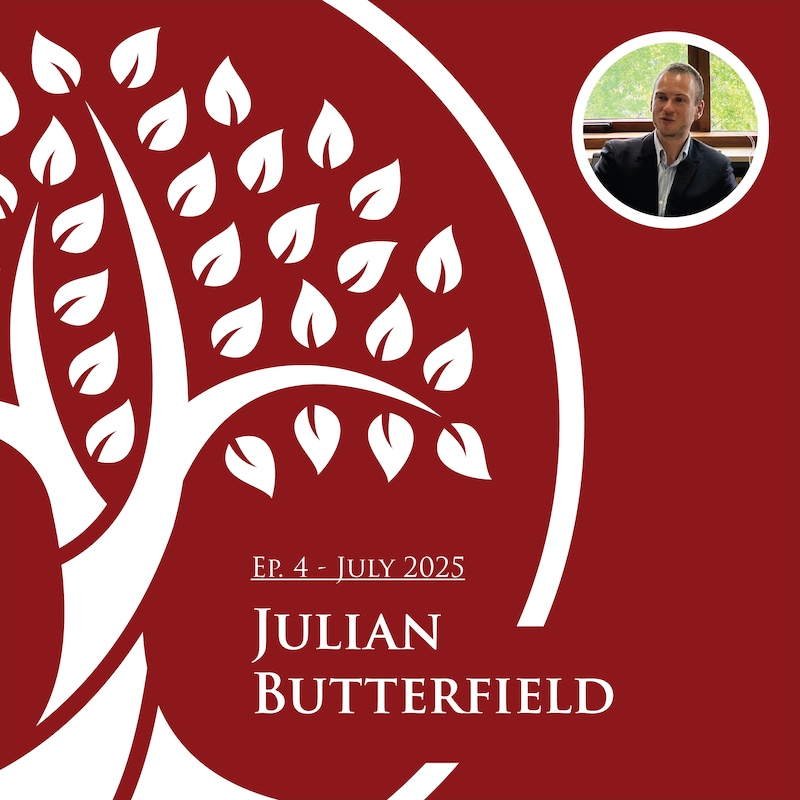
Shownotes
Julian Butterfield talks about the winding path to a dissertation topic, overcoming exegetical resistance to emotional affect in religious literature, and the central role of joyful anumodanā (隨喜 suixi) in the Lotus Sūtra.
Julian Butterfield holds a BA in Comparative Literature and Religious Studies (2016) and an MA in Religious Studies (2018), both from the University of Toronto, and a PhD from Stanford University (2025). Generally interested in the dissemination and development of Mahāyāna Buddhism in early medieval China, his past research explored the textual history of the "Huayan jing" and the related development of bodhisattva ordination in the "Chinese Pusa yingluo benye jing." Julian’s current research interests include the history of Buddhist drama, especially along the Silk Roads, and the poetics of divine encounter across Mahāyāna literature and ritual.
Interview by Miles Osgood.
Transcripts
[Prologue]
MILES OSGOOD: Welcome to “The Ho Center for Buddhist Studies at Stanford” podcast. Come join us by the tree.
[music - Ani Choying Drolma, guitar]
The third chapter of the Lotus Sūtra doesn’t begin how we might expect. Śariputra has just listened to a speech of the Buddha’s that upends everything he has learned before; in fact, according to these verses, all this previous teaching was only provisional. In this foundational Mahāyāna scripture, the Buddha reveals that the true dharma will disclose the “One Vehicle” and will bring all beings to buddhahood.
And so startling is this new doctrine to the assembly that five thousand listeners have already silently risen and departed, in prideful protest.
Ahead of chapter three, that’s one kind of response you could readily imagine for Śariputra, whose privileged status and knowledge as an arhat is now thrown into question. Another kind of response, befitting Śariputra as a keen and curious questioner, would be that of the exegetical scholar: to puzzle over the conceptual consequences of this new teaching.
But instead, at the beginning of chapter three, we get the following: (quote) “At that time Śariputra’s mind danced with joy.”
JULIAN BUTTERFIELD: “... there are ambiguities in the text that make them quite chewy for exegetes. Nevertheless, right, what I hope to draw attention to in the dissertation is that the way that the text performs these doctrinal revelations is so spectacular that we as the reader—I think that we’re invited to have specific kinds of feelings about them. And in fact the text tells us what kinds of feelings we should be having about them by having its own characters respond.”
MILES OSGOOD: Up ahead: why the Lotus Sūtra insists on these moments of wonder, joy, and feeling.
[music - Ani Choying Drolma, guitar and flute]
I’m your host, Miles Osgood.
This introduction is a special one, because I get to welcome Dr. Julian Butterfield, who earned that title when he defended his dissertation the day before our interview. Julian completed his BA in Comparative Literature and Religious Studies and his MA in Religious Studies at the University of Toronto before undertaking his PhD here at Stanford.
Julian is a specialist on the dissemination and development of Mahāyāna Buddhism in early medieval China, with early research on the textual history of the Huayan jing and the related development of bodhisattva ordination in the Chinese Pusa yingluo benye jing. His current work includes publications on Buddhism and modern music: specifically, Western composition and the tradition of the avant-garde from the nineteenth-century onward.
Julian was the recipient of an ACLS Ho Foundation Dissertation Fellowship in twenty twenty-four, and the resulting thesis that he just defended is titled, “Marveling at the Dharma: On the Roles of Rejoicing (anumodanā [in Sanskrit], suixi [in Chinese]) in the Lotus Sūtra and its Cult in Medieval China.”
Julian’s defense took place in our very own Buddhist Studies Library, and as I mentioned, our interview took place there the next morning. So let’s head back there now.
[Interview]
(bell dings)
MILES OSGOOD: So, we're very happy to have Julian with us on the heels of a successful defense and to talk about his dissertation and his other work. Welcome, Julian.
JULIAN BUTTERFIELD: Thank you so much. MILES OSGOOD So, this keyword in your dissertation, "anumodanā," is that... Tell us a little bit about what that term means, because in a moment I want to ask you about a version of that experience that maybe you might have had in your own introduction to Buddhist Studies.
JULIAN BUTTERFIELD: Yeah, absolutely. "Anumodanā" is a word that appears throughout a huge array of Buddhist canonical texts, and labels a lot of different kinds of practices, that is very much current in the Buddhist world. It vaguely means to… Every translation is a little problematic, but: "to rejoice at," "to rejoice with." And there are many different kinds of terms in the Sanskrit language and other Buddhist languages for expressions of delight, but most often "anumodanā" refers to either the expression of joy when one hears the dharma being preached, or expressions of joy and delight when, for instance, a gift is made or some other kind of meritorious deed is committed. And I became especially interested in this when I discovered how pervasive it is in the "Lotus Sūtra." So, the basic pattern in that text is that the Buddha reveals some new and often fairly astonishing piece of doctrine, and his audience, who are depicted very richly in the text, respond with expressions of joy and delight. I also discovered that the Buddha, in that text, frequently talks about and even prescribes "anumodanā" as its own kind of salvific act, with its own powerful karmic charge. And so that was kind of— that was at the beginning of my dissertation research: was discovering this term, which previously I had been quite ignorant to, and slowly kind of piecing together the prominence that it holds in this one particular sūtra.
MILES OSGOOD: Yeah, lovely. Okay, great. So, we will circle back around to the thesis...
JULIAN BUTTERFIELD: Sure.
MILES OSGOOD: ... and sort of where that concept and that joy surfaces. But now, as promised, I want to go back to your beginnings as a Buddhist Studies scholar. Were there particular moments of joy, wonder, excitement that got you hooked into this field that you can remember?
JULIAN BUTTERFIELD: Absolutely, yeah. I grew up, I suppose, around Buddhists. I was always very interested. I was lucky to grow up actually mostly around Asian art and so I had a kind of a background interest, I guess, in the religious traditions of Asia. When I was an undergrad at the University of Toronto, I took an "Intro to Buddhism" course, which blew my mind, basically, you know, twice a week for the entire year. I think it was a year-long course. Basic survey of Buddhist traditions and history. MILES OSGOOD: And that would have included the "Lotus Sūtra" at the time?
JULIAN BUTTERFIELD: To tell you the truth, I can't remember if it did. And in fact, it's an interesting question of how the "Lotus" came to occupy me so much. At that time, I remember being exposed to enough kind of, like, Nikāya Buddhism, like background, you know, the kind of Indic, supposedly the kind of earlier tradition, to the extent that the first Buddhist language that I started to learn also at the University of Toronto was Pali. So, I spent a lot of time with the Pali Canon during those four years. And because you asked about my own experiences of wonder and joy: originally, those experiences for me came out of being exposed to overtly kind of philosophical texts. Texts about emptiness really kind of rocked my world. And it maybe seems a little odd to respond to that with joy...
MILES OSGOOD: Yeah.
JULIAN BUTTERFIELD: ... but in fact, I remember there's a text by Tsongkhapa that is translated in the textbook that we must have used, which is kind of like a hymn of praise to the Buddha, specifically for revealing the doctrine of 12 links of dependent origination. That just totally like... It's something that I like to teach with partly because, as an 18-year-old, it really kind of blew my mind.
MILES OSGOOD: Have you witnessed students have a similar reaction?
JULIAN BUTTERFIELD: No, unfortunately, but I'm holding out hope that, you know, maybe one or two in the future.
MILES OSGOOD: Maybe they'll come back to it.
JULIAN BUTTERFIELD: Yeah, exactly. But, yeah, I spent some time— I spent most of my undergrad falteringly trying to learn Indic Buddhist languages. I studied Pali for a few years, I studied Sanskrit. Not that any of it really stuck that much. And because my primary kind of teacher-mentor during that time, Amanda Goodman, is a historian of medieval Chinese Buddhism, that gradually came to really occupy my interest. And she was extremely encouraging that I start learning Chinese, which I did, and ultimately did a master's in Buddhist Studies, where my focus was pretty much squarely in Chinese Buddhism.
MILES OSGOOD: Yeah, nice. So, let's talk a little bit about that master's and your graduate years here...
JULIAN BUTTERFIELD Sure.
MILES OSGOOD: ... at Stanford: deepening in medieval Chinese literature, doing some travel, especially in Europe to various places where you could look at the Dunhuang manuscripts, at Chinese and Asian art more generally. What was the evolution of deepening a focus?
JULIAN BUTTERFIELD: That's a good question. Focus is a problem in my life. And when I—in my defense yesterday, I wanted to speak with my committee about my process. Because the four of my committee members have been very important in urging me to have a focus. I suppose that already, you know, when I started a master's degree and began studying Chinese, that was the beginning of giving a kind of a shape to a research career, or some kind of parameters, I guess. That, everything… I mean, I knew by the end of my master's degree that I was basically very, very interested in the transmission of Buddhism in medieval China. And I was starting to gather the tools to do research in that field. When I started at Stanford, you know, I had that as my kind of default. But actually, things got complicated because I started my PhD here in twenty nineteen. And so, I was only on campus with—who became, you know, the profs who became my committee—for about six months before everything kind of fell apart. And so, I spent 18 months still studying full time, but not really in the environment
where I was, you know, spending most days with Buddhist Studies folks.
MILES OSGOOD: Yeah.
JULIAN BUTTERFIELD: And so, during that time, it was kind of a mixed bag because on one hand, I kind of spiraled outwards. I think just not being in the Stanford environment, I felt like freer rein to explore other interests.
MILES OSGOOD: Were there other particular topics that became especially tempting?
JULIAN BUTTERFIELD: Yeah, in fact, that's like the genesis of this project that I have on music. I started taking courses all over the place—I think to the chagrin of some of my teachers in Buddhist Studies. But they were very patient with me. I guess had faith that ultimately it would spiral back in. But yeah, I took courses in Music, I took courses in Theater and Performance Studies. I took some in Comp Lit, basically across the humanities. And it was a really rich time for me. But whatever focus I had kind of come into the doctorate with kind of went out the window for a period of time.
MILES OSGOOD: Yeah. But there must be some value to that, right? Of going out, getting some breadth, kind of seeing other points of comparison, of things you can study...
JULIAN BUTTERFIELD: Absolutely.
MILES OSGOOD: ... and then understanding what's eccentrically interesting...
JULIAN BUTTERFIELD: Yes.
MILES OSGOOD: ... about coming back to medieval Buddhism.
JULIAN BUTTERFIELD: Yeah, and I should say that I'm extremely grateful, right? John Kieschnick, my advisor, as I say, is extremely patient. And I think that he saw that what I was kind of gathering from this kind of migratory, (Julian laughs) or like grazing across disciplines, was actually fueling some ideas that I had brought to the table in the study of Buddhism. And so, when everybody came back to campus, John and I started working together in person in a much more concentrated way. He encouraged me to add a bit more focus or emphasize a bit more what I had come here to do and study Chinese texts. And that's around the time that I started to discover what became the issues in my dissertation.
MILES OSGOOD: Yeah.
JULIAN BUTTERFIELD: So, in a way, it all kind of worked out.
MILES OSGOOD: Yeah, that's great. And so now you've mentioned one of our faculty directors, Professor Kieschnick. And it sounds like the other of our faculty directors, Professor Paul Harrison...
JULIAN BUTTERFIELD: Yeah.
MILES OSGOOD: ... also had an influence textually, if not personally...
JULIAN BUTTERFIELD: Absolutely.
MILES OSGOOD: ... on the direction this would go, insofar as he's somebody who kind of laid down a gauntlet for scholars for how to think about these kinds of Mahāyāna sūtra texts.
JULIAN BUTTERFIELD: Yeah, absolutely. Paul, I mean, I always knew that I wanted to study with both Paul and John. During my undergrad studies, I was introduced to Paul's work on Mahāyāna sūtra literature. And that, for me, is amazing. I mean, talk about moments of wonderment and joy. Discovering Paul's work on the "Pratyutpanna Samādhi Sūtra," which figures in my dissertation, was a very major moment for me. And this statement of Paul's that I reiterate in the dissertation, and hope that I kind of helped to address somewhat, that much of the kind of modern scholarship on Mahāyāna sūtras has focused perhaps inordinately on the rare kind of deposits of doctrine that we find in Mahāyāna sūtras, at the expense of or neglecting all of the other literary components of those texts that we need to appreciate in order to understand them as literary works, as religious objects. So that was kind of a watershed observation in my kind of thinking, and the development of my scholarship.
MILES OSGOOD: Can we take that beat by beat, actually?
JULIAN BUTTERFIELD: Yeah, absolutely.
MILES OSGOOD: So, in the case of the "Lotus Sūtra," what would have been the tradition of the small mined bits of doctrine…
JULIAN BUTTERFIELD: Sure.
MILES OSGOOD: ... that initially would have focused folks' gaze?
JULIAN BUTTERFIELD: Yeah.
MILES OSGOOD: And what are the literary dimensions that people need to be aware of instead?
JULIAN BUTTERFIELD: I mean, that's a great question because often— and I think that I've tried to kind of show this in the dissertation— is that they're so profoundly intertwined with one another that it's remarkable to me that anybody ever kind of teased them apart and really wanted to focus on doctrine. So, in the "Lotus," I think the major points are that everything the Buddha's taught up until this point has been kind of a strategic ruse, and the absolute teaching of the One Vehicle hasn't yet been revealed, or is now being revealed in the text itself. And then also that what we know as the Buddha, as Prince Siddhartha Gautama, or Śākyamuni, has also been kind of like a trick. And in fact, the Buddha remains in the world for longer than we can possibly imagine. Those are the two kind of— across most kind of traditions of interpretation—those are the big points in the text.
MILES OSGOOD: Yeah.
JULIAN BUTTERFIELD: And, you know, quite rightly so: they're fascinating to think about, think with, and there are ambiguities in the text that make them quite chewy for exegetes.
MILES OSGOOD: Yeah.
JULIAN BUTTERFIELD: Nevertheless, right, what I've hoped to draw attention to in the dissertation is that the way that the text performs these doctrinal revelations is so spectacular that we, as the reader, I think that we're invited to have specific kinds of feelings about them. And in fact, the text tells us what kinds of feelings we should be having about them by having its own characters respond, often with "anumodanā," right, these performances of joy. And then, you know, at times Śākyamuni will pipe in and say, actually this is what we're supposed to be doing. Or this is what you're supposed to be doing when I tell you I'm, you know, sticking around in the world indefinitely...
MILES OSGOOD: Yeah.
JULIAN BUTTERFIELD: ... to rejoice. And so I think, you know, in these moments, as I say, it's like, it's hard for me to pull apart what is happening doctrinally in the text with these quite extraordinary literary performances...
MILES OSGOOD: Yeah.
JULIAN BUTTERFIELD: ... that call, I think, tacitly and also very explicitly for certain kinds of readerly response. But the other thing that strikes me is that another kind of element of scholarship— that I think Paul's statements that we just talked about are quite important for— has also done the important work of showing that, right, these texts, you know, the way that we in the modern West perhaps think about a religious text, as scripture, right—it's a book, you know, people read it, people study it, often silently, right, often in isolation or, you know, we have this idea of the text being its kind of own, like, hermetically sealed world—when we look at evidence about how Mahāyāna sūtras may have, you know, been circulated, certainly how they were received in medieval China, there is no reason to think that that's what people were doing with texts. In fact, there's a lot of evidence of people using the texts to preach with, people simply committing them to memory and reciting them aloud, right. That the whole kind of ritual world in which they're embedded is extremely vivid, embodied, alive...
MILES OSGOOD: Yeah.
JULIAN BUTTERFIELD: ... sensory, affective, right? And so, I think that it was easy for, say, late 19th- and 20th-century scholars in the West to imagine that, because this is a scripture, right, the point is that it involves these doctrines, these kind of ideas, when in the historical reality and, you know, even absolutely in the present, in Buddhist cultures, like, the scripture has an amazing and very full life of its own that involves all the senses, right? And so that's another kind of current this project is trying to recover, right: the text not merely as something that is just trying to say something to the reader, but the text which is really kind of already quite alive and in most contexts of its traditional use, made much more so...
MILES OSGOOD: Yeah.
JULIAN BUTTERFIELD: ... in, you know, acts of recitation and performance and so on.
MILES OSGOOD: And it sounds like the text is giving you its own internal clues about that as well, right? It's not just emotional reactions, but the fact of a kind of congregational...
JULIAN BUTTERFIELD: Yeah.
MILES OSGOOD: ... context, that we should remember is not the hermetic exegesis that we might ascribe to the reader.
JULIAN BUTTERFIELD: Exactly. I know. I mean, it's amazing. (Julian laughs) It took me so long to realize this with "Lotus Sūtra," which is crazy to me because now it seems so obvious. But that it's just a series of, I mean, the whole—one way of looking at the text is a series of celebrations. But once I kind of snapped into focus, that way of looking at the text, it's exactly, yeah, exactly as I say, it's like the Buddha's word becomes this thing which is registered in so many ways beyond just, like, you know, a piece of doctrine...
MILES OSGOOD: A principle.
JULIAN BUTTERFIELD: ... an abstract thought, a principle. Exactly.
MILES OSGOOD: Yeah, that makes sense. So, okay, in passing, you've also mentioned another context here, which is really key to the dissertation, which is specifically the fact that much of the history of the "Lotus Sūtra" that we seem to know has to do with its translation into Chinese, its reception into Medieval China, and that that's going to be your focus. And that also seems to allow you to say, "Well, insofar as we need to understand this particular text, "maybe there are other texts that "are playing a similar social "or religious role or that just "have similar literary dimensions that we can kind of play off as analogies or corollaries."
JULIAN BUTTERFIELD: Sure.
MILES OSGOOD: What does the miracle tale literature at least tell us? Because you've spent some time with that.
JULIAN BUTTERFIELD: Sure, yeah. I have to say that, I mean, if this is not already obvious, I really, really love the Mahāyāna sūtra material. I really love medieval Chinese miracle tales. These are short, popular narratives, most probably originating as oral stories that circulated in social groups, a lot of lay people probably, but also monastics, from the 4th century CE onward in medieval China. I work with compilations of tales that were written down. The compilations that I'm looking at in the dissertation come from the 8th century. They often—not always, but often—tell of people who find themselves in trouble. I mean, the default is usually: somebody has a serious illness, somebody is beset by bandits, somebody, I don't know, their house catches on fire. Usually, the outlook that we start these tales off with is not so good.
MILES OSGOOD: A miracle is needed.
JULIAN BUTTERFIELD: Exactly. And so, what typically happens is that the character, the protagonist, either has devoted themselves to a Buddhist cult object— whether that be a sūtra or a particular bodhisattva or a relic—and as the reward for their devotion, some unseen, numinous Buddhist power intercedes on their behalf. Either they clear up the illness, they put out the fire, they keep the boat from sinking. So typically, they have a happy ending. And the things that interest me in this literature—I mean, that already interested me before I started working on the dissertation project—is just how they're often very short, but they include a kind of a roller coaster of affect, at least in my reading. I was struck when I was first introduced to these texts by how fleshy they are. This is particularly so in tales about illness. They're often really gross. (both laugh) They involve... And it was clear to me as I was kind of translating, I was first translating some miracle tales, right that's, in some cases, they're trying to gross you out. In some cases, they're trying to terrify you, make you really anxious. And then, of course, as they resolve with the intercession of a Buddhist holy being or of a text, that all transforms into the experience of wonderment and joy. And so, what I started to notice as I was thinking about the dissertation project is that much like the "Lotus Sūtra" itself, the tales will often tell you exactly how to feel. Either they will show you people who witnessed the miracle, responding to it with wonderment and joy, or otherwise, one thing that really interests me, sometimes they'll just say, "People wept," which is often kind of ambiguous whether that's from joy or whether it's from pity. Or… But in any case, they're quite full of these really rich affective cues. And what that suggested to me is that the way that people in medieval China are talking about the objects of devotion...
MILES OSGOOD: Yeah.
JULIAN BUTTERFIELD: ... in Buddhist culture is really shot through with affect. In other words, it's not— I mean, I guess the default would be to say they're reverential or something like that—but actually there's a lot more going on, a lot more vivid affective stuff happening.
MILES OSGOOD: Yeah.
JULIAN BUTTERFIELD: On one hand, right, life is grisly and brutal, and in medieval China it often was. On the other hand, the Buddhist sūtras, the bodhisattvas have this power to save that causes some pretty intense emotional reactions. And so, if the dissertation accomplishes anything, my hope is that it demonstrates that, at least for the kind of milieu that shared and ultimately wrote down miracle tales, that Buddhist life involved emotions, some pretty strong emotions, as a very important part of its being.
MILES OSGOOD: Yeah, so it makes me wonder a little bit about my own academic training in ways that maybe suppress what feel like sentimental reactions to literature. So, it's great to have this corrective and this way of rounding out the experience of all kinds of literature. When you say something like the text is telling you how to emote or how to react...
JULIAN BUTTERFIELD: Right.
MILES OSGOOD: ... You can feel, or I can feel at least, my defenses...
JULIAN BUTTERFIELD: Yes.
MILES OSGOOD: ... rising up against that...
JULIAN BUTTERFIELD: Absolutely.
MILES OSGOOD: ... against being manipulated or against a kind of easy, empathetic reaction, as opposed to a more academic and analytical one. So I think two ways of maybe breaking through this...
JULIAN BUTTERFIELD: Yeah.
MILES OSGOOD: ... in our conversation would be: one, to talk to you a little bit about other analogies or examples for this kind of feeling you can have in respect…
JULIAN BUTTERFIELD: Sure, yeah.
MILES OSGOOD: ... to a kind of cultural performance or religious rite, and then maybe after that to get to what have been some of these moments for you personally.
JULIAN BUTTERFIELD: Oh, sure, yeah.
MILES OSGOOD: So first, because you open your dissertation with this really lovely example that would be, I think, very unexpected, but fun for that reason—and I'll let you describe it in more detail.
JULIAN BUTTERFIELD: Sure.
MILES OSGOOD: But going from there, from—I'll just tease this— the "Monterey Pop Festival" and the film thereof of nineteen sixty-eight and the experience of Californians hearing Ravi Shankar in North America for the first time...
JULIAN BUTTERFIELD: Yeah.
MILES OSGOOD: What other analogies have you come up with for, "No, this is a way where you give "yourself over to this feeling, and it's part of the intended experience."
JULIAN BUTTERFIELD: Yeah. So, it's a really rich series of questions, and I guess what I want to start with is this idea… In the dissertation, I put myself in the position of what I call the text's ideal reader. That is to say, I'm looking for exactly, as you say, the ways that at least the "Lotus Sūtra" and then the miracle tales about it from medieval China… I'm experimenting. I'm trying to think always when I'm reading, "Okay, what does the text want me to feel?" And fortunately, it's very explicit a lot of the time, so it's not too difficult to put yourself in that position. And for me, that's quite fun, and maybe it's easy for me because I already have those kinds of feelings.
MILES OSGOOD: Yeah.
JULIAN BUTTERFIELD: So, for instance—there are so many moments, even before I became aware of this whole kind of current in the "Lotus Sūtra" of the text trying to determine readerly response. Even before that, in reading it, episodes in the text like when the jeweled stūpa emerges out of the ground and a voice emerges from within it— which is really not supposed to happen in Buddhism. Whatever's in there is not supposed to talk. And certainly, there aren't supposed to be two Buddhas in the world at one time. You know, similarly, moments… Actually, in that same episode, all of these emanated Buddhas from all parts of the cosmos want to come and witness what's happening, and so the Buddha expands the world so that they can all have their own seat. Just these kind of aesthetic pyrotechnics in the text: I'm very vulnerable to those already as a reader. So, for me, it's not really that much of a jump to put myself in the position of then saying, okay, reading the Buddha saying it's correct to feel joy at this.
MILES OSGOOD: Yeah.
JULIAN BUTTERFIELD: Right. Nevertheless, I'm acutely aware of the fact that it's not everybody's experience with the text. In fact, yesterday during my defense, I think at a certain point, boredom came up. The "Lotus Sūtra" involves a lot of repetition. I've been in seminar rooms where people from Buddhist Studies are reading the text and just like, "Come on, again?" So, there are dimensions. As you say, that's either because you're bored or because you're resistant to the strategy of the text or from wanting to be critical in certain ways. There are all kinds of things that can happen in the reading of the text where what I think is the intended response is resisted.
MILES OSGOOD: Right.
JULIAN BUTTERFIELD: But that brings me to maybe give some examples of the text's strategies for nevertheless encouraging its reader to be joyful.
MILES OSGOOD: Right.
JULIAN BUTTERFIELD: And as you mentioned, I have a couple of analogies for this. Maybe the most straightforward one is a laugh track, right? So, when you're watching a sitcom, none of the jokes are actually that funny, but the producers have included a laugh track that tells you as the viewer what's funny, how funny it is...
MILES OSGOOD: Yeah.
JULIAN BUTTERFIELD: ... what kind of laugh is right. Are we going for a big guffaw?
Is it kind of like a nervous titter? There's actually a lot of information that's packed into that that's not necessa— literal information.
MILES OSGOOD: Yeah.
JULIAN BUTTERFIELD: But as the viewer right, it kind of, it has an effect. Often you find yourself laughing at jokes that are not funny. These are ways of grooming or massaging the viewer into having some kinds of responses.
MILES OSGOOD: Yeah.
JULIAN BUTTERFIELD: The example that I open the dissertation with, as you mentioned: in the film of "Monterey Pop," the festival where Ravi Shankar performed in America—I believe it was the first time, at least for a rock music audience—there's this beautiful 20-minute sequence where the audience is not really sure what they're listening to. Maybe they've heard Indian music, classical music before, but certainly they've never been in the performance space. Right? It's unfamiliar. They've been rocking out all weekend, right? And the camera pays very, very close attention to the reactions of the audience. This is kind of a trope, I guess, in all concert film media, right, that it's important to show the audience enjoying themselves or something. But what I love so much about this one example is that the camera really captures the audience transitioning from not really knowing what they're listening to...
MILES OSGOOD: Yeah.
JULIAN BUTTERFIELD: You know, this kind of suspended wonderment at what's going on.
MILES OSGOOD: Potentially boredom or confusion. Potentially, exactly.
JULIAN BUTTERFIELD: Yeah, exactly. To, as the raga picks up, a completely rapt and euphoric experience of music. And as the viewer of the film, right, you get to participate in that. Not only are you hearing the music yourself and then ultimately seeing the performers, but also, and very importantly, you're getting this kind of vision and you're having certain responses suggested to you. There are these incredible close-up shots of audience members. There's at one point, you see Jimi Hendrix really briefly, and he's just kind of like agog at what's happening. And so that's been really helpful for me as an analogy for what I see in the "Lotus Sūtra," right? The Buddha performs in some way, something happens, he reveals something, you know, which often is so much more than him actually speaking. Things happen around him, right? And the whole time, we also get these characters: Maitreya often is the focal point.
MILES OSGOOD: The equivalent of the Jimi Hendrix.
JULIAN BUTTERFIELD: Yeah, exactly. Literally, that's a precise analogy, right? He's sitting, watching the guru and just experiencing a kind of—importantly in the "Lotus Sūtra," it's often a transition between wonderment and possibly doubt because nobody's sure what the Buddha really means to say.
MILES OSGOOD: Yeah, it seems to be undoing other things he said.
JULIAN BUTTERFIELD: Exactly, into when they finally get it, locking into this kind of experience of joy. So those are fun, those are nice little analogies that help me both talk about the "Lotus Sūtra" and then, I think, in a general way, talk about the ways that media suggests, right, ideal emotional responses...
MILES OSGOOD: Yeah.
JULIAN BUTTERFIELD: ... or states.
MILES OSGOOD: Yeah.
JULIAN BUTTERFIELD: Yeah.
MILES OSGOOD: And sometimes, in the case of a really good director, acknowledges the resistance as well as the acceptance.
JULIAN BUTTERFIELD: Yeah, absolutely. I mean, this is one thing that came up. I don't talk about this enough in the dissertation. Hopefully the book will have more about this.
I've focused a huge amount on all these really good feelings.
MILES OSGOOD: Right.
JULIAN BUTTERFIELD: The "Lotus Sūtra" also involves some bad feelings. There are some people in the audience who do not agree.
MILES OSGOOD: Right.
JULIAN BUTTERFIELD: And they don't see it. They don't want to participate. At one point, 5,000 people get up and leave, which is shocking. You're not supposed to do that to the Buddha.
MILES OSGOOD: Yeah, yeah.
JULIAN BUTTERFIELD: That's crazy. And then, again, in a few episodes in the text, you have to confront these people who don't agree. And it gets a little nasty at points. And so, those are some things that I have to think about in developing this project a little bit more. Similarly, in the Chinese miracle tales and certainly other literary genres, there's a huge amount of suggested and sometimes very explicit competition with other religious groups, be they indigenous Chinese religious groups, Daoists...
MILES OSGOOD: Right.
JULIAN BUTTERFIELD: ... or other Buddhist communities, for whom, for instance, the "Lotus Sūtra" isn't "the text."
MILES OSGOOD: Right, yeah.
JULIAN BUTTERFIELD: So that's the kind of underbelly, I guess.
MILES OSGOOD: That's great. So, this is where we're going to wrap. But in terms of these analogies of film and concert experience and the laugh track— which I think maybe we should even go further back and we should go to the live studio audience as a model,
because it seems...
JULIAN BUTTERFIELD: Totally.
MILES OSGOOD: ... to be about you getting to participate in a collective experience that you weren't present for.
JULIAN BUTTERFIELD: Right.
MILES OSGOOD: But because you can imagine the collective being
so awestruck…
JULIAN BUTTERFIELD: Yes.
MILES OSGOOD: ... or so happy, you want to be a part of that. And it's more contagious.
JULIAN BUTTERFIELD: Yeah.
MILES OSGOOD: Now I want to kind of spin that around and say, well, insofar as Pennebaker gives us those close-ups, insofar as the "Lotus Sūtra" gives us those close-ups of individuals having particular reactions...
JULIAN BUTTERFIELD: Yeah.
MILES OSGOOD: ... could you finish us up by telling us about an individual moment? I mean, you've mentioned some along the way...
JULIAN BUTTERFIELD: Sure.
MILES OSGOOD: ... but an individual moment in the "Lotus Sūtra" that individually for you had an affective impact?
JULIAN BUTTERFIELD: Yeah. I mean, I'll go back to when the stūpa emerges out of the earth. It has all this really splendid visual description. It itself is gigantic. It's covered in precious substances. The fact that it just emerges kind of out of the ground all of a sudden. It's shocking. But the moment that for me is— I keep coming back to it, and I haven't written about it so much in the dissertation, but I really hope to, perhaps in a separate piece. There's a moment when the door into the stūpa, into the kind of recess where the Buddha, Prabhūtaratna, is sitting, the door unlatches. And the text suddenly shifts from very visual description to a description of the sound that the latch makes, and then the voice of Prabhūtaratna coming out of it. And that transition from this already kind of astonishing literary performance that is so cued to vision, right, to all of a sudden have this very vivid evocation of a sound. That's not ultimately that, I mean, it's quite a... it has… There's an element of fear, or maybe something is going on that we're not totally sure what's going to happen.
MILES OSGOOD: Yeah.
JULIAN BUTTERFIELD: Right. And certainly everybody is already kind of on their toes. But that's the moment that I keep coming back to. It's like something, there's, you know.
MILES OSGOOD: Because of the feeling of awe and suspense.
JULIAN BUTTERFIELD: Exactly, yeah. And just, I mean, the text is so skillful with its management of our imaginations. You know so much of that, so much is just accomplished by references to sense, mostly vision. And it's like, but in this case that sudden snap into the sound. Yeah, really does it for me. (Julian laughs)
MILES OSGOOD: That's great.
JULIAN BUTTERFIELD: But there are a lot. I could go on and on and on.
MILES OSGOOD: That's a great one to end on. I'm going to have to either find the perfect sound effect or just a reading of that passage...
JULIAN BUTTERFIELD: It's tempting. I always think about it.
MILES OSGOOD: ... to close on. Okay, well, thank you so much, Julian, or I should say Dr. Butterfield, for this conversation.
JULIAN BUTTERFIELD: Thank you.
MILES OSGOOD: Hopefully reinvigorates lots of folks' readings of the "Lotus Sūtra" and how they think about it, and more importantly maybe how they feel about it.
JULIAN BUTTERFIELD: Sure, thank you.
MILES OSGOOD: So, wonderful, great.
JULIAN BUTTERFIELD: Thanks.
[Epilogue]
[music - Ani Choying Drolma, guitar and bells]
MILES OSGOOD: As promised, here’s an excerpt from Chapter 11 of the Lotus Sūtra where we hear the sound of the latch that Julian described at the end of our conversation. This is Burton Watson’s translation.
“Shakyamuni Buddha with the fingers of his right hand then opened the door of the tower of seven treasures. A loud sound issued from it, like the sound of a lock and crossbar being removed from a great city gate, and at once all the members of the assembly caught sight of Many Treasures Thus Come One seated on a lion seat inside the treasure tower, his body whole and unimpaired, sitting as though engaged in meditation. And they heard him say, ‘Excellent, excellent, Shakyamuni Buddha! You have preached this Lotus Sutra in a spirited manner. I have come here in order that I may hear this sutra.’”
[music - Ani Choying Drolma, guitar and bells]
Thanks again to Julian for joining the show. To watch a video recording of the conversation you just heard, head to our YouTube Channel, @thehocenterforbuddhiststudies (all one word), or visit our website: buddhiststudies.stanford.edu.
On our site, you’ll also find information about other current students and alumni.
[music - Ani Choying Drolma, Oṃ maṇi padme hūm̐]
As usual, the music for this episode is a recording from Ani Choying Drolma’s “Buddhist Chants and Songs,” performed at Stanford’s Memorial Church in twenty seventeen.
Until next time, this has been “The Ho Center for Buddhist Studies at Stanford” podcast.
[music - Ani Choying Drolma, Oṃ maṇi padme hūm̐]

