What does it actually take to get something you designed onto a supermarket shelf at scale?
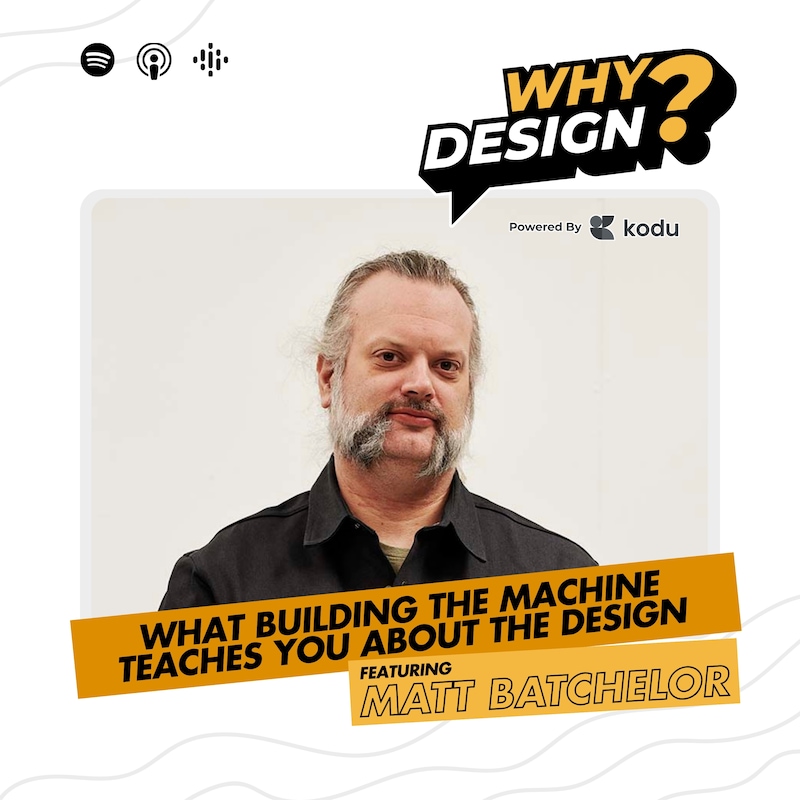
In this episode of Why Design, Matt Batchelor shares the belief that sits at the heart of his work: that the best design does not stop at the render. It runs all the way through the material choice, the tooling, the supply chain, and the factory floor and the designer should know all of it.
Rather than staying in the comfortable upstream of concept and CAD, Matt and his co-founder Nick Paget built Instrument into a studio that also manufactures what it designs, co-invests in the products it believes in, and builds the machines when no suitable machine exists. That decision led to ten weeks in hotels, a crimping machine that kept stopping, and a refillable aluminium personal care system now stocked across four major UK supermarkets.
This conversation is not about packaging.
It is about what engineering at volume actually demands, and why most design processes are not built for it.
It is not about sustainability as a brand position.
It is about what it takes to give people a genuinely better object and get it made reliably at scale.
Don't just listen. Go beyond the podcast.
Join the Why Design community -> teamkodu.com/whydesign
What You'll Learn
- 🔩 Why the hardest part of the Meadow project was not the invention - it was getting cans reliably off a conveyor
- 📐 How ergonomic research from a Sheffield engineering lecturer shaped the torque specification for a refillable closure
- 🔬 Why Matt hired a test engineer into a team of starters, and what a love of statistics does for a product development process
- 🏭 What you learn about design when you also manufacture what you design - and why most consultancies miss this feedback loop
- 🎓 How hiring only from your known network shapes the kind of work a studio attracts, and what it costs in diversity and capability
- 🤖 Why AI has not transformed physical product development - and the difference between embedded intelligence and badly considered tools
Memorable Quotes
"As with any project, it's always the details - like a hinge or a lock or a seal - that take all the time. Most of the machine will look like the first sketch."
"There's no point designing a safety mechanism if someone's grandmother can't open it."
"I was never sat there thinking, what am I doing this? It's like, well, there's this thing I do. How do I get people to pay me money to go and do it?"
"There is still a part of my job which is making myself redundant."
"Good designers are just people who can articulate why that quality is good to someone who maybe can't sense it, but can't see it in definitive terms."
Resources and Links
🎧 Listen on Spotify, Apple Podcasts, YouTube & Amazon -> whydesign.club
👥 Join the Why Design community -> teamkodu.com/whydesign
📸 Follow @whydesignxkodu on Instagram
🎥 Watch full episodes -> YouTube.com/@whydesignpod
🔗 Follow Chris Whyte -> linkedin.com/in/mrchriswhyte
🔗 Explore Instrument Industries -> instrumentindustries.co.uk
🔗 Connect with Matt Batchelor -> linkedin.com/in/mattbatchelor
About the Episode
Why Design is powered by Kodu, a specialist recruitment partner for the hardware and physical product development industry.
Through honest conversations with designers, engineers and creative leaders, we explore not just what they build but why they build it; the beliefs, decisions and responsibility behind meaningful work.
About Kodu
Why Design is produced by Kodu, a recruitment partner for ambitious hardware brands, design consultancies and product-led start-ups.
We help founders and leadership teams hire exceptional talent across industrial design, mechanical engineering and product leadership bringing structure and clarity to one of the hardest parts of scaling.
🔗 Learn more -> teamkodu.com