Shownotes
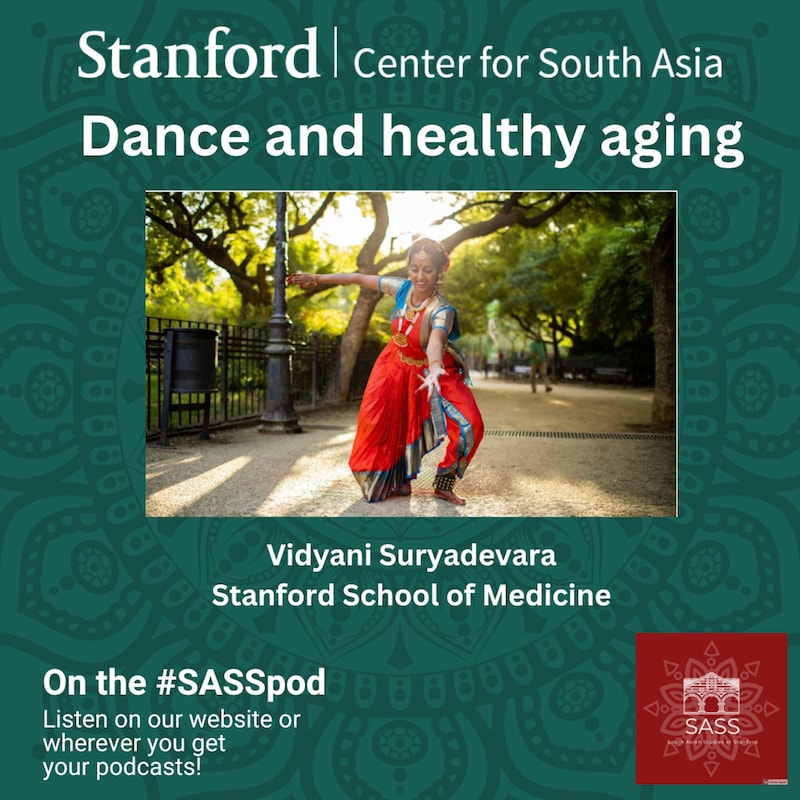
Lalita du Perron talks to Vidyani Suryadevara of the Stanford School of Medicine on her work on healthy aging, the benefits of dance, and the Stanford Heritage Dance Series.
Read the Stanford Report article on the transformative power of dance in health.
Transcripts
WEBVTT
2
::Lalita du Perron: Today I am joined on the SASSPod by Vidyani Suryadevara. She is an instructor in radiology.
4
::Lalita du Perron: Bless you!
5
::Vidyani Suryadevara: Thank you.
6
::Lalita du Perron: This goes to show even people in school of medicine are not immune to little allergies and things like that. She is an instructor in radiology and works in the radiology molecular imaging program at Stanford, and also has a connection to dance. And we're going to be talking about all these things. And more. The reason I found Vidyani is because she was featured in the Stanford Report because of her work on
7
::Lalita du Perron: kind of dance and well-being, dance and aging, and as somebody who has studied dance academically and loves to dance, I was very curious about all this. So, Vidyani, thank you for joining me today.
8
::Vidyani Suryadevara: Yeah, thank you, Lolita, for inviting me, and I'm excited to speak to your audience on the dance initiative and also regarding healthy aging.
9
::Lalita du Perron: Yeah, healthy aging, I mean, that's such an important topic for all of us. Tell us a little bit about yourself. What do you do at Stanford, and what are your kind of professional interests?
10
::Vidyani Suryadevara: Yeah, I was born in South India, and then I moved to the U.S. in 2013, and I got a Phd in bioengineering, and I started at Stanford in May 2022 mostly to focus on research where we're developing new imaging tools to detect senescence, which is aging in osteoarthritis.
11
::Vidyani Suryadevara: So these radio tracer and MRI-based imaging probes that we have developed can be used not just for osteoarthritis, but any other age-related diseases wherein these tools will help us non-invasively monitor the progression of the disease, and also for us to be able to screen new senolytic therapies that are developed for age-associated diseases.
12
::Lalita du Perron: What is the interest in age? I mean, you're very young. We're meeting on Zoom but you're not yet of an age, it seems, where that would be a concern. Where does this interest come from?
13
::Vidyani Suryadevara: Wherever I go, a lot of people tell me, which school are you studying? And I feel a lot of this has to do with not just the genetic genes that I acquired from my parents, but also, I think, the healthy lifestyle choices that I've acquired over the years. And after being in biomedical research for like almost 15 years,
14
::Vidyani Suryadevara: I've realized that they're not FDA approved drugs for many of the diseases. And even if they're approved drugs, they're like so many side effects that people are not necessarily talking about. So my only goal is for the whole world to kind of age healthy, so that we can do as much as possible within
15
::Vidyani Suryadevara: our possibilities to prevent the diseases and age healthy, because I've seen my grandparents. One of my grandparents had lung cancer, and my parents took care of him. If we as individuals are deceased, it's a huge burden, not just for the family, but also a socioeconomic burden for the country as a whole. So I feel like, if we can all work towards
16
::Vidyani Suryadevara: maintaining our own individual health and increasing the health span as we age, because, as we all know, the aging population numbers are increasing all around the world. But
17
::Vidyani Suryadevara: The focus should be, I think, increasing the health span and how we age healthy. And one anecdote here would be like, I relate a lot to older people, because I feel like I get the best advice from them. They share the best knowledge and wisdom possible. And whoever I had in my life, the mentors, the older uncles and aunts I talked
18
::Vidyani Suryadevara: to, I've seen how they have aged gracefully and it's very fascinating for me to learn a little bit more about what they have done in their professional lives, but also in their personal life to
19
::Vidyani Suryadevara: age so well, and being able to share those wisdom with the younger generation, people like us. So I'm very inspired and fascinated to leverage this knowledge and the wisdom. This will only happen if we also help them
20
::Vidyani Suryadevara: stay healthy and show them the means to do it.
21
::Lalita du Perron: Yeah, I love that because I think India, or South Asia, has a stronger focus on kind of seeing older people not as a burden, but as positive contributors to the household and to society. I think, in what we may call the Global North, that's really lost in many places.
22
::Lalita du Perron: But I love this idea of kind of combining those ideas like, let's draw on the wisdom and the compassion and the patience that comes with being older, whilst also making sure that people are healthy. And
23
::Lalita du Perron: because I think in our kind of very busy, the busy lives that capitalist economy dictates we have, it's difficult to then also be caretaker of the people whose wisdom we'd love to have around us. So I love the model that you're combining cultures. I don't know if you're doing that, but that's what it kind of sounds.
26
::Lalita du Perron: What are the... I mean, I'm aging. We're all aging, but I'm at the side of, you know the half. where aging happens more rapidly. And for me, I read up on it, so exercise, I think, diets, but that changes a little bit. Now I read, you know, I have to triple my protein intake. That was debunked, and then it comes back. But I guess, diet, exercise, and
27
::Lalita du Perron: positive thinking... I mean, what are some of the main things that people can do to age healthily?
28
::Vidyani Suryadevara: I think it's easier to remember if you remember the five fingers.
30
::Vidyani Suryadevara: First one is food. Second one is physical activity. Third one is social interactions. Fourth one is cardiovascular health. And fifth one is the cognitive exercises.
31
::Lalita du Perron: So what are cognitive exercises?
32
::Vidyani Suryadevara: It could encompass a whole range of things. It could include even playing chess. It could include even learning a complicated musical instrument or dance forms, because dance needs integration of the body, hands, legs, and all the movements integrated together. And some people in South Asia are familiar with the Rangolis. It's a very complex art
33
::Vidyani Suryadevara: that's still being practiced in the villages, where, before the festivals, they deck their houses with beautiful Rangolis. It has all these patterns and dots. So this involves all the cognition around it. And currently, there are several apps which will either be games or exercises to kind of improve the cognition.
34
::Vidyani Suryadevara: So it could be a traditional activities that we usually do, or it could be latest apps and tools that could improve our cognition.
35
::Lalita du Perron: Okay. So even like games you play on your phone, or whatever. That can be okay.
36
::Vidyani Suryadevara: Depends on the type of the case.
37
::Lalita du Perron: But Wordle? I'm a big fan of Wordle. I imagine that will pass the test?
38
::Lalita du Perron: Yes, yeah.
39
::Lalita du Perron: Okay. Good. Good.
46
::Lalita du Perron: Let's talk about dementia then, or Alzheimer's. That spectrum is increasingly common, I believe in India, as the population ages, but may be not understood. What are the attitudes towards that particular disease in South Asia or in India as far as you know?
47
::Vidyani Suryadevara: Yeah. So I got into Alzheimer's field in 2018, where I was looking at the impact of Alzheimer's disease on the bone, and we were one of the first groups to find that we see changes in the bone even before the onset of a myeloid pathology. And, my current research focus at Stanford also involves elucidating the crosstalk between the brain and bone during Alzheimer's disease. Aging is not
48
::Vidyani Suryadevara: necessarily one disease that is affecting a person, but it's different diseases, comorbidities and multi morbidities growing
49
::Vidyani Suryadevara: importance currently. And when we look at dementia, in some countries it's still a taboo, unfortunately, even in some parts of India. Once people are diagnosed with the disease, they don't go to the doctor. But I just want to emphasize that all over the world dementia has been a growing problem, and it is a disease that one should unfortunately confront with. It's nothing to consider it as a taboo.
50
::Vidyani Suryadevara: We don't have FDA approved drugs yet, but then there are ways to kind of manage the disease. There is a worldwide finger team in Sweden which has shown a multi-year longitudinal interventional studies that practicing the 5 fingers that we talked about earlier can help prevent dementia, or if one already has dementia, it can slow down the rate of cognitive decline.
51
::Lalita du Perron: This is so important. Okay, I like this.
52
::Lalita du Perron: Tell us about dance, because you already mentioned dance as a way of combining some of these fingers in that it's challenging for the brain, and it also involves the body. And this is obviously how we met through the dance program. Tell us first about your life as a dancer. When did that start? And what you get out of it?
53
::Vidyani Suryadevara: So I wanted to learn a very traditional dance form in India, one of the oldest dance forms since I was a kid. But then we moved from South India to Bombay, and then my mom always thought I wouldn't focus on my studies if I also pursued dance. I still taunt her for that.
54
::Vidyani Suryadevara: Fortunately, during the middle of my Phd when I was in Chicago, I was able to kind of start learning the art form, and with the last 10 years, I was fortunate to be able to make time and find the teacher to learn dance. I'm doing it over Zoom, but it's still working. It's been a great
55
::Vidyani Suryadevara: opportunity for me to immerse myself into this art form as a hobby. I'm not a professional dancer, but I find great joy while I learn and
56
::Vidyani Suryadevara: reach moments where I completely forget myself and immerse in the dance form. It's kind of very meditative, because, we're juggling a lot of things these days at work. If we have an ambitious career, we are always thinking ahead of the next step. But dance has been one
57
::Vidyani Suryadevara: time where I've been investing in myself, where I just have to focus on it for that one hour that I dance. I cannot think about anything else, because the moment some other thought enters my mind, my teacher can see that I'm making a mistake.
59
::Lalita du Perron: Yes.
60
::Vidyani Suryadevara: For me, it's been a very interesting experience, because that's the only thing that's making me so focused on a particular task at hand, and because it involves coordination of our legs, hands, our facial expression, everything, all at the same time. So it needs that intense focus and dedication to the art form, because we have to keep practicing it.
61
::Vidyani Suryadevara: And the way I kind of push myself to make time for it is whenever I travel to give scientific conferences across the world, or when I'm on vacations, every new country I travel, I shoot a new piece that I've learned in the entire costume in a new country. So that kind of motivates me to
62
::Vidyani Suryadevara: practice this, and make it a part of my busy life.
63
::Lalita du Perron: I love it.
64
::Vidyani Suryadevara: I'm very grateful that I'm able to pursue this dance form. And in the meantime, over the last few years, I've noticed and read a lot of articles from World Health Organization of how arts can improve health, not just music, but also dance. And when I reached Stanford, I also was so happy to see that for Parkinson's Disease patients, they're offering dance as a therapy. That's the only therapy that's
65
::Vidyani Suryadevara: working so well. So it kind of triggered interest in me that why not leverage this dance to be able to treat multiple diseases? Not just Parkinson's disease, because even dementia patients would benefit a lot from the dance.
66
::Vidyani Suryadevara: And also, I'm currently teaching biology of aging and deciphering senescence course at Stanford, where I'm teaching my students a lot about how we incorporate healthy lifestyle practices into our life to increase our health span.
67
::Vidyani Suryadevara: And one of it has been physical activity and cardiovascular health. So maintaining our cardio dance is one very good form. Not just for neurodegenerative diseases, but overall it keeps us active physically as well as mentally, and it will help us kind of age healthy, instead of trying to
68
::Vidyani Suryadevara: accumulate all the diseases with age.
70
::Lalita du Perron: This was a very good kind of selling of dance as something to slow down aging or slow down the impacts of aging. Do you think it matters which dance people do?
72
::Lalita du Perron: Or do you think particular dances, like Bharatanatyam, there's so much going on. Do you think it is particularly good? Or do you think it kind of doesn't matter?
73
::Vidyani Suryadevara: I think most of you have heard about personalized medicine, where the field of medicine is heading towards. Similarly, I feel personalized dance... so I feel dance is one thing that, in addition to the health benefits, provides us joy and connects us back to our culture. So I feel like any traditional art form practiced in its true essence
74
::Vidyani Suryadevara: will have all of these benefits to it. Because dance kind of covers the social interaction aspects of it, and also it will cover
75
::Vidyani Suryadevara: the physically activity. It improves our cardio, so I think it could be any dance, but practiced in its true essence.
76
::Lalita du Perron: Yeah.
77
::Vidyani Suryadevara: Mix and match.
78
::Lalita du Perron: So there is something called checks, notes, medicine, and the muse at Stanford, and you're part of the Heritage Dance Series which is part of Medicine and the Muse, is that right?
79
::Vidyani Suryadevara: Yeah.
80
::Lalita du Perron: So for those of you, my listening community, who don't know... I mean, I think we think of the School of Medicine, or maybe that's just me, as a hospital. And then there's labs, and then there's, you know, the children's hospital. But it's all very kind of medical, and I don't know that many people are aware that there's all these adjacent programs looking at the benefit of the arts. There's something called the Stanford Medical Humanities which I've only just learned about from you.
81
::Lalita du Perron: So tell us about the Heritage Dance Series and what Stanford's role is in that. What does it do?
82
::Vidyani Suryadevara: So, as I mentioned earlier, like different dance forms, all of them have their own benefits, and Stanford being such a diverse community, we all come from all different parts of the world, bringing our extraordinary skill sets and our cultural heritages. So what we're doing is every month, in accordance with the different heritage
83
::Vidyani Suryadevara: months that the State is observing at that particular school of medicine events, we bring those heritage dance groups to perform and showcase their
84
::Vidyani Suryadevara: ethnic dance forms so that the community can connect to it. And also, if others who are interested in that dance form can engage with it and learn, or even collaborate with them. So, for example, in January, we brought an African heritage dance group.
85
::Vidyani Suryadevara: In May, we showcase the South Asian heritage dance group, and in October there's a Latin American dance group. So it depends on which school of medicine event is going on in that particular month. We partner with them to kind of showcase all these different heritage dance groups.
86
::Lalita du Perron: And do people watch or do people participate? People being like the audience.
87
::Vidyani Suryadevara: So as of now, they're watching. And since it's just the first year of the program, we're just introducing the different heritage dance groups to the audience. Our goal in the next few years is for people to kind of come together and also perform.
88
::Vidyani Suryadevara: There needs to be more reception for dance at these events, because we are all very tuned to only our academic, scientific talks at all of these meetings. This is just the first introduction of dance at these events and integrating arts into the
89
::Vidyani Suryadevara: core Medical School. So I think in the next few steps, we would also encourage the audience to be part of it. And we also want to encourage faculty to write grants on studying how dance can help treat each of these diseases, even gain mechanistic insights of the benefits of dance and disease treatment.
90
::Lalita du Perron: I mean, it feels like such a no brainer. It's one of those things that everybody's like, well, of course. But then there's no real evidence for it. Research has not been done. So the idea is that at some point the patients will dance, so that meets some of the Five Fingers, and this will help their aging. What about the physicians? What about all those people in the school of medicine that are just like always
91
::Lalita du Perron: teaching, seeing patients, writing grants, writing research papers? We know that physicians lead incredibly busy lives. Is it good for them to dance as well with their patients?
92
::Vidyani Suryadevara: So when the few events that we have launched the Stanford Heritage Dance Series, we got like very good feedback from the faculty who were at these meetings about how interesting it was to kind of observe the different heritage dance groups, and how it really fit well with the theme of the meeting that they were hosting.
93
::Vidyani Suryadevara: And as you said, they're juggling a lot of things. It would be a good break and a personal thing for them to kind of invest on themselves to make dance part of their routine, which would improve not only their overall well-being, but also being more joyful, and they would be spreading this joy not only to their co-healthcare providers, but also to the patients that they are seeing.
94
::Lalita du Perron: I feel that, like nobody walks away from a dance class. I was going to say nobody walks away from a dance class feeling stressed. I think it can be stressful if you feel that you have to be good at it. I think anything where you feel you have to be good at it, it gets stressful. And then especially something that is so different from what we do all day. I think most academics are good at
95
::Lalita du Perron: you know, the things that academics do. But then, when they have to be in their bodies, I think that can be stressful. But I think if you flick a switch a little bit and really understand, there's no goal here, that just enjoying it is the goal,
96
::Lalita du Perron: it's just so relaxing and rejuvenating, which I guess exactly what your point is right? It makes you young to dance. So yes, everybody should dance. That's the dream. Now you're working in India. You're trying to bring this kind of knowledge to
97
::Lalita du Perron: government healthcare? Who do you work with in India, and at what level to get this message across?
98
::Vidyani Suryadevara: So, being a scientist in the first place, I started collaborating with the National Institute of Nutrition in India two years ago to kind of
99
::Vidyani Suryadevara: establish the scientific evidence specific to Indian population, that lifestyle interventions will
100
::Vidyani Suryadevara: actually prevent dementia or increase the health span of the people. But then doing science alone will not help us reach to the broader community. So I started engaging with the governments of Telangana and Andhra Pradesh, and I was very happy to note that both the governments were very much interested to implement this, to improve the health of their aging population.
101
::Vidyani Suryadevara: So that's where we're starting now, and we strive to make a lot of progress in these two states which could be then a role model for the rest of the country to follow.
102
::Lalita du Perron: And what is the trajectory? I mean, are you going to go through the states? Are you hoping to work at the national level? What's the dream?
103
::Vidyani Suryadevara: The dream, I think, would be for the Prime Minister Modi to take up this initiative and launch it across the country. Then it would kind of be disseminated faster, and it would reach all the population across the different states in India.
104
::Lalita du Perron: So Modi might say, well, we already have Yoga Divas. So what do we need your dance for? What would you say to that? Because I'm sure people say that when we do, yoga, that's just as good. Is it?
105
::Vidyani Suryadevara: There are so many things already in place. Now, there's a Fit India Movement for physical activity. There's a lot of awareness for Yoga. There's a lot of awareness for different things. But this is kind of these Five Fingers contributing to the overall health, giving the benefits for the increasing overall health span of the aging population.
106
::Lalita du Perron: Okay, fine. So dance it is. Well, I don't think that Modi listens to the SASSPod. I haven't heard that, but if anybody at that level does, please let them know that we would like to see dance as a kind of a healthcare strategy implemented across India, and then also in the United States. What are you doing here beyond your work at Stanford, or is it very much focused on Stanford?
107
::Vidyani Suryadevara: Here, mostly, I focus on my research at Stanford, and I've created a new course which I'm teaching currently. But I mostly work with the NIH Senate Consortium, where we developed biomarkers for aging last year. And now we're kind of working on defining xenotypes for the field.
108
::Vidyani Suryadevara: And beyond Stanford, I'm also working with Dr. Lucy Sterland in Uk, where we launched the global comorbidity and multimorbidity in dementia working group, which will bring together scientists working across the comorbidity space during dementia and aging.
109
::Lalita du Perron: Wow! It's really incredible work that you do. And it's so broad.
110
::Lalita du Perron: You say that you developed a new course. Is this for students in the medical school, or could other students also take that class?
111
::Vidyani Suryadevara: I have students in my class who are not only from medical school, but also from business school, and also there's a student who wants to be a politician. So we have a wide range of interests, students who are interested in a wide range of things. But I think overall, everyone is, all the students are interested in longevity and learning more about
112
::Vidyani Suryadevara: healthy aging. And not just for themselves. It was very heartwarming to hear that some students are taking the course to see what they can learn to make their parents and grandparents healthy.
113
::Lalita du Perron: It's beautiful.
115
::Lalita du Perron: Well, any final words of advice that you have for my audience?
116
::Vidyani Suryadevara: Dance is definitely a difficult mode of art form. It's not like music where we can hear it anywhere, while we're walking, while we're driving. So it comes with its own challenges. But once we immerse ourselves completely into the dance form, there are moments where we enjoy the bliss of
117
::Vidyani Suryadevara: being immersed into our bodies and into the dance form. And it's just one of the many other things that will contribute to our overall health and social interactions.
118
::Lalita du Perron: I absolutely love this promotion of dance for a healthy lifestyle. Thank you so much for joining me on the podcast. We're going to link to some of the initiatives we talk about in the show notes, and so people can find out more about you online. Thank you for making time for me today, and everybody make time to dance.
119
::Vidyani Suryadevara: Yeah, thank you, Lalita. I had a great time chatting with you on this.


