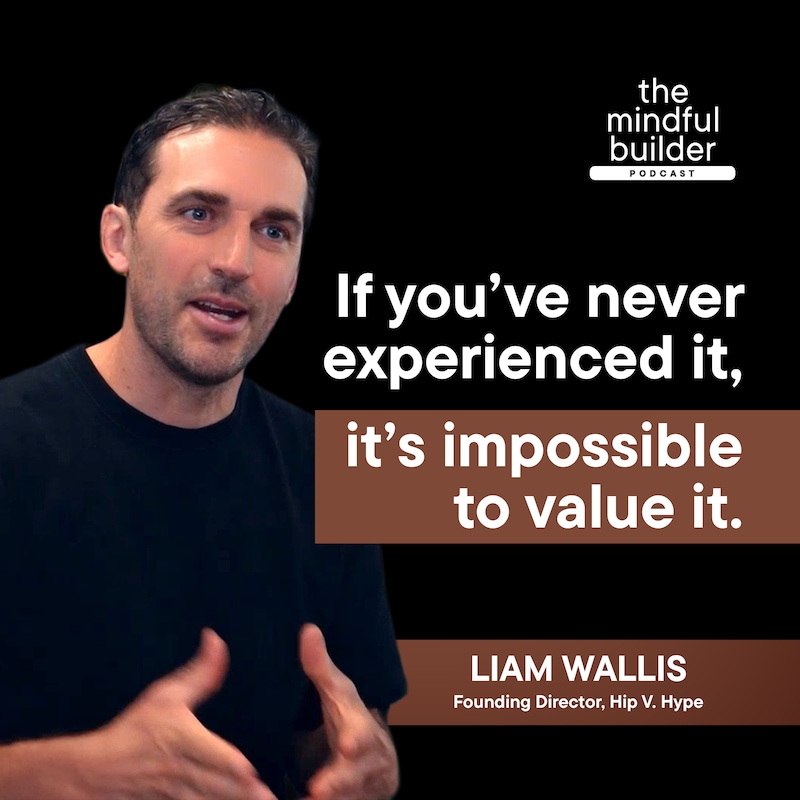
Shownotes
“Success looks great on social media. The reality is usually messier.”
In this episode, we sit down with Liam Wallis, Founder and Managing Director of HIP V. HYPE, to talk about what sustainable development really looks like behind the highlight reel. Not just pretty renders and big announcements, but pressure, responsibility, and the constant work of improving systems so each project is better than the last.
Liam shares why sustainable success is built through iteration, not perfection. Using ParkLife 2 as an example, we unpack how strategic planning, process improvement, and a long-term mindset help create high performance apartments that can scale without losing the values that matter. This is sustainable building that is practical, repeatable, and designed for real people.
We also explore how lived experience shapes better design. From simple moves like bike storage on apartment levels to bigger performance goals like an eight and a half star NatHERS rating, Liam explains how energy efficiency, comfort, and lower running costs become tangible outcomes when you design for the long game. Better thermal performance. Smarter energy decisions. Homes that support people to live well.
Finally, we talk about why experience is belief through the HV Hotel, and why community does not happen by accident. Liam breaks down the importance of community-centric design, feedback loops, and building places where residents feel connected and invested. We also touch on construction mental health, and why building better buildings means building better support systems for the people doing the work.
👇 CHAPTER MARKERS 👇
00:00 Introduction
01:38 Park Life Two Intro
10:13 Building In House Engineering
12:11 What Park Life Two Is
13:39 Lived Experience Design
16:44 Solar And Regulations
18:21 Electrification And Hot Water
23:03 NatHERS And Passive House
27:22 Design Versus Performance
29:18 HV Hotel Experience
33:59 Park Life Two Sales
36:43 Owner Occupiers Vs Investors
39:29 Collaborating With Builders
42:23 Tendering And Capability
44:08 Scaling Industry Capacity
44:56 Open Sites And Trade Schools
48:15 Parkside Project Vision
49:19 Mindful Moment Mental Health
52:51 Closing Reflections
LINKS:
Stay in HV Hotel:
ParkLife 2 Project:
https://hipvhype.com/projects/parklife-2
Our Sponsors:
Proclima - https://mindful-builder.captivate.fm/proclima
MEGT - https://mindful-builder.captivate.fm/megt
Connect with us on Instagram: @themindfulbuilderpod
Connect with Hamish:
Instagram: @sanctumhomes
Website: www.yoursanctum.com.au/
Connect with Matt:
Instagram: @carlandconstructions
Website: www.carlandconstructions.com/
Mentioned in this episode:
Transcripts
What is it about this industry that would takes so many lives?
Speaker:We live in a social media bubble where everyone sits on Instagram and
Speaker:they just flick and flick and they see a life that isn't real stick.
Speaker:And just because I see Hamish from Sancton Homes doing these
Speaker:beautiful homes, he must be so good.
Speaker:He must have everything.
Speaker:He must have so much money.
Speaker:You don't know what happens behind the scenes.
Speaker:You don't know what's going on.
Speaker:Mm. But the perception from everyone in society is like, that's awesome.
Speaker:Like I know people that put stuff up online and it sucks for
Speaker:their life behind the scenes.
Speaker:Yeah, but the, the, the, the visual of it and the just insecurity to
Speaker:try to keep up with everyone else, I think that's the problem that we have.
Speaker:We've been taught to work harder and nine to five isn't enough and it's got a
Speaker:great business to have 13, 14 employees.
Speaker:Some people just happy just working by themselves.
Speaker:So this is, uh, episode number two with Liam.
Speaker:I think last time we recorded with you we're actually in the space.
Speaker:Where you are about to start construction for park life too.
Speaker:And this is the reason why we wanted to get you in today because cool,
Speaker:sustainable developments, you know, developers, you know, there's a lot
Speaker:of virtue signaling when it comes to this kind of stuff in the industry.
Speaker:But, um, you know, we've known each other for a long time, seeing what
Speaker:you guys do with hip burst hype.
Speaker:Like you guys are actually doing it.
Speaker:In my opinion, from what I see from the outside looking in, uh,
Speaker:you guys are actually doing it so.
Speaker:Thanks for coming back in and know we'd love to talk through Park
Speaker:Life two today and you know what problems you are trying to solve
Speaker:with this particular construction.
Speaker:We probably covered it last time we caught up, but I guess our approach to
Speaker:improvement is iterative and I think that's a really, really important point
Speaker:because you know, you can only do so much.
Speaker:At any given point in time.
Speaker:One thing that we've actually been working on o over the
Speaker:summer, 'cause what is it now?
Speaker:We're sort of early February, construction industry is such a great time to sort
Speaker:of get your head out of operational.
Speaker:I know for me at taking that through three weeks after I am disconnected
Speaker:from work, if I didn't do that.
Speaker:Yeah.
Speaker:I'm with my family.
Speaker:I'm at the beach, I'm surfing, I'm bike riding.
Speaker:Right?
Speaker:If I, if I didn't do that, then I wouldn't be showing up
Speaker:and doing what I'm doing now.
Speaker:No, it's really important point.
Speaker:And but again, left side, right side, 'cause I'm, I'm not one of
Speaker:these people that, um, reenergizes by switching off, um, uh, I'm a person
Speaker:that reenergizes by flipping between the, the different ways that I think.
Speaker:Um, and for me contrast is, is energizing, you know, through January this year.
Speaker:Um, to get, to get back to that original point, we, we were working through
Speaker:Harry from our team, uh, and I were working through a procurement map
Speaker:for us, which is seeking to capture each of the elements of our process
Speaker:through each phase of procurement.
Speaker:Um.
Speaker:Because the lifecycle of the projects that we work on are long, you know, it's four
Speaker:to five years from the very beginning to to when you, um, get people moved in and
Speaker:then a year of commissioning the projects.
Speaker:That's pretty good.
Speaker:I thought it would've been longer.
Speaker:I would've sort like eight years.
Speaker:What that means is you forget stuff.
Speaker:Yeah.
Speaker:You know, so from, you know, four years ago, people from the team come and go.
Speaker:You just mentally can't hold that, that information in your head.
Speaker:So capturing that at each phase of the, a phase of the process and setting up.
Speaker:An ability for us to capture, learn, and iteratively improve.
Speaker:So we review that procurement map quarterly.
Speaker:Um, at whatever stage we're in on any given project, it gives us
Speaker:a, a checklist, you know, what, what are, what are we just done?
Speaker:Um, how does that compare to what we've done previously?
Speaker:And what do we have coming up in the next quarter?
Speaker:What do we need to think about?
Speaker:What do we need to plan for and for us?
Speaker:With our broader improvement agenda, that's really, really critical 'cause
Speaker:it gives us an ability to be strategic.
Speaker:As opposed to reactive, you know, you're always chasing your tail,
Speaker:but how can you set systems and processes up in a way that, that
Speaker:you can foresee what's coming next?
Speaker:Uh, what, what you just explained is relevant for every business.
Speaker:You know, you and I, we had Dave Jennings from Systemology on talking
Speaker:about systems, and this, what you're talking about right now is exactly that.
Speaker:It's like dialing in your systems, not getting it perfect, but then
Speaker:reviewing them and making them better.
Speaker:And, you know, you said that you're.
Speaker:Over the years, hit first hype has been iterative and I know I came
Speaker:here probably before COVID in 2018.
Speaker:It was 19.
Speaker:And seeing the people in here change the team growing, like you guys have just
Speaker:changed so much over the years, but it hasn't been like, bam, we're changing.
Speaker:It's been all these small incremental changes and as the business grows,
Speaker:you get better and you review and you analyze and you know, again, getting,
Speaker:getting that to what we're talking about.
Speaker:I, I fair at the beginning, the pressure, you know, um, the pressure to perform,
Speaker:the pressure to, to, to succeed.
Speaker:You can't do everything at once, you know, so, um, uh, understanding that, and again,
Speaker:trying to be strategic understanding.
Speaker:One of my favorite quotes go, probably said this last time, that, you know,
Speaker:people overestimate what they're gonna achieve in one to three years.
Speaker:They drastically o overestimate that, and then, then you take a 10 year view.
Speaker:And, and we underestimate what we can achieve.
Speaker:I heard that quote like two weeks ago.
Speaker:It's a bit of a Bill Gates quote.
Speaker:Yeah.
Speaker:And he's not, he's not at the moment.
Speaker:But strategically, when you think about that, you're like,
Speaker:where were you 10 years ago?
Speaker:Oh yeah, yeah.
Speaker:Versus.
Speaker:Where you were today and last year that was particularly relevant.
Speaker:'cause looking back to 2015, when we just set up the business to 10 years forward,
Speaker:you are looking at it going, shit, in 10 years you can achieve a hell of a lot.
Speaker:Yeah.
Speaker:In one year to two to three years, you might look at where you're at
Speaker:and be like, shit, I'm not, I'm not really going where I want to be going.
Speaker:But again, that consistency, that the discipline, the
Speaker:confidence, um, and, and not.
Speaker:Not beating yourself up too much.
Speaker:Um, but, but following a vision, you know, you get to that tenure
Speaker:period, you turn around and you're like, shit, set up a business.
Speaker:You know, I've built these things.
Speaker:I've, I've built these relationships.
Speaker:I've had children.
Speaker:I've got a, got a meaningful.
Speaker:A relationship with my partner, et cetera, et cetera, et cetera.
Speaker:If you were to map that, like plot it on a graph, do you think there comes a
Speaker:point where the energy starts feeding into more sort of exponential growth?
Speaker:I know every business is gonna be different, but do you find that once the
Speaker:machine is moving, you know, you talk about systems before, like do you think
Speaker:there's like a critical point where first one to five years you're just
Speaker:figuring out what the fuck you're doing?
Speaker:Yeah.
Speaker:And then you get to a point where you've got good people, you've,
Speaker:you've failed and failed and failed, and then you start seeing successes.
Speaker:Yeah.
Speaker:This is the other thing.
Speaker:It's like the, the majority of say companies that we see as being uber
Speaker:successful, um, have existed for like seven or eight years Yeah.
Speaker:Before they'd blow up.
Speaker:It's, there's, there's some statistic around that that I've read somewhere.
Speaker:And so you, you know, there's really.
Speaker:Big famous companies and you know, these founders that have made
Speaker:it, blah, blah, blah, blah, blah.
Speaker:They've been, you, you know, they've been chipping away somewhere.
Speaker:The quote that I heard was Overnight success is 10 years in the making.
Speaker:Yeah.
Speaker:It's, it's a great quote.
Speaker:Right, and I can attest to that.
Speaker:'cause before 2015, seeing up at feet height, there was another
Speaker:15 years of crying behind that.
Speaker:Right.
Speaker:It didn't just, yeah.
Speaker:You just didn't walk in and say, oh, we're here now.
Speaker:There was a huge amount of work that went into.
Speaker:You know, I'd identified pretty early on in my career that I
Speaker:wanted to set something up.
Speaker:So there was a process of, of building skills building.
Speaker:Relationships, um, broader industry connections and, and
Speaker:that, that was purposeful.
Speaker:But there is something beautiful about perseverance, you know, and backing
Speaker:yourself because, you know, on that daily basis, things can go one of two ways.
Speaker:But if you make a decision that it's gonna go a certain way, well
Speaker:then you're managing that and you're relying on the people around you.
Speaker:You know, I couldn't do any of this without the team we've got and, yeah.
Speaker:Finding those people that are, that are willing to feed into
Speaker:that and, and bringing them into that in a meaningful way.
Speaker:You know, we have multiple shareholders in the business now.
Speaker:Um, and really seeking to share the success of VA hype more broadly.
Speaker:You know, we've just had, um.
Speaker:Two of our team members buy an apartment in Park Life too.
Speaker:That's so cool.
Speaker:Right?
Speaker:'cause that's what they believe in the product.
Speaker:Wanna go back, you said success before and everyone works
Speaker:with works towards succeeding.
Speaker:What does that look like?
Speaker:Well, what today, what does today look like?
Speaker:What does success today look like?
Speaker:I don't need heat.
Speaker:Um, success for me means having the freedom to, to make the
Speaker:choices that are important to me.
Speaker:Um.
Speaker:And, and I know like I'm not there yet.
Speaker:I'm not where I would like to be in that, in that space.
Speaker:Um, but I'm also someone that gets, um, I'm motivated by rolling my sleeves up and
Speaker:getting into the, into the detail, right?
Speaker:Like I think we said last time when we caught up, success is not.
Speaker:You know, making a bunch of money and, and checking out and, and all
Speaker:of a sudden doing the whole five star thing, that's just not success.
Speaker:But one of the coolest things, uh, about if they hype is, um, again, the ideas,
Speaker:the energy, the work that the team are doing, the scales that the work the
Speaker:team are working at on our own projects.
Speaker:Um, bringing Harry into the team last year, an incredibly
Speaker:capable young guy leading.
Speaker:Um, design optimization, design integration on the project, seeking to,
Speaker:to absolutely maximize each dollar that we're spending, um, for the benefit of
Speaker:the future occupants, but also as part of our process of iterative improvement.
Speaker:We're just in the process of setting up a building services engineering team, um,
Speaker:to sit alongside our sustainability team.
Speaker:Adam, we've got a young guy coming into that team.
Speaker:We're just about to make an announcement next week.
Speaker:But to me that's just super exciting.
Speaker:'cause now we have the capability to design and certify the electrical
Speaker:and mechanical and hydraulic systems.
Speaker:So having them work alongside each other Yeah.
Speaker:Is, yeah.
Speaker:Okay.
Speaker:It's everything.
Speaker:Right?
Speaker:Yeah.
Speaker:So it is awesome.
Speaker:We're, we're now gonna be able to design and certify the elect and me system.
Speaker:At scale.
Speaker:Yep.
Speaker:That supports the sustainability ambition of both the business and, and our clients,
Speaker:um, in, in an integrated way, importantly.
Speaker:So this, this is the thing at the moment, we're at a stage where kind of over the
Speaker:hump of, of the, the capital expenditure.
Speaker:Now on these systems shows meaningful payback.
Speaker:Yeah, yeah, yeah.
Speaker:Within commercial timeframes.
Speaker:Yeah.
Speaker:And so maybe your traditional engineering consultancies haven't put the effort
Speaker:into understanding the potential.
Speaker:Um, and or are too risk averse.
Speaker:Well, I mean, they're also just looking, looking within a box though.
Speaker:They're not, they're not looking at the peripheral.
Speaker:Yeah.
Speaker:But perhaps, um, we see an immense opportunity.
Speaker:Yeah.
Speaker:We're really excited.
Speaker:Yeah.
Speaker:Um, to add that service offering Park Life two.
Speaker:Yeah.
Speaker:What is it, like, what does it look like to someone that's going to live there?
Speaker:Um, well Park Life two.
Speaker:The coolest thing about Park Life two is it's, it's
Speaker:basically, um, the love child of.
Speaker:Verizon York, which was the, the, um, our most recently completed
Speaker:project in that at Melbourne.
Speaker:Yeah.
Speaker:20 apartments, um, and Park Life, which is the, the building that
Speaker:Austin Mannar and Architects, um, had designed and delivered as part of,
Speaker:um, uh, the, the Nial Housing Precinct Project in Brunswick, Ingal Village.
Speaker:Um, and so both sort of best in class projects, both,
Speaker:you know, the year prior to.
Speaker:Uh, I think Park Life completed a year earlier than Verizon, York
Speaker:that both won all the awards, um, uh, which, which is pretty cool.
Speaker:The great recognition for, for kind of leading apartments in, in the
Speaker:Australian context and really bringing together the learnings for both of
Speaker:those projects into one project, um, has been the exciting thing.
Speaker:And Katu and I lived.
Speaker:Uh, at Fries York for three years.
Speaker:So really that lived experience is such a big part of our process.
Speaker:And there are all sorts of elements within Park Life too that, that are
Speaker:a result of our lived experience.
Speaker:Like what?
Speaker:Well, I was just about to say, what's so special about these buildings for
Speaker:and New York and and apartment there?
Speaker:What, what, what, what distinguishes that from another apartment in the city?
Speaker:Well, look, design, sustainability, community.
Speaker:When, when we think about these apartment buildings, it's so much
Speaker:about the spaces in between the actual apartments themselves that drive, um,
Speaker:your experience within the building.
Speaker:So that welcome home moment, how you approach the building, um, the
Speaker:lobby spaces, um, uh, you know, the entry thresholds into apartments,
Speaker:the communal spaces within the buildings, how they're laid out.
Speaker:Um.
Speaker:One.
Speaker:One of the things we took from Raz and York Kaur and I lived on level four and
Speaker:we're the only apartment on that level, there was not a level above us and.
Speaker:With two young kids.
Speaker:One thing that we did, um, was we used to bring our e-bike up onto our level
Speaker:and we'd pack the e-bike up with the kids on our level, so right in front
Speaker:of the front door, and then you'd be able to ride the e-bike straight into
Speaker:lift and straight outta the building as compared to having a bike room
Speaker:on the ground floor of the building.
Speaker:Yeah.
Speaker:Having to lu all your stuff down into the bike room, load your bike up and head out.
Speaker:So what we've actually brought into pipeline two is.
Speaker:All the bike parks are on each lobby level.
Speaker:So you come directly out of each of your front doors and you bike straight
Speaker:there and you can load it up and go.
Speaker:So for people who are living in the inner north in Brunswick, why do people ride?
Speaker:Um.
Speaker:We think there's a real convenience element to that, and that hasn't really
Speaker:been done before in a meaningful way.
Speaker:It definitely hasn't been done before.
Speaker:The way that we are doing it at Park Life two, that's direct learning from
Speaker:just us having had that experience.
Speaker:And then, and then working with Austin Maynard to build it into the design.
Speaker:Um.
Speaker:There's also kind of unfortunately, you know, security issues shut a big bike room
Speaker:on ground floor, it's just a honey pot.
Speaker:Yeah.
Speaker:Um, for, for people.
Speaker:And, and unfortunately that's been an experience across Melbourne is,
Speaker:you know, you put all the bikes in one place and, and you're gonna, it's
Speaker:someone, someone's gonna, it's like, Hey guys, I'll just come grab one.
Speaker:Hey, it's a honeypot and it's very, very difficult to protect it.
Speaker:So what we're also hoping here is that this is a significantly more secure way.
Speaker:For people to store, um, you know, bikes and e-bikes these days aren't cheap.
Speaker:No.
Speaker:Um, uh, and, um, you, you know, so that, that's one example.
Speaker:Another example is, you know, the roof yard frozen your two young kids.
Speaker:Again, constant anxiety of, of, you know, fall risk.
Speaker:Um, we, we had a cat fall off the building at Ferraz and York from level six.
Speaker:It was Okay.
Speaker:We literally fell off the bills line.
Speaker:Okay.
Speaker:Going, um, was.
Speaker:Sun baking on a, on a, um, on a ledge and, and slipped off the
Speaker:belt like this shit happens.
Speaker:Right.
Speaker:So for us in York, what, what we're built in is almost like an arbor
Speaker:style, um, detail above the roof yard.
Speaker:Yeah.
Speaker:Um, with, with some fine stainless steel mesh Yeah.
Speaker:To detail that Austin Mannar Architects used at, at, um,
Speaker:nine Hour Village at Park Life.
Speaker:So it brought these elements in and we feel like that y you know.
Speaker:That would complete the experience.
Speaker:Yeah.
Speaker:Um, you should do solar, can you, is that like a, I don't know.
Speaker:In the commercial setting, like that would become hard, hard to generate your
Speaker:own energy if you're using roof space.
Speaker:There is a conflict between activating a roof yard and
Speaker:maximizing, um, onsite generation.
Speaker:There's definitely a conflict.
Speaker:You know, interestingly, getting into the details we're right on the eight
Speaker:level 2025 meter effective height limit.
Speaker:So we did try and, um, look to, to use solar for sun
Speaker:shading on, on the roof yard.
Speaker:Oh, that'd be cool.
Speaker:Can't do it.
Speaker:It triggered, it basically triggered the, um, ninth level
Speaker:under the NCC safe for that.
Speaker:Surely there's a common sense level that would apply to that.
Speaker:Oh, they're doing the right thing here.
Speaker:I know that we don't have common sense in our industry, but someone as a.
Speaker:Um, someone doesn't get paid for common sense.
Speaker:You know, like we, we create all of this regulation and a whole bunch of
Speaker:people get paid, um, to tick boxes.
Speaker:Um, we're, we're no longer common sense died a while ago in Australia,
Speaker:unfortunately, the solar side of it, I, I actually had energy
Speaker:generation written down here on my, on my, on my, um, pad here.
Speaker:And I, and I would be interested to know how.
Speaker:Lessons from past projects in this current project, and then as
Speaker:you look towards next projects.
Speaker:Yeah.
Speaker:How, 'cause in my opinion, electrification and energy generation
Speaker:is gonna be such a big relevant thing.
Speaker:Yep.
Speaker:And I think a selling point for the people that wanna move into these homes.
Speaker:Ideally electric there or attempting to be a hundred, a hundred percent Yosh shark.
Speaker:Yeah, yeah, yeah.
Speaker:No, no.
Speaker:Fossil fuel free.
Speaker:So yeah.
Speaker:Look like there, there's.
Speaker:There's this tension in these sorts of apartment buildings
Speaker:between centralizing new systems and decentralizing new systems.
Speaker:So, and the tension is, um, one of capital expense typically of centralized
Speaker:systems is a little bit higher.
Speaker:Typically, you get a trailing benefit, um, uh, lower cost through time.
Speaker:Yeah.
Speaker:Um, but then, then you get joint, um, usage.
Speaker:So, hot water's a great example, right?
Speaker:So you go with the centralized heat pump hot water system, it's gonna cost
Speaker:you more to install it slightly than decentralized three phase, you know?
Speaker:So Drew, do, just to, just to clarify, centralized heating is one unit.
Speaker:Hot water.
Speaker:Yeah, one hot one.
Speaker:There's one hot water system in the whole boot.
Speaker:And that, that feeds every apartment.
Speaker:Yeah, yeah, yeah, yeah.
Speaker:So it's a big tank when Yeah.
Speaker:There's big buffer tanks, right?
Speaker:So Frozen york's about that.
Speaker:When the system goes down, the whole building doesn't have hot water Now.
Speaker:That that's no different to a single house when a system goes down.
Speaker:'cause in this happens, right?
Speaker:Yeah.
Speaker:Like stuff needs maintenance.
Speaker:Little bit of solidarity there between everyone that's in the apartment.
Speaker:Well, culture.
Speaker:Well, there's no difference if that were to happen in living in a single
Speaker:residence versus in her apartment.
Speaker:And the problem is the problems amplified.
Speaker:'cause you got 60, 60 residences screaming that they've got no hot water, right?
Speaker:So what we find across our sustainability business is.
Speaker:You know, community housing providers, these sorts of people that are managers of
Speaker:large amounts of housing will prioritize the decentralized system that uses
Speaker:more electricity but is more reliant, arguably not in practice necessarily.
Speaker:Um, so.
Speaker:You, you know, what we're always trying to do is work towards the sort of optimized
Speaker:solution, the fit for purpose solution.
Speaker:We are working towards more centralized systems in Park Life.
Speaker:Two.
Speaker:We've got two systems split across 60 apartments.
Speaker:Yep.
Speaker:Um, that feed into the, the centralized ring name.
Speaker:So if one system goes down.
Speaker:You, you'll just have lukewarm, lukewarm, you'll still get a
Speaker:warm shower versus a cold shower.
Speaker:Right?
Speaker:So that, these are the sorts of decisions we're making and we're making
Speaker:it in the detail and we're working.
Speaker:This is the coolest thing about having the building service
Speaker:engineering team come here.
Speaker:'cause we're, we're now like really getting into the detail.
Speaker:Um, we're putting a BMS system in.
Speaker:Our ARBs talk to the BMS, we're gonna be able to get Just, just for, for
Speaker:those planning at home or what's BMS Building Management System?
Speaker:I thought it was, yeah.
Speaker:So basically an ability to scrape all of the, all of these systems these days.
Speaker:Ping data.
Speaker:Yeah.
Speaker:To be able to scrape it back to a central location, to create a interface dashboard.
Speaker:And for us to be able to track that.
Speaker:'cause one cool thing we did from Verizon York was.
Speaker:We did 12 months postdoc research and we had our better building
Speaker:sustainability team in there.
Speaker:12 months.
Speaker:Here's, here's what we designed.
Speaker:Um, how, how, how is it performing against what we designed?
Speaker:Nobody does that.
Speaker:We need to do that way more.
Speaker:It'll how you optimize.
Speaker:Um, but if you, so if you got dirty management systems, one that
Speaker:just do, well, this was the thing.
Speaker:So five years ago when we were designing for as in org, um, the sort of.
Speaker:Light BMS that's now available wasn't really available slash we didn't have
Speaker:a building services engineering team that was across that information.
Speaker:So fast forward five years, the intent there is to scrape more data, to learn
Speaker:more about how the building's operating.
Speaker:Our billing services engineering team came up with a solution.
Speaker:It's 50 grand.
Speaker:We'll, we'll invest that.
Speaker:Um, there is a zero.
Speaker:Kind of immediate commercial incentive to do it.
Speaker:But the longer term play is we wanna scrape more accurate data Yeah.
Speaker:To feed into this iterative improvement process that we're trying to develop.
Speaker:That will help us focus on, you know, perhaps we can find a, a
Speaker:better, you know, energy recovery ventilation system at scale.
Speaker:That, that will deal with, say the, the feedback we get from the data.
Speaker:From the building in the future.
Speaker:Because?
Speaker:Because is this, is this BMS tracking like humidity levels?
Speaker:Temperature like energy can, the RV system will, has capability to track that.
Speaker:The BMS will scrape it back to a single point.
Speaker:Yeah.
Speaker:So you've got behind on this poster and I actually had ish's
Speaker:question before we started.
Speaker:You've got eight and a half stars that you're chasing.
Speaker:It says chasing Matt, hers rating eight and a half stars.
Speaker:Yeah.
Speaker:Is that a legit, because you've got the data now, is that like an accurate.
Speaker:Eight and a half stars compared to a hypothetical eight and a half stars, if
Speaker:you kind of get where I'm going with this.
Speaker:Yeah, look like Nat, hers is really interesting.
Speaker:Um, like obviously it's about thermal envelope.
Speaker:So it's about, it's about how, how a building, how, how the, the envelope
Speaker:would be building keeps you, you know, cooler and summer and warmer and winter
Speaker:out basically by how it's insulated.
Speaker:Um, in really, really simple terms and.
Speaker:Uh, yeah, we have set ourselves an ambition of an eight and a
Speaker:half star average, um, target.
Speaker:Um, so, uh, some of the apartments are performing at like nine and a half star.
Speaker:Um, I think we, we don't yet have our, our minimum, um, 'cause we haven't done the.
Speaker:Analysis for building permit, which is going through that at the moment.
Speaker:Um, but frozen you up the minimum 7.4 style.
Speaker:What's the average apartment complex that might go up of the, say it's
Speaker:just, I know John, Nick door is putting up an apartment complex.
Speaker:Yeah.
Speaker:What would they just be getting average?
Speaker:Well, the NCC currently, or is it under the new NC?
Speaker:It's seven, isn't it?
Speaker:So that, that will apply to commercial buildings as in that hers, yeah.
Speaker:Well, 'cause they're residential.
Speaker:Yeah, I thought, is it nab, hers?
Speaker:I thought it went to something different.
Speaker:Our neighbors, uh, commercial, uh, commercial assets.
Speaker:But the cool thing about n hers is one of our, actually, um, Pippa, uh,
Speaker:who I study architecture with, she's leading a research project for CSRO.
Speaker:So she's looking at about, I think it's about 450 apartments, sample
Speaker:apartments that are all, um, raided.
Speaker:So they're all.
Speaker:Um, Nat H rated, so I think built after 2011.
Speaker:Um, so she's testing the performance of those apartments right now.
Speaker:Wow.
Speaker:That's true.
Speaker:To gather a data set to feed into the CSRO, um, engine that
Speaker:supports the Nat h modeling.
Speaker:Yep.
Speaker:Because current Nat h modeling is based on assumptions.
Speaker:It's not based on actual performance data.
Speaker:So her project will feed in.
Speaker:Performance data to further optimize the model.
Speaker:So what we should see is a closing of the gap between what, what we assume
Speaker:at design phase and what actually gets built that that's gonna probably
Speaker:bring so, so, so arguably Nat, hers then, or neighbors is gonna be a, a
Speaker:more valuable tool, more relevant tool rather than, and her, her project will.
Speaker:We will make Nat hers a more, um, accurate tool.
Speaker:Yeah.
Speaker:And you've got a, you've got a team that's pretty big on passive house as well.
Speaker:Yeah.
Speaker:And passive house is all about testing and verifying.
Speaker:Yeah.
Speaker:Are you bringing any of that testing and verifying into the Nat Hers model?
Speaker:Um, not so much into the Nat Hers model, but into our practice.
Speaker:Yes.
Speaker:Yeah.
Speaker:Um, so we had Marcus Strang from our team run a passive house feasibility model on
Speaker:the preliminary design for Park Life two.
Speaker:We're gonna do that on all of our projects.
Speaker:Um, uh, unfortunately what we have at Parklet two is a building with
Speaker:quite a large amount of external surface area and two, um, two cores.
Speaker:So two vertical circulations.
Speaker:We is very, very difficult, um, to, to achieve, um, standard.
Speaker:But what we're also doing in the detail is persecuting, um, cost benefit analysis
Speaker:on details, on insulation details on.
Speaker:On thermal bridging details for the building, and we're looking at all
Speaker:across a raft of details, bringing that capability from Rob and Marcus
Speaker:in our team to, to analyze whether or not we should be doing certain
Speaker:the, uh, we still blow a door test the ha like the, the whole complex.
Speaker:Uh, we won't do the whole complex.
Speaker:We'll do a sample of apartments that the team identifies being representative,
Speaker:um, and then we'll, we'll use that data.
Speaker:Um, to, to, to, to feed into the performance data set.
Speaker:We get to help us understand.
Speaker:So, so Rob, Rob and Marcus are using similar approaches to what we're doing
Speaker:when we're certifying a building Yeah.
Speaker:For risk analysis really.
Speaker:Yeah.
Speaker:Risk and optimization.
Speaker:So we've, we build a dynamic model, um, for, for our project.
Speaker:Um, and we use that.
Speaker:I'd love to see that data.
Speaker:That's cool.
Speaker:Yeah.
Speaker:And so we built that.
Speaker:We don't have to build it.
Speaker:We built it.
Speaker:And then we feed that information in again to our building services engineering team.
Speaker:So, um, you, you know, we were making decisions on where to
Speaker:locate windows within apartments.
Speaker:We're running glare analysis, daylight analysis to to help.
Speaker:Um, and we were, we, we were running a collaboration between architecture
Speaker:and performance, so having to make certain decisions on where windows are
Speaker:located, we wanted to make sure that yes, it looked good architecturally,
Speaker:but also it, it didn't mean that we're we, we were creating a G clear
Speaker:problem or reducing daylight too much.
Speaker:Yeah.
Speaker:So that caused conflict between say, your design performance team
Speaker:and then the architect being like, well, we want to talk like this now.
Speaker:No, it doesn't perform though.
Speaker:It could cause conflict, but because.
Speaker:We're very clear on our objective, which is to build the best possible apartments
Speaker:we can for the people that live in the building that's driving everything.
Speaker:And then, you know, um, a considered compromise is something that, that
Speaker:I reiterate to the team always.
Speaker:You know, we, we always, you know, we're not artists, right?
Speaker:The architects aren't artists, so.
Speaker:We are working through a process of considered compromise.
Speaker:So, you know, we, we are respectful of the way a building looks, right?
Speaker:It's, that's the beauty of architecture.
Speaker:It's really valuable.
Speaker:Um, but it also, you can't have the way a building looks leading
Speaker:to perverse outcomes that are reasonably avoidable for occupants.
Speaker:Yeah, well, I think I've said this before, you know, by, and this is the
Speaker:challenge I say to architects, you know.
Speaker:Use passive house is a design constraint, just like a house next
Speaker:door or the size of the block patient.
Speaker:Nine.
Speaker:Your nine levels, your nine levels.
Speaker:Like it's, it's, if you go right, performance is a design consideration
Speaker:or, or something that's going to drive how something looks, then that's your
Speaker:problem to solve as an architect.
Speaker:That's why you're engaged for the project.
Speaker:Yeah.
Speaker:Yeah.
Speaker:What's your, so you, are you gonna live in this one as well?
Speaker:We.
Speaker:Weren't, um, KATU and I, and, and the boys weren't.
Speaker:We kind of got to a point where, where Massimo's in primary school now
Speaker:and we're gonna stay where we are.
Speaker:Um, but what we are doing is we will continue the HGH hotel concept.
Speaker:Yeah, yeah.
Speaker:From Verizon, New York.
Speaker:So for New York, we had a, we have a two bedroom apartment
Speaker:available to, to, to lease.
Speaker:Um, it's been really successful.
Speaker:Um, really that's set up so.
Speaker:One of the hardest things about high performance, you guys will
Speaker:know this from your day to day, is if you've never experienced it,
Speaker:it's very difficult to value it.
Speaker:Yep.
Speaker:And so with HV Hotel, what we're trying to create is an opportunity
Speaker:for more and more people to experience better and therefore to demand it.
Speaker:The best analogy I have is hydronic heating You.
Speaker:At back in the day, it was incredibly, when I was working in building,
Speaker:it's very difficult to, to convince someone to pay the extra foot to
Speaker:hard dry and Keating people who had it won't even question the expanse.
Speaker:And once people have installed it, they So they won't change.
Speaker:They won't change.
Speaker:Right.
Speaker:Yeah.
Speaker:The thing about building a high forms building is you don't necessarily
Speaker:need hydro heating anymore.
Speaker:'cause like you really don't need that heat there.
Speaker:A failure Australia.
Speaker:Yeah.
Speaker:Um.
Speaker:So same idea, right?
Speaker:We want, we wanted to create this, this apartment that people could stay in.
Speaker:It's a busy, noisy location.
Speaker:When you're inside, you're completely insulated from,
Speaker:from that noise and energy.
Speaker:You get a great night's sleep and.
Speaker:You know, it's that light bulb Baha moment and the number of people we get
Speaker:emailing us afterwards saying, oh my God, I can't believe how well I slept.
Speaker:Yep.
Speaker:Yeah.
Speaker:Is so that's interesting.
Speaker:I, I, I, I can't believe this has never clicked for me before and I,
Speaker:I know we have a lot of potential clients listening to this podcast.
Speaker:H how can people book into this hotel?
Speaker:How do they get access to it?
Speaker:Because I, everyone asked me, is there one I can go and stay?
Speaker:And I'm like, yeah, John Burke's got one out in wpo, but there's
Speaker:one in the middle of Melbourne and it's not a passive house, is it?
Speaker:But it's got dedicated ventilation, et cetera.
Speaker:Um, yeah.
Speaker:Um, eight plus star, Nat, hers.
Speaker:Um, so yeah.
Speaker:All, all, all of the critical bits.
Speaker:Yeah.
Speaker:Not certified pass fa, so you, you know, um, not, not down to the air
Speaker:change requirements of pass faus, not dealing with, you know, a number
Speaker:of the thermal brake requirements, but you, you know, across the
Speaker:border, high performance apartment.
Speaker:Yes.
Speaker:Very, very good standard.
Speaker:Yeah.
Speaker:And, and importantly.
Speaker:I guess symptomatic of the kind of benefits that you receive,
Speaker:but a good experience for someone to go, oh, I can't get it now.
Speaker:Blow your mind.
Speaker:And for us, it's been an advocacy tool too.
Speaker:So I think now we're coming on about 700 people have stayed.
Speaker:Oh.
Speaker:And for us, that's the impact piece, right?
Speaker:That's the more people that stay, the more light bulb moments we have, the
Speaker:more people we have out in the market that are coming to you guys coming
Speaker:back to us saying, I want better.
Speaker:We've just used this space as an advocacy piece.
Speaker:So I've had.
Speaker:Government ministers, uh, in the space from both sides.
Speaker:That's the important bit is like, if all we're doing is talking to the people that
Speaker:are already on board, what's the point?
Speaker:Yes.
Speaker:From both sides of that.
Speaker:So I've had federal housing minister, um, of, from the
Speaker:opposition end, really important.
Speaker:I think he's coming on a podcast.
Speaker:We have got, we have one Victorian.
Speaker:Yeah.
Speaker:Take people inside.
Speaker:Close the door.
Speaker:Lock it.
Speaker:Go.
Speaker:A nice bink front door mate.
Speaker:Yeah.
Speaker:So, and that's pe people are like, whoa, you know?
Speaker:Yeah.
Speaker:So like you, like you can hear the suc on the door and it's like, yeah.
Speaker:And you're like, and then you cannot hear anything.
Speaker:So I did this exercise the other day.
Speaker:I listened to a TED talk and it was all about sometimes just
Speaker:stopping and listening to quiet.
Speaker:So I did it in my house.
Speaker:And my house I ears were kind of like ringing 'cause I literally
Speaker:started trying to like hear anything I put outside, like, and I mean
Speaker:like trying to hear like a bird or.
Speaker:I couldn't, I couldn't even hear a car drive past.
Speaker:Yeah.
Speaker:And it's so quiet.
Speaker:That's pretty cool.
Speaker:So, um, yeah.
Speaker:Yeah.
Speaker:I, I, I've, it's awesome.
Speaker:The comfort levels are insane.
Speaker:Like, just you're not fluctuating from hot to cold to hot to cold, like, yeah.
Speaker:Yeah.
Speaker:I think you do have to get a very light Do not because it's too hot.
Speaker:Absolutely.
Speaker:And what an amazing, Hey, I slept in a sheet through winter.
Speaker:Yeah.
Speaker:I, I literally, it was 45 degrees and I'm gonna say, is Nicole's like killing me?
Speaker:It was 45 degrees last week.
Speaker:Our house had a 22.5.
Speaker:Yeah.
Speaker:And she's like, she called me, she's like, oh, I'm a little bit too cold.
Speaker:I had a shower to warm up.
Speaker:I mean, I, I wanna give hit verse.
Speaker:High Hotel, a plug.
Speaker:How can someone book into that?
Speaker:Hey, the hotel just on our website, it's on.
Speaker:So we are gonna do it again in Brunswick, um, at Park Life two.
Speaker:'cause again, um.
Speaker:I just, the more people that are staying and experiencing better,
Speaker:the more people we have out in the world that are demanding it.
Speaker:And you've got a huge presale rate on Park Life Tour already?
Speaker:Yeah, we've sold half the building.
Speaker:And is that, you reckon that is related to that evidence of people who potentially
Speaker:stay, like, have you even studied this?
Speaker:Some who stayed go, no, I want one, I'm buying it because of that experience?
Speaker:Yeah, like we've had.
Speaker:To a couple of people.
Speaker:It's crazy.
Speaker:Um, but that just pays for itself in itself.
Speaker:Yeah.
Speaker:Well, but the other cool thing is too, we also have the
Speaker:ability to offer people a stay.
Speaker:So if they're thinking of buying and park left too, we can give
Speaker:them a night at South Melbourne to say, Hey, go and check it out.
Speaker:Alright.
Speaker:If there's any content listening to this and you are on the fence of whether or
Speaker:not you wanna build with Sancton Homes, mention this podcast and I'll pay for you
Speaker:to go and stay in hit first High Hotel.
Speaker:And also like.
Speaker:You know, we want you to come in and we don't mind if you run
Speaker:into residence within Verizon, New York and have a conversation.
Speaker:We're not trying to hide anything, you know?
Speaker:Yeah.
Speaker:Six, Jerry, you'll have, you'll meet people, you can stay the night, you'll
Speaker:meet people who live within the building.
Speaker:It's their home.
Speaker:And you know, the important thing to acknowledge here is like, you're kidding
Speaker:yourself if, if you think everything's perfect, it's just not reality.
Speaker:But that's.
Speaker:Not the point.
Speaker:The point is that, um, you know, the intent from hippy hype is to achieve
Speaker:the best possible outcome We can.
Speaker:We do everything we possibly can to set, set buildings up for success.
Speaker:And what we end up having is a group of really great people who come in
Speaker:and become custodians of the building, and they're there to take care of
Speaker:the building and build community amongst themselves through time.
Speaker:We're here to.
Speaker:To create the settings for that, that to evolve through time and you'll meet
Speaker:some really great people in the building at Raz and it's awesome community.
Speaker:Dove the people that live there and go, I don't think you're
Speaker:right for this community.
Speaker:We sell our own projects.
Speaker:Um, so Cartier is head of sales.
Speaker:She, that's her gig.
Speaker:I kind of do the building thing.
Speaker:She sells and she's part of the community management.
Speaker:I actually wanted to get her on, but she's not here at the moment.
Speaker:I was actually wanted to have a chat to her about that real estate
Speaker:versus the traditional approach.
Speaker:Yeah.
Speaker:Look, she's got a really interesting perspective on this since she's, she's
Speaker:really great with that side of things and, you know, look, no, we don't
Speaker:curate perhaps from time to time.
Speaker:You know, we're a little bit sold yet, actor people who stand out
Speaker:as perhaps not being a great fit.
Speaker:But all of this is self-selecting as well, right?
Speaker:Like we market a certain way, we speak a certain way.
Speaker:If that doesn't appeal to you, you're not, you're not coming to us and
Speaker:you're getting a, a cross section of own occupiers and investors,
Speaker:uh, of the, of, of Park Life Two.
Speaker:Are they, are they all owner ies?
Speaker:Yeah.
Speaker:Of.
Speaker:The 30 sales 29 are owner occupiers.
Speaker:One investor is a family friend.
Speaker:Yeah.
Speaker:Okay.
Speaker:And they're buying an apartment for their kids in 10 years.
Speaker:So it's still there since stuff.
Speaker:Yeah.
Speaker:Yeah.
Speaker:Hey, that's different game, right?
Speaker:So yeah, we almost exclusively get owner occupiers, buyers.
Speaker:We don't say no to investors because at the end of the day,
Speaker:we want, we, we just want people who are invested in the building.
Speaker:Yep.
Speaker:Buying, whether they're an unfit hire an investor.
Speaker:Yeah.
Speaker:Yeah.
Speaker:They wanna buy a quality asset.
Speaker:Probably the, the, the reason I asked whether or not there was investors there,
Speaker:probably not more from a, um, you know, trying to encourage capitalism or anything
Speaker:like that, but it's more you've got this rental market out there that doesn't
Speaker:necessarily have an opportunity or have the means to buy something like this.
Speaker:Oh, yeah.
Speaker:And is there an opportunity for them to rent one of these?
Speaker:And that only comes about by either.
Speaker:You know, you guys keeping some and renting it, or then an investor
Speaker:coming in and renting it out.
Speaker:From a purely commercial perspective, better quality assets
Speaker:are gonna outperform the market.
Speaker:Yeah.
Speaker:So the market average is made up of good and bad, and you'll land in the middle.
Speaker:Right?
Speaker:So whenever you're buying quality asset, you're always gonna
Speaker:outperform the market average.
Speaker:So that makes financial sense.
Speaker:Yeah.
Speaker:And then there are some people who give a shit about if they are
Speaker:going to be, you know, a landlord.
Speaker:They give a shit about the, the renters.
Speaker:Yep.
Speaker:And so, you know, you're buying a really good quality
Speaker:apartment, like from yourself.
Speaker:Right.
Speaker:Fee from a selfish perspective, you're gonna get a better return than average.
Speaker:Yep.
Speaker:Yeah.
Speaker:By definition.
Speaker:Yep.
Speaker:And then you're also gonna be doing the right thing.
Speaker:'cause your renters are gonna have a, have a really high quality, um Yeah.
Speaker:Experience.
Speaker:So like it's, we they're the sorts of investors that Yeah.
Speaker:Yeah.
Speaker:Where, which we expect to start.
Speaker:Starting in March.
Speaker:So because legislation changes in July around developer bonds for Yeah.
Speaker:Yeah.
Speaker:Does that, does that affect you at all?
Speaker:Yeah.
Speaker:It's gonna be part of our process.
Speaker:Yeah.
Speaker:Yeah.
Speaker:Okay.
Speaker:So you like, is, is that already enacted or is that coming July one?
Speaker:Uh, it's coming, yeah.
Speaker:Yeah.
Speaker:Okay.
Speaker:And that's just from my understanding, in 2% you would have to hold to five years.
Speaker:That's a year.
Speaker:So, which, which is.
Speaker:Why I wanna ask you this is because you said about building better.
Speaker:What I'd love to know is like the average apartment, and we,
Speaker:we won't know this, refuse.
Speaker:And how much of that developer bonds actually being accessed by
Speaker:rectification works compared to yours?
Speaker:Um, what, what I know, um, from Fresno, New York, we had no, no
Speaker:major defects, which is crazy.
Speaker:Zero.
Speaker:Which is a tossed out too.
Speaker:It's a nice hurdle.
Speaker:Builder.
Speaker:Builder and, and our collaborative process.
Speaker:Yeah.
Speaker:So we don't have.
Speaker:We don't have a third party project manager sitting
Speaker:between us and the builder.
Speaker:We project manage the build ourselves.
Speaker:Yeah.
Speaker:And culturally we, we exist through that process.
Speaker:To collaborate with the builder.
Speaker:Yeah.
Speaker:To get the best outcome we can.
Speaker:You know, so there's trust, you trust them.
Speaker:Well, you have to, but we're working together to achieve an outcome.
Speaker:We want the builder finishing on time, if not early.
Speaker:We want the builder building the best quality outcome we can.
Speaker:Um, that's good for our customers and it's good for the builder.
Speaker:Well, the market offers you good for your brand.
Speaker:At the end of the day, if the builders are losing money, everybody loses.
Speaker:Yeah.
Speaker:Um, and, and if we're sitting there with a stick beating the builder up, how,
Speaker:how, how is that current our dynamic that's objectives focused to get go.
Speaker:Getting back to the objective.
Speaker:We do things like, we put our marketing renders up in the smoko sheds
Speaker:'cause like there's a lot of people involved in building our buildings.
Speaker:We want the end, we want the cleaner.
Speaker:You know, this is a little bit idealistic, right?
Speaker:But I want the cleaner, you know, who has a very small part in the
Speaker:process seeing the beautiful end product that we are trying to achieve.
Speaker:Yeah.
Speaker:And, and I want them in the smoker.
Speaker:She seeing that on the wall.
Speaker:So that, and, and hopefully there's, there's a bit of a rub there, right?
Speaker:Like it's setting a standard.
Speaker:You know, I walk around site, I say Good day to guys working on site.
Speaker:I go and have a chat.
Speaker:To people, you know, the actual people that are doing a job.
Speaker:I believe that that makes a difference and not everybody's gonna bring that.
Speaker:And that's frustrating at times.
Speaker:Yeah.
Speaker:You're never gonna please everyone, but, but you're also giving everyone the
Speaker:opportunity to though, but we, I give them the opportunity to bring their best.
Speaker:Yeah.
Speaker:Yeah.
Speaker:That's what I'm saying.
Speaker:And, and, um, and, and we respect that and, and we build that into
Speaker:our team as well, so that, that, that dynamic with the builder.
Speaker:Mate, we're, we're not there to wrap.
Speaker:Knuckles doesn't work.
Speaker:Can you talk about the builder that you've engaged?
Speaker:Yeah, we're, we're gonna work with, um, a company called Marks from John.
Speaker:Marks.
Speaker:We had a conversation about the builder before we started and, um, you know,
Speaker:it sounds like they're definitely the right builder for the project.
Speaker:And what I'd love to see.
Speaker:More of these bigger builders do off the back of projects like this is see
Speaker:that there is value in these buildings.
Speaker:And I wanna start, 'cause I know you, you're on our case all the time.
Speaker:Scale up.
Speaker:Scale up.
Speaker:And I like, sorry, maybe, maybe, but yeah, like you, US resources, like we'd
Speaker:be happy to share out, curious on a smaller scale and be like, yeah, like.
Speaker:They, you are jumping into the deep end to some extent and you kind of take
Speaker:a risk, but the risk is so worth it.
Speaker:Well, we're gonna open site in three weeks.
Speaker:You should bring 'em along.
Speaker:The whole thing about sustainable alliance, what you guys are
Speaker:doing with this podcast, like capacity building, right?
Speaker:Like what we're trying to do with HVH Hotel capacity building with 700
Speaker:people now that have experienced better a capacity building in the industry.
Speaker:Um, knowledge building, capacity building.
Speaker:But Mark's gone look, they won the tender.
Speaker:We ran a tender.
Speaker:We have four builders tender.
Speaker:And it's remarkable.
Speaker:You know, Melbourne's a relatively small ecosystem.
Speaker:Um, it's remarkable how much difference you get even across four builders.
Speaker:And we selected the four builders strategically.
Speaker:Yep.
Speaker:Because they had had experience across varying scales of the kind of
Speaker:project that we were seeking to build.
Speaker:Our investment partner for the project, I should say, is Save us property.
Speaker:So we have quite a stringent um.
Speaker:You, you know, procurement requirement through the tender phase.
Speaker:Um, but we ran that process and, and, you know, our, our, our
Speaker:assessment matrix is not just price.
Speaker:Price is a bit and it's weighted, um, and it's well below 50%.
Speaker:Um, we've got a reality there.
Speaker:And if we can't get to the price project doesn't go ahead, but.
Speaker:Y, you know, demonstrated capability and sustainability, safety, culture, these
Speaker:sorts of things come into our selection criteria seriously and meaningfully.
Speaker:Yep.
Speaker:And you know, probably one of the things that stood out for Scon
Speaker:is, you know, that they built now a number of nine GAL projects.
Speaker:And through building those projects, they've built capacity that were
Speaker:one of only two of the four builders that could demonstrate having.
Speaker:Dealt with HRVs at Yeah.
Speaker:Any meaningful scale.
Speaker:Yeah.
Speaker:They were the only builder that could demonstrate having dealt with
Speaker:a high performance window package at the scale, we need to build that.
Speaker:Okay.
Speaker:Um, they were, again, one of only two builders that could
Speaker:demonstrate having, having achieved, um, tightness performance.
Speaker:Four builders strategically selected, who've had experience.
Speaker:Yeah.
Speaker:The, we've still got a long way to go, particularly in the HIV space.
Speaker:At scale, there's like plugger all capability in the
Speaker:industry that will change.
Speaker:So the projects that we're doing, park Life two gets built.
Speaker:Uh, you know, we know through our sustainability business, there are quite
Speaker:a few homes, Victoria and community housing projects being built right now.
Speaker:Mm-hmm.
Speaker:That in two to three years time will mean that there's mechanical
Speaker:subcontractors out in the market who've delivered a hundred apartments with HRA.
Speaker:Okay.
Speaker:Um, there are trades that have installed that at an individual level.
Speaker:There are project managers with the experience of managing a team to
Speaker:implement tests, verify those systems.
Speaker:It's all about capacity building in the industry, you know, um, takes time.
Speaker:But again, getting back to that point.
Speaker:One to three years versus 10 years.
Speaker:Yeah.
Speaker:So what's the most important thing that we didn't discuss, discuss today,
Speaker:that we should have talked about?
Speaker:We could sit here for like three, four hours and we wouldn't stop.
Speaker:There's so much to talk about in the industry and like we didn't even really
Speaker:get onto what you guys are doing and how we can translate that and scale it.
Speaker:Um.
Speaker:Uh, you know, the information like bringing people onto site the
Speaker:way that you guys do is awesome.
Speaker:I really like that.
Speaker:I think that's so powerful.
Speaker:Can I do that with Park Life too and do an open house?
Speaker:Like it might be a little bit more Oh yeah.
Speaker:We still do it with, with, um, for us in New York, in construction though.
Speaker:It's hard, it's a whole different level.
Speaker:It's a safety thing, but like, could you do like a certain section of it to
Speaker:be like, guys, this is what industry can do because we do it at ours.
Speaker:I think we can do an industry focused one and maybe we could
Speaker:have a think about doing that together, opening it up more broadly.
Speaker:All sorts of challenges.
Speaker:Um, yeah.
Speaker:Yeah.
Speaker:But I think an industry focused one find that that's what up, because you
Speaker:can think, you see if you, if you get a half a dozen or government, half a dozen
Speaker:other developers to show them that, that, that, that the nuts and bolts of this.
Speaker:Uh, it's still a building.
Speaker:It's just different elements.
Speaker:Yeah.
Speaker:There's definitely a role there.
Speaker:Um, we, we do that more indirectly through our sustainability business.
Speaker:So we do that strategically.
Speaker:We, we actively bring clients in and show them Yeah.
Speaker:Um, through the process.
Speaker:But I do, yeah, that's pretty good idea.
Speaker:'cause you could just, like, you'd reach out to all the government officials
Speaker:in that area, all the council members, like a few builders, a few architects,
Speaker:like, and just be like even your biggest competitor if there's one Yeah.
Speaker:Come along.
Speaker:I wanted to talk about this.
Speaker:I wanna get you guys into, um, into trade schools.
Speaker:I wanna get you guys giving presentations at TAFEs and we've, so, so SBA has, uh,
Speaker:very slowly working on some really good connections in with, um, Melbourne Polley.
Speaker:Yep.
Speaker:Uh, in the, the back off the base of our first chat with him.
Speaker:So I know someone on the board at Melbourne, Holly May, maybe we could
Speaker:connect a couple of dots there and Yeah.
Speaker:That happening a bit quicker.
Speaker:We've got a c. Well, I met the CEO and we were dealing with, I can't remember his
Speaker:name, but yeah, it's, it's, it is old guy.
Speaker:It's happening.
Speaker:Yeah, it's happening.
Speaker:We had him on the podcast.
Speaker:Yeah.
Speaker:I won't mention names on the podcast, but, um, what, let's keep chatting about that.
Speaker:'cause I think like young people, you know, what you guys are doing
Speaker:is so inspiring and, and, you know, charismatic and great leaders and,
Speaker:you know, getting you guys in front of some young people instead of,
Speaker:you know, old crusty lecturers.
Speaker:Um.
Speaker:The, that's a legislation change though, that the moment to, for us to go talk,
Speaker:we need to go do a diploma in education.
Speaker:We, if we can, if we just go and do with this lecture.
Speaker:No, not at all.
Speaker:Really?
Speaker:No.
Speaker:That, no, no.
Speaker:We, yes.
Speaker:Lecture.
Speaker:Um, li how, if people wanna buy one of those, how do they, how do they,
Speaker:how do they go about doing that?
Speaker:Again, our website's the best place.
Speaker:Um, yeah, we'd love to, we'd love to hear from people.
Speaker:There's, um, all the information, um.
Speaker:Give us a shout out.
Speaker:Kaia and, and, and or Kirsty will come back and Yeah.
Speaker:And people can have a chat.
Speaker:So, so these are high performance, they're high star rating.
Speaker:They're all electric.
Speaker:They're E RVs.
Speaker:They're fresh, they're healthy, you know, it's hit be hype.com.
Speaker:You, uh, just.com bill.
Speaker:It'd be hard.com.
Speaker:Um, all of the above.
Speaker:But look, we, the other thing I should say about this project is, and probably
Speaker:one of the things that makes it.
Speaker:Ultimately so unique is it's on a park.
Speaker:So Clifton Park's on your doorstep.
Speaker:There's nothing between you and the park.
Speaker:So you get kind of the best of both worlds.
Speaker:You get to live in a high performance apartment, um, with
Speaker:a park on your front doorstep.
Speaker:So the park is your backyard.
Speaker:That's park life.
Speaker:That's US Park Life.
Speaker:That's where Diana comes from.
Speaker:The other thing is too, we're our studio where we're currently sitting doing
Speaker:this podcast, we're moving our team into the ground floor of Park Life too.
Speaker:Oh, awesome.
Speaker:Um, that's another thing for us, like anchoring the building.
Speaker:You know, we're not a developer that cuts and runs, we're developer.
Speaker:That takes a position in the life of the buildings.
Speaker:Yes.
Speaker:Her job is to, her job is to hand the building over to the occupants.
Speaker:They're ultimately the custodians, but.
Speaker:We're part of that process, um, and having an opportunity to have our studio in the
Speaker:building, that'll be a really big part of our continued learning process as well.
Speaker:Yeah.
Speaker:So I'm gonna jump onto our MEGT Mindful Moments, sponsored by MEGT.
Speaker:Australia's largest of just apprenticeship provider.
Speaker:Now, Matt, I asked you before we started this podcast whether or not you would
Speaker:feel comfortable talking about this, and I think, um, mental health is something.
Speaker:That is so important broadly in our world, but I think it's actually
Speaker:a big problem in our industry.
Speaker:And you've experienced something in the last 24 hours, which,
Speaker:you know, I'm deeply sorry for.
Speaker:And, um, yeah, if you wanna share, so I won't go into too much detail.
Speaker:We lost one of our tradees, uh, sadly lived their own life for the day.
Speaker:Um, very close to us, so.
Speaker:What I want to get out of this is like we, why do we start this podcast ish?
Speaker:I think the biggest, one of the biggest motivations was it's
Speaker:called the mindful Builder.
Speaker:You know, we were coming on, you know, you, you've have a history of anxiety.
Speaker:I've had a history of anxiety.
Speaker:You know, I know that everyone I talked to in the industry at one time
Speaker:or another has had a problem with anxiety or mental health, and I felt
Speaker:like we, I guess the position in our.
Speaker:That we have in the industry.
Speaker:We had a, a microphone to like talk to this and share our experiences.
Speaker:Yeah.
Speaker:So I, coming to this, we're not doing enough, um, as an industry,
Speaker:as a group, like is a huge issue and a lot more needs to be done.
Speaker:So apprentices, um, this is mainly focused on you guys,
Speaker:but it's okay to ask for help.
Speaker:Like, doing your apprenticeship is tough.
Speaker:It's not easy.
Speaker:It's, it's difficult.
Speaker:You'll want to give up.
Speaker:I wanted to give up in my third year.
Speaker:Your third year, I would say the hardest year of all your apprenticeship years.
Speaker:Um, there are resources everywhere for you to reach out to should
Speaker:you need help, and that doesn't need to be directly to your boss.
Speaker:Family, friends, don't be afraid to speak up.
Speaker:Like we've even had, Hamish and I have had people reach out, out to us directly
Speaker:through our social media channels, through the podcast to be like, I need help.
Speaker:What do I do?
Speaker:Um, so there are resources everywhere that you can reach out to and ask for help.
Speaker:Um, don't be afraid to do that because I promise you that you
Speaker:are loved, that there's people around you that will support you.
Speaker:And then this could be triggering for people and it could be com confronting,
Speaker:but we need to stop hiding behind these issues, like more needs to be done.
Speaker:Um, if you're someone in the government level listening to this,
Speaker:you need to be better and do more.
Speaker:Um, we need to solve this, not just tick a few boxes on a piece of paper
Speaker:that make it sound fine and damning because there's people hurting every day.
Speaker:And I think on a personal level, like to give a TX a shout out.
Speaker:So TX it stands for, this is a conversation study.
Speaker:You might have seen them in a really loud shirts by no way affiliated with this
Speaker:podcast at all, but they have a free.
Speaker:Counseling service, and they, they, to my team right yesterday, they, they exist to
Speaker:the blue collar workers who unfortunately have a higher, statistically have a
Speaker:higher chance of taking their own lives.
Speaker:So they have an amazing, um, uh, free resource for you and
Speaker:yeah, like life can get better.
Speaker:You just gotta work at it.
Speaker:Um, so, um, don't wanna put a downer on it, but I'd rather talk
Speaker:about real stuff That's true.
Speaker:And not hide behind that.
Speaker:And that's what both me and you set out the start of this podcast is not
Speaker:only just talk about building better, but building mindfully in the mindful
Speaker:moment, I think sort of sums it up.
Speaker:So cool.
Speaker:Yeah.
Speaker:No, who share what you're doing.
Speaker:It's good.
Speaker:Um, it's great to, to have some leadership within the industry and, and like we,
Speaker:like we said, like dis disseminating learnings and ideas and passion and.
Speaker:And, you know, dealing with really challenging subjects.
Speaker:Um, yeah, unfortunately we're just living in a world where, where everyone's at
Speaker:each other's throats, you know, it's like just kind of taking a little
Speaker:bit of a step back and, and, um, and living in the moment a little bit.
Speaker:Um, we're all people at the end of the day, regardless of which side you sit on.
Speaker:Mm-hmm.
Speaker:Yeah, I, nothing, we'll just leave to that.
Speaker:Yeah.
Speaker:Thank you.
Speaker:Thanks guys.
Speaker:Thanks.
