Shownotes
Hi there and a very warm welcome to Season 6 Episode 41 of People Soup, it's Ross McIntosh here.
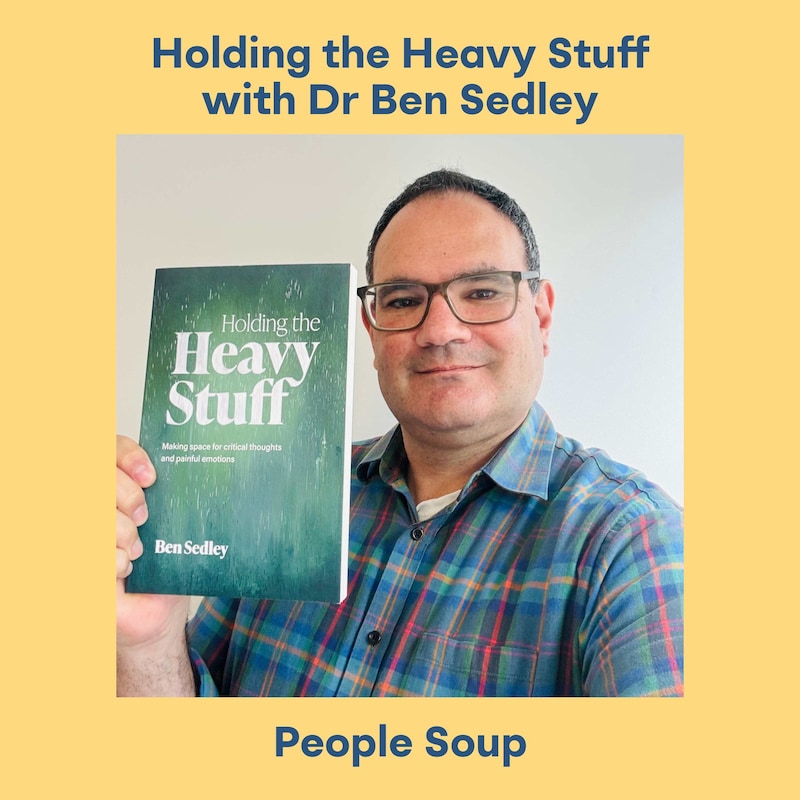
In this episode I continue my chat with Dr. Ben Sedley, a clinical psychologist, author, and speaker.
We delve into his book - 'Holding the Heavy Stuff - Making Space for Critical Thoughts and Painful Emotions.
The conversation covers the book's structure, featuring chapters on presence, compassion, curiosity, purpose, and support, and explores how it aims to serve individuals navigating life's pressures in work, relationships, leisure, and health. Ben discusses the motivation behind writing a relatable guide that is accessible to those who may not typically pick up self-help books. I share my review and highlight the value of Ben's empathetic and jargon-free writing style. We also touch upon practical applications of self-compassion in the workplace and personal life, underscoring the importance of being kind to oneself. The episode emphasizes the broader impact of the book, the collaborative efforts involved in its creation, and the journey of publishing and promoting it.
For those of you who are new to People Soup - welcome - it's great to have you here - I aim to provide you with ingredients for a better work life from behavioural science and beyond. For those of you who are regular P Soupers - thanks for tuning in - we love it that you're part of our community.
- Ben on facebook
- Follow Ben on Instagam
- Ben Sedley, Clinical Psychologist, Author + Speaker
- Building better teams with Ross McIntosh - Contextual Consulting
- Leading with purpose with Ross McIntosh - Contextual Consulting
There is a transcript for each episode. There is a caveat - this transcript is largely generated by Artificial Intelligence, I have corrected many errors but I won't have captured them all! You can also find the shownotes by clicking on notes then keep scrolling for all the useful links.
Here's the People Soup Website.
And you can subscribe to the People Soup YouTube Channel here.
Visit Ross' Website.
Connect with Ross on LinkedIn
People Soup on Instagram which also features plenty of Ross' photos of the Andalusian life.
Transcripts
Part 2.1 ben sedley
[:Ben: How would I talk to someone else I cared about? That's not accepting
mediocrity. That's not giving in. It's saying, Hey, this is hard. You've got this
ts and painful emotions. The [:The episode emphasizes the broader impact of the book, the collaborative efforts involved in its creation, and the journey of publishing and promoting it. [00:02:00] Thanks for tuning in folks. People Super is a podcast that mix a stories science and a sprinkle of daftness to explore what helps people thrive at work and beyond.
Our mission is to give you the ingredients for a better work life through insights and stories grounded in behavioral science, especially acceptance and commitment therapy, and other evidence-based approaches.
Before we go on, let's take a quick scoot over to the News Desk. I am presenting two courses this year in collaboration with Joe Oliver at Contextual Consulting. The first is called Building Better Teams, where I'll present a practitioner approach to pro-social and act based collaboration in a three hour workshop on the 11th of February.
grates the principles of ACT [:I will introduce you to the approach, my experience of using the approach and the core tools. The second is called Leading With Purpose Act, strategies for Resilient and Authentic Leadership. This one is over three sessions in May, and the early bird rate ends soon on the 30th of January, 2026. I will introduce you to fresh and practical approaches to support leaders showing how key skills rooted in behavioral science can help them develop and sustain their authentic leadership style.
These skills are designed to enhance resilience, focus, and effectiveness, while supporting leaders to navigate the pressures and complexities of modern workplaces with clarity and purpose. You'll find the details of both of these courses in the show notes or [email protected].
brew on and have a listen to [:Ross: So Ben, I'd like to dive into your book please and just to remind people what it's called, holding the heavy stuff, making space for critical thoughts and painful Emotions. Now, Ben, I've read the book
Ben: I am excited.
Ross: and I've written a review, which I'm gonna share with you now. And Ben hasn't heard this yet, folks, so don't be alarmed. Ben is my little spoiler for you.
REview
to know different characters [:you about the sequence
ence, compassion, curiosity, [:Ben: What a very kind, lovely review. Thank you, Ross. I really was trying to write a book for people who may not [00:07:00] normally pick up self-help books. I look in the self-help book section, I see these pages, they're 400 pages long, and I'm like, who reads these books? And turns out there are some people who do, but most of us struggle to read a 400 page book lots of the time.
But especially when you're really stressed or depressed,
Ross: Mm-hmm.
Ben: you know, you need something that's quick. Gets to the point with pictures, not too many words on the page. so I've written a book
for the people who are struggling,
which is all of us
some of the time.
at the moment. And it was a [:And what I don't have is a review yet, but I'll keep you posted.
Ben: Oh, Ross, thank you so much for that. Thank you. And thank you for recommending it to your friends. I will just do a really tiny plug to say. To everyone listening, reviews really matter. If you ever like any book, go back to Good Reads or Amazon or wherever you get your books or post and write a review for the book, it's the most useful way of getting algorithms to recommend it to other people.
om me found some of my ideas [:oh, it's gold,
right? It's all we could,
it's beyond what I could ever
hope for in life.
Ross: Ben, at the beginning I talked about how I believe this book could be useful to have in workplaces as a reference point on a, on an organizational website. Do you, do you resonate with that? Do you see that it could be useful for adults in the workplace?
Ben: Oh, so much so as I said in part one, this book is written for human beings with emotions and critical thoughts, and those are human beings. And you know, everyone in the workplace is, has their bad days and has their thoughts that are upsetting or the heavy feelings. And the more we can normalize that, it's fine.
t so a manager can say, Hey, [:But here's one idea I got from the book. And you know, in this world of
I put on my old man pants, you know, I've got tiktoks of 30 second messages rather than hour long videos and tweets rather than books. Just getting across one idea to one person on one day matters so much that we just need to say, here's one idea that resonated for me. You know, something like,
figure out what you care about and care about it.
That's just one page from stuff that sucks. That,
you know, here's one tweet you can take and share in your workplace. most of the adults I work with have jobs, or job hunting, which
compassion is so useful and [:Example fo self compassion
Ben: How can you use that voice on yourself too? I'm thinking someone's working with last week who shared her own history of trauma. And so she had many reasons why she was anxious about speaking up or you know, expressing her voice or saying no to someone. And there sound like there was one work colleague in particular who was possibly, and I only know her side, but it was possibly obnoxious to lots of other people, but certainly seemed to deliberately or not deliberately take advantage of this and talk to her in ways that aren't really acceptable as human and ask her to do things that were probably not reasonable things for her, him to be asking her to do work jobs.
I'm allowed to speak to, I'm [:And I watched him and I was like, you're acting like a toddler. You're having a tantrum right now. Just 'cause I'm saying no to you one time. And she could only get there by holding the heavy stuff with presence, by catching her breath and noticing, this is where I am right now. I'm not in my childhood.
I'm not face-to-face with my abuser. I'm in a workplace and this isn't how we talk to each other in workplaces. And then she could tune in. She could hold her heavy stuff with compassion and she could listen to that internal voice that is kind, strong, confident and wise, and. She can remember that she can include herself in the list of people that she values and say, it's actually okay for me not to be rushing all the time.
And it's okay for me to say [:outside my scope, or I just, I've got enough work to do. I'm not slacking off. I've got enough work to do and
it can make such a difference. So that was just one example of helping her figure out how much energy do I want to put into keeping my head down and not upsetting this person?
Don't deserve the energy, they're not worth it right now. I need to care for myself while caring for other people, not becoming an arrogant
person, but actually I'm
gonna include myself in the list of people I care about,
Ross: Beautiful.
Ben: and that is compassion.
Ross: Which leads me on to you. You have gathered I'm a fanboy of the structure of
ent in the work environment, [:the, the speed, which we're people are encouraged to fulfill their contractual obligations. And I just love the, the sequencing. Can you talk to me more about how, you came up with that, that framework for the book?
Book framework
Ben: Yeah, so my framework was me imagining I was meeting someone, someone, the client I'm working with. This is the order I talk to them about it. Not always I different things to different people, but a rough guide. So this is the order it naturally comes out for me. You gave all those examples about the reasons it's hard to be present in the workplace and there's lots and lots of external pressure, but most often.
y mind tells me I should be. [:Or if only I should have done this yesterday or last month or, and that's all energy. That doesn't help us, right? We're saying actually right here, right now, this is where I am. This is how I am today.
Ross: Hmm.
Ben: How do I want to be today? How can I work towards what matters from the starting point? And then how do I take those steps?
I need to use compassion. I don't need to use compassion. I can try and bully myself and beat myself up.
Being horrible
Ben: And we know, you know, you're never gonna get the best outta your work mate, outta your colleague. Or an employee by being horrible to them. You know, there's so many workplace trainings that you run saying, how do you want to talk?
anyone else you work with if [:Self Talk
Ben: Yet so often we think we're gonna get the best out of ourselves by talking to ourselves in the horrible tone, right? We talk to ourselves in a way that we never talk to our colleagues, never talk to our friends or our partners, and we honestly believe that if I stopped using that voice on myself, then I would slip, or I'd be lazy, or I'd get it wrong, even though we know it does not work, and actually saying, you know, what's this tone of voice?
How would I talk to someone else I cared about? That's not accepting
mediocrity. That's not giving in. It's saying, Hey, this is hard. You've got this cool, you can do this. I can see you're struggling. We, I, I'm supporting you. Dennis Church, who's in New York, who's one of the people I learned compassion work from, he had a lovely way of saying that.
ndness is saying, I've had a [:It's about being that supportive advocate for yourself,
that person who's pushing you a little bit harder, but in a really supportive, caring, loving way.
Ross: Beautifully explained. Ben, thank you. And I often talk about compassion in, in coaching and in in group work. And it can be a difficult thing to land with organizations. I once spoke about it with, a kind of an introductory session to a, a group.
And it was a
the loved ones in our lives. [:And I think it was a blessing in a way. I mean, I feel for the, the people there, but they weren't gonna resonate with my approach.
plain it, but they're not my [:if one of your workmates said, I'm thinking of learning tennis. Do you know any tennis coaches you are like, do you know what's really weird? I actually do know two tennis coaches. There's Al and Al. He sits on the side of the court with a megaphone just going, what the hell was that? Get you served right next time
and there's Betty, and she stands right next to you alongside you. Says, okay, that was good. I can see what you're trying to do. You're not quite there yet. Let's try the serve
again this
way.
If you knew those two tennis coaches, which name would you recommend to your colleague at work? To which most people say I you'd recommend Betty.
how about if it wasn't your colleague? How about if your colleague said, Hey, my neighbor's cousin's looking to go
to learn tennis. Do you know any
tennis coaches?
Which name would you give to your workmates neighbor's cousin?
Ross: I think I'd still be inclined to give Betty.
still, even though, I dunno [:I'd still want 'em to go to this coach. Right. Which one would you send yourself to? I,
Ross: hmm.
Ben: we'd probably say, well, I
like Betty, but too often we think the only way to
get
the best out of ourselves is to go to that first coach.
Ross: That's such an, a neat explanation because I could see myself almost being tempted
to go with, uh, megaphone
Ben: For yourself.
Yeah. Even though you want your neighbor's, cousins, your workmates neighbor's cousin to go with Betty.
Ross: I love it. That's, that's beautiful.
Ben: We'd rather give, we'd rather give them more compassion than we'd give to ourselves. Eh.
And she talks about when we [:career. The ballet career is, I only get a glimpse into it, but I do work with dancers in the uk but it's it's quite regimented, it's quite
structured and it's quite Push your body, push your body to achieve these artistic interpretations.
and to get to where she got [:'cause I think it just really emphasizes in, our work that the context plays a really important part.
Ben: Yeah, I am one. Look at me and you. No, straight away, I'm not a professional dancer. Um, but I suspect all professional, top performing athletes
Ross: Mm-hmm.
Ben: actually do with a lot more fierce compassion and a bit Al Sergeant as well. So not kindness, not, oh, don't worry. It's okay to be the fifth best in the world.
t dancers have to go through [:performing at that level
staring in the mirror all day, having
somebody yell at you all day. but I think even in those contexts, fierce
compassion could be really useful.
Ross: absolutely agree. And because these people are often role models for people who are looking up to them and looking for behavioral cues or, or guidance on how to get to where they've got to. And those messages can be quite damaging if they are very more like your megaphone man and less like fierce compassion. I wanted to also ask Ben about your writing style. Because it feels natural, sort of infused with humanity care. I'm just curious about how that style has evolved
Ben: That's a lovely question I haven't been asked before. Ross, I love it. Thank you. I.
talking to someone, bring to [:Um, I say, how would I explain this to someone in front of me? A real human being? I think the thing that drew me to writing self-help books, the thing that I said, the first pitch I gave to Joe was too many self-help books. Even act books like, Hey, I've got the answers for you. And I would never do that with a client who walked in and sat down opposite me.
I would never say, hello, thank you for coming to see me. Let me tell you the answers. I would want to first understand what's going on for them and say, oh my gosh, that sounds really hard.
Maybe here's some ideas that could help. And that's why stuff that sucks starts the first third is me validating the emotions, talking about what it feels like to have the emotions.
t what it feels like to have [:based loosely on composites of people I work with, that I hope will resonate with the readers
so that the reader's going, Hey, this person gets what it feels like for me before they jump in with any ideas at all.
Um, there's a quote which is attribute of Thomas Edison, and that may or may not be 'cause as Abraham Lincoln said, don't trust anything you read on the internet. but the quote is, nobody cares how much you know until they know how much you care. And that's what I was trying to get across in the book.
I have, uh, an amazing friend, Claire Murdoch, who's an editor, and she looked at a really early draft of my first attempt at writing the book for adults. And based on her feedback, I threw out about two thirds of the book. but one of the things she said, anytime you try and be funny, you lose the reader.
g light when I'm writing the [:Just
be present with
somebody's real
pain. And even though I can't hear the reader's pain, I've made enough human beings
to know that the reader is suffering.
Ross: Thank you. And there's a, there's a quote
on your or sentence on
your website saying, books have an incredible power to connect, reassure, and guide. You've talked a little bit about the impact of the first two books, It's early days for this book, I guess, but how are people responding?
Ben: it is early days and I've had some lovely feedback from people. There was a review on Radio New Zealand by someone didn't know this person, and she just captured all the bits I was hoping somebody would get from the book. One of the lovely things she described was, I thought self-compassion was centered. Candles and having a bath, it turns out self-compassion is talking to yourself the way you talk to other people. And just hearing somebody
io, that just really, really [:Um,
and yeah, I'm already starting to get feedback from people who go, actually, oh, somebody this week told me they read my book while they're away on holiday. They're traveling. And, and there's a page in my book where it asks you just to reflect on a perfect cup of coffee, just one moment where you're just sitting and things feel right.
It's a way of helping you notice what matters to you. Who are you with? What are you doing? And he said that exercise led him to come home.
And he's someone who's been struggling with how much time does he spend doing his day job versus how much time does he spend painting? And he said he read that chapter and he came home and painted a whole painting based on that idea.
So
I can't paint to save my life. I can barely draw a stick figure,
but hearing that somebody else has
painted a beautiful painting based on something I wrote in my book, that's so special. so
big
shout out to that artist. Thank you.
keeps you going? Were there [:Ben: So for me, the secret to writing box is not many words and lots of pictures and pay someone else to draw the pictures. So I knew I was gonna get to the end. 'cause I knew I was only aiming for a few words, but the levels of doubt and despair and what the hell am I doing this? And I, because I've been that clinician psychologist for over 20 years, so many of my friends, a psychologist and, or they've just heard me talk enough.
they can't or they're broken [:And there are some other amazing books out there. But to remind myself that just like we need different psychologists and therapists and counselors in the world because there's different human beings and everyone's going to different person who resonates with them. We need different books out there too.
And the way I write isn't gonna resonate with everyone, but there's certain people who are gonna find my writing style and the way I express these ideas, even though I didn't come up with any of these ideas, these are all ideas from much clever people than me. But the way I get the ideas across resonates with some people.
And I had to say that to myself an awful lot because there was many times where I was going, what the hell am I doing? The world doesn't need this book. People will find out that I'm a big fraud. People will see me on my my worst clinical days, or when I'm really grumpy with my kids or any of my other times and go, why the hell should I read a book by this person?
[:but I know some of the things I say resonate with some of the people some of the time and that's blows my mind.
It's a really cool thing.
Ross: Any plans, Ben, what's next for you?
Ben: Oh,
that's a big question. My book just came out in.
August,
ease the book halfway through:I am looking for more podcasts. I'm looking for places to write books. I'm on the other side of the world for most people. I can't be at conferences, I can't be running workshops across Europe and America. So my way is how do I get my message across from, know, literally the furthest corner of the earth.
that's my grandfather left [:How do I get these ideas across in as many different places as I'm able to? And my plan is to have as many lovely conversations with people as I can. If you are listening to this and something resonates, please do reach out to me. I'm on the other side of the world, and it means the frigging world to me, hearing from people on the other side of the world and knowing that something resonates.
as my poor wife will tell you, I really love talking about act and she loves it when I talk to other people about act. so my plan for this next year is to have as many exciting, interesting, moving conversations with people as I can. And if one of those conversations leads to, uh, what should I do next, then that's super exciting.
year plan. There's no. [:it came from the one before, which I hadn't planned, that came from the one before, which I hadn't planned.
I'm looking forward, I'm looking forward to finding out what happens next
too. Ross is a long
way of saying that
Ross: Thank you. And just to finish off for us, Ben, do you have a takeaway for the listeners?
Ben: takeaway for the listeners. Um,
the central page of stuff that sucks is figure out what you care about and care about it, and I think that's probably one of the most useful things I've ever said. If I could summarize my work into one.
Billboard or tombstone or
take away for a
podcast, it's possibly that.
It's like the world needs all the
things.
Find your passion and do it.
been a delight and a joy to [:Ben: I had love
that. Thank you so much,
Ross.
That's it. Peace Supers part two of my chat with Dr. Ben in the bag. You'll find the show notes for this episode at People Soup Captivate fm or wherever you get your podcasts. Now, more than ever, you can help me reach more people with the special people, soup ingredients, stuff that could be really useful for them.
So please, if you found this episode useful, do share it with people you know, and also if you subscribe and drop us a review, It helps us get recognized in the charts. Thanks to Andy Glenn for his spoon magic and Alex Engelberg for his vocals. But most of all, dear listener, thanks to you.
Look after yourselves. Peace supers and bye for now.
Ben: Thank you so much, Ross. It's been a lot of fun and thank you for
helping [:You have a
great day and I'll head home.
Take care my friend. Bye-bye.



