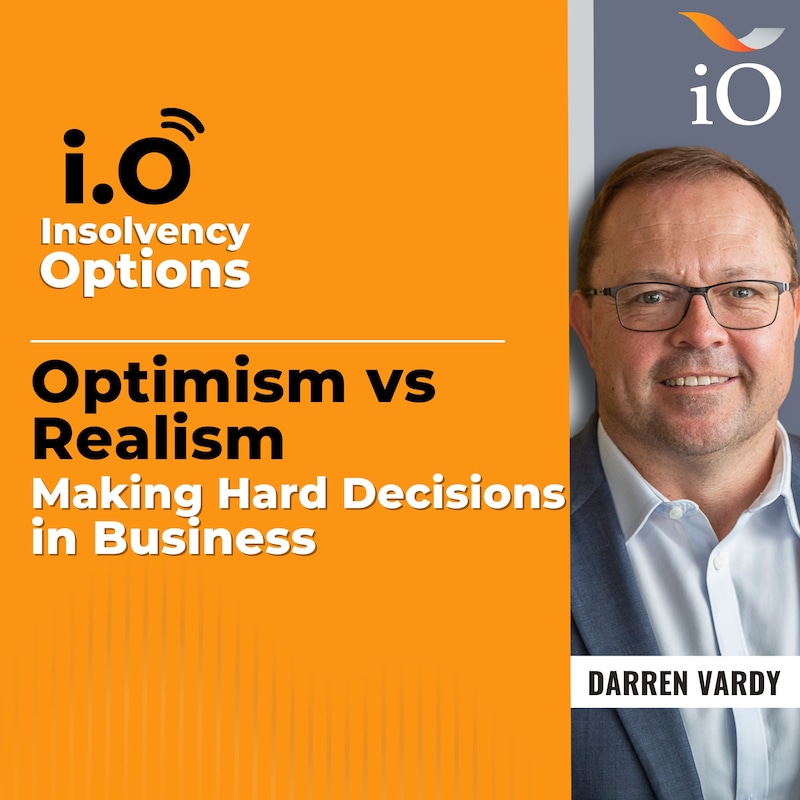
Shownotes
Are you being optimistic or unrealistic about your business? In this insightful episode, Darren Vardy explores the daily conversation he has with business owners about hope versus reality. Learn why the 'she'll be right' mentality keeps businesses trading at losses, how fear of failure leads to kicking the can down the road, and why early engagement with advisors transforms outcomes. Discover how to set realistic goals, identify systemic versus temporary issues, and understand why businesses that go through restructuring often emerge stronger. Darren shares the importance of viewing your business as an investment and knowing when to cut your losses.
KEY TOPICS COVERED:
• The daily conversation about optimism versus reality in business • Why hope and fear of failure lead to poor decision-making • The 'she'll be right' mentality and its dangers • Setting realistic goals and knowing when to pivot • Identifying systemic issues versus temporary cash flow problems • Why early engagers have far more options than late engagers • How creditor relationships impact restructure success • The importance of viewing your business as an investment • Why businesses that survive restructuring often thrive afterwards • The difference between optimism and unrealistic expectations
KEY TAKEAWAYS:
✓ It's okay to be optimistic if you set realistic, measurable goals ✓ Fear of failure causes business owners to delay hard decisions ✓ The longer you leave problems, the harder turnarounds become ✓ Early engagement with advisors provides more options and less creditor resistance ✓ Businesses should be viewed as investments - assess returns like any other investment ✓ Systemic issues require different solutions than temporary cash flow problems ✓ Directors who go through restructuring rarely want to repeat the experience ✓ Successful restructures require thorough due diligence and realistic forecasting ✓ Businesses that survive restructuring often become better operated and more profitable ✓ It's okay to fail if you learn from mistakes and don't repeat them
Who Should Listen: Business owners, company directors, lawyers, accountants, and anyone wanting to understand financial distress warning signs.
About the Host:
Darren Vardy - Managing Director of Insolvency Options and Registered Liquidator with over 30 years of experience in business recovery and debt solutions. Darren has helped thousands of businesses and individuals navigate financial distress and find practical solutions to complex problems.
Connect With Us:
• Website: insolvencyoptions.com.au • Phone: 1800 463 328 • LinkedIn: https://www.linkedin.com/in/darrenvardy/
Subscribe & Follow:
Don't miss future episodes! Subscribe to i.O. - Insolvency Options
Like this episode? Please leave a review and share with colleagues who might benefit from these insights.
Co-host: Anthony Perl
Produced by: Podcasts Done For You
Transcripts
Optimism versus realism, making hard decisions in business.
2
:Welcome to IO Insolvency Options
with Darren Vadi, the Managing
3
:Director of Insolvency Options
and a registered liquidator.
4
:With over 30 years of experience
helping businesses and individuals
5
:navigate financial challenges.
6
:In today's episode, Darren
explores the daily conversation
7
:he has with business owners.
8
:About the difference between
optimism and reality.
9
:He reveals why hope and fear of
failure can lead to poor decisions.
10
:How the she'll be right mentality
keeps businesses trading at losses.
11
:And why early engagement with advisors
dramatically improves outcomes.
12
:You'll learn how to set realistic
goals, when to pivot, and why businesses
13
:that go through restructuring often
emerge stronger and more successful.
14
:I'm your co-host, Anthony Pearl.
15
:Let's dive into unlocking
more about insolvency options.
16
:Darren, I imagine over the
years of you doing this.
17
:That this whole concept of being
optimistic about a business versus
18
:realistic, I imagine that is day
one looking at a business that
19
:you see that every single time,
20
:Darren Vardy: daily conversation.
21
:Absolutely.
22
:Absolutely.
23
:And you know, we get
back to our discussion.
24
:We started with about what is the true
position of the company and what is the
25
:true realizable value of the assets?
26
:Is the company showing to be better
than it's actually performing?
27
:Because no one wants to admit
that their business is failing.
28
:No one really wants to.
29
:People fear failure.
30
:So human nature is, should be
right, particularly in this country.
31
:Should be right.
32
:I'll just wait.
33
:Next month is looking better.
34
:Next quarter is looking better,
and it's okay to be optimistic.
35
:So long as you've got some
goals, realistic goals set for
36
:the performance of the business.
37
:And then if the business doesn't meet
those performance goals, the stakeholders
38
:need to then make the hard decision.
39
:Well, we've attempted to do it.
40
:We've set some goals, which
should have been realistic.
41
:We haven't achieved them, so therefore
we need to look at that alternative.
42
:Anthony Perl: And I imagine every business
has a bad month or two, but there's a
43
:point where that needs to change and
you need to have a good look at that.
44
:That's the common element.
45
:I imagine, that it's not just one
or two bad months, it's seeing
46
:a pattern of it when you go in
47
:Darren Vardy: correct,
it becomes systemic.
48
:And when it becomes systemic,
that's when it's an issue.
49
:And you know, cash flow
is key to all business.
50
:And we've just come through
the December, January period.
51
:Where for the majority of businesses,
there is an impact on cashflow where,
52
:and it's an adverse impact on cashflow
because you have to pay extra wages.
53
:You've got the holiday
close downs and the like.
54
:So leading retail aside, which tends to
thrive through the December and January
55
:period, the majority of businesses
slow down and stop over this time.
56
:So that is generally
accounted for in the budgets.
57
:When the budgets happen, so you move
on to the regular months, February,
58
:March, April, for instance, if those
loss scenario, the trading loss
59
:scenario continues, directors need
to be then realistic and say, right,
60
:why are we still continuing to incur
losses when in reality we should have
61
:came back out of the holiday shut down
period and be back to normal training.
62
:And that is certainly a key.
63
:Now, I mentioned that cashflow is tight.
64
:Quite often during that period,
director shareholders might look
65
:for some short-term funding,
which comes at a far greater cost.
66
:But again, you need to look
at the reason as to why you
67
:need that short-term funding.
68
:Is it just getting
through the slower months?
69
:Or if it lingers on through months
where the business ought to have
70
:recovered and be back to normal trading?
71
:Then the other question is, well
then why haven't we got back there?
72
:It's not throwing money at it just
to solve that short term issue.
73
:It's, Hey, do we have a more systemic
issue where we haven't recovered?
74
:Why haven't we recovered?
75
:What does that then look like for
the next couple of months thereafter?
76
:And do we need to pivot and look at
going in a different direction for
77
:some products or for our business
as a whole so we can ensure that
78
:this loss making doesn't continue.
79
:Anthony Perl: When you go in and get
asked to look at a business and you
80
:see this straight away, the reality
versus the optimism that's in there,
81
:are those conversations difficult?
82
:How are they generally received?
83
:Darren Vardy: The always
difficult conversations to have,
84
:particularly where directors and
shareholders have been involved
85
:with their business all their life.
86
:But quite often we sit there and
say, well, look, you know, you can
87
:continue to operate at a loss, but
to do that, you are continuing to put
88
:your money into a loss making business.
89
:Now you need to be really careful
that every time you put money into
90
:your business, whether it being out
of your mortgage or borrowing money.
91
:You are minimizing your wealth, your
personal wealth, and a business like
92
:a house, like an investment property.
93
:It's just another investment, and
that's where business owners need
94
:to look at it from that perspective
and say, is this a good investment?
95
:If I'm to put more money in,
am I going to get my returns?
96
:And if business owners aren't gonna get
their returns and their returns might be
97
:repayment of the monies they've put in
at a commercial interest rate, payment of
98
:wages to them along the way, and payment
of dividends as a shareholder, whatever
99
:the level of their returns are that
they expect there to be, the question's
100
:going to be is, is it a good investment?
101
:And if it isn't, then why do it?
102
:Anthony Perl: Yeah, I mean,
optimism that hope gets in the
103
:way of good decisions, doesn't it?
104
:Darren Vardy: Hope does get in the way.
105
:I also get back to the fear of failure as
well, and I think that's the driving force
106
:is that people don't want to naturally,
they don't wanna admit to failure.
107
:They fear failure, but putting it
off and kicking the can down the
108
:road just makes the situation worse.
109
:Anthony Perl: And how often.
110
:If at all, do you find that these
businesses have some sort of advisor, be
111
:it a coach, be it a, an actual genuine
advisor that is actually in place
112
:in telling them these things versus
them not having anyone, so they're
113
:kind of just left for themselves?
114
:Darren Vardy: Every business I see
have got an external accountant.
115
:Your external accountant
is your trusted advisor.
116
:Quite often businesses won't seek
advice from their external accountant
117
:because they actually see it as
a cost, particularly where the
118
:majority of external accountants
are doing compliance work or their
119
:focus is on the compliance work.
120
:So for most businesses,
you know, that's a chore.
121
:It's a cost.
122
:They don't see the value in that.
123
:So they'll engage on a minimum basis.
124
:With their accountants and advisors, so
they minimize the cost, but what they
125
:don't realize is that spending that
little bit more time with the advisors
126
:can really be of assistance to identify
a problem and then look at solutions
127
:to address that problem before it gets
to the stage where the advisor needs to
128
:refer the client to someone like myself.
129
:Anthony Perl: So what's the
outcomes of when you're going into
130
:businesses, and I imagine, as you
said, you see this all the time.
131
:You go in, you give
them this reality check.
132
:How do they respond generally
speaking, and, you know, give us
133
:some examples perhaps of where
it's gone one way or the other.
134
:Darren Vardy: The shock is not uncommon,
particularly where business owners
135
:have invested significant monies of
their own back into the business,
136
:and every business is different.
137
:The longer people tend to leave the
business, the harder it is to do a
138
:turnaround, so the options are very
limited, whereas the early engagers.
139
:Tend to have far more options and less
resistance from their creditors to
140
:support the business going forward.
141
:Quite often we find that if people
have been trying to survive for months
142
:on end, the creditors chasing them.
143
:They're avoiding phone calls from
their suppliers in respect to payment.
144
:Quite often you'll find that
those businesses won't get the
145
:support from their creditors.
146
:Where they look at a turnaround situation.
147
:Whereas, you know those business
owners who identify a problem, act
148
:early, seek urgent advice, communicate
with their suppliers as to what's
149
:going on, because the suppliers
just wanna know what's going on.
150
:If payment can't be made, they want to
know what can be done to reduce the levels
151
:of the debt if they can't be paid in full.
152
:So really it's a matter of that
early engagement and being upfront
153
:with the people you work with.
154
:Which will put you in the best lie.
155
:The best step forward to enable you
to do a turnaround if necessary.
156
:Anthony Perl: How often do you see that
people that do go in and they're start and
157
:you work with them and they're starting
to see that there is a turnaround,
158
:is it still being overly optimistic?
159
:Do you walk away sometimes going, okay,
well you've got them to the point where
160
:they're trading in their back to a, you
know, being able to run the business,
161
:but you probably shake your head thinking
they could well end up in the same place
162
:in the future because they're still
being optimistic rather than realistic.
163
:Darren Vardy: Yeah.
164
:I think as a result of going through
a process and as a result of coming
165
:to see someone like myself with the
financial position that they face.
166
:And what we need to do to go
through a turnaround process.
167
:That optimism very quickly moves to
reality in a realist position because
168
:ultimately, to put a restructure plan
together, there needs to be some thorough
169
:due diligence on the operations of the
business, which you know, your creditors.
170
:And importantly, as a major creditor,
the A TO have a significant.
171
:Input into, they'll want to see a certain
level of due diligence done by the
172
:practitioner to ensure that the business
in the future is not going to fail.
173
:So quite in going through that
process, the forecast, the budgets,
174
:the review of the business operations.
175
:Is looked at in a significant level
where everything's challenged.
176
:And by virtue of challenging everything
and making sure that the numbers are real
177
:effectively, there is no room for optimism
to enable a successful turnaround.
178
:So therefore, it does bring the.
179
:Directors back to reality, so
to speak, as to if they've got a
180
:business, what that business looks
like, and if they're gonna have it be
181
:able to successfully turn it around.
182
:Anthony Perl: I mean, in some of
these cases, do you look back and
183
:see they're better businesses for
having been through this process?
184
:They're better business
operators at least.
185
:Darren Vardy: Absolutely, because one
thing that drives the business owner
186
:is that they don't ever want to be in a
position that they've previously been in.
187
:That resulted in them coming to
see me and to do a turnaround.
188
:So quite often we see that if the business
owners are faced with a situation, they
189
:genuinely have to become invested in the
success in the future, and quite often.
190
:From my experience is that once someone
has been through a process, they tend
191
:to go on and survive and even thrive.
192
:On the other side of that process
193
:Anthony Perl: because it's interesting,
you often see people who are sprouting
194
:themselves as coaches, consultants,
and things who do actually talk very
195
:openly about the fact that I've been
through a process and this has happened,
196
:and we're now in this environment.
197
:And it's lessons learned, isn't it?
198
:And they can be important things because
that optimism that people have going
199
:into a business, nobody goes into a
business thinking that it's going to fail.
200
:Darren Vardy: No, that's exactly right.
201
:I hate to say, but sometimes people
just need an attitude adjustment.
202
:Sometimes they're more than
optimistic, they're unrealistic,
203
:and not being aware of the risks.
204
:It's okay to be optimistic,
but when you're unrealistic.
205
:You are not conscious or
identifying the risks as you go.
206
:That is where failure can occur as well.
207
:So it's being alive to those risks.
208
:It's okay to be optimistic, but not
unrealistic, but at the same time, you
209
:need to be managing the business to ensure
that you are meeting targets, meeting
210
:budgets, and more importantly, meeting
that break even level to ensure that
211
:all the debts are being paid as you go.
212
:Anthony Perl: And tell me, do you
look back, kind of almost like a proud
213
:parent when you see some of these
businesses that you've dealt with in
214
:periods gone past and see that they
are seemingly going really well?
215
:Darren Vardy: Yeah, look, you
know, that's one of the reasons
216
:why I'm in this business.
217
:You know, I'm in this business to try
and help people and educate people
218
:on the better ways of doing business.
219
:And it's okay to fail so long as
the reasons for failure have been
220
:identified and addressed and learn.
221
:As you said earlier, you
learn by your mistakes.
222
:It's okay to make a mistake so long as you
learn by it and don't let it happen again.
223
:And as business owners, we're
all gonna make mistakes.
224
:It's just a matter as to what is the
severity of that mistake and how do I
225
:fix it to minimize any impact on the
business, on all the stakeholders per
226
:shareholders, creditors, and the like.
227
:Anthony Perl: And that's all we
have time for in this episode.
228
:But next time on IO insolvency options,
we'll dive into the critical difference
229
:between compliance and advisory services.
230
:Darren will reveal why accountants must
be more than just compliance officers
231
:and share a shocking case study where
a director nearly lost everything
232
:because important documents were
simply readdressed without urgency.
233
:It's essential listening for business
owners and accountants alike for details
234
:on how to get in touch with Darren
and his team on insolvency challenges.
235
:Please consult the show notes.
236
:This podcast is produced by my
team at podcast done for you.com
237
:au helping professionals
share their expertise through
238
:powerful podcast content.
239
:If you found value in today's
episode, please like, comment and
240
:subscribe to IO insolvency options.
241
:Until next time, remember, there's always
a way forward when you know your options.

