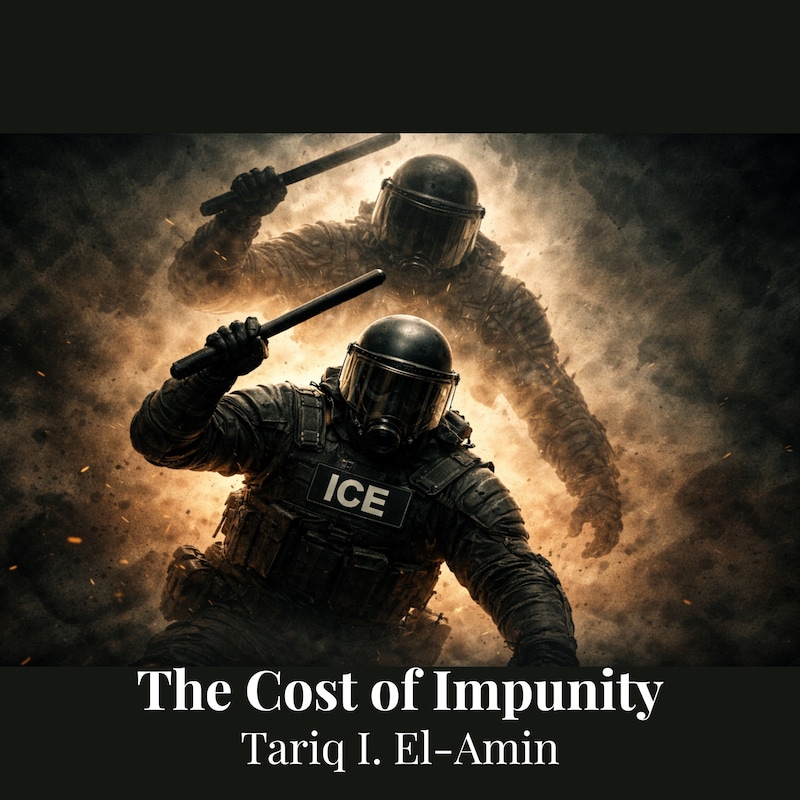
In this special episode of The American Muslim Podcast, Imam Tariq I. El-Amin shares a spoken essay reflecting on power, impunity, and moral injury.
Drawing on historical memory, contemporary events, and ethical reflection, The Cost of Impunity explores how unaccountable state violence harms not only those subjected to it, but also those authorized to carry it out. The essay examines the denial of protection, the psychological consequences of normalized violence, and the quiet damage that spreads through families, institutions, and society when power operates without restraint.
This episode invites listeners to consider a difficult but necessary question: what happens when no one feels safe, and what kind of people do we become under those conditions?
Written, Read, and Produced by Tariq I. El-Amin
Music & Art by Tariq I. El-Amin
Transcripts
The Cost of Impunity
Imam Tariq: [:
What we're witnessing right now with ICE isn't simply immigration enforcement. It's the normalization of terror, exercised with impunity masked agents, public manhandling, family separated in the open. No accountability, no consequence. No concern for dignity, age, gender, or humanity this moment. Deserves more than outrage.[00:01:00]
It deserves examination because unaccountable power doesn't only traumatize the people on the receiving end. It also corrodes the souls relationships and moral imagination of those who are authorized to wield it,
protection and its denial. Recently after Fajr prayer, that's our morning prayer. A group of us had a serious conversation about safety, not abstract safety, but the very human question of what it means to provide and defend safety for one's family, beginning with one's wife. For black men, that question Kent, be separated from history.
have paid with their lives. [:
It leaves marks when the inability to protect goals unnamed. It doesn't evaporate. It turns inward. Shame settles into the body. Pain looks for somewhere to go In relationships, that tension doesn't stay abstract. It shows up as frustration, as strain, as unmet expectations around protection, provision, and presence.
ity and relationships alike. [:
It wasn't clear where it took place or even who she was. What was clear was the force being used against her. Suddenly a man entered the frame, presumably her husband. Instinctively, he rushes in trying to pull the agents off of her. Their response to his act of valor was immediate, brutal. The agents turned on him.
n is suddenly impossible for [:
What happens to identity? Relationships and self understanding when the state demonstrates that it will not honor your right to protect those you love the other side of violence, there is another dimension to this moment that demands attention. On the other side of this terror is a force made up largely of men, predominantly white, though not exclusively, they're armed, emboldened and shielded by political power.
ical, it's psychological and [:
It trains the conscience to quiet itself. It teaches the body to obey power over principle. It creates allegiance not to justice, but to authority. Those outside your ranks become objects. Those within become the only moral reference point. There's also fear embedded in this alignment. The unspoken knowledge that you are spared the indignity of oppression only because you are useful to power and that usefulness has conditions, moral injury, and the cost of families.
er rates of substance abuse, [:
And violence. Moral injury occurs when individuals participate in or witness acts that violate their deepest moral convictions, especially when they feel powerless to repair the harm they've caused. It's not trauma from fear alone. It's trauma from guilt, remorse, and unresolved responsibility. It is reasonable to ask.
those who still have souls. [:
What happens to intimacy? To tenderness to children who learn what power looks like by watching how it's carried at home. Unjust power doesn't remain neatly contained in the workplace. It travels, it settles, it reshapes relationships,
ke domination for order from [:
Divorce from Mercy becomes corruption. Strength unmoored from accountability becomes cruelty power. Exercise without restraint, ultimately consumes the one who holds it. This isn't a political issue, it's a human one. It's about what? Kind of people we're becoming under the conditions we're normalizing.
It's about whether we recognize that violence once authorized rarely limits itself to its intended targets
isn't only whether we oppose [:
Socially and spiritually, whether we recognize the patterns being set, whether we are willing to name the cost of impunity, not just for the oppressed, but for the enforcers, their families, and the society that authorizes them. Power always has a price. The only question is who pays it and how long we pretend otherwise.