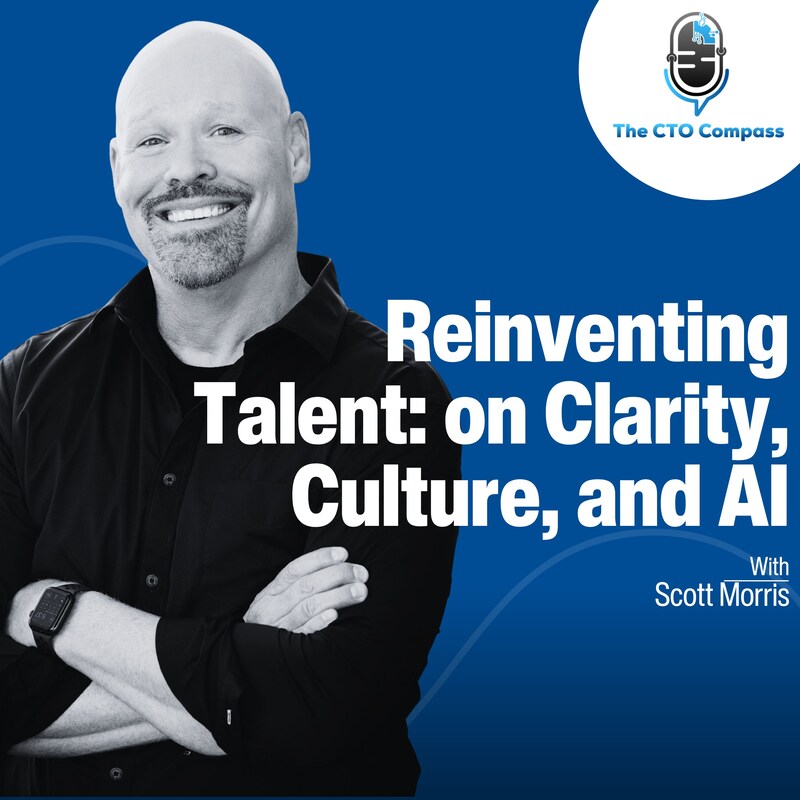
Shownotes
Scott Morris, a veteran HR leader turned startup founder, discusses his transition from a successful corporate career to launching Propulsion AI, an innovative company focused on AI-powered HR solutions. He highlights the significant challenges in traditional HR practices, particularly the lack of clarity in role expectations and the misalignment of employee engagement. Scott introduces Athena, an AI teammate designed to enhance role design and improve hiring processes, ultimately aiming to create a more effective and engaged workforce. The discussion also touches on the future of hiring, performance management, and the importance of understanding the value of operational roles within organizations.
Chapters
00:00 - Risks, Startups, and HR
07:35 - Solving The Problem with Hiring
14:39 - Athena and Propulsion
21:20 - Importance of Operational Roles
25:04 - Athena as a Teammate
29:41 - Collaborating with Tech
32:08 - Culture in the Hiring Process
34:32 - Are You Ready to Hire?
38:41 - Future of HR Tech
41:44 - Hiring and Managing Advice
About Scott
With more than 25 years of HR leadership - including two decades at the C-suite level - Scott Morris has navigated talent management across five distinct industries and two continents. He's led HR strategy for nimble tech startups with 250 employees and orchestrated comprehensive workforce solutions for enterprises exceeding 15,000 employees. His experience spans the full spectrum of organizational complexity, guided by a core philosophy: if it feels comfortable, you're behind.
Scott is now Founder & CEO of PropulsionAI, building the first HR team made entirely of AI - digital teammates that coach managers through strategic talent decisions using proven frameworks. These AI coaches clarify how roles connect to business outcomes, transform hiring and performance management, automate labor-intensive documentation, and help organizations simultaneously raise employee engagement and productivity.
Where to find Scott
• Website: https://getpropulsion.ai/
• LinkedIn: https://www.linkedin.com/in/mscottm/
Transcripts
I think it was a moment of insanity. But it's insanity that comes out of really two factors. For 25 years, I bought HR tech. It always felt to me that the people who made it were somehow adjacent to the problems. But they never had really solved the root causes. I'm a very vocal Workday critic, and in part because I don't think I've ever met anybody who has been in a Workday system that actually likes Workday.
Mark:Welcome to the CTO Compass podcast. I'm your host, Mark Wormgoor, tech strategist and executive coach. In every episode, we meet tech leaders from startup CTOs to enterprise CIOs to explore what it means to lead in tech today. They share their stories and their lessons so that you can navigate your own journey in tech. Let's dive into today's episode. What if your next HR teammate wasn't human? Today we're joined by Scott Norris. He's a veteran HR leader turned startup founder who's rewriting the rules of telemanagement. He spent 25 plus years leading people operations across five industries and two different continents. And Scott walked away from the C-suite to actually build something radically new, PropulsionAI. And it's a company, they're building an AI powered HR team, which is really cool.
So whether you're scaling a startup or leading talent strategy in an enterprise, Scott has a really new take on building teams with clarity, accountability, and AI, and might just change the way that you hire, lead, and grow. Not just on the technology side, he has a lot to say on the HR side of it as well. Scott, you left a decades-long career in HR, very successful, the C-suite, to start a startup.
So what made you decide to actually leave the cushy job that you have behind and actually go for the startup route?
Scott:Well, first of all, thank you so much for having me. I'm lucky to be a guest. I'm a listener. I love your show. And I like what you're trying to do and the points you bring out. I think to directly answer your question, I think it was a moment of insanity. But it's insanity that comes out of really two factors. For 25 years, I bought HR tech. And it always felt to me that the people who made it were somehow adjacent to the problems? But they never had really solved the root causes. And, you know, I'm a very vocal workday critic, and in part because I don't think I've ever met anybody who has been in a workday system that actually likes workday. And yet, if you look at them, they're a behemoth. They sell a ton of work. They're an industry leader. And yet people just don't like the solution. And when I look at what they built, it feels to me as if they have found a faster way to solve the wrong problems. And I kept looking at that and I said, you know what? Rather than trusting Silicon Valley to do it, I think domain experts should be building software. I think the people that have solved the problems should now be thinking about, especially in an era where you've got a bunch of no-code tools, I think we should be thinking about how we bring domain experts forward and let them build solutions. But there was another of the two factors that was equally important, and that is that my last corporate assignment was a complete failure. And it wasn't because I was bad at my job and it wasn't because I didn't know what I was doing. It was because after 25 years of giving people advice, about Finding fit. And the importance of really understanding the role and what the, you know, what your boss wants you to do in the role. I found myself in a place where, you know, I was traveling 80% of the time I wanted out of the travel. There was a role that came available that they, you know, the company was interested in me for, it was the money was obscene. The location was perfect for me and I jumped at it and I didn't do anything. What I had been advising other people to do, which was really dig into the role, really dig into not just like culture is too easy of a word, as an umbrella to use, but you've got to really understand, like when somebody says they want a strategic HR leader, in my case, What does that mean to them? There's a lot of different variants of that, right? And maybe my version of a strategic leader is not their version of it, right?
So you gotta get it under the covers. That failure. Had a consequence. For the company, it was a financial one. It was really expensive. For me, it was a personal one. There was like anytime you fail out of anything, whether it's your fault or not, if you are not out there hitting home runs. And you take what you do seriously, there's a huge personal impact to that. Feeling of failure, feeling like you're an imposter, feeling like, you know, like the loss of confidence. Those are very hard to quantify, but they're very real. When I look at the research, lack of fit at work is a 1.9%. Billion dollar problem. In the U.S. $8.8 trillion globally, 9% of global GDP, all coming back to these same factors.
So I said, you know what? I'm going to fix that or I'm going to try and contribute in a way that adds something good. To what is otherwise a bets situation.
Mark:And still that's, I mean, a startup is a big risk, right? It's, of course you said you had an, a cushy job, right? Even if it wasn't the right fit for you, money was obscene, a nice pay startup is absolutely nothing, right? And it's 60, 70 hours a week as well, but with absolutely no pay. Why was the problem so big for you that you decided to give that cushy job up and actually go and solve the problem yourself?
Scott:Well, let's look at what we know from other pieces of research. Gallup tells us, and as late as their 2025 survey, which came out earlier in the year, less than half of workers feel that they have a solid understanding of what their boss wants. 47% is the exact number. That's a frightening number to me. We know from... A study that was published in Fortune magazine, the authors followed 20,000 new hires. 46% of them. Failed in their first 18 months. And it wasn't because they didn't have the technical skill to do the job. It was other factors. The last one, you know, Towers Watson did some work that suggests that Fully engaged employees tend to produce 16% more than we pay them, fully disengaged employees about 60% of their payroll value.
So if you have a company of 100 and you have disengaged employees, you have as many as 40 people on your org chart who you are paying full salary benefits. Who are not accomplishing much of anything for you. That's a huge loss. And when you take all three of those and you sum them up, I think it's easy to see why IDC claims 20 to 30% of top line revenue is lost by mid-market companies because of misaligned and underperforming employees. That's a big problem. That's a problem for private equity owned businesses. It's a problem for startups who are trying to scale without adding overhead. It's a problem for established companies. And the cost of that Again, it's not just a financial one. There's a cost to the people of that. We see it in turnover. We see it in low productivity. We see it in low engagement. And regrettably, we see it in quiet quitting. And I think that's arguably worse, right? People who Hate going to work every day. Their boss isn't thrilled about their work. But nobody's terminating them. Nobody's giving them feedback and they're not quitting. Bad situation.
Mark:That's really bad, right? So, and I think you said, and I've seen this all my life, right? The job description is that most companies with an HR, they say they have a template for a job description. You want to hire someone, you fill out the job description. What are the responsibilities? What is the role? What is the company? Give that to HR. They write an ad. And basically that's the whole thing. Guidance for the recruiter, at least, and the hiring manager to go and hire for that role.
So what's actually wrong with that process?
Scott:Well, so the starting point, right, if we're looking at a job description, given what we do at PropulsionAI, I know it probably sounds funny for me to say, who cares about the job description? What I care about is clarity in the mind of the manager, right? And so if we back the process up, you know, think about Just get a mental image for me for a second. And I hope everybody that is listening will do the same thing. Think about the boss you always wanted to work for. Or think about the boss you were really happy that you were a part of that person's team. Whoever just came to mind probably occupies that space because they were doing things differently than most managers. And they did things differently because they knew different things. Specifically, here's what we believe that all of the ones that are going to be those great managers have in common. They understood how each role fit into the broader strategy. They understood the outcomes that the person in the role needed to produce, not the tasks, but why those tasks mattered, why that box was on the org chart to begin with, how it moved the business forward. They were able to define good, meaning that they could specifically tell you how they were going to measure your performance against those outcomes. And they knew the competencies and skills that were going to be necessary for the person to perform well. They knew the competencies and skills they wanted to help the person acquire. Those five How the role fits strategy, the outcomes, the specific success measures and the competencies and skills. That's what turns the average manager into a talent magnet. And when a recruiter goes out and works really hard to find good candidates for a role and brings them in and puts them in front of a manager, who does not have a command of those five things, that top talent, They're really smart. Top.
You know, performers smell out really quickly that manager has not thought through the role. And you know what they do? They walk away. Similarly internally, Talent gravitates toward managers that have thought that through, not just because they are fundamentally better or they become better at hiring, but they're better at managing. Because if I can sit down with you in my one-on-one with you and I can say, How are you doing to the results that we agreed that we were going to achieve? Where are you? Are you exceeding? Are you falling below?
Right? I've got to be able to define the results first. How are you showing up? At work. We said these competencies were important. Let's talk about this. This is what I'm seeing, right? This is a conversation, not just about performance. It's about growth. And internal talent gravitates toward those kind of managers. Now, the big problem is most managers are not that manager. And a bigger problem is, Most HR people are not equipped to help them become that. And that's why we built the company. Most HR people are playing defense, not offense. They're playing not to lose. They're not playing to win. They are risk managers focused on policy and handbooks. And those things have their place. I don't want to be dismissive about it. I spent 25 years of my life in the profession. But those things are not helping managers. Build teams that people want to be on. Or improving business performance. And there is a small fraction of VHR people that are capable of doing that. They have the business acumen and they have the consulting skills, but they run out of bandwidth fast.
So we brought technology into bear on that problem, and that's why we are building an HR team with just AI, digital teammates who work alongside their human colleagues and directly with managers on these problems.
Mark:Yeah, and I want to hear more about that, but I do want to go back a bit to the leadership side as well. And I fully agree with everything that you said. And that was amazing, manager.
I mean, I've had one or two in my life, people that I would... Easily go back to work for again, right? The dream managers and I've had the others as well. Absolutely. I think everybody has that experience.
Still, there are some things that you said that aren't maybe necessarily HR, but I mean, there needs to be a clear strategy. There needs to be clear team goals as well that the leader needs to say. There's more to this than just HR or just write how they manage their team. Do you get involved in those? Tasks of leadership, like setting the team strategy, making sure that is in place so that you can actually set those individual goals for that employee as well.
Scott:When you think about it, the manager... So the direct answer to your question is no, not currently, but we're at the beginning of a journey. Athena, who is the first of the digital teammates that we've released, she focuses on role design, but we envision about seven different teammates that extend throughout talent management. And we're thinking right now really critically about problems that we're hearing from our customers and that we're hearing from CEOs.
You know, the cascade of I think a lot of, here's another example of where I think the tech people have gotten it wrong on the technology, right? You know, platforms that manage OKRs, they do nothing better than a cascade. Right. And in some cases, they don't even do a very good job of that. They're just like repositories for where you put the different goals. And I've used a lot of these platforms. But the you know, I think the right way to think about workforce planning and strategic planning more broadly, the executive team should say, here are big, hairy, audacious goals, right? These are the things that we are going to go out and conquer. And wouldn't it be amazing if we then fed those into artificial intelligence who started to reorganize the company, not by function, but by value creation. And started to think about like, if we put the like, here's the goal, here's how you break the goal down, here's how we would have to organize around that goal, and then here's how we would describe the roles of the people involved. Now, obviously, tech isn't going to be able to do that alone. And we don't at PropulsionAI, we don't believe in handoffs to technology. We believe in what we call technology in the loop. A lot of people call it human in the loop. But we think the humans always should be in charge. And the creation of these artificial intelligence tools, simply are that. They are just better tools that help the humans become more effective.
So that's the cascade that we're thinking of in the future that starts with the strategic goals for the organization but ends with the role design. That helps people understand how they're going to contribute to that.
Mark:Yeah, and it's such a different way of looking at org chart versus just the boxes that we tend to put on there. I love that.
And then we're now at Athena and Propulsion. Tell me exactly what you guys have built right now, what Athena and PropulsionAI actually do right now and what your longer term roadmap is then.
Scott:Okay. So Athena, as I said, a second ago, Athena's focus is on role design and So. She will interview, effectively, a manager about a role. We, you know, the way that we've designed her is she processes very similar to how a human would.
So imagine you have a really good consulting partner. A HRBP, a recruiter could be an OD person, right? And they're going to sit down and talk to you about what do you want to achieve with your team? And what do you want from each of the roles? That person is going to ask you questions, get answers, put different things together, reason about them. That's exactly how we built Athena. She engages the manager directly in a conversation about a role. That could be a role that they're pivoting inside, redesigning in some way because business has changed. It could be a role that they're bringing in from the outside. In the course of this conversation, Athena is going to provoke your thinking. By asking you questions. She's going to help you to uncover insights about the particular role. And in the course of doing that, she's going to deliver her greatest value. And that's clarity in the manager's mind. Who cares whether you have a piece of paper called a job description or What you really need is for the manager to truly understand the role, how it contributes and how you're going to measure success. But because Athena is digital, she can do some things faster than humans. In the course of the conversation, which can be as little as 15 minutes, She is writing a performance-based job description. With KPIs. Turned into first-year measurable results. And SEO optimized posting for the web, social media content for LinkedIn X, Facebook, and Instagram, a spec for the recruiter to go source with, an interviewer guide, the beginning of a performance charter. She'll even do Compensation analysis on base salary, given your geography and reporting relationship. Duties and skills. To make sure that not only are you thinking in outcomes terms about the role, but you're equitable in your thoughts about what you're going to pay it. And she can get all that done in as little as 15 minutes.
Mark:Wow. Yeah, I've seen the process in my past, right? Without Athena involved, then those can easily take couple of weeks to get some clarity around that and not even deliver all of the outcomes that you just mentioned.
I mean.
Scott:Well, let me tell you, Mark, let me tell you two additional things that we have given one that we are about to release and one that we just released. Athena has the ability to not just coach managers going forward, but to look at all of your existing job descriptions analyze them. Rewrite them. Shifting them from task-based to outcomes-focused. Flag potential duplicate roles. Put them in your library on the PropulsionAI platform.
And then, coach managers as they edit those roles. Now I'll tell you a horror story. My last corporate gig, the CEO came to me and said, this was like mid October, I think, and said, by January 1st, I want everybody to have a new job description. Now we were a private equity company. We were rolling together four previously independent businesses. We, so I had 500 people And some of them had job descriptions and some didn't, and some understood their role and some didn't. And everybody was new to their manager. CEO says, I want everything ready by January 1st. I said, you have no idea what you're asking for. And here's the horror story part. It took us 13 weeks of doing nothing but writing job descriptions. All of the managers hated the process because it didn't move fast enough for them. We missed the deadline. And so the CEO was really upset. My team got completely burned out. If Athena had been involved, The writing would have been done in an afternoon.
And then my team would have spent the next couple of weeks, not 13, adding what only humans can add. Judgment. Discretion. Consultation. Connection to Strategy. Interrogating the KPIs. Pushing managers. Are we asking enough from this role? Are we asking too much from this other role? Right. Applying a layer of human judgment. And this is why we call it a technology in the loop system, because what the humans should be doing is thinking about the stuff that tech can't. And tech should be taking over the administrative and the difficult tasks that tech is inherently faster at.
Mark:Very similar experience here. We did a reorganization. We have to rewrite 30, 40 different, no 500 job descriptions. It was horrible, just horrible work to do.
So I can imagine how bad 500 must be. So, You now have launched this. You actually have some clients. Can you share some real-life client stories? What changed business performance, hiring outcomes? What has Athena done already?
Scott:Well, so I can share anecdotally, we're too we're too nascent of a company to have hard case studies yet because the effects are felt farther down the road. But I'll tell you a couple of stories that have surprised us. The first, I had a CEO who shared with me that she's instructed her leadership team. That all of their high potential employees need to start working with Athena. And what they are directed to do is to design their dream role.
So now the high potential employee is talking with Athena and they are together creating the role that individual wants to have in the company. And what the CEO told me is it's really changed two things for them. One is that the conversation with their high potential employees, which in a lot of companies, and I know you have experience with this, it feels like window dressing, right? It feels like false platitudes, like you're a high potential employee, we want to invest in you, right? But it's always really, you know, in the clouds. And what the CEO told me is, Athena has made this conversation very real because now the employee says, this is the job I want. And they sit down with their manager and there's a real role design that they are now talking about. And they tell the employees going in, now recognize we don't have these jobs today, but we want to work toward them.
So now the manager can say, hey, look, okay, let's look at where your gaps are. Let's look at what I can help you to get ready for. And the other thing the CEO told me was that They're starting to look at some of those roles and question themselves and say, why don't we have these roles in our company? Because it's really easy to see what the return is. Hey, another story a CFO told me about their headcount planning. I think regardless of where I've been, I don't know how it is for you, but Everybody does headcount planning the same way. We all figure out the roles that we want, and then we go to finance, and they have a spreadsheet. And we fill out their spreadsheet and then kind of finance goes like this. And, you know, with a thumb in the air and she just tries to figure out like, what's the best place to put the money. C. We are now insisting that managers go to Athena first. And they have the conversation about the role.
And then when they come over to finance to fill out the spreadsheet, they bring the documents with them and they're able to say, Here's the role I want. Here's what it's going to contribute. Here's how I'm going to measure success. This is what it's going to return. Here's what I'm going to pay it. And the CFO said that is a completely different way of us evaluating what is effectively an investment. Salary is an investment. And we should be thinking about it in terms of like an investor would. We're not just paying people to pay them. We're paying them because they're going to return something to the business. And so this CFO said it's, Totally changed. The way that we look at headcount planning and allocation of dollars to salaries.
Mark:And just personal question, how does that relate to more like operational roles? You have all these operational roles in a company that maybe don't have return, but are absolutely critical to an organization. How do you look at those?
Scott:Well, so first of all, I got to call BS on that. Like there are no operational roles that don't have an impact on the company. And I'll give you an example. Let's say we were talking about an accountant. And normally we would hear overhead, right? And we just have to process things. And if you look at that accountant's job description, you would probably see something like follow up on delinquent accounts. It's totally like expected in a legacy job description. This is right there. If I can just pause to reveal it. That's the problem. That's task-based thinking. Why do I need to tell somebody, like, I want you to follow up on Delinkum accounts. Do I need to see them at the desk making phone calls that nobody wants to get, writing emails that nobody wants to receive? Following up on delinquent accounts is a means to an end. And in accounting, The end is bringing down what's called day sales outstanding. DSO. It's a measure of how fast the company can collect. But here's the deal. In a company that is $10 million ARR, if I move DSO from 90 days to 60 days, I create $833,000 worth of value.
So why don't we tell that accountant your job? Is to bring down DSO and keep it as low as possible. It's currently at 90. It needs to be at 60. You have 12 months to do it. That's your job. Now, by the way, you're going to have to do a variety of tactics. You're probably going to have to make some calls. You're probably going to have to do some other things. But when I shift my focus from task to outcome, I position the employees so that they can take accountability so that they can take initiative. Because now that employee comes to me and says, hey, Scott, if that's my job, shouldn't I do these things? And I say, Yes.
Like... I'm not on the front lines. I hadn't really seen that, but yes, do those things. That is what managers want. Managers want initiative. They want accountability. They want ownership.
You know what employees want? They want jobs with meaning and purpose. Both are missing each other because we're focused on tasks.
So I think you can take any role in the company and you can use that example as a proxy for the work that they do.
Mark:Yeah, and I think that's a very big mind shift for a lot of leaders, a lot of managers, not just HR, not just adult description, but actually as a leader to focus on those outcomes, the results, instead of just the tasks, the standard KPIs, especially for, I think what you said, like an accountant. Okay. And Athena isn't, I mean, it's not like, and well, I mean, we're all used to LLMs and chat GPT and Gemini and cloud these days. We all use that. You're actually positioning Athena, not as another chat tool, but actually as a teammate. I love that.
So, What does that actually mean? And what does it look like when AI becomes a co-worker instead of just not a tool?
Scott:Well, so I think, again, I come back to the one core principle that kind of drives us as a company when I think about that, and that's outcomes. What's the outcome that if you start thinking about outcomes for any role, it doesn't really matter whether you're digital or whether you're human. Right. The outcome is what becomes important. And so there is a day that we see that we are working toward where and I'm going to be thrilled when it happens with one of our customers where they've actually added our digital teammates to their org chart. And, you know, in this case, like Athena's got a very focused role. But she performs that role just like a human would perform their roles. It's just the humans are a little bit more broad in what they're doing and the digital teammates are a little bit more narrow. But when you build a product, you know, first of all, the difference in. In what you get with a chat GPT Because we get asked that question a lot. Why wouldn't I just go to chat GPT? And there are a couple of really big reasons. One is scalability. It's really hard to scale a commercially available LLM for a specific purpose to a large group of managers. And in part, that's true because With an LLM, you have to understand... What to ask for. Which means you have to have subject or domain expertise to ask the questions right. Then you have to understand how to separate good answers from bad answers. You have to understand how to, what to do with the answers you actually get.
And then you may have to transform depending on how advanced the GPT is or what kind of training you've given it. You may have to transform it. PropulsionAI scales very easily. It is intended for people who have zero domain expertise. And Athena leads you. In the process. You have to lead a commercially available LLM. The other You know, we've blended human intelligence and machine intelligence. And when you look at a commercially available chat GPT, its training base is the Internet. And like the word culture, I can say culture to 10 different people. I'll get 15 different ideas about what it means. The same that you say, I need a role design to a commercially available LLM, it's going to use its training database, which is basically all, you know, the very thin sliver of good stuff and the very giant pile of really bad stuff that leads us in the same situation. That I started with on the statistics. 50% of the people don't know what's expected of them.
You know, disengaged employees producing about 60% of what you pay them. It's, you know, and 46% of new hires quitting within or leaving, being separated within the first 18 months. Bad situation.
Mark:And how do the people, so maybe the HR people or the managers respond to not just getting another tool, but actually getting an AI teammate? I think a lot of companies you work with, Athena may be the first AI teammate that they've seen, they've worked with. How do they respond?
Scott:Well, I mean, so far, great from our customers. Our customers love it and they love it for two reasons. The recruiters say that Athena saves them four to five hours per role. The HR business partners say it allows them to contribute at a more strategic level. For, I mean, 20 years in C-level HR roles, and I've heard from my teams for almost all of those 20, We just don't have the capacity to do what you want, Scott. We just we need more people. Right. And the answer is not throw more people at it. It's find really good consultative HR people, pay them more and let technology take the harder. More labor-intensive work that has always drug them down.
Mark:And that's very repetitive work, right? Which people don't really aren't interested in.
I mean, after the first five job descriptions, you've seen what it looks like and you really don't want to do another five or 10, especially I can't imagine how bad the 500 must be.
Scott:You know, that's a really good point. And add to that, if I'm doing this as a human, even if I don't get bored with the work, let's say I'm going to sit down and interview you. I have to ask you smart questions, listen to your answers, take notes, go away, write something, come back, test it with you, get your feedback, go away. Athena does all of that in parallel.
So you and I can have a really short 20 minute conversation. You're done. And here are your docs. It's 100% documented.
Mark:And then I want to ask a bit about tech leaders. I mean, you've been in HR space. I know that you've done actually a merger of different tech companies, right? We speak to a lot of different tech leaders here in this podcast. They are so technical, right? They built their tools, everything is done with so much precision and agility. Hiring there is still so much guesswork, and maybe sometimes even worse than in other departments. What have you specifically seen happening in tech departments? Love your insights.
Scott:I wish we had more examples of that. We're really big in healthcare. We're really big in manufacturing. But here's what I know about tech people. And I think largely from my experience working directly with them in not only my own startup, but in the PE world.
You know, you want people to come in and you want them to write really good tech. Or a really good code. Right. You want them to write code that isn't buggy. But to do that, they have to contribute in scrum meetings. They've got to be able to help other developers Well, one, they've got to be able to interpret requirements that are given by product and in some cases push the product people that may not have fully developed those.
So they've got to think through consequences. So it's not just writing code that's important, but there's a collaboration aspect that's important as well.
So when we think about like, how do we make how we make that work? The answer is you have to raise it up to the outcomes level.
Right? We have to think about What is what's the impact of you writing really good code? It means we don't debug a lot.
So what is your job? It's not to write code. It's to keep the bugginess down or it is to ensure that, you know, the say-do ratio that we have. We commit to this in a sprint. We got that a hundred percent done, right? It's those things. And there are both interpersonal things that get in the way of that. There are technical things that get in the way of that. There are cross functional departmental things that get in the way of that, right?
Solving the problem is the tech person's job. And I think too often we're just happy to go, wow, I found somebody who knows Kubernetes. And so let's just, we'll just come over here and you can be an open worker and we'll just pretend like you aren't accountable for anything else. When in reality, you're accountable for a business result. It's again, it's a shit mindset. That we facilitate with a tool.
Mark:Yeah. Interesting.
And then I think that brings us a bit to culture. And I think you've said a couple of things about culture already. And I think it comes back very much in job descriptions where we often have must be a culture fit or must fit into our culture.
And then we name our three or four or five company values and make sure that they adhere to that. What do you believe we should be optimizing for instead? Or how does CultureFit work into the job description and the hiring process?
Scott:I had no idea when you asked this what a dangerous question this was to ask me because I... Hate the word culture, but I hate it because we've used it in so many different ways for so many different things that it's almost lost all of its meaning. There are some people that interpret culture as perks that we give employees. There are some people that interpret it as employee satisfaction. There are some people that interpret it as fit with values. And when we say somebody isn't a cultural fit, Quite honestly, I mean, after a number of years of listening to that, it's code for bias. It's code for you're just not like me. And I just want to hire somebody that's just like me because I just want things to be easy.
You know how you get to what's easy is you get to what the real definition of culture is. Culture is an ingrained understanding of how you were expected to behave.
So to do that, you need a couple of ingredients. You have to understand the mission of the organization. You have to understand how your role supports that mission. You have to understand the specific outcomes your boss intends for you to produce. And you have to understand how you're going to be measured. And when you understand those things, then figuring out how you're supposed to behave gets a lot easier. Now, it is even more easy. If the company has taken the time to define their talent philosophy, What's our philosophy on promotions? Is it because you've been here for a long time? Is it because you're consistently producing to the outcomes?
Well, you got to have the outcomes first. Is it because you show up with the behaviors that we say are critical to driving our business performance? Got to have the behaviors first, right?
So all of these things come back to role design. Role design is the unlock. I'm a firm believer you are not going to have clarity if you don't have good role design. You're not going to have strong culture if you don't have good role design. And I think the only thing that managers really need to be preoccupied with, Gallup on their survey asked the question, I understand what's expected of me at work. And if your people can answer that, if you've worked to give them and deliver that clarity, you're going to have strong culture.
Mark:Wow. Okay, that makes, yeah, I've done Gallup quite a few times, and I've seen the answers to that question, right? And they're really hard to get right.
So and then I think I know the answer to this question, but I'm going to ask you anyway. Tech leaders, right? They always need to hire their next Kubernetes expert, like you said, their next software engineer, their product lead, or their next head of operations. What should they do? What should they all ask themselves or what should they all do before they actually start hiring for the role? How do they make sure that person is successful?
Scott:Yeah, I mean, I think that the key question is if you could go a year into the future and After you've hired this person, what is different in your group? By the numbers. How will you know that an impact has been made, that you've moved forward? What are your indicators? And until you can answer that question, you're not ready to hire because all you're going to hire for is what's three feet in front of your face. But if you've got a plan for moving that department forward, I know as a manager, here's what my boss is expecting of me. How am I going to then take that, translate that into my team and get my team to help me to move my department farther forward? When you've really thought that through, you understand that. I'm hiring this role because it's going to do this for me, not because it comes in and does tasks, but because it's helping me move this number forward or this qualitative result forward.
Mark:Yeah. And they actually have to think that one year into the future. And maybe that doesn't mean having a strategy, but at least knowing what's. Hiring the single role is going to do to your numbers, your KPIs, and how it's going to move it all.
Scott:Forward. And you know what? If I can do just one clarification, because when I work with tech leaders, I hear from them all the time.
Well, Scott, you just don't understand the tech world because we can't plan in 12-month increments. It's just too far out. And I 100% agree.
Right? But whether your sprint is 13 weeks or whether it's two weeks or whether it's one week or whatever your sprint is, you still are constantly adjusting. You still have thought into the future and you're like, wouldn't it be great if we wound up here?
And then you don't just hold that and you say, well, we've got to hold that course forever. You course correct every sprint and you say, okay, we're going to adjust that a little bit, but you still set a North star. You still knew where you were going to go. And it still said, this role is important in this way for achieving that result, even if we're shifting and course correcting based on what's actually happening in the business from sprint to.
Mark:Sprint. I would argue with that, and that's the discussion I've always had. If you don't know you're going to need somebody a year from now because you don't know what the world is going to look like a year from now, maybe it's better to hire an interim person, hire a contractor if you don't know you're going to need them a year from now. Because if you're hiring permanents, you better need them for the next two, three, four, five years.
Yeah. Indeed. You.
Scott:Know what? You bring up an interesting point, though, too, because business, like we used to have a construct that would allow us, you know, a two or three or five year window, right? We don't have that anymore. I honestly, I think business is changing so fast and the priorities are changing that I think it's likely we're going to start remaking roles and redesigning roles every six, eight, 12 months. And the cool thing about Athena is she edits every using the same approach as she designs.
So you can go back to her and say, hey, I'm going to change this role. And rethink the outcomes and rethink the measures, and she makes it really easy And that's why we include valued behaviors, competencies, and skills in the design of the role.
Mark:To do it. - But it does mean hiring for people that have the flexibility that can change in six, eight, or 10, or 12 months.
Scott:Because if results orientation or learning agility or those kinds of things are critical to the unknowns that you're going to face, then you better have that in the design of the role so that we can source people who have those. And I would say learning agility is equally important and results orientation equally important as behavioral competencies to some of the technical competencies that we search for in roles.
Mark:That makes a lot of sense. Just want to ask you as we're wrapping up some questions about the future, right? What excites you, right? Or maybe scares you about where HR tech is heading in the next three to five years. It's very long term. Don't know if you can oversee it, but still things are going so fast. You're introducing AI. Where do you think it is heading and what excites you about it?
Scott:I love, so first of all, I love the question. I think we're going to see certain things disappear. I think we are going to see job postings disappear. I think we're going to see resumes disappear. I think we're going to see reference checks disappear. And I think performance management is going to be done much differently. And the reason I say that is that you know, let's say that You. Utilize Athena. And you design a great role and your recruiters take that role and they post it We have a new problem now, and it's called 500 applicants or 1,000 applicants. And in part of that is an old problem. We've worked so hard for so long to make it so easy to apply for jobs. Nobody has to do anything. You just touch a button and you apply, right? What does that encourage? People who haven't really thought on the candidate side about why they would want that role. But we all have a new component of that problem called everybody uses AI to tailor resumes so that they are very attractive to that particular job. And so the one previous source of truth, even though statistically about 84 percent of resumes on the market today have some form of embellishment from little white lies to very big lies. Right. It's unreliable. The only future reliable way I think to vet candidates is going to be to actually talk to them. But you can't in a human capacity, you can't talk to 500 people.
So we know that the rise of artificial intelligence involved in screening interviews is going to be huge. And I think when that happens and it happens well and it happens without bias, it's going to mean the end of the resume. Nobody's going to be interested anymore because we're going to pull that information out of you in a way that we can interrogate it real time. Same with reference checks. When your performance evals and one of our teammates that is on our future roadmap will sit in one-on-ones with you. Not only coaching you about delivering feedback to me, not only coaching you about having the interaction, but tracking our one-on-one items, my open items, and then ultimately utilize where am I to my numbers? How am I showing up at work? What kind of skill development have I had, right? To help you write my performance eval. And when we have that actual performance information, Why do we need a reference check? Because the way reference checks works today, unless you're really thoughtful about it, like I've tried to be in the past, the only reference checks I do are with bosses. But Most people will say, hey, just give me some references, right?
So I give you three people that are going to say the most of me. I'm like the most amazing guy in the world, right? Which is totally not true. I'm a hugely flawed human being, right? But I find three people and they tell you good things and you go, okay, check that box, right? But when you have actual performance data, you don't.
Mark:Need that. So and then if you were advising a startup founder right now who's hiring the first couple of people, you have actually founded a startup. I don't know if you've seen other startups around you. What would you tell them all to do differently? Hiring the first two, three people, five people in a startup?
Scott:I would say put As much time into hiring as is needed to make sure that you've got the right people, but make sure that there are people that are aligned to the outcomes. Start like the practice of hiring doesn't change the scale changes. And so you build muscle around these things. Do you understand how the role fits the strategy that you designed? If we're talking about a couple of person startup, you designed the strategy. Do you understand when you're hiring this person, how it's going to contribute? Do you understand the outcomes that you want? Specific enough to say, these are the outcomes and these are how I'm going to measure your success. Start now. Because if you scale, when you scale, People need to watch you. Because that, like, remember, culture is an ingrained understanding of how you are expected to behave.
So if you are establishing these strong indicators around outcomes focused for roles and, you know, outcomes based hiring and those kinds of things, people will follow that. They will follow if you are very casual, very task focused, right? Not very rigorous in your approach to hiring.
So start now and practice early because you need it when you get.
Mark:Bigger. Last question, and this is more summarizing question. What is the one thing that you would wish that every manager understood or learned or remembered maybe from this call about building high performing teams?
Scott:There is an unlock that you're not paying attention to that will get you outsized results. And that is clarity with your people about what it is that you expect. And you've got to get it down to very practical language. This is why the box is on the org chart. This is what the outcomes I expect you to produce. This is how I'm going to measure your success. Here's how I want to help you grow. LinkedIn did a survey. 94% of the respondents said they would stay longer and be more committed if they really felt the organization was invested in their growth. And that's why the competencies, the skills are included.
So that is an unlock that has outsized results for you. You will see it in engagement, lower turnover, higher productivity, less management. Managers spend on average 20% of their time compensating for underperforming employees. Get that day a week back.
Mark:Wow. 20%. That's quite bad, but Yeah, I understand.
Scott:It's 17% to be accurate with a number, but.
Mark:That is significant. So not just generic objectives for the entire team at the beginning of the year, having actual practical objectives, outcomes for every person on the team that they understand and they resonate with. I appreciate it. Scott, it's been incredible having you on today. Thank you very much for everything. If people want to find you, where can they find you?
Scott:So LinkedIn, I have been the beneficiary of such goodwill from people. I am Really open to networking, to helping, to offering advice. I'm not a consultant, but I will help if you ask questions. Always happy to provide a point of use. LinkedIn.com slash mscottm.
And then if you want to find PropulsionAI on the web, you can get us at www.propulsion.com. GetPropulsion.ai.
Mark:So cool. Thank you very much Scott.
Scott:It's been such an honor. I'm really happy you invited me. Thank you for the time.
Mark:As we wrap up another episode of the CTO Compass, thank you for taking the time to invest in you. The speed at which tech and AI develop is increasing. Demandling a new era of leadership tech. Leaders that can juggle team and culture, code and infra, cyber and compliance. All whilst working closely with board members and stakeholders. We're here to help you learn from others, set your own goals and navigate your own journey. And until next time. Keep learning. Keep pushing and never stop growing.


