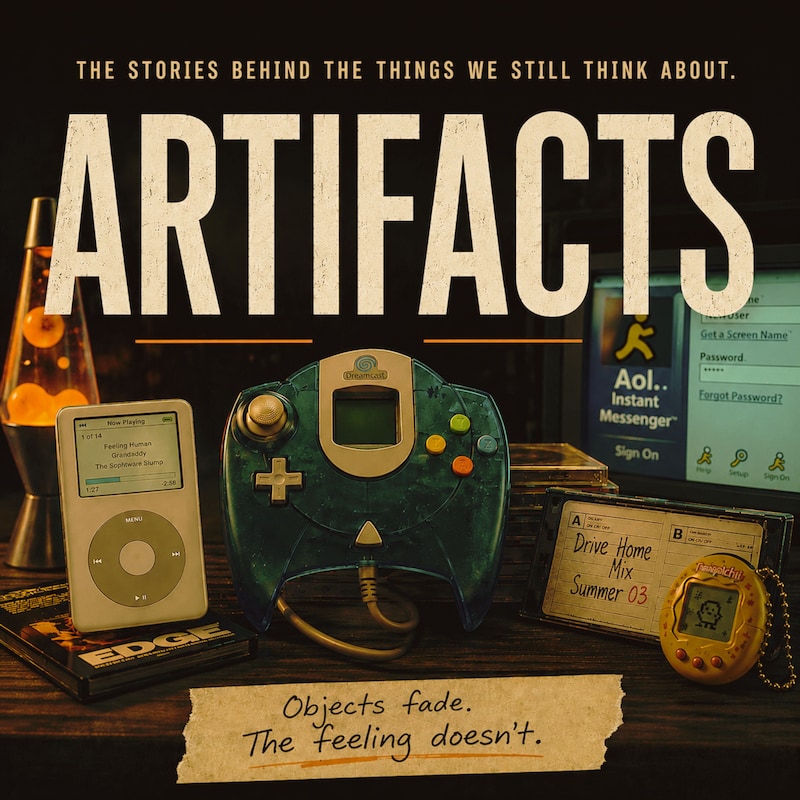
Speaker:
00:00:00
Before we begin, a quick thank you to Matt Cundill, right here in Canada,
Speaker:
00:00:04
for his recent Apple Podcast review of Artifacts.
Speaker:
00:00:07
Matt wrote, What I appreciate most is that it isn't just nostalgia for nostalgia's
Speaker:
00:00:12
sake, Artifacts will make you smile, think and probably say, I had one of those.
Speaker:
00:00:17
Thanks for your kind words Matt, and thanks for helping keep the archive alive.
Speaker:
00:00:22
Waiting in line is terrible. Nobody enjoys standing outside a store at 11.30 at night.
Speaker:
00:00:28
Nobody enjoys cold weather or sore feet. Or the realisation that somebody ahead
Speaker:
00:00:32
of you brought a folding chair and clearly understands life better than you do.
Speaker:
00:00:37
And yet, people miss midnight launches. A lot.
Speaker:
00:00:41
Not because the waiting was fun, but because the anticipation used to be something
Speaker:
00:00:45
we shared. And that's becoming increasingly rare.
Speaker:
00:00:48
Because midnight launches were never really about buying things.
Speaker:
00:00:51
They were more about belonging to a moment.
Speaker:
00:00:54
Before digital downloads, Launch day actually meant something.
Speaker:
00:00:58
You couldn't preload. You couldn't stream it instantly. You couldn't wake up
Speaker:
00:01:03
and find it already waiting on your hard drive.
Speaker:
00:01:06
If you wanted a new game, movie, console or album, you waited.
Speaker:
00:01:11
And sometimes that waiting became an event.
Speaker:
00:01:13
People lined up outside game stores, electronics retailers, shopping malls and movie theatres.
Speaker:
00:01:20
Hours and hours before midnight, sometimes longer.
Speaker:
00:01:24
Not because we had to, but because we wanted to. Because everybody in that line
Speaker:
00:01:29
already had one thing in common. Excitement.
Speaker:
00:01:33
You didn't need introductions, you just started talking. What are you playing
Speaker:
00:01:37
first? What are you hoping for?
Speaker:
00:01:40
What do you think happens next? And strangers became temporary communities.
Speaker:
00:01:45
One thing more than convenience quietly removed is anticipation.
Speaker:
00:01:49
And anticipation matters.
Speaker:
00:01:51
Psychologists have studied this for years. Often, the excitement before an event
Speaker:
00:01:56
creates as much happiness as the event itself, sometimes more.
Speaker:
00:02:00
Midnight launches stretched anticipation into a shared experience.
Speaker:
00:02:04
The wait became part of the story.
Speaker:
00:02:07
And years later, people rarely remember the transaction. but they do remember
Speaker:
00:02:12
the crowd, the conversations, the countdown and the energy.
Speaker:
00:02:17
The memory wasn't the purchase, it was the atmosphere.
Speaker:
00:02:21
Today we get things instantly and that's wonderful, mostly, but instant access
Speaker:
00:02:26
changes emotional pacing.
Speaker:
00:02:29
Everything arrives immediately, which means fewer moments feel special.
Speaker:
00:02:33
Midnight launches, on the other hand, forced everybody into the same timeline,
Speaker:
00:02:38
so everybody experienced release together.
Speaker:
00:02:41
That collective excitement created cultural moments. You remember hearing cheers
Speaker:
00:02:45
when the doors opened, or seeing complete strangers counting down the final
Speaker:
00:02:49
seconds, or someone holding up their new console or game like they'd just won a championship.
Speaker:
00:02:55
Now the product mattered, of course it did, but the experience mattered too, and maybe even more.
Speaker:
00:03:02
Because anticipation transforms ordinary purchases into stories,
Speaker:
00:03:06
and stories are what people remember.
Speaker:
00:03:09
Today, our entertainment is increasingly personalised. Algorithms recommend
Speaker:
00:03:13
different things to different people.
Speaker:
00:03:16
We stream different shows, listen to different playlists, follow different creators.
Speaker:
00:03:22
And while that's incredibly convenient, it also means we experience fewer things together.
Speaker:
00:03:27
Midnight launches, though, they were collective experiences.
Speaker:
00:03:31
Everybody was excited about the same thing at the same time.
Speaker:
00:03:35
For a few hours, it felt like you were part of something bigger than yourself.
Speaker:
00:03:38
Not a fandom, not a customer base, but a moment. And moments like that stick with people.
Speaker:
00:03:45
Because humans are wired for shared experiences. The line outside the store
Speaker:
00:03:50
wasn't really about what you were buying.
Speaker:
00:03:52
It was about the people standing beside you.
Speaker:
00:03:55
The conversations, the excitement, the feeling that everyone there understood
Speaker:
00:04:00
exactly why you were willing to stay up until midnight or later for something
Speaker:
00:04:04
that would still be available the next morning. Normally.
Speaker:
00:04:08
And maybe that's the thing people miss, not the waiting, not the inconvenience,
Speaker:
00:04:13
not even the product itself, but the feeling that anticipation could bring people together.
Speaker:
00:04:19
So sure, midnight launches were inconvenient, inefficient, probably completely unnecessary.
Speaker:
00:04:27
And yet somehow they were memorable. Because some experiences become meaningful
Speaker:
00:04:32
precisely because they ask something from us.
Speaker:
00:04:35
Time, patience, presence And maybe that's why people still talk about them years
Speaker:
00:04:41
later Not because of what they bought, but because of how it felt to wait together,
Speaker:
00:04:47
Because sometimes what we're really nostalgic for isn't the thing itself It's
Speaker:
00:04:52
the people we shared it with,
Speaker:
00:04:54
I'm Danny Brown and this is Artifacts.