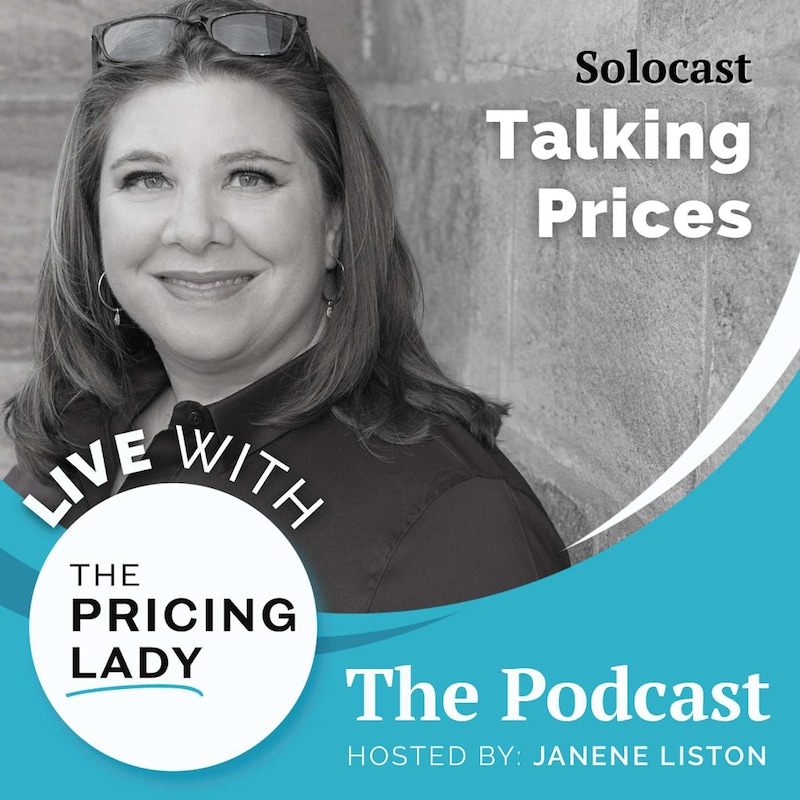
Artwork for podcast The Pricing Lady
Why Is It So Hard to Tell Customers What You Charge
Episode 1020th May 2024 • The Pricing Lady • Janene Liston
00:00:00 00:18:34

Share Episode

Transcripts

Speaker:

Welcome to Live With The Pricing Lady.

Speaker:

I'm Janene, your hostess.

Speaker:

This show is all about helping you build a sustainably profitable

Speaker:

business while making an unbelievable impact on your world.

Speaker:

Learn from my 20 years of experience and from my guests as we discuss their pricing

Speaker:

challenges, failures, and successes.

Speaker:

Pricing is a way of being or behaving in your business.

Speaker:

My mission is to help you confidently charge for the value you deliver.

Speaker:

Pricing is either hurting or helping your business.

Speaker:

Let's make sure it's helping you reach your dreams.

Speaker:

In this episode of Live with The Pricing Lady, we're talking about why you struggle

Speaker:

to tell your clients what you charge.

Speaker:

Sit back, relax and enjoy the episode.

Speaker:

Today, we're here to talk about pricing.

Speaker:

As usual when it comes to me, we're talking about pricing.

Speaker:

Specifically, we're here to talk about why you struggle to tell

Speaker:

people the Price of Your Offer.

Speaker:

I'm assuming if you're here, it's something that you've

Speaker:

struggled with yourself.

Speaker:

Let me paint a scenario.

Speaker:

You're talking to a client or a prospect.

Speaker:

The conversation is going really well.

Speaker:

It's flowing nicely.

Speaker:

You can tell them what you do and talk about your offer and the benefits of it.

Speaker:

But there's a point in that conversation where you start

Speaker:

to get a little bit nervous.

Speaker:

Maybe you start to lose your focus on the conversation because you know, at some

Speaker:

point you're going to have to talk about the price and it doesn't feel good to you.

Speaker:

It makes you nervous.

Speaker:

Maybe you feel a little bit constricted in your chest or your

Speaker:

breathing tightens, or maybe you feel a little Ill in your stomach.

Speaker:

And then it comes to that point where you have to say the price

Speaker:

and either you freeze or you stumble or you say something.

Speaker:

You didn't mean to say.

Speaker:

And the question is, does that sound familiar to you?

Speaker:

I, I know I've struggled with that at times, even being The Pricing

Speaker:

Lady, yes, there are always clients who want something bigger and

Speaker:

something that I haven't done before.

Speaker:

Of course I've been faced with that myself.

Speaker:

And for me, I can fall back on My skills and competence in the area of pricing.

Speaker:

But for a lot of people, they haven't built and nurtured those skills yet.

Speaker:

For most people, what they understand about pricing is from

Speaker:

what they know, being a consumer.

Speaker:

And in the retail industry, specifically, there's lots of sales

Speaker:

and things going on, and there's not a whole lot of conversation.

Speaker:

You don't really learn the skills and tactics of pricing for your type of

Speaker:

business, but you also don't necessarily learn how to have those conversations.

Speaker:

That's part of what I want to talk to you about today.

Speaker:

The first part is going to be about why we Get So Nervous.

Speaker:

Then we're going to talk about what you can do with it because I want to make

Speaker:

sure you leave here with some tips.

Speaker:

Let's take a look at why we get so nervous or why do we freeze when this happens?

Speaker:

One of the main reasons that people freeze is because they fear rejection.

Speaker:

We've already decided in our mind that this person has to be a customer.

Speaker:

This person has to buy something and oftentimes we don't even

Speaker:

know anything about them enough yet to really make the decision.

Speaker:

It's like when we go into a job interview thinking, We have to have

Speaker:

that job, but we actually don't know anything more than what they've

Speaker:

written on a page of paper, right?

Speaker:

Or a website page, or when we date someone, we see someone across the room

Speaker:

who's interesting, we start talking to them and we've already like gone 20 years

Speaker:

ahead when we're old and retired, we assume that that's the person that we want

Speaker:

without knowing anything more about them.

Speaker:

And so we put all this power and onus on the other person, and then we get afraid.

Speaker:

They're going to reject us.

Speaker:

That's one of the main reasons that people freeze when it

Speaker:

comes to talking about pricing.

Speaker:

Is they're afraid of that rejection.

Speaker:

Along with that comes a fear of being perceived as greedy.

Speaker:

This is especially true for women.

Speaker:

They tend to think that if they have too high a price, that everybody else will

Speaker:

think they're greedy and then they want to go hide somewhere and not be seen.

Speaker:

So there's also an element of that.

Speaker:

Oftentimes the fear also will come from not really understanding why

Speaker:

you have the price you have or not feeling confident about that price.

Speaker:

If somebody just told you, well, you should charge 2,999

Speaker:

for that, and you did it.

Speaker:

You actually don't know anything more than that person told you that.

Speaker:

You don't know why that price is right for your business.

Speaker:

You don't know why that price is right for your customers, or

Speaker:

even if it is in either case.

Speaker:

So how can you feel confident about telling someone what you

Speaker:

charge when you don't even really understand the why behind that price?

Speaker:

It's almost impossible to feel that confidence.

Speaker:

It could also be that you're not really certain about the value.

Speaker:

Or how to communicate that value.

Speaker:

So sometimes it's just a matter of you being better at

Speaker:

communicating it, but other times you don't really understand it.

Speaker:

And one of the key elements here, when we're talking about value is understanding

Speaker:

the difference between benefits.

Speaker:

of let's say functions or features or benefits of coaching and the value.

Speaker:

Benefits are not value.

Speaker:

Benefits actually are the step before value.

Speaker:

So let me explain.

Speaker:

Your mobile phone has lots of functions and features on it, lots

Speaker:

of functionality on it, right?

Speaker:

And they have lots of benefits, but not all of those

Speaker:

benefits are important to you.

Speaker:

So they're not of value to you.

Speaker:

It's the same with any other offer.

Speaker:

You know, somebody could say, well, buy this from me.

Speaker:

I'll get you quicker results.

Speaker:

Maybe I don't want quicker results.

Speaker:

Being able to understand the value, but also communicate it effectively is

Speaker:

also a reason that people feel nervous about telling people what they charge.

Speaker:

There's two other things I'd like to mention in this.

Speaker:

One is personal hangups around money, success, and worthiness.

Speaker:

So that is another big reason.

Speaker:

It's a little bit harder to, let's say, it takes a lot of work to be able

Speaker:

to deal with some of those things.

Speaker:

But when it comes to pricing, if you have the competence to know how to set

Speaker:

your prices and how to communicate the value, you'll feel more confidence.

Speaker:

Your money hangups might still influence you, but they won't influence you as much.

Speaker:

If you've built that competence because you'll have more confidence already.

Speaker:

While working on say money hangups is a, let's say a longer

Speaker:

game, it takes more time to work your way through those things.

Speaker:

You can counter that by understanding how to go about set prices so that you

Speaker:

understand why those prices as well as understanding how to communicate value.

Speaker:

And the last reason why you might struggle is due to simply lack of training when it

Speaker:

comes to how to handle sales discussions.

Speaker:

Now, most of us, a lot of women especially, don't like

Speaker:

even talking about sales.

Speaker:

Sales discussions, because it sounds icky.

Speaker:

I know for me, for a lot of years, I had this image of a sleazy salesman with

Speaker:

greasy hair and his shirt unbuttoned down to his navel, you know, trying

Speaker:

to wheel and deal me something.

Speaker:

Sales doesn't have to be like that.

Speaker:

But if you don't have a process for how you're going to have that discussion,

Speaker:

then of course, It's difficult for you to navigate and you'll feel that uncertainty.

Speaker:

That is another reason why you might be stumbling.

Speaker:

If those are different reasons, why what's helpful for you to do is try

Speaker:

to think about, okay, which of those resonates with me the most, because

Speaker:

then you can understand where to start doing something differently.

Speaker:

Let's talk about some of the things that you can do.

Speaker:

The first thing is when you're having, let's say that conversation with a

Speaker:

potential client, your focus should be on the higher purpose of not selling

Speaker:

them something, but on finding a solution that works for both of you.

Speaker:

And sometimes the best solution for a potential client is to say, Hey,

Speaker:

working with me or buying my product, isn't the right thing for you right

Speaker:

now, but maybe I can recommend this.

Speaker:

By doing that, you take some of the pressure off.

Speaker:

If you're just focused on, I have to close the deal, I have to close

Speaker:

the deal, I have to close the deal.

Speaker:

You put so much pressure on yourself and the potential client that it builds

Speaker:

that nervousness that you're feeling.

Speaker:

Second, the way that you structure the conversation.

Speaker:

A lot of times, what I try to do when I have these conversations with

Speaker:

potential clients is I structure the conversation so that they ask me, how

Speaker:

much I charge, rather than me having to just say it in the conversation.

Speaker:

I feel by leading them towards asking me, they give me permission to say that.

Speaker:

And that takes a little bit of the edge off.

Speaker:

For some other people, they find it easier to talk about

Speaker:

the investment upfront, first.

Speaker:

Weed people out earlier.

Speaker:

You need to structure your discussions in a way that works most effectively

Speaker:

for you and for the types of clients or customers that you'll be working with.

Speaker:

Another one is to understand why you're charging that price.

Speaker:

So a lot of times I will meet with people and I'll ask them,

Speaker:

okay, what do you charge for that?

Speaker:

And they say, Oh, I charge, you know, 2000 francs or 2, 000.

Speaker:

Okay.

Speaker:

So why 2, 000?

Speaker:

And then they go,

Speaker:

especially if they're service based businesses, they usually

Speaker:

go, well, everybody else was charging, between 2000 and 3000.

Speaker:

So I thought I'd charge 10 percent less because I'm new.

Speaker:

But you don't know if those other businesses that you compare to are

Speaker:

successful or how successful, or if they're offering the same thing

Speaker:

or something different, right?

Speaker:

So you have to be careful about what you base your prices on because

Speaker:

that can influence how confident you feel about saying the price.

Speaker:

It's really important to build that competence of knowing how to choose

Speaker:

or how to define the right prices for your business so that you have the

Speaker:

confidence to be able to communicate it.

Speaker:

Practice.

Speaker:

This is a highly underused tactic in pricing, let's say, is to

Speaker:

simply practice saying it out loud.

Speaker:

Sit down with a trusted friend and say, ask me what I charge for this offer

Speaker:

until I can say it, without laughing or without stumbling or without cringing

Speaker:

or you know whatever it is that you do.

Speaker:

And to say you know repeat it to me ask me what I charge.

Speaker:

Ask me what I charge and you repeat and you go back and forth and then there's a

Speaker:

point where you start to feel comfortable and it's really good then for the other

Speaker:

person to then change the conversation.

Speaker:

By the time you get comfortable, you might change the response to,

Speaker:

wow, that's really expensive without telling you they're going to do it.

Speaker:

Yeah.

Speaker:

Or when they're going to do it and it throws you off your game.

Speaker:

And then you practice the conversation up to that point

Speaker:

until it feels comfortable for you.

Speaker:

That practice can really help you.

Speaker:

The last thing I want to share is you want to know how you're going to handle the no.

Speaker:

I have a whole guide online that you can purchase about handling pricing

Speaker:

objections, but one of the things that I want to share with you today

Speaker:

is most people don't think about how they're going to handle that.

Speaker:

So they leave it up to chance.

Speaker:

When somebody gives them the feedback that's too expensive or that's not right

Speaker:

for me right now, they go into panic mode.

Speaker:

Some people will throw out discounts.

Speaker:

Some people will try to, list all the reasons the person should buy.

Speaker:

Their argumentations on why you should buy.

Speaker:

And my best piece of advice here for one of the first things actually you

Speaker:

should do, take a deep breath and then ask them oh, why do you say that?

Speaker:

Because then you put the responsibility on them to explain to you where

Speaker:

that's coming from so that you can understand what's really behind the no.

Speaker:

Now that's just one part of what I talk about in the guide, but it

Speaker:

is a very important part because usually people feel like they have to

Speaker:

leap into action to counter the no.

Speaker:

And I'm actually, Saying no, get curious about the no, and plan for that.

Speaker:

Practice that as well, because it's probably not in your instinct right now.

Speaker:

When someone does reject you and you will get those from time to time, it's probably

Speaker:

not your first instinct to lean in and be curious about why they're saying no.

Speaker:

But it's actually a much better response, both for them and for you.

Speaker:

So those are first, the reasons why we get nervous.

Speaker:

And second, some of the tips about what you can do about it.

Speaker:

I left one off here because I actually mentioned it when I talked about

Speaker:

why you get nervous, but let me just quickly mention that if you have Blocks

Speaker:

around money, success, and worthiness.

Speaker:

Of course, you want to work on identifying those so that you can do it differently.

Speaker:

And an example I can give you as a client I had in the very early

Speaker:

stages of my business, we were doing an exercise where I asked

Speaker:

them to complete a bunch of prompts.

Speaker:

And one of the prompts was pricing is.

Speaker:

Later during the sharing, open sharing part of the conversation,

Speaker:

he shared with us, quite, quite embarrassed, but he did it anyhow.

Speaker:

He said, well, I wrote pricing is something I avoid.

Speaker:

And in his business, he had to have conversations with customers.

Speaker:

before they purchased anything, but he did everything in his power not to talk

Speaker:

about what he charged his customers.

Speaker:

You can imagine how his blocks around money and actually for him it was, had

Speaker:

a lot to do with worthiness, hindered his ability to even close a deal

Speaker:

because he wasn't even really willing to talk to people about the price.

Speaker:

He went on a path of working through that so that he got more

Speaker:

comfortable with pricing itself and having those conversations as well.

Speaker:

That is what I wanted to share with you about why you might be struggling to

Speaker:

talk about pricing with your customers.

Speaker:

As you can imagine, there's a lot more to cover in this topic, but my goal

Speaker:

for this episode was to do two things.

Speaker:

First of all, to help you understand why you might be

Speaker:

freezing up or struggling with.

Speaker:

Telling customers what to charge, because once you can identify

Speaker:

why you struggle so much.

Speaker:

Then you know what to do to start correcting it.

Speaker:

And I gave you a list of quite a few things, but they may not all apply to you.

Speaker:

So take a look at that list and really think about what

Speaker:

it is that's going on for you.

Speaker:

And the second thing I wanted to achieve with this episode is I wanted to give you

Speaker:

some ideas of some of the actions that you can take to start feeling more confident

Speaker:

when it comes to having those discussions.

Speaker:

I hope you've enjoyed this episode.

Speaker:

We'll put a link to the guide in the show notes as well.

Speaker:

So if you want to look more at how to handle pricing objectives more

Speaker:

confidently, then you can grab yourself a copy of that as well.

Speaker:

Have a great day and as always enjoy pricing everyone.

Speaker:

Thank you for listening to this episode of Live with The Pricing Lady, the podcast.

Speaker:

If you enjoyed the episode, rate, review, and subscribe to it, then share

Speaker:

it with your friends and colleagues.

Speaker:

I love hearing back from you listeners.

Speaker:

If you've got comments, questions, or topic ideas, go on over to thepricinglady.

Speaker:

com and contact me there.

Speaker:

Not sure where to start when it comes to improving pricing and profits?

Speaker:

At ThePricingLady.

Speaker:

com you can download a copy of my Self Assessment Pricing Scorecard.

Speaker:

Find out where it's going well and where you can begin improving.

Speaker:

Or just simply book a discovery call with me.

Speaker:

There we can discuss what's up with pricing in your business and

Speaker:

how I might be able to help you.

Speaker:

Thanks once again for joining.

Speaker:

Remember, pricing can hurt or help your business.

Speaker:

Let's make sure it's helping you reach your dreams.

Speaker:

See you next time and as always, enjoy pricing.

Follow

Links

Chapters

Video

More from YouTube