Shownotes
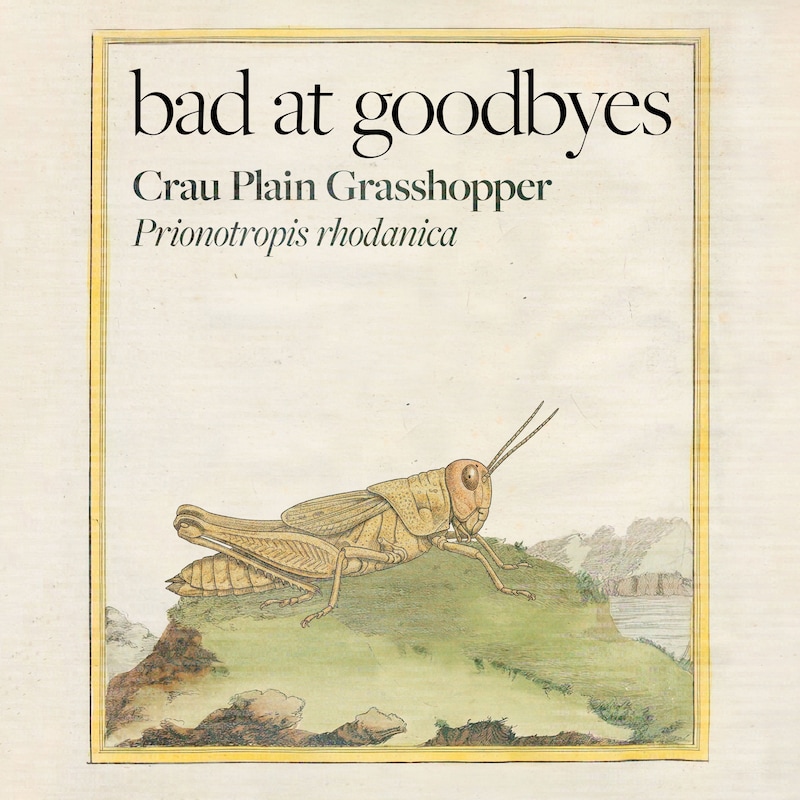
Crau Plain Grasshopper :: Prionotropis rhodanica
Bad at Goodbyes :: Episode 079
On today’s show we learn about the Crau Plain Grasshopper, a critically endangered insect native to Western Europe, to the south of France, in the Provence region, in the Bouches-du-Rhone department, specifically found in the dry grasslands of the Crau Plain. Its scientific name is Prionotropis rhodanica, and it was first described in 1923.
For more information about conservation on the Crau Plain please see Conservatoire d'espaces naturels de Provence-Alpes-Côte d'Azur at https://cen-paca.org.
- (00:05) Intro
- (02:05) Species Information
- (21:37) Citations
- (23:47) Music
- (28:51) Pledge
Research for today’s show was compiled from:
- Bröder, Linda, Laurent Tatin, Anja Danielczak, Tobias Seibel, and Axel Hochkirch. 2019. "Intensive Grazing as a Threat in Protected Areas: The Need for Adaptive Management to Protect the Critically Endangered Crau Plain Grasshopper Prionotropis rhodanica." Oryx 53 (2): 239–246. – https://doi.org/10.1017/S0030605318000170
- Bröder, Linda, Laurent Tatin, Axel Hochkirch, Anja Schuld, Linda Pabst, and Aurélien Besnard. 2020. "Optimization of Capture–Recapture Monitoring of Elusive Species Illustrated with a Threatened Grasshopper." Conservation Biology 34 (3): 743–753. – https://doi.org/10.1111/cobi.13449
- Bröder, Linda, Laurent Tatin, and Axel Hochkirch. 2023. "Quantifying Predation to Insects: An Experimental Approach." Global Ecology and Conservation 44: e02485. – https://doi.org/10.1016/j.gecco.2023.e02485
- Ecomuseum of the Crau. n.d. "The Crau Plain Grasshopper." Life SOS Criquet de Crau. Accessed May 18, 2026. – https://www.lifecriquetdecrau.com/en/le-criquet-de-crau/lespece/
- Foucart, Antoine, and Michel Lecoq. 1996. "Biologie et dynamique des populations de Prionotropis hystrix rhodanica Uvarov, 1923 dans la plaine de la Crau (France) (Orthoptera, Pamphagidae)." Bulletin de la Société entomologique de France 101 (1): 75–87. – https://doi.org/10.3406/bsef.1996.17220
- Foucart, Antoine, and Michel Lecoq. 1998. "Major Threats to a Protected Grasshopper, Prionotropis hystrix rhodanica (Orthoptera, Pamphagidae, Akicerinae), Endemic to Southern France." Journal of Insect Conservation 2 (3): 187–193. – https://doi.org/10.1023/A:1009691612698
- Foucart, Antoine, Michel Lecoq, and R. Sieglstetter. 1999. "Alarm on an Endemic Protected Grasshopper of the Crau Plain (Southern France), Prionotropis hystrix rhodanica (Orthoptera: Pamphagidae)." Annales de la Société Entomologique de France 35 (3-4): 337–340. – https://www.researchgate.net/publication/291864068_Alarm_on_an_endemic_protected_grasshopper_of_the_Crau_plain_Southern_France_Prionotropis_hystrix_rhodanica_Orthoptera_Pamphagidae
- Hochkirch, Axel, Laurent Tatin, and Mark Stanley Price. 2015. Crau Plain Grasshopper Conservation Strategy. Technical Report. IUCN SSC Grasshopper Specialist Group. – https://doi.org/10.13140/RG.2.1.3933.3925
- Hochkirch, A. & Tatin, L. 2016. Prionotropis rhodanica. The IUCN Red List of Threatened Species 2016: e.T15038481A47713628. – https://dx.doi.org/10.2305/IUCN.UK.2016-3.RLTS.T15038481A47713628.en
- iNaturalist - https://www.inaturalist.org/observations?captive=false&nelat=43.60771507014928&nelng=4.966360194513175&quality_grade=research&subview=map&swlat=43.499515082721146&swlng=4.812502979314948&view=species
- Piry, Sylvain, Karine Berthier, Laurence Streiff, Stephane Cros-Arteil, Antoine Foucart, Laurent Tatin, Linda Bröder, Axel Hochkirch, and Marie-Pierre Chapuis. 2018. "Fine-Scale Interactions Between Habitat Quality and Genetic Variation Suggest an Impact of Grazing on the Critically Endangered Crau Plain Grasshopper (Pamphagidae: Prionotropis rhodanica)." Journal of Orthoptera Research 27 (1): 61–73. – https://doi.org/10.3897/jor.27.15036
- Streiff, R., P. Audiot, Antoine Foucart, and Michel Lecoq. 2006. "Genetic Survey of Two Endangered Grasshopper Subspecies, Prionotropis hystrix rhodanica and Prionotropis hystrix azami (Orthoptera, Pamphagidae): Within- and Between-Population Dynamics at the Regional Scale." Conservation Genetics 7 (3): 331–344. – https://doi.org/10.1007/s10592-005-9043-3
- Tatin, Laurent, Raphaël Streiff, Antoine Foucart, and Gilles Besnard. 2013. "Chapitre 6: Présentation de l'espèce: Le criquet rhodanien." In Écologie et conservation d'une steppe méditerranéenne: la plaine de Crau, edited by Laurent Tatin, Axel Wolff, Jean Boutin, Etienne Colliot, and Thierry Dutoit, 93–102. Versailles: Éditions Quae. – https://www.researchgate.net/publication/326389866_Le_criquet_rhodanien
- Wikipedia - https://en.wikipedia.org/wiki/Bouches-du-Rhône
Please find us on the web at Bad at Goodbyes and on instagram. Please subscribe and rate/review Bad at Goodbyes wherever you listen to podcasts. Please help spread the word about the show and about the species we feature. Please take care of each other, and all of our fellow travelers.
A note on accuracy: I strive for it! These episodes are well-researched and built from scholarly sources, hoping to provide an informed and accurate portrait of these species. That said, I’m a musician! I am not an academic and have limited scientific background. I may get things wrong! If you are using this podcast for scholarship of any kind, please see the cited sources and double-check all information.
Transcripts
Welcome to Bad at Goodbyes.
On today’s show we consider the Crau Plain Grasshopper.
Species Information:The Crau Plain Grasshopper is a critically endangered insect native to Western Europe, to the south of France, in the Provence region, in the Bouches-du-Rhone department, specifically found in the dry grasslands of the Crau Plain. Its scientific name is Prionotropis rhodanica, and it was first described in 1923.
Appearance
The Crau Plain Grasshopper is a large grasshopper with a stout body of roughly an inch and a half in length. They have a hard textured exoskeleton, that is a camouflaging blend of earth tones: browns, grays, and greens, often with darker markings and spots that mimic the texture and color of stones typical of their habitat.
The Crau Plain Grasshopper has a large, rounded head, with two compound eyes and two filiform antennae. Filiform means thread-like, so the grasshoppers' antennae are long, slender, cylindrical, tapering slightly from base to tip. They are a key sensory adaptation; antennae are the primary olfactory organ, detecting chemical molecules, smelling, for food sources, and the pheromones of potential mates. The antennae are also used for mechanoreception, that is sensing touch and vibration; they can detect changes in air currents (alerting them to predators), and are used, not unlike say whiskers, to aid in navigation.
At the lower front of their large head are “mandibulate" mouthparts. Mandibles are a kind of small pincers, that protrude from the mouth that the grasshopper uses to grasp and tear off pieces of vegetation. The Crau Plain Grasshopper’s large head is large in part because it houses robust muscles to power the mandibles while feeding: to grip, grind, and crush the tough plant matter of their diet.
The Grasshopper has six legs attached to their stout thorax. They have particularly powerful hindlegs adapted for jumping. The fore and mid-legs are more slender and shorter, used for balance, walking, climbing, and feeding. They have short underdeveloped vestigial wings. They are incapable of flight, and rely on climbing, jumping and terrestrial locomotion, that is walking on the ground.
They are markedly sedentary. In zoology, the term sedentary specifically refers to species that remain in a limited area, and exhibit minimal movement beyond their local environment. So this is different from our common use of sedentary to mean like lazy or inactive. Instead we're describing how a species does not travel far from their initial locale.
In the case of the Crau Plain Grasshopper, a capture study found that the farthest a grasshopper traveled across their entire life, from their birthplace, was roughly 150 feet.
Their day-to-day is focused on feeding, thermoregulation, and predator avoidance.
The Crau Plain Grasshopper is a generalist herbivore, meaning they eat plants and are not picky about which, feeding on a variety of available vegetation: Clover, Spurge, Southern Daisy, Dandelions, and various grasses, herbs, shrubs of their plains habitat.
They are ectothermic, cold blooded, relying on external heat sources to regulate their body temperature; basking in the sun to warm up and seeking shade to cool down.
The Crau Plain Grasshopper mainly relies on their camouflaging coloration to avoid predators, remaining extremely still when detected, though when directly threatened, their strong hindlimbs allow for evasive jumps. The grasshoppers' primary predators are insectivorous avians, insect eating birds, like the lesser kestrel, cattle egret, and rook.
In areas of abundant food, the Crau Plain Grasshopper will sometimes gather in groups but otherwise they are generally solitary, only interacting to mate. Mating occurs in the late spring: May, June, July. The Grasshoppers do not form long term pair bonds, only coming together to copulate after which the male may pursue additional mating opportunities with other female. After successful mating, the female will burrow a small shallow hole in the soil, using her ovipositor. The ovipositor is a tube-like structure on the tip of a female grasshopper's abdomen with two pairs of shovel-shaped valves that open and close to dig a chamber in the ground for the eggs. She lays a clutch of about 16 small eggs, each about the size of a grain of rice.
The eggs gestate underground for about 10 months, with the new nymphs hatching in early April of the following year. There is no parental care; the nymphs are born able to survive on their own. They grow quickly, molting 5 times, reaching reproductive maturity in roughly 6-8 weeks. Adult Crau Plain Grasshopper live for about a month, during which they attempt to mate, reproducing just once annually before dying, this is called a univoltine lifecyle. So, they spend roughly 10 months as an egg in the ground, 2 months as a growing nymph, 1 month as a reproductive adult.
————
In the dream,
as is true in waking life,
I live in a tower, closer to cloud than soil,
and in the dream, as is also true in life,
I long to be more near the earth.
A small breathing stone in a field of stones,
to be earthbound, to be intimate to dirt.
To be still with dust and rock and scrub,
bonded with the depths, not the skies.
To wander a windswept plain
and know its breath in my body like an old song,
A song I’ve heard my whole life.
That I sometimes sing too.
In the dream.
————
The Crau Plain Grasshopper is native to the south of France, to the Coussouls de Crau, the Crau plain, roughly 30 miles northwest of Marseille and 10 miles from the Mediterranean coast, in the Bouches-du-Rhone department. They survive in three distinct isolated subpopulations, all within a roughly 15 square mile area.
y of the Rhone River. Roughly:The climate ranges widely. Summer high temps reach into the 90s°F and winter lows can dip below freezing and the region only sees about 20 inches of rainfall per year, most of which occurs in autumn and winter; the summer months are hot and very dry.
The Crau Plain Grasshopper shares its plain with:
Sweet Alyssum, Common Thyme, Pin-tailed Sandgrouse, Western Marsh Harrier, Great Egret, Star Clover, European Turtle-Dove, Northern Wheatear, European Rabbit, Rook, Purple Loosestrife, Viperine Snake, Common Crane, Mossy Stonecrop, Puncture Vine, Black Stork, Onion-Leafed Asphodel, Meadow Pipit, French Flax, Barn Swallow, Ocellated Lizard, Rough Poppy, Eurasian Kestrel, Mountain Rue, Bittersweet Nightshade, Common Swift, Common Mallow, Eurasian Linnet, Moth Vine, Reed Bunting, Pygmy Cudweed and many many more.
Historically, the Crau Plain Grasshopper population has been severely impacted by human habitat destruction. Large swaths of the plain have been developed for agriculture, highway infrastructure, military and industrial use. In the 20th and early 21st century, the Crau Plain Grasshopper population was estimated to have been reduced by 70% due to habitat loss.
reatens the species. For over:Human induced climate change, due to the persistent overreliance on fossil fuel, is already affecting the Crau Plain Grasshopper population. During the last roughly ten years there were two summers of extensive (longer than normal) drought and one particularly cold winter; all of which impacts the Grasshopper's reproductive success.
Conservation
Fortunately roughly three-quarters of the Crau Plain Grasshopper’s habitat is protected in the Réserve Naturelle des Coussouls de Crau. A broad partnership has been established between the reserve, the regional government, the Ecomuseum of the Crau, the Conservatoire d'espaces naturels de Provence-Alpes-Côte d'Azur, and other local orgs. They are taking a wide-spread approach to conserving the Crau Plain Grasshopper: they've initiated education programs, installed fencing to prevent overgrazing, and instituted a grazing management program that includes economic compensation for shepherds.
They've undertaken predator monitoring studies and developed experiments with overhead fencing, to keep birds from the Grasshopper's mating sites. The program is also exploring predator translocation; moving specifically the Lesser Kestrel to other parts of the Crau Plain.
ce. Those programs, in spring: ed on the IUCN Red List since: imates suggest that less than: Citations:Information for today’s show about the Crau Plain Grasshopper was compiled from:
Oryx 53 (2), Conservation Biology 34 (3), Global Ecology and Conservation 44, Ecomuseum of the Crau, Bulletin de la Société entomologique de France 101 (1), Journal of Insect Conservation 2 (3), Annales de la Société Entomologique de France 35 (3-4), IUCN SSC Grasshopper Specialist Group, IUCN, iNaturalist, Journal of Orthoptera Research 27 (1), Conservation Genetics 7 (3), Écologie et conservation d'une steppe méditerranéenne, Wikipedia
For more information about conservation on the Crau Plain please see Conservatoire d'espaces naturels de Provence-Alpes-Côte d'Azur at cen-paca.org
Music: Pledge:I honor the lives of all Crau Plain Grasshopper. I will commit their name to my record. I am grateful to have shared time on our planet with this being. I lament the ways in which I and my species have harmed and diminished this species. I grieve.
And so, in the name of the Crau Plain Grasshopper I pledge to reduce my consumption. And my carbon footprint. And curb my wastefulness. I pledge to acknowledge and attempt to address the costs of my actions and inactions. And I pledge to resist the harm of plant and animal kin and their habitat, by individuals, corporations, and governments.
I forever pledge my song to the witness and memory of all life, to a broad celebration of biodiversity, and to the total liberation of all beings.




