Shownotes
Why did God give the Ten Commandments?
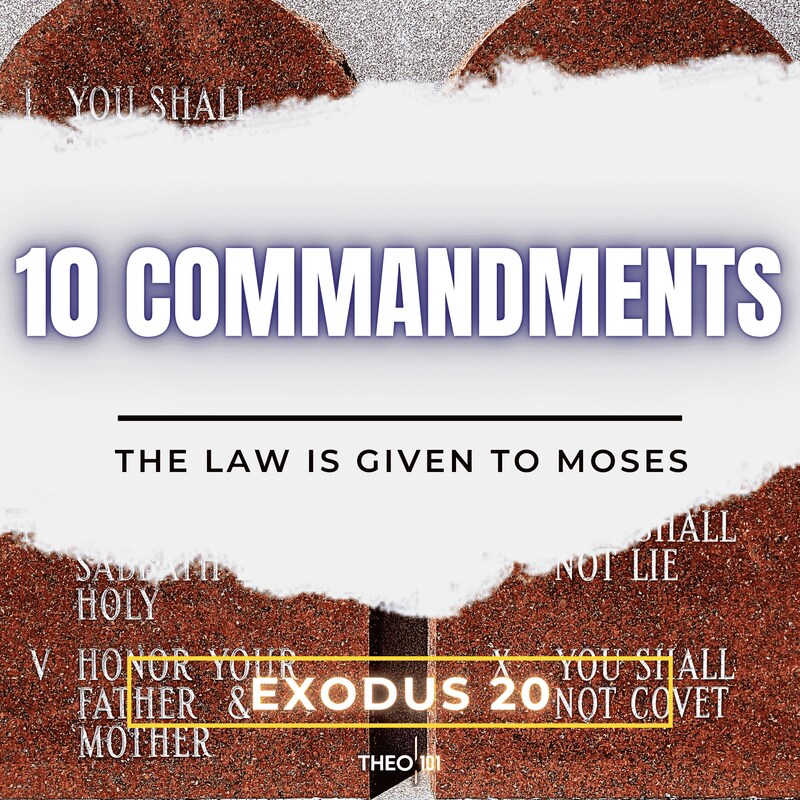
In Exodus 20, God speaks the Ten Commandments aloud from Mount Sinai. Dr. Toby Holt explains the purpose of God's law — and why it cannot save us. The first commandments govern our relationship to God, the rest our relationship to one another; Jesus summed them up as loving God and loving neighbor. Sin is a matter of the heart, not just outward acts — so all of us have broken God's law. The law teaches and convicts but cannot save; it drives us to a Mediator. The frightened people begged for Moses to stand between them and God — but we need a better Mediator, Jesus.
Questions this study answers:
1. How are the commandments divided? The first four concern our relationship with God, the last six our relationship with others. Jesus summarized them as loving God and loving neighbor.
2. Can keeping the commandments save us? No. The law reveals our sin but cannot remove it. It shows our need for a Savior.
3. What hope is there for lawbreakers? A better Mediator — Jesus. Where the law condemns, Christ stands between us and God's judgment.
"You shall have no other gods before Me." — Exodus 20:3 (NKJV)
Dr. Toby Holt is President of New Geneva Theological Seminary, and his sermons have been downloaded more than 1.9 million times on SermonAudio. Find more verse-by-verse Bible teaching at newgeneva.org; support this ministry at newgeneva.org/give.
Transcripts
In Exodus 20, while the people were gathered at the foot of the mountain, God spoke.
2
:Specifically, He gave them a set of laws that we refer to as the Ten Commandments.
3
:What were these commandments, and what was the people's reaction to them?
4
:That will be the focus of today's study.
5
:If you were to ask the average Christian to describe what happened at Sinai,
6
:what do you think they would say if they were to describe what happened from the moment the people
7
:left egypt and the red sea parted and they went through the wilderness and then they arrived at
8
:sinai how would they ascribe what happens from that point forward well most people most people
9
:summarize those events in this way they say this they say all right god's people were led by moses
10
:through the wilderness they arrived there at the mountain and once they got to the mountain
11
:Moses told the people to wait here and he put Aaron in charge and then he went up the mountain
12
:and when he got up the mountain he met with God and he was there a little bit too long for the
13
:people's taste 40 odd days and the people got restless and as they got restless they figured
14
:they got to worship something and so they worshipped what the gold calf they worshipped
15
:the gold calf and meanwhile while they're worshipping the gold calf Moses is up on the
16
:mountain he's meeting with God God's giving the commandments he's got the tablets of stone he
17
:comes down the mountain, and he hears a ruckus occurring in the camp. It sounds like partying,
18
:and in fact, when he comes down, it is a party. They're worshiping the gold idol. What does Moses
19
:do? He takes the tablets of stone. He throws them down. He throws down the Ten Commandments that
20
:were given him to give to the people. He breaks them, and then it's only later that he goes up
21
:and gets a second set, and at that point, the people get the Ten Commandments. Our understanding
22
:of how the Ten Commandments were conveyed from God to the people usually, usually in broad
23
:evangelical circles, looks something like that. And the reason why is because our theology
24
:throughout North American evangelical Christendom has been fueled more by Cecil B. DeMille
25
:than by the pages of Scripture. You see, what I just described, the events happened. Everything
26
:I just said happen in one way, shape, or form. The problem is the chronology. When the events
27
:happened and in what sequence. The chronology is quite a bit different. First of all, you have to
28
:know this. When Moses went up the mountain, he didn't go up just once or just twice to get the
29
:commandments at these different intervals. He went up the mountain seven different intervals. He was
30
:going up and down, up and down to talk with God at regular intervals. Mount Sinai was the original
31
:stairmaster. Moses was going up and down and up and down. He was really getting a workout talking
32
:with God. So that's the first thing you need to realize. There's a lot of intervals when he goes
33
:up and meets with God on the people's behalf. The second thing you need to realize is this.
34
:The Israelites didn't have to wait to weigh down the road to get the Ten Commandments. They didn't
35
:have to wait for Moses to go up, get the first set, break those, then go up, get the second set,
36
:and then deliver those.
37
:That's not how it worked.
38
:Rather, the people received the Ten Commandments
39
:from the very start.
40
:On the third day, they showed up.
41
:And they received the Ten Commandments
42
:not on tablets inscribed by the finger of God,
43
:although that would happen later.
44
:The first time they received the Ten Commandments,
45
:they received it by His voice.
46
:That's what we just read.
47
:That's what we just saw.
48
:The people of Mount Sinai,
49
:they're meeting with God.
50
:The fire has come down
51
:and it's charred the top of the mountain.
52
:There's lightning and thunder and trumpets
53
:and all these different things.
54
:And at the start of chapter 20,
55
:God speaks to the people.
56
:And the first time they encountered the Ten Commandments,
57
:they encounter it from the voice of God himself
58
:echoing and reverberating through the clouds.
59
:Let's hear what God told them.
60
:Let's revisit, starting with verses 1 and 2,
61
:and then again we'll work our way through.
62
:So chapter 20, verse 1.
63
:God spoke all these words.
64
:You see this?
65
:God spoke it.
66
:Not singularly just to Moses at some later date, but to the people.
67
:God spoke all these words, saying,
68
:I am the Lord your God, corporately, not just the God of Moses.
69
:I am the God of you, my people, who I've chosen and rescued out from Egypt.
70
:I am the Lord your God who brought you out of the land of Egypt, out of the house of bondage.
71
:So verse 1 begins with revelation.
72
:God spoke.
73
:The commandments we received were not commands we found somewhere or washed up on the beach.
74
:God revealed it.
75
:God spoke.
76
:See, at other intervals, when God has spoken, more regularly he's used prophets.
77
:More regularly he's used apostles.
78
:But in this time, he himself spoke to his people.
79
:Now, what should we infer from that?
80
:Well, a minimum, we should infer this.
81
:Whatever he said must be really important.
82
:If the clouds part, so to speak, or fire's burning a mountain and a voice comes from heaven,
83
:if a voice comes from heaven, the voice of God himself, then whatever is being said must be
84
:really important, must have a special magnitude, and I think that's true in this case. In this case,
85
:the magnitude is that God is giving a law, a covenant, a set of commands. Beyond that,
86
:he wanted them to know that the laws that they were being given emanated from the throne of
87
:heaven itself. You see, where we live in North American evangelical Christianity, we got a lot
88
:of laws that govern us. There's things in this church. There's polity of the church. There's
89
:things in our society. There's the laws that govern traffic. There's the laws that govern
90
:our taxes. There's laws all over the place. Now, the vast majority of the laws that we're under
91
:come from a human source, a human source that might be flawed, that might apply the laws
92
:inconsistently. But in this case, God is making clear through his own voice, these laws are mine.
93
:They come from me directly to you.
94
:This is an authoritative standard that is not derived by the opinion polls of men governing other men.
95
:But these are the laws of God on high governing the entirety of mankind.
96
:So that's what he's doing by speaking.
97
:Now, what is the first thing he does when he speaks?
98
:That's the reason why he speaks.
99
:But what does he say when he speaks?
100
:Well, first off, he identifies himself.
101
:He says, I'm the one who took you out of Egypt.
102
:I am the Lord your God who brought you out of the land of Egypt, out of the house of bondage.
103
:Now, that should have been obvious, right?
104
:Why did he have to say that?
105
:Well, here's the thing.
106
:Remember the context.
107
:At this time, the people had spent the bulk of their lives in a very polytheistic society,
108
:a polytheistic society in which there was all manner of different gods,
109
:and these gods had different jurisdictions.
110
:You could have the god of one region, the god of another region,
111
:god of the mountain, god of the field, god of the ocean, and the like.
112
:So as the people travel from one place to another and suddenly in this place in Sinai they encounter
113
:this mountain on fire, their theological training, as bad as it was, steeped in Egypt, their
114
:understanding might have been that the God here might be different from the God who got us out of
115
:Egypt. And God clears that eyebrow out of the bat and he says, I am the Lord, your God, the God of
116
:Abraham, the God of Isaac, the God of Jacob, and I am the one who took you out of Egypt, out of the
117
:house of bondage and have brought you here so he identifies himself as the god who heard their
118
:prayers in exodus one who brought down the ten plagues who parted the red sea and has brought
119
:them to this point all right let's look at verses 3 through 11 and here we see the commands or at
120
:least the first set verse 3 you you my people you shall have no other gods before me you shall not
121
:make for yourself a carved image, any likeness of anything that's in heaven above, that's in the
122
:earth beneath, or it's in the water under the earth. You shall not bow down to them nor serve
123
:them. For I, the Lord your God, am a jealous God, visiting the iniquity of the fathers upon the
124
:children of the third and fourth generation of those who hate me, but showing mercy to thousands,
125
:those who love me and keep my commandments. You shall not take the name of the Lord your God in
126
:vain. The Lord will not hold him guiltless who takes his name in vain. Remember the Sabbath day
127
:to keep it holy. Six days, six days you shall labor and do all of your work, but the seventh
128
:day is the Sabbath of the Lord your God. In it you shall do no work, not your son, not your daughter,
129
:not your male servant, not your female servant, not your cattle, not your stranger who's within
130
:your gates. For in six days the Lord made the heavens and the earth, the sea and all that's in
131
:them and he rested on the seventh day. Therefore, the Lord blessed the Sabbath day and he howled.
132
:All right, let me stop there. With the time that we have available this morning, we're not going
133
:to dive into each of the commandments individually. I'm contemplating that for a future series in
134
:which we'll work through each of the commands in order to explain all the various nuances and
135
:application that we find there. So what we're going to do instead this morning is we're going
136
:to summarize the two tablets of the law. The two tablets meaning those commands that were given
137
:here that have application between how man is to relate to God and those commands that involve
138
:man's interaction with his lament. Now this first set of verses that we just read deals with how we
139
:approach God, deals with our interaction with our maker. As I was thinking through the best way to
140
:summarize how our relationship with God is supposed to be, what it's supposed to look like, there's a lot of
141
:words that fill in the blank, but the one that kept popping up to me is the word exclusive.
142
:God does not want to be one item on the buffet of your life choices. He didn't want to be one
143
:God among many gods that you might turn to at different hours. No, he didn't want that.
144
:And he doesn't want to be just a God who's a satellite in orbit of you, who you only reach
145
:out to now and again. Rather, in these texts, we see that he desires to be the exclusive object
146
:and focus of your life the very first commandment you shall have no other gods before me now on the
147
:one hand is that appealing to idols of stone and wood and the like well sure we're going to see
148
:that more when it gets to the graved images but you shall have no other gods before me also within
149
:that can be inferred any other priorities anything else anything if you take anything and you subject
150
:god to it if you take anything in your life you make god a secondary concern then what you've done
151
:is make that thing God.
152
:And that is idolatry.
153
:So we see here, he says, don't do it.
154
:We're going to have an exclusive relationship.
155
:This is the way it works.
156
:I made you, I'm the creator, you're the created.
157
:Our interaction is supposed to be exclusive
158
:and nothing is supposed to get in the way.
159
:Don't let it happen.
160
:The second commandment is an extension of the same principle.
161
:He says, don't be making any graven images.
162
:Don't be making any graven images.
163
:Don't give your worship to any false gods
164
:and false idols because, why?
165
:Because I'm a jealous God.
166
:which he has the right to be if he's the only God.
167
:If he's the only God and he's made all things,
168
:then he absolutely not only has the right,
169
:but the prerogative to be jealous for his own glory.
170
:He wouldn't be God if he was anything less.
171
:So right out of the gate, again, we're not going to expand,
172
:explore all these to the degree that we will at another interval,
173
:but right out of the gate, God says,
174
:I want to be front and center in your life.
175
:In fact, that's my intention, and it should be your intention as well.
176
:And I'm going to give you commands that will give you the structure
177
:by which you'll see me as you should see me
178
:and approach me as you should approach me.
179
:And I will not play second fiddle to anything made of wood,
180
:and I will not play second fiddle to any priority
181
:that might cloud the picture or get in the way.
182
:Now, to prove that that's the greater point in these commands,
183
:remember Jesus was asked, you know, which is the greatest command?
184
:And he summarized. He summarized the commands.
185
:Jesus said this, that this first tablet of the law
186
:can be summarized in this way.
187
:Love the Lord your God with all your heart,
188
:with all your soul, and with all your mind.
189
:exclusive jesus summarized all this this is love the lord your god with all your heart with all
190
:your soul and all your mind the first four commands we see he's uniquely worthy of this
191
:he's uniquely worthy of our praise his glory is not to be shared with anything else his very name
192
:is to be hallowed his holy days to be revered in these commandments god is placing himself and his
193
:priorities at the front of the line he's declaring his preeminence over our hearts our lips and our
194
:calendar, and he's asserting his rightful place at the apex of our affections. And he's telling us,
195
:clear the deck of anything else. Unless you lose that, in reading the commands, Jesus made it very
196
:clear. He says, look, this is what it boils down to. This is what it boils down to. Love the Lord
197
:your God with all your heart and your soul and your mind. Not the easiest thing in the world to
198
:do, and yet that's the standard. That's what we are called to do. Now, before we move on, let me ask
199
:a personal question. As you think about your Christian walk, does it sound like that? For many
200
:of us, for most of us, maybe all of us, the answer is no, at least not to the degree that we'd like
201
:it to be. See, here's the thing. We can go through life. We can come to church for week after week.
202
:We can even be raised in the church, grow up in the church. We can spend most of our life in this
203
:sort of setting. And yet we can come to see the things that we do as matters of faith and our
204
:worship and all the like, we can see these things and we can see God himself as the shiny satellite
205
:that orbits the decaying planet of our life. But we get so focused on what's here that we seldom
206
:look to what's there unless our situation absolutely requires it or it happens to be
207
:Sunday morning. For many of us, our faith, even God himself, is this satellite in orbit of us.
208
:And it's only when it tracks back into our vision that we see and apprehend God himself for who he
209
:is you know it's like the moon every now and then you see the moon you go oh the moon how do you
210
:look at the moon i think we did this just this week the moon was awesome oh look the moon's
211
:wonderful today if you're not careful that could be your approach to god every now and then he
212
:pops up in your radar you go hey look the moon or in this case god oh let's worship god and god says
213
:no i am not something that tracks in your vision every now and then i'm supposed to be the center
214
:the apex of that it's no surprise that in the heavens to come there is no sun there is no moon
215
:or at least it's spoken of in that context, because God is the light.
216
:At that point, there's no confusion of these things.
217
:And yet in our present day and age, our temptation is to see God as this thing
218
:that rotates in and out of our field of vision and to treat him as such.
219
:The first tab of the law says, clear the deck of all the other stuff.
220
:Clear the deck of those things that are getting in the way.
221
:I am supposed to be the apex of your affections.
222
:And if you chafe at that, and I know in this room that some, maybe all of us do to a degree,
223
:If you chafe at that, then you really have not apprehended him for who he is.
224
:And the moment that you do, you'll understand why he's worthy of this.
225
:It may have to happen on the other side of glory for us to fully understand that.
226
:But a day will come when we'll understand this in its totality.
227
:We will understand that there's no other light that is as bright in the heavens above or earth beneath as that in our Savior.
228
:All right, let's look at our next verses.
229
:Verses 12 through 17.
230
:Remember, this is all going on with God's voice speaking.
231
:there's fire on the mountain all this is going down with people hearing his voice thundering
232
:across the valley he has just shared these commandments that deal with how to relate to him
233
:and then we get to the next verses verses 12 through 17 that talk about how to relate with
234
:one another so verses 12 through 17 honor your father and your mother that your days may be long
235
:upon the land which the lord your god is giving you it's interesting there's a promise associated
236
:with that command. You shall not murder. You shall not commit adultery. You shall not steal.
237
:You shall not bear false witness against your neighbor. You shall not covet your neighbor's
238
:house. You shall not covet your neighbor's wife, nor his male servant, nor his female servant,
239
:nor his ox, nor his donkey, nor anything that is your neighbor's. You know, there's a commentator
240
:that said that our love for God can be demonstrated by the way we love his people.
241
:You see, it's one thing for us to come even into church and say, I love God, but I sure have the
242
:problem with the people three pews away, or I sure have the problem with other people either in the
243
:church or our community or what have you. God says, look, look, if you love me, then that love bears
244
:its fruit in the way that you love others, including people who can be unlovable. Is there
245
:anyone unlovable here? I speak as one. In Romans 13, the Apostle Paul said, he says, let no debt
246
:remain outstanding except this debt to love one another for whoever loves others has fulfilled
247
:the law the law is not simply the strident set of commands do this don't do that the love is not
248
:simply a strident set of things boxes to be checked the law is a means when it is fulfilled
249
:by which we express our love for god and for the people he has placed in our lives you can't keep
250
:his commandments without loving his people if you have problems with people be they in a church or
251
:your family, your community, what have you, if you have trouble loving people. And people can be
252
:unlovable, but if you have trouble with this, then it's an area to work on because the expression of
253
:love we have with God finds some of its best fruit in the way that we love some of the hardest people
254
:to love. And you know, here's a newsflash. In the eyes of God, you and I have got to be really hard
255
:to love. Why? Well, think of how much we rebelled against him. Dear heavens, if you think you've
256
:been offended by someone, be it in church or any other setting, if you've been offended by someone
257
:at Walmart, for the love of Pete, think about how often you've broken the laws of a holy God,
258
:and yet what has he given you? Patience upon patience upon patience, mercy upon mercy upon
259
:mercy, forbearance, all these things. The love you have for God should manifest itself, and your
260
:willingness to reach out your arms to people who might have hurt you, who might have stepped on
261
:your toes, might have offended you, and express to them the love of Christ. Forgive as we have been
262
:forgiven. So we see that here in these verses, these verses that appeal to how we should interact
263
:with one another. Love is the driving focus. Now with that said, as we look at the individual
264
:laws again, I'm not going to go through each one of these six, but I would reiterate something that
265
:Brian read in the text earlier. Just because you never killed anyone or what have you does not mean
266
:that you have not broken this commandment. God repeatedly says that it's not simply a function
267
:of the action by which we sin, there's something about what's going on in the heart, what's going
268
:on in the heart and mind. Looking at someone with lust in one's eyes is a breaking of the command.
269
:I wish that person was dead is a breaking of this command. And in that sense, we've broken
270
:the whole lot of what we see here. And God says here, simply put, he says, knock it off.
271
:He says, it's important how you treat me. It's important how you approach me. It's important
272
:that you revere me. It's important that you treat me as holy. It's also important how you treat the
273
:person two pews back, how you treat your co-workers. Again, we can lose sight of that. At the base of
274
:Mount Sinai that day, you had a bunch of strung out people. They didn't know what was going on.
275
:They didn't know what the future held. They were all stressed out. I think they needed to hear
276
:these words. I think they needed to hear about how to bear up one another. I think they needed
277
:to hear how to interact and treat one another. I think they needed to know that there was principles
278
:by which they were to govern themselves now that they were out of Egypt. And I think they needed
279
:to open their hearts to their neighbors at this time.
280
:I imagine it's probably true for us in this room as well.
281
:All right, let's move on.
282
:Again, at another interval,
283
:we'll dive into each of these commandments,
284
:but let's move on to see what happens next.
285
:Remember, today we're looking at all these events
286
:in the context of God's interaction with his people.
287
:So let's see how this interaction begins to wrap up
288
:in verses 18 through 21.
289
:Verse 18.
290
:Now all the people witnessed the thunderings,
291
:the lightning flashes, the sound of the trumpet, and the mountain smoking. And when the people saw
292
:it, they trembled and they stood afar off. Then they said to Moses, Moses, Moses, you speak with
293
:us, you speak with us, and we will hear, but do not let God speak with us, lest we die. Let me stop
294
:there. The people, there's been fire and smoke and trumpets and lightning and thundering and the
295
:ground is shaking whatever you picture to be the ultimate sign of god's presence whatever comes to
296
:your mind multiply that times 10 100 or what have you and you have this moment you have god showing
297
:up in real time and real space the very heat of his holiness being felt by those who are gathered
298
:and then his voice breaks through offers these commandments and their reaction to this is dear
299
:heavens. Moses, don't let that happen again. Moses, you go up and talk to him. You go up,
300
:not us. If that happens again, we can't survive the encounter. So that's what we see here in
301
:verses 18 through 21. The people witnessed all these things. They said to Moses, you speak with
302
:us and we'll hear. Do not let God speak with me lest we die. And Moses said to the people,
303
:He said, do not fear. God's come to test you, that his fear may be before you, that you would see his
304
:holiness, and that you'd remember it. If you had this encounter, maybe, just maybe, that would
305
:affect and inform your decisions next week, the next month, that you saw this. So Moses said to
306
:the people, do not fear. God has come to test you, that his fear may be before you, so that you may
307
:not sin. Sometimes God startles us with things that go on in our lives, which prompt us to turn
308
:from behaviors that were wrong, not healthy or sinful. Verse 21, so the people stood far off,
309
:but Moses drew near the thick darkness where God was. All right, as we said earlier this morning,
310
:the first time that the people received the Ten Commandments, it didn't come on the tablets of
311
:stone. If you learned nothing else today, I hope you learned that. The first time that the people
312
:received the Ten Commandments, it wasn't like Cecil B. DeMille and Charlton Heston told us.
313
:It happens somewhat differently.
314
:They didn't come through the tablets and his divine finger inscribing upon them,
315
:but rather they came through his voice as it thundered from the mountains.
316
:And in verse 20, we see it was intended.
317
:It was intended to be an oppressive sight.
318
:The authority of the law was to be yoked to the identity and the authority of the lawgiver.
319
:If someone from the kindergarten class comes in when we let out from church
320
:and walks up to you and gives you a law as to how to drive your car when you leave the parking lot,
321
:are you going to heed it? I'm not. Why not? Because there's no authority. In this particular case,
322
:the presence of God showed up in such a way as to demonstrate that he had the authority to lay down
323
:the laws and that they were subject to him. That was the point. That's what's intended. And we see
324
:that there in verse 20. However, I think there was another point beyond that. I think there's
325
:another point. You see, the law has a lot of advantages to us. The law is not a bad thing.
326
:The law makes us more like the lawmaker. If you do what God has told you to do, if you do what God
327
:tells you to do, you know what you'll be? You'll be more godly. Surprise! If God tells you, hey, do
328
:x, y, z, do these things, when you do these things and you study them and meditate upon them and act
329
:upon them, you become more godly. When a righteous lawgiver gives you things to do and you do them,
330
:you become increasingly righteous as a result. You're standing before God does not change. You're
331
:saved, and yet God uses his law and our obedience to it to continue to strengthen us and remake us
332
:more and day by day in his image. So it has a good objective. There's a lot of benefits and
333
:advantages to his law, and we could focus on them in another interval. But with our remaining moments,
334
:I want to mention one of the disadvantages of the law, and it's significant. For all the ways
335
:that God's law teaches us for all the ways
336
:that it makes us in his image,
337
:it cannot save us.
338
:It can only condemn us.
339
:The law of God cannot save those who are born dead
340
:in their sins and trespasses.
341
:For you and I, and for the people at Sinai,
342
:the law is what?
343
:It's this fiery, thundering barrier
344
:that says you may not approach God
345
:because you have transgressed the law to us is a fiery thunderous barrier between god and man
346
:it's forever teaching it's forever correcting yet it's never ever redeeming you see that the law is
347
:good and it's wonderful we are to meditate upon it and yet the law in of itself does not have the
348
:capacity to save it even if you spend the rest of your days keeping the law perfectly which you
349
:won't but even if you did you still stand condemned on your own why because of all the sins you've
350
:committed in times past. You cannot horse trade this. You cannot offset good deeds through bad
351
:deeds. That's not the way that it works. And to us, if all that we had was the law of God,
352
:the law would be this fiery bear that says, don't approach the mountain. It says there's no road to
353
:the top. You touch it, you die. That's the law, independent from grace, independent from Christ,
354
:independent from that which we need. The law is forever teaching, it's forever correcting,
355
:yet never redeeming and i think the people saw that and so they were scared and i think they
356
:were meant to be because that would be this state of our last man woman and child if god didn't do
357
:something else we would forever be looking at a fiery mountain and a voice on top but the path to
358
:him would be impassable it touched the mountain we die long before these people had ever heard
359
:the Decalogue on Mount Sinai. They'd broken all the law's demands. They'd fallen short time and
360
:time again, and they knew it. They knew it. And so the people saw this fire and this holiness.
361
:They saw this on the mountain. They saw the fire and the holiness there, and they knew they were
362
:falling short of the holy character of the one on the mountaintop. The people saw the fire on
363
:Sinai as something that prohibited their approach to God, and it did. It did. And if it prevented
364
:their access to God at Sinai, then what would have made the future any different for them?
365
:So they begged Moses here. They said, Moses, clearly there's something between God and us.
366
:In fact, it's probably for the best that there is. Moses, you be our intercessor. Moses, you be the
367
:mediator. You got to talk to God. If we encounter him based on the rabble that we are, we'll die.
368
:We can't survive this encounter. They begged for a mediator between God and man. You see this.
369
:They understood something about his holy character at that point.
370
:And they, through the commandments, understood his expectation upon them.
371
:And furthermore, they understood that they'd broken those commandments.
372
:There was nothing but fire in front of us.
373
:And they said, we can't pass it.
374
:Somehow, Moses, you, you go.
375
:You be the mediator.
376
:You be the intercessor between God and man.
377
:Wanted someone to stand between God and themselves.
378
:And initially, they settled on Moses.
379
:Initially, they settled on Moses.
380
:However, although Moses could talk with God on their behalf,
381
:He could not make them righteous, and he could not atone for their sins.
382
:Moses was a man of flesh and blood, just like them, with his own sins.
383
:And although he was given the opportunity and the blessing and the privilege
384
:to talk with God on their behalf, he could not atone for the sins of his people.
385
:They needed a better intercessor than Moses.
386
:The people needed a better mediator than Moses.
387
:And the coolest, most wonderful thing, what we call the gospel, the good news is this,
388
:that in time, they got one.
389
:In time, they got a better mediator.
390
:They got a better Moses.
391
:They got a better intercessor.
392
:As we close this morning,
393
:I want you to listen to these words
394
:from Hebrews chapter 12.
395
:Remember, the book of Hebrews was written
396
:from a New Testament perspective.
397
:After Christ had come, died and raised again,
398
:it was written to Jewish audience
399
:in order to express to them their own past
400
:through the lens of what Christ had done.
401
:Hebrews 12, listen to this.
402
:For you, you have not come to the mountain that may be touched and that burned with fire.
403
:You didn't come to that mountain.
404
:You have not come to the mountain that may be touched and that burned with fire
405
:and the blackness and darkness and tempest
406
:and the sound of a trumpet and the voice of words
407
:so that those who heard it begged that the word not be spoken to them anymore.
408
:You haven't come to that mountain.
409
:But you've come to Mount Zion.
410
:This is a heavenly name.
411
:You have come to Mount Zion, to the city of the living God,
412
:the heavenly Jerusalem, to an innumerable company of angels,
413
:to the general assembly of the church of the firstborn
414
:who are registered in heaven, and to God, the judge of them all,
415
:to the spirits of just men made perfect,
416
:and to Jesus, the mediator of the new covenant.
417
:See what the author of Hebrews said?
418
:He says that yes, based on God having given laws
419
:and based on you having broken the laws,
420
:You and I would have had the same problem that they had at Sinai,
421
:the recognition that there is a God, but the inability to access him
422
:because we have broken his laws,
423
:and we have no one to pay the price except we ourselves.
424
:The author of Hebrews is telling Christians in the first century,
425
:and he's telling all of us that the good news is that there's a second mountain.
426
:And furthermore, there's a second mediator.
427
:There's a second mountain.
428
:You and I are going to Sinai, so to speak.
429
:There's a second mountain, and there's a second mediator, and his name is Jesus Christ.
430
:As Christians, we don't come to a mountain that we climb our own works.
431
:If that was the mountain, we'd never get to the top.
432
:Rather, we are ushered to the top through the mediation and intercession of one who
433
:bears us on eagles' wings, and that is the personal work of Jesus Christ.
434
:And that is true of even the greatest transgressor who turns to him in faith.
435
:The thief on the cross, who his own society was happy to be done with, to the point they
436
:put him on a cross to die.
437
:He had done virtually nothing right and everything wrong,
438
:but he looked to the man to his side.
439
:In his final moments, he trusted in him.
440
:He says, Lord, remember me when you come into your kingdom.
441
:And Jesus looked at him and said,
442
:truly, this day you will be with me in paradise.
443
:That thief, like you, like me, like Moses,
444
:we do not ascend to God through Sinai.
445
:We do not ascend through Moses.
446
:We do not ascend through the old covenant based on the law.
447
:We sin through the person and work of Jesus Christ
448
:and the new covenant that was ushered in
449
:through his blood shed on Calvary.
450
:This morning, it's a good thing to remember God is holy
451
:and it's a good thing to remember his law.
452
:And it's a good thing to apply his law
453
:and to practice and teach and implement his law
454
:in all those areas of our life.
455
:It's a good thing for us also to acknowledge
456
:that he is a consuming fire of lawbreakers.
457
:But we close with this thought,
458
:the good news that we're here to worship
459
:and to celebrate and rejoice in this day
460
:is that through the death and resurrection of Jesus Christ,
461
:the penalty for our sins has been paid in full,
462
:and we now have full and unfettered access
463
:to the very top of the peak,
464
:to the top of Mount Zion.
465
:The barrier is down.
466
:The path is clear.
467
:The future is bright.
468
:Let's pray.
