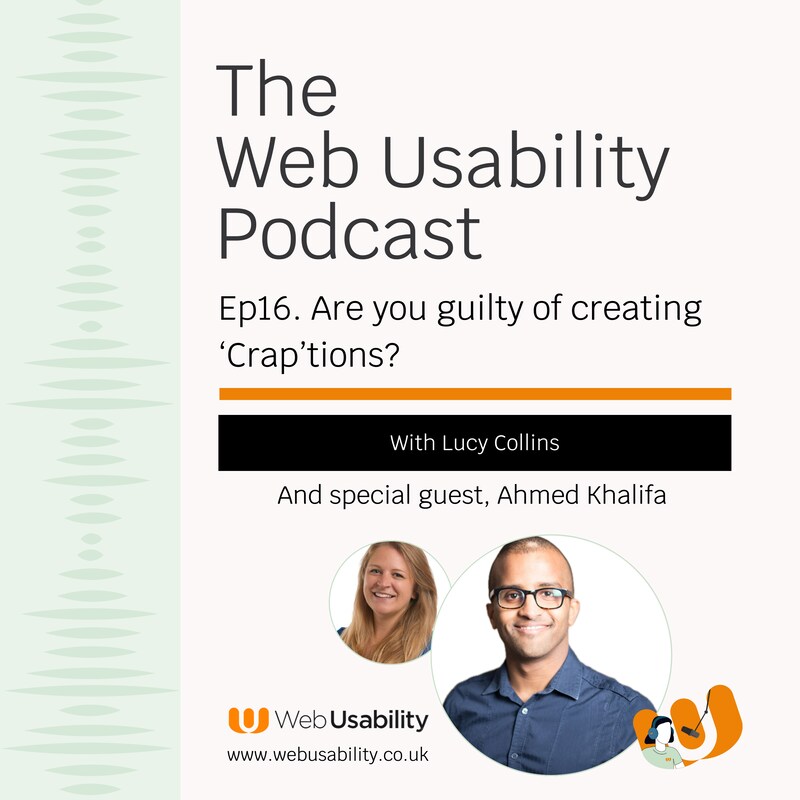
Shownotes
Summary
In this episode of the Web Usability podcast, host Lucy Collins speaks with Ahmed Khalifa, a digital experience manager and advocate for web accessibility. They discuss Ahmed's journey as a deaf individual and how it has shaped his professional life, emphasising the importance of accessibility in digital experiences. The conversation covers the challenges faced by the deaf community, the significance of captions, and the need for accurate and inclusive communication tools. They also explore the future of accessibility with AI and the importance of listening to those with lived experiences to create genuinely accessible environments.
Takeaways
- Accessibility is essential for everyone, not just those with disabilities.
- Captions benefit a wide range of users, including those learning languages.
- Audism is a form of discrimination that affects the deaf community.
- Quality of captions is crucial; bad captions can lead to misunderstandings.
- It's important to advocate for oneself in social and professional settings.
- AI has the potential to improve accessibility tools in the future.
- Listening to the needs of disabled individuals is key to effective accessibility.
- Clear and simple language enhances accessibility for all users.
- Engaging with the deaf community can lead to better understanding and solutions.
- Progress over perfection is a practical approach to improving accessibility.
Titles
- Bridging the Gap: Accessibility in the Digital Age
- The Journey of Ahmed Khalifa: Advocacy and Awareness
- Understanding Audism: Challenges Faced by the Deaf Community
- The Power of Captions: Enhancing User Experience
Sound Bites
- "It's all about progress over perfection."
- "We can miss words and pick up certain keywords."
- "Captions can benefit your toddler's literacy."
- "Bad quality captions are known as corruptions."
- "Nothing about us without us."
- "It's about listening to the right people."
- "You need to speak to the right people."
- "Captions are essential for the deaf community."
Chapters
00:00 Introduction to Web Usability and Accessibility
01:08 Ahmed Khalifa's Journey and Advocacy for Accessibility
04:48 Personal Experiences of Deafness and Professional Adaptations
10:00 Understanding Audism and Its Impact on the Deaf Community
20:02 The Importance of Captions and Their Universal Benefits
30:13 Quality of Captions: The Need for Accuracy
34:56 Future of Accessibility: AI and Diverse Communication Tools
40:12 Moving Beyond Tokenism in Accessibility Practices
Learn more about Ahmed:
- https://purplebyte.io
- https://hearmeoutcc.com
- https://linkedin.com/in/iamahmedkhalifa
- https://bsky.app/profile/iamahmedkhalifa.com
- https://www.instagram.com/iamahmedkhalifa
Transcripts
Ep16. Craptions with Ahmed- Transcript
Lucy Collins
Welcome to the Web Usability podcast, where we explore what it takes to make the web a more accessible and enjoyable place for everyone. Whether you're a website owner, developer, or just a curious mind, we're here to share insights, tips, and stories that can help you improve the user experience of your digital world. I'm Lucy Collins, Director of Web Usability and your guide on this journey to better usability. If you need a transcript of this podcast, just visit our website at www.webusability.co.uk.
Now, let's dive in!
Lucy Collins
Welcome back to the Web Usability podcast. Today, I have the pleasure to be joined by Ahmed Khalifa to the show. Ahmed is a digital experience manager, founder of Purple Byte, a web accessibility and deaf awareness advocate, and hell-bent on creating accessible online experiences. So obviously in the same boat as us, and that's why I'm really looking forward to talking to him today. Through his platform, Hear Me Out, he has been working for many years to create a place where hearing people can learn how to connect and engage with deaf people better plus work together to bridge the gap between the hearing and the deaf worlds more effectively. Now at the head of Purple Byte, he is working directly with organisations to improve the accessibility and inclusivity of online experiences. joins me today to share hopefully some of his own experience about connecting the deaf and hearing worlds, how we can recognise and perhaps even avoid some audism, and how we should be using audio alternative tools to give the deaf community the best possible experience that we can. Akhmed, hello and welcome. Lovely to have you today.
Ahmed Khalifa
Hello.
Thank you very much. Exciting to be here, especially after listening to a few of the recent podcast episode, including with your parents, of course. And yeah, so I have a tough task to follow up to your parents now. So I'll see what I can do.
Lucy Collins
Goodness. I can't believe you listened to that one. It's funny. This is a tangent, but I was so nervous about doing that one. And I don't know if there's something about working with your parents that adds to levels of anxiety, there's probably lots of unpacked baggage there that we won't get into. But yeah, so, well, thank you for listening to it. That's a treat. But this will be equally fantastic. So just to start off with, can you possibly share a bit about your experience of where you have got to today and how you have got there?
Ahmed Khalifa
Sure. So, it's not a straightforward route, but my background has mainly been in marketing and did a lot on SEO and digital marketing, conversionary optimisation along the way into digital experience, just making a good website experience. Along the way, I've always been involved in accessibility as well. Now, a big part of that is because of my own lived experience. I'm someone who is deaf, hard of hearing. I wear hearing aids, and I have first-hand experience of no one was likely to face barriers online, not able to access certain content online. That's always a frustrating thing for me. So, I thought, okay, I need to educate and share stories and be out there more to talk about that. And that can also play along with making the website experience better because everyone can benefit from a good website experience. So, in the beginning, I did initially focus on deaf awareness, but then I also opened up a bit more, which is why I started purple Byte to focus on the general topic of web accessibility as well as there's a niche one which is Hearing Me Out CC and that's about deaf awareness. I talk a lot about that now and I enjoy public speaking. I do talk about that a lot, especially around captions and the importance of it, not just for people who are deaf and hard of hearing, but it can benefit so many people. With the rise of videos, everyone has used captions in some way or form. And I'm determined to make it work. I'm determined to make the internet just that bit more accessible.
And that's why I say one bite at a time, bite as in B-Y-T-E, because it's a big task. But let's just take it step by step. And I'm sure you agree that it's all about progress over perfection, really, rather than make a one fix and that's it all done. It's not going to happen. So, we'll get there hopefully one day.
Lucy Collins
We will indeed. that progressive perfection phrase is something that I feel has been cropping up so much recently because you're right. is such a big task and it can feel so overwhelming. And I was having a previous conversation about where do you even start with it? And so I love your approach of one bite at a time and just doing something is better than doing nothing. But there are so many things we can do and I'd love to come back to talking about captions because I know you've got some strong feelings about those. Can I ask a little bit more about how being deaf has influenced kind of the journey that you've been on, the jobs that you've had? How has it impacted you on a day-to-day basis?
Ahmed Khalifa
Definitely been something that I subconsciously have to adapt to, but until, you know, when you get older, you learn more about yourself and you understand things, then you're like, wait a second, that's what I have to do? In my personal life, for example, there are things that I just struggle with, and I can cross over to the professional life. Say, for example, a social event with lots of people in the room. You want to be a part of that. You want to be part of that experience, but it's just so hard for me to hear in a noisy environment. And I hate that. I hate being excluded from that environment. There's nowhere more prominent when you go to a conference and that happens. And we all love a hallway conversation, you know, in between the talks. We love that. But sometimes it's a bit difficult. And that means the after party, which is notoriously loud and music banging and everything. I tend to avoid that because I know I will struggle and there's been many hard times where I attempted but I just had to walk home alone back to my home or hotel or whatever because I just struggled. I just couldn't keep up and I couldn't hear. And it's not that I blame people for that. I don't think people are aware of it. And I think that's what happened when you have an invisible disability. I'm very, very good at making it seem like everything's fine in terms of I can hear, I can follow along and on the face of it, nothing is going to stop me from being involved. I'm very good at showing that face, but deep down it's very strenuous. I'm very anxious in certain environment in terms of like, am I going to be able to hear or not? And part of me thinking, you know what, that's just my coping mechanism. But then over time I thought, it's not helping.
And that's why I thought I need to speak up more because I want to share stories where, for example, in the workplace, if you want me to hand the phone calls, it's just not going to happen. If you want to do a video call and adapt it in that way, OK, that's another story. If you want me to come to some kind of event, well, then we need to talk about that as well. Even like in the personal life, I am noticing myself be more vocal when I go traveling, for example, and most of the time on a plane.
The tannoy, I don't know what they're saying. I can't hear it. But there are times, certain airline will say, are you able to hear this, this or that? Can I help you with this or that? Because I was more open about it. And I have to be more open. And that's where life experience comes into it. When I was being quiet about it, it could be because I was a teenager, I want to be cool and fitting with different people. But then I realized it actually made my life more difficult. So that's why I am determined to be more vocal about it, whether it's via my individual websites or here or anywhere, I feel like it does make a difference when you speak up more because it helps me, but it helps other person you're talking to as well.
Lucy Collins
Yeah, absolutely. And I was going to ask, why didn't you sort of let people know that that was the situation? It's interesting that you said, as a teenager, obviously you wanted to fit in. And I think that ties back into the perception that we have of disabled people and that they are not normal. And I'd use very big air quotes around those because it's obviously completely untrue. And so you're trying to fit in with what is the perceived version of normal and in a very detrimental way to yourself. So I think it's brilliant that you do feel that you can now stand up for yourself, advocate for yourself, tell people when you need that additional, or when they need to be changing their behaviours quite frankly, to ensure that you're able to experience whatever everyone else is experiencing. How have you found it since you have been more vocal about it? What has been the reception to saying, hey, actually, you know, I need this in a different format, or, you know, it's going to be tough for me to attend this event because of this, of this. What's been the reaction to this increased vocalisation?
Ahmed Khalifa
On general sense, it is positive. There are people who care. There are people who want to do something about it. I think we live in a world now where there are more awareness about different things and people want to accommodate because you realise that there could be so many people living like me, but they hide it. Whether because they have to hide it or they don't feel comfortable to share it, it's not the right environment for them, or they didn't think they need to because they just had to put up with it all their life and they thought, I'm just going to keep on going. When I did open up about it in most scenarios, know, work or whatever, it did make a difference. But at the same time, there are situations where it's just not possible or I feel like maybe there's not enough emphasis on trying to do it. And a big example would be if there are a hundred people in the room, I can ask them to come or go to a different place and let's go somewhere outside where there's not like a low ceiling and echo and whatever, that kind of thing. That's not going to happen. And if a company who has hired a venue for a certain thing and everyone's going to go there, well, you're not going to get them to come out and go where you're going because it's just not going to happen.
I have to be mindful of that and I do appreciate that. I'm not going to say like you did it wrong, not about that. But there are situations where I feel like it's a very, very difficult thing to tell people, which is to come and go somewhere else. I can't hear you in this environment, especially when, as I say, like, for example, that whole conversation in a conference, that's where people are, that's where people are going to be. And that's where sometimes it can be a very lonely experience when you can't do that.
And even if you speak up about it and there will be a trickle of like, okay, I'm going to help you a bit there. But then that just got forgotten and then they go back to where they want to be. And I can't stop them from doing that. So it's almost like a, I wouldn't say 50-50, it just can be hit and miss. It depends on who you're talking to, what are their awareness and knowledge of the background? What is your relationship like with them? If you have that close relationship, then obviously they're more understanding. Whereas the person you first met who doesn't understand it, that might be a bit more difficult for you. And then there's many things like it depends on the nature of environment, the occasion, the context. It's a hit and miss, but it doesn't mean that I won't stop speaking about it because if I stop speaking about it, then it would be 0 % of possibility of having something adapted to me. And I'm slowly getting there. And I think even little things like, for example, I try my best to say in a video call, I'm trying to mention to people that if you have a microphone, it makes a big difference. One, because obviously it's just a better experience for everyone. You're not going to listen to bad quality audio in a video podcast and movie music, whatever. That's just a norm for a of people. So it makes for a more pleasant experience. Even for me, with hearing it on and just some equalisation, it's easier for me to hear and it improves the quality of the auto captions.
Because auto captioning would not be 100 % perfect, but it's still dependent on the quality of the audio. Because you can imagine if there are a lot of background noise, the auto captioning will not pick it up. And because in a live environment, live video, auto captioning is not going to be manually edited, of course. So, we are dependent on the quality, of course, the quality of how we speak and number of people speaking, you don't speak over each other. But I tell people that if you have a microphone, it can make a better experience for you and I for the technology and so on and so on. So, I can only do that by speaking up and that's the journey I'm on forever.
Lucy Collins
Yeah. And I was reading your resources, which are brilliant and I highly recommend everybody goes onto your websites. I was shocked at myself that I had, I did not know the word audism. I did not know that there was a word that specifically described discrimination against the deaf community. Although of course that exists and I'm not surprised there is a word to describe it, but given the space I work in, was I was like, God, check yourself, but that's not great. So, I was fascinating to read around the topic and I wanted to ask you about, we've talked about attitudes and how people have been when you've disclosed your position to them. Can you share with me some examples of audism that we should be watching ourselves for? I know there's a lot of talk these days around unconscious bias, things that we're doing because of lack of awareness. So, this isn't an opportunity to sort of tell people off, but I feel as you say, it's an opportunity to raise awareness around behaviours that might be occurring or we might be doing that are inadvertently or would you say audistic? I don't know. But yeah, there is, there is audism like quality to the behaviour that we have. So yeah, can you share some examples of those sorts of things?
Ahmed Khalifa
Of course. And you've definitely made a good point that we shouldn't not talk about things that are uncomfortable. And I don't want that to happen.
If you don't know or you're not aware, that's okay. It's a curse of knowledge. That's what people call it. You can't expect other people to know what you know. And especially if you have lived experience, then you can't just assume that people will know. audism, I'm not surprised that it's something that people are not aware of because even when you search for it or even when I was just reading the auto caption while you were saying it, it kind of adjusted to audism. Did it? my goodness.
So even the auto caption is like, what the heck is audism? So, you know, it's just, never really know whether people know about it or not, but more often than not, autism, and rightly so, it needs to be talked about. Of course it does. But it's not something that people are aware of. The deaf community, and when I say deaf, I would say, know, capital D deaf, where it's like culturally deaf and they have that history and they're proud of it. I'm somewhat involved in it in Edinburgh, where I live.
controversy even back in the:They wanted to ban who are teaching deaf people and they know sign language, they expand it. The irony is that the majority of representatives are by 170 odds, only three of them were deaf and the rest were hearing. So, it's like, okay, so you really know your crowd. I'm saying this because audism has existed for hundreds of years where there has been an oppression on deaf people. Specifically, on, in that time was more about sign language speakers, but it can be people who are hard of hearing as well and on top of it, but Still to this day, there's a certain part of the world where deaf people who communicate with sign language, are encouraged to lip read and to use oral language. And they are sometimes forced or threatened or told off or punished when they use sign language. So much so that they're often told to sit on their hand because they are not allowed to communicate in sign language. And that's their identity, their history, it's who they are but they've been forced to not do that. Even to this day, in certain parts of the world, it's just like, no, you need to learn how to speak like, air-quote, normal people.
That's been very, traumatic and the trauma still lives today. So, all of them still carries on to today where the general term is discrimination against deaf people and it's when you are not going to do anything to help deaf people. It could be something as severe as you are not allowed to communicate in sign language, sit on your hand.
But it could be something as, it looks innocent, but it could be something as simple as if I say something to you, like, what did that person say? And you say, don't worry about it, it doesn't matter, I'll tell you later. Something which I've heard all my life, that is kind of a form of audism because you're not allowing me to experience what you're experiencing and you're not willing to help me out. And this can happen in all environments. It can be work, could be in a dinner table around everyone. What did that person say?
Don't worry about it, it's not important. Well, it is important because everyone is hearing it. There are tons of ways of creating audism and even in the deaf community, you can implement it on other people. If you know sign language and you refuse to communicate in sign language, that is actually a type of audism. You're not accommodating people; you're not helping people. And there are things that we will be aware of where you don't want to patronize people. And that's something that is quite common in the disability community as a whole.
You don't patronise people and say, oh, you poor thing, or I feel sorry for you, or does that mean you can't do it x, y and z, or you are lesser than me, which means you can't do this job. They're still relevant from ableism and audism. They're still crossover in that sense. But then there are certain things that are quite unique. Like for example, here's a video. You need to watch it because it will tell you how to do your job. It doesn't have captions, but you'll be fine. Just put up with it.
That is audism and I've seen that happen before and I've lived that as well. So you think, you you can talk about this day and age but for hundreds of years it has existed and it's only since the 70s the word audism existed. And then the early 90s there was another research by an American psychologist talked about a bit more. So that word really only existed for about 50 years, but it's really existed in humanity for hundreds and hundreds of years.
Lucy Collins
Yeah. And I think it's something that like with all forms of discrimination, you just have to, you really, we really need to be aware of it. And as you say, those, those unconscious things, that dismissal of, I'll tell you later, you know, I can see that happening. And immediately from your perspective, I can understand how isolating and frustrating that must be. Well, I can't imagine, but you know, I empathise with the situation certainly. And I think that we should be able to offer you exactly the same
experience as much as possible as a hearing person. so, learning a little bit of sign language, if that's your way of communicating or if auto captions are not working because I don't have a great mic. We've all got wired microphones that come with our phones these days, don't we? So, it would be very easy for me to go and grab one of those out the drawer and stick it into my computer if it's going to make the experience better for you. So, it's little things, isn't it? I don't know if you've seen, it's obviously been doing the rounds a lot lately in the accessibility space, you probably have, but the amazing Cadburys advert for Cadbury's Chocolate Fingers, where they basically get you to experience what it's like for a deaf girl. They use the captions very creatively to sort of allow you to walk in her shoes. And I think that that is something that everyone should watch, because it's so powerful at giving you what the experience must be like for you on occasions when you are in a busy space or you've got lots of people trying to talk at the same time, so you miss the odd word here or there. And it's so frustrating.
And I could like feel the pain of this girl. And it's what we do a lot in our research as well as get people to watch that lived experience. Because I think when you feel the pain and you understand the challenge, that's the thing that then causes change as much as possible. anyway, a bit of a tangent, but I just, I loved that advert.
Ahmed Khalifa
It does. It does. It's a really good advert because as you say, it's creative, it's engaging, and I think that's better than making it boring. I always say that when I have a conversation with anyone, It's a jigsaw. How many pieces are missing will be dependent on where I am and the environment. Now, obviously, if it's like incredibly noisy and I can't hear and there too many people, then this 100 piece jigsaw will be missing, you know, 75 pieces. But if it's a little bit better, not perfect, but it's OK, I've got some idea what's going on, then OK, maybe there are only 25 pieces missing. You get the general picture, but you don't have everything.
A lot of the time when I have a conversation, I don't get 100%. But what we are very good at is we can miss words and pick up certain keywords and we know generally what the topic is about. If we know what the topic is about, then we can keep up with conversations. So if you have 75 pieces out of 100 over Jigsaw, you can get an idea what that is. And it'd be great to get it 100%, but sometime in a certain situation, we can't. So that advert is, I would say, very accurate.
that certain weather covered that caption covered. And I know you're saying that it's very hard to have lived experience. And I agree with that. I would never know how it feels to be a wheelchair user, for example. But at the same time, in terms of deafness, let's just say you're talking of caption, for example. We have all watched a video with captions on, on the bus, on public transport, out and about. You have to be quiet maybe, or you want to keep the volume down or on mute.
We have all benefited from that in some way or form. Social media is filled with videos and there are strong evidence that when you have captions in it, it's more engaging because a lot of the time people watch videos with like sound. So I'm not saying that's lived experience because that's just isolated moment. It's not 24 to seven, but you can still benefit from all these things. And I'm a big advocate of that. Absolutely.
Ahmed Khalifa
They're so universal, the application of that. I I've got a personal lived experience of that is that I'm four months into a new baby and I spend quite a bit of time watching TV with her screaming in my ear. So obviously I can't hear what's going on. So we will almost consistently watch TV with captions on if she's awake because you just don't know when she's going to start up. So you're quite right that it's while captions were obviously originally developed to support deaf and hard of hearing people, actually the application of them is completely universal and these days, if you put a video out without captions, I mean, not only is it inaccessible, but as you say, it's just not, it's just not going to do well on social media anymore. it?
Ahmed Khalifa
It's not, it's not going to work at all. And I should also shout out because I'm a parent as well. Anybody who is a parent, anybody who's a guardian, anyone who has children, if your child watches TV, put on the captions or subtitles or whatever you have, there is a strong, strong evidence that it will help them with their literacy over time. Fascinating. There is even like a campaign, a campaign called Turn On Subtitles. There's a campaign where there people trying to make sure that for children's programs, there's either always subtitles or captions or a switch on default in certain apps, for example, wherever. The reason being because there's evidence that it can massively help with their literacy because they can hear what that person is saying
and the letters are shown, and they can connect that dot. anybody who's listening, again, this is another benefit of captions. It can benefit your toddler, whoever's watching TV, that it can help them with their literacy over time. So I strongly recommend people doing that. If you have children in your household and they're watching a bit of TV, put on the subtitles.
Lucy Collins
My God, I'm immediately going to go to our Netflix settings and change that because you're so right. That's so interesting. yeah, I mean, let's get into captions. So I think my first question to you is, which something that we get asked a lot is captions versus subtitles. What is the difference and which one should I be using on my videos?
Ahmed Khalifa
Valid question. It's very confusing. Subtitles is known as like a translation of a spoken language, whereas captions include sounds on top of the spoken words. Now there are times where you might need to include certain sound effects depending on the context. So there are times where I've seen exceptional captions when watching the classic David Attenborough animal documentaries. I remember watching and I remember there was one about the underwater and there were dolphins and the caption was written as dolphin shittering and then the dolphin squeaking and then it's like, and there's like different sound effects. I couldn't hear it because I'm deaf to high frequency sound. I can't hear high frequency sound at all. So I wouldn't know that they are communicating and they do not sound. But because they've captioned it and they're putting a sound effect in there, it meant that, oh, they're playing or they're communicating while David Attenborough's voice is beautifully narrating. You know, can also imagine that the dolphins are also playing and making those sounds and as part of the story, part of what the documentary is about, and you're involved in it as much as you can. In that context.
Of course, should caption the sound effect because they are so, important. But then there are times where if you're a YouTube video, a lot of time people will call it caption, but really, it's subtitles. It's just a talking headshot. And generally called subtitles because there's not really going to be sound effects. You could put sound effects of the intro music if you have to, know, what type of music has been played. I wouldn't say it's a must, but it's good to have. there are times where sound effects are essential and it's part of the story, part of a movie. If there's a car crash in the background and the person is speaking and that's important, then you can tell it. If someone is speaking and you're watching an action movie and there's a gunfire, well, then you need to put gunfire in the caption because it's part of the storyline. Because if you imagine if you don't have that and then you see that character panicking, then the person would be thinking, why that character is panicking? A hearing person would know that because there's a gunfire. So it's just about being aware that there are times where captioning sounds is important and you can go above and beyond and even caption the music in terms of not just the style and type of music, but if possible, who is singing that music and the track name. And if you watch a movie on YouTube, it's really good to do that. Watch it on Netflix, you'll find it all the time.
Lucy Collins
Yeah. And it's funny, you say, I was just thinking that as you were talking, because obviously having watched a lot of TV with captions on recently, I've learnt the names of so many songs that I was familiar with, but I didn't know who they were because we were watching Chaos on Netflix, for example, which has got a great soundtrack and all these songs were coming on and I was like, that's sung by that guy. And also I learnt the lyrics because they were also captioning like the lyrics that were being sung in song in moments. So it was very educational, I have to say. So there you go. We all win from that end. We do all win completely. And so I feel like not all captions are made equal though, right? And I don't want to steal your punchline, but you have an amazing word to describe those captions that are not so great that you've used a few times.
Ahmed Khalifa
I can't take credit for it. In the deaf community, bad quality caption and most of the time with auto caption are known as craptions. And it's quite obvious. don't need to explain why. It's a very, very common thing you hear in deaf community. And I think it's just because we know the pain of bad quality captions and we're fed up of it.
Again, if you don't take it seriously, then you're missing out. You're missing out on engagement. You're missing out on having a way to repurpose that content in other ways. You're missing out on exporting that caption and then repurpose it into a transcript or blog post or whatever. It's frustrating because technology is getting better. I'm not going to deny that. But there was a statistics I remember I read a few years ago where the quality of auto-captions ranges around 30 to 70 percent accurate. And for me, that's very, poor. It's just not good enough. It's not good enough at all, it? It's really rubbish. So let's just say 70 percent accurate. Let's just assume that. And that's not good enough. And I always say, like, if your blog post is only 70 percent accurate, your video, your book, your brochure, if the spelling and grammar and structure and everything is only 70 percent accurate, is that acceptable? If it's not acceptable.
then why are we allowing captions to be in that quality? It should all be treated as equally each other. The caption should be taken as seriously as any other written format. I'm a big believer of that.
Lucy Collins
Yeah, I mean, absolutely. As you say, you wouldn't put out a video that was only 30 % good, would you? I mean, that's just, it's just ludicrous. So, the idea that you would be happy with captions that are only 30 % accurate, I mean It's just wrong. It just should not be allowed. So how can we avoid the craptions then? What should we be doing?
Ahmed Khalifa
Just like when we are now living in an age of AI and people sometimes use AI to help with content and create some kind of paragraph, you still need to edit it. And this is the thing as well that people talk about AI, it's a big trend right now, but really auto caption is AI. That is what it is. And that's been around for decades really. But like any form of written content, they will need to be checked manually by humans and edited by humans. It's just like any other content at all. You are more than welcome to use auto-caption as a starting point. YouTube is good at that. When you upload a video, creates the auto-caption. You can then edit it directly in YouTube Studio or you can export it and edit it that way. It can take time, but then so is editing a blog post that can take time. It's the same idea. So you always have to do that. Make sure that you do it, it the same way and make sure you realise that if you're to have the spelling of like a person's name or anything like that, put the capital letters where appropriate, know, label things correctly and make sure that you put in the comma and full stop in the right places and everything that we know of in terms of editing content that is in written format, apply it to captions as well. So I'm not saying that's not good, use auto-caption, absolutely. But that's only the starting point. And then obviously have a check and everything's OK. If you do use human generated captions, brilliant. It's more expensive, but it will save you a lot of time. But you still have to check it, because if you have writers, you still have to check it. So, it's the same idea. It's not something that is groundbreaking. It's just the same as what we're kind of used to already, just in a different format.
Lucy Collins
Yeah, it's just good attention to detail really, isn't it? And I think you're right that AI enhanced tools are going to take you 80, perhaps 90 % of the way there. But as with all those tools, you need to still have a critical mind. You still need to make sure that you are checking those outputs. I like to think that people aren't just copying and pasting blogs from ChatGPT onto their websites, although no doubt they probably are. But again, you're going to be adapting it, making sure it's your tone of voice. And you're right that captions are no different to that.
So yeah, I had a question on AI because it's the buzzword at the moment. Everybody's talking about it. And I feel like AI and captions will work quite nicely together to a certain extent. Do you think that we'll ever get to a point where you would trust AI 100 % to develop captions for a video?
Ahmed Khalifa
there. Next year, that's the:Lucy Collins
I feel like, obviously, captions are just one kind of part of this puzzle. There are so many other audio alternative tools available to us in the form of British Sign Language, transcripts, presumably other adaptations. I feel one of the conversations that we often have with clients is about the diversity in the size of disabled people. And obviously, within the deaf community, there is a huge range of different types of hearing loss, deafness. And so when we think about some of these other tools that are available to us, how can businesses manage the varying needs of both the people in this community and also then the different ways that we can communicate with deaf people?
Ahmed Khalifa
It's a valid point because I do think that there will come a point where I believe one big thing that AI will do really well is potentially put it in an avatar that will do a sign language of whatever you have written down. I think that will happen actually.
That would be, you know what, maybe quite accessible because we are very aware that it's not feasible for everyone to have a sign language interpreter on your website translating every single content that you have. Of course, it's very difficult to do that. It's not something that people demand. It's just that there's an appreciation difficulty. It's just about making sure that, at least make the effort to make sure that your content is accessible in terms of captions, yes, all that stuff.
But even the way you write the content matters in terms of is it clear? Is it easy to read? Is it consumable? it because a lot of the time people forget that, especially for those who are sign language users, the first language is sign language. People forget that if you know sign language doesn't mean that you automatically are 100 % fluent in whatever language you speak in. So let's just say English in this case. So a lot of my friends fluent in sign language because that's first language.
It has its own syntax and grammar and structure and wording. So it's not a like for like translation if you have something written down. But at the very least, keep it as clean and simple as possible. And this goes beyond deafness. This is for those who are in other form of disability. That if you have, for example, learning disability or neurodiversity or whatever, you want to be able to read your text. But if you make it difficult to consume it, whether it's the words that you use, whether it's the font that you use, whether it's the spacing between lines and letters, whether it's just the language and how you structure it. You're not just making it difficult for those, you for your customers and all these things. You're not just excluding people who are deaf, but you're just excluding so many different people. So, it's all about going back to basic. And I know, you know, want to use fancy tools and technology to help us along the way, but the basic is so, important. Clear language. If you write in a blog post,
Just make it straight to the point and clean and easy to read. And if you're going to captions in the video, put that in. I would say that is essential. OK, you're not going to have a sound language interpreter. OK, I understand. But put captions in, because that is a big part of the way as well. And then let's see where technology will take us in terms of AI. Like I said, I think the auto-captioning tools will get better, but we still have a responsibility in terms of how we speak and how we say things.
the quality of the background noise, audio microphone. And then let's see about an avatar that is doing some kind of sign language interpretation. I think that will happen. And it might not be an avatar, I think it might be a human as well. And I'm seeing some early signs of that, looks very interesting. It's not accessible yet in terms of everyone doing it, but it's there. But until we have to wait for that to happen, go back to basic with your website and make it as usable as possible.
Lucy Collins
Yeah. And I think my final question, is really about how can we move past what feels like quite kind of tokenistic approaches to accessibility. I feel like there's a lot of people that just kind of pay lip service to it rather than actually living and breathing it. What do you say to your businesses? As we were saying before we kind of started recording, we've got lots of people interested in making sure their website are compliant, ticking that box, but actually how do you move them past that? How do we get them to genuinely believe that this is a good and important thing to make websites accessible?
Ahmed Khalifa
It's all about listening to the right people. There's a lovely saying I would say in the disability community is that nothing about us without us. And I think there's a time where people assume that we know what disabled people need and want and we know what it looks like. But until you have that lived experience, you won't know what it looks like. And the irony is it could happen to you as well. But in the meantime, if you haven't got that lived experience, then it's all about listening to the right people.
who can help you. So for me, for example, okay, I can definitely talk about it from the angle of deafness, but I'm not the right person if you want to talk about how can I make my building accessible? Well, I don't know that. That's not my forte. So you need to speak to someone else that I know who is a specialist in that, but don't assume that, we just need a lift in the building and then our building is accessible. No, there's more to it than that, but you just need to speak to the right people and have an open mind.
If you have an open mind and you're willing to receive that information, it's amazing what it can do to your business. And that obviously applies to all aspects of business. But if you open your mind to what people are saying, who are living that and you take it on board and you implement it, then you are far, far away ahead than most people because from what I'm seeing, people are assuming that what they know is best and it will do. It's enough. We'll do it later. It's an add on.
And we know that's never good enough, but it's just about listening to the right people with an open mind, and you will make a huge step in making your business accessible for more people.
Lucy Collins
Yeah. Well, I love that. Well, I think that's probably a really lovely note to end on as well, because, you know, what's better than keeping an open mind and as you say, involving those people that have the lived experience. So Ahmed, thank you so much for sharing your own personal experience and also obviously some of that fantastic professional advice. I think that as we've discussed for people within the deaf community, these things like captions are essential, but you've made the point so nicely that it's such a universal thing that can help so many people. And captions are just one of these tools that we can use creatively to not only help people embody the experience of those that have other lived experiences but also make the experience of engaging with video content just better across the board.
I'm so going to take away the idea of sticking on captions for my little girl while she's watching more Peppa Pig, God. Because yeah, I mean, of course it's going to help her learn. That makes perfect sense. So yeah, thank you, Aamir. What an absolute treat to speak to you and all the best with Purple Byte. And obviously we'll be sharing links to everything that you do within the show notes. So if anyone does want to work with you, then they'll know how to get in touch. But thank you. I appreciate it. Thank you very much for having me. Thank you for tuning in to the Web Usability Podcast.
We really hope you enjoyed this episode. If you have any questions, comments or topics you'd like us to cover, reach out to me on lucy at webusability.co.uk or connect with us on LinkedIn. Please don't forget to like and subscribe so you never miss an episode. Until next time, keep making the web a better place, one user at a time.
