Shownotes
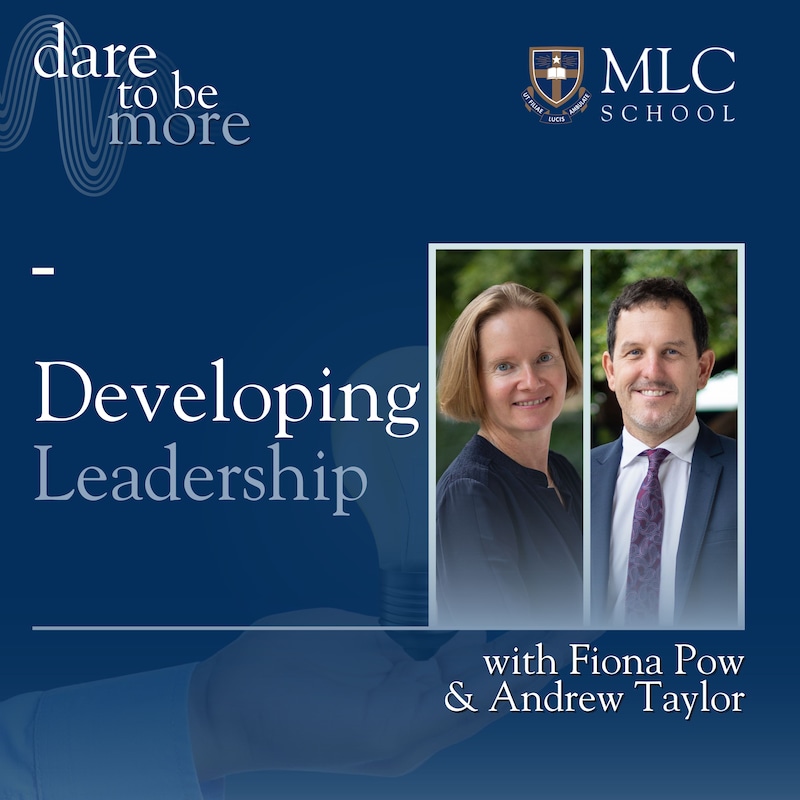
In this episode of 'dare to be more', host Anthony Perl speaks with Fiona Pow, Head of Students, and Andrew Taylor, Deputy Head of Senior School Wellbeing, about how MLC School develops confident, capable leaders who are prepared to step up and make a difference.
Fiona and Andrew challenge traditional notions of leadership, explaining that it's not just about badges and elected positions - it's about any student who steps outside their comfort zone, does the right thing at a difficult moment, or starts a new initiative. They emphasise that leadership opportunities exist for every student, just as they do for staff throughout the School.
The conversation explores the extensive range of leadership opportunities at MLC School, from the Cadet program starting in Year 8 and the Middle Years Leaders program, to the SRC, co-curricular activities, and the powerful Sonycamp experience where Year 11 students serve as companions for children with disabilities. Fiona and Andrew describe how leadership happens in both formal and informal settings - in classrooms, on sports teams, and through the Big Sisters program where Year 11 and 12 students mentor younger girls.
They discuss how MLC School teaches leadership through structured programs like the International Coalition of Girls Schools' 'Lean in Leadership' curriculum in Year 8, where students learn about values-driven leadership and aligning behaviours with values. The episode explores the comprehensive training that Year 12 captains receive, including vision planning and goal setting with external organisations.
Fiona shares inspiring stories of students who have taken initiative - from creating a midwifery club that sparked passion in others, to graduates who have gone on to leadership roles at university and beyond. She discusses how the School supports students in balancing leadership responsibilities with academic demands through weekly team meetings, staff mentoring, and a strong culture of peer support.
Andrew reflects on the unique advantage of an all-girls environment, where students don't need to compete for space at the table because they are the hosts. He explains how seeing strong women in leadership throughout the School gives girls something to aspire to, and how learning to advocate for themselves prepares them for the realities of leadership beyond school.
The conversation concludes with both educators reflecting on what 'dare to be more' means in the context of leadership - Fiona describing it as having the drive and initiative to step up and do something more, whilst Andrew emphasises the importance of risk-taking, stepping outside comfort zones, and not being afraid to fail as essential elements of developing resilience and growth.
About MLC School: MLC School is a leading independent girls' school in Sydney, committed to empowering young women through academic excellence, character development, and innovative education. Our mission is to inspire girls to dare to be more.
Connect With Us:
- Website: mlcsyd.nsw.edu.au
- Instagram: @mlcsydney
- Facebook: @MLCSchoolSydney
- LinkedIn: MLC School
Co-host: Anthony Perl
Produced by: 'Podcasts Done for You'
Transcripts
Developing leadership.
2
:Welcome to Dare to Be More, the podcast
from MLC School in Burwood, Sydney.
3
:Today we're exploring leadership
development with Fiona Powell, head
4
:of students and Andrew Taylor, deputy
Head of Senior School Wellbeing.
5
:Discover how leadership isn't just
about badgers and titles, but about
6
:any student who steps up to do the
right thing or tries something new.
7
:Learn about the countless formal and
informal opportunities at MLC School from
8
:the cadet program and SRC to classroom
moments and co-curricular activities.
9
:We'll explore how MLC School prepares
young women to confidently take their
10
:seat at the table in a world where
they'll be the hosts, not just the guests.
11
:I'm your co-host, Anthony Pearl.
12
:Let's get into today's conversation.
13
:Well, hello everyone and
welcome to another episode of
14
:The Dare to Be More Podcast.
15
:I'm really excited about this
topic because I think it's a topic
16
:that people sort of understand but
don't really think too much about.
17
:So it's a good thing that we've got two
very special guests joining me today.
18
:Andrew and Fiona, welcome to the podcast.
19
:Fiona Pow: Thanks Anthony.
20
:LA
21
:Andrew Taylor: Thanks.
22
:Thanks for having us.
23
:Anthony Perl: Well, we better start off
by allowing you to introduce yourselves.
24
:So Fiona, do you wanna kick things off
and tell everyone a little bit about you?
25
:Fiona Pow: Yeah, sure.
26
:I'm the head of students at MLC School,
so head of students for 10 to 12.
27
:So I look after the whole student
from 10 to 12, working with them
28
:in wellbeing, but also across their
academic and co-curricular and just
29
:making sure that the girls supported.
30
:All the way through those important years.
31
:I've myself, I've been at the
school now for 13 years and worked
32
:in a range of different roles as
a head of year, and I'm also an
33
:English teacher, which I love to do.
34
:And before that I've worked
internationally and worked across
35
:different contexts in different
countries and in different leadership,
36
:student leadership systems as well.
37
:Anthony Perl: I detect a little
bit of an accent there still.
38
:Fiona Pow: It's definitely still there.
39
:Yeah.
40
:So I'm from the north
of England originally.
41
:Anthony Perl: Lovely.
42
:And Andrew, what about you?
43
:Andrew Taylor: So my title is Deputy
Head of Senior School Wellbeing.
44
:So essentially I look after all
facets of student wellbeing.
45
:My role changed slightly
over the last year.
46
:I, I still work really
closely with Fiona and the.
47
:Heads of students and the heads of
year team, but my role is in more of a
48
:sort of strategic direction now looking
at the planning and the implementing
49
:of our wellbeing strategic plan.
50
:So that's my space.
51
:This is my third year at MLC School.
52
:I've been in girls schools for about
15 years now, and prior to being
53
:deputy head of senior school here,
I've been a director of students in
54
:other girls schools, and originally
I started off in P-D-H-P-E, so
55
:really strong interest there.
56
:Obviously there's a nice link
between P-D-H-P-E and student
57
:wellbeing and leadership, so
that's a bit of my background.
58
:Anthony Perl: Fantastic.
59
:Well, we're gonna have a well-rounded
discussion here based on all of that,
60
:uh, because it, the topic at hand is
developing leadership at the school,
61
:and I think it's a, it's quite a
broad thing is a starting point.
62
:So maybe we need to start off by
defining what a leader actually is.
63
:Fiona, what does that mean for you?
64
:Fiona Pow: For me, it's something that's
available for all students because I
65
:think it's any student who steps up.
66
:To either do the right thing at a
difficult moment or steps outside of
67
:their comfort zone to try something
new, or a student who might start a
68
:whole new initiative and really start
to push something big in the school.
69
:So I think that.
70
:When I think about leadership, I don't
think about the badge and I don't think
71
:about the students that have the titles
and that have the elected positions.
72
:I mean, I obviously do think of them,
but there's always opportunities
73
:for any student in the school to
become a leader in, in small ways.
74
:And I think that's true
of our staff as well.
75
:You know, some of us have
positions, but there's leadership
76
:all throughout the staff, and we
see that in our students as well.
77
:Anthony Perl: And Andrew,
what about for you?
78
:Because I think that's
a very interesting take.
79
:That leadership isn't
necessarily about the badges.
80
:'cause we tend to think of it in that way.
81
:I mean, you know, sports
teams are the obvious ones.
82
:Who's the captain of the team,
who's the captain of this or
83
:that, but it's beyond that.
84
:Andrew Taylor: Yeah, absolutely.
85
:And I guess on that note too,
it's really interesting, love to
86
:use a sport analogy, but it's.
87
:It's not always the best players
that are the captains of the team,
88
:and that's not what it's about.
89
:It's not better being the best player.
90
:It's about ones that have that vision or
that ability to influence other people.
91
:And I think that's what I think
about when I think about leadership,
92
:being able to positively influence
and guide others and support others
93
:and empower, empower other students.
94
:I think that's what resonates
for me when we think about.
95
:Leadership, having that ability, having
a vision, being able to, to bring people
96
:together to get the best out of them.
97
:Anthony Perl: I think it's an interesting
point that you made there, that
98
:leaders aren't necessarily the best
at whatever it is that they're in.
99
:The best player in a team isn't
necessarily the leader in the team.
100
:Andrew Taylor: Mm-hmm.
101
:Yeah, I, I absolutely agree.
102
:It's those e ai skills, those soft skills,
the being able to understand people.
103
:Having empathy is obviously a
really, really big part of that.
104
:Being able to recognize the strengths
and the qualities in other people,
105
:um, and then utilize those strategies
and bring them, draw them out of
106
:people to get the best outcomes
for the collective, for the group.
107
:Anthony Perl: So with that kind of
broad definition in place, Fiona,
108
:where are the opportunities within
MLC for girls to become leaders?
109
:Fiona Pow: Oh, there's, I think
there's countless opportunities.
110
:I think that we have a strong leadership
program all the way through from
111
:the young years up until the year 12
when we have our elected captains.
112
:But we have our cadet
program that runs from.
113
:Year eight.
114
:And so students can have
opportunities within the cadet
115
:program to lead in different ways.
116
:We have a Middle Years leaders program,
so we have elected leaders, then we
117
:have an SRC where students can nominate.
118
:We have.
119
:I'm trying.
120
:We have many different opportunities.
121
:We have a wonderful Sony camp at the end
in year 11 where students step up and be
122
:companions for children with disabilities.
123
:And that takes immense leadership to be
able to be a part of that camp and to,
124
:to really be able to advocate for others.
125
:And I'd say that within
classroom settings.
126
:Any day of the week, any student
can step up and be a leader.
127
:We have formal opportunities, but we
have informal opportunities as well.
128
:And within co-curricular activities,
there's lots of different scenarios
129
:where students can lead as well
and take on subgroups within teams
130
:and within dance, within drama.
131
:I think that.
132
:Uh, there's many, many opportunities
and like Andrew said earlier, it is not
133
:just about being the best, it's a bit
about being the person who could either
134
:energize others or see an issue and act
on it and be like an upstander or students
135
:who just really want to give something
a go and take others along with them.
136
:So I think we have many, many
opportunities and I love it because
137
:I've worked in different schools.
138
:Where they didn't have such a
defined leadership program or as many
139
:opportunities, and what I see is that
our girls just thrive on this and the
140
:way that they leave us at the end of
year 12, confident and ready to go and
141
:take on the world, I find that really
exciting and something that I hadn't
142
:really experienced in a school before.
143
:Anthony Perl: I wanna come back to that,
but Andrew, I wanted to ask you then
144
:about training girls to become leaders.
145
:Andrew Taylor: Mm-hmm.
146
:Anthony Perl: It's all very well to
say they've got this opportunity, but
147
:how do you actually develop that skill?
148
:Andrew Taylor: Yeah.
149
:I guess just to go off what Phil
was saying, there are there,
150
:there are a whole range of.
151
:Informal and formal opportunities, uh,
that we recognize across the school.
152
:And when we look at things like informal
opportunities, for example, all of our
153
:year 11 and 12 students are big sisters
to students in year seven and eight.
154
:And we have a year, six
to nine middle year.
155
:Buddy system we're
working on moving forward.
156
:So there are lots of those opportunities
for, they're essentially informal
157
:leadership opportunities, opportunity
for year 11 and 12 students to role
158
:model and to lead and to share their
knowledge and their experiences and
159
:provide support for our year seven
and eight in terms of teaching and
160
:how we actually teach leadership.
161
:So.
162
:To give you an example,
we start in year eight.
163
:Our year eight students actually
engage in a program from the
164
:International Coalition of Girls
Schools called Lean in Leadership.
165
:So we've adopted that this year and
we've incorporated that into our
166
:pastoral and wellbeing programs.
167
:So there our year eight students are
learning really early on all about
168
:leadership, what it looks like,
how we can demonstrate leadership.
169
:They learn about values driven
leadership and aligning our values
170
:with our behaviors and how we can
use that to enact positive change.
171
:So they learn about that in a really
structured, um, sort of formalized
172
:manner in their luminaries.
173
:But as I said, again, there's also a
lot of informal opportunities too to
174
:engage with other students, sub captives
of teams, luminary representatives.
175
:I know Fiona mentioned the middle
years leadership in the SRC.
176
:Students can join committees.
177
:We have lots of different committees
throughout the school where students,
178
:particularly younger students, get to
observe how our older students lead and
179
:our older students get the experience,
or our captains or leaders have that
180
:opportunity to lead the younger students
and actually provide support there.
181
:So there is lots of, lots
of opportunities there.
182
:So yeah, it takes place in the
luminary classroom, but it also
183
:takes place outside of the classroom.
184
:Uh, also we have workshops We
te send students on workshops.
185
:So there are formal training programs.
186
:Start of this year, we did a big program
with our incoming year 12 captains.
187
:We partner with some external
organizations to really
188
:dig deep and dive into.
189
:Whole school leadership and what we
would like to see, and our captains
190
:do, vision planning of what their
whole school goal is going to be and
191
:how we're gonna enact positive change.
192
:So it does take place in formal
settings, but it also does take place.
193
:The training or the learning about
leadership happens all over the school.
194
:Anthony Perl: And Fiona, how do you
balance then in a leadership position
195
:between doing that and all of the other
requirements you have of being a student
196
:at school to actually get work done?
197
:Fiona Pow: Yeah, I think that's a
good question because I think that
198
:students, particularly the elected
students, definitely, you know, they
199
:do with such earnest and they want to
do their jobs so well and they want to
200
:go all in, but especially the senior
years when they have academic demands.
201
:And the co-curricular, there's a
risk of it becoming overwhelming,
202
:but they themselves work together
exceptionally well as a team.
203
:They have a weekly meeting where
they're discussing what's happening
204
:in each portfolio, and they're
leaning on each other for support.
205
:They're asking for help, and that's
something that we encourage with them, and
206
:it's part of their leadership training.
207
:So either Andrew, myself, or the
head of year Andrew Renick, or b.
208
:In the team meeting to help them sort
of navigate that and to make sure that
209
:they're not overwhelmed with work.
210
:But then we also have mentoring staff
mentoring for the portfolio captains,
211
:and also year 12 students all have a
staff mentor as well who meets with
212
:the student to help them navigate
some of those challenges in terms of
213
:time management and responsibilities.
214
:And I think that's.
215
:That tends to work well because they have
staff looking after them, but they're
216
:really very good at leaning on each other
for support and making sure that, you
217
:know, when they need a hand, they shout
and people, they work as a team so well.
218
:So yes, it's about leadership and
leading your own portfolio, but the
219
:team and how much the team works
together is really key to that as well.
220
:And that's something that we work
on with the students all the time.
221
:Anthony Perl: I might just pick you
up on a point that you mentioned
222
:earlier on about how surprised you are
to see how great they are at the end
223
:and where they might go afterwards.
224
:So particularly you've been involved
with MLC for a number of years now.
225
:Have you got some favorite stories
about girls that have risen to the
226
:occasion of leadership, either during
school or as a result afterwards?
227
:Fiona Pow: Yeah, I think I
can think of a few examples.
228
:It was a few years ago now, but there
was a student who was particularly.
229
:Interested in midwifery.
230
:She had a different, she
wanted to do different things.
231
:When she first joined the
school, she wanted to join
232
:the circus, but that changed.
233
:She develops, you know, her academics.
234
:She decided that she really
wanted to do midwifery and she
235
:was applying to do midwifery.
236
:But what she ended up doing was.
237
:Creating a midwifery club and they
would meet once a week and they would
238
:like read recent articles on midwifery.
239
:They would, you know, talk
about different cases and they'd
240
:look at like new developments.
241
:And yes, she did go off to
study midwifery, but so did
242
:some of her friends as well.
243
:And this student was
an exceptional student.
244
:Very, very capable student and I love
that she took on what she wanted to do
245
:and but took others with her as well.
246
:And it was a passion that she shared
with others and they developed that
247
:passion too, which I think is brilliant.
248
:Other students who have had formal
leadership positions have gone on
249
:to then, you know, we've had vice
captains go off and edit or co-edit.
250
:The student newspaper at Sydney Uni
and take on leadership roles in their
251
:university life, and then they're
stepping out into really exceptional
252
:careers and being successful and it's
always just, yeah, it's brilliant
253
:to hear those stories from students
where you can see that those, the
254
:sort of the fabric of leadership
that we've helped develop in them has
255
:carried forward into their future.
256
:Anthony Perl: Fantastic.
257
:Yeah.
258
:Andrea, I'm interested particularly
in your perspective of leadership,
259
:particularly afterwards because having
worked at a number of girls schools and,
260
:and seen that, the reality of course is
that we go into a business world that
261
:potentially can be very male dominated.
262
:So how do the girls go
in relation to that?
263
:Does this, you know, put them
in good stead by going through
264
:these kinds of programs?
265
:Andrew Taylor: Absolutely.
266
:Yeah.
267
:Look, I think, I think that's one of the
great things about being in a girls school
268
:in an all girls environment is that I.
269
:You know, we talk about
having the seat at the table.
270
:The girls don't need to have a seat at
the table because they are the hosts.
271
:Um, they don't have to
compete for the space.
272
:They don't have to share the space.
273
:So I think having this environment
is really supportive for our girls.
274
:They get to see.
275
:Leadership modeled from their older
peers, from our staff, from our
276
:school leadership all the way down.
277
:So there's a really clear idea
for them, or a clear visibility
278
:around what leadership is.
279
:They get to see really
strong women in leadership.
280
:Um, and it gives 'em
something to aspire to.
281
:I mean, yeah, absolutely.
282
:I think that's really important.
283
:I mean, we know the statistics and
the data around what it's like for
284
:women in leadership beyond school.
285
:I think they get a really great chance
to step up and to step into those spaces.
286
:I.
287
:And they learn to be competitive.
288
:They learn to advocate and speak
up and advocate for themselves
289
:and speak out for what's right
and speak out for what they want.
290
:And again, that's one of the great things
about being in a school like MLC School,
291
:is that, that our students can see that
and if they can see it, they can be it.
292
:And that puts them in really
good stead beyond school.
293
:Anthony Perl: Fantastic.
294
:I need to ask you both a question that
we're asking all of the guests who appear
295
:on the program, which is Dare to Be
More, which of course is the name of the
296
:podcast and the motto for the school.
297
:What does it mean in relation
to this topic of leadership?
298
:Fiona, if I can start with you.
299
:Fiona Pow: I think that in some ways it
probably lends itself best to leadership.
300
:Doesn't it dare to be more?
301
:Because it's about pushing
yourself the extra step further.
302
:Don't just sit on the fence, step
up, do something a little bit more
303
:for yourself, see something that you
want to do and go out and get it.
304
:And I think that's part
of leadership as well.
305
:Having that drive initiative and
knowing that you're in a space
306
:where the, where you can do that
and you'll be supported to do that.
307
:I think that's a lot of what makes MLC
special is that we support our students
308
:to do the things that they want to do.
309
:And so yeah, if they dare me more,
we'll help 'em along the way.
310
:Anthony Perl: Lovely.
311
:What about you, Andrew?
312
:What's your take on that?
313
:Andrew Taylor: I very
much agree with, with fe.
314
:I think for me, dare me more is.
315
:About that risk taking and about
stepping outta their comfort zone.
316
:Not being afraid to fail.
317
:Mm-hmm.
318
:Not being afraid to get it wrong.
319
:And we know for so many of our girls,
and we know particularly with the
320
:things around perfectionism and
particularly being judged and what will
321
:people think and how's it gonna look?
322
:And we know all of the
research around that.
323
:But I think, yeah, for me,
dare to be more is about that.
324
:Taking a chance.
325
:Not being afraid to fail, developing
resilience, learning, and then putting
326
:that into practice again as they move on.
327
:I think that's what it looks like for me.
328
:Anthony Perl: Excellent.
329
:Really enjoyed that discussion.
330
:Thank you both for being
part of the program.
331
:Fiona Pow: Thanks so much.
332
:Andrew Taylor: Thank you.
333
:Anthony Perl: Thank you for
joining us on Dare To Be More.
334
:If you enjoyed this episode, please
subscribe wherever you get your
335
:podcast so you never miss an episode.
336
:Your likes and comments also
help more families discover
337
:these valuable conversations.
338
:For more information about MLC School
and their approach to girls education,
339
:visit their [email protected].
340
:Check out the show notes
for more information.
341
:The Dare To Be More Podcast is
produced by podcast Done for You.
342
:I'm your host, Anthony Pearl,
and we invite you to join us next
343
:time as we continue to explore
what it means to dare to be more.
