Shownotes
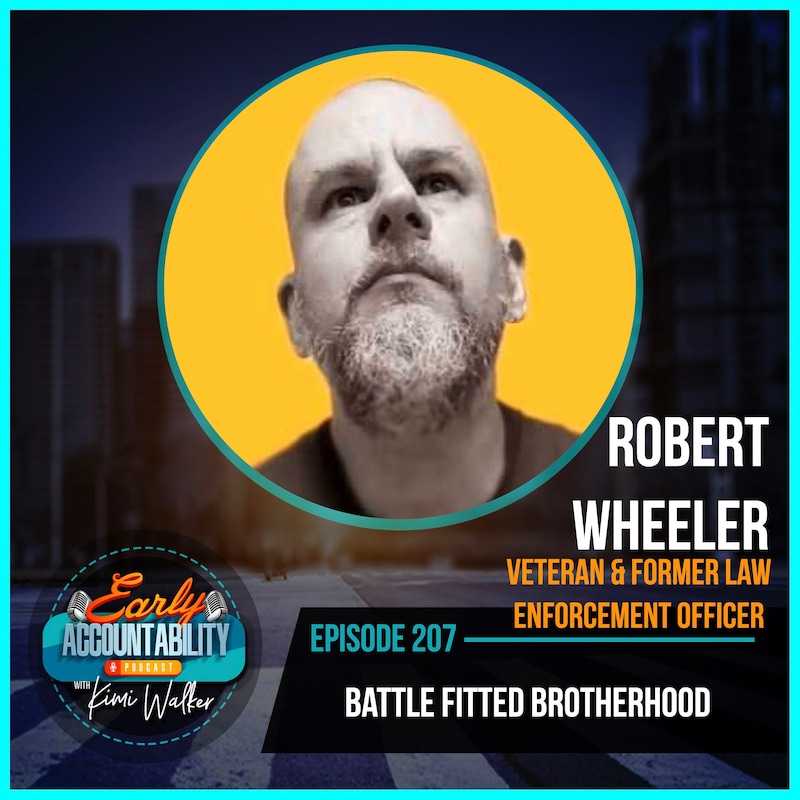
In this powerful and heartfelt episode of the Early Accountability Podcast, host Kimi Walker welcomes Rob Wheeler, a military veteran, former law enforcement officer, and founder of the coaching brand Battle Fitted. Rob opens up about his journey through trauma, PTSD, anxiety, and the loss of his business, sharing how those struggles became the foundation for helping others reclaim their lives through fitness, mindset, and discipline.
Together, Kimi and Rob dive into topics like overcoming adversity, building resilience, and the practical power of daily gratitude. Rob candidly reflects on how he turned his pain into progress, explaining why consistency—not fleeting motivation—is the real key to lasting wellness. Listeners are treated to inspiring stories from Rob’s own path and from his work with men and fellow first responders, as well as simple strategies for creating healthy habits, emotional regulation, and leading with vulnerability. The episode is a reminder that no matter our battles or setbacks, each day presents another chance to choose growth, seek support, and move forward with renewed purpose.
Topics Covered in This Episode
- Turning trauma and adversity into a source of strength and purpose
- The core pillars of wellness: fitness, mindset, and discipline
- The underestimated power of gratitude for improving mental well-being
- Why consistency outshines motivation in building lasting habits
- Addressing the “silent battles” faced by veterans, first responders, and men
- Creating a family legacy of wellness and modeling healthy behaviors for children
About Robert Wheeler
Rob Wheeler is a veteran, former law enforcement officer, and the creator of BattleFitted, a coaching brand that helps people reclaim their lives through fitness, mental resilience, and discipline. A survivor of trauma and PTSD, he uses movement and mindset to fight mental health challenges and empower others to do the same. As the host of the Battle Harder Podcast, Rob shares stories of warriors from all walks of life who have turned struggle into strength. Guided by his motto, “Turn Pain Into Progress,” his mission is to provide real talk, real tools, and a blueprint for resilience
Connect with Robert Wheeler
- Website: https://www.battlefittedbrand.com/
- Email: [email protected]
Connect with Kimi Walker:
- Visit: earlyaccountability.com
- LinkedIn: Kimi Walker
- Facebook: Kimi Walker
- Instagram: Kimi Walker
- YouTube: Kimi Walker
Transcripts
Kimi Walker here and welcome back to the next episode of the
Speaker:Early Accountability Podcast.
Speaker:Today we have a special guest.
Speaker:We have Rob Wheeler, who is a veteran and former law enforcement officer.
Speaker:He is the creator of Battle Fitted, a coaching brand focused
Speaker:on helping individuals reclaim their lives through fitness,
Speaker:mental resilience, and discipline.
Speaker:So Rob, thank you so much for being a guest on the show.
Speaker:Thank you.
Speaker:It's my pleasure to be here.
Speaker:Why don't you just tell the audience a little bit more about you and how
Speaker:you created your brand and how you got into doing the work that you do today
Speaker:do we have enough time
Speaker:except for all of that.
Speaker:I'll give you the abridged version.
Speaker:Hopefully.
Speaker:10 year Navy vet 17 years total law enforcement between
Speaker:military, federal, and state.
Speaker:Law enforcement former gym owner owned a strength and conditioning
Speaker:gym for four years that unfortunately I lost due to COVID.
Speaker:But my story comes from one of just, I had trauma, childhood
Speaker:trauma that I didn't realize I had.
Speaker:Military trauma, law enforcement trauma of losing the the business
Speaker:and then, diagnosed with PTSD, major depressive disorder.
Speaker:Anxiety and social anxiety and realized that I didn't want
Speaker:those things to define who I was.
Speaker:So found my way out of the darkness, out of the turmoil, so to speak.
Speaker:And now that's what I teach from the fitness mindset,
Speaker:discipline pillars of my coaching.
Speaker:Okay.
Speaker:You have modeled, turned pain into progress.
Speaker:So we here, early accountability talk about how, how people.
Speaker:Can move or pivot or maneuver for themselves in, any domains of wellness
Speaker:when it comes to the early stages.
Speaker:So what kind of, how are you able to hold yourself accountable and
Speaker:move through overcoming your trauma or PTSD or navigating through them?
Speaker:I would say.
Speaker:Yeah, great question.
Speaker:And the first thing I always wanna preface is that my mental
Speaker:health issues didn't go away.
Speaker:Okay.
Speaker:I am not like.
Speaker:Magically cured.
Speaker:This is not a cure.
Speaker:All my coaching does not make things disappear, but I found the tools,
Speaker:the tips, the tricks, the things that help me have better days, and if I
Speaker:can have more good days than bad.
Speaker:That's how you live a happy life, right?
Speaker:We're all gonna have bad days, but how we deal with it is what's gonna
Speaker:make the difference between if it's gonna be a good day or a bad day.
Speaker:So for me, that was going very heavily into the personal development space.
Speaker:I like to tell people, believe it or not, the simplest of
Speaker:things is what actually works.
Speaker:And that started with me with gratitude.
Speaker:I was just.
Speaker:A very unhappy, very negative person.
Speaker:I always, let the people on Instagram with their cars and their houses that
Speaker:you don't know if real is real or not.
Speaker:Affect how I feel.
Speaker:I let society affect how I feel.
Speaker:That self-worth, self-love of not feeling good enough or not being good enough was
Speaker:always weighing in the back of my mind.
Speaker:So practicing gratitude was like, honestly the simplest, easiest first step
Speaker:for me to get out of this negativity, this dark thinking, realizing that
Speaker:my life honestly isn't that bad.
Speaker:So let's go into, you have a, there's a lot of good points in here.
Speaker:So you have the battle Harder podcast, right?
Speaker:And battle fitted.
Speaker:So you talk the print prongs or fitness mental resilience, right?
Speaker:And discipline.
Speaker:How important would you say consistency is and how much do you, especially to
Speaker:like your coaching clients or to your audience, how much do you press having
Speaker:consistency in routines as far as helping people achieve or get a greater
Speaker:level of like mental and physical wellbeing or just overall wellness?
Speaker:Yeah, so I learned, early on that, honestly, motivation is garbage.
Speaker:And especially when we have mental health issues, motivation is like really garbage.
Speaker:Coach Rob does not want to go to the gym, three times, five times a week.
Speaker:I don't wanna fricking, it's very hard to get out of that.
Speaker:Negativity, like I said, that bad place if we have mental health issues, not only
Speaker:with everything going on in the world and things that we deal with day to day.
Speaker:So I learned early on through the military, honestly, that.
Speaker:Consistency or discipline they're both the same thing, that without
Speaker:that you're not gonna have progress.
Speaker:Like you have to have discipline and building discipline.
Speaker:I equal it to if we have a bad habit that we want to break, it takes,
Speaker:can take anywhere from two weeks to a month to break that bad habit.
Speaker:It's the same thing with good habits.
Speaker:You have to essentially get those reps in, right?
Speaker:If I go to the gym and I wanna lift heavy weight, I can't go grab a 50 pound
Speaker:dumbbell and automatically lift that.
Speaker:I have to start at the 20 and I have to continue that over time.
Speaker:So that compounds into being able to lift the 50 pound weight.
Speaker:And that's the same with consistency.
Speaker:You, it has to be over time to stack the winds to just be 1% better every day.
Speaker:So when creating your brand, or I guess the development of it, right?
Speaker:Because you lived it what made you create or keep, or I, I should say, elect the
Speaker:physical fitness as one of your pillars.
Speaker:That's, that's my whole fitness is the number one pillar because I truly
Speaker:believe, and when I say fitness, okay.
Speaker:Overall health and fitness, nutrition, your emotional health, your spiritual
Speaker:Body.
Speaker:The
Speaker:physical health.
Speaker:So fitness as a whole.
Speaker:Because I can't just go to the gym and expect that to be the one
Speaker:thing that helps me be better.
Speaker:And we know, science backed data that going to the gym provides or working out
Speaker:or doing some form of activity provides so much overwhelming value besides.
Speaker:Just getting in shape or just losing weight or just getting muscle, like
Speaker:the Endor, like it's my therapy.
Speaker:It's part of my therapy session.
Speaker:When I go in the gym, I, it's a non-negotiable for me.
Speaker:I like to work out in the morning.
Speaker:I get in there.
Speaker:I headphones are on the world for me is honestly turned off.
Speaker:Like I'm in my own space, I'm focused on my own stuff.
Speaker:I let my mind wander.
Speaker:I'm not thinking of, oh crap, I have to get on this podcast, or I have
Speaker:to write this book or do this email.
Speaker:No, like that's my quiet time, so to speak.
Speaker:So I'm in this flow state of just lifting weights and focusing on the reps, the
Speaker:movements, and it's it's very calming.
Speaker:It is very.
Speaker:We think workout's hard, right?
Speaker:We push ourselves through these hard workouts, we torture our body, but at
Speaker:the same time the calmness that comes within that is a beautiful thing.
Speaker:And I know from a perspective as a man or anybody for that matter, when we
Speaker:work out, if we look good, we feel good.
Speaker:So that's for our mental health right there.
Speaker:And at 47 I want to continue to play with my kids.
Speaker:I wanna continue to be able to go upstairs.
Speaker:I wanna continue to do all those things that I need mobility for.
Speaker:Without fitness, I always tell people this and they don't believe me.
Speaker:I would've succumb to my military injuries.
Speaker:I have a lot of military injuries and they are at bay because I work out,
Speaker:because I lift weights, because I have muscle, not because I took that
Speaker:doctor's advice of, oh, you can't do a deadlift, or You can't do a squat.
Speaker:No, I do what works for me.
Speaker:That's very important.
Speaker:I think people understanding, and one thing you said too that I know
Speaker:is so important, and I learned that too, just going through my own, like
Speaker:weight loss or wellness journey.
Speaker:It's not just the, you don't just hit it one day and then it's done.
Speaker:Same thing like with mental health.
Speaker:It's like you are creating a lifestyle that you need to create
Speaker:habits around to support where
Speaker:and that, that spans if you have kids are gonna see what we do.
Speaker:They're very true.
Speaker:Not what
Speaker:My son typically I have him every other weekend.
Speaker:I have him summertime holidays.
Speaker:I had him this summer and he's 13.
Speaker:He just turned 13.
Speaker:And the greatest gift I could have asked ever asked for is he just asked me one
Speaker:day, dad, I wanna go to the gym with you.
Speaker:There was no me pushing him.
Speaker:There was no me, baiting him or he went.
Speaker:And for that summer he trained with me.
Speaker:He didn't complain.
Speaker:He like.
Speaker:And I was, I wasn't like tough on him, but I was tough on him
Speaker:and he still wanted to do that.
Speaker:So kids are watching what we're doing.
Speaker:Oh good.
Speaker:Yeah, and absolutely, and that's a great way to just, like you said, naturally,
Speaker:put more, kind of stories in and just teach other lessons in there too.
Speaker:Like you said not too hard on 'em, just teaching and learning stuff about their
Speaker:body and how their body responds to so you have the Battle Harder podcast
Speaker:and from there you interview what you say, warriors from all walks of life.
Speaker:And same thing, you're talking about turning struggle and
Speaker:strength now having this platform, especially where you're interviewing
Speaker:guests as well and increasing.
Speaker:More visibility and understanding around people who have what we
Speaker:would say, like silent battles.
Speaker:How have you felt that your platform has helped you with that?
Speaker:What have you felt you have been even more enlightened about when it comes to those
Speaker:silent battles, especially I'll say silent battles and even taboos, particularly
Speaker:for like veterans and first responders.
Speaker:Definitely.
Speaker:Yeah.
Speaker:So you know, I'm that guy that I'm trying to break the stigma and I'm
Speaker:trying to, my version of masculinity, goes to a more old school kind of way
Speaker:of thinking is how a man leads, how a husband acts, how a father behaves, but.
Speaker:The caveat to that is we can be vulnerable as men, we can cry, we can
Speaker:be upset, we can feel all the feels.
Speaker:It's, it doesn't make you weak.
Speaker:It doesn't make you a bad person.
Speaker:It doesn't make you less of a man.
Speaker:And if you want to have a good relationship with, all people in
Speaker:your life, you have to be vulnerable.
Speaker:So I always urge men.
Speaker:If the spouse, partner, family member asks you if you're okay
Speaker:and you're not okay, be honest, be real, and tell them you're not okay.
Speaker:And explain to them why.
Speaker:Because so many times, like you said, that silent battle, we sit in silence and
Speaker:I'm even guilty or was guilty of that.
Speaker:What's wrong?
Speaker:Nothing's wrong.
Speaker:Leave me alone.
Speaker:And then you carry all that internal struggle and weight because we don't know
Speaker:how to emotionally regulate our feelings.
Speaker:And then it becomes an argument for no reason.
Speaker:Why didn't you do the dishes?
Speaker:How come we take things out on our spouses?
Speaker:And it's not intentional, but it happens because no one taught us
Speaker:growing up how to regulate our emotions and what to do with things when we
Speaker:don't feel happy or loved or whatever.
Speaker:How would you, what are some signs, I guess you would say?
Speaker:So I think you have a lot.
Speaker:A lot you have like military and law enforcement and it's those are
Speaker:the two, like you're expected to be very, like you said, disciplined but
Speaker:stoic and, almost emotionally numb per se is say to, to certain things.
Speaker:What are some signs you may tell someone who's in either of those fields?
Speaker:Or just period who have like a perception that they feel like they have to uphold,
Speaker:whether it's at home, at work, about what are some signs that maybe they
Speaker:aren't being able to express those needs, letting those needs, be met reaching out
Speaker:and communicating to those around them.
Speaker:What are some things that you notice in your work with people and from
Speaker:your own journey that may be some signs that, hey, I might wanna
Speaker:look into this a little bit more.
Speaker:Unfortunately there's a lot, and I would say for, military and first
Speaker:responders, that's gonna fall heavily on the place they work, if they
Speaker:have a supportive community or not, because there still is this old way
Speaker:of thinking, like you said, that as a police officer, we need to be tough.
Speaker:We can't have emotions, we have, we can't talk about things we see and.
Speaker:That's not the right answer.
Speaker:There has to be better support.
Speaker:My second day on the job as a Florida State Police officer, which was my last
Speaker:duty station as a police officer, a young man killed himself and I witnessed that.
Speaker:I had to process the scene.
Speaker:I had to take the gun out of his hand.
Speaker:And the answer was, oh, do you wanna talk to the chaplain?
Speaker:No, I don't wanna talk to the chaplain.
Speaker:Like my spirituality's not in question here.
Speaker:My, my faith is not in question.
Speaker:What I saw is in question and how do I deal with that?
Speaker:How do I. Get the idea of this guy's face that I can tell you right now, I know
Speaker:exactly what he looks like to this day from what I saw, and how do I deal with
Speaker:that and overcome that or process that.
Speaker:So I would say in anybody struggling with some form of mental health issues,
Speaker:it's gonna be withdrawal, right?
Speaker:You don't want to be around people.
Speaker:You wanna be left alone.
Speaker:You don't want to be.
Speaker:In any, relationship with anybody, you don't wanna be bothered.
Speaker:You don't answer phone calls or texts.
Speaker:The biggest one, emotional regulation, right?
Speaker:Emotional outbursts.
Speaker:And this was something that I learned as a police officer.
Speaker:You see something bad or you get in a fight with a bad guy or
Speaker:you take someone to jail, or you see the mother who beat her kid.
Speaker:That's just the horror, right?
Speaker:Because we see more bad than good in these
Speaker:And then you get home and you didn't.
Speaker:You weren't taught by the department or the command or a psychologist to,
Speaker:Hey, maybe you need to breathe, take off your uniform, walk around the block
Speaker:a couple times, listen to some music.
Speaker:Do something to divert that trauma that you faced before you walk in that
Speaker:door, because then you go in the door.
Speaker:You're throwing your stuff on the ground, wife's what's wrong?
Speaker:You're like, leave me alone.
Speaker:You can't process it.
Speaker:Then you're arguing at her because she didn't do the dishes or
Speaker:cook dinner or he, she whatever.
Speaker:And it causes unneeded arguments and it once again, not because we're angry
Speaker:or evil or mean or bad people, we don't know how to control those emotions.
Speaker:We're not taught that.
Speaker:We're not taught how to deal with trauma.
Speaker:Most military members, most police officers, most firefighters, first
Speaker:responders, no one has a class that says, Hey, this is what you're gonna see.
Speaker:This is some of the stuff you're gonna deal with, and this is how we process it.
Speaker:They don't care, they care about you being at work.
Speaker:I haven't found, and I'm hoping it's changing, and the climate is changing.
Speaker:And this is one of the things that why I'm here talking, there needs to be
Speaker:more on your job, does not define you.
Speaker:There's too many places that they think that your job's supposed to define
Speaker:you, and that you're supposed to be a mechanical robot that is just there to do,
Speaker:take whatever call they give you without any form of accountability for your mental
Speaker:health, and that's the wrong answer.
Speaker:Especially, I know even military too.
Speaker:It's if you're going into for career or to retirement, it's like that is your end.
Speaker:Tire of life.
Speaker:And I've heard a lot of people, veterans talked about just finding their identity
Speaker:after retirement or leaving 'cause
Speaker:We could do a whole other podcast on transitioning outta
Speaker:yeah, absolutely.
Speaker:Absolutely.
Speaker:That's just, it's huge.
Speaker:And I think too, even with, when I think of law enforcement as well, I or just
Speaker:watch stuff all the time on YouTube.
Speaker:Just seeing that when people make mistakes or do things in their regular
Speaker:life, it's like you're expected to always be on and in a certain
Speaker:way act and respond a certain way.
Speaker:So that is important.
Speaker:I think it's important for.
Speaker:Those of us who are around people that we can maybe just understand and
Speaker:have a little bit more compassion or we may not understand, or like you
Speaker:said, maybe giving them a space or like a gentle check in, just to, to
Speaker:transition and maybe support those.
Speaker:So let's see.
Speaker:I would like to know, I would like for you to tell Rob, tell the audience
Speaker:a little bit more about like the coaching you offer your podcast, how
Speaker:they can find out more about you, where they can listen to your show.
Speaker:Definitely.
Speaker:So the best way to reach me is battle fitted brand.com.
Speaker:That's the website.
Speaker:It has literally everything I do.
Speaker:You can book a call with me coaching, you can listen to the podcast.
Speaker:From there, you can buy my clothing Battle fitted is also a clothing line.
Speaker:You can book a consultation to speak.
Speaker:Everything is there.
Speaker:I'm on all social medias at Battle Fitted Instagram being my biggest
Speaker:platform and where I do answer more of my dms and have more action
Speaker:with my community and everything.
Speaker:My coaching once again.
Speaker:So my coaching, I help men 30 and over get unstuck in their lives
Speaker:through fitness mindset, discipline.
Speaker:As we were talking backstage, I can usually have a talk with somebody
Speaker:and they're usually, if you're stuck, you're usually lacking one or off.
Speaker:Three.
Speaker:So we have to take those things and find where the holes are at in your life,
Speaker:and then help you build back better so you can have that purpose, that
Speaker:fire in your marriage, whatever it is.
Speaker:You need to be a purposeful man, and that's my whole mission because
Speaker:as a man, if we don't have purpose, that's a very scary thing for us.
Speaker:We need to have some sort of purpose, some sort of goal, something to drive us.
Speaker:That's just the way our physiology works.
Speaker:If we don't have that's where we get depressed.
Speaker:That's where we.
Speaker:Start getting in arguments.
Speaker:That's where our relationship, because if we don't feel fulfilled and we
Speaker:don't feel fulfilled, we can't love ourselves and we don't love ourselves,
Speaker:we can't love anybody else, and
Speaker:right.
Speaker:You have to be.
Speaker:crazy thing.
Speaker:And then the Battle Harder podcast is everywhere where a podcast is
Speaker:available with the video being on YouTube and it's therapy for me, like
Speaker:it's more than just a podcast because every time I have someone come on.
Speaker:I had a veteran who had stage four cancer, decided to run an Iron Man while
Speaker:having cancer, ran the Iron Man healed, got cancer again, did another Iron Man.
Speaker:Like I had a woman that was pretty much abused and left with nothing.
Speaker:And she was from the Ukraine and she was here in the States, had nobody.
Speaker:And now she's a resilient coach and she helps women.
Speaker:So the ability to be a storyteller and tell these stories of these
Speaker:people who went through hell and back, and now they're better for it.
Speaker:It is a beautiful thing.
Speaker:I enjoy it so much because that comeback story that shows people
Speaker:that decide to listen to my show, like Maybe your life isn't so bad.
Speaker:And that's why we practice gratitude and say, oh crap, like I didn't go
Speaker:through what this person did so I can be okay and I can deal with this.
Speaker:Rob, I wanna thank you again so much for being a guest on the show.
Speaker:I'm very impressed by your mission and know the work that you're doing is very
Speaker:much needed and the platform that you have is very much needed in society.
Speaker:So I wanted to thank you again for being a guest on the show and to the audience.
Speaker:Until next time.

