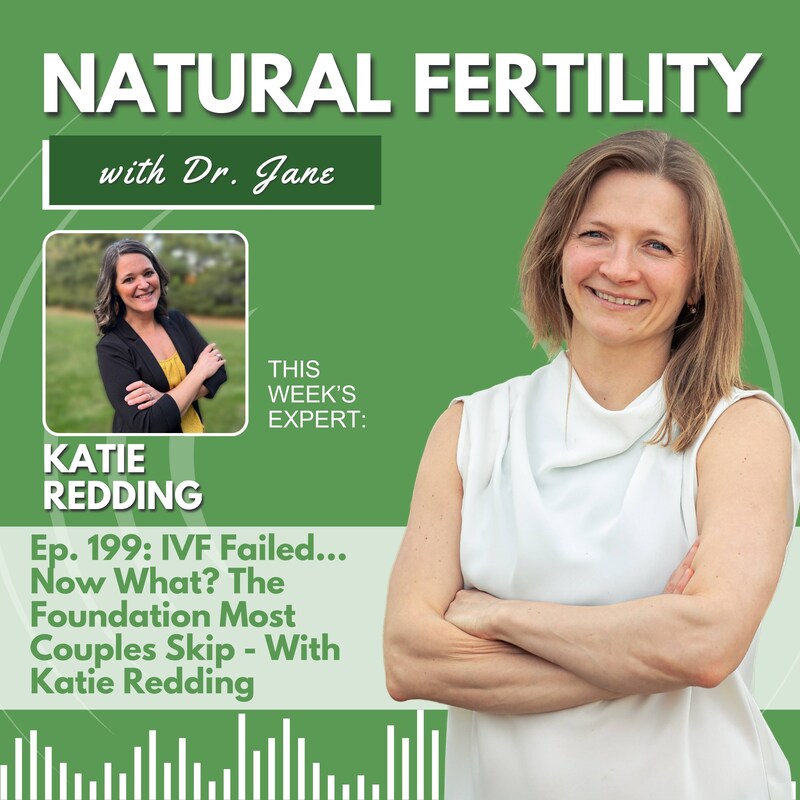
Shownotes
EPISODE SUMMARY:
Too many couples are promised a fast track to pregnancy through IVF, only to end up more confused, depleted, and heartbroken. In this episode, Katie and I break down what IVF was originally designed for and why it cannot override inflammation, poor sperm DNA integrity, blood sugar dysfunction, or immune imbalance. We discuss the emotional toll on both partners and why proper testing changes the trajectory. Fertility is not separate from your overall health, it is a reflection of it.
ABOUT DR. JANE’S PRACTICE:
Dr. Jane is a Naturopathic Doctor and a Natural Fertility Expert. She and her team of expert practitioners help couples navigate infertility for 1+ years, get to the root cause of their struggles, heal, and bring healthy babies home.
After having a family member struggle with infertility and experiencing a miscarriage herself, Dr. Jane realized how little support and education women receive. She is on a mission to change that. Since 2020, she has dedicated her practice to fertility, where she and her practitioners work with couples 1:1, running functional lab work, customizing treatment plans and providing her couples with the support they need to get pregnant, have a stress free pregnancy and a healthy baby.
Learn more about Dr. Jane’s practice: www.drjanelevesque.com/practice
Apply to work with Dr. Jane & her team: www.drjanelevesque.com/application
Join to receive Dr. Jane's weekly Fertility Files: https://link.getcmm.com/widget/form/JStvkHpRAamc7VwPMEQE
CHAPTERS:
00:00 Understanding IVF Limitations
04:59 The Role of Male Fertility
10:03 Quality Over Quantity in Reproductive Health
14:55 The Emotional Burden of Fertility Challenges
19:58 Building a Strong Foundation for Fertility
22:42 The Power of Data in Health Awareness
25:09 Transforming Health Through Emotional Realizations
26:40 Generational Health and Its Importance
29:20 Understanding the Connection Between Health and Fertility
32:44 The Importance of Personalized Medicine
35:51 Transformational Journeys in Health
TAKEAWAYS:
IVF is often seen as a magic solution, but it has limitations.
Many couples feel disillusioned after unsuccessful IVF attempts.
Quality of eggs and sperm is crucial for successful conception.
Emotional burdens of fertility struggles often fall on women.
Men's fertility issues are frequently overlooked in the IVF process.
Personalized medicine can lead to better outcomes in fertility treatments.
Understanding health history is essential for addressing fertility issues.
The foundation of health impacts reproductive success.
Couples should focus on overall health rather than just fertility treatments.
Generational health is important for the future of children.
ABOUT NATURAL FERTILITY:
Pregnancy is a natural process, so if it’s not happening or it’s not sticking, something is missing. Join Dr. Jane, a naturopathic doctor and a natural fertility expert, every Tuesday at 9am for insightful case studies, expert interviews and practical tips on optimizing your fertility naturally.
If you’ve struggling with infertility, pregnancy loss, women’s health issues or just want to be proactive and prepare yourself for the next big chapter in your life… this show is for you.
SUBSCRIBE TO & FOLLOW NATURAL FERTILITY:
Spotify: https://open.spotify.com/show/0WjrEeP...
Apple: https://podcasts.apple.com/us/podcast...
CONNECT WITH DR. JANE:
Website - www.drjanelevesque.com
Instagram - www.instagram.com/drjanelevesque/?hl=en
Facebook - www.facebook.com/dr.janelevesque.nd
YouTube - www.youtube.com/@dr.janelevesque7319
----------------------------------------------------------
Join to receive Dr. Jane's weekly Fertility Files: https://link.getcmm.com/widget/form/JStvkHpRAamc7VwPMEQE
Individualized care is essential for effective treatment of chronic fertility issues.
Transcripts
Hi guys, welcome to another episode of Natural Fertility with Dr. Jane. I'm Dr. Jane. Today I'm joined by one of my practitioners, Katie, a functional diagnostic nutrition practitioner. That's a mouthful, FDNP. We are competing for the highest download podcast today and we're gonna bring you a hot topic. What are we gonna talk about?
Katie Redding, FDNP (:It is a mouthful.
Katie Redding, FDNP (:Yeah, we are going to talk about what IVF can't fix. Yeah.
Jane Levesque (:Yes. And we're going to tie it into male fertility, female fertility as well. But we've had a couple of, I talked about a client that I was just thinking about. You have had a couple of clients recently where they're just, you're confused of why IVF is not working because you're sold that it's this magic pill. And that's the way that you're going to get pregnant without actually doing proper diagnostics and proper.
Katie Redding, FDNP (:Mm-hmm.
Jane Levesque (:you know, treatment preparation of any kind. And we're seeing it that it's actually creating a lot of a mess. So I'll let you kind of dive in and then I'll add my case studies as well.
Katie Redding, FDNP (:Yeah, I mean, we could talk all day on this topic. think, you recently I've seen a lot of couples come to us after going through some portion of the IVF process and they're just very disillusioned by the outcome, which is essentially nothing, right? Like the outcome has been nothing.
Jane Levesque (:or they're in a worse situation.
Katie Redding, FDNP (:Absolutely, you know, and that's what they find themselves in and they they're never told that upfront that your health is not going to get better during this process. It's actually going to get worse. And even if you have high chances, it's still a very, very low percentage that are successful on the first try.
but that's not what they're told, right? They look at statistics and then they get to the end of this process and they're like, my gosh, it didn't work. And then there's a lot of blame, there's a lot of guilt, there's a lot of shame that happens within usually the woman because she feels like she was a failure. And the men are showing up saying, I did everything that I thought they told me to do, you know, I paid for this.
Jane Levesque (:Which is nothing.
Katie Redding, FDNP (:Well, I paid for this process, right? Like they think they're the provider, they play that provider role and they're like, I'm supporting my wife or my partner by helping her achieve her dream, you know.
and making it financially possible, making the environment they live in possible. And both partners get there and then they feel really, really let down. And then they're questioning, it the IVF process or is it me? And that's when they find themselves giving us a call and trying to work through what really could be going on.
Jane Levesque (:Yeah, the heartbreak I think is that women are blaming themselves. Because they're just going, I am so broken that even the drugs didn't work. And it's, I want to really change, I can't tell you how many women I sat in front of who felt a pressure to do the IVF because they were like, I need to provide these children to my family. And it's not even that the husband is putting the pressure on or the grandparents, but you just feel this internal pressure of like, this is what I'm.
Katie Redding, FDNP (:Absolutely.
Katie Redding, FDNP (:Yeah.
Katie Redding, FDNP (:Uh-huh.
Jane Levesque (:meant to do and I can't do this thing like my body is supposed to be able to do it. So it's a very, very big burden to carry, if you will. And then the idea that we have been painted is that IVF is just going to bypass those things and you're just going to be able to get pregnant. And that's, you know, that's not the case. It's not that simple. And I have a,
Katie Redding, FDNP (:Mm-hmm.
Jane Levesque (:a patient that I'm thinking about right now that we're working together where you get to a point where I'm asking her like, do you think it's possible for you to get pregnant naturally? Even like the because she's improving tremendously and she's like, no.
Katie Redding, FDNP (:Mm-hmm. Mm.
Jane Levesque (:And so then I'm like, answer this question and I don't like, you're gonna need to think about it for me. Is it that you don't feel, because once you're pregnant, do you feel that your body is capable of carrying the pregnancy, giving birth, feeding that baby? And if the answer is yes, then what component is it that you feel your body is stuck in? Is it that the ovulation, the maturation of the follicles isn't happening? Is it there's something around ovulation where you feel like your body is not?
you know, not doing something, is it the fertilization component? Is it the traveling down of the tube? Is it the implantation? Like, where do you feel? And I just want her to answer from like, don't think it, what's the first thing that comes? So then I can work with her to see if I can optimize that process. Because it's like, well, how can you trust your system that I will be able to carry this pregnancy and grow this baby and no issues, and I'll be able to birth this baby and I'll be able to.
breastfeed this baby, but no, I can't get pregnant. You know, I'm like, where are we breaking down here?
Katie Redding, FDNP (:Mmm.
Katie Redding, FDNP (:Yeah, and I think we actually do intuitively know things, even though our brain doesn't know them. And so it's a great question to ask because it is a limiting, it's a limiting belief that will limit the progress. I don't think we, we don't talk enough about that part of things. Yeah.
Jane Levesque (:Yeah, let's talk about what IVF can't fix.
Katie Redding, FDNP (:Yeah, well, I IVF was originally, and correct me if I'm wrong, but it like originally created specifically for tubal issues, right? Like it couldn't get through to the uterus. And now we use it for everything. It is literally like, you haven't been successful naturally in six months.
Jane Levesque (:Yes.
Katie Redding, FDNP (:IVF it is. Like there is no evaluation. I can't get over how many people we see that don't have even basic blood work. I know we've talked about this on podcasts before, but like how do we miss something that basic? And we catch things all the time, know, insulin resistance, or not major, but like things that are significantly.
Jane Levesque (:blood sugar, cardiovascular disease. Like we were on a call yesterday and I was like, this guy, I'm wondering if he's gonna make it to 40, let alone have a baby. Like these are really bad numbers. Like your liver enzymes are through the roof. Your cholesterol is through the roof. And then they look at their sperm and they're like, yeah, your sperm is fine. It's like, well, it can't be. It's okay. It's fine within these parameters that the World Health Organization has set, but.
Katie Redding, FDNP (:Yes.
Right.
Katie Redding, FDNP (:And it's not. Yeah, it's not.
Yeah.
Jane Levesque (:When I look at the level of inflammation in this male's body, I'm concerned about a heart attack. I'm not concerned about, you know, sperm quality anymore, which obviously is still impacted, but like, you're not even going to be around for your kids if we don't fix this.
Katie Redding, FDNP (:Absolutely. But you know, IVF is, I want to say it's more of a mechanical type of process where they just rule out the mechanically based issues and if they're all clear, then we move on and they don't look beneath the surface. They don't look under the hood at all of those pieces that create really good egg quality and sperm quality. Those are all ignored. And no matter how great of an IVF doctor you have,
they can never fix the quality of the egg in the sperm. And so many couples come to us with recurrent miscarriage or implantation failure or chemical pregnancies through the IVF process where they got so far and then it failed for some reason. And we go back to what is the quality? It's not about quantity. It isn't about can we put these two pieces together better? It is literally a quality issue, not quantity.
you know, when we, when I work with couples, particularly when I go through that process with the male partner, it's like an aha moment when they're like, so wait a minute, I have a lot of quantity, but you're telling me that, you know, it's my DNA that's actually impacting this. And then you can show that to them in their lab results. And they're like, my gosh, I'd never, no one ever told me that.
Jane Levesque (:Yeah, I think the biggest, when we're not successful through IVF, I have a lot of questions. And one of the questions is, you know, why didn't it work? And let's understand all of those pieces as opposed to you're just gonna try again, we're gonna do a different dose of drugs, we're gonna do whatever. And when it's an embryo quality issue, it is just as much as egg quality as it is sperm quality.
So I can't tell you how many of my patients who are 40 plus, they got blamed that it was egg quality and no one looked at the male at all. And it's like, well, was it a quality issue or was it embryo quality issue? And it was like, it was an embryo quality. Right. So what's going on with the sperm? And then we look at the sperm and the ranges, the reference ranges are set by the World Health Organization for IVF.
Katie Redding, FDNP (:Mm-hmm.
Yes.
Katie Redding, FDNP (:PDF.
Jane Levesque (:not for natural conception. And then I see posts all the time on social media where you're like, you can bypass male fertility issues with doing icksy and you can bypass most of them. It's like, no, you can't. That's crazy. You're telling me because you are a scientist in a lab, you can look at the sperm and pick the best looking sperm. You have bypassed male fertility issues. You have no idea what is in that sperm.
the methylation, the DNA damage, the oxidative stress, you have not bypassed anything. You've picked out the best sperm, but guess what? The egg can do that too. It just doesn't wanna be fertilized by bad sperm. Like literally the egg signals to the sperm, and if that sperm is rubbish, it does not wanna get fertilized by it. And you have all this ego in the IVF community to be like, no, I can bypass this.
Katie Redding, FDNP (:Yeah.
Katie Redding, FDNP (:Yeah.
Katie Redding, FDNP (:Thank
This is completely.
Jane Levesque (:It's like, what are you talking about? Look at the man standing in front of you and you tell me what genetics you're bypassing. You know?
Katie Redding, FDNP (:Mm-hmm. Yeah. I love that you bring that up about the egg send signals. I was sharing that with somebody recently and they, I mean, it is mind blowing how smart God created our bodies to be. Talk about natural selection. Like it is at its finest natural selection. So that egg.
Jane Levesque (:Yes, it's insane!
Katie Redding, FDNP (:can tell if it wants to be fertilized by the sperm. So in some ways, and I've actually listened to a lot of kind of theories on this, but in some ways it's like ethically, are we doing the right thing when we are trying to force this together and force the egg to accept something that it doesn't want to? So I just don't think people are aware of the intricate detail of each step of the process. And then, you know, take a step back further and say, what could I do to improve upon each
step of those processes to make this happen. So, you know, we certainly work with couples that will eventually need some type of assistance, but it comes back to we help them with the foundation. Because whether they do it naturally or they do it with assistance, we want the quality to be good because it impacts the pregnancy. It impacts the health of that child for the rest of their life and then their children. So, you know, we're talking much bigger stakes
then can we just get these two little pieces to come together? It's so much bigger than that.
Jane Levesque (:Yeah, yeah, and there is for sure couples that IVF is not an option because of the ethical concern. And there is no right or wrong. think my job, like, our job as practitioners is just to support you in your journey and help you bring, you know, that baby forward. And there is a lot of different pathways and some people are going to be comfortable with those pathways and others are not.
Katie Redding, FDNP (:Mm-hmm.
Jane Levesque (:I kind of always take the stance of like, you want to have a baby, I'll have you have a baby, but I don't know what that's going to look like. So we're going to start here and then I'm going to see what you're able to do because at the end of the day, I want you to have quality of life. If I have someone coming in and they are already working extremely hard on their health and they're not getting better and they're still, testing some infection spannel and they're just filled with crap. I'm like, what's going on here?
Katie Redding, FDNP (:Mm-hmm.
Jane Levesque (:You know, and now this is a woman that I'm thinking about. like, she went through four and a half rounds of IVF. So she just called the last round because she just felt so terrible in her body. She had such terrible methylation, terrible liver function, terrible gut function. And when you put an insane amount of drugs into a system that's already struggling, that's setting you up for some really high risks of developing cancer, like literally any kind of cancer, cardiovascular disease, metabolic disease, like.
Katie Redding, FDNP (:Thank you.
Katie Redding, FDNP (:Yeah.
Jane Levesque (:autoimmune disease, any disease, because it's just a really big strain on the body. So if we want to do IVF, if that is the next step for us, and maybe that's because there is tubal defects, or maybe it's because we are going to use a sperm donor or an egg donor, or it's there's something else that's, you know, and those are going to be like the biggest reasons why we should be doing it. If it's an autoimmune condition, you can't, IVF is not going to fix your immune system. It's going to make it angry or
they're just gonna suppress your immune system with steroids, which, yeah, I mean, the detrimental effects of that is a whole other story.
Katie Redding, FDNP (:have an effect.
Katie Redding, FDNP (:Yeah, yeah, absolutely. Yeah, so it all comes down to kind of evaluating is this egg, is this sperm, is it, it's usually both in some way.
You know, but I just think about, I had a client a few weeks ago who came to us and she had already gone through two rounds of IVF. The husband was so supportive. Like literally, he would do anything. They were both working on their metabolic health without any guidance. They just were like, we just feel like we need to do this. And the only thing he had done was a sperm analysis and she'd already gone through one round or two rounds, both failed. And because she was 40, they said, you probably need
an egg donor. Never looked any further.
All I had to do was take a look at the sperm analysis, which was 2 % morphology, not even eligible for IVF. I mean, theoretically, they want it at 3 to 4%. And he was at 2%. And he had his hormones were a wreck. You know, his metabolic health was in pretty decent shape, but his hormones were a wreck. Like, there's no way this is going to work for you guys. And it all fell back on her. And I'll never forget, like,
I thought the gentleman was gonna cry because he thought he had been doing everything to support her. And he was, he was doing amazing things, but he just didn't know what was missing. And if you don't know what's missing, you can never fix it, right?
Jane Levesque (:You
Well, nobody told him that he was an issue. So he was just doing things next to her, not optimizing. And I actually kind of made this mistake. I had some feedback from my mentor recently because one of my female patients were working through a urea plasma protocol and I kind of have just been treating him.
for the urea plasma instead of testing him and seeing what else. And so they have a history of very many partners, like 80 plus partners before they met one another. And there was history of STDs and STIs. And even though they're quote unquote cleared now, there's a lot of kind of microbial issues and unwinding of your past life, if you will, to the effect that it has now on your histamine levels, your estrogen levels, on testosterone levels for the male. then obviously,
Katie Redding, FDNP (:and we'd to hear from
Jane Levesque (:the ability to ovulate and the autoimmune conditions that are existent with that. we've, we've done some really good work on her and you could see how like her antibodies are going down and everything. And for him, I was just kind of following the protocols that she needs to do because I'm like, if we unwinding her, I just want to make sure he's not reinfecting her with the same thing, but he might have something that she's not showing up, but it's still triggering her immune system. And so
Katie Redding, FDNP (:Mm-hmm.
Jane Levesque (:down the rabbit hole I go, looking into, you know, seminal microbiome testing, looking into even a proper like, it's called the UTI screen, but essentially it's just screening for infections and doing like a urine culture because if the infection is sitting in the bladder versus in the semen versus in the stool, like we gotta find it. And to help, if we kind of just leave the partner on the side, it...
Katie Redding, FDNP (:testing.
Katie Redding, FDNP (:Bye.
Katie Redding, FDNP (:Mm-hmm.
Katie Redding, FDNP (:Thank you.
Jane Levesque (:they support the woman, but they're not working through their own stuff and that essentially holds them back. So that was a really big aha moment for me just this last week. And so as you were talking about that couple, I'm like, there's so many men who just have no idea and they're kind of told to keep a strong face.
Katie Redding, FDNP (:Mm-hmm.
Katie Redding, FDNP (:Mm-hmm.
Jane Levesque (:because I'm not as bad as my wife. I'm handling it emotionally better. I don't feel like a wreck or they won't even say the things that they struggle with because they see their wife struggle so much more. And I actually want to bring that to the surface because it's, yes, you're going to be better at handling this emotional stress because you're like, you're, I don't want say you're better equipped for it, but you're not as impacted by it for the most part as women are arguably.
Katie Redding, FDNP (:Thank
Katie Redding, FDNP (:Okay.
Jane Levesque (:but it's you know, it's doing.
Katie Redding, FDNP (:Yeah. Well, they have a lot more emotion under there than they think, than they want to let out, right? Like what you're saying. And another couple I'm thinking of recently I worked with, like he was so angry. He was silent almost the entire first call we had together. And there were just two almost outbursts of just anger. And it came back to...
He felt like he was working really, really hard for her to have the outcome she wanted, meaning he was working two jobs to pay for, let's face it, this is not an inexpensive journey. And so I do think the men, I alluded to this earlier, they show up feeling like I'm going to make this happen for her.
Jane Levesque (:cheap.
Katie Redding, FDNP (:probably financially, work really hard, and I don't have to address anything because that's my role. And that led him, they ended up going all the way through the IVF process. He had a lot of faith in the system because he had experience in his family with IVF decades prior. And so he just had a lot of faith. And then when it didn't happen, he was like, everybody's just out to get our money. And it just brought forth so much.
emotion and I don't think he was prepared for that. It comes out as anger. And then also realizing we had to have a really frank conversation about his sperm quality. Again, never told that that was an issue. And it's heartbreaking to me that couples have to experience that to be able to get to their aha moment to be able to move on. So.
Jane Levesque (:Mm-hmm.
Jane Levesque (:Yeah. I just think, you know, when you were like, he had a lot of faith in the conventional system. I just have this like heartbreak because I know I remember what it was like when I realized that the conventional system wasn't going to help me. You know, like I remember the moment it's heartbreaking where you're like, I trusted this doctor. I put so much time, energy, money, whatever into this process and I'm worse.
I'm not better. This person doesn't care. They quit. They left. They told me that I need to have, you know, blood in my stool every time before I can get any testing done. And it was like, wow, you know, so I think it's, it's hard when we trust something.
I don't want to say blindly, but you know, I look at my parents and even my grandma, like there's no way she would ever question the authority. Like she just wouldn't. It's the doctors know I'm going to follow what the doctors say. And they would just keep putting her on more medications that would keep making her sicker and not, you and it didn't lead to anywhere. So it's deep, like it's deep. And I think we're in a place where we have to start questioning it.
Katie Redding, FDNP (:Yes.
Katie Redding, FDNP (:Mm-hmm. Mm-hmm. Mm-hmm.
Jane Levesque (:If you feel like you're being ripped off, it's probably because you are. If something feels fishy as you're going through the process, it's because it is. Like I don't move forward with anything if it feels fishy. I just don't like, and even with my clients where they try to quote unquote pressure me to be like, am I ready? Am I ready? Am I ready to start trying? I would just look at the data and I'm really honest. Like, listen guys, something is still out of whack for me here and I can see it on your data.
Katie Redding, FDNP (:It's a story.
Katie Redding, FDNP (:Mm-hmm.
Jane Levesque (:And I can see that your ANA is still elevated. I can see that there's iron that's still low. So there is an infectious component. And I know you're 45 years old, but if we just go forward with IVF in this state, I'm concerned about the health of that pregnancy and the health of that baby.
Katie Redding, FDNP (:Thank
Katie Redding, FDNP (:Yeah, yeah, and everybody's in a hurry, right? If you're 40 or over, for sure, you want to fast track. And I think that's what IVF promises is you can be pregnant in three months versus if you do this on your own, we don't know how long it'll take or if it'll happen.
Jane Levesque (:Of course.
Katie Redding, FDNP (:So that is one of the shiny parts of IVF that cause us to rush into something rather than saying, can we take a six month break, lay a really solid foundation and then try whether that's naturally or with assistance. So really.
focusing on the foundation. going back to what you said earlier with the labs we were looking at yesterday with that, the gentleman who like, we are worried about a heart attack. Like it is obvious he's headed in that direction at 30, what was he, 30 or 31. And then you think like, okay, so even if you can have a baby, but then you end up with disease or death two years later, like, is that what you want? Like, so.
Jane Levesque (:31, yeah.
Katie Redding, FDNP (:The foundation just matters so much in every way, shape or form that we can talk about the fertility conversation.
Jane Levesque (:Yep. Yeah, and I think if you root yourself in data, it's going to be really difficult for you to be misguided.
Katie Redding, FDNP (:Me too.
Katie Redding, FDNP (:Well, that's, the gentleman that I've been talking to recently where we, I say, look, here are the labs that you submitted to us. Let me go through them and share this information with you. That is what, that's what gets them. That's what opens their eyes and says, holy cow, we have been missing something really important. But then that leads to a lot of emotions that they have to deal with of, of coming to that realization that, that you've been lied to.
Jane Levesque (:that you've been lied to, that you're not perfect.
Katie Redding, FDNP (:But also that just there was more they could be doing even though they didn't know. Like I think that's important to understand. Like we're not, we're not like pushing blame on this is the male's fault and he should have known better because they don't tell you throughout this process. Your doctor doesn't tell you, your GYN, your fertility specialist. They don't have the time, energy or resources to dig deeper, unfortunately. It's just the way the system is. But these gentlemen show up and for the first time are hearing this really difficult news and then they have to process that.
like I could have been the one holding this process up. That's really hard. But the data significantly helps, but the data also helps to track it too, right? Like we can look at it from the negative, my gosh, it tells me all these bad things. Or we can also look at it from, now we have this baseline and we can make changes and then recheck it. How?
Jane Levesque (:yeah.
Katie Redding, FDNP (:I mean, you've seen guys just light up when they see that their hard work actually paid off and that they're going in the right direction. So, you know, using data. Yeah.
Jane Levesque (:You feel significantly different when your data changes, right? Like you don't realize it because it's a slippery slope. But when you have made the changes, you feel significantly different when your liver enzymes are not elevated, when your cholesterol is intact, when your blood sugar is regulated, you feel different. And I root into data more and more because it just, sometimes you're like, this is the best I have ever felt. And then it's like, yeah.
Katie Redding, FDNP (:Mm-hmm.
Jane Levesque (:but there's still all these things that are elevated and you just have never actually felt really good. And that's okay, but I'm gonna show you how. Yeah, there's another layer for it. And this is where we get into like breaking some limiting beliefs where you're just like, didn't...
Katie Redding, FDNP (:How much better are you going to feel?
Jane Levesque (:realize how crappy I felt. And it's this shedding, if you will, of this old person and personas and you know, even character traits that you've had in these beliefs that you've had about yourself. As you go through this process, because you go, my God, there's this whole other thing that I didn't realize existed. And I think about it as, you know, something that when I first started this in the fertility space six years ago, it was
Katie Redding, FDNP (:Mm-hmm.
Katie Redding, FDNP (:Mm-hmm.
Jane Levesque (:I want to help people build generational health. Like, I want you to have healthy children. And I've seen plenty of people who did not struggle with fertility in any way, shape or form, suffer through pregnancy, suffer through postpartum, and then suffer with their children.
Katie Redding, FDNP (:Mm-hmm.
Jane Levesque (:And that's the pain that's the worst because when I had a three-year-old in clinic who had severe EDHG and rage where he would be running after his mother with a knife, you're like...
Katie Redding, FDNP (:Mmm.
Jane Levesque (:Can we hold back? Can you tell me about what happened in pregnancy? Can you tell me what happened during labor? Can you tell me what happened in preconception? And there were so many red flags, like so many red flags in terms of the depletion that she had, the irregularity of her cycle, the way that that baby came into this world. Like that's when I was like, yeah, no, we can, there is so much that we can do to prevent and to support. And we can do that by looking at data.
Katie Redding, FDNP (:Thank
Katie Redding, FDNP (:.
Thank
Katie Redding, FDNP (:Mm-hmm.
Jane Levesque (:Because if I look at a pregnancy and I see high inflammation or I see blood sugar dysregulation, I'm worried about the health of that child and their metabolic health. You know, like it's painful as a mother because to see it and to go through it and it's not to blame, but to just to...
Katie Redding, FDNP (:Yeah.
Jane Levesque (:bring context and awareness that absolutely preconception care is the most important thing that you can do for the health of your child, let alone like just to improve your own quality of life.
Katie Redding, FDNP (:Thank
Katie Redding, FDNP (:Mm-hmm.
Absolutely. Yeah, that also goes back to just like you mentioned earlier about we trust our doctor kind of blindly. Like we've been trained to do that. We also just link disease to it happens. Like, we got bad genes and it just happened. I see so many kids with eczema at like four months old, six months old. Like they haven't even been around long enough to...
Jane Levesque (:Yes.
Katie Redding, FDNP (:be exposed to something to cause them to be allergic to something and have this entire immune response. So it came from somewhere, right? So asthma, allergies, eczema, PCOS, right? Some of these processes don't show up till later when your daughters start having a period and then you're like, why do they have PCOS? Why do they have all these other inflammatory conditions? So.
Jane Levesque (:Dej Deem.
Katie Redding, FDNP (:We have to start looking at the things that we do, the way that we live affects our actual selves, right? We're talking about cellular health and that foundation. We have to start asking better questions and looking at data and then making changes based on that.
Jane Levesque (:Yep.
Jane Levesque (:Yeah, I think it's really hard for people to zoom out because we were just kind of living in the immediate world and you're like, I'm not thinking about these. then honestly, like I've always been that kind of person in the homeopathic world. I'm a bird, which means I can zoom out and I can see things. And I, as a teenager, or even as a, you know, a young adult in my early twenties, it was like, I didn't really fit in because I'm like, why would you do that?
Katie Redding, FDNP (:Yes.
Good.
Katie Redding, FDNP (:I
Jane Levesque (:I could see the consequence of that and I don't wanna do that. So it felt very against me, but then I felt very lonely. And I battled with that a lot to try to fit in, then like, but I don't wanna keep doing that because it doesn't make sense. And the consequence of our action is so much deeper than, I went out drinking and so the next day I'm not feeling well and that's it. There's so much in when couples are sitting in front of us like for the initial consultation.
Katie Redding, FDNP (:Yeah.
Thank you.
Katie Redding, FDNP (:Yeah.
Jane Levesque (:they're always so surprised of like, went so far back. Like I just thought you were going to talk to me about fertility and correct me if I'm wrong, but you had a male patient recently who was like, why are we talking about this? I just want to know about fertility. And it's like, we're talking about it because your sperm is a direct reflection of everything that you've done in your health. And so if your liver enzymes are elevated, if your blood sugar is elevated, if your inflammation is through the roof,
Katie Redding, FDNP (:Yeah.
Jane Levesque (:That's going to reflect in your sperm. Because your sperm is what the body makes with the tools that it has. So if the tools that it has is not very good because they're so inflamed, or the nutrients that you have, then that's going to be a reflection of the sperm. We have to stop looking at fertility as this fragmentation of your health. Like, it's just the reproductive system. What are you talking about? It's just the reproductive system. How do you think the reproductive system works? If I pull it out of the body, do you think it's going to work on its own?
Katie Redding, FDNP (:Mm-hmm.
Thank
Yeah.
Katie Redding, FDNP (:Yeah, continuation.
Katie Redding, FDNP (:Yeah, yeah. Yeah, we have to go back super far. And I think about for my own kids, mine are bigger now, but I'm already thinking about, my son is almost 20 and he's got a almost fiance. yeah, but we talk about, I'm like, he was doing something the other day and I'm like, I'm worried about your fertility. And he's like, mom.
Jane Levesque (:No, that's crazy. we, the fragmentation has to stop.
Jane Levesque (:Cool.
Katie Redding, FDNP (:I'm not even thinking about kids. And I'm like, I am. And I also know your history because I'm your mother. And I know how many antibiotics you had as a child because he had terrible ear infections. Before I knew anything about functional root cause wellness, I just think about with my own kids, so many, I wish I just could go back and make that change, but I can't. So what can we do differently now? And what ways can we optimize now to make their future better?
But when we're working with clients, we have to go really far back because infections could be from 20 years ago. antibiotics. Right. And you, has become your normal, the way that you feel has become your normal and you don't know anything different. So if we don't go back to figure out what that root cause was and to find which factors are contributing to your health today, then we cannot fix them. So we have to dig deep.
Jane Levesque (:You just learned to live with it.
Katie Redding, FDNP (:We have to, know, we meet initially for kind of a get to know you session to make sure we're a good fit with clients, but then the session after that is where we dig deep in that initial consultation. And sometimes our clients don't understand why we have the process that we have, but it's because we have to go deeper and we also don't want to overwhelm. Like we can't, if we're meeting you for the first time, we're gonna talk about some of this information, but we're not, we're not.
That's not the time and space to go deep. We need to kind of split that up and we have two separate sessions to do that. So it is important for our recommendations to our clients to be able to give them very specific recommendations based on their health history, not based on this research says this would be good for you. We want to look at them individually and then be able to make specific recommendations.
Jane Levesque (:Yeah. And it might be that it's don't get me wrong. We're deep into research and we love the papers, but at the end of the day as clinicians, have to treat the person sitting in front of us. And just because the research came out for this, what's the profile? Like I remember one of the papers was like, if you used NAC, the women that were used NAC, so N-Acetyl-Cysteine at 300 milligrams for seven days, noticed an improvement in X, Y, and Z.
Katie Redding, FDNP (:Right, was not even therapeutic.
Jane Levesque (:And was like, imagine if they actually used the proper dosages. They knew, like they did some testing, right? Like they looked at the nutrient panels for these women and saw, well, like the women that didn't see an improvement, is it because 300 milligram dose was too low? Is it because NAC was actually not the right molecule for them to increase the glutathione? Is it because...
they don't actually need it and that is not the molecule that they need. It's more glycine or the actual glutathione component. Like there's so many issues there where there's so many variables. And so you can look and say, yes, NAC is really great in it. But then in practice, if you have someone who every time they take NAC, they get a stomach ache, are you going to just give them NAC? Hopefully as a clinician, you're not. And so you're going to try to find ways to help them build that molecule more naturally, or you're going to...
Katie Redding, FDNP (:There's so many variables.
Katie Redding, FDNP (:Perfect. Yeah.
Jane Levesque (:Do know like you're going to incorporate different proteins, you're to add glycine and glutathione, and you're going to be able to see that through doing the testing and then like the actual experience with a patient. You know, and then eventually you get more of an intuitive sense. When I see someone, I go, yeah, she's not going to be able to handle NAC. Let me give her this. And I can do that by looking at the labs and then having the past clinical experience where the...
Katie Redding, FDNP (:different pictures.
Yeah.
Jane Levesque (:the quick fix mentality of like, but I want, like, why don't you ask me all the history now? Why don't you just get all the information now? That's the opposite of the space that we create to develop a deep emotional connection with you because we need to do that. So you trust us because we're gonna go on a big transformation. Like, I don't know if you know this, but this is gonna change your life. And it's not the transactional.
Katie Redding, FDNP (:Yeah.
Thank
Katie Redding, FDNP (:Mm-hmm.
Jane Levesque (:relationship that you have with your IVF doctor where I paid the money and I didn't get a baby or I did get a baby grade. That's my ROI. It's like, no, no, no, this is a transformational journey. I can't even see you having a baby until all those liver enzymes are regulated, your blood sugar, cause it's a mess. And I know what that pregnancy is going to look like. And I know what that postpartum is going to look like in the health of that child. And I ethically don't feel right going, yeah, go ahead. Just
Katie Redding, FDNP (:video.
Jane Levesque (:have the baby and see what happens. Because I know what happens, you know? And it's hard to have that conversation, but I'm like at a point in my life where it's like, listen, if it doesn't resonate for you, that's cool. Here's what I'm doing. If you want to come and you want to actually like change your life and the trajectory of it and build yourself the family that you're dreaming of, all of that stuff, I'll hope you do that.
Katie Redding, FDNP (:Yeah.
Katie Redding, FDNP (:Mm-hmm.
Jane Levesque (:If you just want to have a baby, because that's all you want to do, I'm probably like, we're not the right team to help you, you know?
Katie Redding, FDNP (:Yeah, yeah, I think that's a good distinction. It's important. And a lot of when we look at the medical based world, when we look at IVF in particular, it is a lot of based on research and articles. And while those subjects are real people in their studies, like you mentioned, we don't know the variables associated with their success or their failure. And that's where
actual experience matters rather than in theory. And I see a lot of couples basing so many decisions off of theory rather than experience. Even down to, you know, they're taking a ton of supplements that they heard, again, based on theory, they needed, but.
Jane Levesque (:Yes.
Katie Redding, FDNP (:they don't know if they need that dose or that supplement at all like you just said. So you know that's what we're here for is to help work through all of that and help evaluate what you need in particular not just in theory. And I actually had a doctor. Yeah.
Jane Levesque (:Mm-hmm.
Jane Levesque (:And there's so many different forms of things, right? Like I was thinking about, people are like, well, can I take this Burberry and it's cheaper? No, because it doesn't work. And here's how I know, I've tried it and it didn't work, right? So I've tried it, I got sick, I looked at my data, I looked at my analysis, my stool analysis before and after, and it did nothing. So no, I'm going to save you a lot of time, energy and money. And I'm going to tell you to get this thing that's exactly the
Katie Redding, FDNP (:Yeah.
Yeah.
Katie Redding, FDNP (:Yeah, absolutely.
Jane Levesque (:the one that works and sometimes it changes and then it's like, this used to work and now they changed something in the formulation and it doesn't work. We're doing that. Like, you you should see my cupboards of supplements. Yes, yeah, yeah.
Katie Redding, FDNP (:Yeah.
Katie Redding, FDNP (:I have a little pharmacy in my dining room, like a cabinet. And even you try something and you're like, well, that's out and I'm not gonna recommend that brand or that type. My dad, had a conversation with him last night and he was like, I don't think supplements work. And I said, dad, you're taking one from Walmart that's been sitting on the shelf for six years and is made of all synthetic disgusting crap. Of course it's not going to work.
You know, right. And you have expensive pee and it's, anyway. I had a doctor that used to say, because before I made this transition in my mindset over to more functional health, I had one doctor that actually stopped me and said, listen, it doesn't matter if I think this medicine will work for you because it it worked for somebody else. He said the proof is in the pudding.
Jane Levesque (:It's actually making things worse, right? Like, yeah.
Katie Redding, FDNP (:Right? Like when it works for you, then we know it was good. And so we need to get to personalized medicine so that we can get results. Yeah.
Jane Levesque (:Yep, I love that. wanna do, do you wanna finish with that? Cause that's good. Personalized medicine to get results. And if you guys, if you want personalized medicine, you wanna go on a transformation, you can fill out an application to work with us and that's linked down below. And then our, you know, our fertility strategist will be in touch and see if we can help.
Katie Redding, FDNP (:Yep, we need personalized
Jane Levesque (:And if we can't help, we always try to point you in the right direction. Cause I genuinely like, I'm just such a proponent for the body. I think the body is so incredible and I hate hearing women and men just give up on themselves and go, that's the way that I am. And that what actually tells me is that the infections, the pathogens, the toxins are overburdening you. Cause I say human cells are happy cells. And if you didn't have a bunch of this toxic load that you're not even aware of.
Katie Redding, FDNP (:Yeah.
Jane Levesque (:you would never have thoughts like that. And the problem is that some of the people that we admire on the internet are actually filled with those things as well. And you like, they just have a nicer package and you think, well, I should be like this. And it's like, no, this guy's brain is full of lead. Like I can tell, you know, or like he's full of parasites or whatever. So.
Katie Redding, FDNP (:Yeah.
Yes.
Thank you.
Katie Redding, FDNP (:Yeah.
Katie Redding, FDNP (:Mm. Mm.
Jane Levesque (:I think individualizing and understanding that it's your own unique journey and to just try not to compare as much as you can will actually do you a lot of good. And then like I said, human cells are happy cells. You would never have negative thoughts about yourself if you didn't have this load. And I've seen it, you know, so many times now where I detox lead and he literally becomes a different person or she becomes a different person. And you're like, there you go. That's who you were meant to be. That was lead. Let's get that.
Katie Redding, FDNP (:Mm-hmm.
Jane Levesque (:shit out of your body. It's not meant to be there.
Katie Redding, FDNP (:Yeah, we certainly don't want it there for pregnancy to create a baby.
Jane Levesque (:We certainly don't want it there for pregnancy. Well, then you see it in the babies. When I see lead in a five-year-old, I'm like, what the fuck? Yeah, we're...
Katie Redding, FDNP (:Yeah, where did that come from? That we've removed it from our environment like they're not eating the windowsills anymore. Yeah.
Jane Levesque (:Yum.
Yes, yeah, yeah, yeah, exactly. Well, thank you, Katie. What a wonderful conversation we had today. And we'll be back next month. Thanks guys for tuning in and we'll see you next week.
Katie Redding, FDNP (:Yeah, thanks for having me.




