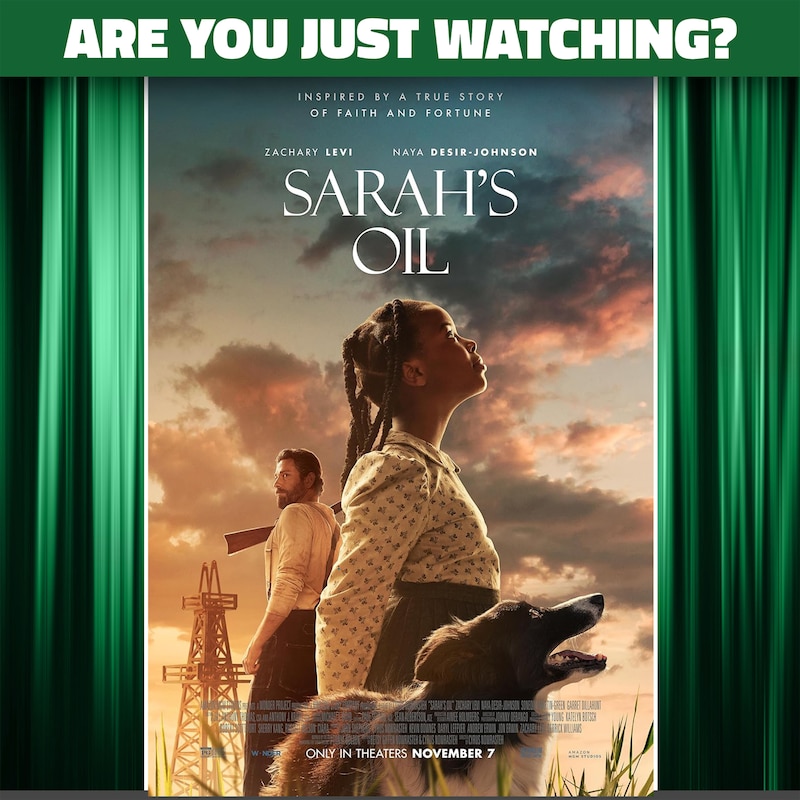
Shownotes
This Christian review of Sarah’s Oil explores historical accuracy, faith, justice, and discernment, helping viewers watch with wisdom and a biblical worldview.
Are You Just Watching? Episode 167: Sarah's Oil
For the full show notes please visit areyoujustwatching.com/167
Share your feedback!
We would like to know, even if just your reactions to the trailer or the topics we shared in this episode. Or what general critical-thinking and entertainment thoughts or questions do you have? Would you like to suggest a movie or TV show for us to give a Christian movie review with critical thinking?
- Comment on the show notes
- Call (513) 818-2959 to leave a voicemail
- Email feedback@AreYouJustWatching.com (audio files welcome)
- Join our Facebook discussion group.
- Join our Discord server.
Sarah’s Oil turned out to be a surprisingly rich movie to review—both as a historical drama and as a story that pushes Christians to think more deeply about character, truth, and perseverance. Eve and I found ourselves returning to themes familiar to longtime AYJW listeners: the intersection of faith and movie, the tension between real history and storytelling, and the challenge of Christian discernment in a culture shaped by entertainment. Like movies we’ve discussed in past episodes such as Harriet and Hidden Figures, this movie uses a real-life figure—in this case, Sarah Rector—to explore issues of justice, hope, and integrity. So as we unpack this movie, we’re not just revisiting old territory; we’re pressing into what it means to watch with purpose in a world where “inspired by a true story” rarely means the whole story.
Takeaways:
- The podcast delves into the challenges of distinguishing fact from fiction in films based on historical figures, raising questions about trustworthiness.
- The hosts express their initial skepticism regarding the movie, 'Sarah's Oil', which diverged from their usual cinematic preferences and expectations.
- A significant discussion centers on the portrayal of Christian themes in the film, highlighting the complexities of cultural representation versus genuine faith.
- The episode emphasizes the importance of critical thinking about historical narratives, especially in movies that blend entertainment with educational content.
Transcripts
When a movie fleshes out the life of a private historical figure, can we trust it as true?
Speaker A:Are you just watching episode 167, Sarah's Oil?
Speaker A:Welcome to the podcast that shares critical thinking for the entertained Christian.
Speaker A:I'm Eve Franklin.
Speaker B:And I'm Tim Martin.
Speaker A:And we're doing something a little different this month.
Speaker A:This isn't our usual kind of movie.
Speaker A:We're usually dealing with more action, adventure.
Speaker B:Or, yeah, popcorn movies.
Speaker A:I don't know, drama of a different sort.
Speaker A:Yeah, I probably would not have gone to see this movie if you hadn't brought it to my attention.
Speaker A:It was not something on my radar at all, in fact.
Speaker B:Yeah, mine.
Speaker B:Mine either.
Speaker A:I wasn't even sure I was going to make it into a theater to see it because when I first rattled off the movies that were in my theater, it was not among them.
Speaker A:And then you were like, well, how about Sarah's Oil?
Speaker A:And I'm like, it's not at my theater.
Speaker A:It did end up coming to my theater.
Speaker A:It just came like the day it opened instead of being previewed.
Speaker B:The movies you listed, I was like, man, I'm not really interested in any of those.
Speaker A:Well, they were the only ones that were not rated R. Yeah, exactly.
Speaker B:They're real slim pickings this month.
Speaker A:Well, not until later in the month.
Speaker A:Yeah.
Speaker B:But I pulled up, you know, one of those second party sites of new releases and this one was on there and Zachary Levi was on the poster and I was like, how is there a movie with him in it that I wasn't aware of?
Speaker B:So I started investigating and that's when I suggested it.
Speaker A:He actually came onto one of my news commentary shows that I watch and he was on.
Speaker A:Yeah, because it was before I went to see the movie and I didn't realize that he was the actor that was in the movie until at the end when they, you know, they asked him if he wanted to shout anything out at the end.
Speaker A:And he was like, oh, yeah, I've got a movie coming out this week called Sarah's Oil.
Speaker A:And I'm like, oh, he's in it.
Speaker A:Yeah.
Speaker A:I didn't realize that he was conservative.
Speaker A:So that was kind of nice to.
Speaker B:Yeah, it's always nice to know that, to learn, you know, that one of the actors you like is at least a little like you.
Speaker A:Yeah.
Speaker A:So anyway, this isn't the type of movie that I normally go to a theater to see.
Speaker A:I would normally, like, watch it as a streaming later or something.
Speaker A:It's not something I would typically spend money on, but, you know, you mentioned it.
Speaker A:It seemed like a good flick, and I actually enjoyed it.
Speaker A:I don't dislike period historicals.
Speaker A:I mean, the ones I've watched, I've usually enjoyed.
Speaker A:It's just not a genre I follow closely.
Speaker B:Yeah, yeah.
Speaker B:It's understandable.
Speaker A:It did seem a little bit more Christian than I was expecting on its face.
Speaker A:But then when you watch the movie, I kind of.
Speaker A:And we're going to deal with this in a theme.
Speaker A:I'm not entirely sure they were going for, like, Christian thematically, like a Christian movie.
Speaker A:It was more like Christian, cultural Christian movie.
Speaker A:So kind of a different spin on Christianity.
Speaker A:And we've dealt with that a little bit in the past.
Speaker A:I mean, when we did the movie Harriet, which was about Harriet Tubman, she came across as kind of more of a cultural Christian.
Speaker B:Right.
Speaker A:Than a believer, you know, kind of thing.
Speaker A:And I kind of feel that that's kind of what was going on in this movie as well.
Speaker A:So.
Speaker A:Yeah, similar vibes, similar types of characters, honestly.
Speaker B:Yeah.
Speaker B:Yeah.
Speaker B:Similar time frame.
Speaker B:I mean, similar.
Speaker B:What, 30 years separate the two?
Speaker B:Or 40 years.
Speaker A:40 years, yeah.
Speaker A:Harriet was before the Civil War, so I enjoyed the movie.
Speaker A:I thought it had enough drama, enough tension to keep you on the edge of your seat.
Speaker A:Even though I was laying back in a lounger.
Speaker A:I love those loungers.
Speaker A:They're so comfy.
Speaker B:I'm jealous.
Speaker A:Not only was I laying back in a lounger, but it was a heated seat, so I could, like, turn on the little button and go, now, see.
Speaker B:I go to sleep.
Speaker B:That would be bad for me.
Speaker A:But I did enjoy the movie.
Speaker A:I think that, you know, it was kind of an established outcome.
Speaker A:So that kind of made it a little bit less suspenseful because you kind of knew.
Speaker A:Yeah.
Speaker A:There was nothing in there that was kind of like, oh, no, they're gonna kill her, or no, you know, all that stuff was kind of a given that she becomes the richest little black girl in the country.
Speaker A:So you knew none of that was gonna happen.
Speaker B:Someday somebody's gonna make a historically true movie and they're gonna completely change the ending just to mess with everyone.
Speaker B:Yeah, the Titanic made it into port.
Speaker B:What are you talking about?
Speaker A:Alternate reality.
Speaker A:There's a lot of those, actually.
Speaker B:True.
Speaker A:There's some that, you know, that changed the history of, like, you know, whether the Nazis won the war and that kind of stuff.
Speaker A:So it's done.
Speaker A:They're just not historical.
Speaker A:They're alternate reality.
Speaker A:Yeah.
Speaker A:So other than that, my only other comment, you know, before we get into a theme discussion, was that while the movie Is pg.
Speaker A:There is some stuff in there I think that you would want to be careful with taking young children in to see.
Speaker A:It's not necessarily a bad movie per se, but there are some bad characters in the movie and.
Speaker B:Yeah, some sad things.
Speaker A:There are some sad things.
Speaker A:There's some racial slurs.
Speaker A:There's some things like, you know, drinking and that kind of stuff.
Speaker A:So I would just say handle it with care.
Speaker A:I mean, it should be safe enough for the age that Sarah is in the movie, like 10 and up.
Speaker A:But I'd be careful going any younger than that, to be honest.
Speaker B:Yeah, but, Eve, we haven't talked about the music.
Speaker A:Yeah, there's a problem with the music in this movie.
Speaker A:At least a problem for us discussing it.
Speaker A:They have not released a soundtrack for this movie.
Speaker A:There is nothing out there.
Speaker A:I looked and looked and looked and looked, and I was like.
Speaker A:I remember hearing music while I was watching the movie.
Speaker A:It didn't really make a massive impression on me.
Speaker A:But I can't go listen to the soundtrack afterwards.
Speaker A:So I'm kind of stuck without.
Speaker B:I remember specifically thinking, hey, I like this.
Speaker B:And the composer and the only reason we know this is off of IMDb is Kathryn Bostic.
Speaker B:But, boy, looking at her list of movies, I don't see any that we've reviewed in the past.
Speaker B:Yeah, I'm gonna keep watching for the soundtrack to come out, I think, because I'd like to hear it again.
Speaker A:Yeah, there were a lot of songs that I think that were written specifically for the movie, and it did have a lot of that kind of like, black spiritual kind of sound to it, which fits the movie.
Speaker A:But to be able to play it for you is going to be difficult because there was only one song that I could find that I could buy, and it's not one I really wanted to purchase.
Speaker A:So this is gonna be one of the movies where we don't play a soundtrack for you.
Speaker A:I'm so sorry.
Speaker A:But, you know, it is what it is.
Speaker B:Should I sing?
Speaker B:You know, just to fill in?
Speaker A:Well, they can go see the movie for themselves.
Speaker A:I would imagine this movie's gonna end up on Amazon prime fairly quickly.
Speaker B:Yeah, it is an Amazon production.
Speaker A:I think we both went on opening weekend, actually.
Speaker A:I went Monday, so it opened on Thursday.
Speaker A:I went Monday night.
Speaker A:And there was very few people in the theater.
Speaker A:And in fact, I think there were four older ladies that sat on the same row as me and two other couples, and that was it.
Speaker A:Wow.
Speaker B:We went to a 205 showing on veterans Day and our theater was half full.
Speaker A:Wow.
Speaker B:But, you know, Norfolk is a predominantly black neighborhood overall, so that doesn't really surprise me.
Speaker B:And it was a Norfolk theater, so.
Speaker B:But I wish I had seen more kids in there because I. I think this is a movie that, you know, young teenagers, pre teens, I think they really could have gotten inspiration from.
Speaker A:Yeah.
Speaker A:I mean, and we'll get into this in the discussion.
Speaker A:I'll let you get to your.
Speaker A:Yeah.
Speaker A:Initial impressions first.
Speaker A:But I think that there's a lot in this movie that is attributed to Sarah that in real life she didn't actually do.
Speaker A:So while it is possibly she does sort of make a decent role model for young girls, at the same point, a lot of that is fictionalized.
Speaker A:So it's kind of like, you know.
Speaker B:Maybe unlike you, I'm a sucker for historical movies.
Speaker B:I have a history of being a sucker for historical movies.
Speaker B:And I really enjoy movies with coming of age protagonist because it's a sense of wonder that that doesn't easily fit into a lot of other movies.
Speaker B:And once you throw Zachary Levi in, like I said earlier, I was sold.
Speaker B:I probably would not have gone to see this in the theater had it not been the fact that we were doing this movie this month.
Speaker B:But I'm glad I did.
Speaker B:I enjoyed the movie too.
Speaker B:It was a feel good movie.
Speaker B:And though we dove into the actual history to look at fact versus fiction, I really feel like it.
Speaker B:The feel good nature of it was as true to current events as it needed to be.
Speaker B:So I like that.
Speaker B: om history that racism in the: Speaker B:And I would almost go so far as to say unchecked.
Speaker B:People would use racial slurs and make racial comments and no one of the same persuasion would bat.
Speaker B:And I, we still have that kind of thing today, but not nearly as bad as it was back then.
Speaker B:And the movie, I think, handled the racism well.
Speaker B:It included it, but it didn't beat us over the head with included it enough just to make sure that we saw that it was there and was part of the story, but was not the entirety of the story.
Speaker B:It certainly is a foundation to what happened with Sarah's oil and even more so in real life than in the movie.
Speaker B:But the movie was about Sarah Rector and her family and Bert and Mace, really.
Speaker B:And I appreciate that they went out of their way to.
Speaker B:To focus on that.
Speaker B:I liked how they integrated Faith gently into the movie.
Speaker B:It wasn't overwhelming.
Speaker B:It really did reflect more of the cultural truth of a Freedman black family in early 20th century Oklahoma Territory.
Speaker B:Well, Oklahoma, I don't think it was still a territory at that point.
Speaker A:That was actually the point of the land allotments was because.
Speaker B:That's right.
Speaker A:They needed to have to break it up because it was a state.
Speaker B:Yeah, it felt authentic to me, and I like that.
Speaker B:Of all the characters, the only one that I really had any creative problem with was the oil baron composite character.
Speaker B:He, like some of the other characters in the movie, he was representative of the entire industry and how they treated not only Sarah Rector in real life, but many of the children who had been given land in Oklahoma as part of the allotments that ended up having oil.
Speaker B:His name was Devnan, and he was played by Garrett Dillahunt, who's somebody I like as an actor.
Speaker B:I very much enjoy his work.
Speaker B:But the character was written sort of one dimensional or two dimensional, depending upon how many dimensions we're talking about.
Speaker B:I did like how they played it early on in the movie that when they first introduced the character, they played it to show that he wasn't racist.
Speaker B:We just come to learn later in the movie, he may not be racist, but he's still a jerk.
Speaker B:He's still evil through and through.
Speaker B:But, you know, I. I liked it.
Speaker B:I had sympathy for the right characters, and it was a really good movie.
Speaker B:Something I wouldn't mind sitting down with my grandkids and watching and using it as a springboard to talk about what it really was like back then.
Speaker B: ong ago because it was in the: Speaker B:It's ancient history.
Speaker B:To a teenage me, it was like the same as, you know, ancient Greece and Aristotle.
Speaker B:And I appreciate that they capitalized on having access to the family when they were filming this too.
Speaker B:It really did help with the authenticity for me.
Speaker B:And though, like we said, they took quite a few creative liberties, including giving Sarah a lot more.
Speaker B:Not agency.
Speaker B:That's not quite the right word here.
Speaker B:A lot more activity in the movie than it seems she had in real life, it.
Speaker B:It still felt good.
Speaker A:Yeah.
Speaker A:Yeah.
Speaker A:And we'll kind of get into that a little bit more too, because our first theme will deal with that.
Speaker A:But before we get to that, let me encourage everybody to support our podcast.
Speaker A:We've seen a kind of a bump in our listenership over the last couple months, but not any response from anybody.
Speaker A:We'd love to hear from you if you're a new listener, if you've just discovered us.
Speaker A:And we'd love to get feedback from you and be able to touch base with some of the people that have been downloading our past episodes in the last couple months.
Speaker A:So we'd love to hear from you.
Speaker A:But you could support our podcast financially if you so desire by going to are you justwatching.com patreon or patreon.com are you just watching?
Speaker A:And we do want to thank our current patrons, Isaiah Santiano, Craig Hardy, Stephen Brown II and David Lefton for giving to us generously on a monthly basis.
Speaker A:And to be honest, we were thinking about actually stopping this podcast this year, but the Lord has just not released us from it.
Speaker B:I guess he's not done with us yet.
Speaker A:So we're still plugging away and we'd like to take it to the next level.
Speaker A:We'd like to figure out how to get video on YouTube and maybe even start some memberships that way.
Speaker A:And, you know, being able to do that means more time, more money, and, you know, a greater commitment on both of our parts.
Speaker A:So, you know, if something you want to see us do and you want to continue to support us, so we could probably use a couple more patrons on Patreon to make that possible.
Speaker A:So anyway, just let us know if that's something you're interested in doing.
Speaker A:You can give us feedback by going to the show Notes for this episode, which will be at are you just watching.com167?
Speaker A: -: Speaker A:You can email feedback at Are you just watching dot com.
Speaker A:Or you can join one of our two social media groups.
Speaker A:You can come to Facebook, which is are you just watching.com community?
Speaker A:Or you could join our server, which is where we're recording this.
Speaker A:It's at are you just watching.com discord.
Speaker A:That's an invite to Discord.
Speaker A:You have to create an account if you're not already in Discord and it's not been very active there for several months.
Speaker A:But if we start seeing more people coming in, we'll start actually promoting when we're recording again and give people the opportunity to join us live.
Speaker A:So we'd love to hear from you, we'd love to know that you're out there and we'd like to, especially if you're new to the podcast, we'd love to touch base with you and see what you like about what we do and what you'd like to hear from.
Speaker B:Us in the future when you've been doing.
Speaker B:Are you just watching as long as you in particular have?
Speaker B:And I've been doing it with you now, we find that a lot of the themes that we come up with are it's stuff we've done a lot, sometimes to death.
Speaker B:So we are becoming more and more skilled in finding new ways to approach stuff.
Speaker A:You patting yourself on the back, Tim?
Speaker B:No, no, no.
Speaker B:At least I hope not.
Speaker B:But I found myself thinking about the themes for this movie in particular, and as we do with Based on a True Story or true story ones, we usually do research into it and find out how true it is to what actually happened.
Speaker B:And Sarah's oil is no exception.
Speaker B:And it turns out that Sarah's oil has a lot of inserted elements to it.
Speaker B:And one of the inserted elements is faith.
Speaker B:And it's one of the things that drew me to the movie in the first place.
Speaker B:But as I thought about it, you know, what they did by putting faith in the movie is exactly what are you just watching preaches to think critically about?
Speaker B:In secular movies, we tend to watch for the insertion of humanist themes, and we watch for secular themes that encourage thoughts and actions that are contrary to how we should be living as Christians.
Speaker B:And by considering that through that critical thinking lens, it helps us grow as Christians because we see what they're presenting, we consider how it applies to our life and how the Bible speaks to it.
Speaker B:And that's what we try to help people with.
Speaker B:But I thought to myself, what if Kingdom Story company put the faith in without any evidence to back it up?
Speaker B:Would that be manipulative?
Speaker B:In the trailer, there's a few hints to the idea of faith in the movie.
Speaker B:In both trailers I watched, at one point, Sarah says something along the lines of God gave me ears to hear.
Speaker B:And throughout the movie, there's a number of mentions of the faith of Sarah and her family, in particular her mother.
Speaker B:But there's not really any evidence to support it.
Speaker B:But there's also not any evidence to disprove it.
Speaker B:And I was curious how accurate it would actually be.
Speaker B:I started looking more into whether or not that is a reasonable way to portray that family, knowing nothing else.
Speaker B:And it turns out it absolutely was.
Speaker B:And earlier you mentioned back to our review of Harriet.
Speaker B:And in Harriet, we saw enslaved communities that were very much Christian in nature.
Speaker B:They were very much church communities.
Speaker B:And as it turns out, that plays into it because Christianity was still the dominant religion for Black Americans.
Speaker B:Even 40 years post civil War, the Rectors themselves were Creek freedmen, which is a class of descendants from people who had been enslaved by the Creek nation and then freed at the end of the Civil War.
Speaker B:And on top of even that, in rural Oklahoma, where they were living, the Way I Read said, everyone spoke with a Christian moral vocabulary, regardless of whether or not they lived it.
Speaker B:So even the degenerate gambler among them would still have a Christian moral vocabulary.
Speaker B:So in reality, the level of faith that they portrayed in the movie was a perfectly reasonable supposition, even with no other data.
Speaker B:But the thing is, with the Rectors, we have plenty of other data.
Speaker B: Though: Speaker B:It's like I mentioned, when I was in my teens, I thought the Spanish American War was ancient history.
Speaker B:Sarah Rector died three years before I was born.
Speaker B: in: Speaker B:The family histories are still there.
Speaker B:When people were writing the book that this was based on and the movie was being made, the creative teams and the author, they all had access to people who knew Sarah Rector.
Speaker B:And though she was historically very recluse, very quiet, you know, she didn't reach out to the press or anything, they still had family stories that her nieces and nephews and grandchildren could pull on.
Speaker B:And you actually shared a video.
Speaker A:With.
Speaker B:Me yesterday that's about an hour long interview with five of her.
Speaker B:Five of Sarah Rector's grandkids talking about.
Speaker A:Well, it's, it's actually three granddaughters and one great granddaughter.
Speaker B:Yep, that's right.
Speaker B:But they're talking about, you know, the family stories that are handed down.
Speaker B:So my point is that this wasn't in a vacuum and we can look at this all reasonably and say, yes, they took creative license with a number of things, but they have to, because you can't expect real life to have the pacing and the tidiness that you need for a Hollywood movie.
Speaker B:So really what it comes down to for me, that question is, you know, as Christians, if we were Christian filmmakers, would we specifically be called not to embellish?
Speaker B:And I think we are.
Speaker B:In the Sermon on the Mount, Jesus said in Matthew 5:37, but let your yes mean yes and your no mean no.
Speaker B:Anything more than that is from the Evil One.
Speaker B:And he's speaking to the fact that when we convey information, we should be ensuring it is as true as we can possibly be aware.
Speaker B:Now, if you were to ask me, am I going to Richmond tomorrow?
Speaker B:And I say yes, but then I go out to start my car and the car battery is dead.
Speaker B:Nothing I can do about it.
Speaker A:Well, let me interrupt for just a minute, please.
Speaker A:I think context matters.
Speaker A:So in the context of that verse, he's talking about swearing.
Speaker A:So like not swearing as in saying bad words, but swearing as in saying something that you know is truthful to somebody.
Speaker A:And then instead of saying, I swear by heaven that this is true, you shouldn't have to swear by heaven.
Speaker A:You should be so trustworthy that your yes is yes and your no means no.
Speaker A:There's no concern about whether you're shading the truth or whatever.
Speaker A:I don't necessarily think that has to do with storytelling.
Speaker B:So I would disagree.
Speaker A:I do agree that we should be truthful, but when it comes to telling stories, you know, there's some things where you just have to fill in the gaps.
Speaker A:I mean, there's lots of people who tell biblical fiction stories and we don't have all of the facts.
Speaker A:So you're not necessarily telling a lie, but you're not necessarily telling the truth either, because if you told the truth, there'd be no story.
Speaker A:Yeah.
Speaker B:My point is more along the lines of using those voids to fill in your own message.
Speaker B:So perhaps there was no evidence of Sarah's faith, but they put it in knowing.
Speaker B:Or worse yet, there was evidence that she didn't have any faith and they put it in anyway because they wanted to get that message in there.
Speaker A:Well, I would think that they had.
Speaker A:From what I understand, a lot of the family actually attended the premiere of this movie.
Speaker A:So I don't know that they would have, they would not have been supportive of this movie if it was saying something about Sarah Rector that they didn't believe should be out there.
Speaker A:So I don't know that there, there was anybody in this movie that was out to portray a message that that would have been against what the family desired about Sarah.
Speaker B:You are absolutely right.
Speaker B:And I wasn't trying to say that they were only that we as Christians, even in non swearing situations, that we have a responsibility to be as trustworthy as we can.
Speaker A:Oh, definitely.
Speaker A:Yes, I agree we should be trustworthy and truthful, but.
Speaker A:And I don't see that they weren't in the case of this movie.
Speaker A:Yeah, yeah, yeah.
Speaker B:And I'm glad that they were because I looked at their film catalog and I liked a lot of their films.
Speaker B:So that leads us to how do you fill in what is the purpose of making that movie?
Speaker B:Right.
Speaker B:Because the movie is not going to have the Right.
Speaker B:Pacing.
Speaker B:It's not going to be a nice neat package if you just go totally historical accuracy the whole way.
Speaker B:Just like when we did that review for Monument Men, you know, they had to combine a lot of events and they had to compress the timeline.
Speaker B:So what is the point of making historical movies when you don't have all the facts?
Speaker A:Well, I think, for one thing, the number one reason that you make a movie is for entertainment.
Speaker A:And I feel like sometimes when we deal with historical stuff, we're expecting a biography.
Speaker A:And I don't think any of these movies, like, I thought of several when I was sitting down to try and think of where this fits into the historical genre.
Speaker A:And we've actually dealt with several historical dramas, red tails and 42.
Speaker A:A combined episode I did before you joined the podcast, where I talked about the Tuskegee Airmen from the red tails, and 42 is about Jackie Robinson.
Speaker A:And when I did that combined movie discussion in one episode, it was amazing to me how much was historically taken out of context, but yet they were really good movies, talking about the impact that these very important men had on their culture in our society in general.
Speaker A:And they were entertaining movies.
Speaker A:And then I think of the review we did of Hidden Figures in which we found that there was a lot of liberty taken with it, but yet it presented a story that most people didn't know about.
Speaker A:And so it was both entertaining and educational because it, you know, it piques our interest, and then we go and look into the real people.
Speaker A:So it's useful in that it brings about stories that we wouldn't necessarily be exposed to in a classroom, a historical classroom, where we're dealing with fact.
Speaker A:And because we live in the information world now, once our interest is piqued, then we can go and look for the authentic person that the movie was based on.
Speaker A:And we learn something.
Speaker A:And so it's educational without being academic.
Speaker A:And so it brings stories and history into the lives of people who wouldn't otherwise intersect with it.
Speaker A:So I think it's very valuable.
Speaker A:Yeah.
Speaker A:And I was thinking about that in the context of another movie that's actually one of my favorites that introduced me to the historic genre many years ago, and it was the movie Seabiscuit.
Speaker A:And I'm horse crazy, so anything that has a horse in it is going to draw my attention.
Speaker A:And I also did a review on the movie Secretariat, which is also a movie about a horse, a very famous horse, actually, but heard of him.
Speaker A:The thing about the movie Seabiscuit, I was trying to remember whether I read the book first or saw the movie?
Speaker A:I think I saw the movie first.
Speaker A:And then, which is something that I don't do a lot of, is reading nonfiction.
Speaker A:It's not a genre I really enjoy reading usually, but I actually read the nonfiction book that Seabiscuit was based on, and I came out of it realizing that both the movie and the book were not really about the horse.
Speaker A:And the horse was the vehicle in which the author of the book and the movie that was based on it was trying to portray a picture of what happened to American culture during the Great Depression and how it took an underdog winning under the most impossible odds to garner the interest and the enthusiasm of the American people who had been so utterly depressed by what happened during the Great Depression.
Speaker A:So this movie and book, which were about a horse and the people who took that horse and raced him and made a legend out of him, it was really her way of telling the story about the Great Depression, which my grandmother lived through.
Speaker A:And there are people today who probably don't know their grandmother who lived through it or their great grandmother who lived through it.
Speaker A:We're losing that generation.
Speaker A:And so the only way that we can hear these stories or know these stories is through the fiction that is put out that makes it interesting to us so that we want to know more about it and research it.
Speaker A:And so I think there's value in, you know, framing historical events in the form of fiction because it makes it entertaining, it makes us inquisitive, so that.
Speaker A:I mean, every single time that you and I have done a movie that was based on history, we spend probably much more time than we spent watching the movie in, you know, digging into.
Speaker B:The actual history, trying to understand the actual events.
Speaker A:Yeah, right.
Speaker A:Yeah.
Speaker A:And that in itself is educational because, I mean, when we looked up Sarah Rector on Amazon, it blew my mind how many books have been written about her, and I'd never heard of her ever.
Speaker B:Yeah, so never heard of her before I suggested this movie.
Speaker B:I can't believe I'd never heard of her with as much of a history geek as I am.
Speaker A:So, yes, I do think there is a great deal of value in presenting fiction that represents real history.
Speaker A:And even when it comes to biblical history, you know, there's people who have written biblically based fiction about characters in the Bible that we know very little about, and they make up a lot, lot of the story, because there's not a lot in the Bible about them.
Speaker A:And I think Christians who write such books need to write them with care.
Speaker A:They need to make sure that where the story is in the Bible, they represent the Bible authentically.
Speaker A:But, you know, creative licenses is part of the, you know, the way of bringing that into a form that makes people interested, and then it takes them back to the Bible.
Speaker A:And I think of, you know, where I live, I live in Northern Kentucky, and there's a ministry that built the Ark Encounter here.
Speaker A:And if you go through the Ark Encounter, they will have signs in several places inside the Ark Encounter that talk about artistic license, because the only thing we know about the flood is what's written in the Bible.
Speaker A:But we can infer a lot from science about, like, what kind of animals would have been on board the ark.
Speaker A:But we don't know what the names of the son's wives were.
Speaker A:We don't know what Noah's wife's name was.
Speaker A:We don't know what kind of clothing they wore.
Speaker A:We don't know what they look like.
Speaker A:And so to portray them, we don't.
Speaker B:Know his wife's name.
Speaker B:It was Yester.
Speaker B:I'm sure that's what he called her.
Speaker B:Sorry.
Speaker A:And, yeah, so anyway, artistic license, you know, we definitely have to be realistic about where it needs to be applied, and then we have to be responsible.
Speaker A:We have to be responsible, and then we have to be transparent about where we applied it.
Speaker A:So we're not going to present something that we made up as historically true.
Speaker A:So, you know, as Christians, while I agree with you, we should be trustworthy in the way we deal with the information.
Speaker A:We should be as authentic as possible.
Speaker A:And then we just be transparent about where we applied the artistic license.
Speaker B:And I think that, yeah, that transparency is part of that trustworthiness.
Speaker B:Right, right.
Speaker B:And if we try to obscure motive, then we're not being trustworthy.
Speaker B:So.
Speaker B:Yeah, you're.
Speaker B:You're absolutely right.
Speaker B:And I think Kingdom Story company here, I think they were every.
Speaker B:Every ounce of trustworthy.
Speaker B:I very much like how they did it.
Speaker B:And, you know, like you said earlier, they are using this as an entertainment vehicle, but they're tying the events into, you know, Sarah Rector and her family's faith.
Speaker A:Yeah.
Speaker B: , just like First Corinthians: Speaker B:Brothers and sisters, whenever you come together, each one has a hymn, a teaching, a revelation, a tongue or an interpretation.
Speaker B:Everything is to be done for building up.
Speaker B:Now, Paul is specifically speaking to the church in.
Speaker B:In Corinth at this point, but in A more general sense, he is referring to our duty as Christians to lift our brothers and sisters in Christ up as we interact with them as part of our fellowship.
Speaker B:Because we're a family and we lean on each other even when we don't want to.
Speaker B:So it's a very important part of the Christian community that we lift each other up.
Speaker B:And this is part of the way that Kingdom Story Company is blessed to be able to do that.
Speaker A:Right?
Speaker A:Yeah.
Speaker A:And, you know, it's a fabulous story.
Speaker A:You know, the more I researched it today, I watched several historical videos, short ones on YouTube, about Sarah.
Speaker A:And, you know, it fascinated me that it sounds to me like she really wasn't involved in finding oil on her land.
Speaker A:There was none of this, but God told me there was oil there or anything like that.
Speaker A:I think, you know, from what little is available about the actual, you know, way that it all happened was that they couldn't farm the land and it was actually quite a distance.
Speaker A:Her allotment was like 60 miles away from her parents allotment, so it wasn't convenient to go there.
Speaker A:And they were having to pay $30 a year in property taxes and on land that was making them no money.
Speaker A:And so the father tried to sell the property and found out that because it was in his daughter's name and she was a minor, he couldn't dispose of it.
Speaker A:And so since he couldn't sell it, he rented it out to an oil company.
Speaker A:And they were making, I think $3 a day on the rent or something like that.
Speaker B:On the royalties.
Speaker A:Yeah, well, that was before they found oil.
Speaker A:So it was just.
Speaker B:They were being paid the royalties of the oil company having the right to pump oil on.
Speaker A:Right.
Speaker A:Try to find oil and sell it.
Speaker B:Prospect for it or whatever it's called.
Speaker A:Whatever.
Speaker A:Yeah.
Speaker A:So they were making a little bit of money, but it wasn't useful money.
Speaker A:And so when they found the oil, you know, she became an instant millionaire almost like overnight.
Speaker A:But she didn't have anything really to do with it.
Speaker A:It was just because the land was in her name and her dad was managing it.
Speaker A:So a lot of what goes on in this movie doesn't sound like it pans out in real life.
Speaker A:But at the same time it's great because she really was.
Speaker A:Once she got rid of the guardianship and took control of her own finances, which I think she was like 18 when that happened, she was able to responsibly use the money and do very well for herself.
Speaker A:And so she really still is quite a good role model.
Speaker A:She ends up doing a lot of charity with her money too, which is pretty cool.
Speaker B:One of the things that jumped out at me was the fact that this did not turn into one of those riches to rag stories that you always hear about.
Speaker B:Somebody comes into a great deal of money and then loses it rather quickly.
Speaker A:And I think the guardianship may have had something to do with that, because it's possible.
Speaker A:You know, I was thinking about that.
Speaker A:We look at it and we think, well, you know, that was so bad that they wouldn't let her manage her own money.
Speaker A:But what does an 11 year old know about managing that much money coming in, Right.
Speaker A:And then, of course, they didn't treat like her parents would know how to manage it.
Speaker A:But having somebody who actually knew how to manage the money take over her fortune and manage it for her may have actually been a good thing.
Speaker A:Because by the time she was old enough and was given the access to the funds herself, she had already learned how to do it and she had time to adjust to it.
Speaker A:You know, like learn what to do with the wealth.
Speaker B:I think it's one of those things that's good in concept but allowed too many bad actors to badly act.
Speaker A:I mean, well, it worked for her, but I'm not saying the system was wonderful.
Speaker A:I'm just saying it worked for her.
Speaker A:It gave her a chance.
Speaker A:She had somebody trustworthy that was managing her finances for her.
Speaker A:And by the time she was able to petition to get that access to it herself, she had learned how to, you know, I mean, she'd gone to school and she, you know, she'd grown and matured and she actually knew what to do with the money.
Speaker A:And so, you know, it doesn't work for everybody.
Speaker A:I've heard so many times of like these young kids that become stars and stuff.
Speaker B:Oh, yeah.
Speaker A:And they make all of this money before they're even of age, while they're still minors and their parents mismanage it and leave them destitute.
Speaker A:I think I even heard there was this one pretty famous male singer who became famous as a child and his parents quite literally squandered all his money before he reached majority.
Speaker A:And he was a pulper by the time he got old enough to take over his own finances.
Speaker A:Yeah, So I can't remember the name.
Speaker A:It was one of those documentaries I watched on Discovery or something.
Speaker A:It happens often.
Speaker B:Yeah, yeah.
Speaker B:The last thing I just wanted to mention on this topic is like every other element of history is it, you know the old saying, the trope, Those who do not learn history are Destined to repeat it.
Speaker A:Yes.
Speaker B:And that's really what this is about.
Speaker B:But Isaiah 1:17 says, Learn to do what is good, pursue justice, correct the oppressor, defend the rights of the fatherless, and plead the widow's cause.
Speaker A:Yeah.
Speaker B:And that's really what I think Kingdom Story company is seeking to do here, is they are helping us learn to pursue justice, correct the oppressor, etc.
Speaker B:Because that's how that is the way they are framing this story.
Speaker B:And I would, again, like to think that children who see this, you know, it'll stick with them and it will be just one more small puzzle piece, and they're maturing as a Christian and as a member of society.
Speaker A:Yeah.
Speaker B:There was one other thing from Sarah's oil that I wanted to talk about, and that's a line that Bert gives to Sarah about three quarters of the way through the movie.
Speaker B:And he tells Sarah sort of as a way to persuade her that his questionable actions are necessary.
Speaker B:He says, when the game is rigged, it's best you do the rigging.
Speaker B:And I realized that I have seen a lot of that attitude in life where people go back to the biblical eye for an eye, tooth for tooth, you know, taking it out of context, or fight fire with fire, which isn't biblical.
Speaker B:But they always seem to think that sinking to the level of your opponent is acceptable because they've already done it.
Speaker B:And, you know, this is through every walk of life.
Speaker B:It's a fairly common theme in movies, too.
Speaker B:But it just jumps out to me that as Christians, that is absolutely, positively not the case.
Speaker B:There's all kinds of evidence, and there are all kinds of scripture references that say that it is not okay.
Speaker B:And I just wanted to point some of these out.
Speaker B:And the first is that it's important to note that there are no circumstances that can act to suspend God's moral law, not even a risk of death.
Speaker B:You look at Fox's Book of Martyrs, and you see all these people who obeyed God all the way up until the very end of their lives being stoned or being fed to lions, and they didn't sink to the level of their opponents.
Speaker B:Not that they, you know, really could have.
Speaker B:But it's important to note that they didn't even want to.
Speaker B: ee this in verses like Romans: Speaker B:And in first Peter 1:15, but as the one who has called you is holy, you also are to be holy in all your conduct, for it is written, be holy because I am holy.
Speaker B:So if you can't see Jesus in your situation, and I don't mean to call out, what would Jesus do?
Speaker B:That's a whole other discussion.
Speaker B:But if you can't see Jesus in your situation picking up a rock and throwing it, then chances are it's not okay to do.
Speaker B:And there are a lot of verses that prohibit the way of the wicked and just pulling out three here, Exodus 23:2, you must not follow the crowd into wrongdoing.
Speaker B:Do not testify in a lawsuit, and go along with the crowd to pervert justice.
Speaker B:So that is literally saying, just because everybody else is doing it doesn't mean you should too.
Speaker A:Yeah.
Speaker B:Proverbs 26:4 says, don't answer fool according to his foolishness, or you'll be liked him yourself.
Speaker B:And Proverbs, of course, is a great place for, you know these little proverbs.
Speaker B:Proverbs 3:31 and 32 say, don't envy a violent man or choose any of his ways, for the devious are detestable to the Lord, but he is a friend to the upright.
Speaker B:So even when we're faced with rotten circumstances, we still need to retain our righteous behavior because we are still representatives of God on earth.
Speaker B:And a lot of things in movies in particular is vengeance.
Speaker B: many other cases, but Romans: Speaker B:Instead, leave room for God's wrath.
Speaker B:Because it is written, vengeance belongs to me.
Speaker B:I will repay, says the Lord.
Speaker B:Even if somebody, an evil person, seems like they're being rewarded on this earth, we Christians know that this earth isn't even a speck of sand in the totality of their eternity.
Speaker B:And they will, just like we will one day stand before the throne and face judgment for our actions.
Speaker B:And our prayer is that people will understand how wanting we will be found and what our only hope for avoiding eternal damnation is.
Speaker B:So we have to trust God when he says, like in Luke 12:2, there is nothing covered that won't be uncovered, nothing hidden that won't be made known.
Speaker B: And in Psalm: Speaker B:God will have his due.
Speaker B:There is absolutely no stopping it.
Speaker B:And we have to trust.
Speaker B:When we have a desire for vengeance, we need to focus on forgiveness, because it's through that that we can grow in Christ.
Speaker B:Yeah, but we have to remember that vengeance is God's and everyone will have to face the consequences for their actions.
Speaker B:And lastly, I wanted to call out some biblical figures who faced very unfair circumstances in their lives and still remained righteous.
Speaker B:Joseph, he was sold into slavery by his brothers.
Speaker B:And then when Potiphar's wife tried to seduce him and he turned her down, she accused him of attempted rape and he got thrown in jail.
Speaker B:So he resisted Potiphar's wife.
Speaker B:He endured the betrayal.
Speaker B:And he trusted God all the way through being imprisoned.
Speaker B:And God used him even in prison for his will.
Speaker B:Daniel submitted to the pagan kings of Babylon all the way to the point of being thrown into the lion's den to specifically be fed to lions.
Speaker B:And I think, correct me if I'm wrong, but I think scripture says that they had starved the lions too.
Speaker A:Right.
Speaker B:The lions were starving by the point that they had thrown him in.
Speaker B:And God used Daniel and the lions to make his will known.
Speaker B:And when he was pulled out, the king repented, Right?
Speaker A:Yeah.
Speaker A:It wasn't the king's fault.
Speaker A:He had been tricked into creating a law that said you couldn't pray and then he couldn't overturn it.
Speaker A:And so he was actually outside the lion's den praying to Daniel's God that he would survive.
Speaker A:And then he threw the evil people in and the lions ate them before they hit the ground.
Speaker A:So they were very hungry lions.
Speaker B:That is such an image.
Speaker A:Yes.
Speaker B:Esther, you know, she faced a really rotten situation.
Speaker B:God had put her in a position to prevent the genocide of her people.
Speaker B:And you know, there was this one guy who preached peace and well being and the people didn't like it.
Speaker B:So they nailed him to a cross and oh, oh wait, that's Jesus.
Speaker B:Yes.
Speaker B:Jesus faced the worst injustice of them all.
Speaker B:He was the literal awaited Messiah of Israel and his people turned on him.
Speaker A:Yeah.
Speaker B:So yeah, we need to look at all of these examples and try to emulate them.
Speaker B:And we need to remember that just because the enemy robs or murders or lies, it doesn't give us the authority to as well.
Speaker A:And just to tack onto that, it's a good reminder that man's justice is never God's justice.
Speaker A:Right.
Speaker A:So often we think, you know, that we're going to make things right and all we're doing is twisting things.
Speaker A:And we see that actually in the Bible too, because there was the story of Jacob and his brother Esau, and then even Jacob tried to like steal what God had already promised he would have.
Speaker A:And then he goes to look for a wife and his wives father tricks him out of his wages over and over and over again.
Speaker A:Just a greedy, greedy man.
Speaker A:And God blesses Jacob.
Speaker A:But at the same time, I think Jacob was kind of learning a lesson about trickery from that, you know, because like, he tricked to get what he thought he needed and God kind of paid him back with some trickery and blessed there was a lesson in that.
Speaker B:He reaped what he sowed.
Speaker A:Yeah.
Speaker A:So.
Speaker A:And I think that's a lesson, you know, that seeking justice for ourselves on man's plane of existence is just not useful.
Speaker A:That God is going to bring things about to his glory in his time and we shouldn't try to orchestrate it ourselves and seek man's justice.
Speaker A:Yeah, we've been going through Genesis at my church and the story of Jacob has been very interesting, you know, and you gotta pass who's really delving into the stories and really getting into the nitty gritty.
Speaker A:It's pretty fascinating.
Speaker B:And this is a guy that the entire nation of Israel was named after.
Speaker A:Yes.
Speaker A:Yep.
Speaker A:He was the child of promise all the way from Abraham through Jacob.
Speaker A:And yeah, it was interesting.
Speaker A:They brought out in the sermon that we had on the taking of the wives and the family strife that was going on that if you go by the account, it appears that God blesses the marriage with Leah because she became his wife based on Laban's trickery.
Speaker A:But it was the wife that God intended Jacob to have because the two sons of promise from which Jesus is descended is through Leah.
Speaker A:So it's Levi and Judah are both sons of Leah, not sons of any of the other women, but through Leah.
Speaker B:Yeah.
Speaker B:Yeah.
Speaker A:It's something I had never thought about before, but that's a bunny trail.
Speaker A:Anyway, let's deal with our last theme so we can wrap this up.
Speaker A:The last theme that I thought about was the topic of discernment and trustworthiness.
Speaker A:Zachary Levi, your favorite actor, plays Bert, who is in actuality a made up character.
Speaker A:So as far as we can tell, historically, he's either a composite character or he was completely added to the.
Speaker A:Because as far as we could tell, there was no wildcatter involved in finding oil on Sarah's land.
Speaker A:But anyway, he's an interesting character because when we're introduced to him, he's circling obituaries in his newspaper and we find out that he's one of those con artists who like, fleeces rich widows out of their fortunes.
Speaker A:And it's an interesting way to introduce his character.
Speaker A:And they actually fleece some of that money later on to try to unstop the widow and get it running so they can get to the oil that's too deep otherwise.
Speaker B:Yeah.
Speaker A:And it's interesting because Sarah Kind of wraps up the movie because this is narrated in Sarah's voice, even though, as far as we know, she didn't leave an autobiography.
Speaker A:So this was kind of made up in her narration.
Speaker A:But she says at the end of the movie that she never saw Burt again after he left, but that she realized as she grew older that he was a gambler, that it wasn't the getting rich that he was really after.
Speaker A:It was the next prospecting chance, you know, the next treasure hunting.
Speaker A:He was a gambler, he wanted to gamble and he wanted to seek things that were hard to find.
Speaker A:And so he was an interesting character all the way around.
Speaker A:But the reason I bring him up is because he's presented as not a very trustworthy person.
Speaker A:And yet when we see Sarah interact with him, he's very nice to her.
Speaker A:He treats her, for the most part, like a decent person, where the rest of the world is treating her like a nothing.
Speaker A:Like, you know, going into the cafe that was whites only in the.
Speaker A:They wouldn't even give her a cup of water because she didn't belong in there.
Speaker B:Yeah.
Speaker A:And so he was treating her like a person and she reacted well to that.
Speaker A:And part of that's because he was a charmer.
Speaker A:I mean, that's how he got all the money out of the windows.
Speaker A:So he was a charmer.
Speaker A:But she becomes his partner based on a handshake, and then later she trusts him to become her guardian in the movie.
Speaker A:And I stress again, this was a made up character.
Speaker A:None of this was historical.
Speaker A:But it brought to mind the fact that we see him in the process of double crossing her at the end of the movie.
Speaker A:Because once he has the guardianship, he's actually kind of forced into the guardianship by the tycoon that we mentioned earlier, the oil baron.
Speaker A:He basically said, she's going to end up having to have a guardianship and we'll back you getting it.
Speaker A:We won't get in your way of getting the guardianship if you promise us, you know, that you'll do business with us.
Speaker A:In a way, he was kind of forced into it, but he saw dollar signs and even his partner Mace, you know, was like, hey, amigo, you're not being a very good friend.
Speaker A:And he goes through with it.
Speaker A:I mean, he gets the guardianship and he starts double crossing Sarah and some other people step in and stop it.
Speaker A:And at that point, Mace had gotten killed and Bert changed his mind, and so he backed it thoroughly.
Speaker A:Take the guardianship away from me.
Speaker A:I've done bad things with it.
Speaker A:But I'm wondering why they created this character, because as we've already established where they went away from the historical account, they were actually trying to make points.
Speaker A:And the only thing I could think of was that they were trying to make some kind of statement about the need for discernment and being able to discern whether people are trustworthy or not.
Speaker A:And Sarah had.
Speaker A:I mean, she's an 11 year old child.
Speaker A:I mean, all children are gullible to some extent based usually on how they.
Speaker B:Were ra Lack of learned experience.
Speaker A:Yeah.
Speaker A:I mean, they believe in Santa Claus for the most part.
Speaker A:Unless their parents are realistic, Santa Claus isn't real.
Speaker A:So they're gullible and they trust easily and they learn not to trust through hard lessons.
Speaker A:Typically, and thankfully, in this instance, in the context of the movie, Sarah's trust was not as misplaced as you thought it was going to be.
Speaker A:He did kind of deceive her, but at the same time he changed his mind at the last minute because she readily presented herself as being more caring about him as a person than what he could make her.
Speaker A:And so he kind of reciprocated that at the end.
Speaker A:And I thought that was kind of nice.
Speaker B:I was holding my breath for that redemption arc for Burt.
Speaker A:Yeah.
Speaker B:Even up to the very last moment because he had just said something along the lines of, you showed me I have a soul.
Speaker A:But yeah.
Speaker B:Yeah, it never came to pass.
Speaker A:Well, for a character that didn't actually exist historically, you never know.
Speaker A:Maybe he ran off into the sunset and got honest somewhere along the way.
Speaker B:Oh, she never saw him again because he never existed in the first place.
Speaker A:Yeah.
Speaker A:So just to kind of emphasize the topic of discernment because it is a spiritual gift, believe it or not, and not everybody has it.
Speaker A:Some people could just see, you know, when things are wrong.
Speaker A:But at the same time, as Christians, if we have the indwelling of the spirit, we have discernment through the Spirit, and we can learn how to use it, regardless of whether it's our spiritual gift.
Speaker A:And I know that because it's scriptural.
Speaker A:So here's just a few verses that I picked out on this topic.
Speaker A:First, John 4:1 says, Dear friends, do not believe every spirit, but test the spirits to see if they are from God, because many false prophets have gone out into the world.
Speaker A:Now, John would not be making that statement to the Christian church unless he believed that they could actually test the spirits and know whether they were true or not.
Speaker A:So he's encouraging the early church to be discerning and to Be honest.
Speaker A:We need a lot of that discernment in the Western church today.
Speaker A:And then in Hebrews 5, 11, 14, it says, we have a great deal to say about this, and it is difficult to explain since you have become too lazy to understand.
Speaker A:Although by this time you ought to be teachers.
Speaker A:You need someone to teach you the basic principles of God's revelation.
Speaker A:Again, you need milk, not solid food.
Speaker A:Now, everyone who lives on milk is inexperienced with the message about righteousness because he is an infant.
Speaker A:But solid food is for the mature, for those whose senses have been trained to distinguish between good and evil.
Speaker A:So this is the writer of Hebrews, whom some think is Paul, but we don't know for sure, is really saying, hey, listen, don't be immature.
Speaker A:Don't just be trusting everything.
Speaker A:You need to have the knowledge, and you need to train yourself to distinguish between good and evil.
Speaker A:So it is something we can learn to do, something we can be trained in.
Speaker A:And then Philippians 1, 9, 11 says, and I pray this, that your love will keep on growing in knowledge and every kind of discernment, so that you may approve the things that are superior and may be pure and blameless in the day of Christ, filled with the fruit of righteousness that comes through Jesus Christ to the glory and praise of God.
Speaker A:And then finally, and this is actually the words of Jesus, John 7:24, stop judging according to outward appearances, rather judge according to righteous judgment.
Speaker A:So this is a good reminder.
Speaker A:It's kind of a paradox because we're encouraged to come to the faith as little children.
Speaker A:Little children are very trusting, but at the same time, we are cautioned over and over again in the New Testament to have discernment, to grow and mature, and to not be gullible when it comes to our faith and to what's going on in the world.
Speaker A:That's only a selection that I could go on and on and on that there's the verse about the Bereans who researched diligently to make sure that the things they were being taught were.
Speaker A:So they didn't just accept it, they actually delved into the Bible to make sure it was true.
Speaker A:And I could go on.
Speaker A:There's so many verses in the Bible about that.
Speaker A:So while Burt is not a historic figure, as we've already said, it's just a reminder, I think, that he was in there for a reason.
Speaker A:And I think maybe one of the reasons why Sarah didn't lose her fortune like so many of the other people who had oil on their land in Oklahoma was because she learned discernment somewhere along the way and she handled her fortune well.
Speaker A:And one other thing about discernment in there that kind of stands out to me.
Speaker A:And it was the two assessors who tested the mud.
Speaker A:Oh, yeah, there was the one that was in the pay of the oil barons who told them that their oil wasn't any good, it was too deep and it wasn't pure.
Speaker A:And Burt had a feeling that he was not on the up and up.
Speaker A:And so he watched them for a while and realized that he had sold out to the oil barons.
Speaker A:And then they went and got another assessor who gave them the accurate information and found out how pure it was.
Speaker A:So yeah, there's a lot in the movie about that.
Speaker B:The character of the two assessors was obvious by their level of hospitality too.
Speaker A:Hmm.
Speaker A:Yeah, the one didn't even want him to stay, says come back later.
Speaker B:Yeah, yeah, yeah.
Speaker A:So.
Speaker A:Well, I think we've probably done a good enough coverage of this movie and there's several movies coming out the end of November that we could choose from to do for December.
Speaker B:Hopefully we can Thanksgiving releases.
Speaker A:Yeah.
Speaker A:So hopefully we'll have something out for December before the end of the year.
Speaker A:Give you a Christmas presentation of another episode.
Speaker A:So hopefully everybody enjoys this and we wish everybody a happy Thanksgiving and I pray that you are able to spend it with family and or friends and that you are able to give God the glory for the things that he has given you this year.
Speaker B:Amen.
Speaker A:Thank you so much for listening.
Speaker A:I'm E. Franklin.
Speaker B:And I'm Tim Martin.
Speaker A:And don't just watch.
Speaker A:The Christian Podcast community is a cohesive group of like minded Christian podcasters proclaiming the truths of Christ with expertise and passion in the areas of theology, church history, Christian living, evangelism, apologetics, parenting, homeschooling sermons, and much, much more.
Speaker A:So check us out@christianpodcastcommunity.org One stop for all your favorite Christian podcasts.
Speaker A:Christianpodcastcommunity.org.







